
Judge, 1916-09-02 · page 12 of 28
Judge — September 2, 1916 — page 12: what you’re looking at
What you’re looking at
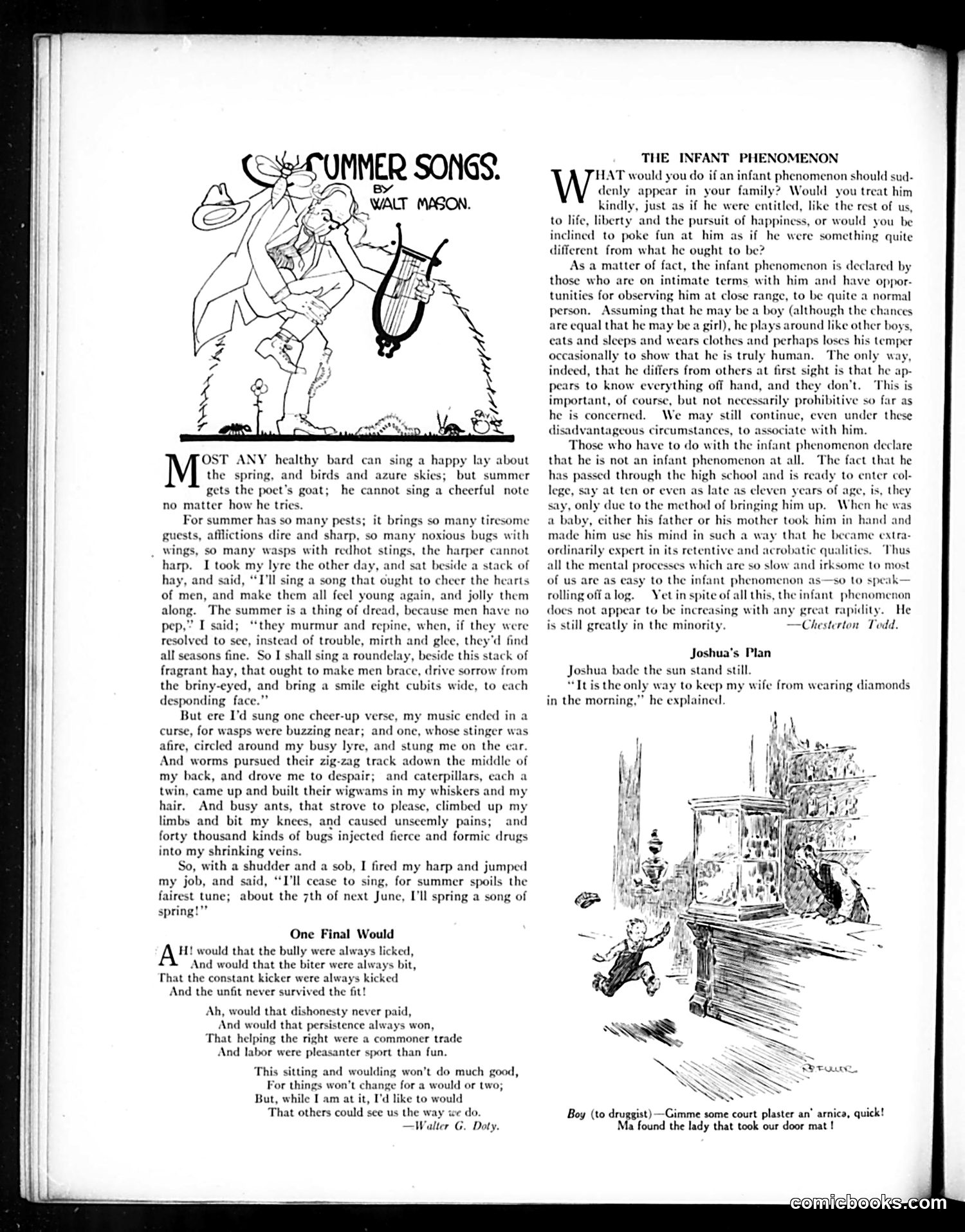
This *Judge* page contains two distinct pieces: **"Summer Songs" (left):** A humorous poem by Walt Mason depicting a poet's failed attempt to write cheerful summer verses. The joke is straightforward: despite his intentions to inspire joy, he's attacked by insects—wasps, worms, caterpillars, ants, and bugs—forcing him to abandon his lyre and postpone singing until spring. It's a relatable complaint about summer's discomforts, likely resonating with early-20th-century readers who lacked air conditioning. **"The Infant Phenomenon" (right):** An essay by Chesterton Todd discussing precocious children. The piece argues that gifted children shouldn't be treated as curiosities or mocked as "different," but as normal people who simply learn faster due to better education methods. It advocates for treating intellectual prodigies with the same kindness as ordinary children—a progressive stance on child development for the era. The accompanying sketch shows a small figure in an urban setting, likely illustrating the "infant phenomenon" concept.
📄 Transcribed text from this page (OCR, searchable)
Machine-transcribed from the original scan — historical spelling and the odd misread are preserved.
OST ANY healthy bard can sing a happy lay about M the spring, and birds and azure skies; but summer gets the poct’s goat; he cannot sing a cheerful note no matter how he tri For summer has so it brings so many tiresome guests, afilictions dire and sharp, so many noxious bugs with wings, so many wasps with redhot stings, the harper cannot harp. I took my lyre the other day, and sat beside a stack of hay, and said, “I'll sing a song that ought to cheer the hearts of men, and make them all feel young again, and jolly them along. The summer is a thing of dread, because men have no pep,” I said; ‘they murmur and repine, when, if they were resolved to sec, instead of trouble, mirth and glee, they'd find all seasons fine. So I shall sing a roundelay, beside this stack of fragrant hay, that ought to make men brace, drive sorrow from the briny-eyed, and bring a smile eight cubits wide, to each desponding face.” But ere I'd sung one cheer-up verse, my musi curse, for wasps were buzzing near; and one, whose stinger was afire, circled around my busy lyre, and stung me on the ear. And worms pursued their zig-zag track adown the middle of my back, and drove me to despair; and caterpillars, cach a twin, came up and built their wigwams in my whiskers and my hair. And busy ants, that strove to please, climbed up my limbs and bit my knees, and caused unseemly pains; and forty thousand kinds of bugs injected fierce and formic drugs into my shrinking veins. So, with a shudder and a sob, I fired my harp and jumped my job, and said, ‘I'll cease to sing, for summer spoils the fairest tune; about the 7th of next June, I'll spring a song of spring!"” ended in a One Final Would H! would that the bully were always licked, And would that the biter were always bit, That the constant kicker were always kicked And the unfit never survived the fit! Ah, would that dishonesty never paid, And would that persistence always won, That helping the right were a commoner trade And labor were pleasanter sport than fun, This sitting and woulding won't do much good, For things won't change for a would or tw But, while I am at it, I'd like to would That others could see us the —wW THE INFANT PHENOMENON HAT would you do if an infant phenomenon should sud- denly appear in your family? Would you treat him kindly, just as if he were entitled, like the rest of us, to life, liberty and the pursuit of happiness, or would you be inclined to poke fun at him as if he were something quite different from what he ought to be? As a matter of fact, the infant phenomenon is declared by those who are on intimate terms with him and have oppor- tunities for observing him at close range, to be quite a normal person, Assuming that he may be a boy (although the chances are equal that he may be a girl), he plays around like other boys, d sleeps and wears clothes and perhaps loses his temper y to show that he is truly human. The only wa he differs from others at first sight is that he ap- pears to know everything off hand, and they don’t. This is important, of course, but not necessarily prohibitive so far as he is concerned. We may still continue, even under these disadvantageous circumstances, to associate with him. Those who have to do with the infant phenomenon declare that he is not an infant phenomenon at all. The fact that he has passed through the high school and is ready to enter col- ay at ten or even as late as cleven years of age, is, they . only due to the method of bringing him up. When he a baby, either his father or his mother took him in hand and made him use his mind in such a way that he became extra- ordinarily expert in its retentive and acrobatic qualities. Thus all the mental processes which are so slow and irksome to most of us are as easy to the infant phenomenon —so to speak— rolling offalog. Yet in spite of all this, the infant phenomenon docs not appear to be increasing with any great rapidity. He is still greatly in the minority. —Chesterton Todd. Joshua's Plan Joshua bade the sun stand still. “Itis the only way to keep my wife from wearing diamonds in the morning,” he explained. SS Boy (to druggist) —Cimme some court plaster an’ arnica, quick! Ma found the lady that took our door mat !