
Judge, 1916-09-02 · page 4 of 28
Judge — September 2, 1916 — page 4: what you’re looking at
What you’re looking at
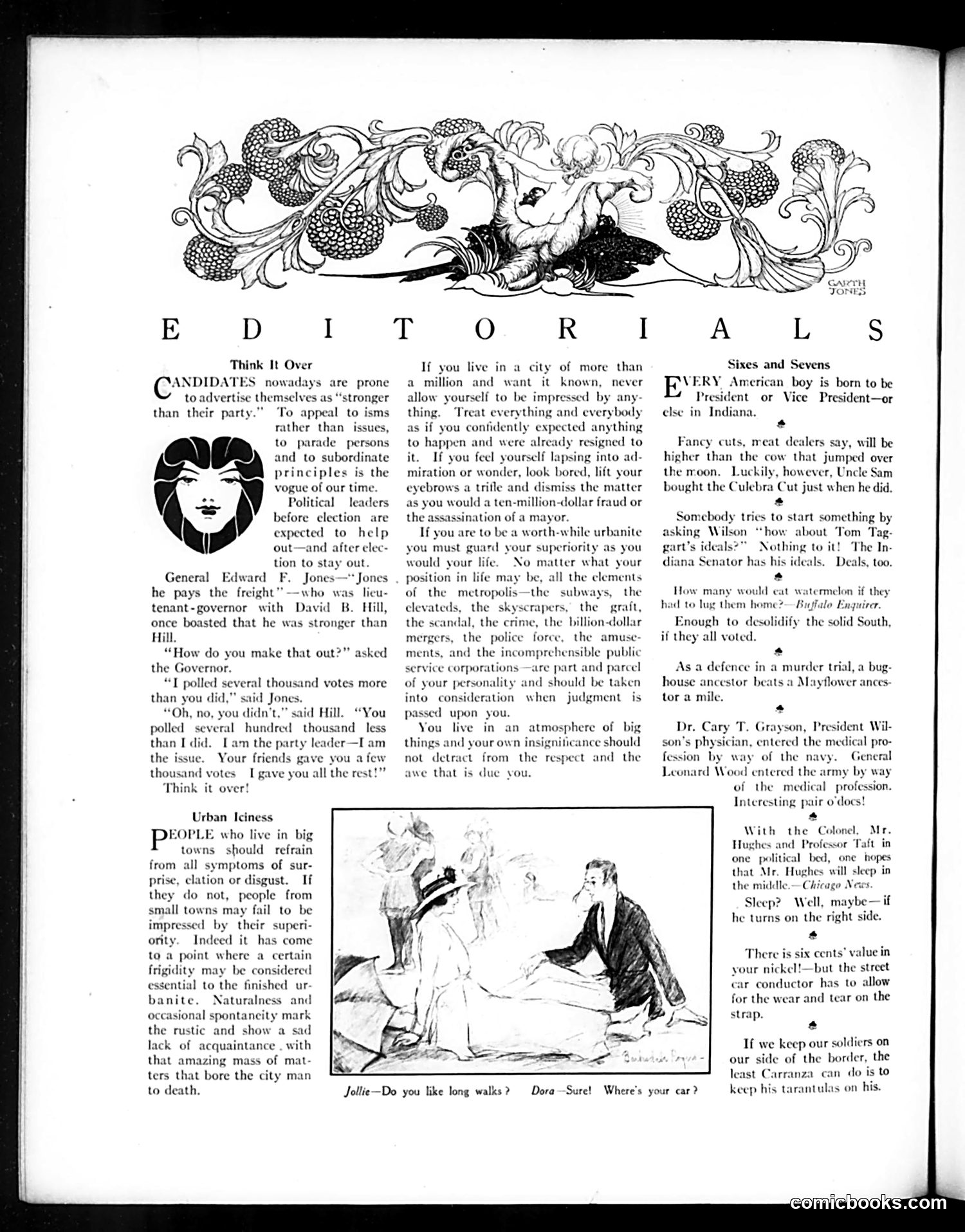
This page contains political editorials and social commentary typical of Judge's satirical style. The main cartoon depicts two figures in what appears to be a romantic or social situation, captioned "Jolie—Do you like long walks? Dora—Sure! Where's your car?" The joke satirizes modern urban dating customs, mocking the expectation that courtship involves automobile travel rather than traditional walking. This reflects 1920s anxieties about how automobiles were changing courtship and social interaction. The surrounding editorials address candidates advertising themselves as "stronger" than competitors, urban pretension, and political ambition—typical Judge fare attacking self-promotion and social climbing among the wealthy and political classes. The commentary is generally conservative, warning against affectation and excessive ambition.
📄 Transcribed text from this page (OCR, searchable)
Machine-transcribed from the original scan — historical spelling and the odd misread are preserved.
Think It Over ANDIDATES nowadays are prone to advertise themselves as “stronger than their party.” To appeal to isms rather than issues, to parade persons and to subordinate principles is the vogue of our time. Political leaders before election are expected to help out—and after elec- tion to stay out. General Edward Jones he pays the freight’’—who was licu- tenant-governor with David B. Hill, once boasted that he was stronger than Hill. “How do you make that out?” asked the Governor. “T polled several thousand votes more than you did,” said Jones. “Oh, no, you didn’t,” said Hill. “You polled several hundred thousand less than I did. Lam the party leader—I am the issue. Your friends gave you a few thousand votes I gave you all the rest!” Think it over! Urban Iciness EOPLE who live in big towns should refrain from all symptoms of sur- prise, clation or disgust. If they do not, people from small towns may fail to be impressed by their superi- ority. Indeed it has come to a point where a certain frigidity may be considered essential to the finished ur- banite. Naturalness and occasional spontaneity mark the rustic and show a sad lack of acquaintance . with that amazing mass of mat- ters that bore the city man to death. Jollie—Do you like long walks ? If you live in a city of more than a million and want it known, never allow yourself to be impressed by any- thing. Treat everything and everybody as if you confidently expected anything to happen and were already resigned to it. If you feel yourself lapsing into ad- miration or wonder, look bored, lift your eyebrows a trifle and dismiss the matter as you would a ten-million-dollar fraud or the assassination of a mayor. If you are to be a worth-while urbanite you must guard your superiority as you No matter what your be, all the elements of the metropolis—the subways, the clevateds, the skyscrapers, the graft, the scandal, the crime, the billion-dollar mergers, the police force, the amuse ments, and the incomprehensible public service corporations —are part and parcel of your personality and should be taken when judgment is would your life. position in life ma into consideration passed upon you. You live in an atmo: things and your own insign not detract from the respect and the here of big ance should awe that is due vou. Dora Sure! Where's your car? Sixes and Sevens VERY American boy is born to be President or Vice President—or else in Indiana. * will be higher than the cow that jumped over the moon. Luckily, however, Uncle Sam bought the Culebra Cut just when he did. 2 Somebody tries to start something by asking Wilson “how about Tom Tag- gart’s ideals?” Nothing to it! The In- diana Senator has his ideals. Deals, too. 2 1 cat watermelon if they lo Enquirer. Fancy cuts, meat dealers How many wou had to lus them home?—A Enough to desolidify the solid South, if they all voted. * As a defence in a murder trial, a bug- house ancestor beats a Mayflower ances: tor a mile. 2 Dr. Cary T. Grayson, President Wil- son's physician, entered the medical pro- fession by way of the navy. General Leonard Wood entered the army by way of the medical profession. Interesting pair o'docs! Mr. onl, the C nd Professor Taft in hopes that Mr. Hughes will sleep in With Hushes one political bed, or the middle.— Chicago } Sleep? Well, maybe— if he turns on the right side. * There is six cents’ value in your nickel!—but the street car conductor has to allow for the wear and tear on the strap. @ If we keep our soldiers on our side of the border, the least Carranza can do keep his tarantulas on his.