
Judge, 1916-09-02 · page 17 of 28
Judge — September 2, 1916 — page 17: what you’re looking at
What you’re looking at
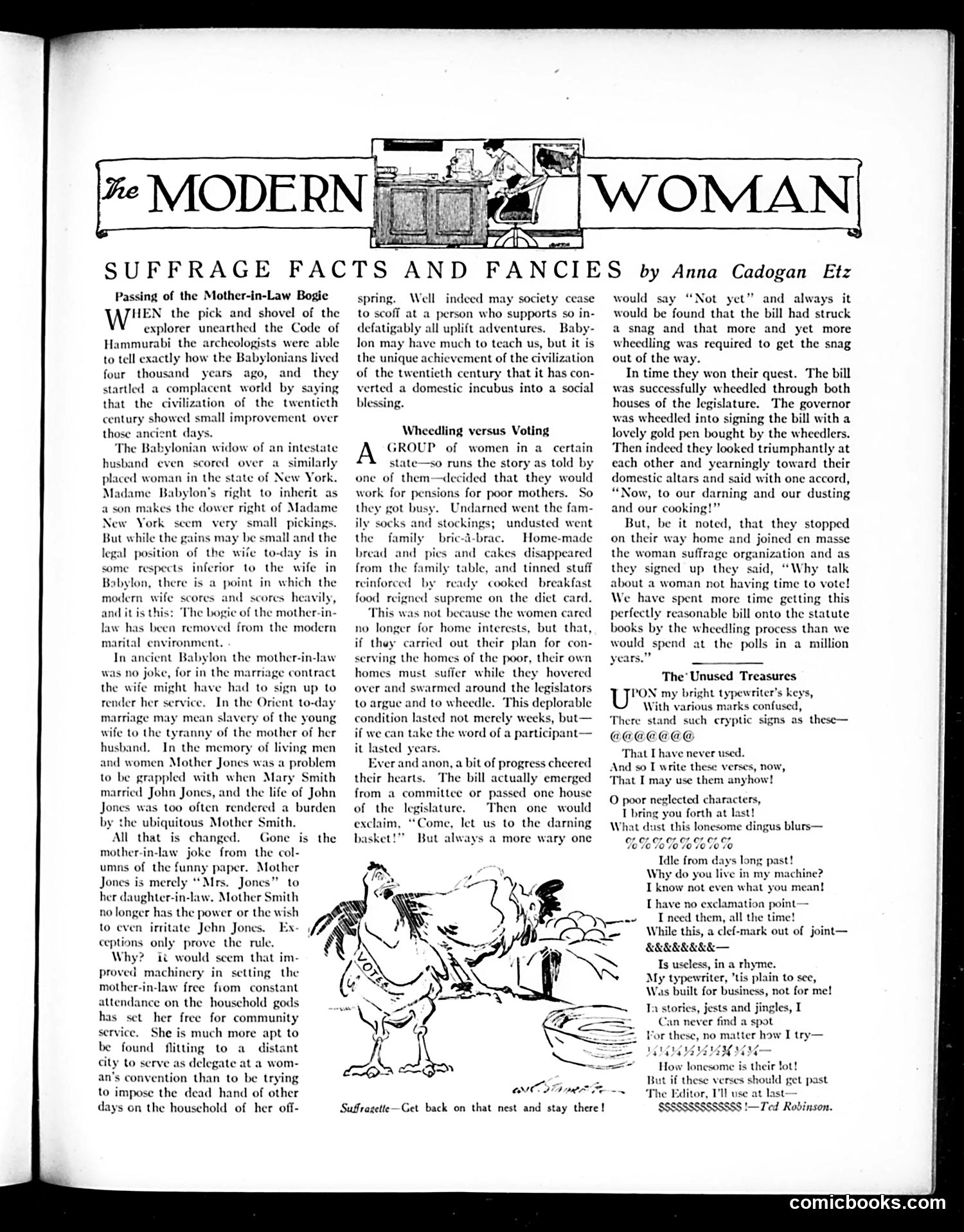
This page from Judge magazine contains satirical commentary on women's issues by Anna Cadogan Etz, focusing on suffrage and women's activism. **Main cartoons/articles:** 1. **"Passing of the Mother-in-Law Bogie"** argues that modern machinery freeing mothers-in-law from household drudgery has transformed them from domestic tyrants into active community organizers—a positive social change. 2. **"Wheeling versus Voting"** satirizes women activists lobbying legislators for poor mothers' pensions. While they neglect their own homes (undone laundry, tinned food replacing home cooking) to "wheedle" politicians, the cartoon at bottom depicts a suffragette as a brooding hen, suggesting women should stay domestic rather than engage in political activism. **The satire's point:** The page presents contradictory arguments—praising women's community service while simultaneously mocking their political engagement through the cartoon. This reflects Judge's ambivalent or critical stance toward women's suffrage and activism during this era.
📄 Transcribed text from this page (OCR, searchable)
Machine-transcribed from the original scan — historical spelling and the odd misread are preserved.
y= SUFFRAGE FACTS AND FANCIES by Anna Cadogan Etz Passing of the Mother-in-Law Bogie WHEN the pick and shovel of the explorer unearthed the Code of Hammurabi the archeologists were able to tell exactly how tke Babylonians lived four thousand years ago, and they startled a complacent world by: sayi that the civilization of the twenticth century showed small improvement over those anc The Babylonian husband even scored over a similarly placed woman in the state of New York. Madame Babylon’s right to inherit as a son makes the dower right of Madame New York seem very small pickings. But while the gains may be small and the legal position of the wife to-day is in some respects inferior to the wife in Babylon, there is a point in which the modern wife scores and scores heavily, and it is this: The bogie of the mother-in- law has been removed from the modern marital environment. In ancient Babylon the mother-in-law was no joke, for in the marriage contract the wife might have had to sign up to render her service. In the Orient to-day marriage may mean slavery of the young wife to the tyranny of the mother of her husband, In the memory of living men and women Mother Jones was a problem to be grappled with when Mary Smith married John Jones, and the life of John Jones was too often rendered a burden by the ubiquitous Mother Smith. All that is changed. Gone is the mother-in-law joke from the col- umns of the funny paper. Mother Jones is merely “Mrs. Jones” to her daughter-in-law. Mother Smith no longer has the power or the wish to even irritate John Jones. Ex ceptions only prove the rule. Why? it would scem that im- proved machinery in setting the mother-in-law free fiom constant attendance on the household gods has set her free for community service. She is much more apt to be found flitting to a distant city to serve as delegate at a wom- an’s convention than to be trying to impose the dead hand of other days on the household of her off- spring. Well indeed may society cease to scoff at a person who supports so in- defatigably all uplift adventures. B lon may have much to teach us, t the unique achievement of the civilization of the twentieth century that it has con- verted a domestic incubus into a social blessing. A ROUP of women in a certain state—so runs the story as told by one of them—decided that they would work for pensions for poor mothers. So they got busy. Undarned went the fam- ily socks and stockings; undusted went the family bric-d-brac. | Home-made Dread and pies and cakes disappeared from the family table, and tinned stuff reinforced by ready cooked breakfast food reigned supreme on the dict card. This was not because the women cared no longer for home interests, but that, if they carried out their plan for con- serving the homes of the poor, their own homes must suffer while they hovered over and swarmed around the legislators to argue and to wheedle, This deplorable condition lasted not merely weeks, but— if we can take the word of a participant— it lasted years. S on, a bit of progress cheered their hearts, The bill actually emerged from a committee or passed one house of the legislature. Then one would exclaim, “Come, Iet us to the darning But always a more wary one Wheedling versus Voting NOI MA Suffragette—Get back on that nest and stay there! would y “Not yet” and always it would be found that the bill had struck a snag and that more and yet more wheedling was required to get the snag out of the way. In time they won their quest. The bill was successfully wheedled through both houses of the legislature. The governor was whcedled into signing the bill with a lovely gold pen bought by the wheedlers. Then indeed they looked triumphantly at each other and yearningly toward their domestic altars and said with one accord, “Now, to our darning and our dusting and our cooking!” But, be it noted, that they stopped on their way home and joined en masse the woman suffrage organization and they signed up they id, “Why talk about a woman not having time to vote! We have spent more time getting this perfectly reasonable bill onto the statute books by the wheedling process than we would spend at the polls in a million years.” The’ Unused Treasures PON my bright typewriter’s key: With various marks confused, ‘There stand such cryptic signs as these— @@@E@E@ That Ihave never used. And so I write the SCS, NOW, That I may use them anyhow! O poor neglected characters, I bring you forth at last! What dust this lonesome dingus blurs— %% 0% % Idle from days long past! Why do you live in my machine? I know not even what you mean! [have no exclamation point— I nced them, all the time! While this, a clef-mark out of joint— K&EEREEE— Is useless, in a rhyme. My typewriter, ’tis plain to see, Was built for business, not for me! Ta stories, jests and jingles, I Can never find a spot For these, no matter how I try— WuyMM? S14 MM: How lonesome is their lot! But if these verses should get past ‘The Editor, I'll use at last— SSSSSSSSSSSSSS !—Ted Robinson. comicbooks.com