
A complete issue · 28 pages · 1916
Judge — July 29, 1916
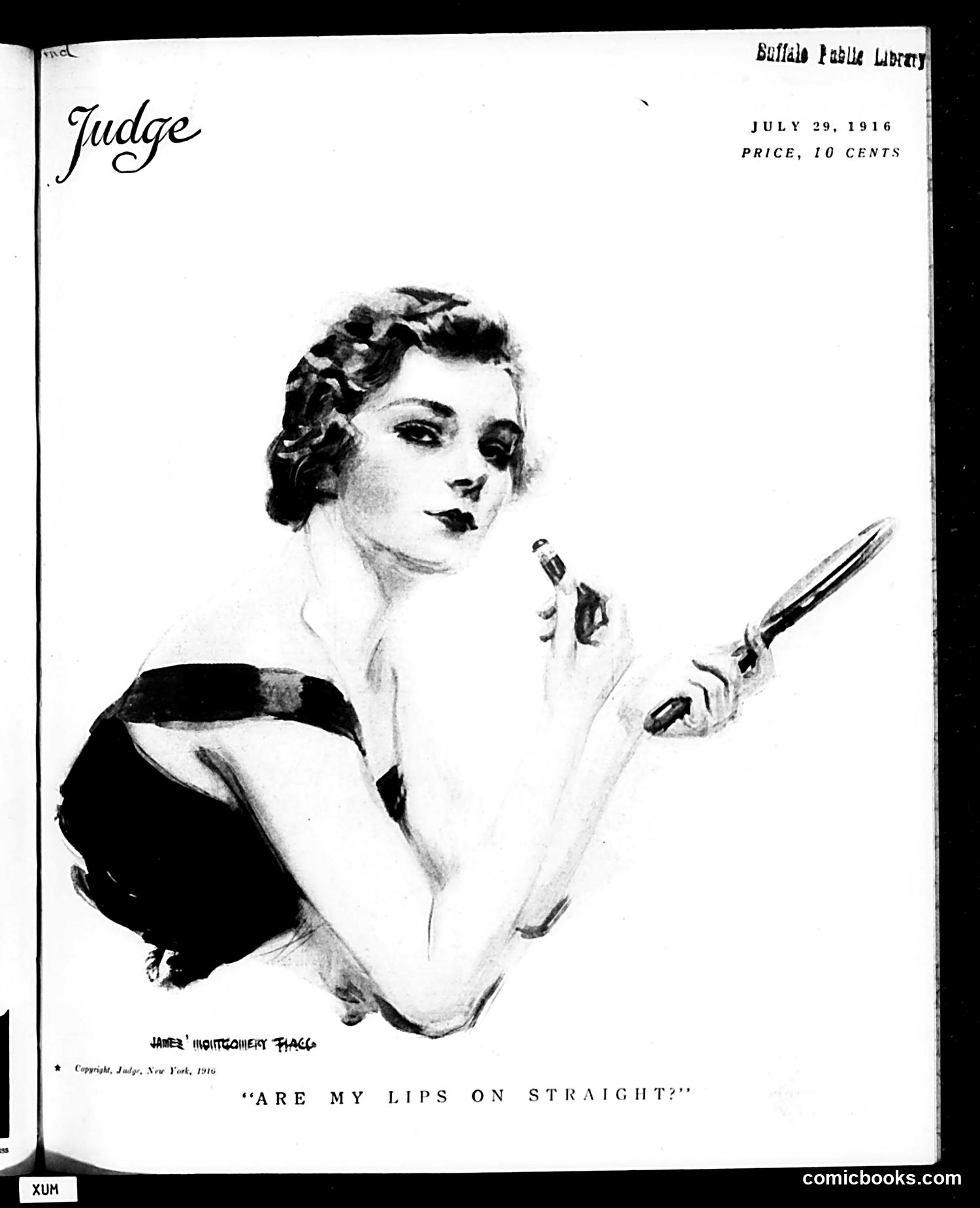
This cover illustration by James Montgomery Flagg depicts a woman examining her reflection in a mirror, asking "Are My Lips On Straight?" The cartoon satirizes the emerging cosmetics industry and changing beauty standards of the 1910s. The woman's anxious self-scrutiny about lipstick application reflects contemporary anxieties about the "modern woman" adopting visible makeup—a practice still considered somewhat scandalous or theatrical at this time. Previously, makeup was largely associated with actresses or women of questionable reputation. The humor targets both women's newfound consumer interest in cosmetics and broader social concerns about shifting gender norms and female independence during the Progressive Era. The detailed mirror and applied lipstick emphasize the artificiality and self-consciousness surrounding these new beauty practices.
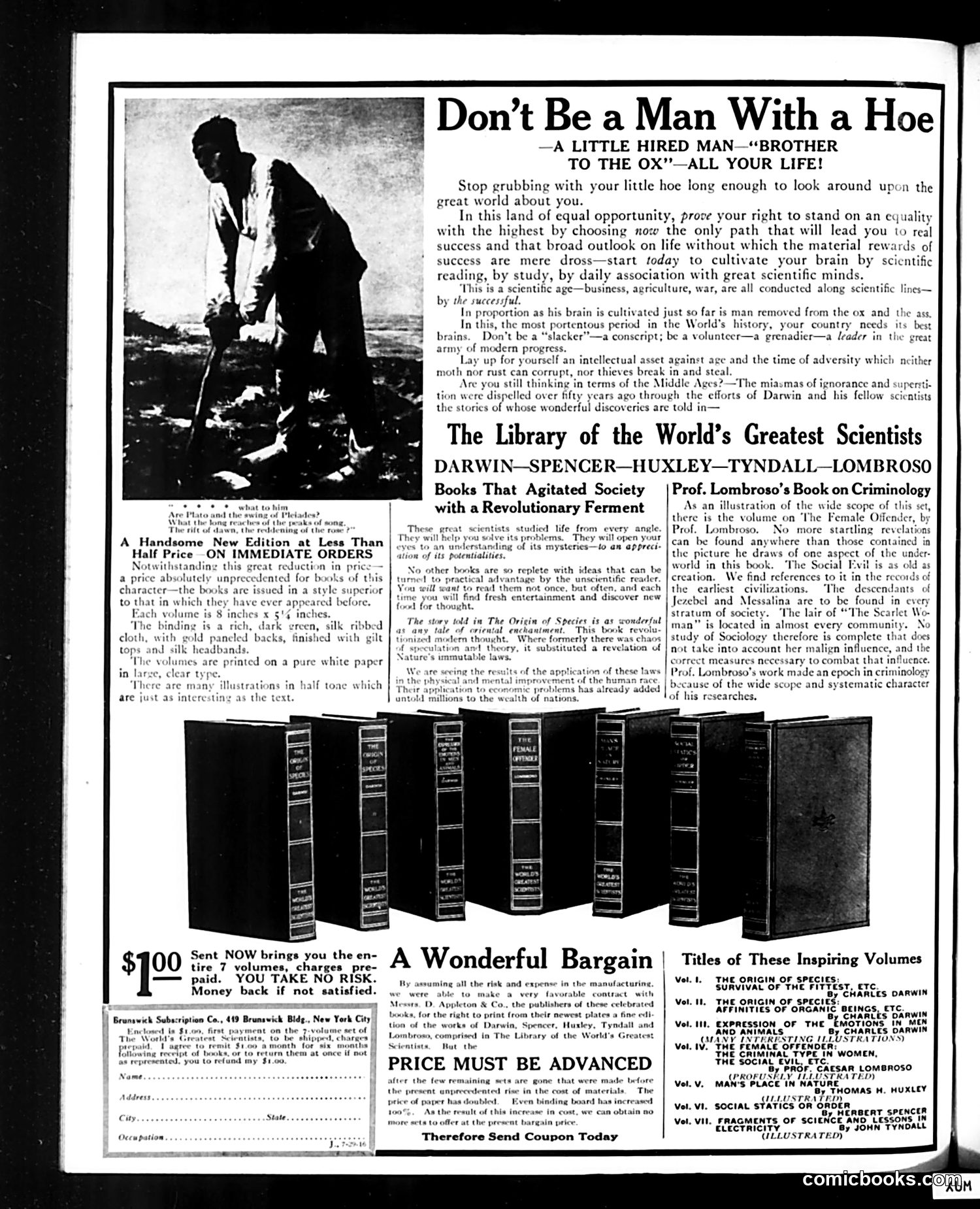
This page is primarily **advertising**, not satire or political commentary. The headline "Don't Be a Man With a Hoe" references the famous 1899 painting/poem criticizing agricultural labor, but ironically uses it to *encourage* self-improvement rather than social reform. The advertisement promotes "The Library of the World's Greatest Scientists" — a multi-volume book set featuring Darwin, Spencer, Huxley, Tyndall, and Lombroso. The pitch argues that studying science represents progress beyond manual labor ("don't be a slacker"), positioning intellectual self-cultivation as the path to success. The accompanying image shows manual labor only to contrast it with the aspirational message: embrace scientific knowledge rather than remain a mere farm worker. This reflects early-20th-century progressive ideology celebrating expertise and education as vehicles for upward mobility.
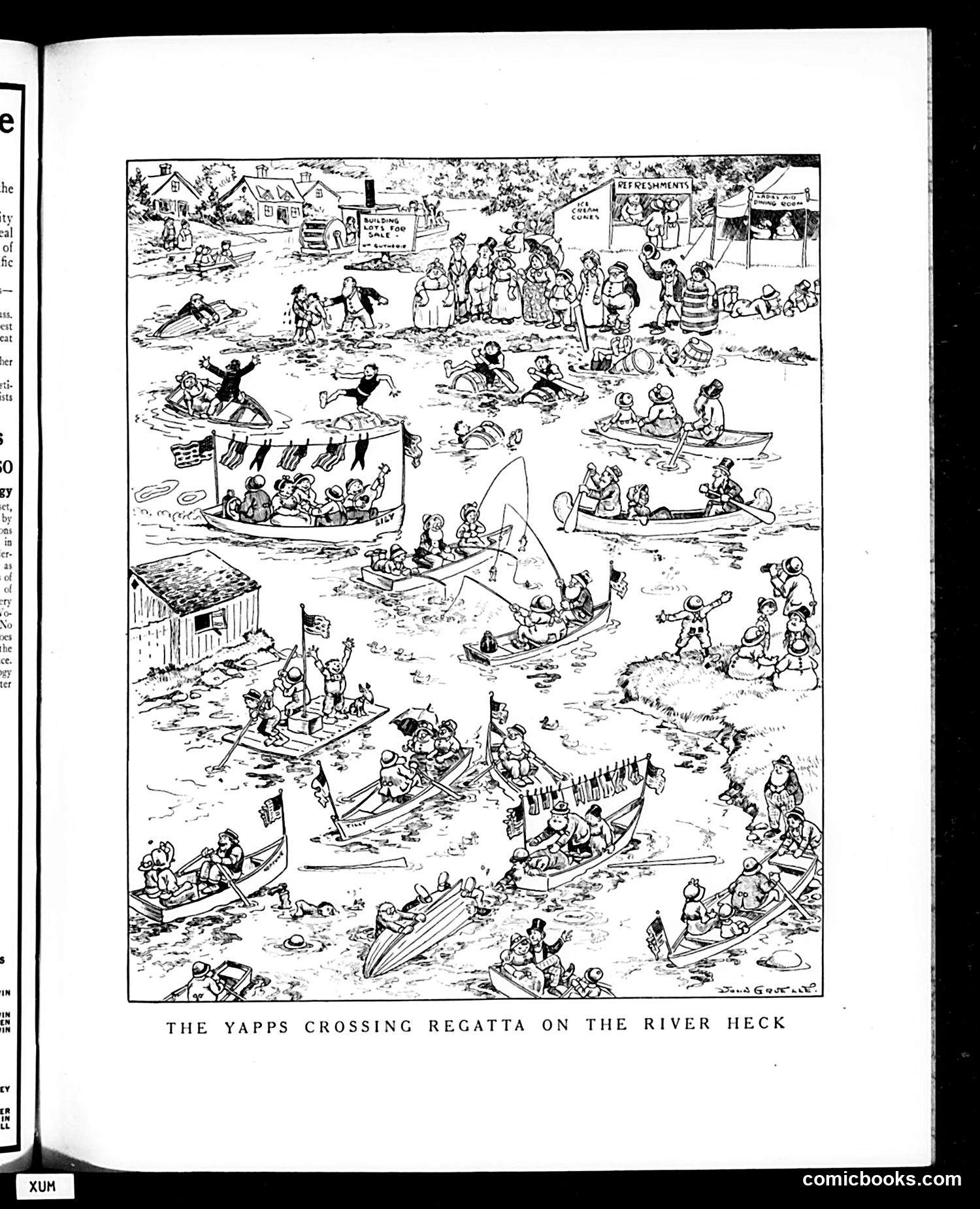
This is a humorous satirical cartoon depicting a crowded riverside scene with numerous boats and people engaged in what appears to be a chaotic regatta or boat race. The title plays on wordplay—"Yapps" and "River Heck" are likely puns or invented names meant to sound absurd or lowbrow. The satire appears to mock the Victorian era's popular leisure activities and public spectacles, particularly crowded recreational events on rivers. The detailed chaos—with multiple boats of varying quality, spectators on shore, refreshment stands, and general pandemonium—satirizes both the pretensions of organized sporting events and the unruly behavior of large public gatherings. The cartoon exemplifies Judge magazine's style of social commentary through exaggerated, densely-packed illustration.
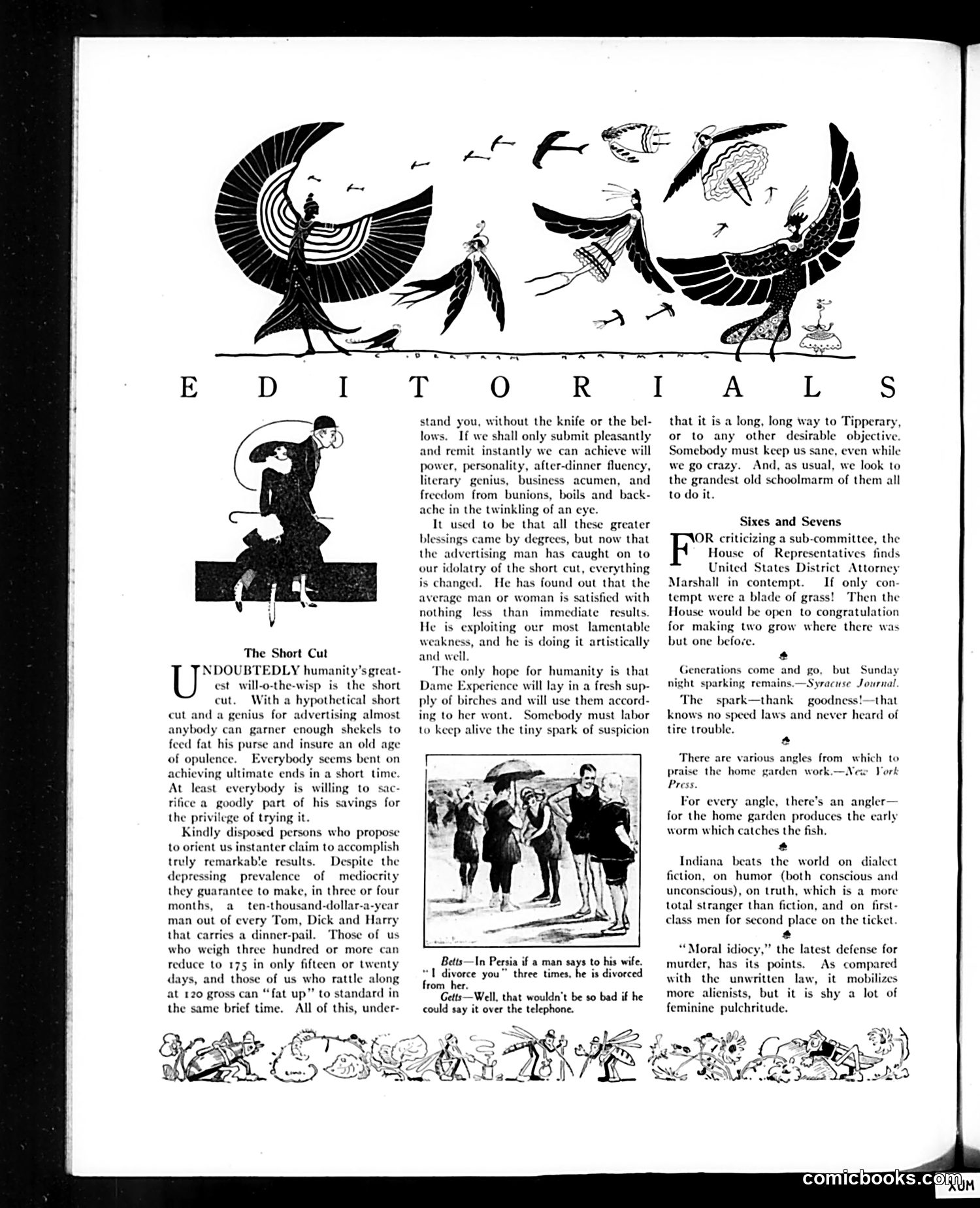
This page contains editorial commentary with illustrations rather than political cartoons. "The Short Cut" criticizes advertising's false promises—specifically that brief advertisements can sell major products or ideas. The author argues advertising exploits human weakness and mediocrity by claiming instant results are possible when they're not. The subsequent editorials discuss various social topics: a U.S. District Attorney's criticism of a Congressional sub-committee ("Sixes and Sevens"), home gardening, Indiana's literary reputation, and divorce laws in Persia. The illustrations are decorative rather than satirical—showing figures in period dress. Without identifying specific individuals, the page represents Judge's typical mix of satirical commentary on American consumer culture, politics, and social manners during this era.
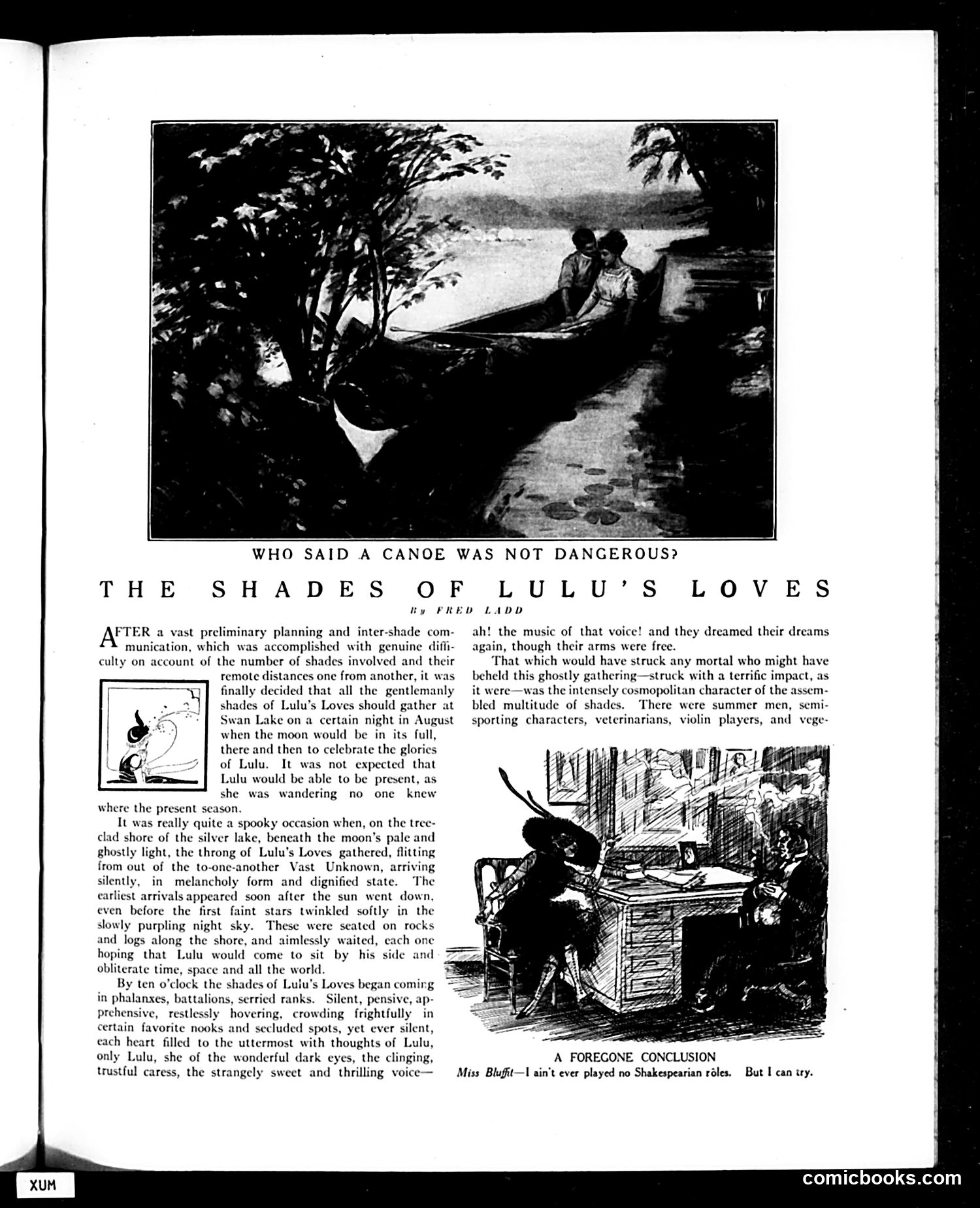
This page from Judge magazine presents a serialized romantic story rather than political satire. The narrative describes a moonlit gathering at Swan Lake where various suitors of a woman named "Lulu" assemble silently, each hoping she'll sit beside them. The text emphasizes the melodramatic, somewhat comedic nature of this romantic scene—with "summer men, semi-sporting characters, veterinarians, white players" waiting anxiously. The caption "Who Said a Canoe Was Not Dangerous?" suggests romantic peril. The illustration labeled "A Foregone Conclusion" features an actress (Miss Bhagti) preparing for Shakespearean roles, indicating this may be theatrical fiction or a celebrity narrative rather than political commentary. The page functions as entertainment-focused magazine content typical of early 20th-century Judge publications.
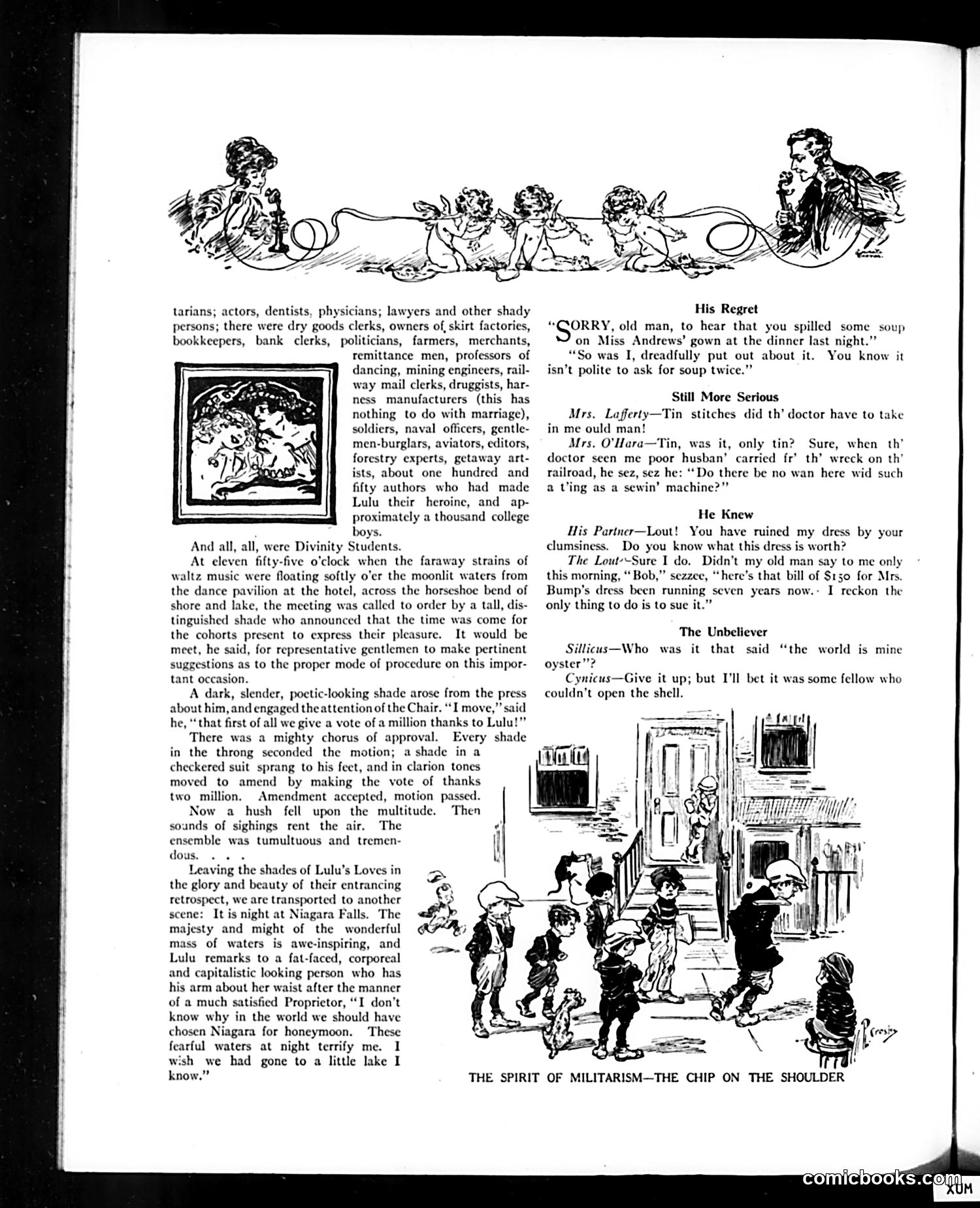
This page contains several brief humorous anecdotes satirizing social pretension and marital discord among the upper-middle classes. **"His Regret"**: Mocks bourgeois etiquette obsession—a man apologizes for spilling soup on a woman's dress, then admits he won't ask for soup twice to avoid repeating the embarrassment. **"Still More Serious"**: Uses Irish dialect humor (common in early 20th-century American comedy) to contrast working-class medical emergencies with upper-class concerns. **"He Knew"**: Satirizes henpecked husbands—a man responds to his partner's complaint about a ruined dress by revealing the bill has been running for seven years, suggesting chronic marital conflict over expenses. **"The Unbeliever"**: A philosophical joke questioning optimism; someone claiming "the world is mine oyster" likely couldn't afford or open actual oysters. **Bottom cartoon** ("The Spirit of Militarism"): Children playing soldiers, likely critiquing militaristic attitudes being taught to youth—though context beyond the image is unclear. The page reflects Judge's satirical approach to American social and domestic life.
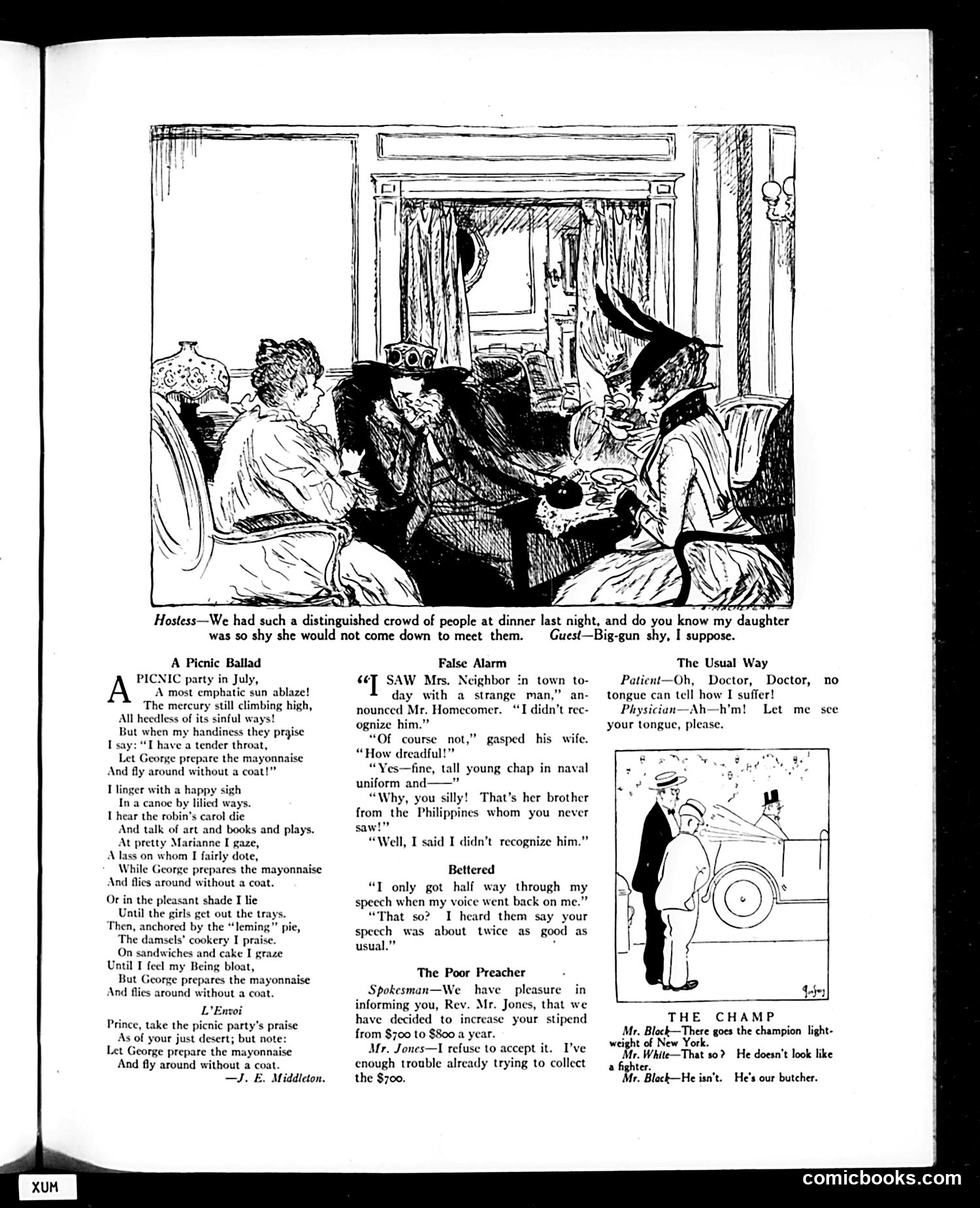
This page from *Judge* contains several short satirical pieces mocking middle-class social conventions and pretense: **"A Picnic Ballad"** satirizes lazy, self-important men who delegate all work to servants (George) while enjoying leisure and romance at picnics—a commentary on class exploitation dressed as lighthearted verse. **"False Alarm"** jokes about provincial narrow-mindedness: a man suspects his neighbor of impropriety, only to learn the "strange man" is her brother from the Philippines, whom he'd never met. **"The Poor Preacher"** critiques clergy underpayment and financial desperation—a minister refuses a modest raise because he can't even collect his existing meager salary. **"The Usual Way"** is a brief doctor joke about patients exaggerating complaints. **"The Champ"** plays on misleading appearances: the "champion lightweight" is actually a butcher, not a boxer—humor based on unexpected contradictions. The top cartoon depicts a hostess embarrassed by her shy daughter avoiding distinguished dinner guests—social anxiety among the affluent. Overall, the page targets genteel pretense, class hypocrisy, and middle-class anxieties.
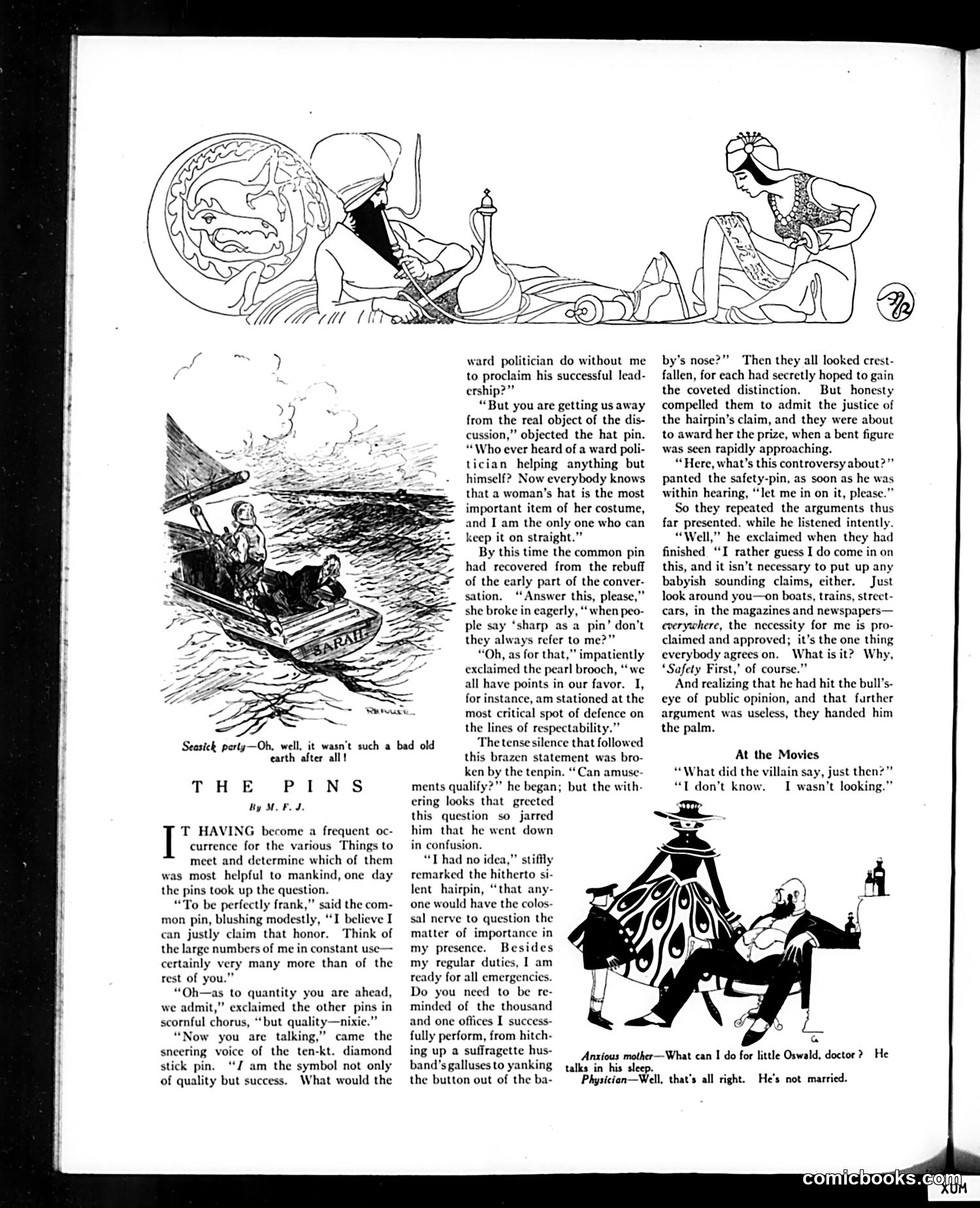
This page contains two satirical pieces: **"The Pins"** is an allegorical debate where different types of pins argue about their importance to society. The common pin claims utility (quantity used), the diamond stick pin boasts of symbolizing success and ward politicians, the hat pin emphasizes fashion, the pearl brooch represents respectability, and the hairpin proves indispensable for practical emergencies. The safety pin wins by invoking "Safety First"—a major public-health campaign of the early 20th century emphasizing accident prevention. The satire mocks contemporary social vanity and self-importance by showing how each group claims superiority, ultimately revealing that safety concerns trump status symbols. **"At the Movies"** is a brief joke about cinema distraction, where a woman admits she wasn't watching the film's plot, suggesting early movie audiences' divided attention or women's perceived disinterest in narrative. The seasick illustration above shows someone humorously reconsidering life after maritime illness.
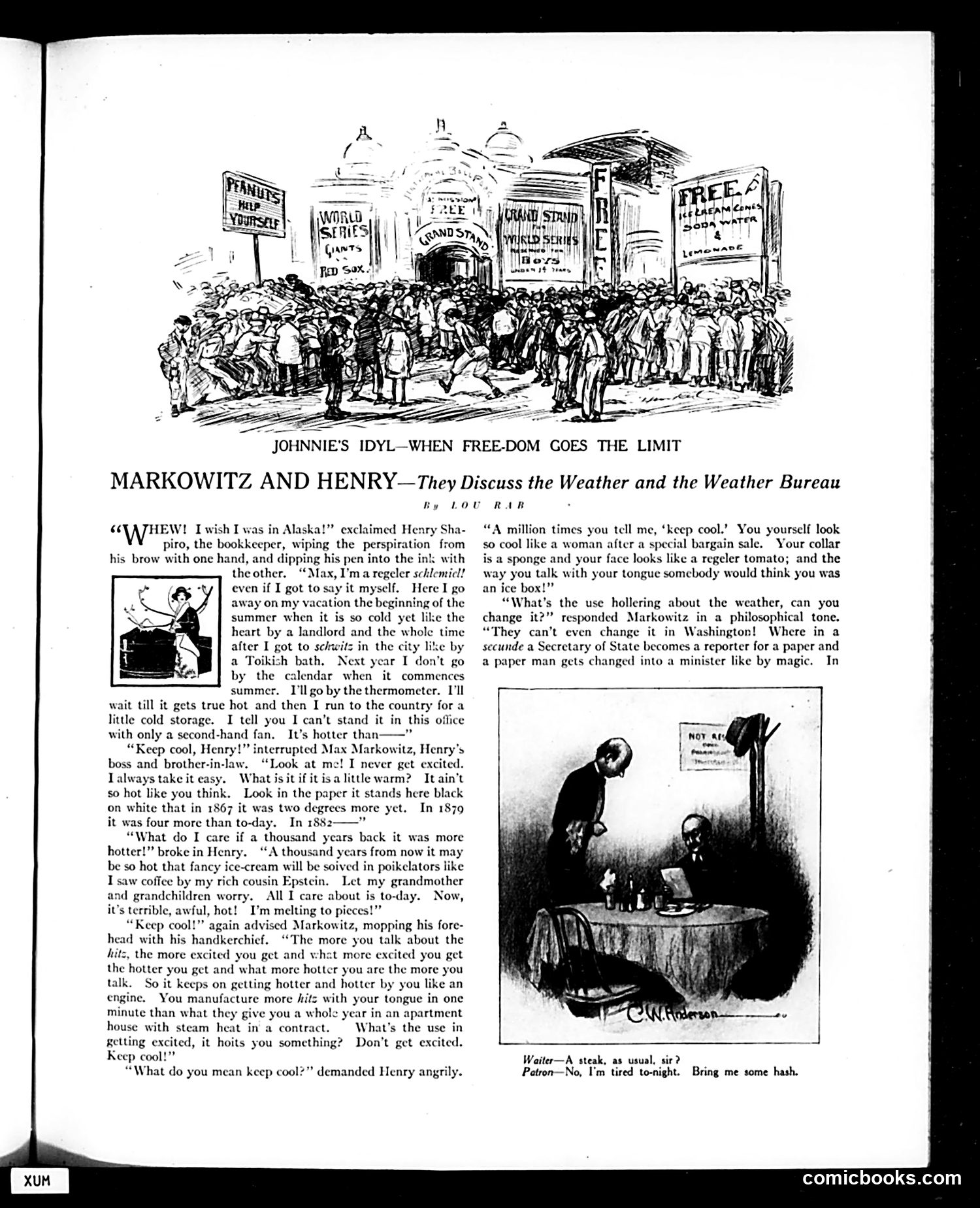
This page from *Judge* satirizes Jewish immigrant characters through dialect humor and workplace dynamics. The top cartoon, "Johnnie's Idyl—When Free-dom Goes the Limit," depicts a crowded street scene with various commercial stands, likely mocking American consumer culture and public spectacle. The main feature, "Markowitz and Henry," presents two Jewish office workers (identifiable by names and Yiddish-inflected English) debating summer heat. Henry complains about the sweltering office; his boss Markowitz responds with philosophical fatalism, citing historical temperature data and absurdly comparing American political instability—where a State Department official becomes a newspaper reporter and vice versa—to humanity's inability to control weather. The satire targets both the characters' anxious working-class perspective and American bureaucratic incompetence. The bottom illustration shows a tired restaurant patron requesting hash instead of steak, continuing the mundane, relatable-humor theme. The comedy relies on ethnic stereotyping through exaggerated dialect, a common (if now offensive) convention in early 20th-century American humor publications.
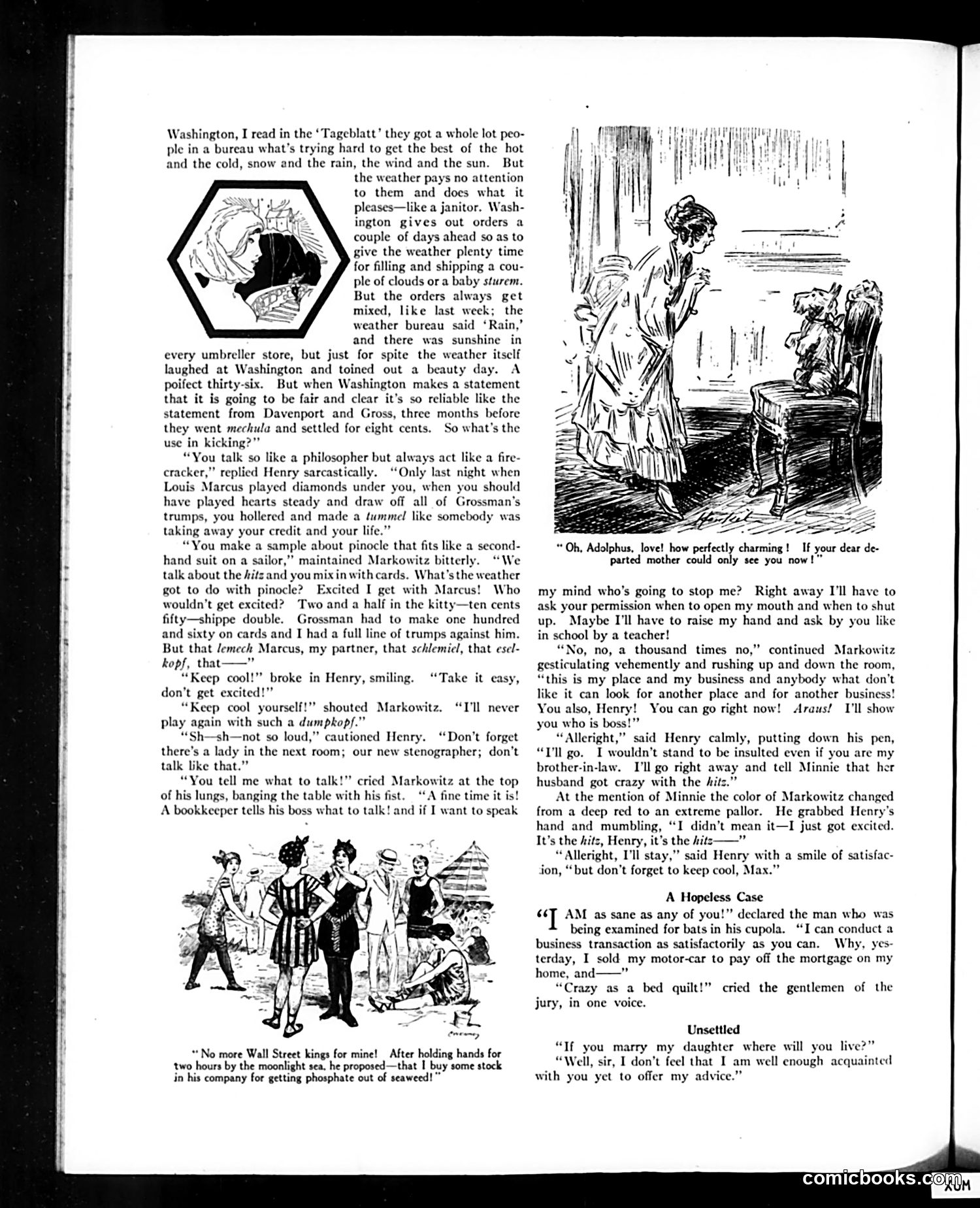
This page satirizes turn-of-the-century American immigrant life and workplace dynamics through dialogue between Jewish characters (identifiable by Yiddish expressions like "schlemiel," "dumkopf," "araus"). **Main Cartoon:** The upper illustration shows a woman and man in domestic scene, captioned with flirtation about a suitor's proposal. **Primary Content:** A lengthy conversation between Markowitz (a business owner) and Henry (likely his brother-in-law/employee) reveals workplace tensions. Markowitz becomes enraged over a pinochle card game dispute and asserts his authority, threatening to fire Henry. When Henry threatens to tell Markowitz's wife Minnie that her husband is "crazy with the hits" (obsessed with the game), Markowitz immediately backs down and apologizes. **The Satire:** Judge mocks both the petty vanity of immigrant businessmen and how they're controlled by their wives. Markowitz's explosive temperament and malapropisms ("fummel," "eselkopf") make him ridiculous; his instant capitulation when domestic consequences are threatened ridicules male authority as ultimately fragile. The smaller cartoon below depicts Wall Street speculation satire.
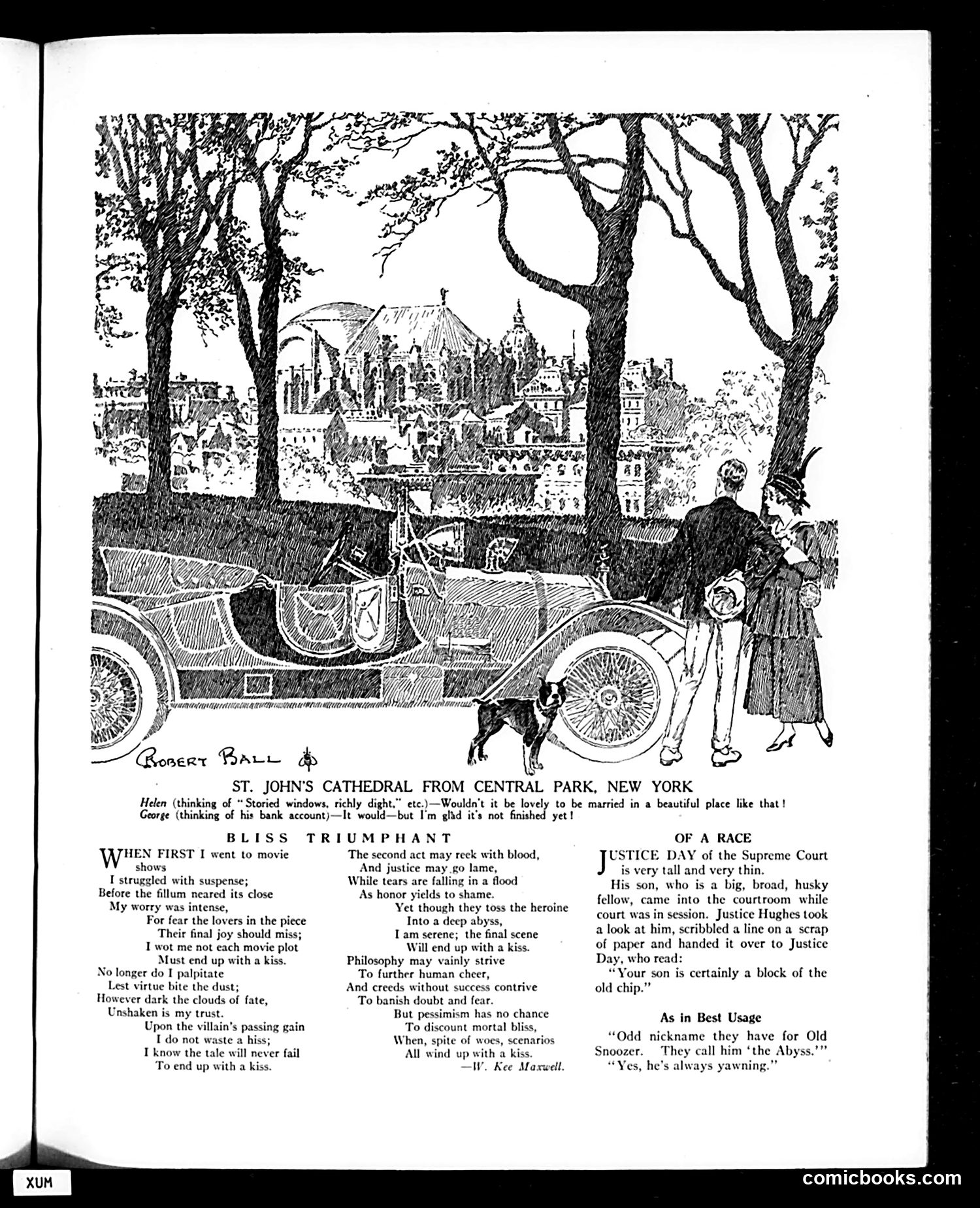
This page contains three separate satirical pieces typical of early 20th-century humor: **Main Cartoon:** A couple admires St. John's Cathedral from Central Park. Helen romanticizes marrying there; George worries about the cost, relieved the cathedral isn't finished yet—mocking middle-class financial anxiety masked by pretense. **"Bliss Triumphant":** A poem by W. Kee Maxwell satirizing the predictability of early cinema (silent films). The poet mocks moviegoers' naive emotional investment in formulaic plots that always conclude with a kiss, despite melodramatic chaos beforehand. It's gentle satire on both film conventions and audience gullibility. **"Justice Day" Anecdote:** A short joke about Supreme Court Justice Edward Terry Sanford, who was notably thin. His tall, lanky son visits court; Justice Hughes jokes that the son is "a chip off the old block"—mocking the physical contrast between father and son while playing on judicial gravitas. All three pieces reflect 1920s preoccupations: marriage costs, cinema's growing cultural impact, and high-society gossip.
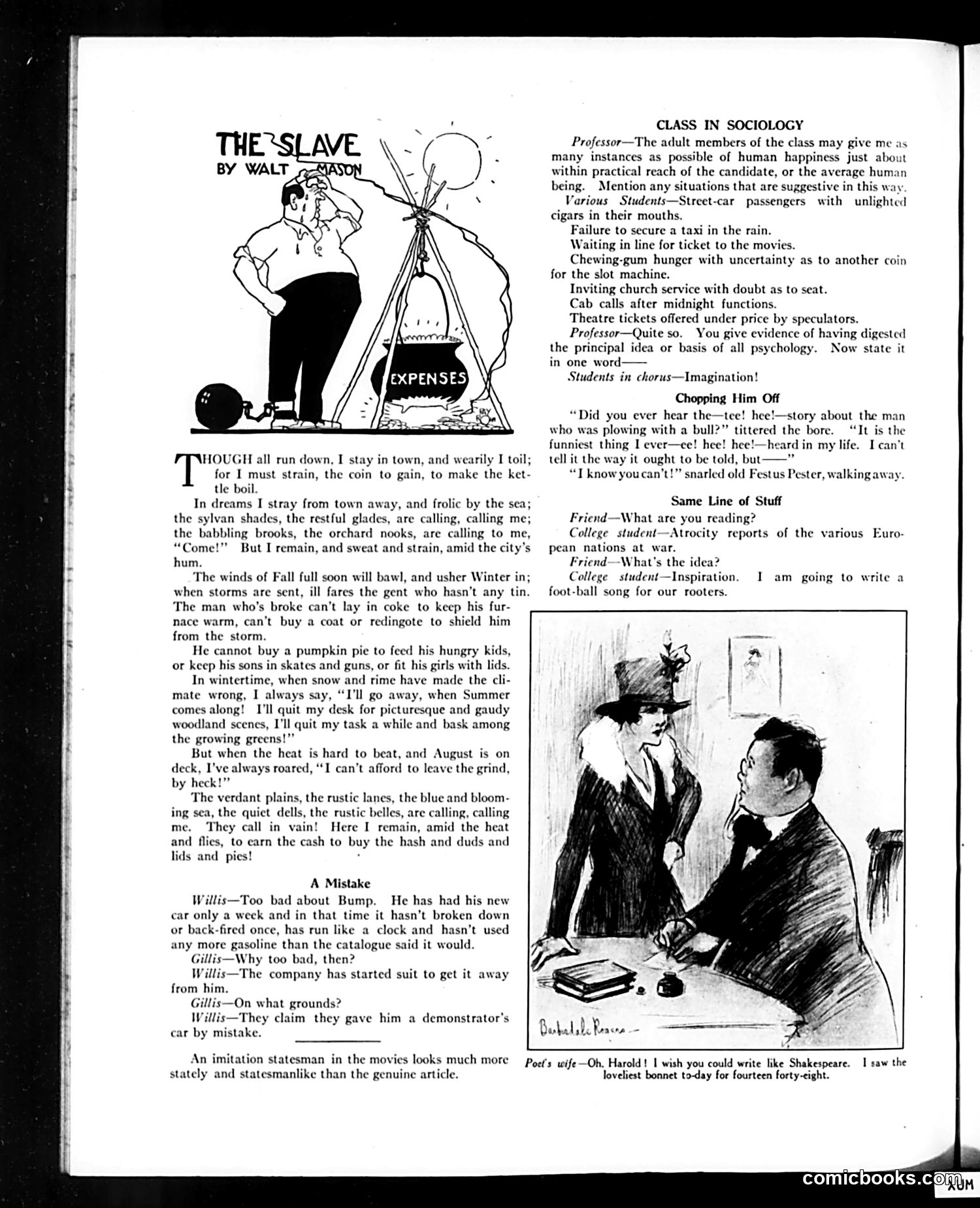
**Main Poem**: A working man laments his economic trap—stuck in the city grinding away, unable to afford winter necessities (coal, coats, food) or escape to the countryside he dreams of. He cannot leave in summer due to heat, nor in winter due to poverty. The satire critiques wage labor's inescapability and the worker's perpetual financial desperation. **"A Mistake"**: A man buys a new car that runs perfectly—the joke being the company sues to reclaim it, having mistakenly given him a "demonstrator model" instead of their notoriously faulty regular cars. This satirizes poor automobile manufacturing quality of the era. **"Class in Sociology"**: Students humorously define human happiness as minor conveniences (unlit cigars, cheaper theater tickets, cheap gum)—mocking both academic pretension and modest working-class aspirations. **Minor sketches** mock bore storytellers and intellectually mismatched couples. The page's overall theme: economic inequality and the absurdities of modern urban life.
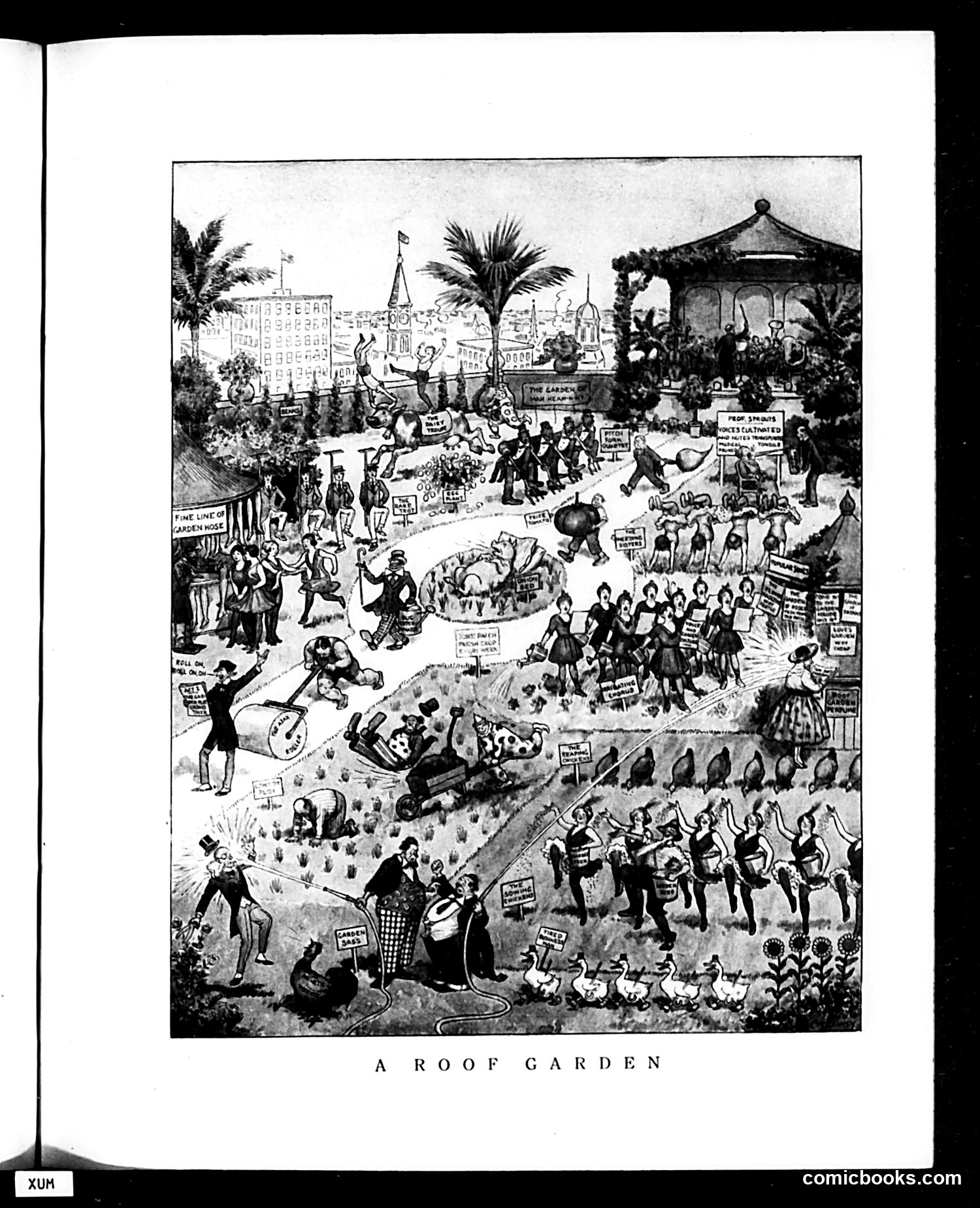
This satirical illustration depicts a chaotic rooftop garden scene teeming with various activities and figures. The cartoon appears to lampoon the fashionable rooftop garden trend that was popular among wealthy urbanites in early 20th-century America. The image shows numerous labeled vignettes of frivolous pursuits—dancing, socializing, dining, and entertainment—occurring simultaneously on the rooftop, with city buildings and church spires visible in the background. The densely packed composition suggests satirical commentary on the pretension, excess, and frivolous nature of upper-class leisure activities and social climbing. The specific figures and references are difficult to discern clearly, but the overall point appears to mock the fashionable set's obsession with exclusive rooftop venues as status symbols and entertainment destinations.
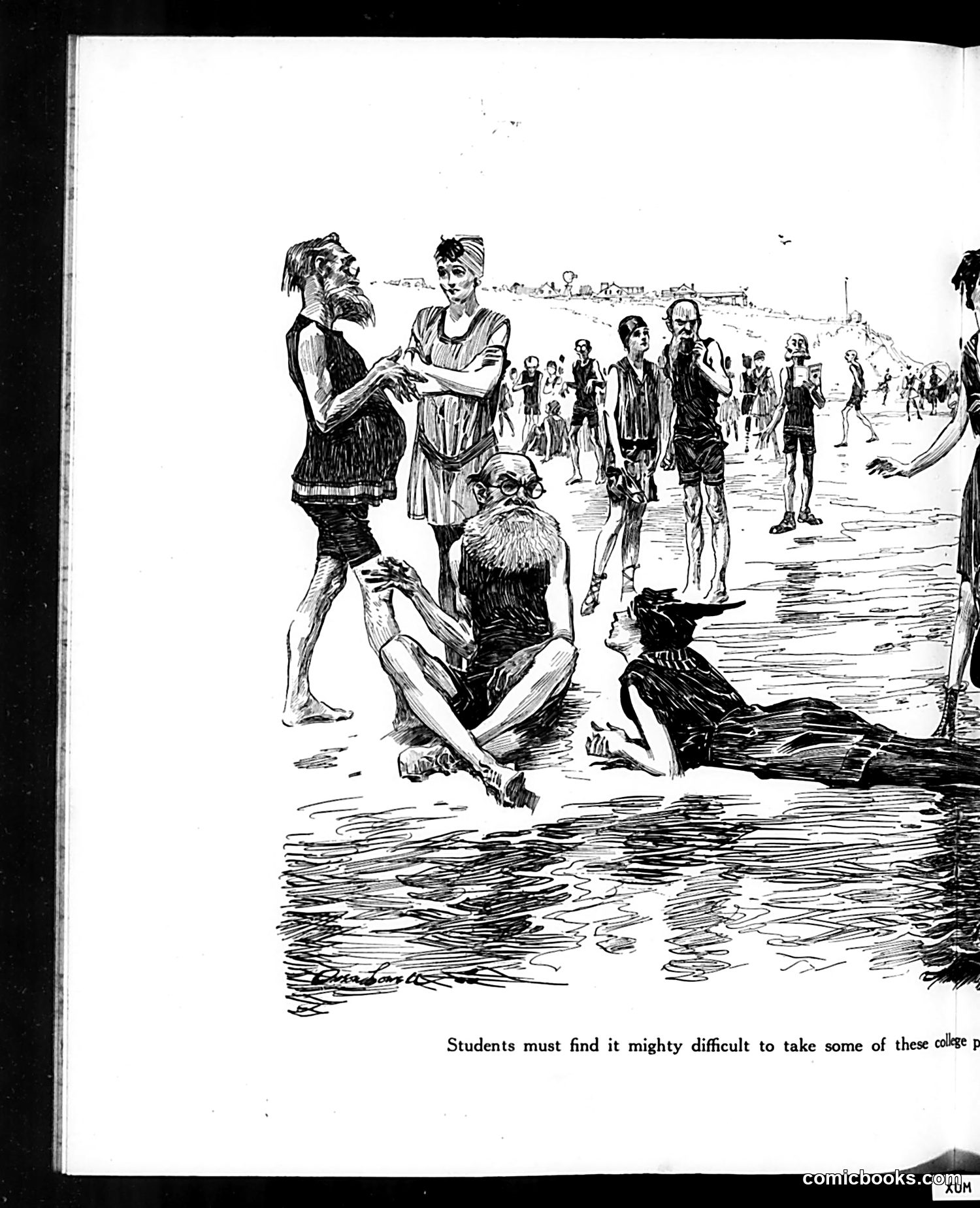
This beach scene satirizes college hazing practices. The caption reads: "Students must find it mighty difficult to take some of these college p[ractices]" (text cuts off). The cartoon depicts what appears to be initiation rituals or hazing at the shoreline. An older bearded man sits in shallow water while younger people (likely college students) stand around him in various states of dress and undress. The scene suggests physical ordeals or humiliating ceremonies that college pledges endured. The satire targets the prevalence of hazing in American colleges during this era (Judge's heyday was late 1800s-early 1900s). The juxtaposition of dignified figures with awkward beach activities mocks how absurd and degrading these traditions were, while the caption's sympathetic tone toward struggling students implies criticism of the practice itself.
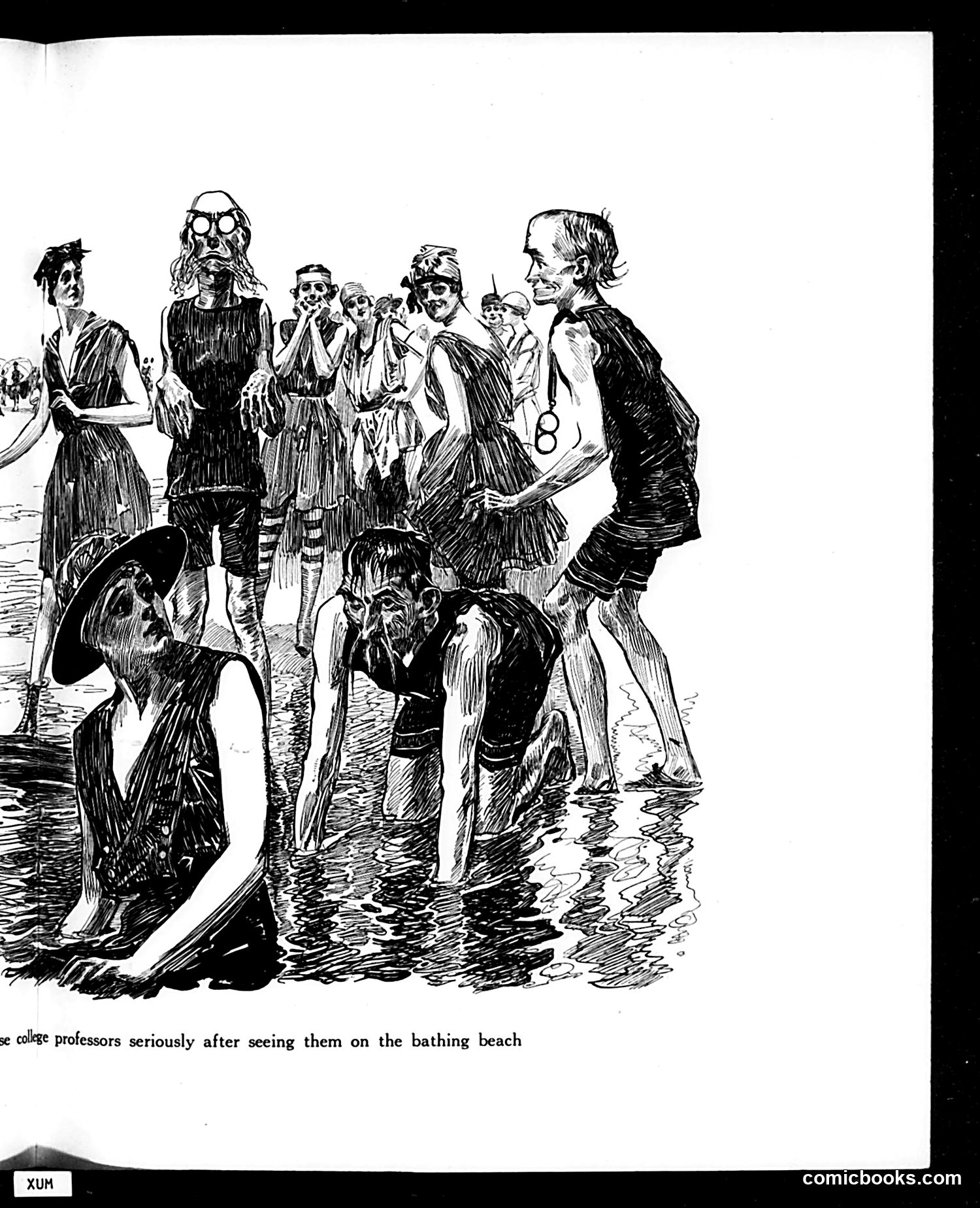
This cartoon satirizes the dignity of college professors. The caption indicates professors are being seen at a bathing beach, where their formal authority appears undermined by casual swimwear. The image shows well-dressed figures (likely representing professors or respectable society members) reacting with apparent shock or concern to two men in bathing attire wading in shallow water. The humor relies on the contrast between the professors' usual formal, authoritative appearance and their vulnerability in swimwear—suggesting that seeing authority figures in such casual, undignified contexts damages their scholarly credibility. This reflects early 20th-century attitudes about maintaining social propriety and the importance of appearance in commanding respect, particularly for educated professionals.
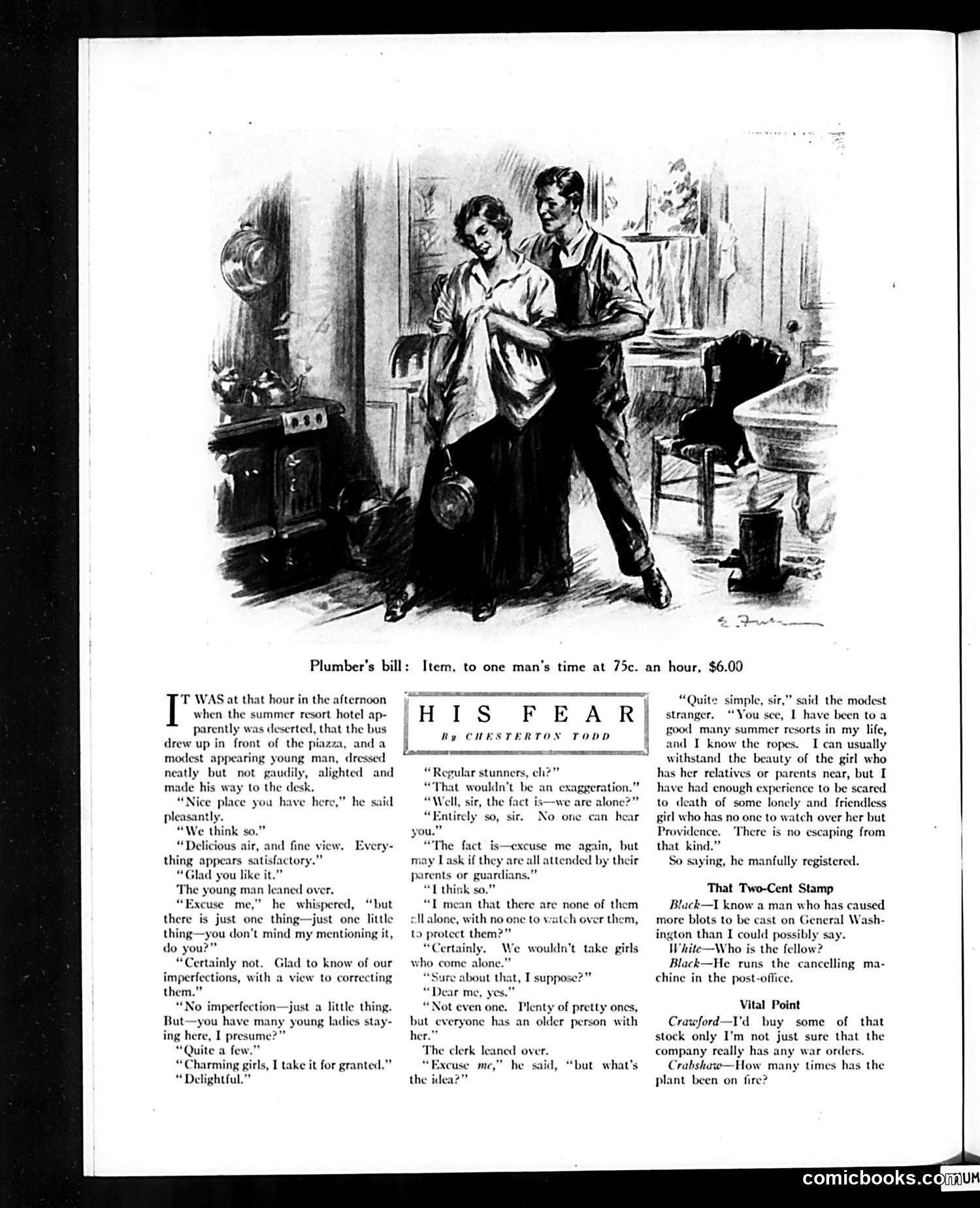
This satirical story mocks the anxieties of a middle-aged male seducer at a summer resort. A modest-dressed stranger arrives at a hotel and converses with the proprietor, praising the establishment. His true concern emerges: he nervously inquires whether the young female guests are chaperoned by parents or guardians. The joke's dark twist: he admits he specifically *fears* lonely, friendless girls with no one watching over them—not because he respects their safety, but because such vulnerability makes them easier to exploit, removing the deterrent of protective family members. His candid confession ("manfully registered") exposes the predatory calculations beneath respectable appearances. The accompanying brief jokes mock incompetence (a postal worker creating cancellation blots) and wartime profiteering (judging company value by fire incidents, implying insurance fraud). The cartoon illustrates this narrative, showing the stranger at the hotel desk during the conversation.
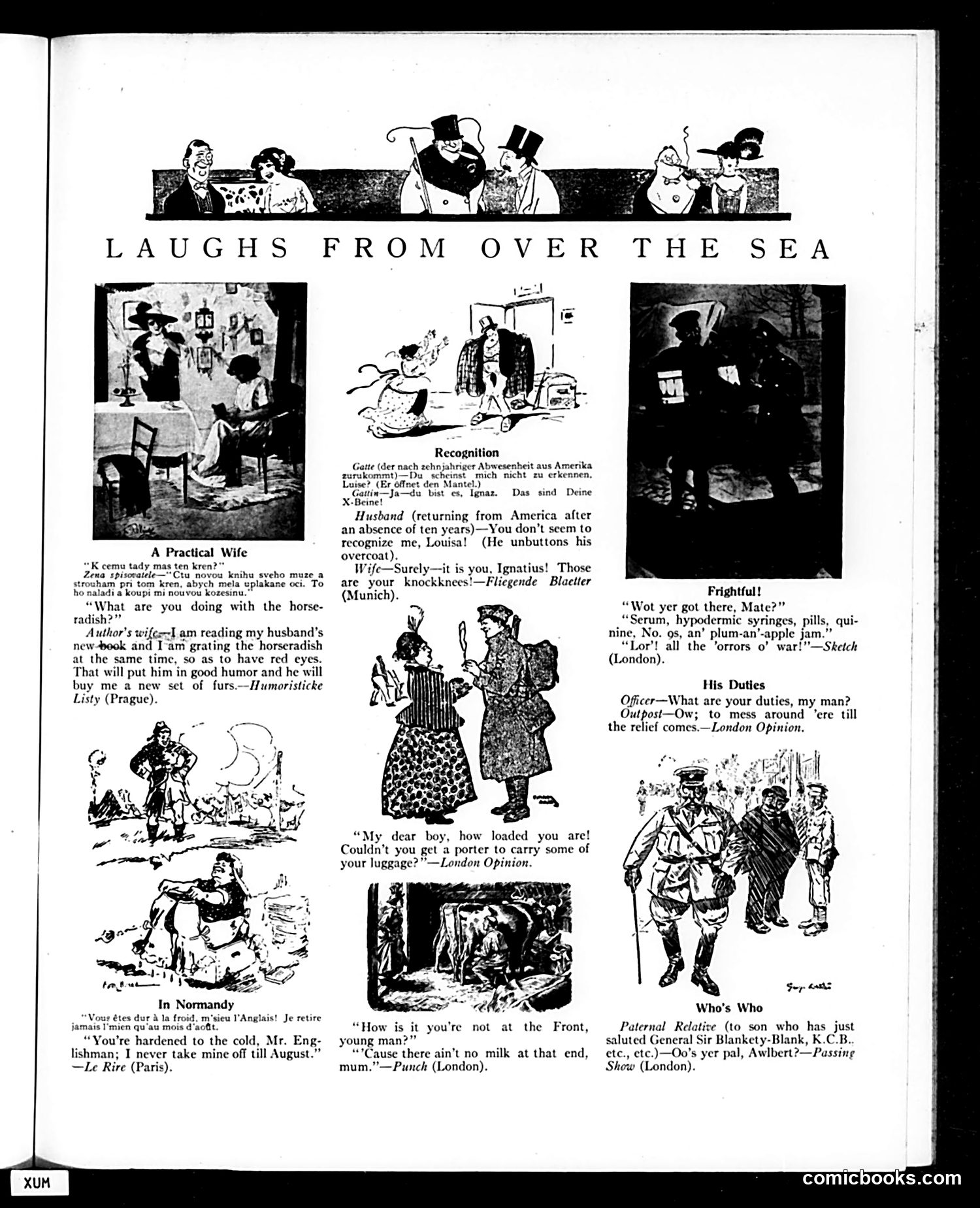
This page collects jokes translated from European satirical magazines, reflecting early 20th-century attitudes during World War I. **Notable cartoons:** - **"A Practical Wife"**: A wife deliberately cries while grating horseradish to fake emotion, manipulating her husband into buying her furs—satirizing marital deception and materialism. - **"Recognition"**: A husband returning after ten years abroad is recognized only by his knock-knees, mocking how absence changes people or how superficial recognition can be. - **"His Duties"/"How is it you're not at the Front"**: Multiple jokes about soldiers' reluctance or excuses (preferring milk to combat), satirizing wartime morale and military service complaints. - **War supply joke**: Medical supplies listed as "horrors of war," darkly joking about battlefield conditions. The page demonstrates how Judge republished European humor to entertain American readers, while the jokes reveal contemporary attitudes toward marriage, masculinity, and WWI participation—often mocking those dodging combat or using domestic pretexts.
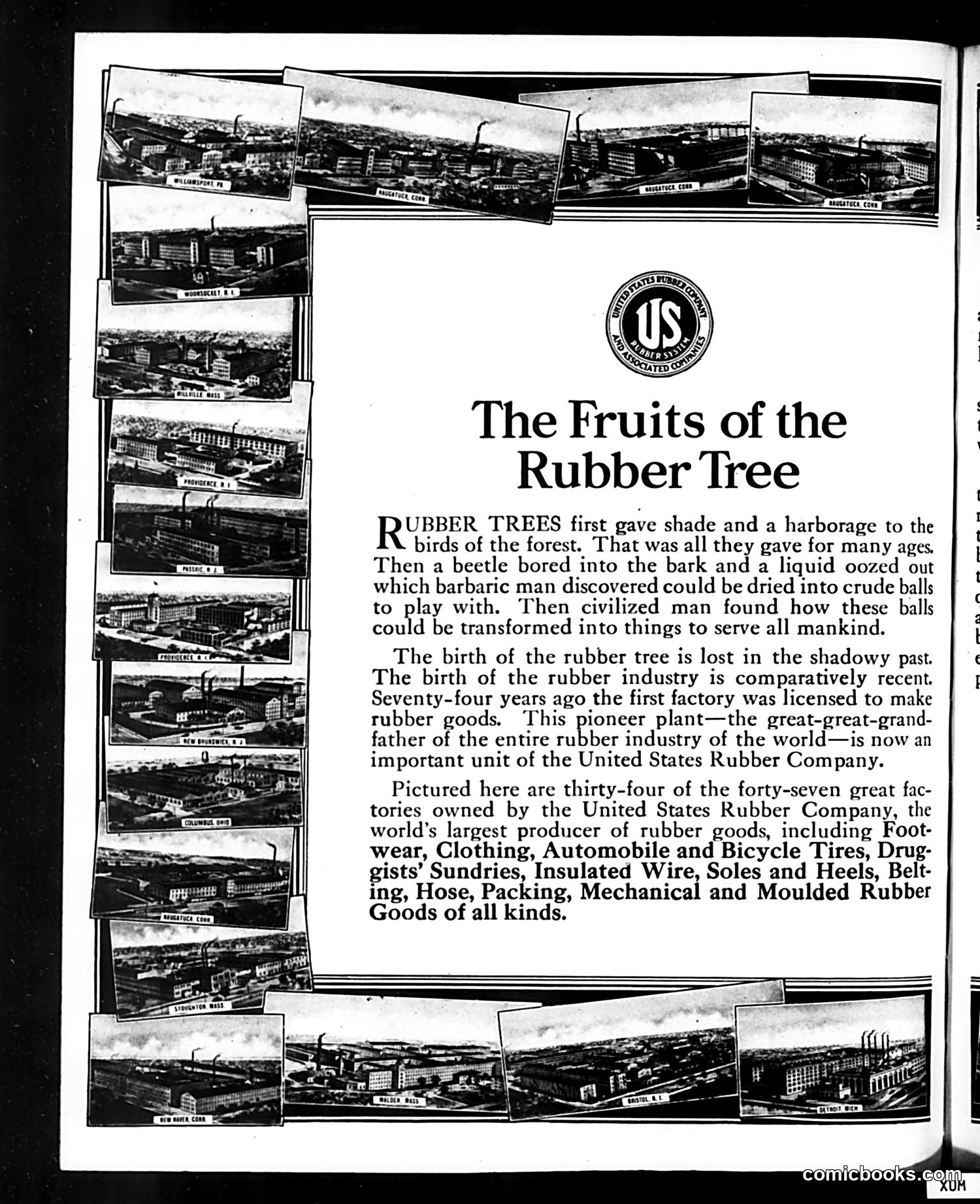
This is **not a political cartoon** but rather **corporate advertising** for the United States Rubber Company, disguised as editorial content in *Judge* magazine. The page celebrates the rubber industry's evolution from natural resource to industrial dominance. It presents a narrative arc: rubber trees originally served only ecological purposes until "civilized man" discovered their commercial potential. The text emphasizes that the U.S. Rubber Company now controls 47 major factories producing diverse rubber products—from tires to clothing to medical supplies. The numerous factory photographs surrounding the text function as visual evidence of corporate scale and industrial might. This is essentially propaganda dressed as historical commentary, typical of early 20th-century corporate messaging in magazines. There is no satire here—the piece earnestly promotes American industrial capitalism and the rubber company's dominance in the market.
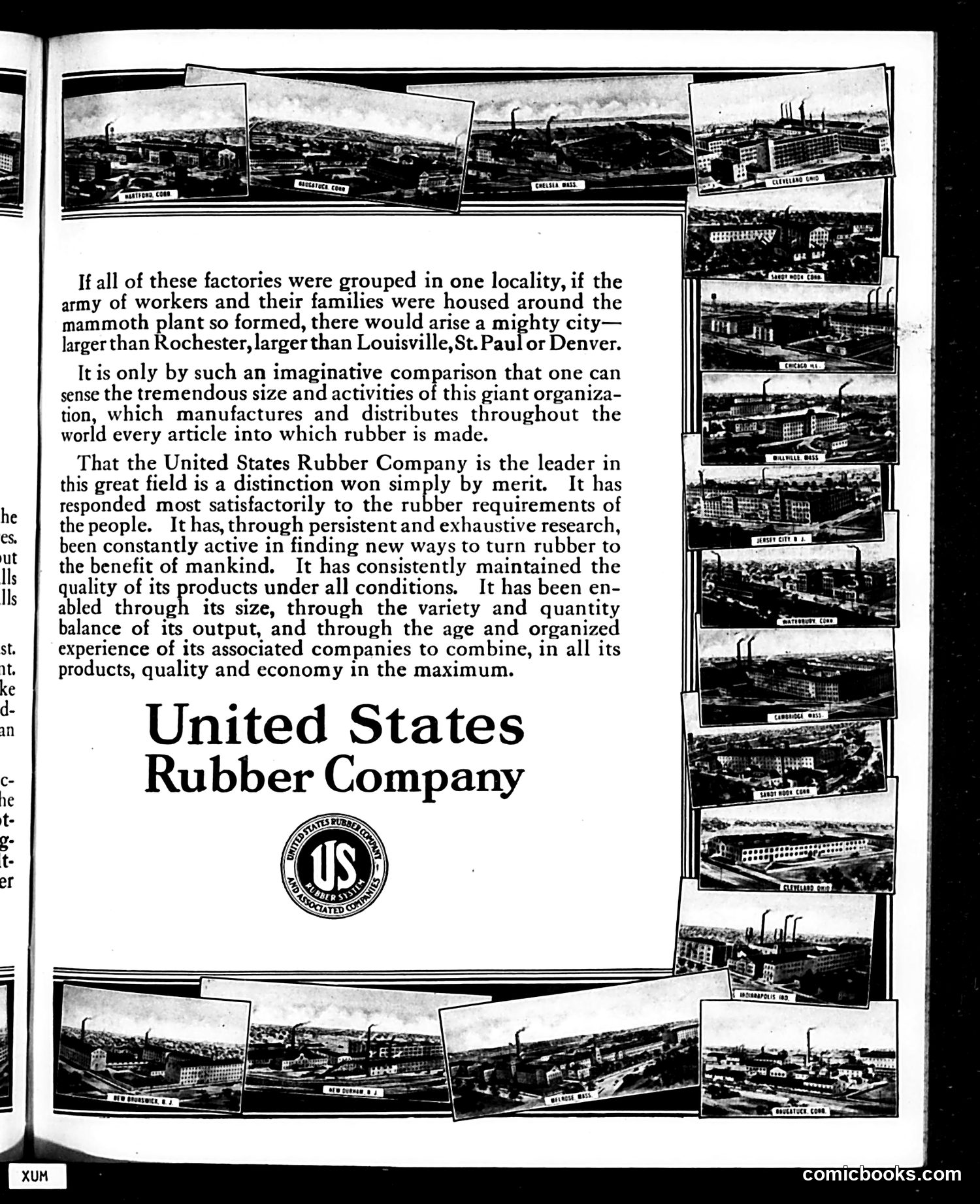
This is **not a satirical cartoon page** but rather a **corporate advertisement** for the United States Rubber Company, likely from the early 20th century. The page uses **promotional rhetoric** rather than satire: it boasts that if the company's factories, workers, and families were consolidated, they'd form a city larger than Rochester, Louisville, St. Paul, or Denver. This hyperbolic comparison aims to impress readers with the company's massive scale and industrial dominance. The surrounding photographs show various factory facilities across different locations—the company's physical presence across America. The text emphasizes the company's leadership through "merit," quality control, research, and economy of scale. **For modern readers:** This exemplifies early industrial-era corporate propaganda, celebrating monopolistic size and manufacturing power as inherently virtuous, without irony. The satirical magazine *Judge* accepted such advertisements, indicating the era's acceptance of unironic corporate self-promotion in periodicals.
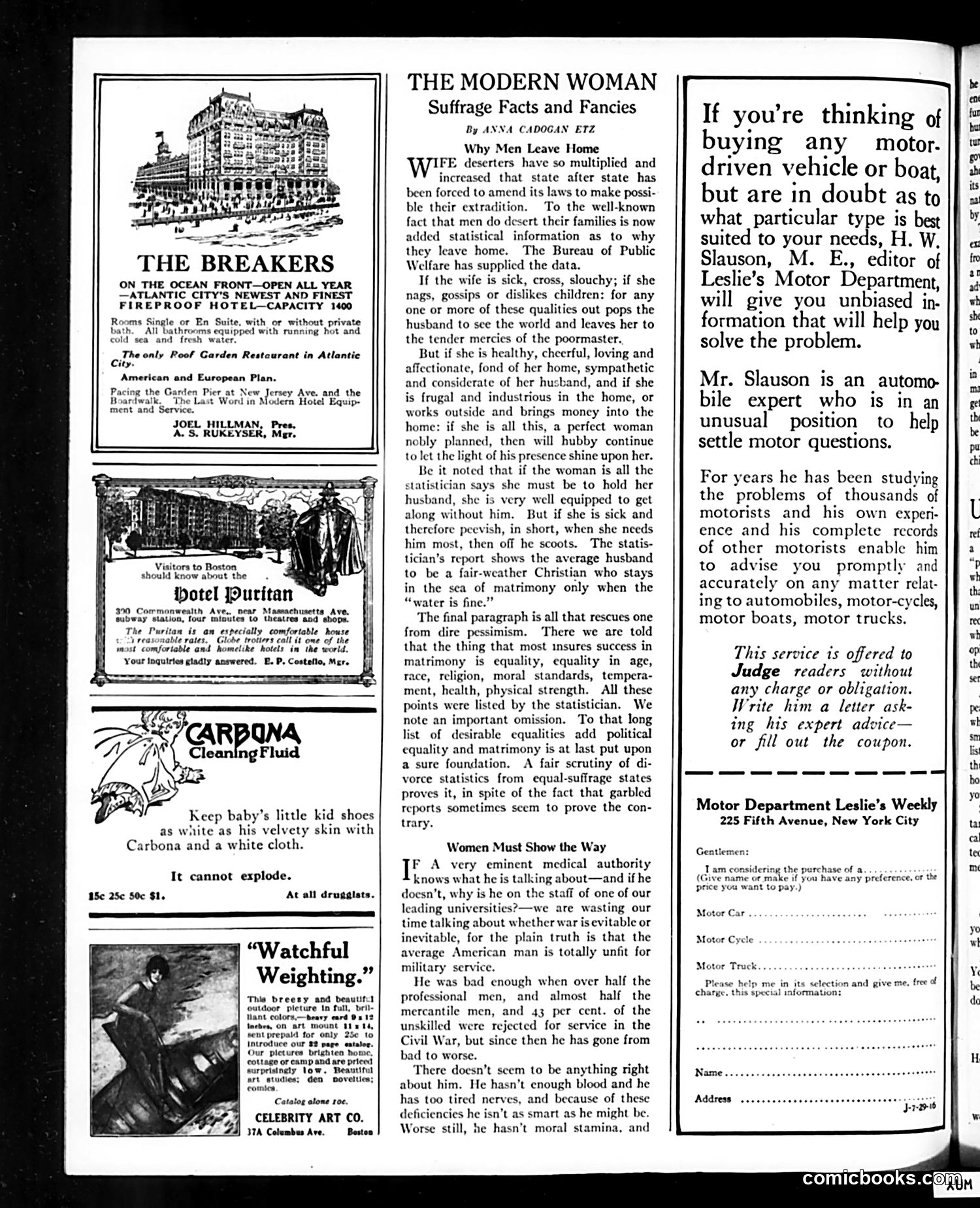
This page contains satirical commentary on women's suffrage and gender relations, typical of Judge magazine's early 20th-century content. **"The Modern Woman" column** by Anna Cadogan Etz uses mock-statistical analysis to critique men who abandon families. The satire argues that wives must be simultaneously perfect homemakers AND economically productive—an impossible standard—yet the author observes that such "perfect women" wouldn't actually need husbands. **The political point**: The column advocates for women's suffrage as the solution to matrimonial inequality, arguing that "political equality" should be added to the list of factors ensuring successful marriages. This was a genuine suffrage argument of the era: that voting rights would give women legal and social power to protect themselves. **The irony**: While ostensibly sympathetic to women's struggles, the piece reinforces stereotypes about women's domestic duties while using them to argue for voting rights—reflecting how suffrage advocates sometimes framed the issue within traditional gender roles rather than challenging them outright. The surrounding advertisements for hotels and consumer goods represent typical Judge content filler.
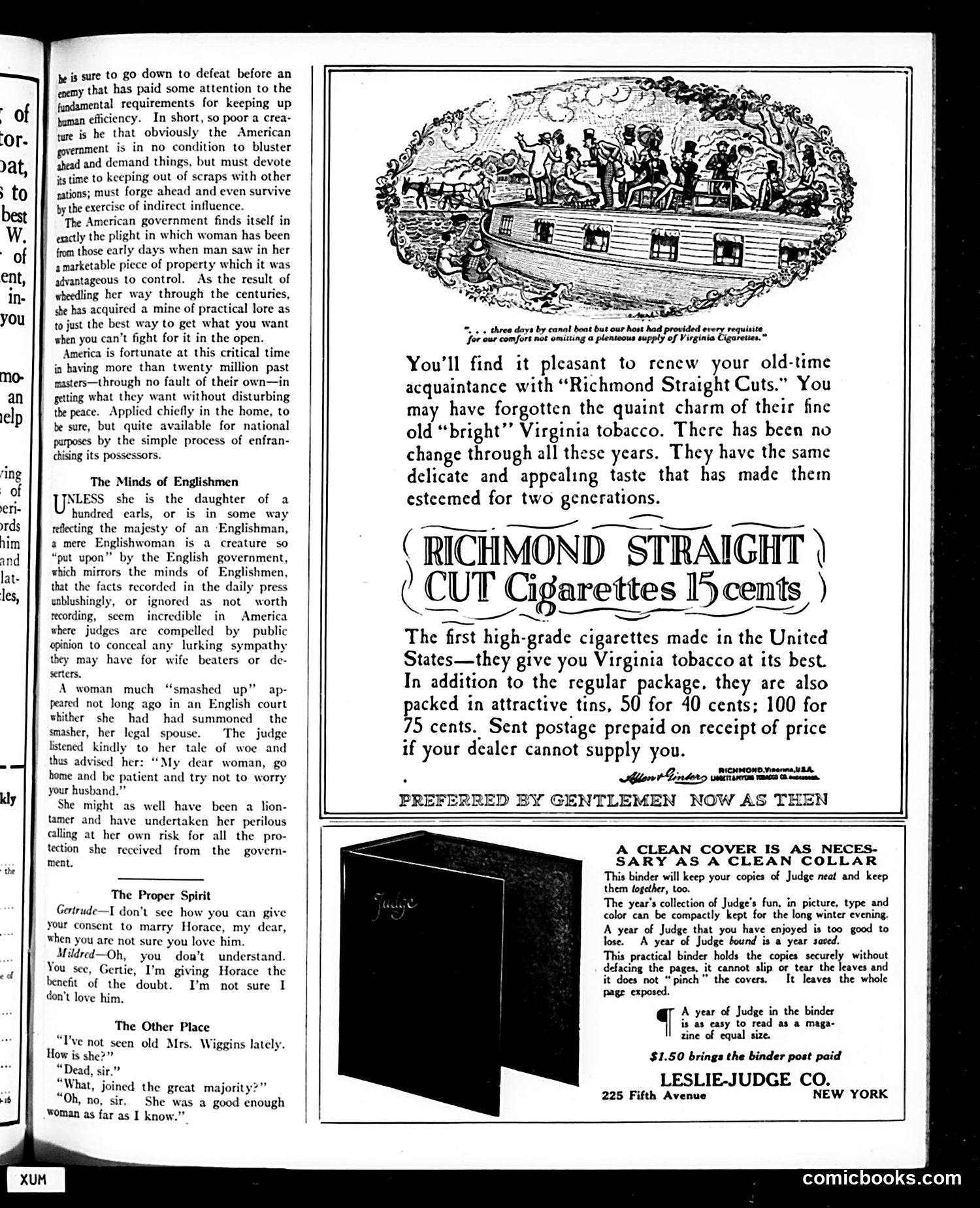
This page mixes editorial content with advertising. The main articles use satirical commentary on women's roles and legal systems: **"The Minds of Englishmen"** critiques how English courts treat domestic violence victims—a judge advises an abused woman to go home and "not worry" her husband. The satire contrasts this with American courts' supposed protections for women, though the piece ironically notes America has "twenty million past masters" (women) in getting what they want through indirect influence rather than direct action. The implication: women are forced into manipulative strategies because direct power is denied them. The short dialogues mock romantic courtship and class pretensions typical of Judge's humor. **Advertisements occupy significant space:** - Richmond Straight Cut Cigarettes (15 cents) emphasize Virginia tobacco and "high-grade" quality - Leslie-Judge Company offers a magazine binder ($1.50) The page reflects early 20th-century attitudes: women as perpetually scheming, class anxiety, and casual tobacco marketing to gentlemen—then considered respectable.
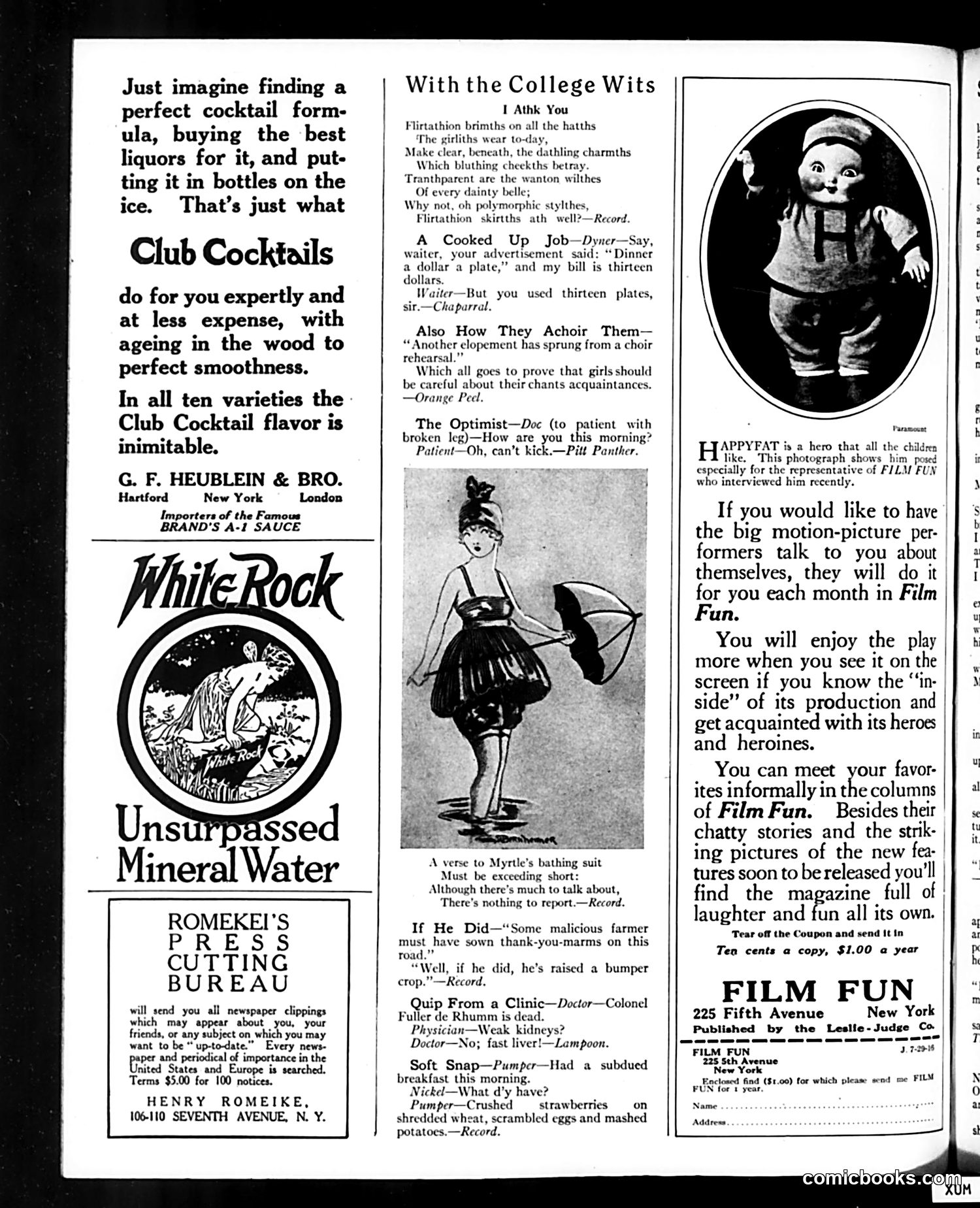
This page is primarily **advertising and promotional content**, not political satire. The left side features ads for Club Cocktails, White Rock Mineral Water, and Romeike's Press Cutting Bureau—a clipping service that tracked newspaper mentions of clients across America and Europe. The center contains "With the College Wits"—light humor jokes, apparently from college publications. These include mild sexual innuendo about women's bathing suits and flirtation, puns about restaurant pricing, and brief observational gags. None reference specific political figures or events. The right side promotes **Film Fun magazine**, featuring an unnamed child character called "Happy Eat" photographed for the publication. The text encourages readers to buy Film Fun for behind-the-scenes gossip about movie stars. **Overall:** This is a typical Judge magazine page from the 1910s-1920s era—mostly commercial content with generic college humor, aimed at selling related publications and consumer goods to readers interested in entertainment and celebrity culture.
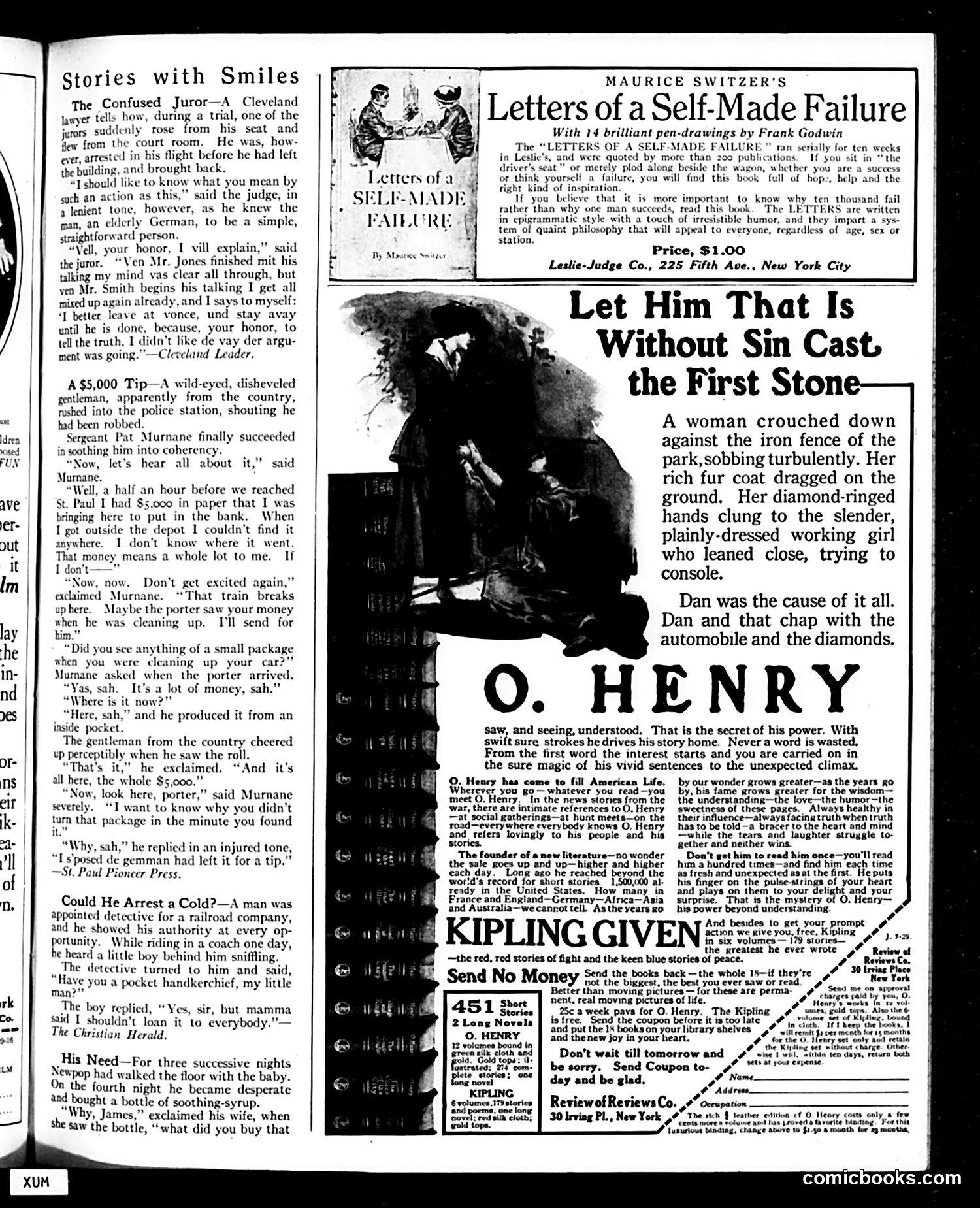
This page from Judge magazine contains three humorous anecdotes in the "Stories with Smiles" section, plus advertising for Maurice Switzer's *Letters of a Self-Made Failure*. **The three jokes:** 1. "The Confused Juror" mocks an elderly German immigrant juror who flees court during closing arguments, claiming conflicting testimony confuses him—satirizing immigrant accents and jury duty absurdities. 2. "A $5,000 tip" depicts a country gentleman losing money at a train station. A porter found it but kept it, believing it was left *as a tip*—humor derived from rural naiveté and class misunderstanding. 3. "Could He Arrest a Cold?" shows an officious railroad detective demanding a boy's handkerchief to stop sniffling, satirizing petty authority figures abusing power. All three target common turn-of-century stereotypes: immigrants, rural rustics, and pompous officials. The page exemplifies Judge's satirical approach to American social foibles through working-class and immigrant characters.
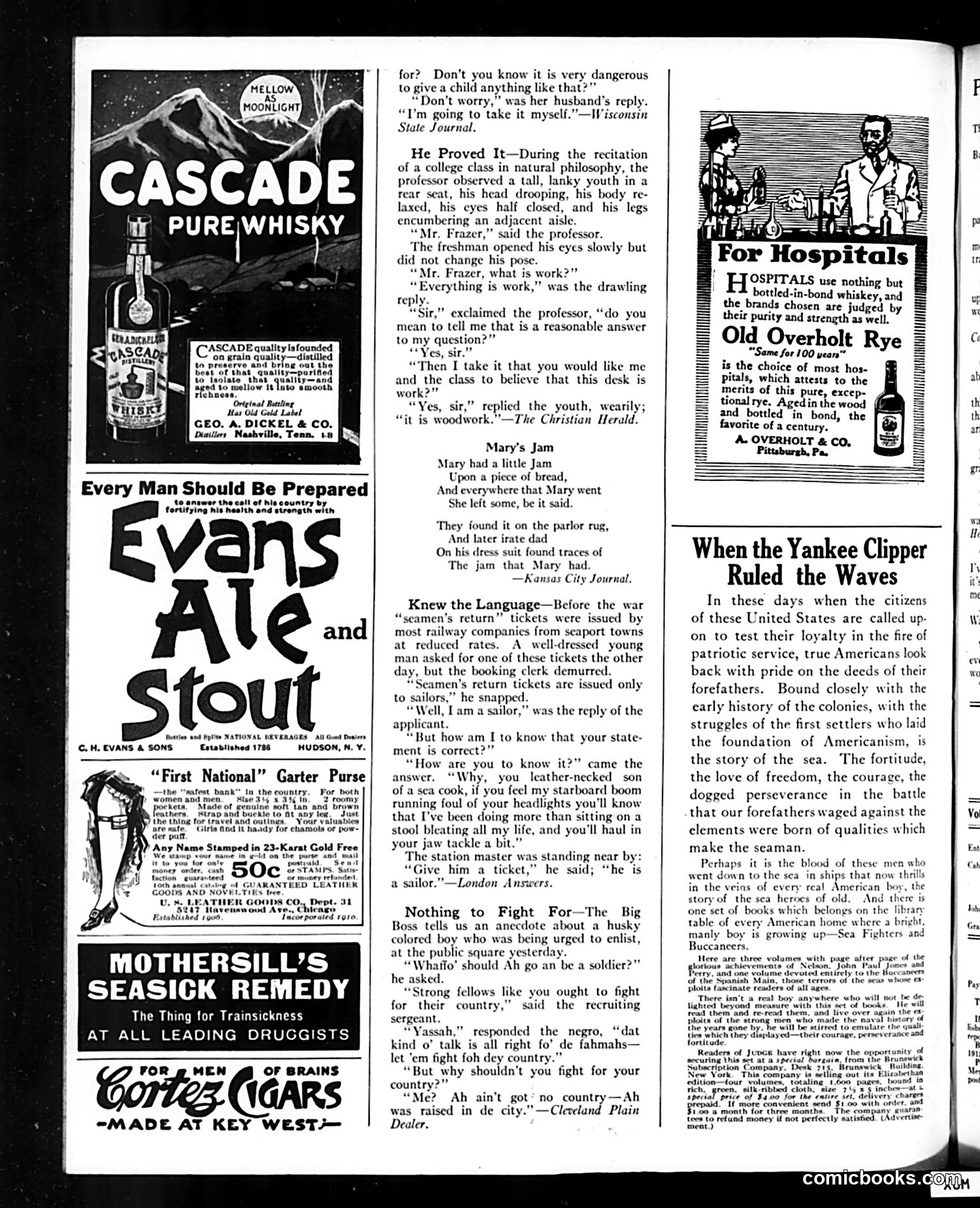
This page primarily comprises **period advertisements and humorous anecdotes** rather than political cartoons. The notable satirical content appears in the short story "Nothing to Fight For," which uses racial stereotypes (common to the era) to comment on class inequality. A Black man refuses military enlistment because, as a city laborer rather than a farmer, he has "no country"—a pointed critique of how patriotic appeals ring hollow for those excluded from civic participation and economic opportunity. The other brief humorous pieces ("He Proved It," "Mary's Jam," "Knew the Language") are gentle jokes about college students, children, and working-class sailors—typical light fare for Judge magazine. The advertisements (Cascade Whisky, Evans Ale, Mothersill's Seasickness Remedy) represent common product marketing of the period, while "When the Yankee Clipper Ruled the Waves" appears to be patriotic historical content, likely tying to WWI-era themes given references to citizens being "called upon to test their loyalty." The page reflects early-20th-century sensibilities regarding race, class, and patriotism.
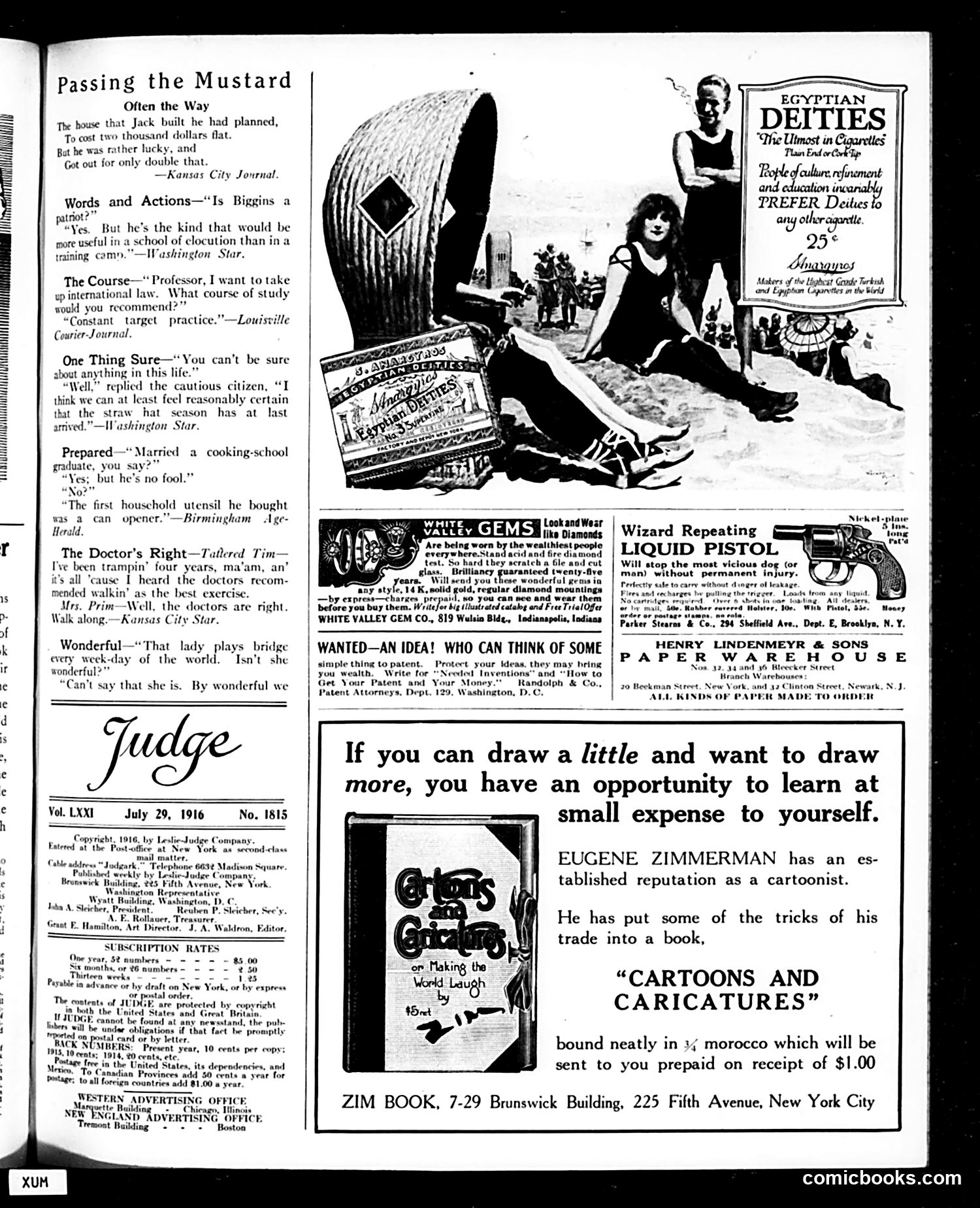
This page is primarily **short humor pieces and advertisements** rather than political cartoons. The content reflects early 20th-century American domestic life: **Short Jokes Section ("Passing the Mustard"):** Brief, mostly non-political humor about marriage, medicine, and everyday situations. Examples include a joke about a house costing double its estimate and a cooking-school graduate husband buying a can opener. These are light social satire about domestic life and professional advice. **Advertisements:** The page features ads for diamond gems, patent services, Egyptian Deities cigarettes, a "Wizard Repeating Liquid Pistol" (self-defense device), and a cartooning instruction book by Eugene Zimmerman. **Historical Context:** The single political reference appears in "Words and Actions," where someone called a "patriot" is compared to an elocution student—likely referencing WWI-era patriotism debates (the U.S. entered WWI in 1917, so this predates full engagement). The page demonstrates Judge's mixed format of humor, light satire, and commercial content typical of 1916 American magazines.
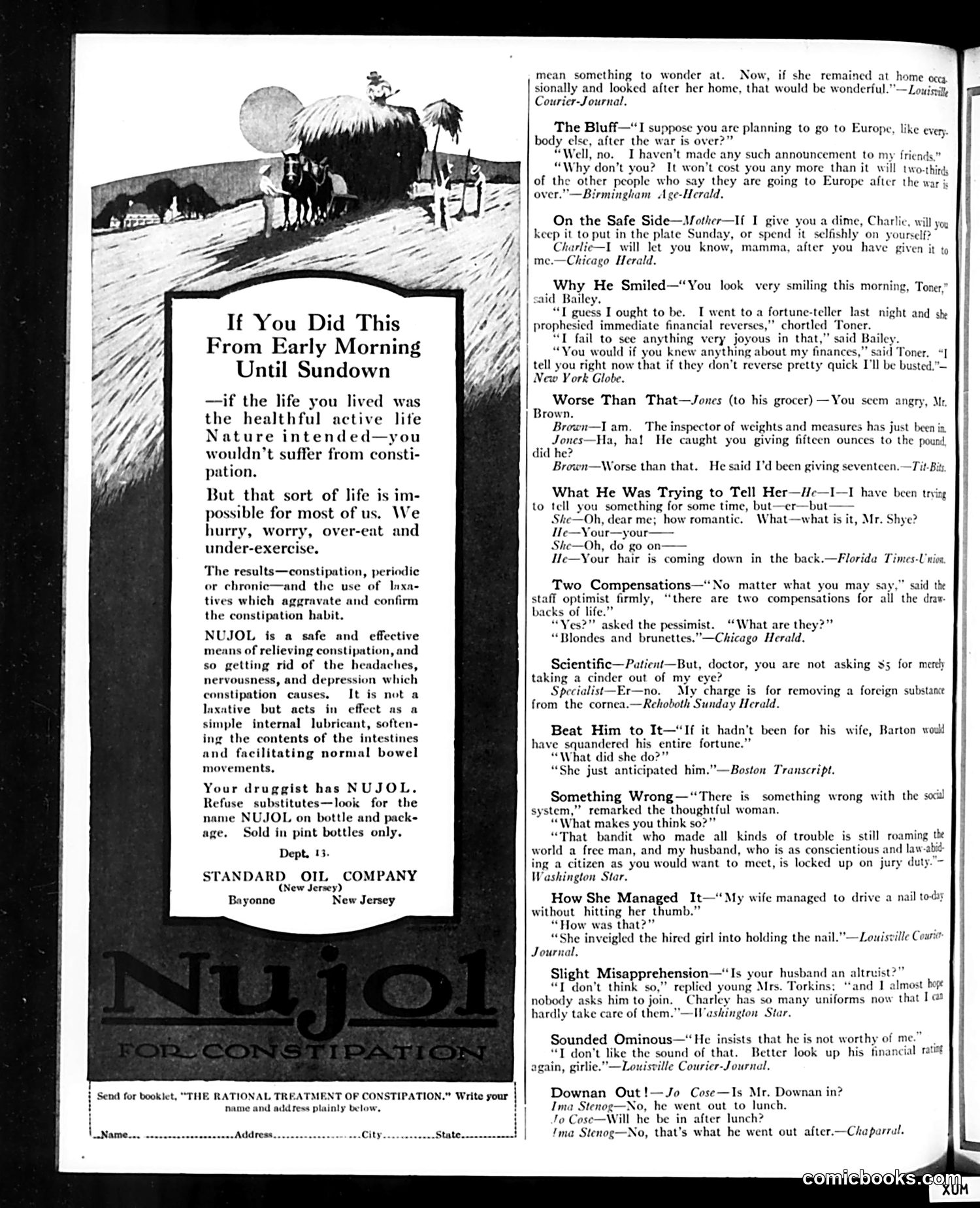
This page contains primarily **short humorous anecdotes and jokes** rather than political cartoons. The content reflects early 20th-century American social preoccupations: **The dominant feature** is a NUJOL laxative advertisement disguised as health advice, claiming constipation results from modern life's stress and sedentary habits—a common concern of the era. **The jokes satirize**: - Post-WWI social pretension (people falsely claiming European travel plans) - Parental hypocrisy about money and morality - Gender dynamics and marital relationships - Class anxieties (grocery store cheating, financial instability) - Professional overcharging (doctors exploiting patients) **The humor targets** ordinary middle-class anxieties rather than specific political figures or events. References to "the war" (likely WWI) and social "systems" suggest post-war disillusionment, but no identifiable caricatures appear. The content is fundamentally **domestic and social satire** reflecting period concerns about modern life's pressures.
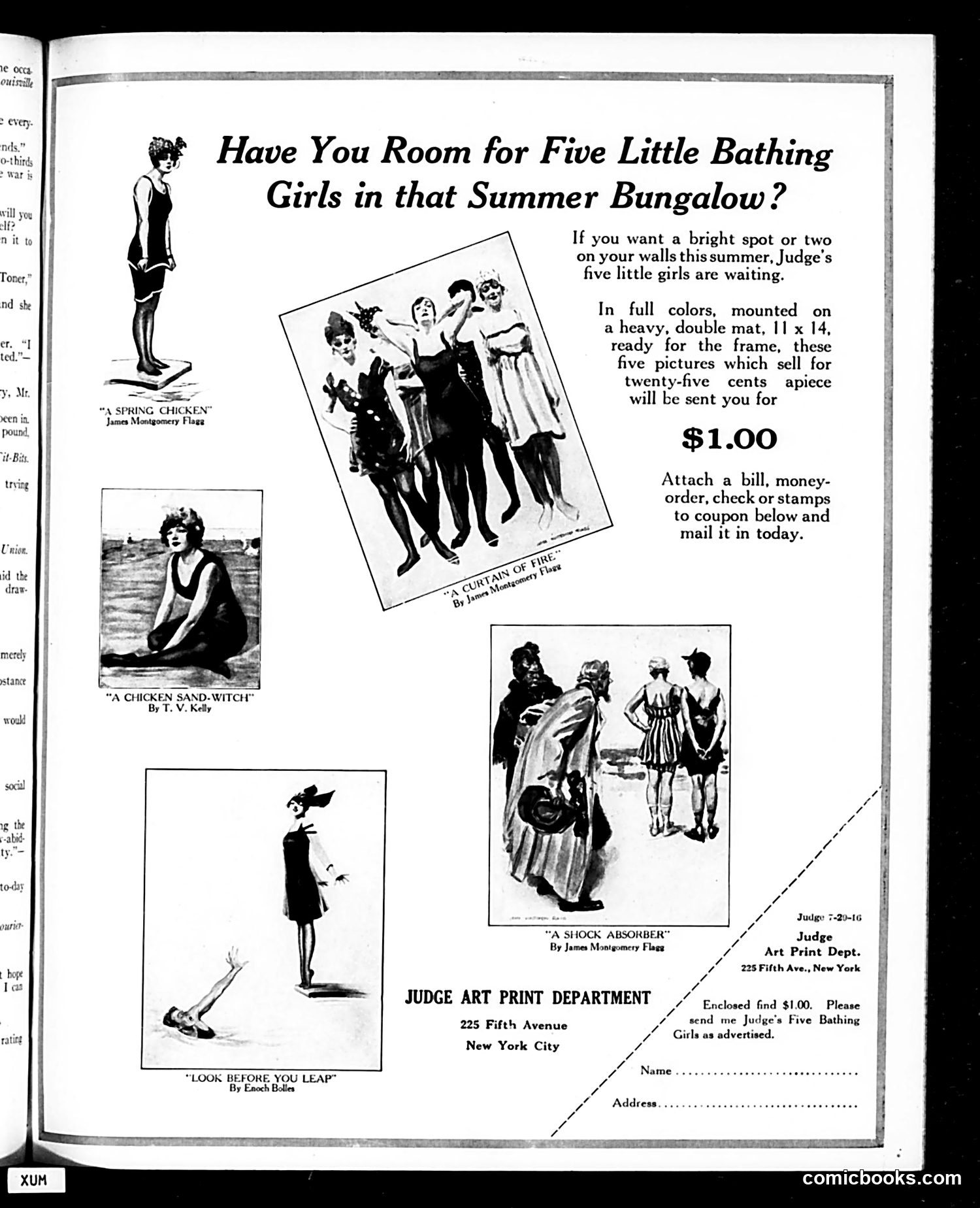
This is primarily **advertising**, not political satire. Judge magazine is promoting a mail-order print collection titled "Judge's Five Bathing Girls"—five color illustrations by renowned artist James Montgomery Flagg, each 11x14 inches, selling for $1.00 total (25 cents per print). The individual cartoon titles shown are: "A Spring Chicken," "A Chicken Sand-Witch," "Look Before You Leap," and "A Shock Absorber." These appear to be lighthearted, flirtatious illustrations of young women in bathing attire—typical of 1916 magazine humor featuring attractive female figures. The "satire" is gentle wordplay: titles like "Shock Absorber" and "Spring Chicken" pun on the bathing girls as decorative wall art for summer bungalows. The headline's question—whether readers have "room"—references both wall space and double-entendre about accommodating attractive women. This reflects early 20th-century magazine culture where such prints were popular home décor, and humor magazines regularly commodified images of fashionable, attractive women.
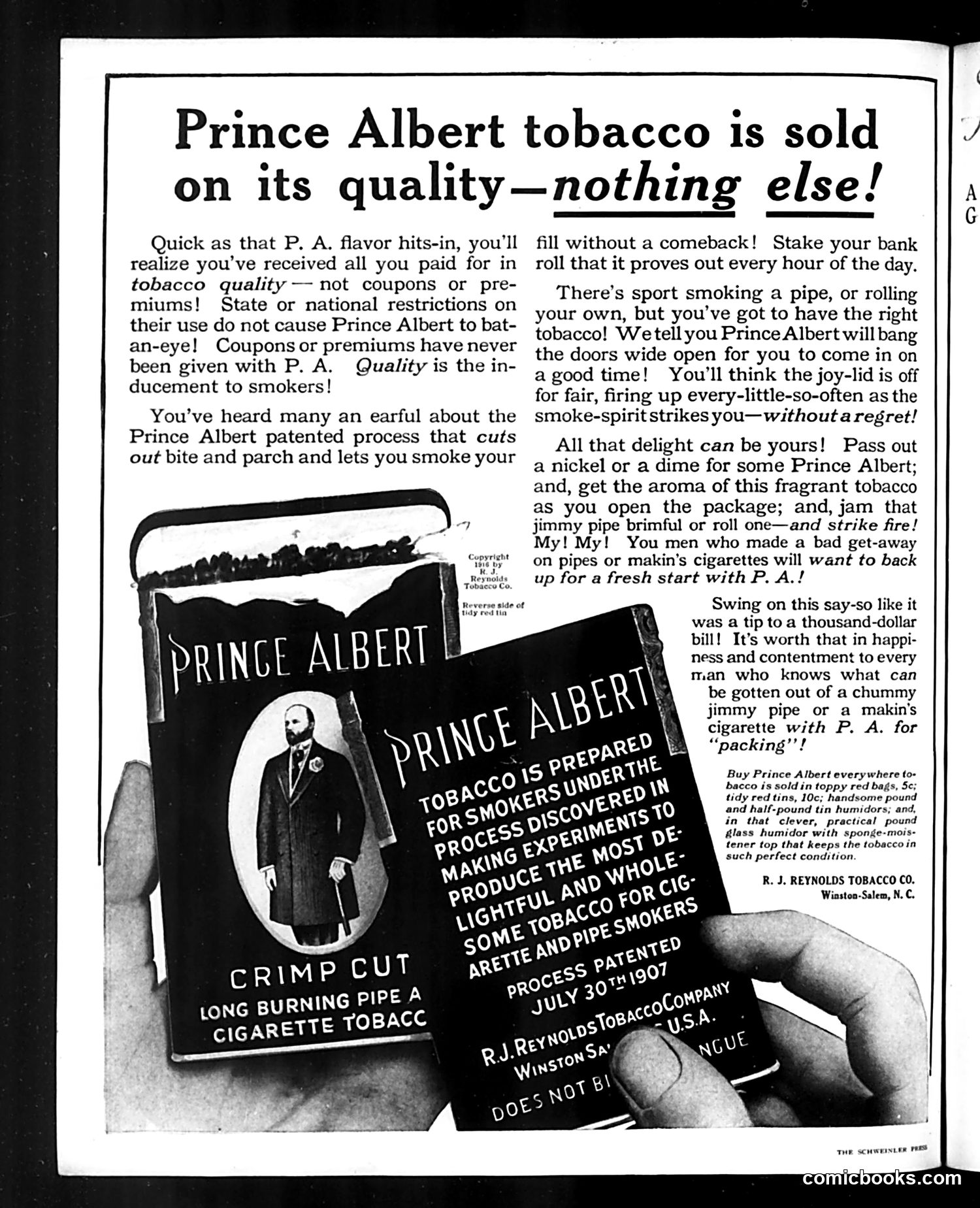
This is a **straightforward cigarette advertisement**, not satire. It promotes Prince Albert tobacco, emphasizing quality over premiums or coupons—a selling point against competitors who offered giveaways. The ad highlights the brand's "patented process" that allegedly reduces harshness ("bite and parch"), allowing longer smoking enjoyment. It targets pipe and roll-your-own smokers, positioning Prince Albert as superior for both formats. The visual shows tobacco packages and hands holding them. The colloquial language ("jimmy pipe," "strike fire," "makin's") appeals to working-class male smokers. Notably, this reflects early 20th-century advertising before cigarette health warnings. The ad ran in *Judge* magazine during an era when tobacco advertising was standard in mainstream publications. No political satire or caricature is present—this is genuine product marketing.