
Judge, 1916-07-29 · page 6 of 28
Judge — July 29, 1916 — page 6: what you’re looking at
What you’re looking at
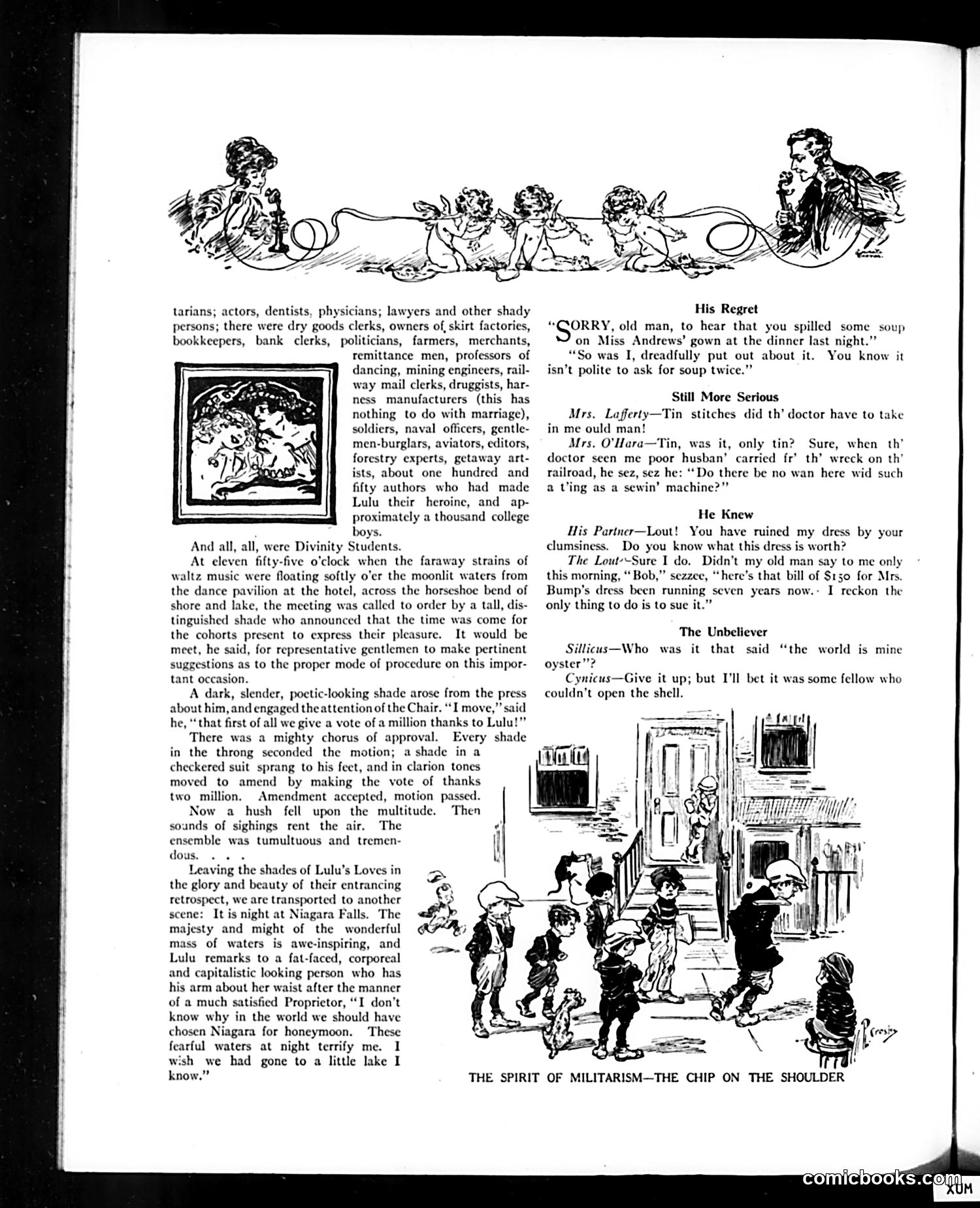
This page contains several brief humorous anecdotes satirizing social pretension and marital discord among the upper-middle classes. **"His Regret"**: Mocks bourgeois etiquette obsession—a man apologizes for spilling soup on a woman's dress, then admits he won't ask for soup twice to avoid repeating the embarrassment. **"Still More Serious"**: Uses Irish dialect humor (common in early 20th-century American comedy) to contrast working-class medical emergencies with upper-class concerns. **"He Knew"**: Satirizes henpecked husbands—a man responds to his partner's complaint about a ruined dress by revealing the bill has been running for seven years, suggesting chronic marital conflict over expenses. **"The Unbeliever"**: A philosophical joke questioning optimism; someone claiming "the world is mine oyster" likely couldn't afford or open actual oysters. **Bottom cartoon** ("The Spirit of Militarism"): Children playing soldiers, likely critiquing militaristic attitudes being taught to youth—though context beyond the image is unclear. The page reflects Judge's satirical approach to American social and domestic life.
📄 Transcribed text from this page (OCR, searchable)
Machine-transcribed from the original scan — historical spelling and the odd misread are preserved.
tarians; actors, dentists, physicians; lawyers and other shady persons; there were dry goods clerks, owners of, skirt factories, bookkeepers, bank clerks, politicians, farmers, merchants, remittance men, professors of dancing, mining engineers, rail- way mail clerks, druggists, har- ness manufacturers (this has nothing to do with marriage), soldiers, naval officers, gentle- men-burglars, aviators, editors, forestry experts, getaway art- ists, about one hundred and fifty authors who had made Lulu their heroine, and ap- proximately a thousand college boys. all, were Divinity Students. n fifty-five o'clock when the faraway strains of And all, At ele waltz music were floating softly o'er the moonlit waters from the dance pavilion at the hotel, across the horseshoe bend of shore and lake, the meeting was called to order by a tall, dis- tinguished shade who announced that the time was come for the cohorts present to express their pleasure. It would be meet, he said, for representative gentlemen to make pertinent suggestions as to the proper mode of procedure on this impor- tant occasion. A dark, slender, poctic-looking shade arose from the press about him, and engaged the attention of the Chair. “I move,” said he, “that first of all we give a vote of a million thanks to Lulu!” There was a mighty chorus of approval. Every shade in the throng seconded the motion; a shade in a checkered suit sprang to his feet, and in clarion tones moved to amend by making the vote of thanks two million. Amendment accepted, motion passed. Now a hush fell upon the multitude. Then sounds of sighings rent the air, The ensemble was tumultuous and tremen- dous. . . . i ing the shades of Lulu’s Loves in the glory and beauty of their entrancing retrospect, we are transported to another scene: It is night at Niagara Falls. The majesty and might of the wonderful mass of waters is awe-inspiring, and Lulu remarks to a fat-faced, corporeal and capitalistic looking person who has his arm about her waist after the manner of a much satisfied Proprietor, “I don’t know why in the world we should have chosen Niagara for honeymoon. These fearful waters at night terrify me. I wish we had gone to a little lake I know.” His Regret “CORRY, old man, to hear that you spilled some soup n Miss Andrews’ gown at the dinner last night.” 0 was I, dreadfully put out about it. You know it isn’t polite to ask for soup twice.” Still More Serious Mrs. Lafferty—Tin stitches did th’ doctor have to take in me ould man! Mrs. O'Hara—Tin, was it, only tin? Sure, when th’ doctor seen me poor husban’ carried fr’ th’ wreck on th’ railroad, he sez, sez he: ‘Do there be no wan here wid such a ting as a sewin’ machine?” He Knew His Partner—Lout! You have ruined my dress by your clumsiness. Do you know what this dress is worth? The Lout-Sure I do. Didn't my old man say to me only this morning, “Bob,” sezzee, “here’s that bill of $150 for Mrs. Bump’s dress been running seven years now.: I reckon the only thing to do is to sue it.” The Unbeliever Sillicus—Who that said “the world is mine oyster’? Cynicus—Give it up; but I'll bet it was some fellow who couldn't open the shell. was it THE SPIRIT OF MILITARISM—THE CHIP ON THE SHOULDER