
Judge, 1916-07-29 · page 4 of 28
Judge — July 29, 1916 — page 4: what you’re looking at
What you’re looking at
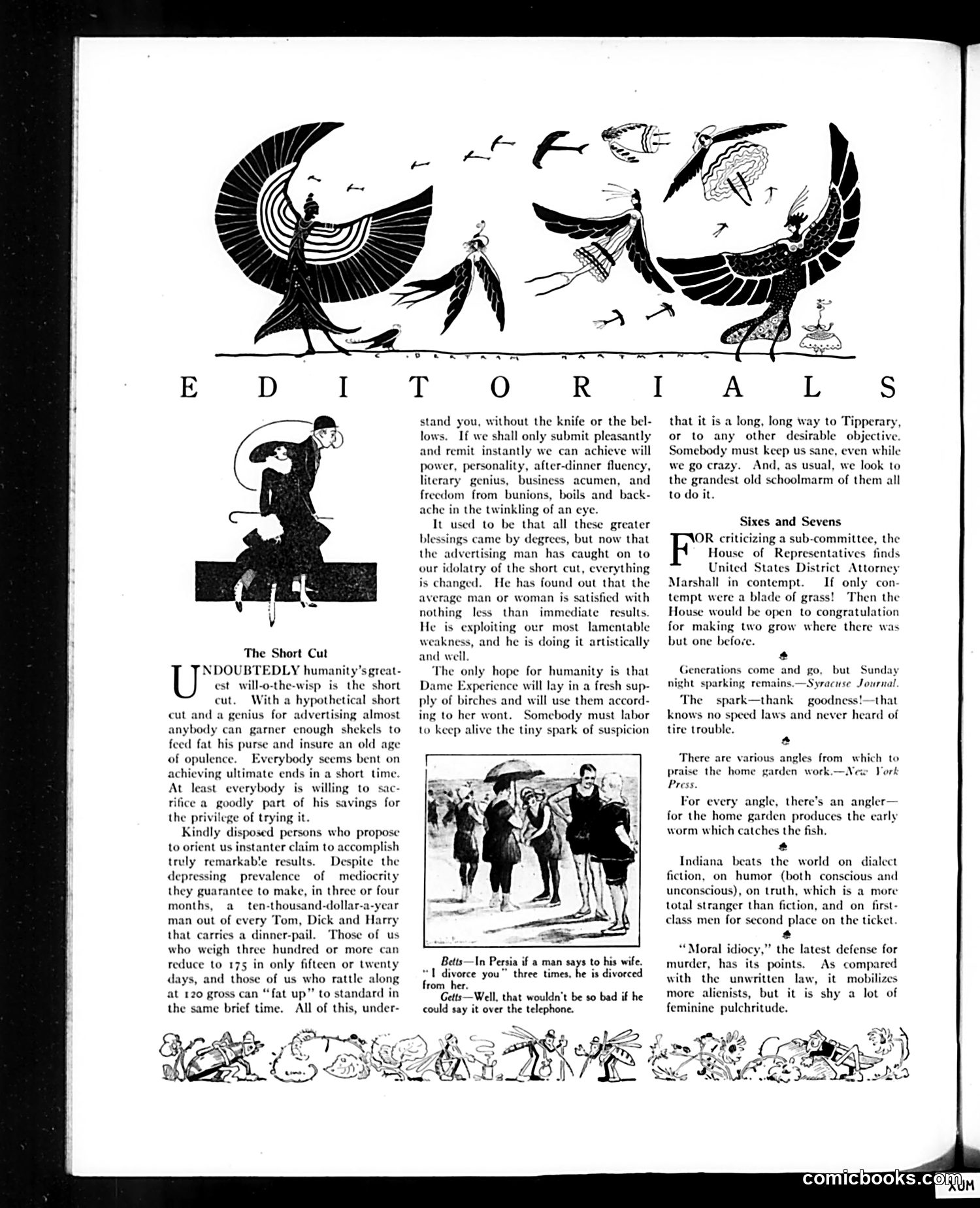
This page contains editorial commentary with illustrations rather than political cartoons. "The Short Cut" criticizes advertising's false promises—specifically that brief advertisements can sell major products or ideas. The author argues advertising exploits human weakness and mediocrity by claiming instant results are possible when they're not. The subsequent editorials discuss various social topics: a U.S. District Attorney's criticism of a Congressional sub-committee ("Sixes and Sevens"), home gardening, Indiana's literary reputation, and divorce laws in Persia. The illustrations are decorative rather than satirical—showing figures in period dress. Without identifying specific individuals, the page represents Judge's typical mix of satirical commentary on American consumer culture, politics, and social manners during this era.
📄 Transcribed text from this page (OCR, searchable)
Machine-transcribed from the original scan — historical spelling and the odd misread are preserved.
The Short Cut NDOUBTEDLY humanity’s great- U est will-o-the-wisp is the short cut. With a hypothetical short cut and a genius for advertising almost anybody can garner cnough shekels to feed fat his purse and insure an old age of opulence. Everybody seems bent on achieving ultimate ends in a short time. At least everybody is willing to sac- rifice a goodly part of his savings for the privilege of trying it. Kindly disposed persons who propose to orient us instanter claim to accomplish truly remarkable results. Despite the depressing prevalence of mediocrity they guarantee to make, in three or four months, a ten-thousand-dollar-a-year man out of every Tom, Dick and Harry that carries a dinner-pail. Those of us who weigh three hundred or more can reduce to 175 in only fifteen or twenty days, and those of us who rattle along at 120 gross can “fat up” to standard in the same brief time. All of this, under- stand you, without the knife or the bel- lows. If we shall only submit pleasantly and remit instantly we can achieve will power, personality, after-dinner fluency, literary genius, business acumen, and freedom from bunions, boils and back- ache in the twinkling of an eye. It used to be that all these greater blessings came by degrees, but now that the advertising man has caught on to our idolatry of the short cut, everything is changed. He has found out that the average man or woman is satisfied with nothing than immediate results. He is exploiting our most lamentable weakness, and he is doing it artistically and well, The only hope for humanity is that Dame Experience will lay ina fresh sup- ply of birches and will use them accord- ing to her wont. Somebody must labor to keep alive the tiny spark of suspicion less Betts—In Persia if a man says to his wife. “I divorce you” three times. he is divorced from_her. Getts—Well, that wouldn't be so bad if he could say it over the telephone. that it is a long, long way to Tipperary, or to any other desirable objective. Somebody must keep us sane, even while we go crazy. And, as usual, we look to the grandest old schoolmarm of them all to do it. Sixes and Sevens OR criticizing a sub-committee, the F House of Representatives finds United States District Attorney Marshall in contempt. If only con tempt were a blade of gr: Then the House would be open to congratulation for making two grow where there was but one befo. Generations come and go, but Sunday ight sparking remains. —Syracuse Journal The spark—thank — goodness!—that knows no speed laws and never heard of tire trouble. s which to York There are various angles from praise the home garden work.—New Press. For every angle, there’s an angler— for the home garden produces the carly worm which catches the fish, * Indiana beats the world on dialect fiction, on humor (both conscious and unconscious), on truth, which is a more total stranger than fiction, and on first- class men for second place on the ticket. 2 “Moral idiocy,” the latest defense for murder, has its points. As compared with the unwritten law, it mobilizes ienists, but it is shy a lot of comicbooks.conim