
Judge, 1916-07-29 · page 12 of 28
Judge — July 29, 1916 — page 12: what you’re looking at
What you’re looking at
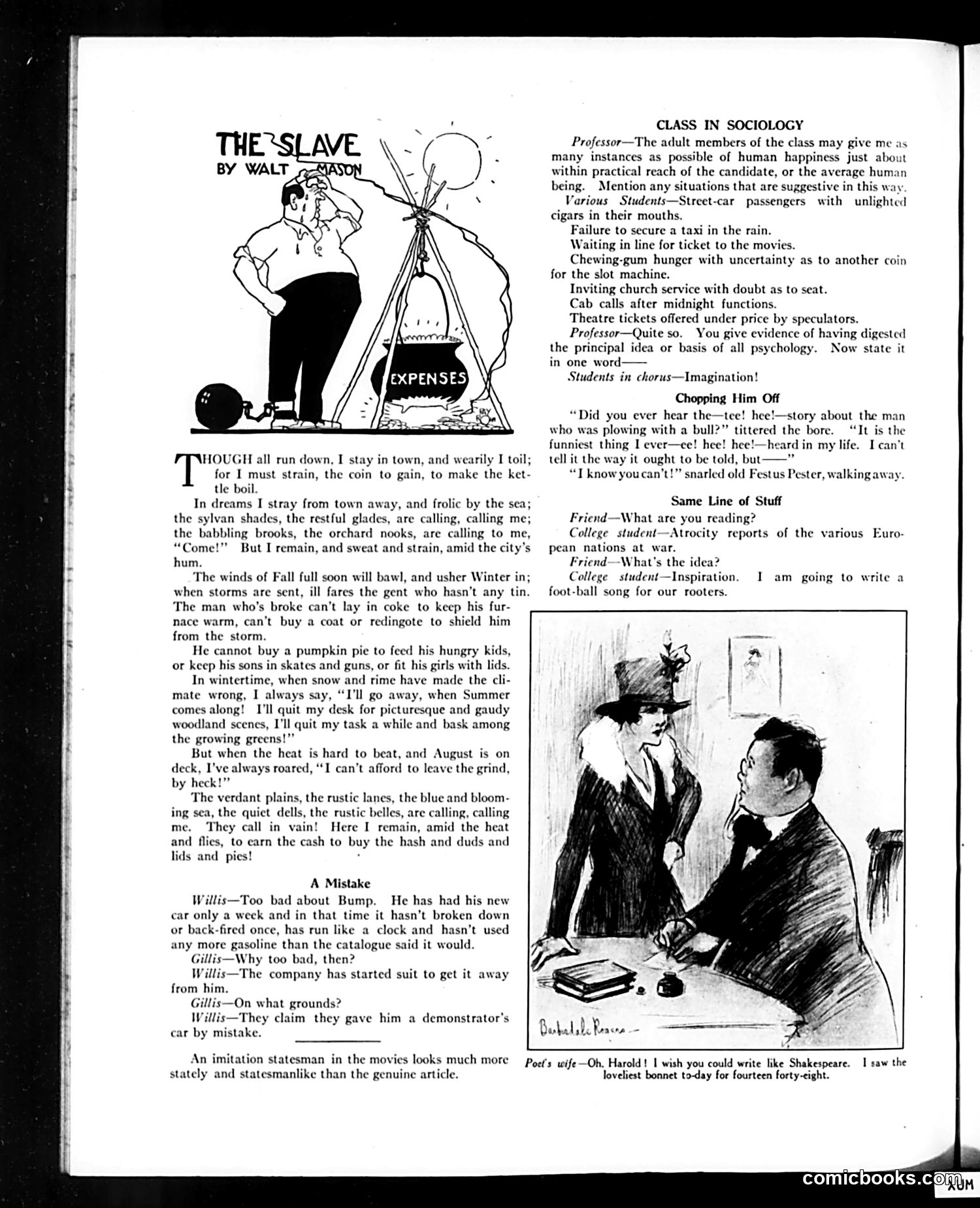
**Main Poem**: A working man laments his economic trap—stuck in the city grinding away, unable to afford winter necessities (coal, coats, food) or escape to the countryside he dreams of. He cannot leave in summer due to heat, nor in winter due to poverty. The satire critiques wage labor's inescapability and the worker's perpetual financial desperation. **"A Mistake"**: A man buys a new car that runs perfectly—the joke being the company sues to reclaim it, having mistakenly given him a "demonstrator model" instead of their notoriously faulty regular cars. This satirizes poor automobile manufacturing quality of the era. **"Class in Sociology"**: Students humorously define human happiness as minor conveniences (unlit cigars, cheaper theater tickets, cheap gum)—mocking both academic pretension and modest working-class aspirations. **Minor sketches** mock bore storytellers and intellectually mismatched couples. The page's overall theme: economic inequality and the absurdities of modern urban life.
📄 Transcribed text from this page (OCR, searchable)
Machine-transcribed from the original scan — historical spelling and the odd misread are preserved.
HOUGH all run down, I stay in town, and wearily I toil; for I must strain, the coin to gain, to make the ket- tle boil. In dreams I stray from town away, and frolic by the sea; the sylvan shades, the restful glades, are calling, calling me; the babbling brooks, the orchard nooks, are calling to me, “Come!” But I remain, and sweat and strain, amid the city’s hum. The winds of Fall full soon will bawl, and usher Winter in; when storms are sent, ill fares the gent who hasn't any tin. The man who's broke can’t lay in coke to keep his fur- nace warm, can't buy a coat or redingote to shield him from the storm. He cannot buy a pumpkin pie to feed his hungry kids, or keep his sons in skates and guns, or fit his girls with lid: In wintertime, when snow and rime have made the cli- mate wrong, I always say, “I'll go away, when Summer comes along! Ill quit my desk for picturesque and gaudy woodland s I'll quit my task a while and bask among the growing greens!” But when the heat is hard to beat, and August is on deck, I’ve always roared, “I can’t afford to leave the grind, by hee The verdant plains, the rustic lanes, the blue and bloom- ing sea, the quict dells, the rustic belles, are calling, calling me. They call in vain! Here I remain, amid the heat and flies, to carn the cash to buy the hash and duds and lids and pies! . A Mistake Willis—Too bad about Bump. He has had his new car only a week and in that time it hasn’t broken down or back-fired once, has run like a clock and hasn’t used any more gasoline than the catalogue said it would. Gillis—Why too bad, then? Willis—The company h from him. lis—On what grounds? Willis—They claim they gave him a demonstrator’s car by mistake. tarted suit to get it away An imitation statesman in the movies looks much more stately and statesmanlike than the genuine article. Poet's wife CLASS IN SOCIOLOGY Professor—The adult members of the class may give me as many instances as possible of human happiness just about within practical reach of the candidate, or the average human being. Mention any situations that are suggestive in this way Various Students—Street-car passengers with unlighted cigars in their mouths. Failure to secure a taxi in the rain. Waiting in line for ticket to the movies. Chewing-gum hunger with uncertainty as to another coin for the slot machine. Inviting church service with doubt as to seat. Cab calls after midnight functions. Theatre tickets offered under price by speculators. Professor—Quite so. You give evidence of having digested the principal idea or basis of all psychology. Now state it in one word—— Students in chorus—Imagination! Chopping Him Off “Did you ever hear the—tee! hee!—story about the man who was plowing with a bull?” tittered the bore. “It is the funniest thing I ever—ce! hee! hee!—heard in my life. I can’t tell it the way it ought to be told, but—— “I know youcan’t!” snarled old Festus Pester, walking away Same Line of Stuff Friend—What are you reading? College student—Atrocity reports of the various Euro- pean nations at war. Friend—What's the idea? College student—Inspiration. 1 foot-ball song for our rooters. am going to wrile a Bosbelabe Rae Oh, Harold! | wish you could write like Shakespeare. I saw the loveliest bonnet to-day for fourteen forty-eight. comicbooks.com