
Judge, 1916-07-29 · page 11 of 28
Judge — July 29, 1916 — page 11: what you’re looking at
What you’re looking at
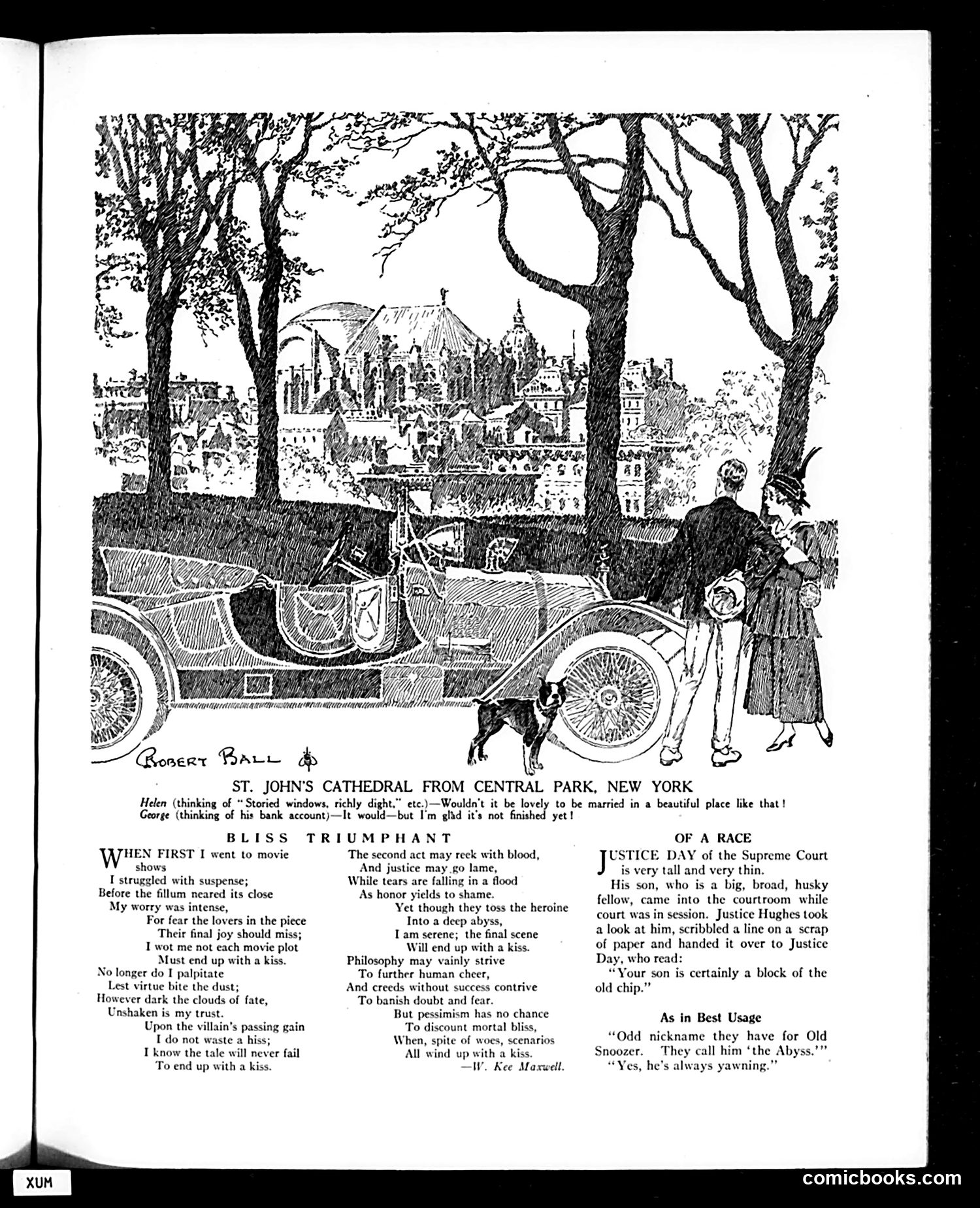
This page contains three separate satirical pieces typical of early 20th-century humor: **Main Cartoon:** A couple admires St. John's Cathedral from Central Park. Helen romanticizes marrying there; George worries about the cost, relieved the cathedral isn't finished yet—mocking middle-class financial anxiety masked by pretense. **"Bliss Triumphant":** A poem by W. Kee Maxwell satirizing the predictability of early cinema (silent films). The poet mocks moviegoers' naive emotional investment in formulaic plots that always conclude with a kiss, despite melodramatic chaos beforehand. It's gentle satire on both film conventions and audience gullibility. **"Justice Day" Anecdote:** A short joke about Supreme Court Justice Edward Terry Sanford, who was notably thin. His tall, lanky son visits court; Justice Hughes jokes that the son is "a chip off the old block"—mocking the physical contrast between father and son while playing on judicial gravitas. All three pieces reflect 1920s preoccupations: marriage costs, cinema's growing cultural impact, and high-society gossip.
📄 Transcribed text from this page (OCR, searchable)
Machine-transcribed from the original scan — historical spelling and the odd misread are preserved.
i l he i LD KAT i \ ltl em ee Ronert Bare & nn Um ide Maratea alr uarirarnae® 5 ST. JOHN'S CATHEDRAL FROM CENTRAL PARK, NEW YORK Helen (thinking of “ Storied windows, richly dight.” etc.) —Wouldn’t it be lovely to be married in a beautiful place like that ! George (thinking of his bank account)—It would—but I'm glad it’s not finished yet ! BLISS TRIUMPHANT OF A RACE HEN FIRST I went to movie shows. I struggled with suspense; Before the fillum neared its close My worry was intense, For fear the lovers in the piece Their final joy should miss; I wot me not each movie plot Must end up with a kiss. No longer do I palpitate Lest virtue bite the dust; However dark the clouds of fate, Unshaken is my trust. Upon the villain’s passing gain I do not waste a hiss; I know the tale will never fail To end up with a kiss. The second act may reek with blood, And justice may .go lame, While tears are falling in a flood As honor yields to shame. Yet though they toss the heroine Into a deep abyss, I am serene; the final scene Will end up with a kiss. Philosophy may vainly strive To further human cheer, And creeds without success contrive To banish doubt and fear. But pessimism has no chance To discount mortal bliss, When, spite of woes, scenarios All wind up with a kiss. —W. Kee Maxwell. USTICE DAY of the Supreme Court is very tall and very thin. His son, who is a big, broad, husky fellow, came into the courtroom while court was in session. Justice Hughes took a look at him, scribbled a line on a scrap of paper and handed it over to Justice Day, who read: “Your son is certainly a block of the old chip.” As in Best Usage “Odd nickname they have for Old Snoozer. They call him ‘the Abyss.’” “Yes, he’s always yawning.” comicbooks.com