
Judge, 1916-07-29 · page 24 of 28
Judge — July 29, 1916 — page 24: what you’re looking at
What you’re looking at
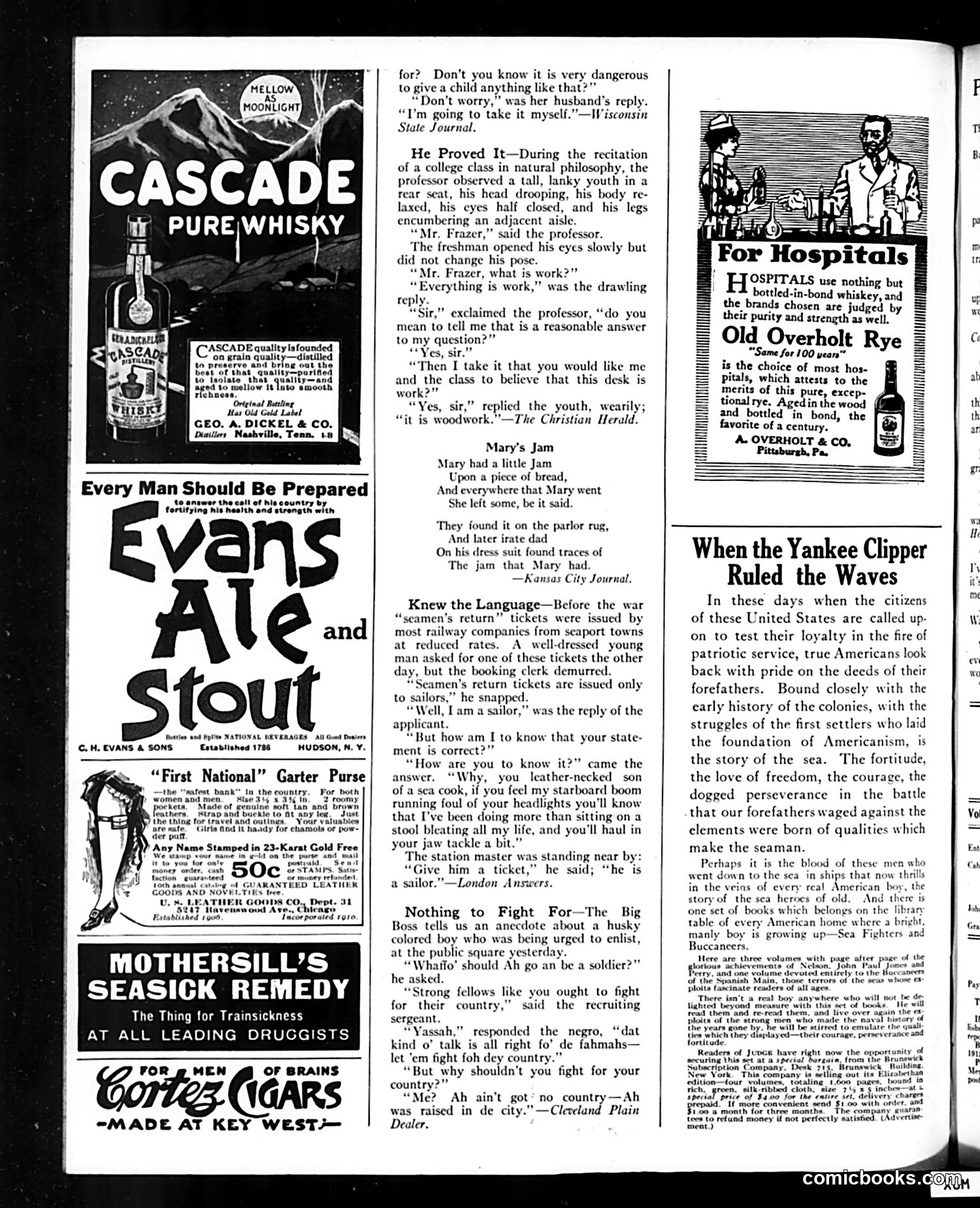
This page primarily comprises **period advertisements and humorous anecdotes** rather than political cartoons. The notable satirical content appears in the short story "Nothing to Fight For," which uses racial stereotypes (common to the era) to comment on class inequality. A Black man refuses military enlistment because, as a city laborer rather than a farmer, he has "no country"—a pointed critique of how patriotic appeals ring hollow for those excluded from civic participation and economic opportunity. The other brief humorous pieces ("He Proved It," "Mary's Jam," "Knew the Language") are gentle jokes about college students, children, and working-class sailors—typical light fare for Judge magazine. The advertisements (Cascade Whisky, Evans Ale, Mothersill's Seasickness Remedy) represent common product marketing of the period, while "When the Yankee Clipper Ruled the Waves" appears to be patriotic historical content, likely tying to WWI-era themes given references to citizens being "called upon to test their loyalty." The page reflects early-20th-century sensibilities regarding race, class, and patriotism.
📄 Transcribed text from this page (OCR, searchable)
Machine-transcribed from the original scan — historical spelling and the odd misread are preserved.
ig PURE WHISKY a CASCADE quality is founded on grain quality—distilled GEO. A. DICKEL & CO. Disillrs Nashville, Tenn. +a Hof tortifying hie health and strength with Va A\ ettag ond Bplte NATIONAL BEVERAGES All Gond Dealers C,H. EVANS & SONS Eetabtisned 1786 HUDSON, N. ¥. “First National” Garter Purse PATHE OS CO. Dept. 31 AY Tavenmwoud Aven Chicags id Intor porated 1910. MOTHERSILL’S SEASICK REMEDY The Thing for Trainsickness AT ALL LEADING ORUGGISTS “MADE AT KEY WEST— for? Don't you know it is very dangerous to give a child anything like that? “Don't worry,” was her husband's reply. “I'm going to take it myself.”—Wisconsin State Journal. He Proved It—During the recitation of a college class in natural philosophy, the served a tall, lanky youth in a sea is head drooping, his body re- laxed, his cyes half closed, and his legs encumbering an adjacent ai “Mr. Frazer,” said the professor. The freshman opened his eyes slowly but did not change his pose. “Mr. Frazer, what is work?” Sverything is work,” was the drawling ”’ exclaimed the professor, “do you mean to tell me that is a reasonable answer to my question?” “Then I take it that you would like me and the class to believe that this desk is work? Yes, sir,” replied the youth, wearily; “it is woodwork.”—The Christian Herald. Mary’s Jam Mary had a little Jam Upon a piece of bread, And everywhere that Mary went She left some, be it said. They found it on the parlor rug, And later irate dad On his dress suit found traces of The jam that Mary had. —Kansas City Journal. Knew the Language—Before the war seamen’s return” tickets were issued by most railway companies from seaport towns at reduced’ rates. A. well-dressed young man asked for one of these tickets the other day, but the booking clerk demurred. en’s return tickets are issued only to sailors, he snapped. “Well, Lam a sailor,” was the reply of the applicant. “But how am I to know that your state- ment is correct?” “How are you to know it?” came the you Ieather-necked running foul of your headlights you'll know that I’ve been doing more than sitting on a stool bleating all my life, and you'll haul in your jaw tackle a bit.” The station master was standing near by: “Give him a ticket,” he said; “he is a sailor."—London Answers. Nothing to Fight For—The Big Boss tells us an anecdote about a husky colored boy who was being urged to enlist, at the public square yesterday. “Whaffo’ should Ah go an be a soldier?” ed. “Strong fellows like you ought to fight for their country,” said the recruiting sergeant. “Yassah,” responded the negro, “dat kind o’ talk is all right fo’ de fahmahs— let ‘em fight foh dey country.”” “But why shouldn't you fight for your country?” “Me? Ah ain’t got* no country—Ah was raised in de city.” —Cleveland Plain Dealer. For Hospitals | H{osrrrats use nothing but bottled-in-bond whiskey, and the brands chosen are judged by their purity and Strength as well. Old 1 Overholt Rye ‘Same for 100 year” is the choice of most hos- Pitals, which attests to the merits of this pure, excep- tional rye. Agedin the wood and bottled in bond, the favorite of a century. A. OVERHOLT & CO, Pittsburgh, Pa, When the Yankee Clipper Ruled the Waves In these days when the citizens of these United States are called up- on to test their loyalty in the fire of patriotic service, true Americans look back with pride on the deeds of their forefathers. Bound clos with the early history of the colonies, with the struggles of the first settlers who laid the foundation of Americanism, is the story of the sea. The fortitude, the love of freedom, the courage, the dogged perseverance in the battle that our forefathers waged against the clements were born of qualities which make the seaman. Perhaps it is the blood of these men who went down to the sea in ships that now thrills in the veins of every real American boy, story of the sea heroes of old. And th re is table of every American Thome where a brieht, manly boy is growing up—Sea Fighters and Buccancers. 411 not be de He will Flite ci"the strong men wal te the years gone by. he will be to-emulate t thes which they Patti rage, perseverance and foratude. Readers of JuocE have right now the opportunity of sccuring this att at a special burgarm, (rom the Brunswick Subecription Company. Deak 71s. Brunawick, Builline New Vort. This company ig out ita Elizabethaa tees to refund money not perfectly satiated. (adver treat) ev wo comicbooks.