
A complete issue · 28 pages · 1916
Judge — July 22, 1916
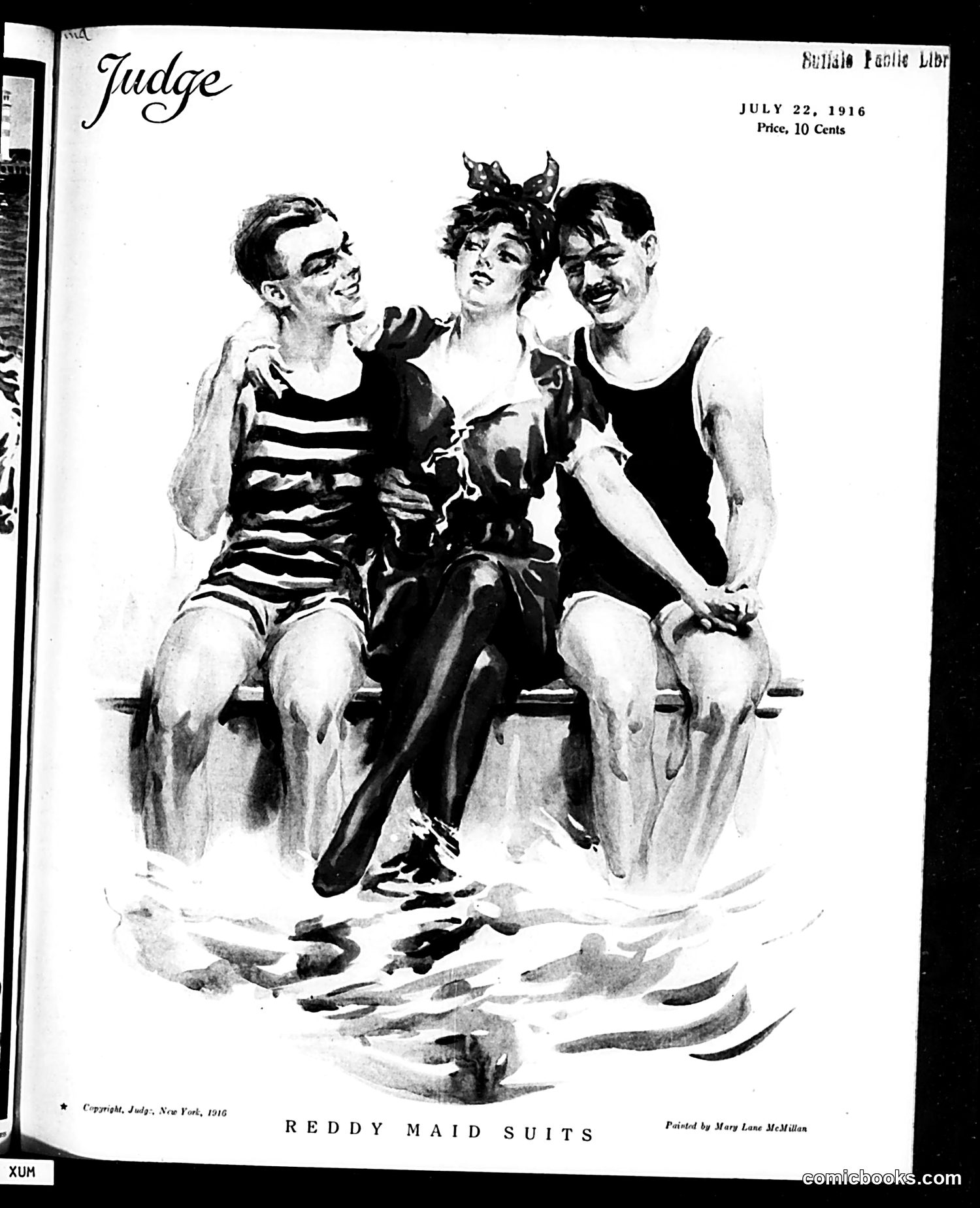
This illustration by Mary Lane McMillon depicts three figures in swimwear sitting together on a beach, with shoes scattered below. The title "Reddy Maid Suits" appears to be a pun on a commercial product or brand name (likely "Ready-Made" suits). The satire likely comments on the then-controversial trend of women wearing practical, less-restrictive bathing costumes rather than the heavily layered Victorian alternatives. The composition—showing a woman confidently positioned between two men in casual beach attire—suggests commentary on changing gender relations and women's increasing social freedom in the 1910s. The joke plays on contemporary anxieties about modern women's independence and fashion choices becoming less modest and more utilitarian.
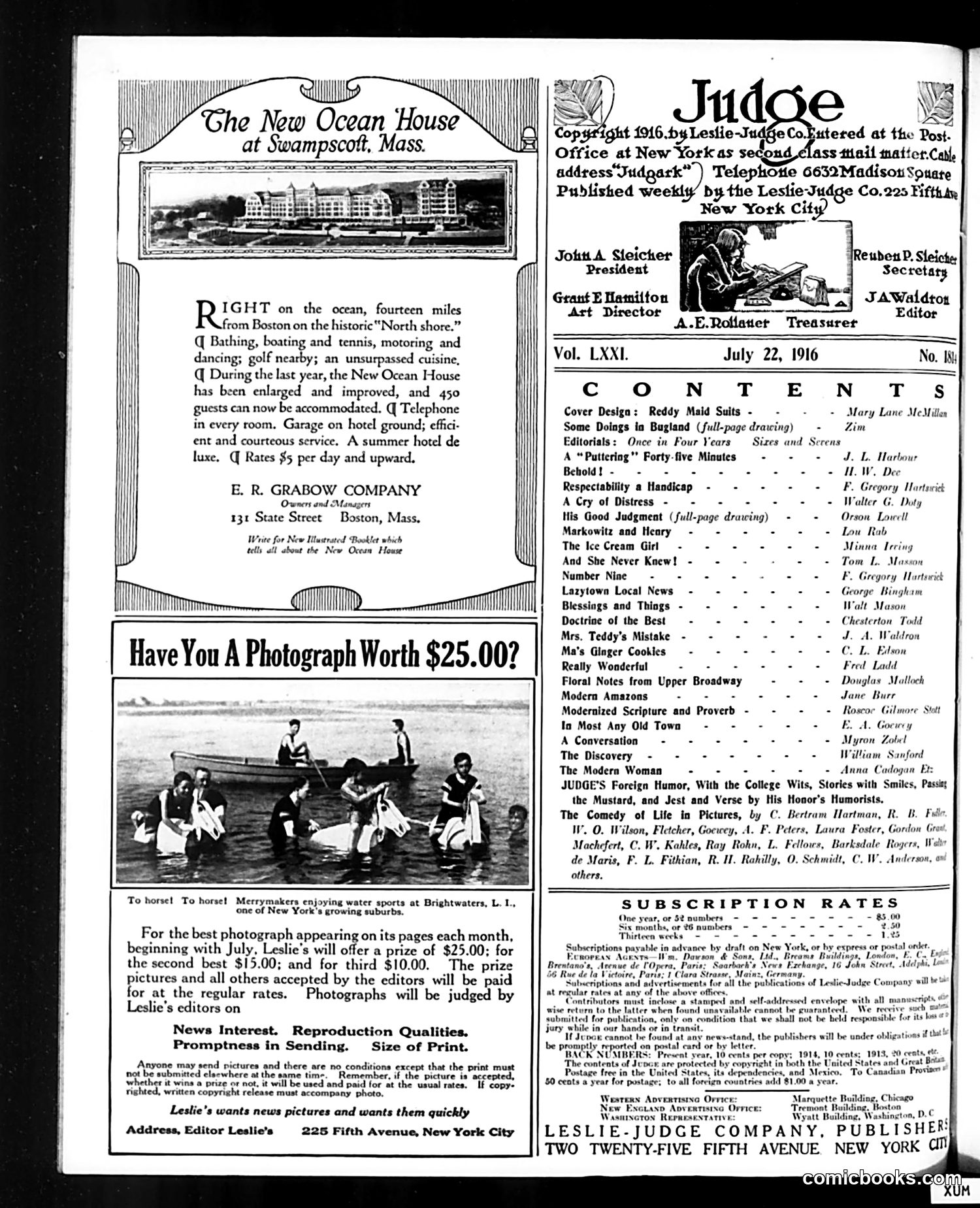
This page is primarily **advertising and editorial content** rather than political cartoons. The main advertisement features "The New Ocean House" hotel at Swampscott, Massachusetts, promoting seaside leisure activities. Below that is a photo contest advertisement offering $25 prizes for readers' photographs, with Judge's editors as judges. The right side lists the magazine's **table of contents**, which includes humorous articles like "Ma's Ginger Cookies" and "The Comedy of Life in Pictures." One entry references "Judge's Foreign Humor, With the College Wits" — suggesting the magazine collected satirical content about contemporary life and education. The page reflects Judge's role as a **humor and satire publication** targeting middle-class leisure activities and social commentary of 1916.
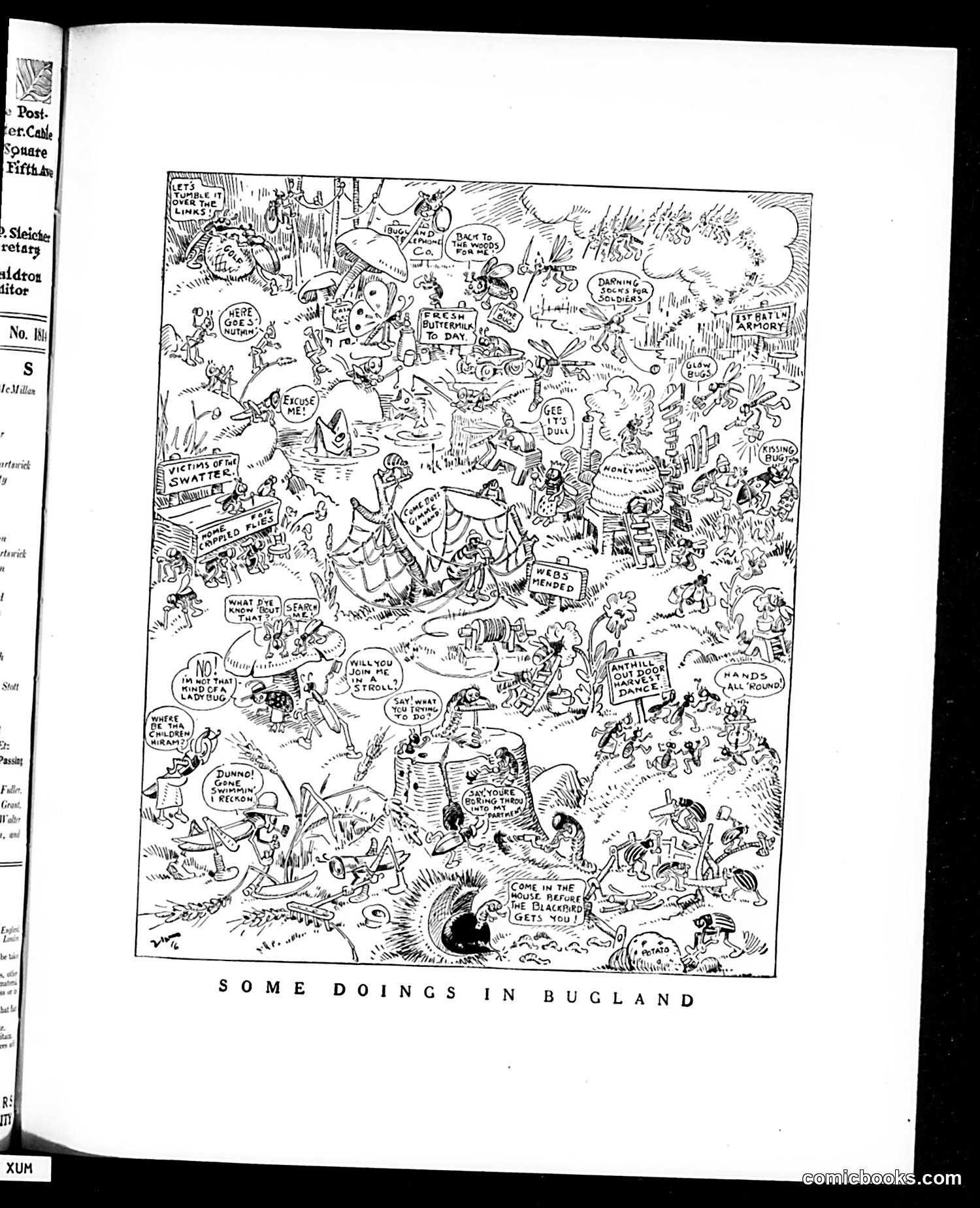
This is a satirical illustration titled "Some Doings in Bugland," depicting an anthropomorphized insect community engaged in various human activities and social behaviors. The cartoon uses insects as stand-ins for human society, a common Victorian-era satirical device. The dense, chaotic scene shows bugs engaged in multiple simultaneous activities—what appears to be commerce, entertainment, labor, and socializing. Various speech bubbles contain dialogue, though most are difficult to read clearly in this reproduction. The satire likely comments on human society's complexity, absurdity, or social hierarchies by portraying them through insects. This approach allowed Judge magazine to critique contemporary social conditions indirectly. Without clearer text, the specific targets of satire remain unclear, but the overall effect mocks human pretension and social organization.
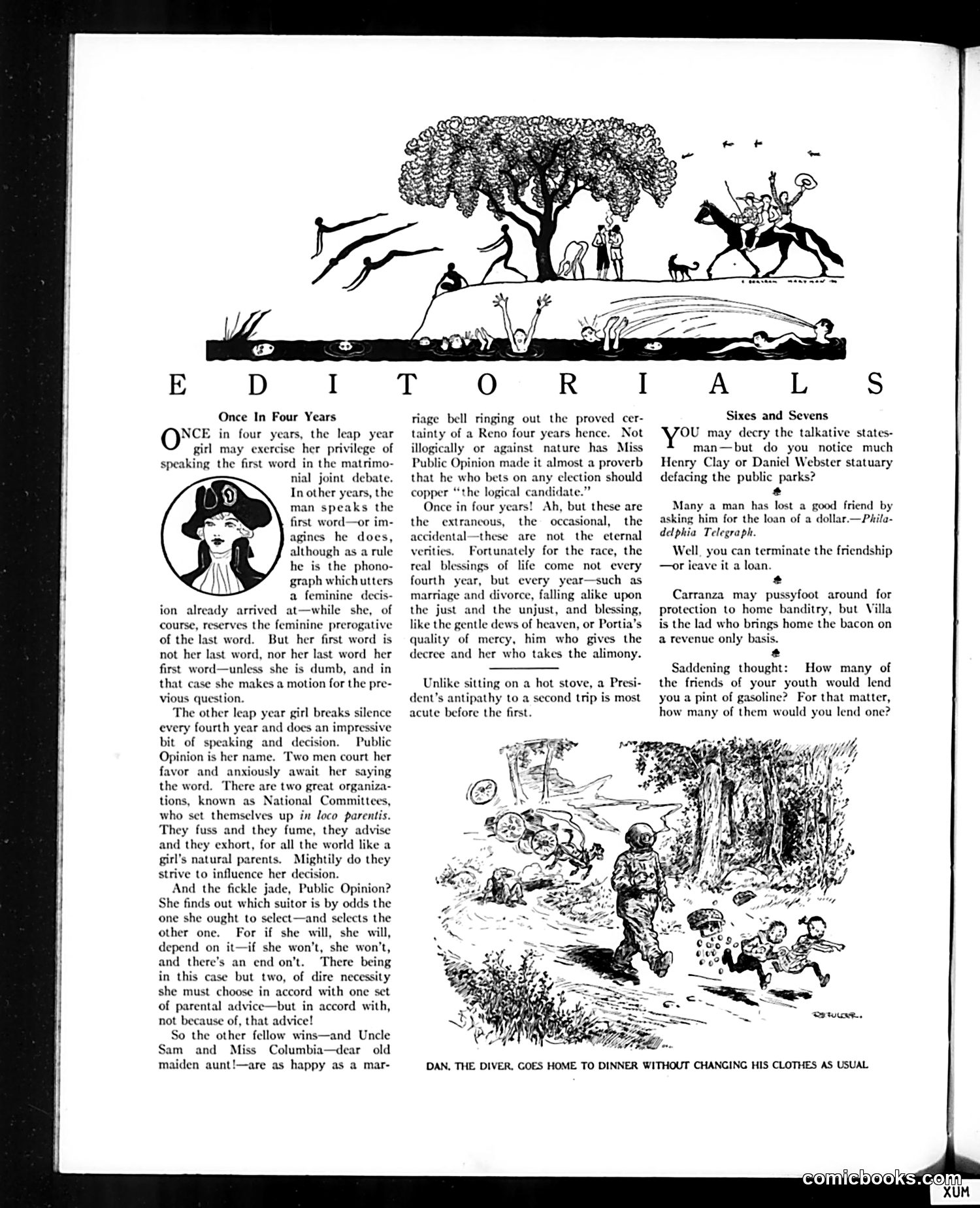
This page combines editorial content with satirical illustrations. The main editorial titled "Editorials: Sixes and Sevens" discusses women's voting rights and public opinion during election years, referencing a woman's "privilege of speaking the first word in the matrimonial joint debate." The top illustration depicts leisure activities—swimming, tree-sitting, and horseback riding—suggesting upper-class recreation. The lower cartoon, captioned "Dan the Diver Goes Home to Dinner Without Changing His Clothes as Usual," shows a muddy swimmer dripping wet, presumably entering a home. This appears to be domestic humor mocking inconsiderate male behavior. The editorial content suggests this reflects early-20th-century debates about women's political participation and domestic authority, presented through Judge's characteristic satirical lens.
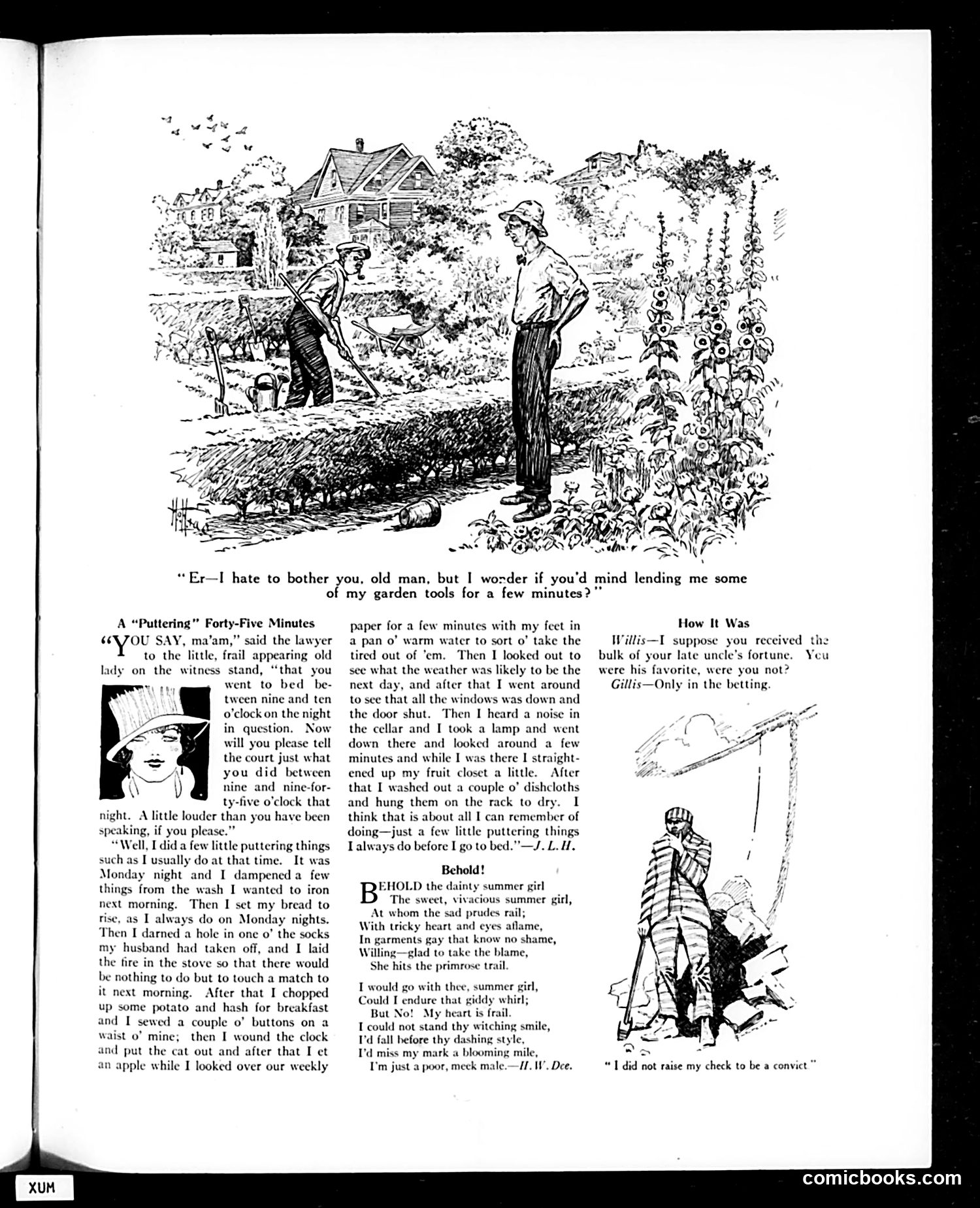
This page contains three unrelated pieces typical of Judge's humor magazine format: 1. **Top cartoon**: A simple domestic comedy about a man asking to borrow garden tools from a neighbor. The humor relies on the awkwardness of the request and the neighbor's reluctant politeness—no political content. 2. **"A 'Puttering' Forty-Five Minutes"**: A humorous anecdote about mundane household tasks (puttering, laundry, cooking) that a man accomplishes on a Monday night. The joke is that minor domestic activities somehow consume significant time—relatable domestic humor with no satirical edge. 3. **"Behold!" poem and illustration**: A romantic/sentimental poem about rejecting a summer girl's romantic advances, featuring a classical male figure. This is sentimental verse rather than satire. The page contains no apparent political commentary or caricature. It's primarily lighthearted domestic and romantic humor aimed at general audiences.
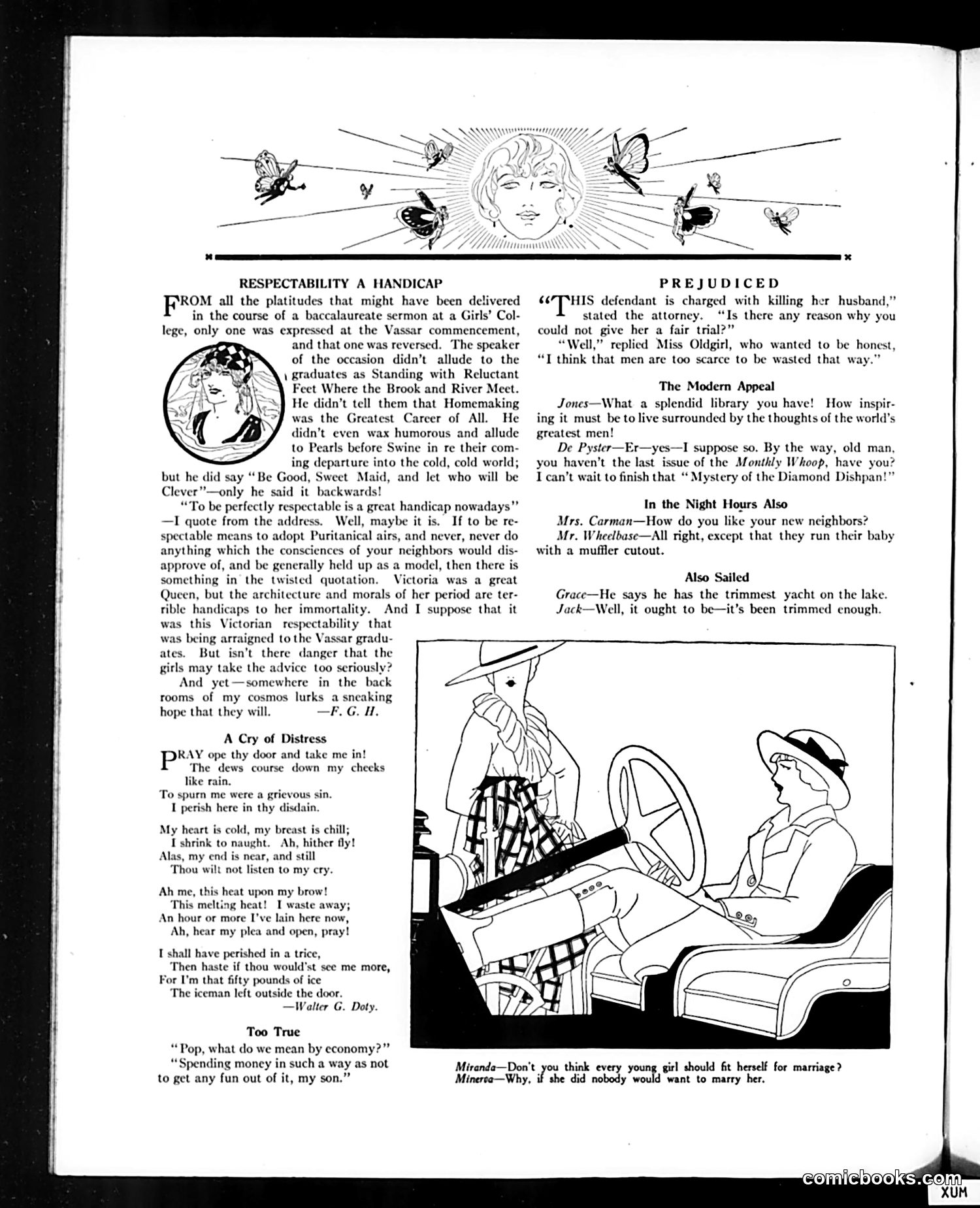
This page combines satirical commentary on women's education with humorous short pieces typical of 1920s magazines. **"Respectability a Handicap"** critiques a Vassar College commencement speech that reversed the traditional "Be Good, Sweet Maid" advice, suggesting respectability is now a handicap. The author debates whether Victorian propriety genuinely limits modern women's opportunities, while expressing ambivalence about whether graduates should take such advice literally. **The cartoon** depicts a woman driving with a man—illustrating modern dating freedoms that would have shocked previous generations. The remaining items are brief humor: - **"A Cry of Distress"**: Sentimental poem subverted—the "distressed" voice is merely melting ice left by the iceman - **"Prejudiced"**: Woman juror admits she won't fairly judge a wife who killed her husband because "men are too scarce" - Other quips mock superficial intellectualism and modern social pretensions The page reflects post-WWI attitudes about women's changing roles, combining anxiety about lost tradition with acknowledgment that social norms were genuinely shifting.
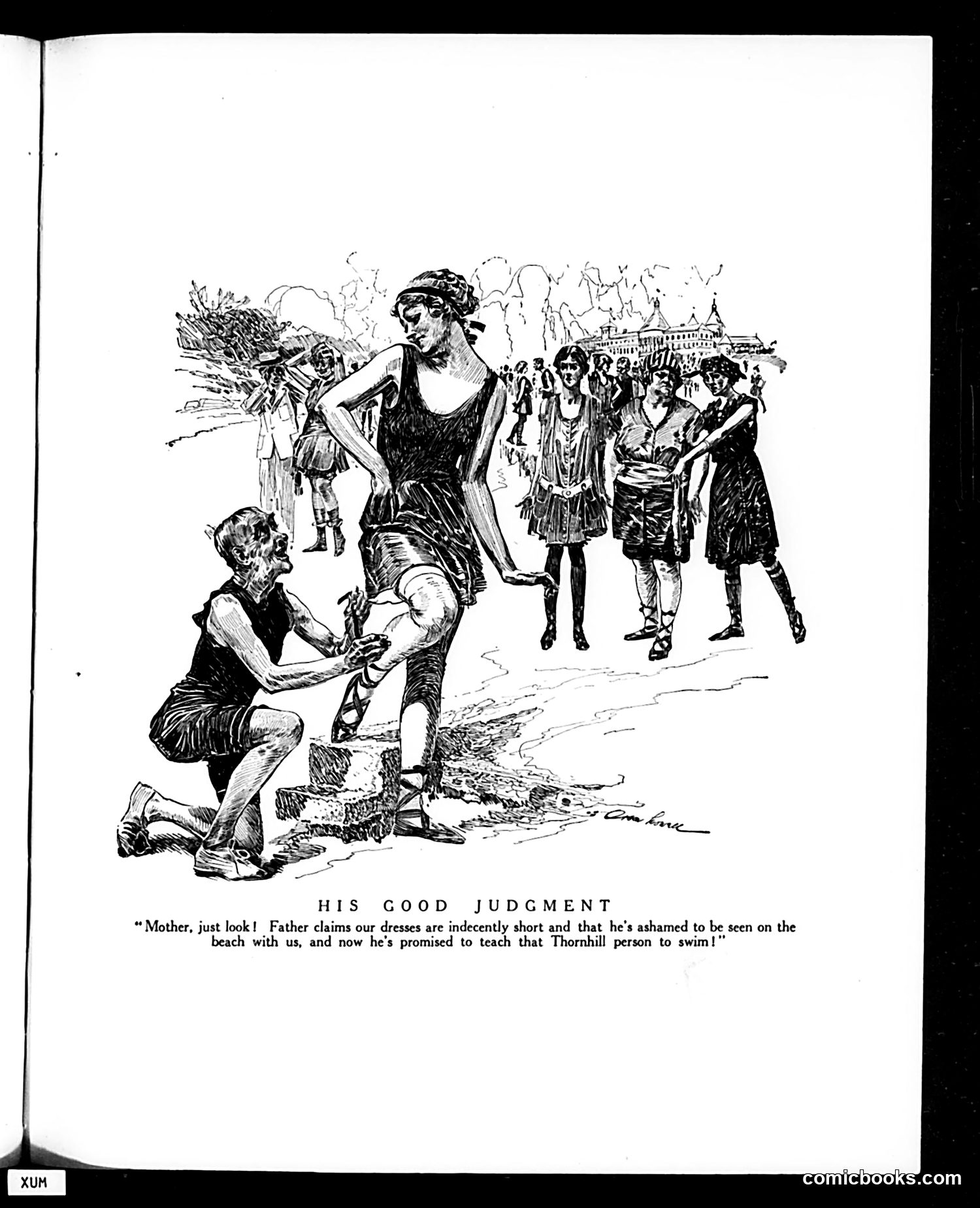
This cartoon satirizes changing attitudes about women's swimwear and propriety in the early 20th century. A father objects to his daughters' "indecently short" beach dresses—likely referring to the gradually shorter hemlines that scandalized conservative society. The satire lies in the father's contradictory "good judgment": he shames his daughters for their modern beach attire while simultaneously offering to teach "that Thornhill person" (apparently a woman) to swim, which would require close physical contact and informal interaction—behavior arguably more improper than wearing shorter dresses. The cartoon mocks Victorian hypocrisy about morality and decorum, suggesting the father's objections are inconsistent or self-serving rather than genuinely principled.
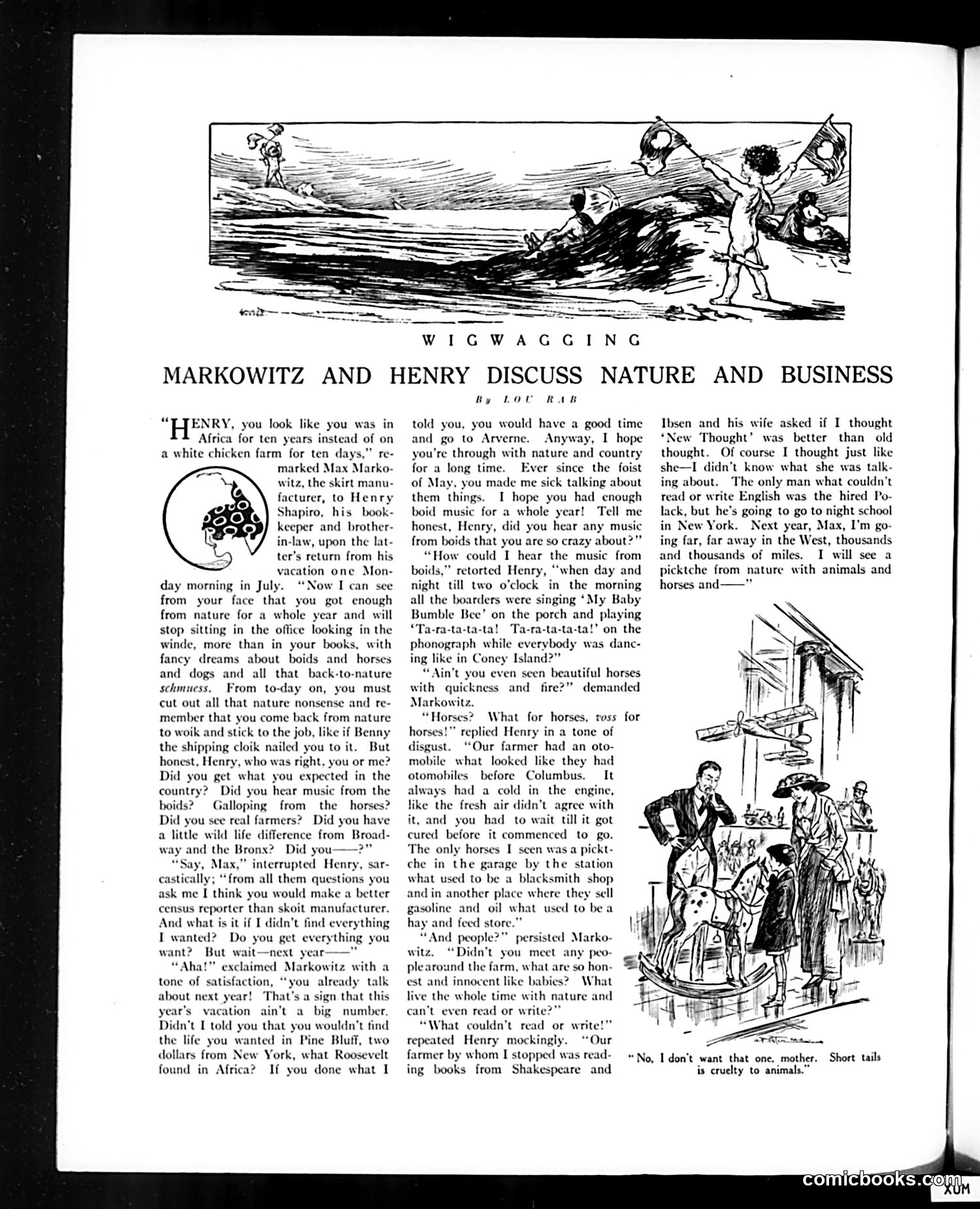
This is a humorous dialogue between two Jewish immigrants: Max Markowitz, a garment manufacturer, and Henry Shapiro, his bookkeeper brother-in-law, upon Henry's return from a rural vacation. The satire mocks the early 20th-century "back-to-nature" movement—a romantic ideology that idealized rural life, simple farming, and communion with nature as superior to urban industrial existence. Max had skeptically warned Henry against such fantasies, predicting disappointment. Henry's experiences confirm Max's cynicism: the "farm" was actually a cheap boarding house with noisy city people; the "beautiful horses" were decrepit automobiles; supposedly innocent rural folk were reading Shakespeare and discussing "New Thought" philosophy—they were educated urbanites, not noble peasants. The humor derives from the clash between romantic pastoral ideals and mundane reality, filtered through the Yiddish-inflected English of working-class Jewish characters. Max's practical business mentality triumphs over Henry's sentimental escapism, reinforcing that city life and work—not nature—are reality.
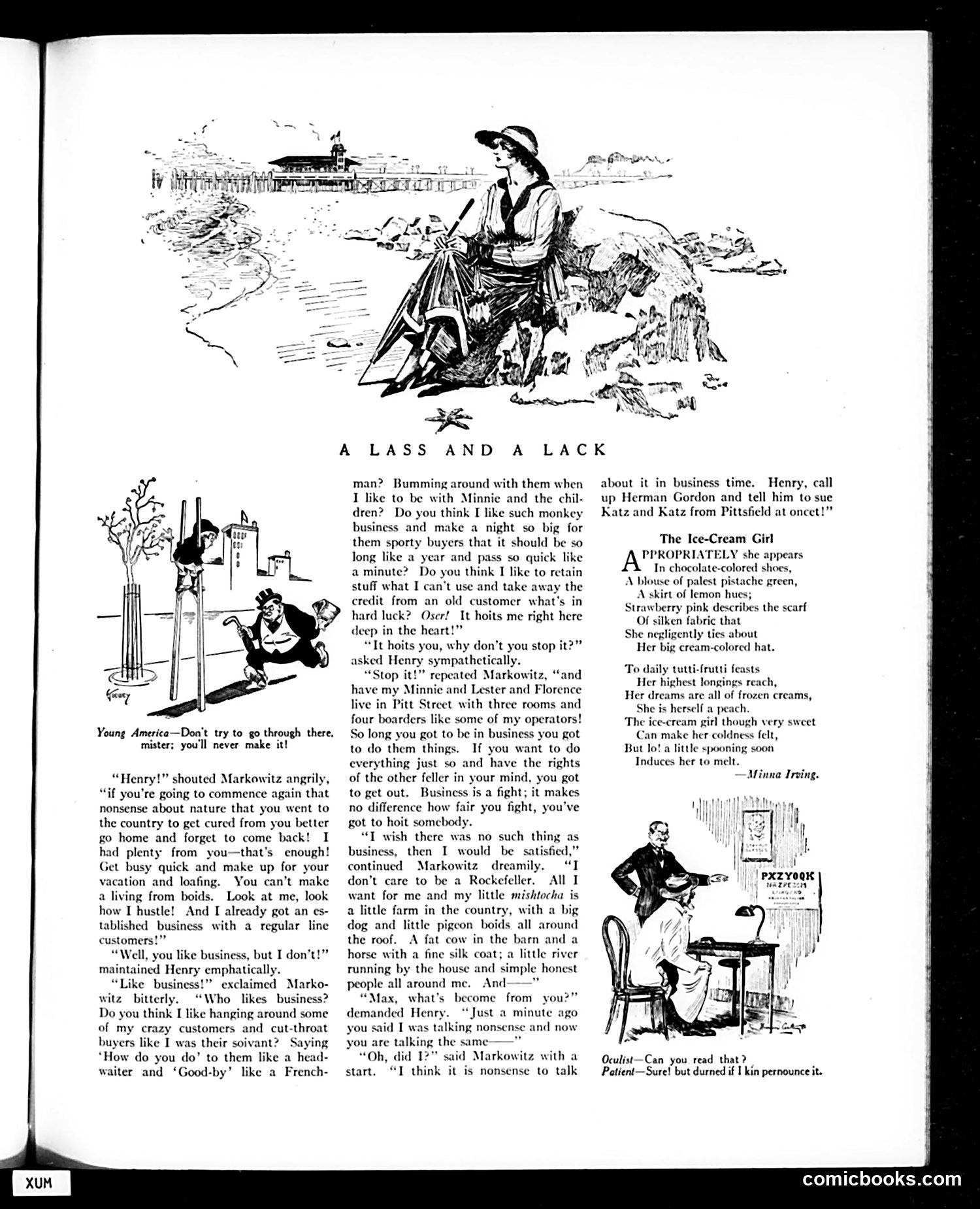
This page contains two distinct pieces of satirical content: **Main Story: "A Lass and a Lack"** A dialogue between Markowitz (appears to be a Jewish immigrant businessman) and his employee Henry. Markowitz rants about the moral compromises of running a business—he must flatter difficult customers, extend credit to struggling people, and prioritize profit over ethics. The satire exposes the contradiction between capitalist necessity and human decency: Markowitz dreams of a simple farm life but admits he cannot afford his principles while remaining in business. The humor lies in Henry pointing out that Markowitz himself has just contradicted his own earlier complaint about Henry's "nonsense about nature." **Secondary Content:** A poem, "The Ice-Cream Girl," describing a girl dressed in pastel ice-cream colors. A brief joke about an eye doctor's incomprehensible prescription chart. The page satirizes immigrant work culture and the moral toll of American capitalism.
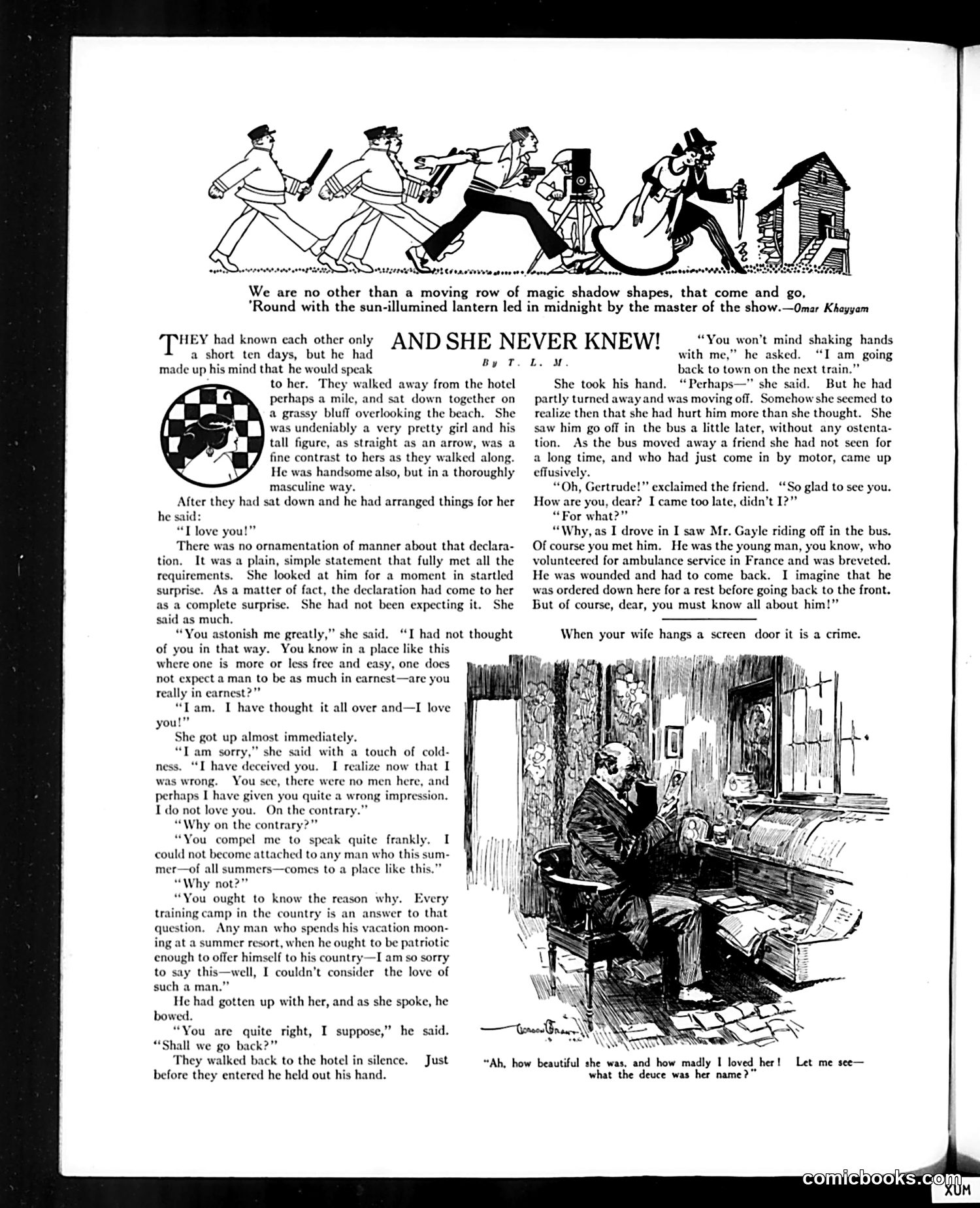
This *Judge* story satirizes the patriotic expectations placed on young men during World War I. The male protagonist is a wounded veteran, breveted (promoted for bravery) after ambulance service in France, who is recovering at a beach resort. The woman rejects his romantic declaration, condemning him for vacationing instead of enlisting—unaware he's already served and been wounded in combat. The satire cuts both ways: it mocks her sanctimonious patriotic posturing while also critiquing how society judges men's wartime contributions. The final irony—her friend revealing his actual military service as he departs—exposes the woman's hypocrisy. She has rejected a decorated war hero based on false assumptions about his patriotism. The cartoon suggests the absurdity of civilian judgment regarding military service and sacrifice during WWI.
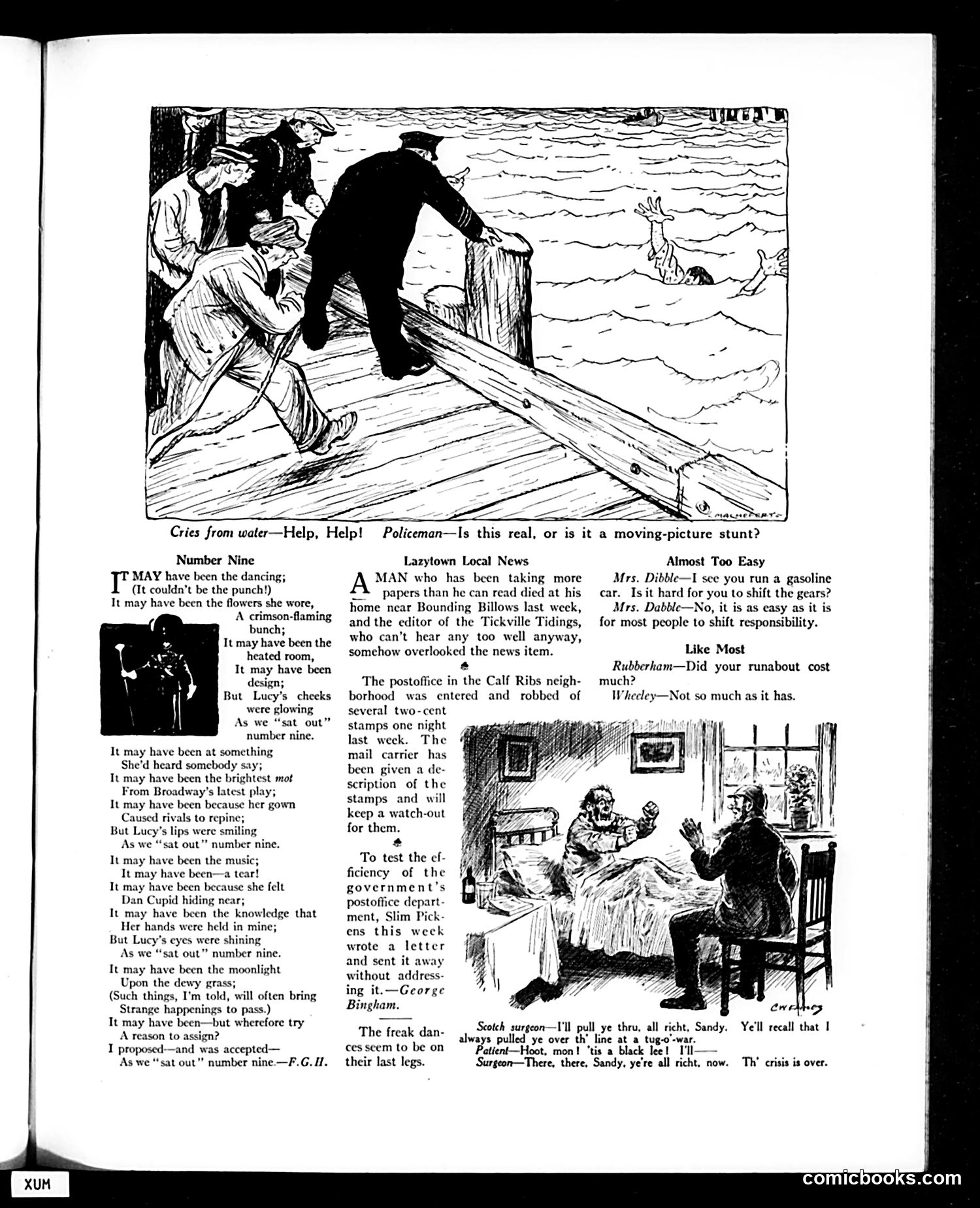
This page contains **multiple humor pieces** typical of early 20th-century Judge magazine: **Top cartoon**: Shows a policeman questioning people on a dock during a rescue scene ("Cries from water—Help, Help!"), likely satirizing whether this is a genuine emergency or a staged movie stunt—reflecting contemporary anxieties about film fakery and sensationalism. **"Number Nine" poem**: A sentimental romantic piece about a man proposing during a dance's ninth number—straightforward courtship humor with no apparent political content. **"Lazytown Local News"**: Gentle satirical short items mocking small-town life: a man who dies from reading too many newspapers; a postoffice robbery of two-cent stamps; a test of postal efficiency by mailing an unaddressed letter. **Other quips**: Brief jokes about gasoline cars and shifting gears; a Scottish dialect medical scene. The page reflects Judge's typical blend of **sentimental romance, small-town satire, and light social commentary**—nothing overtly political. The humor targets everyday domestic and rural life rather than major political figures or events.
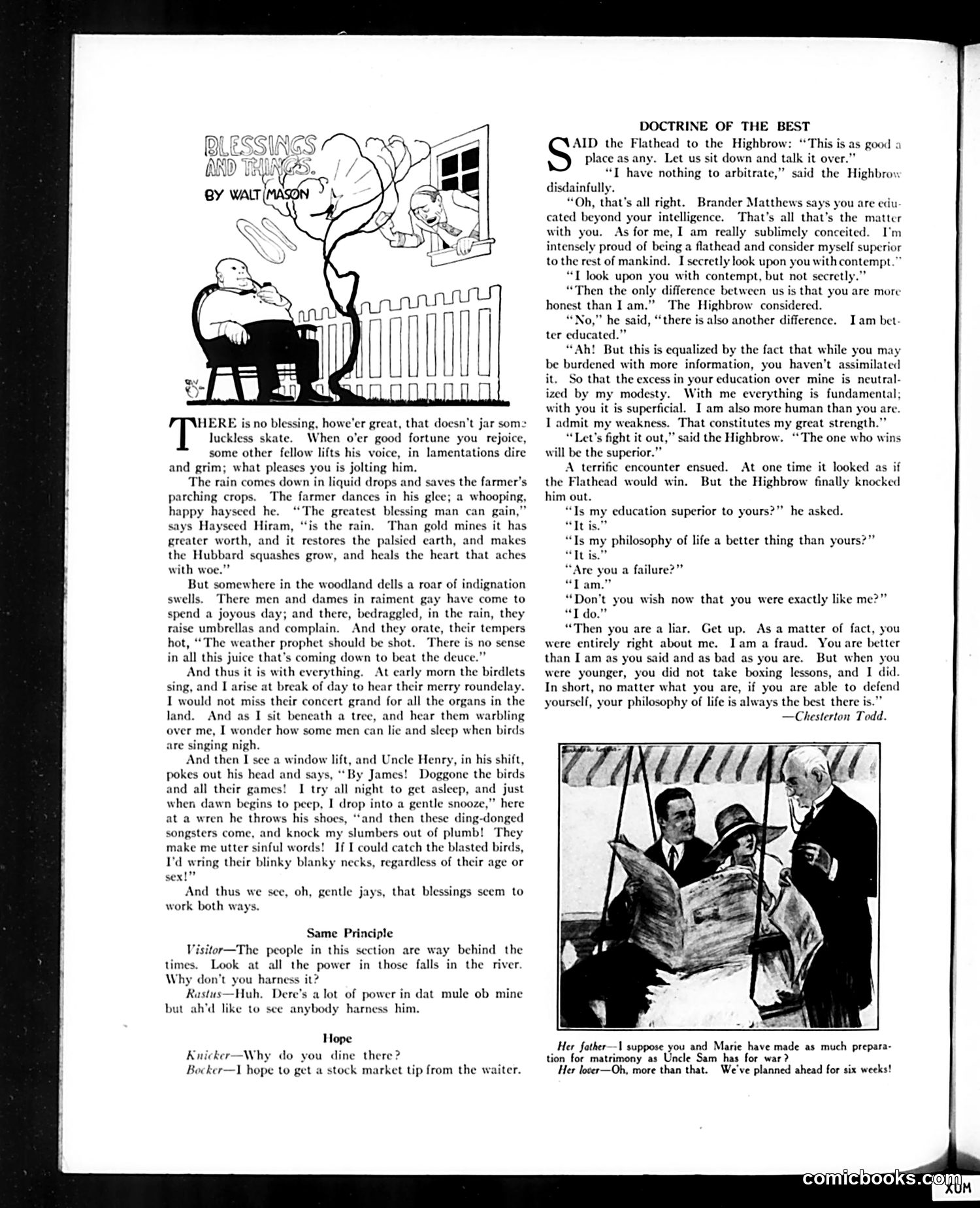
This page contains three satirical pieces mocking different social attitudes: **"Blessings and Ills"** (left) by Walt Mason uses a farmer celebrating rain while vacationing urbanites curse it to illustrate that "blessings work both ways"—one person's good fortune is another's misery. Similarly, birds delighting Mason annoy his neighbor Uncle Henry. **"Same Principle"** (bottom) presents a racial stereotype dialogue where a Black character (labeled "Rastus") refuses to harness a mule, using wordplay to deflect the visitor's suggestion about harnessing waterfall power for progress. **"Doctrine of the Best"** (right) depicts a Flathead (Native American caricature) debating a Highbrow (educated elite) about whose philosophy is superior. They fight; the Highbrow wins but admits the Flathead was "entirely right" about him—a backhanded critique of educated pretension masking dishonesty. The page satirizes class divisions, intellectual pomposity, and the subjectivity of progress, while relying on period racial caricatures now considered offensive.
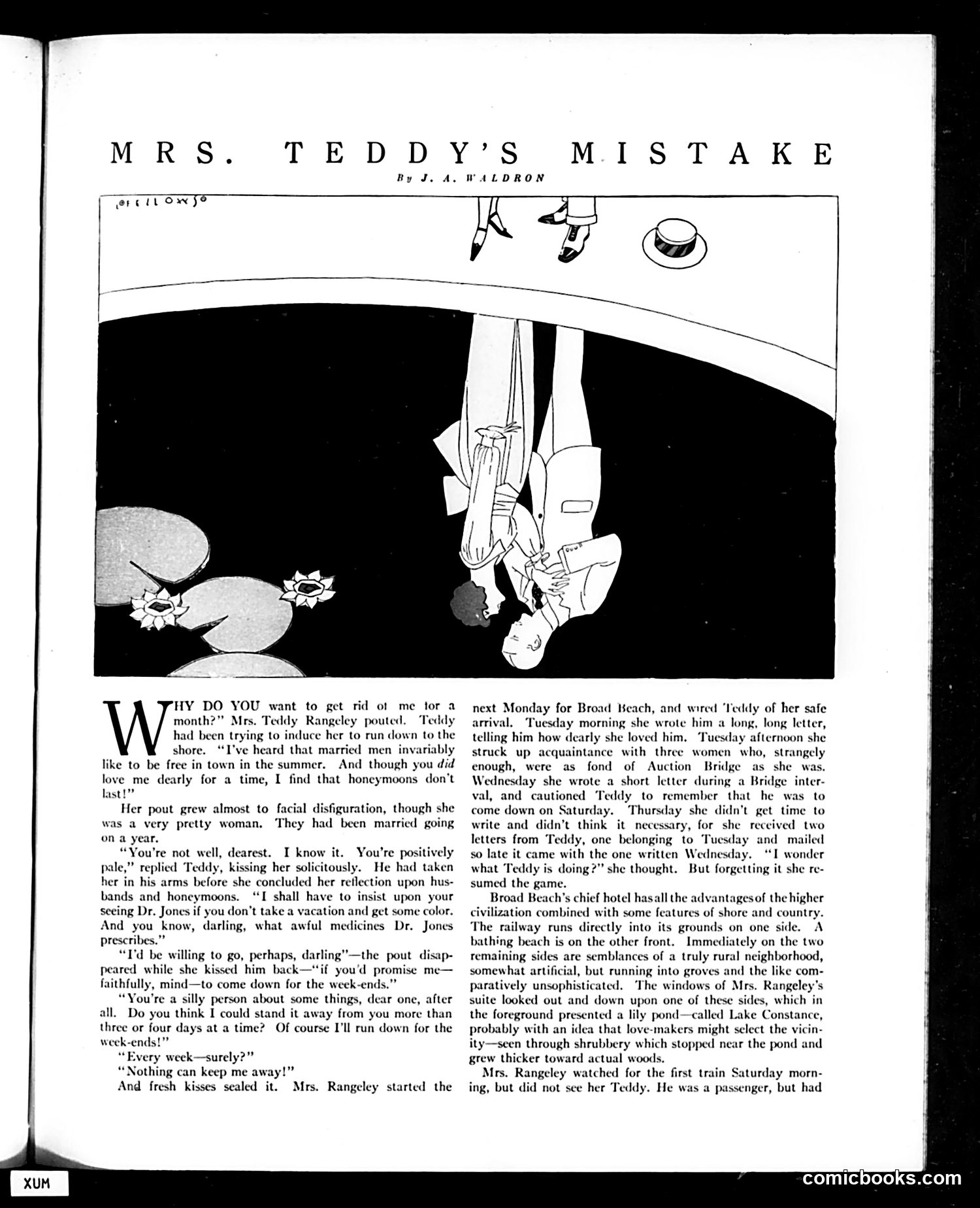
This is a romantic comedy story (not a political cartoon) from Judge magazine. The narrative concerns a newlywed couple: Mrs. Teddy Rangeley convinces her husband Teddy to let her vacation at Broad Beach while he remains in town, with promises he'll visit weekends. The humor derives from typical marital dynamics of the era: the wife's initial jealousy about her husband's independence, their reconciliation through affection, and the ironic setup that follows. Mrs. Rangeley quickly becomes absorbed in social activities (particularly Auction Bridge, a card game) at the resort, progressively neglecting correspondence with Teddy—moving from long love letters to short notes to none at all within days. The illustration shows an inverted perspective: Teddy appears at top (outside looking in), while Mrs. Rangeley is shown below absorbed in leisure activities, suggesting the reversal of their expected roles and concerns. The "mistake" appears to be Mrs. Rangeley's assumption that separation would be difficult, when she actually adapts quite readily to independent life.
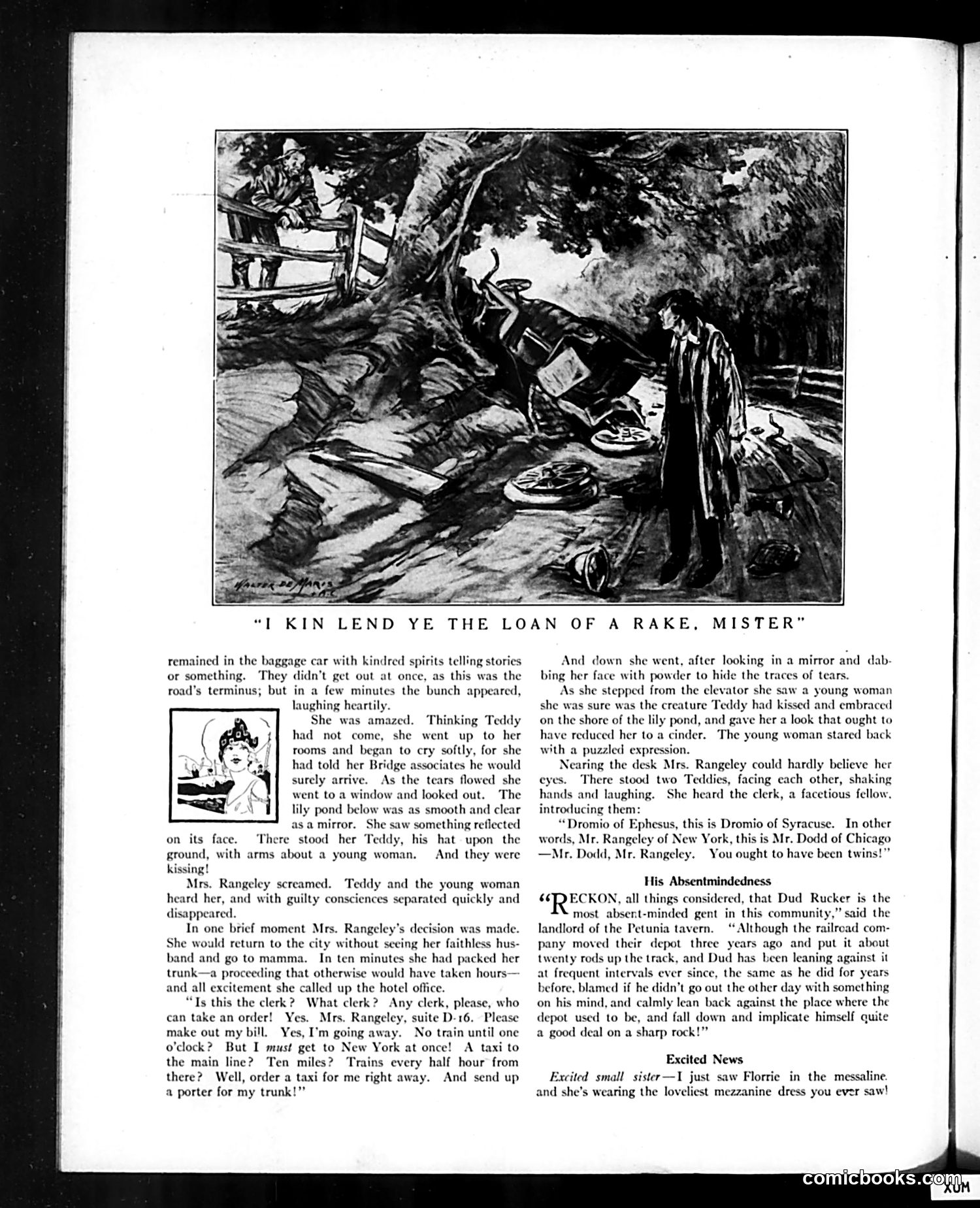
The main cartoon illustrates a classic case of mistaken identity. Mrs. Rangeley believes she witnesses her husband "Teddy" kissing another woman by a lily pond. Distraught, she rushes to leave the hotel. However, the joke's resolution reveals that the man she saw was not her husband at all, but his twin—Mr. Dodd of Chicago. The clerk humorously introduces them as "Dromio of Ephesus" and "Dromio of Syracuse," referencing Shakespeare's *Comedy of Errors*, which also features confused twins. The satire mocks the hasty judgments people make based on incomplete information, and the elaborate panic Mrs. Rangeley's jealousy produces over a misunderstanding. Below this is a brief anecdote about "Dud Rucker," an absent-minded man so distracted he leans against where a train depot *used to be* and falls, injuring himself—satirizing extreme absent-mindedness. The final item is a joke about confused terminology (confusing "messaline" silk fabric with "mezzanine" architectural feature).
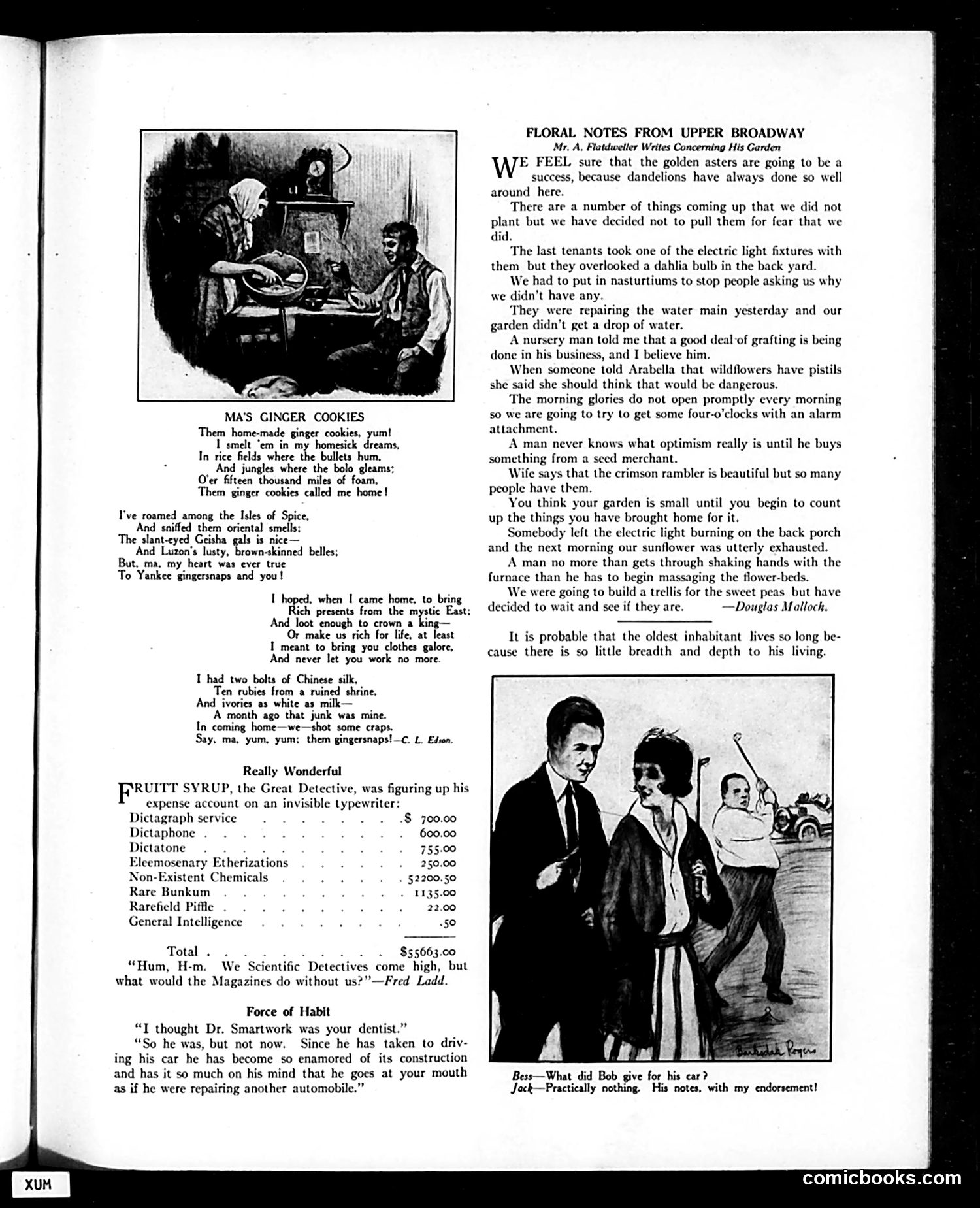
This page contains three satirical pieces typical of early 20th-century American humor: **"Ma's Ginger Cookies"** (poem by C.L. Edson): A soldier returning from the Philippine-American War reflects on exotic Eastern experiences—"Geisha gals," looted treasures—yet ultimately values home and his mother's gingersnaps. The satire gently mocks both imperial adventure (he lost his loot gambling) and sentimental patriotism. **"Fruitt Syrup, the Great Detective"** (by Fred Ladd): Mocks detective fiction and pseudoscientific investigation by showing absurdly padded expense accounts for ridiculous services ("Non-Existent Chemicals," "General Intelligence") totaling over $55,000. The joke: magazines rely on these fraudulent "scientific detectives" for content. **"Force of Habit"** and **"Floral Notes"**: Brief satirical pieces on modern life—a dentist obsessed with car mechanics, and humorous observations about urban gardening failures. The cartoons accompanying these pieces use simple line-drawing style typical of the era's magazine illustration.
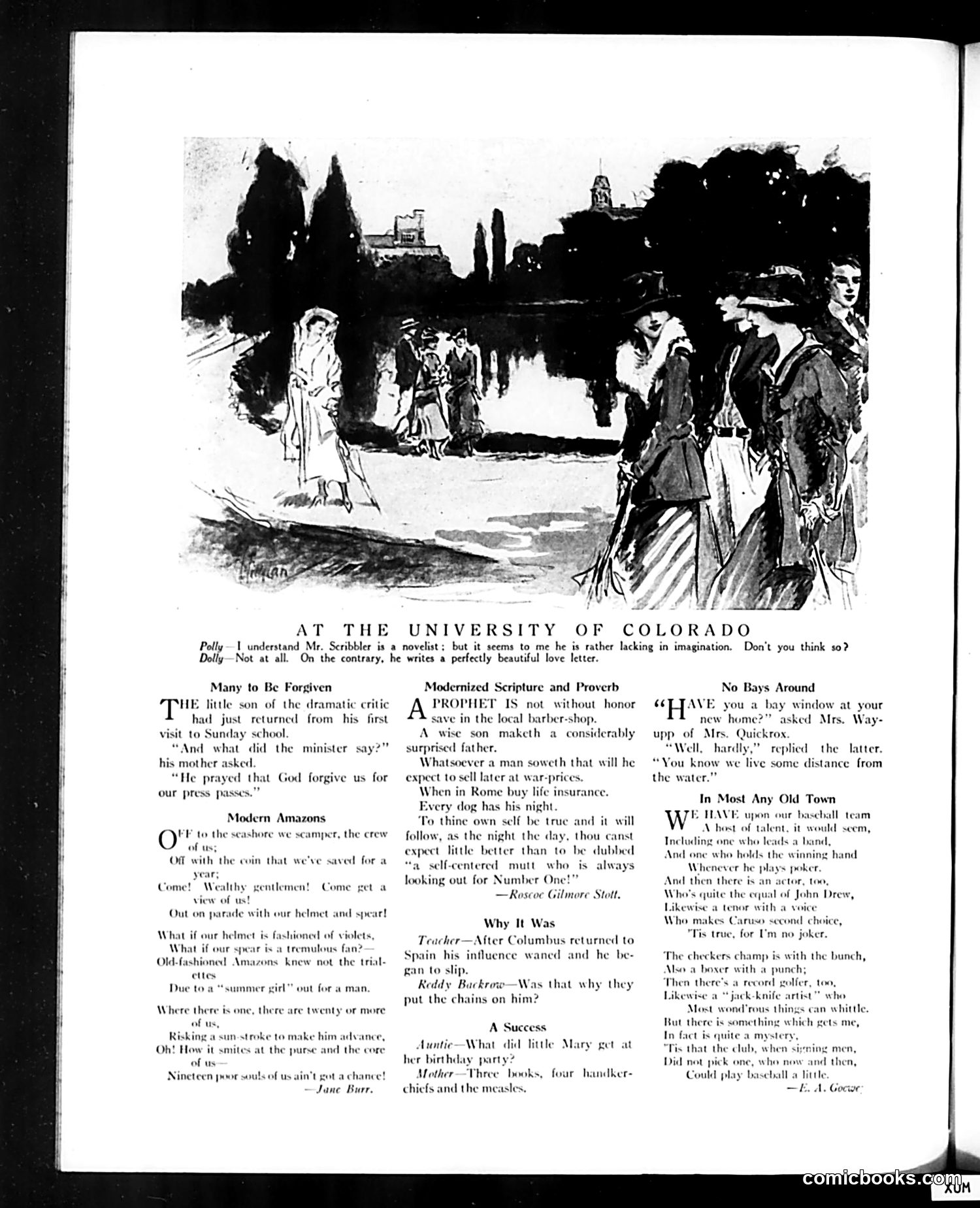
This page contains several brief humorous sketches satirizing modern American life and manners: **"Modern Amazons"** mocks the emerging "New Woman" — young women gaining independence and public visibility. The poem playfully critiques women entering spaces traditionally male-dominated (the seashore, spending their own money), imagining them as comic "Amazons" with feminine accessories replacing warrior gear. The satire targets anxieties about changing gender roles. **"Modernized Scripture and Proverb"** parodies biblical wisdom through contemporary references: prophets lacking honor in barber shops, Romans buying life insurance, and dogs having "nights." The satire comments on how modern commercialism and materialism have corrupted traditional values. **"No Bays Around"** plays on a pun: "bay window" (architectural feature) versus "bay" (water). It satirizes small-town pretension and misunderstanding of urban terminology. Other brief jokes target literary pretension and social climbing. The page reflects early 20th-century concerns about urbanization, modernization, and shifting social hierarchies.
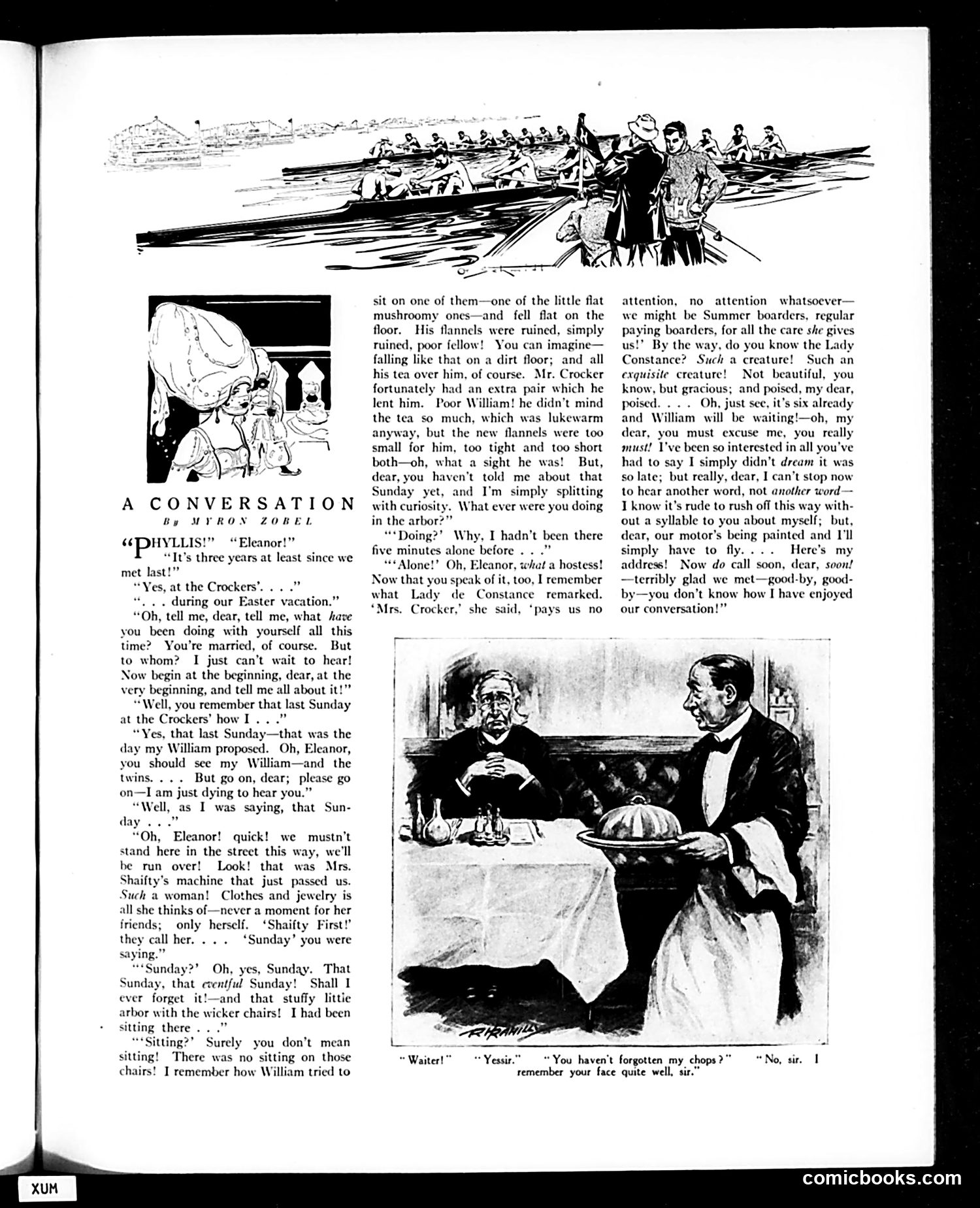
This satirical piece by Myron Zobel mocks upper-class women's social pretensions and superficiality. Two society ladies ("Phyllis" and "Eleanor") reunite after years apart, but Eleanor dominates the conversation, constantly interrupting Phyllis's attempts to share her own story. The satire targets several behaviors: name-dropping (Lady de Constance), materialism (Mrs. Shaifty's obsession with clothes and jewelry), and self-absorption masquerading as social concern. Eleanor claims to be "dying to hear" Phyllis's news, yet monopolizes the conversation with trivial complaints about the Crockers' poor hospitality and uncomfortable wicker chairs. The final cartoon caption provides the punchline: a waiter responds to a diner's anxiety about forgotten chops by saying he remembers the *customer's face*—implying the man is a regular, undistinguished patron. This mirrors the women's hollow sociability: surface politeness masking indifference. The humor lies in exposing the gap between professed interest and actual self-centeredness among wealthy socialites.
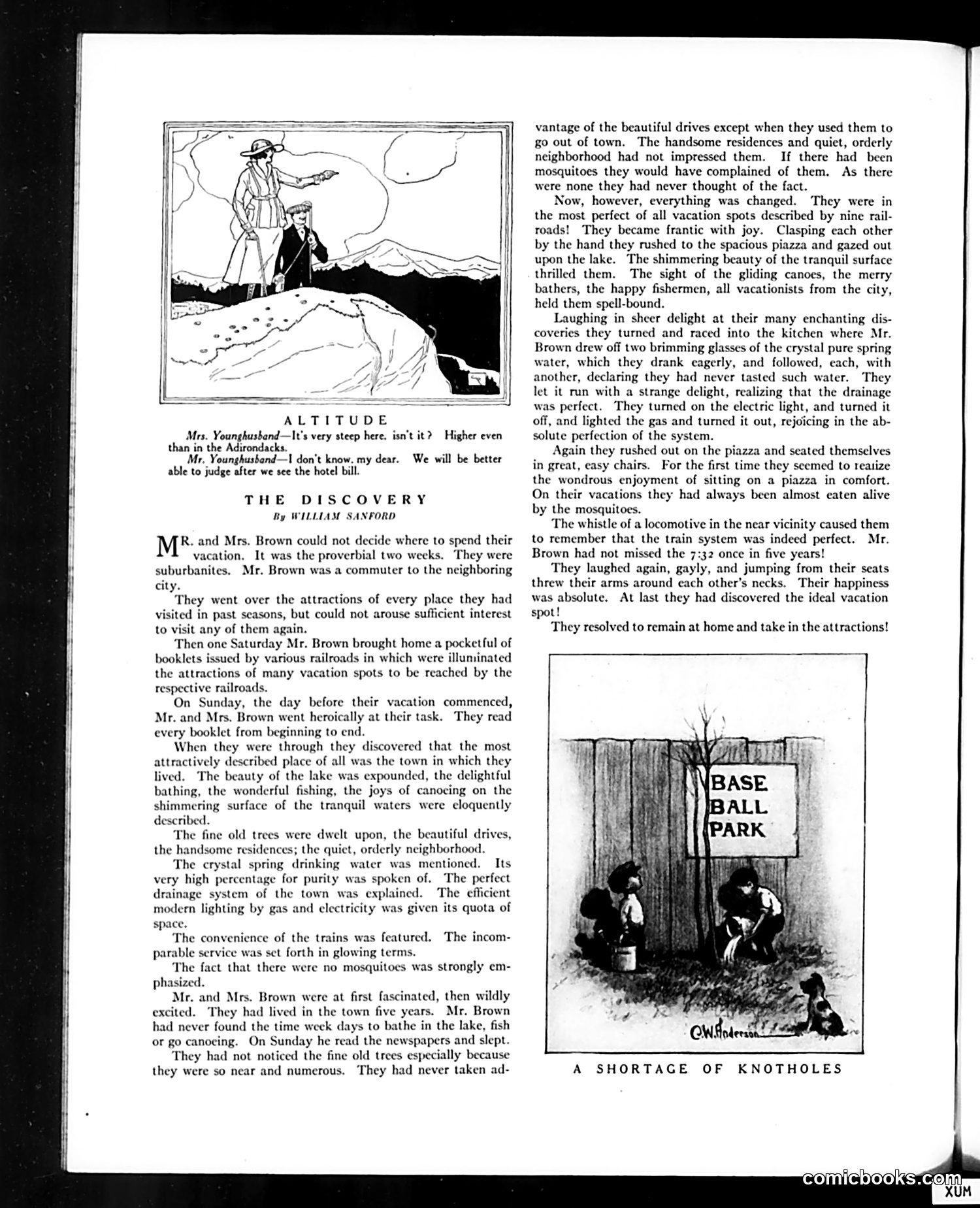
This page contains two satirical pieces about vacation and tourism in early 20th-century America. **"Altitude"** is a brief joke about hotel pricing at mountain resorts. A couple debates whether a location is higher than the Adirondacks, but Mr. Younghusband cynically suggests they'll only know after seeing the inflated hotel bill—satirizing vacation resorts' reputation for gouging tourists. **"The Discovery"** (the main story) satirizes suburban complacency and advertising manipulation. Mr. and Mrs. Brown, suburban commuters, can't decide where to vacation. Reading railroad promotional booklets describing their own hometown as a tourist destination—with pristine lakes, perfect drainage, pure water, and no mosquitoes—they suddenly discover paradise in their own backyard. The satire targets both the exaggerated marketing claims in railroad advertising and the irony that people overlook the genuine attractions of their everyday surroundings, only appreciating them when marketed back as tourist experiences. The cartoon "A Shortage of Knotholes" accompanying this appears unrelated.
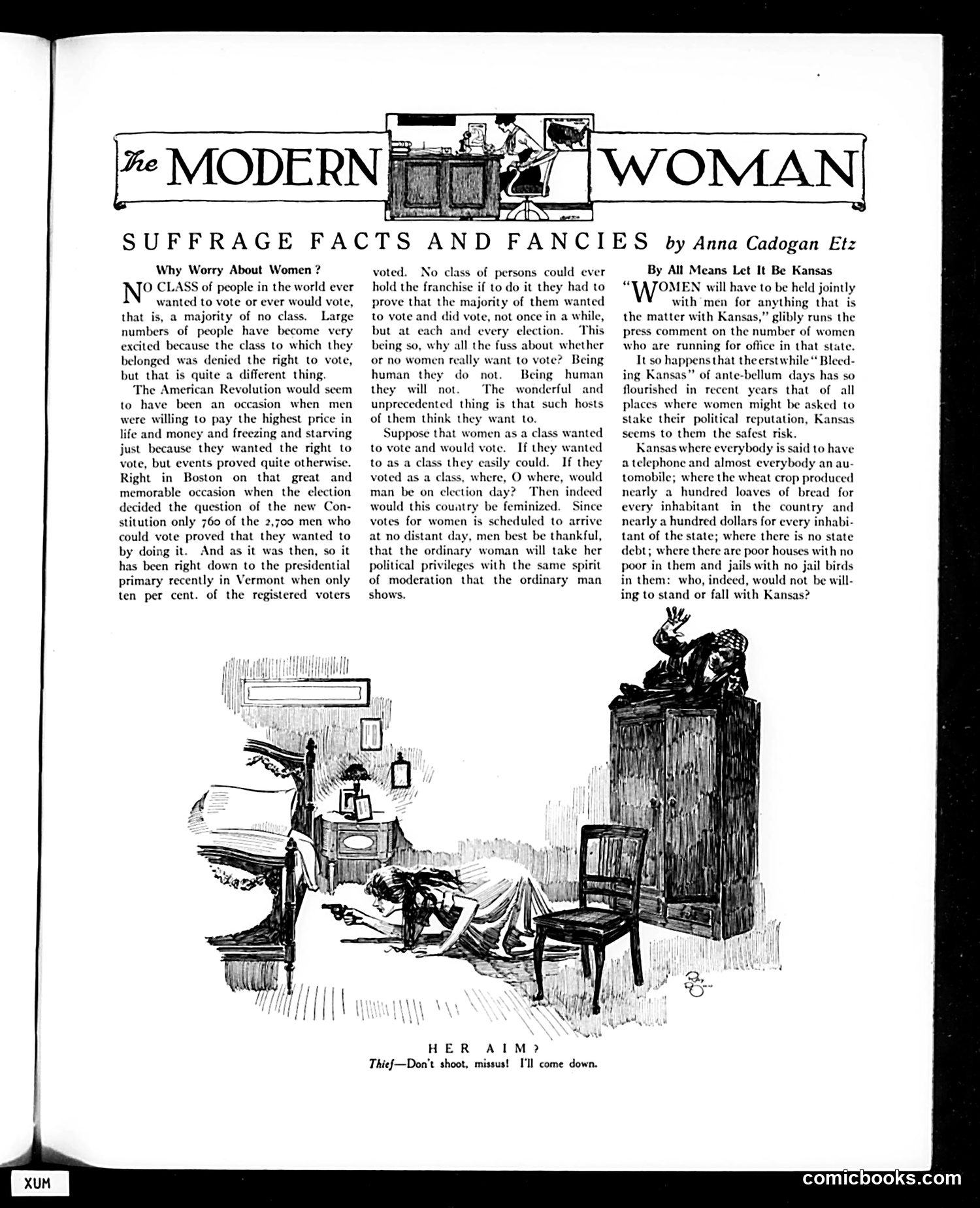
This page presents anti-suffrage arguments through two pieces by Anna Cadogan Etz opposing women's voting rights. **"Why Worry About Women?"** argues that no class of people genuinely desires the franchise, citing low voter turnout historically (only 10% in Vermont's recent primary, 760 of 2,700 in Boston). The author contends women are "human" and therefore won't vote consistently, so opposition to female suffrage is pointless. The tone is sarcastically dismissive—if women voted as a unified bloc, it would "feminize" the country, so men should be "thankful" women lack political cohesion. **"By All Means Let It Be Kansas"** supports women candidates in Kansas specifically, using flattery: Kansas is so prosperous (wheat crops, telephones, automobiles, no debt, empty jails) that women's political participation there poses no risk. **The cartoon** shows a burglar caught in a woman's home saying "Don't shoot, missus! I'll come down"—depicting women as domestically powerful but ironically suggesting their "aim" is limited to household domains, not politics. The satire ridicules both suffragists and suffrage opponents through exaggeration.
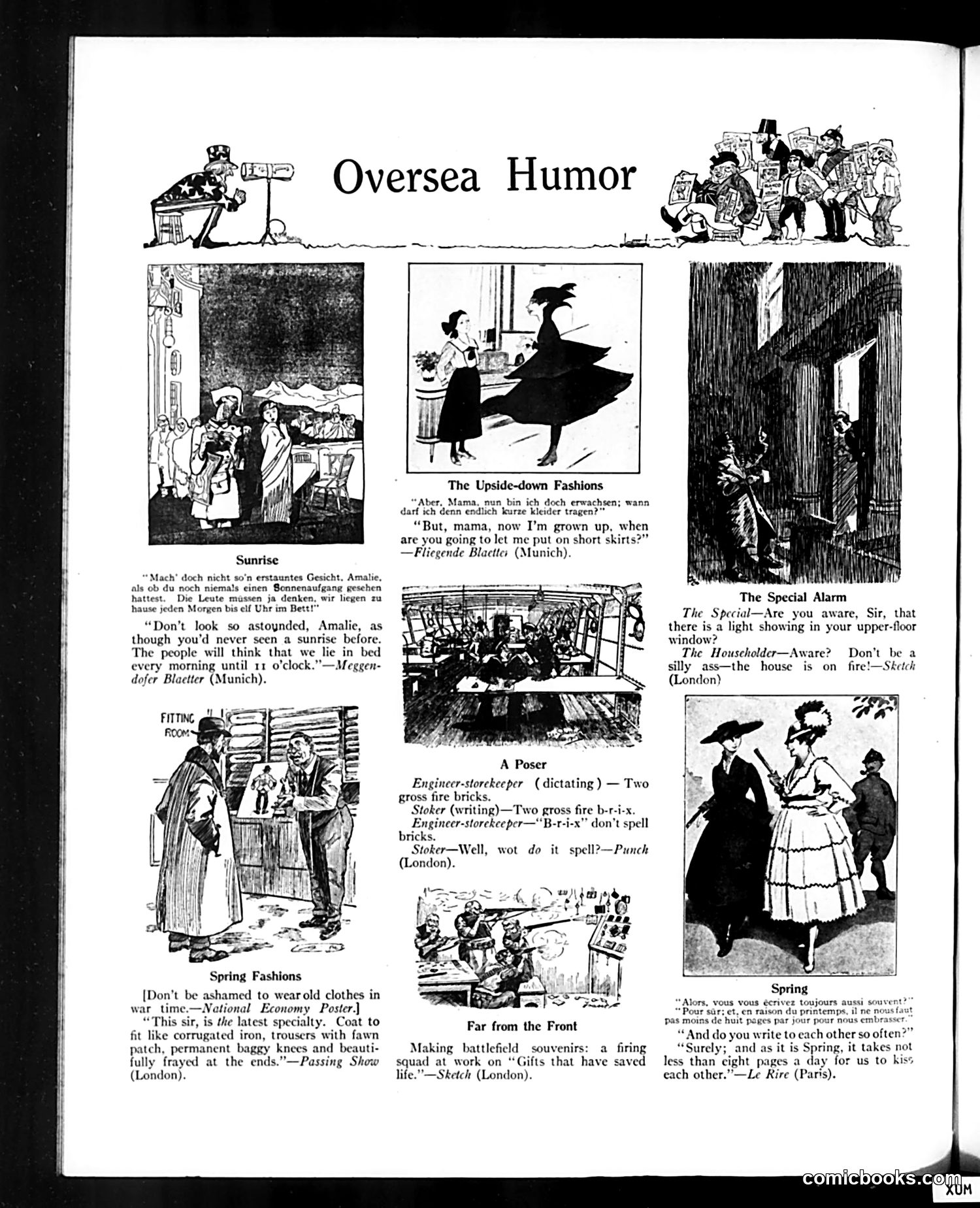
This "Oversea Humor" page compiles satirical cartoons from European publications during World War I, showcasing how different nations humorously addressed wartime conditions. **Key content includes:** - **"Sunrise"** (Munich): A couple pretends to wake early so neighbors won't think they sleep until 11 a.m.—mocking wartime pretense and social shame. - **"Spring Fashions"** (London): Sardonically describes shabby wartime clothing as fashionable—patched trousers and frayed edges as style choices during material rationing. - **"Upside-down Fashions"** (Munich): A daughter asks when she can wear short skirts now that she's grown; the joke addresses changing fashion standards during wartime disruption. - **"Far from the Front"** (London): Darkly jokes about soldiers manufacturing battlefield "souvenirs" using firing squads—gallows humor about wartime profiteering. Other sketches mock wartime blackout regulations and increased correspondence between separated lovers. The collection illustrates how humor helped Allied nations cope with war's absurdities and deprivations.

This is a **Schlitz beer advertisement**, not political satire. It exploits genuine public health anxiety from the early 20th century. The ad quotes a chemist acknowledging that water purity testing was unreliable and disease germs (particularly typhoid) could contaminate drinking water. This reflects real concerns: contaminated water caused serious illness and death in that era. Schlitz's pitch: their beer in brown bottles is safer than water because: 1. Carbonic acid inhibits bacterial growth 2. The brown bottle protects contents from light 3. Beer is boiled/processed, unlike suspect tap water The claim that Schlitz is "the only beer sold nation-wide of whose purity you can be absolutely sure" is deliberately ironic—the ad opens by saying *no natural waters* are absolutely pure, yet promises absolute purity for beer. This exploits legitimate public fear to position beer as a safer beverage than water, a common advertising strategy when municipal water safety was genuinely questionable. The phrase "The Beer That Made Milwaukee Famous" anchors the product's reputation.
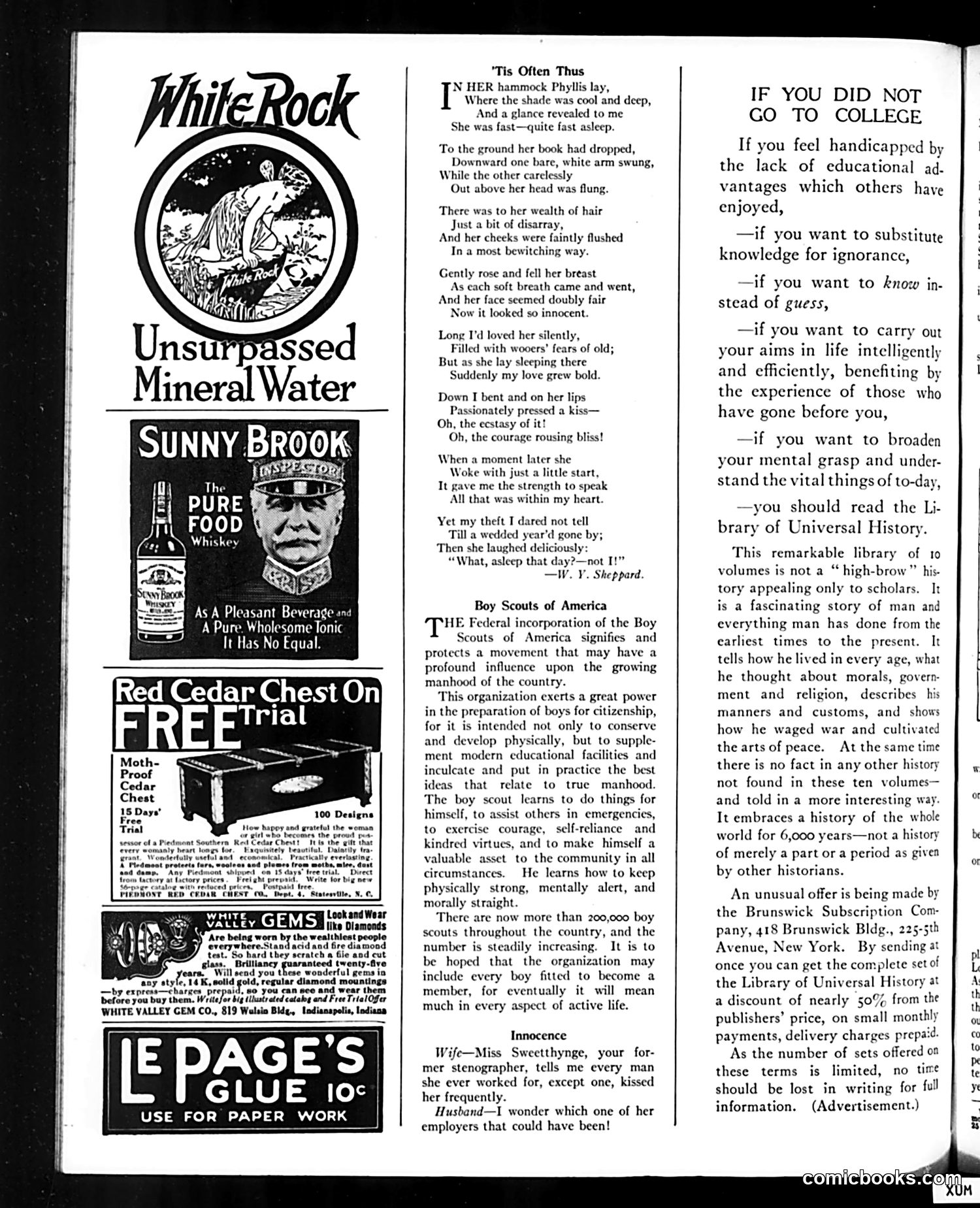
This page is primarily **advertising and light fiction**, not political satire. The advertisements dominate the left side (mineral water, whiskey, cedar chest, gems, glue), while the right contains promotional copy for educational materials. The three short pieces are: 1. **"'Tis Often Thus"** — A romantic poem by W.Y. Sheppard about a man kissing a sleeping woman in a hammock, then confessing the theft of a kiss after their wedding. The "joke" relies on early-20th-century courtship conventions where such boldness was transgressive but ultimately forgiven. 2. **Boy Scouts of America** — Earnest promotional text praising the newly-federally-incorporated Boy Scouts for developing citizenship and manhood in American youth. 3. **"Innocence"** — A brief joke implying a husband was the stenographer's one employer who *didn't* kiss her, suggesting his fidelity or her lack of attractiveness to him. None contains political commentary. This appears to be a general-interest issue mixing humor, uplift, and advertising for a middle-class audience.
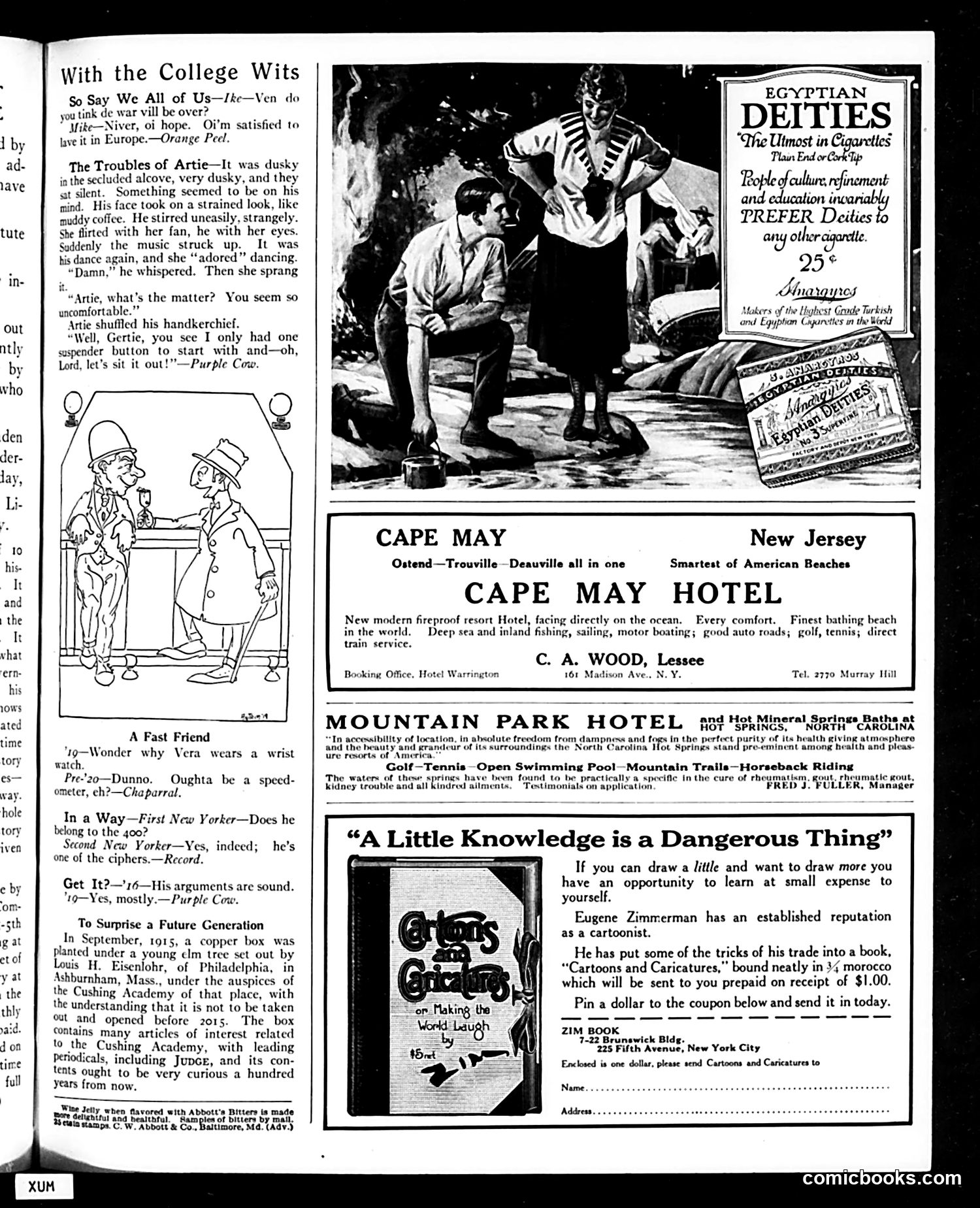
This page is primarily **advertising with light humor columns**, typical of Judge magazine's format. The main content includes college-themed jokes: a dialogue about wanting WWI to continue in Europe (likely mocking isolationism); "The Troubles of Artie," a romantic sketch where a young man's suspender button breaks during a dance date; and brief quips about wristwatches, social status ("the 400"), and faulty logic. The cartoon shows a couple in an intimate moment interrupted by dance music—Artie's discomfort stems from his clothing malfunction. **The satire is gentle**: poking fun at college students' romantic fumbles, social pretensions, and wartime attitudes. The humor reflects pre-WWI American attitudes when the war seemed distant and somewhat absurd to maintain. The remainder consists of **resort hotel advertisements** (Cape May, Mountain Park Hotel) and a promotion for Eugene Zimmerman's cartooning instructional book—typical commercial content filling Judge's pages.
This page contains a Collier's magazine advertisement (left) and a collection of brief humorous anecdotes (right) typical of early-20th-century American periodicals. The advertisement promotes Zona Gale's story "Over There" in Collier's July 22nd issue, using a contemplative quote about post-war commemoration to appeal to readers interested in World War I reflections. The right side features five short joke-stories: 1. **"The Plan Back-Fired"** — Detroit Tigers manager Hughie Jennings recounts how a hired heckler at a political rally backfired when police couldn't distinguish between the real speaker and the plant. 2. **"Wise Dog"** — A dog learns to fake alarm at "Cats!" to trick an elderly woman out of an armchair—a tale of animal cunning. 3-5. Three additional brief jokes about children, peculiar behavior, and domestic situations. These are gentle, accessible humor pieces designed for family readership, emphasizing wordplay, irony, and situational comedy rather than sophisticated satire.
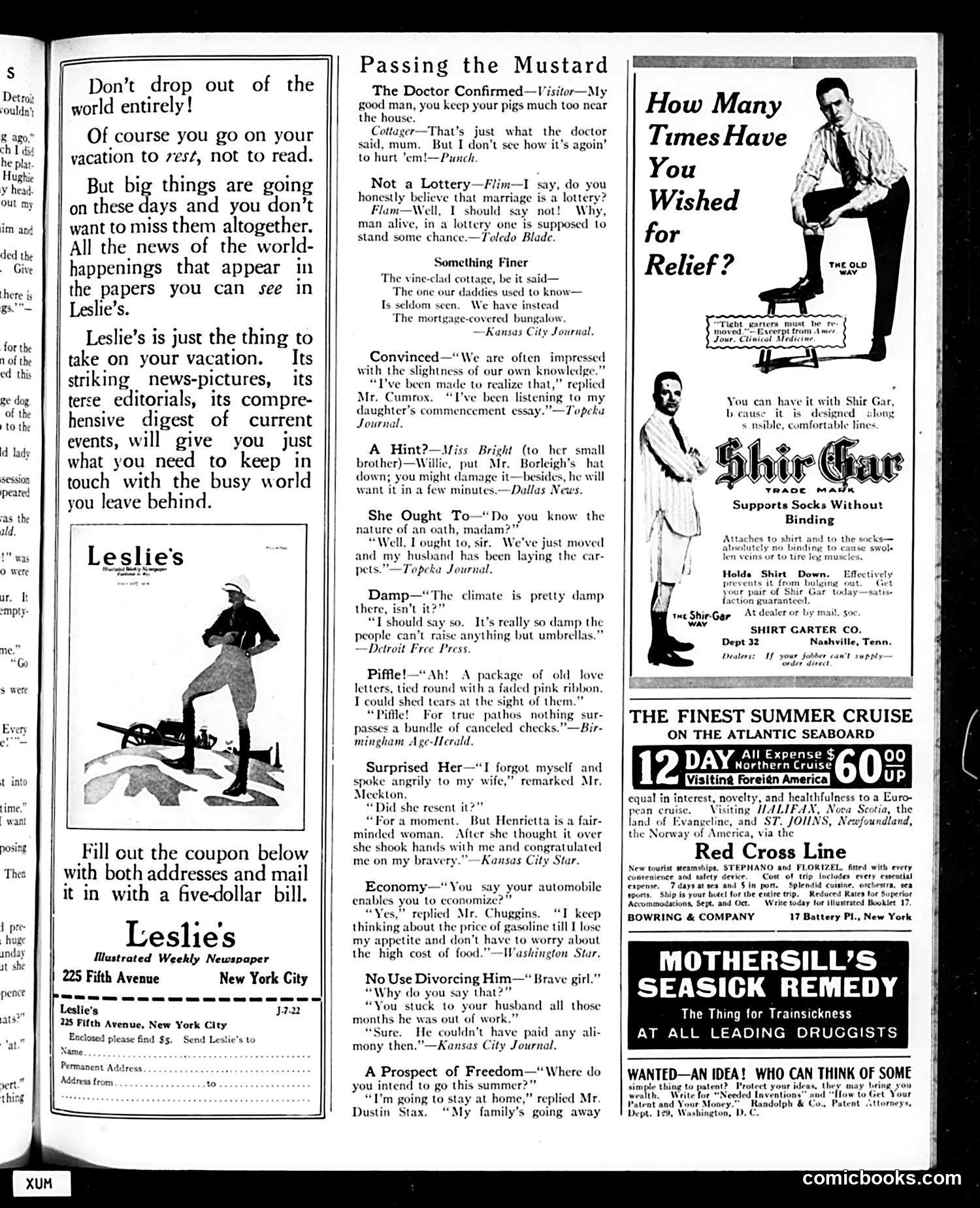
This is primarily an **advertising and humor page** from Judge magazine, with two main elements: **Left side:** A Leslie's magazine advertisement, promoting it as vacation reading that keeps readers connected to world events without requiring serious study. **Center/Right:** A collection of brief humorous anecdotes titled "Passing the Mustard"—short jokes with punchlines. These are gentle domestic humor pieces from sources like *Punch* and *Kansas City Journal*, typical of early 20th-century periodicals. Examples include: - A cottager dismissing concerns about pig odors - Wordplay about marriage being unlike a lottery - A joke about canceled checks being sadder than love letters **Bottom:** Travel and product advertisements for Shir Gar garters, a seaside cruise, and Mothersill's Seasickness Remedy. **The satire/point:** There is **no significant political satire** on this page. The humor is apolitical, domestic, and whimsical—reflecting period sensibilities about family, marriage, and practicality rather than commenting on current events or social movements.
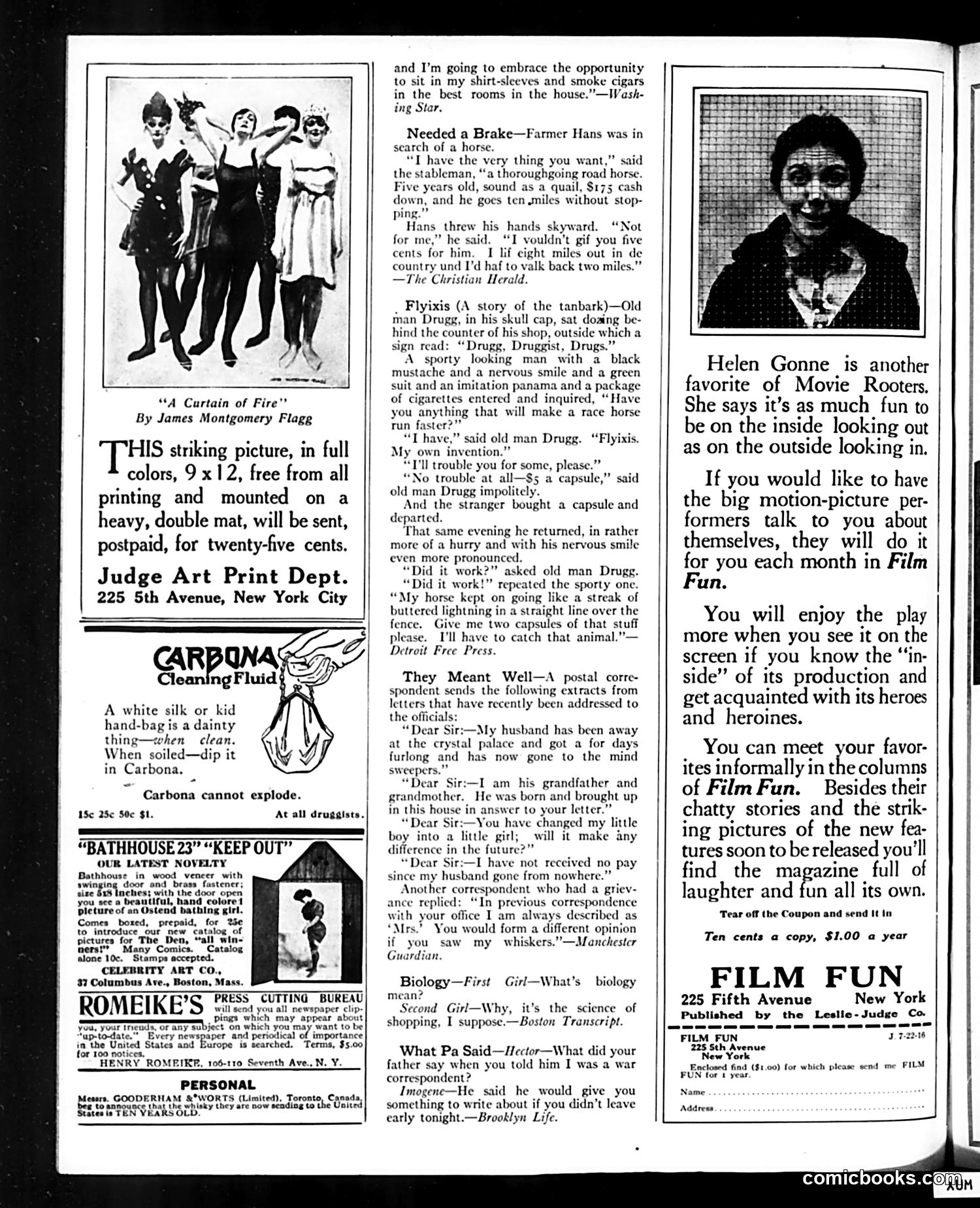
This page is primarily **advertising and humor filler** rather than political satire. The content includes: **Main Features:** - A James Montgomery Flagg art print ("A Curtain of Fire") advertisement featuring three stylized women in 1920s fashion - Multiple small advertisements (Carbona cleaning fluid, novelty bathhouse toy, press clipping services) - Brief humorous anecdotes and jokes about everyday life **The Humor:** The jokes are gentle domestic/rural comedy—a German farmer rejecting a horse because he'd have to walk back from town, a man buying mysterious horse-racing pills that work *too* well, and absurdist exchanges (a girl defining biology as "the science of shopping"). **Historical Context:** This appears to be from the 1920s based on fashion and advertising. The content reflects Judge's shift toward lighter entertainment and consumer advertising rather than sharp political commentary. The German farmer dialect humor was common in American publications of this era. **Overall:** A typical Judge page blending advertisements with mild, non-controversial humor aimed at middle-class readers.
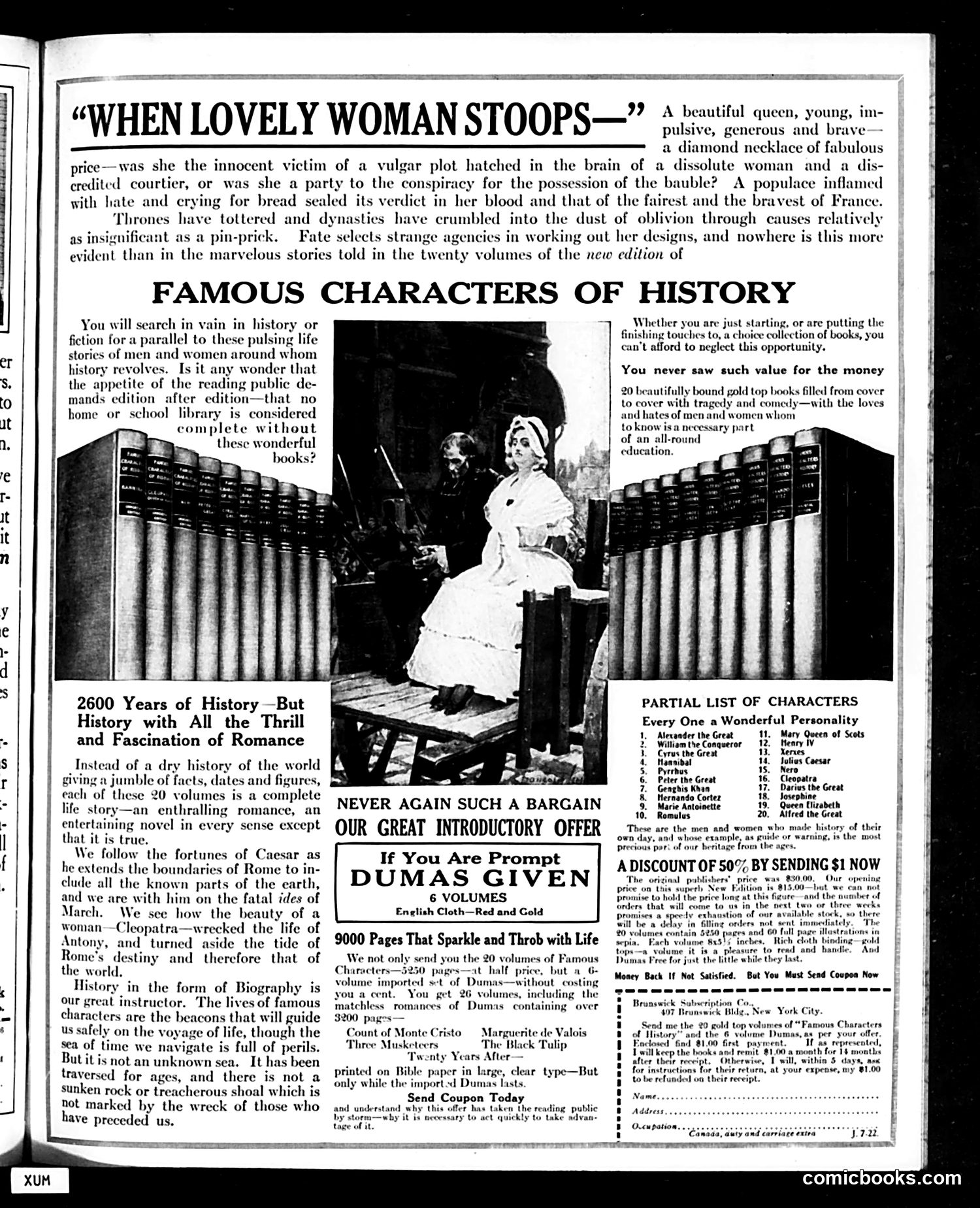
This is primarily a **book advertisement**, not political satire. The theatrical opening headline alludes to Oliver Goldsmith's poem, framing a melodramatic scenario about a queen, a diamond necklace, and court intrigue—likely referencing the historical **Diamond Necklace Affair** involving Marie Antoinette. The ad uses this famous scandal as a hook to sell the "Famous Characters of History" book series. The central image shows a woman in period dress seated among volumes of books, surrounded by suited men—visualizing the dramatic historical narratives promised. The satire is **commercial rather than political**: the ad ironically suggests that history's great events ("thrones have tottered") hinge on trivial causes ("pin-pricks"), yet markets these volumes as essential educational material. The appeal combines legitimate historical interest with sensationalism—history presented as "romance" rather than dry facts. No specific political figures are caricatured; this is marketing dressed in historical narrative.
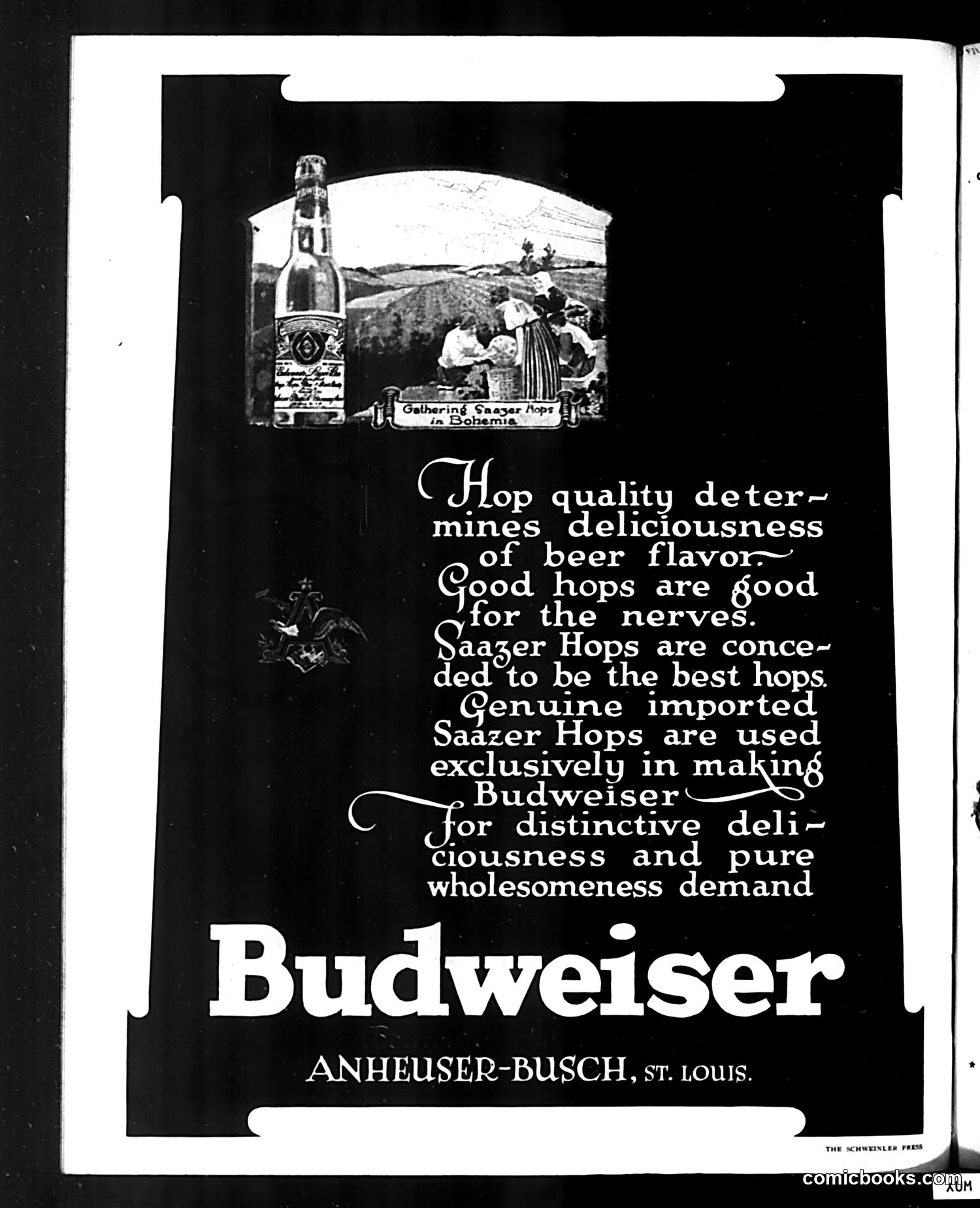
This is a **Budweiser beer advertisement**, not political satire. The page promotes Anheuser-Busch's beer by emphasizing its use of imported Saaz hops from Bohemia (shown in the inset illustration of hop-gathering). The ad makes two key claims: that hop quality determines beer flavor, and that good hops are "good for the nerves"—a common health claim in early 20th-century advertising that positioned beer as wholesome and restorative rather than merely intoxicating. The Bohemian hops imagery appeals to beer-drinking consumers' perception of European brewing authenticity and superiority, a marketing strategy typical of the era.