
Judge, 1916-07-22 · page 24 of 28
Judge — July 22, 1916 — page 24: what you’re looking at
What you’re looking at
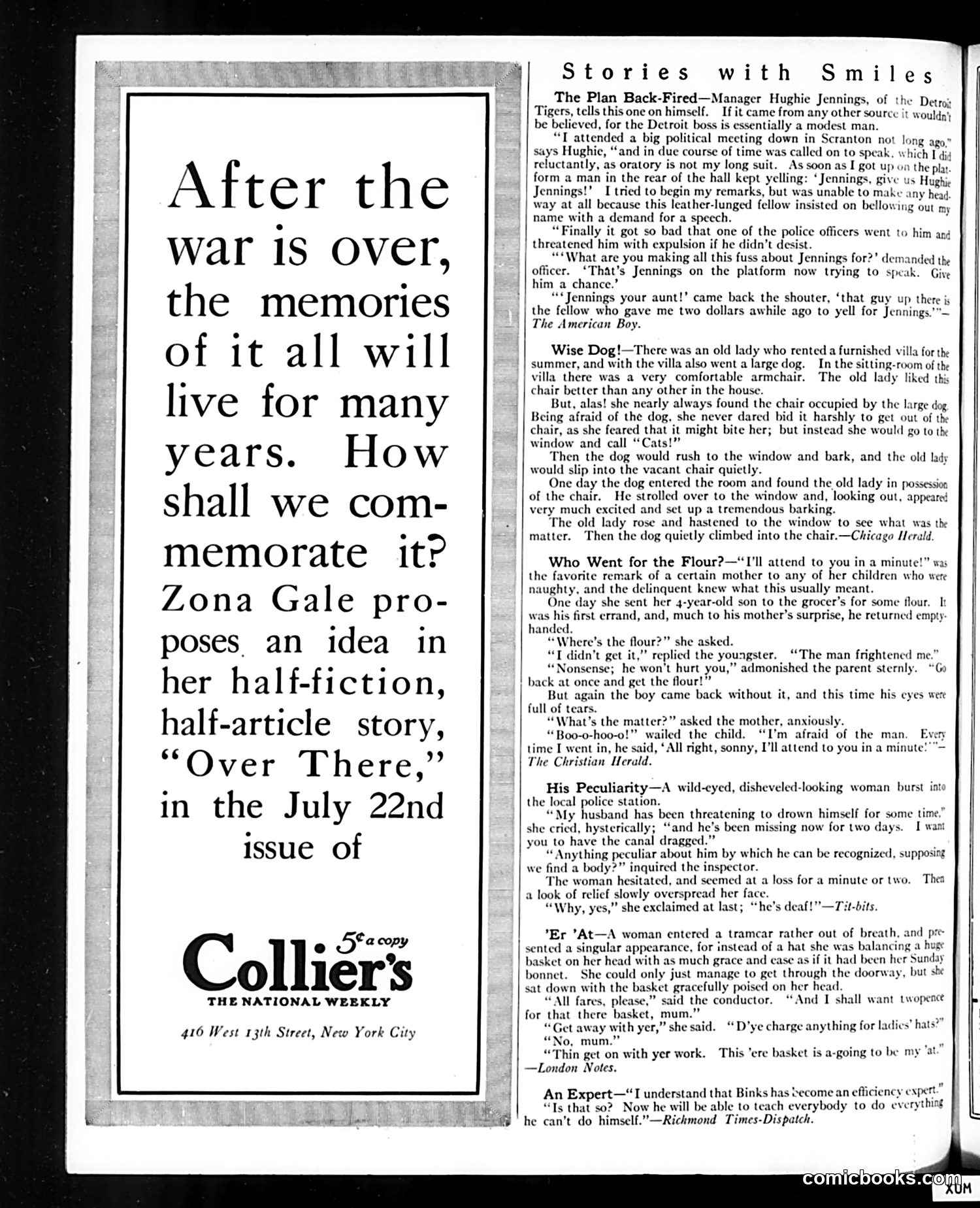
This page contains a Collier's magazine advertisement (left) and a collection of brief humorous anecdotes (right) typical of early-20th-century American periodicals. The advertisement promotes Zona Gale's story "Over There" in Collier's July 22nd issue, using a contemplative quote about post-war commemoration to appeal to readers interested in World War I reflections. The right side features five short joke-stories: 1. **"The Plan Back-Fired"** — Detroit Tigers manager Hughie Jennings recounts how a hired heckler at a political rally backfired when police couldn't distinguish between the real speaker and the plant. 2. **"Wise Dog"** — A dog learns to fake alarm at "Cats!" to trick an elderly woman out of an armchair—a tale of animal cunning. 3-5. Three additional brief jokes about children, peculiar behavior, and domestic situations. These are gentle, accessible humor pieces designed for family readership, emphasizing wordplay, irony, and situational comedy rather than sophisticated satire.
📄 Transcribed text from this page (OCR, searchable)
Machine-transcribed from the original scan — historical spelling and the odd misread are preserved.
After th war 1S Over, the memories of it all will live for many years. How shall we com- memorate it? Zona Gale pro- poses. an idea in her half-fiction, half-article story, “Over There,” in the July 22nd issue of 416 West 13th Street, New York City Stories with Smiles The Plan Back-Fired—Manager Hughie Jennings, of the Detro: Tigers, tells this one on himself. If it came from any other source it wouldn' be believed, for the Detroit boss is essentially a modest man. ch “I attended a big political meeting down in Scranton not long ago” says Hughie, “and in due course of time was called on to speak, which Pd} reluctantly, as oratory is not my long suit. As soon as I got up on the plat. form a man in the rear of the hall kept yelling: ‘Jennings, give us Hughie Jennings!’ I tried to begin my remarks, but was unable to make any head. | way at all because this leather-lunged fellow insisted on bellowing out my name with a demand for a speech. “Finally it got so bad that one of the police officers went to him and threatened him with expulsion if he didn’t desist. ¥ “What are you making all this fuss about Jennings for?’ demanded the officer. ‘That’s Jennings on the platform now trying to speak. Give him a chance.’ “* Jennings your aunt!’ came back the shouter, ‘that guy up the the fellow who gave me two dollars awhile ago to yell for Jenning The American Boy. Wise Dog!—There was an old lady who rented a furnished villa for the summer, and with the villa also went a large dog. In the sitting-room of the | villa there was a very comfortable armchair. The old lady liked this chair better than any other in the house. But, alas! she nearly always found the chair occupied by the large dog Being afraid of the dog, she never dared bid it harshly to get out of the chair, as she feared that it might bite her; but instead she would go to the window and call “Cats!” Then the dog would rush to the window and bark, and the old lady would slip into the vacant chair quietly. ° One day the dog entered the room and found the old lady in possession of the chair. He strolled over to the window and, looking out, appeared very much excited and set up a tremendous barking. The old lady rose and hastened to the window to see what was the matter. Then the dog quietly climbed into the chair.—Chicago Herald. Who Went for the Flour?—“I'll attend to you in a minute!” was the favorite remark of a certain mother to any of her children who were naughty, and the delinquent knew what this usually meant. One day she sent her 4-year-old son to the grocer’s for some flour. It was his first errand, and, much to his mother’s surprise, he returned empty: handed. “Where's the flour?” she asked. “T didn’t get it,” replied the youngster. “The man frightened m “Nonsense; he won’t hurt you,” admonished the parent sternly. back at once and get the flour!” But again the boy came back without it, and this time his cyes were full of tears. “What’s the matter?” asked the mother, anxiously. “ Boo-o-hoo-o!”” led the child. “I’m afraid of the man. Ev time I went in, he said, ‘All right, sonny, I’ll attend to you in a minute The Christian Herald. His Peculiarity—A wild-cyed, disheveled-looking woman. burst int the local police station. “My husband has been threatening to drown himself for some t she cried, hysterically; “and he’s been missing now for two days. Iw you to have the canal dragged.” “ Anything peculiar about him by which he can be recognized, supposing we find a body?” inquired the inspector. The woman hesitated, and seemed at a loss for a minute or two. Thea a look of relief slowly overspread her face. “Why, yes,” she exclaimed at last; “he’s deaf!" —Tit-bits. ’Er ’At—A woman entered a tramcar rather out of breath, and pre- sented a singular appearance, for instead of a hat she was balancing a huge basket on her head with as much grace and as if it had been her Sunday bonnet. She could only just manage to get through the doorway, but ste sat down with the basket gracefully poised on her head. “All fares, please,” said the conductor. “And I shall want twopence for that there bas! mum.” sj ” “Get away with yer,” she said.“ D'ye charge anything for ladies’ hats? “No, mum.” ” “Thin get on with yer work. This ’ere basket is a-going to be my ‘at —London Notes. An Expert—“TI understand that Binks has become an efficiency expett “Is that so? Now he will be able to teach everybody to do everything he can't do himself.”"—Richmond Times-Dispatch.