
Judge, 1916-07-22 · page 10 of 28
Judge — July 22, 1916 — page 10: what you’re looking at
What you’re looking at
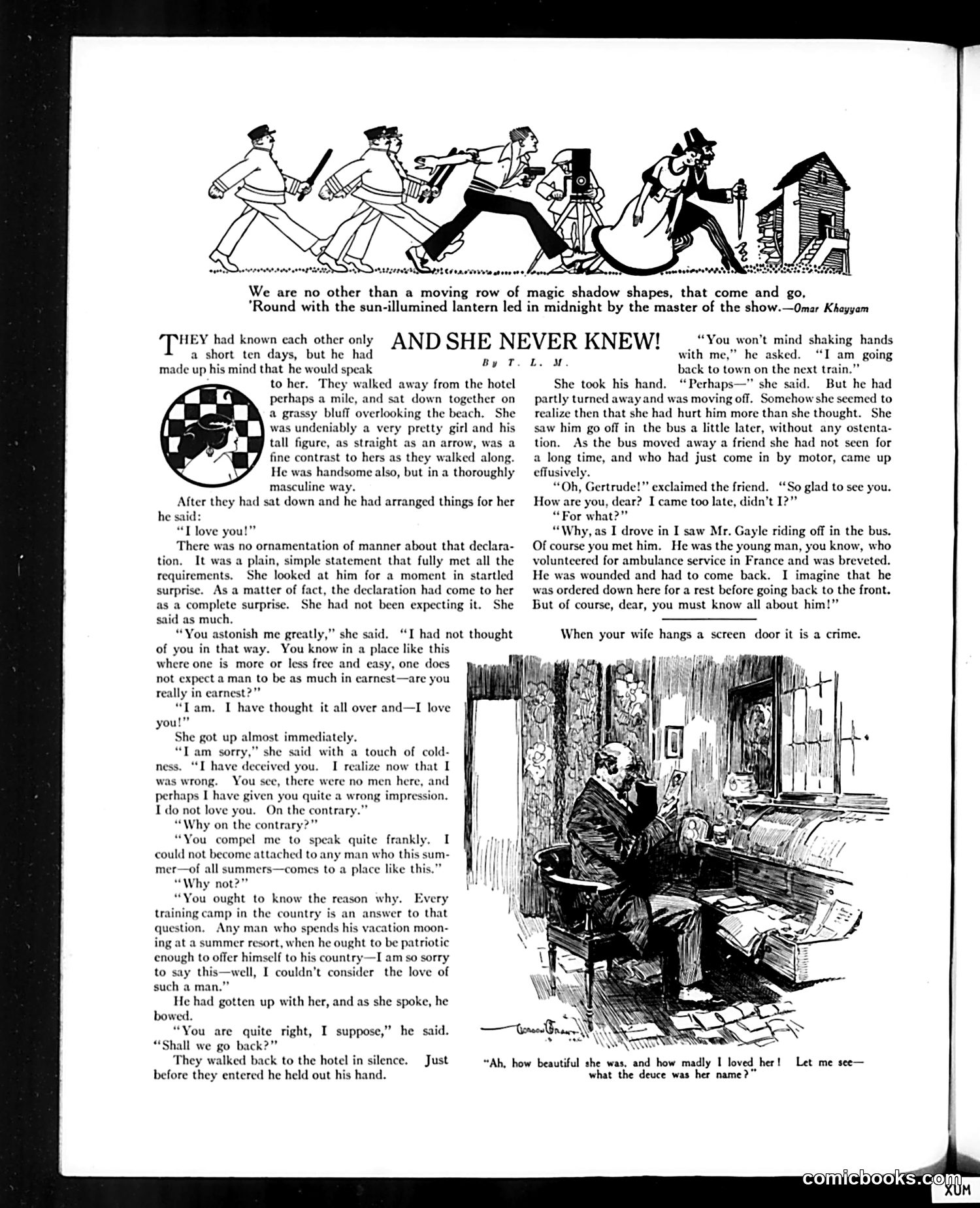
This *Judge* story satirizes the patriotic expectations placed on young men during World War I. The male protagonist is a wounded veteran, breveted (promoted for bravery) after ambulance service in France, who is recovering at a beach resort. The woman rejects his romantic declaration, condemning him for vacationing instead of enlisting—unaware he's already served and been wounded in combat. The satire cuts both ways: it mocks her sanctimonious patriotic posturing while also critiquing how society judges men's wartime contributions. The final irony—her friend revealing his actual military service as he departs—exposes the woman's hypocrisy. She has rejected a decorated war hero based on false assumptions about his patriotism. The cartoon suggests the absurdity of civilian judgment regarding military service and sacrifice during WWI.
📄 Transcribed text from this page (OCR, searchable)
Machine-transcribed from the original scan — historical spelling and the odd misread are preserved.
We are no other than a moving row of magic shadow shapes, that come and go, Round with the sun-illumined lantern led in midnight by the master of the show.—Omar Khayyam HEY had known each other only AND SHE NEVER KNEW! L. M. a short ten days, but he had made up his mind that he would speak to her. They walked away from the hotel perhaps a mile, and sat down together on bluff overlooking the beach. She ably a very pretty girl and his s straight as an arrow, was a By T tall figure, fine contrast to hers as they walked along. He was handsome also, but in a thoroughly masculine way. After they had sat down and he had arranged things for her ” you! no ornamentation of manner about that declara- tion. It a plain, simple statement that fully met all the requirements. She looked at him for a moment in startled surprise. As a matter of fact, the declaration had come to her as a complete surprise. She had not been expecting it. She said as much. “You astonish me greatly,” she said. “I had not thought of you in that way. You know in a place like this where one is more or less free and easy, one does not expect a man to be as much in carnest—are you really in earnest?” “Tam. I have thought it all over and—I love I lov There wi She got up almost immediately. “Tam sorry,” she said with a touch of cold- ness. “I have deceived you. I realize now that I was wrong. You see, there were no men here, and perhaps I have given you quite a wrong impression. I do not love you. On the contrary.” “Why on the contrary? “You compel me to speak quite frankly. I could not become attached to any man who this mer—of all summers—comes to a place like this. “Why not?” “You ought to know the reason why. Every training camp in the country is an ans to that question. Any man who spends his vacation moon- ing at a summer resort, when he ought to be patriotic enough to offer himself to his country—I am so sorry to say this—well, I couldn’t consider the love of such a man. He had gotten up with her, and as she spoke, he bowed. “You are quite right, I suppose,” “Shall we go back?” They walked back to the hotel in silence. before they entered he held out his hand. he said. Just “Ah, how beautiful she was, and how madly I loved her! “You won't mind shaking hands with me,” he asked. “I am going back to town on the next train.” She took hand. “Perhaps—” she said. But he had partly turned away and was moving off. Somehow she seemed to realize then that she had hurt him more than she thought. She saw him go off in the bus a little later, without any ostenta- tion. As the bus moved away a friend she had not seen for a long time, and who had just come in by motor, came up effusiv “Oh, Gertrude!” exclaimed the friend. “So glad to see you. How are you, dear? I came too late, didn’t I?” “For what?” “Why, as I drove in I saw Mr. Gayle riding off in the bus. Of course you met him. He was the young man, you know, who volunteered for ambulance service in France and was breveted. He was wounded and had to come back. I imagine that he was ordered down here for a rest before going back to the front. But of course, dear, you must know all about him!” When your wife hangs a screen door it is a crime. Let me see— what the deuce was her name?”