
Judge, 1916-07-22 · page 8 of 28
Judge — July 22, 1916 — page 8: what you’re looking at
What you’re looking at
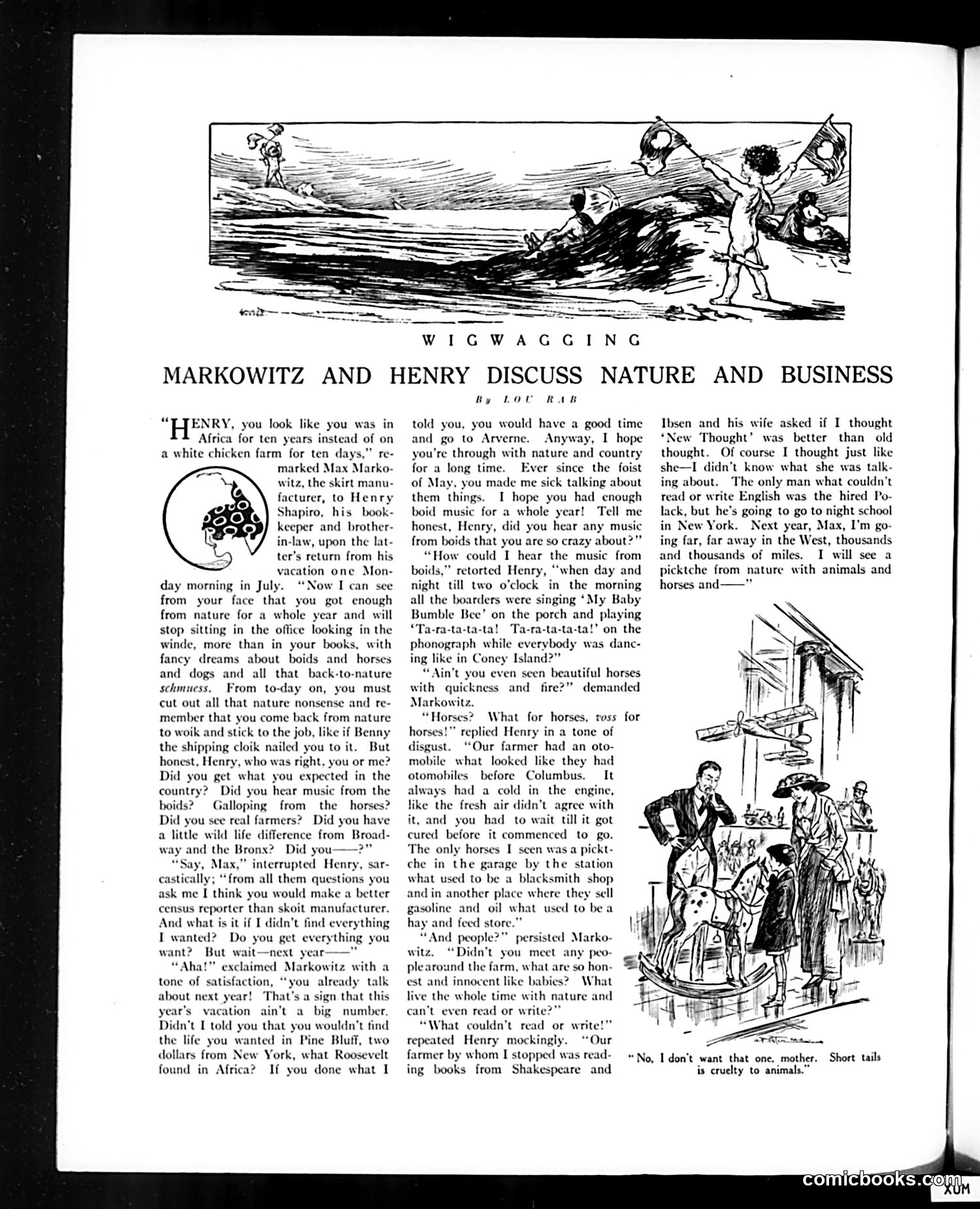
This is a humorous dialogue between two Jewish immigrants: Max Markowitz, a garment manufacturer, and Henry Shapiro, his bookkeeper brother-in-law, upon Henry's return from a rural vacation. The satire mocks the early 20th-century "back-to-nature" movement—a romantic ideology that idealized rural life, simple farming, and communion with nature as superior to urban industrial existence. Max had skeptically warned Henry against such fantasies, predicting disappointment. Henry's experiences confirm Max's cynicism: the "farm" was actually a cheap boarding house with noisy city people; the "beautiful horses" were decrepit automobiles; supposedly innocent rural folk were reading Shakespeare and discussing "New Thought" philosophy—they were educated urbanites, not noble peasants. The humor derives from the clash between romantic pastoral ideals and mundane reality, filtered through the Yiddish-inflected English of working-class Jewish characters. Max's practical business mentality triumphs over Henry's sentimental escapism, reinforcing that city life and work—not nature—are reality.
📄 Transcribed text from this page (OCR, searchable)
Machine-transcribed from the original scan — historical spelling and the odd misread are preserved.
WIGWAGGING MARKOWITZ AND HENRY DISCUSS NATURE AND BUSINESS “LTENRY, you look like you was in Africa for ten years instead of on a white chicken farm for ten da Te- marked Max Marko- witz, the skirt manu- facturer, to Henry Shapiro, his book- keeper and brother- in-law, upon the lat- ter’s return from his vacation one Mon- day morning in July. ‘Now I can see from your face that you got enough from nature for a whole year and will stop sitting in the office looking in the winde, more than in your books, with fancy dreams about boids and horses and dogs and all that back-to-nature schmuess. From to-day on, you must cut out all that nature nonsense and re- member that you come back from nature to woik and stick to the job, like if Benny the shipping cloik nailed you to it. But honest, Henry, who was right, you or me? Did you get what you expected in the country? Did you hear music from the boids? Galloping from the horses? Did you see real farmers? Did you have a little wild life difference from Broad- way and the Bronx? Did you——?” “Say, Max,” interrupted Henry, sar- ly; “from all them questions you sk me I think you would make a better census reporter than skoit manufacturer. And what is it if I didn’t find everything I wanted? Do you get everything you want? But wait—next year——" “Aha!” exclaimed Markowitz with a tone of satisfaction, “you already talk about next year! That’s a sign that this year’s vacation ain't a big number. Didn't I told you that you wouldn't tind the life you wanted in Pine Bluff, two dollars from New York, what Roosevelt found in Africa? If you done what I By LOU RAB told you, you would have a good time and go to Arverne. Anyway, I hope you're through with nature and country for a long time. Ever since the foist of May, you made me sick talking about them things. I hope you had enough boid music for a whole year! Tell me honest, Henry, did you hear any music from boids that you are so crazy about?” “How could I hear the music from boids,” retorted Henry, “when day and night till two o'clock in the morning all the boarders were singing ‘My Baby Bumble Bee’ on the porch and playing ‘Ta-ra-ta-ta-ta! Ta-ra-ta-ta-ta!’ on the phonograph while everybody was danc- ing like in Coney Island?” “Ain't you even seen beautiful horses with quickness and fire?” demanded Markowitz. s? What for horses, toss for replied Henry in a tone of . “Our farmer had an oto- mobile what looked like they had otomobiles before Columbu: Tt always had a cold in the engine, like the fresh air didn’t agree with it, and you had to wait till it got cured before it commenced to go. The only horses I seen was a pickt- che in the garage by the station what used to be a blacksmith shop and in another place where they sell gasoline and oil what used to be a hay and feed store.” “And people?” persisted Marko- witz, “Didn't you meet any peo- plearound the farm, what are so hon- est and innocent like babies? What live the whole time with nature and can’t even read or write?” “What couldn’t read or write repeated Henry mockingly. “Our farmer by whom I stopped was read- ing books from Shakespeare and “No, [don’t want that one, mother. Ibsen and his wife asked if I thought ‘New Thought’ was better than old thought. Of course I thought just like she—I didn’t know what she was talk- ing about. The only man what couldn't read or write English was the hired Po- lack, but he’s going to go to night school in New York. Next year, Max, I’m go- ing far, far away in the West, thousands and thousands of miles. I will see a picktche from nature with animals and horses and——" STA ate Short tails is cruelty to animals.”