
Judge, 1916-07-22 · page 19 of 28
Judge — July 22, 1916 — page 19: what you’re looking at
What you’re looking at
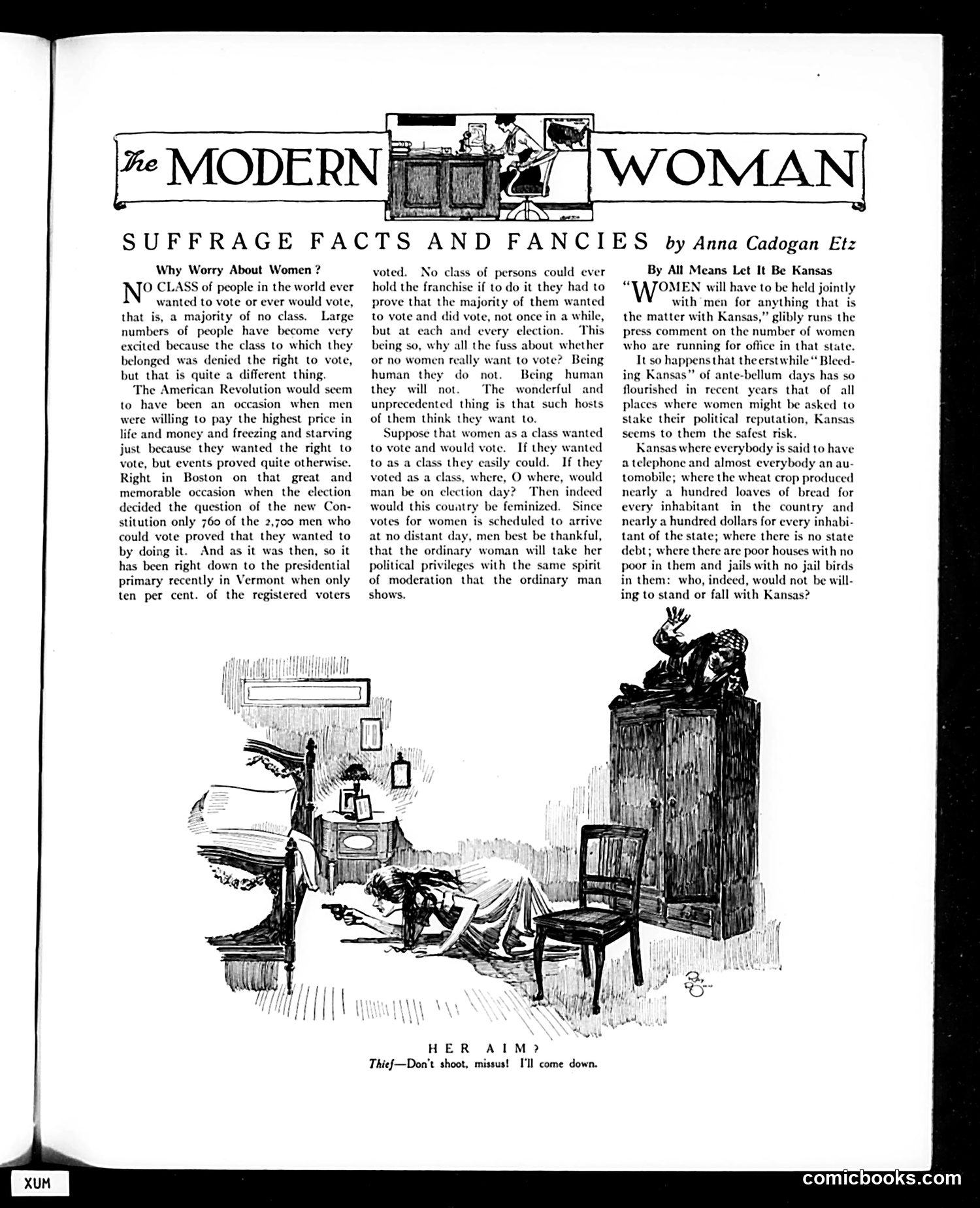
This page presents anti-suffrage arguments through two pieces by Anna Cadogan Etz opposing women's voting rights. **"Why Worry About Women?"** argues that no class of people genuinely desires the franchise, citing low voter turnout historically (only 10% in Vermont's recent primary, 760 of 2,700 in Boston). The author contends women are "human" and therefore won't vote consistently, so opposition to female suffrage is pointless. The tone is sarcastically dismissive—if women voted as a unified bloc, it would "feminize" the country, so men should be "thankful" women lack political cohesion. **"By All Means Let It Be Kansas"** supports women candidates in Kansas specifically, using flattery: Kansas is so prosperous (wheat crops, telephones, automobiles, no debt, empty jails) that women's political participation there poses no risk. **The cartoon** shows a burglar caught in a woman's home saying "Don't shoot, missus! I'll come down"—depicting women as domestically powerful but ironically suggesting their "aim" is limited to household domains, not politics. The satire ridicules both suffragists and suffrage opponents through exaggeration.
📄 Transcribed text from this page (OCR, searchable)
Machine-transcribed from the original scan — historical spelling and the odd misread are preserved.
SUFFRAGE FACTS AND FANCIES by Anna Cadogan Etz Why Worry About Women ? N° CLASS of people in the world ever wanted to vote or ever would vote, a majority of no class. Large ave become very that is numbers of people excited because the class to which they belonged was denied the right to vote, but that is quite a different thing. The American Revolution would seem been an occasion when men were willing to pay the highest price in and money and freezing and starving just because they wanted the right to vote, but events proved quite otherwise. Right in Boston on that great and memorable occasion when the election decided the question of the new Con- stitution only 760 of the 2,700 men who could vote proved that they wanted to by doing it. And it was then, so it has been right down to the presidential primary recently in Vermont when only ten per cent. of the registered voters voted. No class of persons could ever hold the franchise if to do it they had to prove that the majority of them wanted to vote and did vote, not once in a while, but at each and every election. This being so, why all the fuss about whether or no women really want to vote? Being human they do not. Being human they will not. The wonderful and unprecedented thing is that such hosts of them think they want to. Suppose that women as a class wanted to vote and would vote. If they wanted to as a class they easily could. If they voted as a class, where, O where, would man be on cl Then indeed would this country be feminized. Since votes for women is scheduled to arrive at no distant day, men best be thankful, cr c leges with the same spirit of moderation that the ordinary man shows. HER AIM? Thief—Don't shoot, missus! I'll come down. By All Means Let It Be Kansas “ OMEN will have to be held jointly with men for anything that is the matter with Kansas,” glibly runs the press comment on the number of women who are running for office in that s It so happens that the erstwhile“ Bleed- ing Kansas” of ante-bellum days has so flourished in recent years that of all places where women might be asked to stake their political reputation, SAS seems to them the safest risk. Kansas where everybody is said to have a telephone and almost everybody an au- tomobile; where the wheat crop produced nearly a hundred loaves of bread for every inhabitant in the country and nearly a hundred dollars for every inhabi- tant of the state; where there is no state debt; where there are poor houses with no. poor in them and jails with no jail birds in them: who, indeed, would not be will- ing to stand or fall with Kansas? comicbooks.com