
A complete issue · 28 pages · 1916
Judge — April 22, 1916
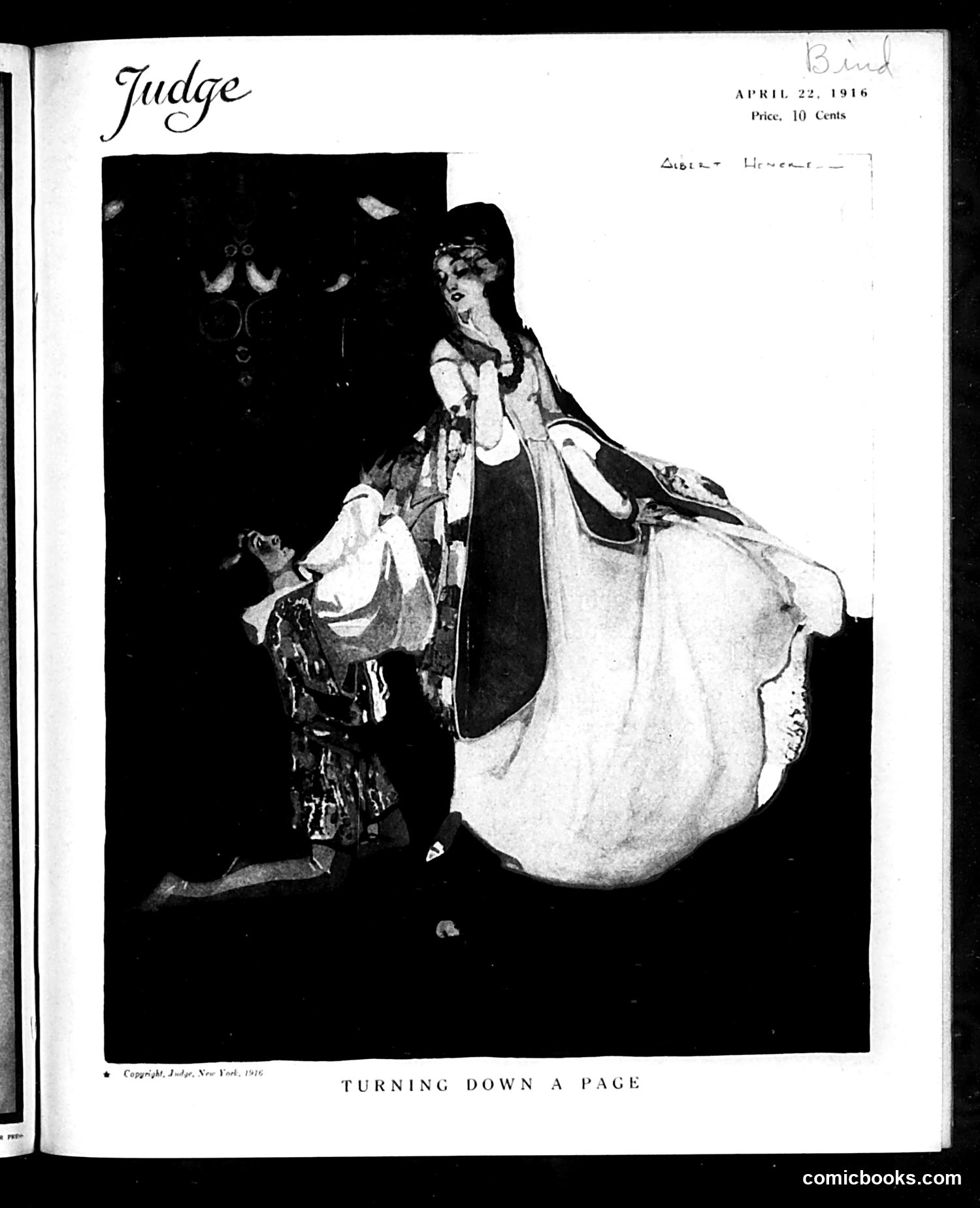
This April 22, 1916 Judge magazine illustration shows a woman in an elaborate gown with a large train, accompanied by a small figure (possibly a child or attendant) holding the fabric. The caption "Turning Down a Page" is a visual pun: the woman's voluminous skirt hem literally extends outward like a turned-down page corner. The satire likely critiques women's extravagant fashion—specifically the impracticality and excess of Edwardian/early 1910s high society dress. The exaggerated proportions mock how wealthy women's elaborate gowns required assistance to manage. This reflects Judge's recurring theme of satirizing upper-class vanity and conspicuous consumption during the Progressive Era.
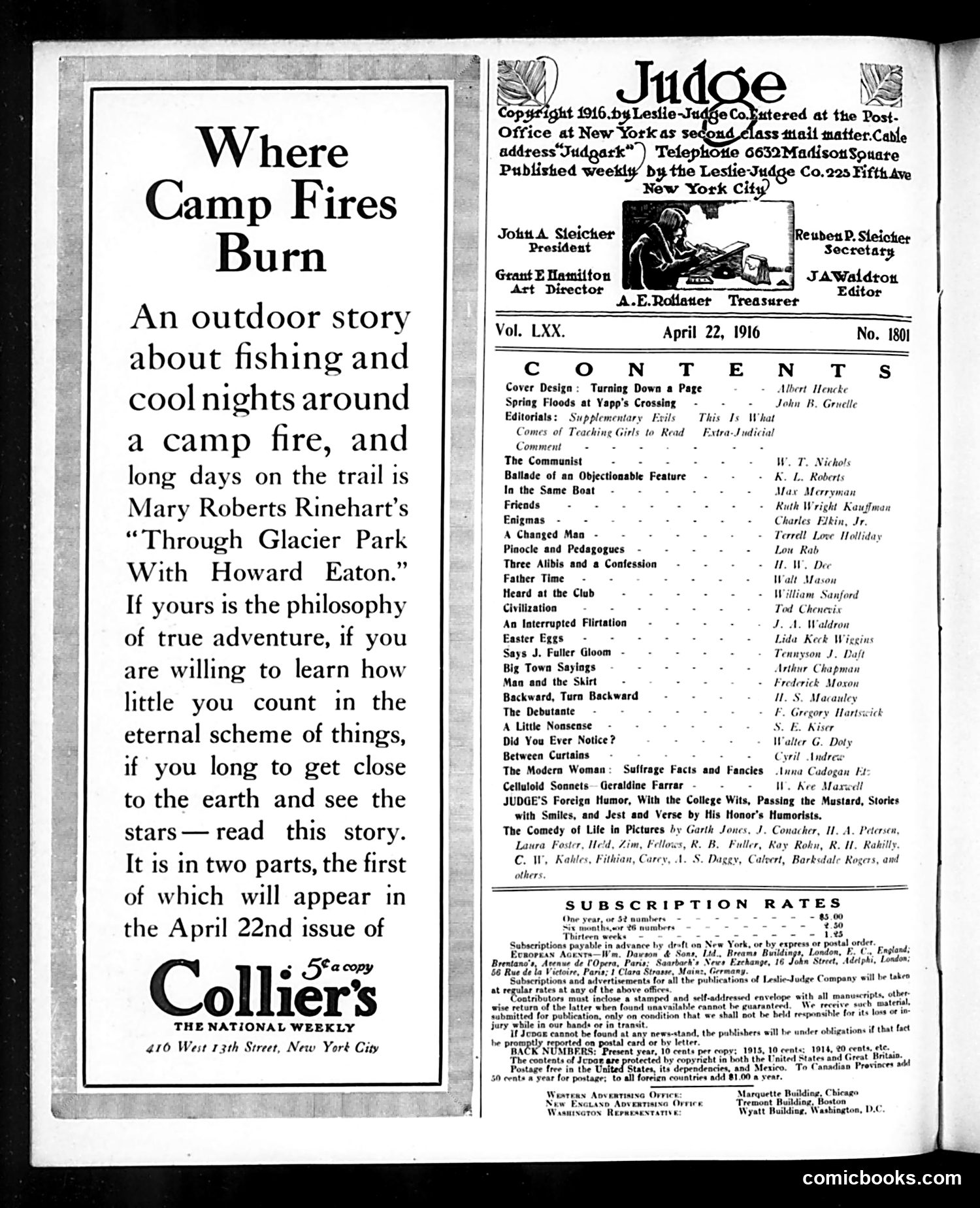
This page is primarily **advertising and editorial content** rather than political satire. The left side advertises a serialized story titled "Where Camp Fires Burn" by Mary Roberts Rinehart, promoting outdoor adventure fiction in *Collier's* magazine (5¢ per copy). The right side shows the magazine's masthead, contents page, and subscription information for *Judge* itself. The contents list includes humor pieces, fiction, and satirical articles typical of the period—titles like "Enigmas," "A Changed Man," and "The Debutante" suggest light social commentary. No specific political figures or caricatures are evident on this page. It represents routine magazine business operations from 1916.
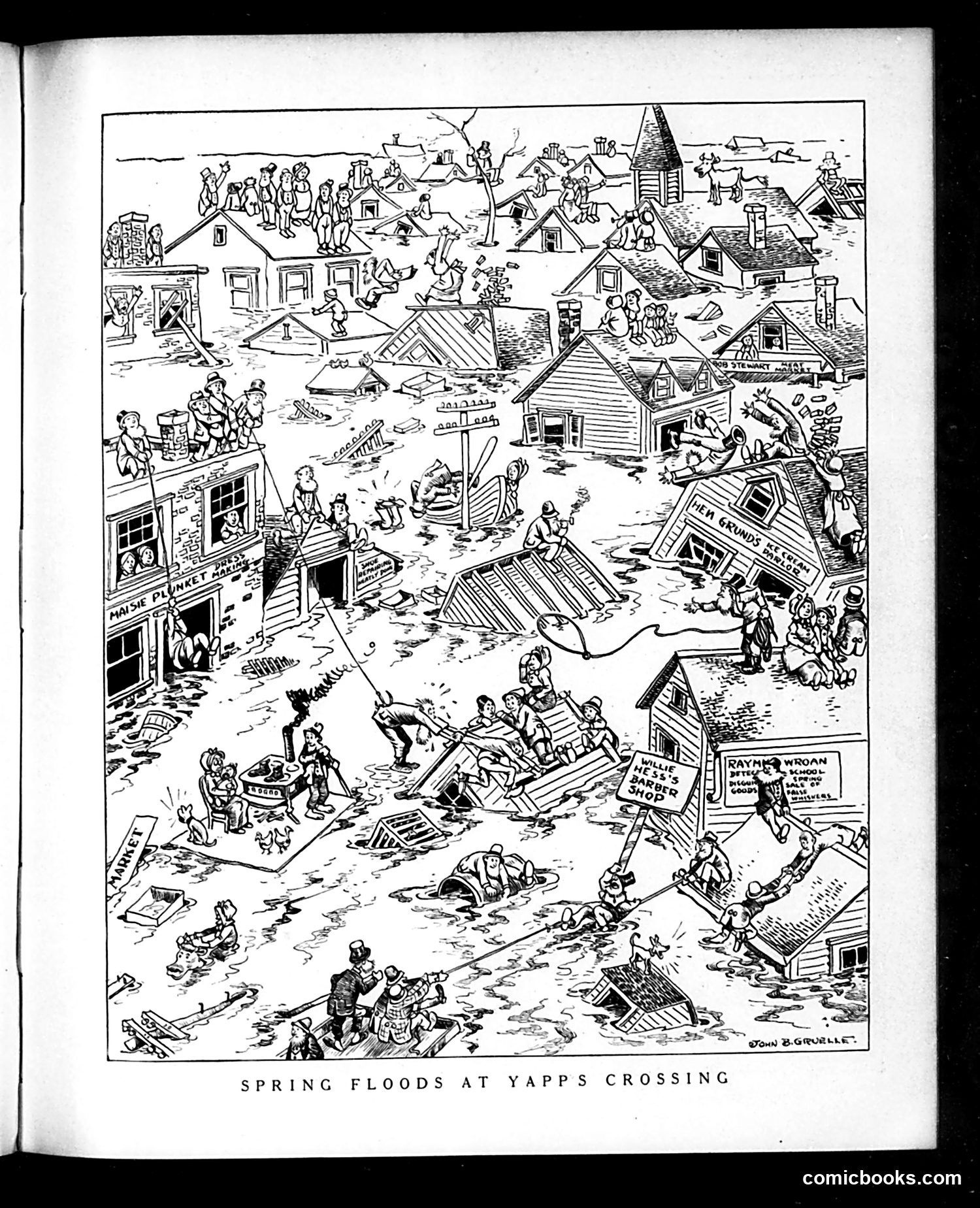
This cartoon depicts a devastating spring flood in a small American town, showing the chaos and destruction when rising waters overwhelm a riverside community. The illustration captures multiple scenes of disaster: houses collapsing or submerged, people struggling in floodwaters, families on rooftops, and residents attempting rescue efforts. Various buildings labeled with shop signs are partially destroyed. The satire appears to critique inadequate disaster preparedness and response—showing the community in disarray rather than organized relief. The artist (signed "Gould B Gruelet") uses exaggerated details of human suffering amid natural catastrophe to comment on vulnerability to seasonal flooding and possibly the government or local authorities' failure to provide proper protection or infrastructure.
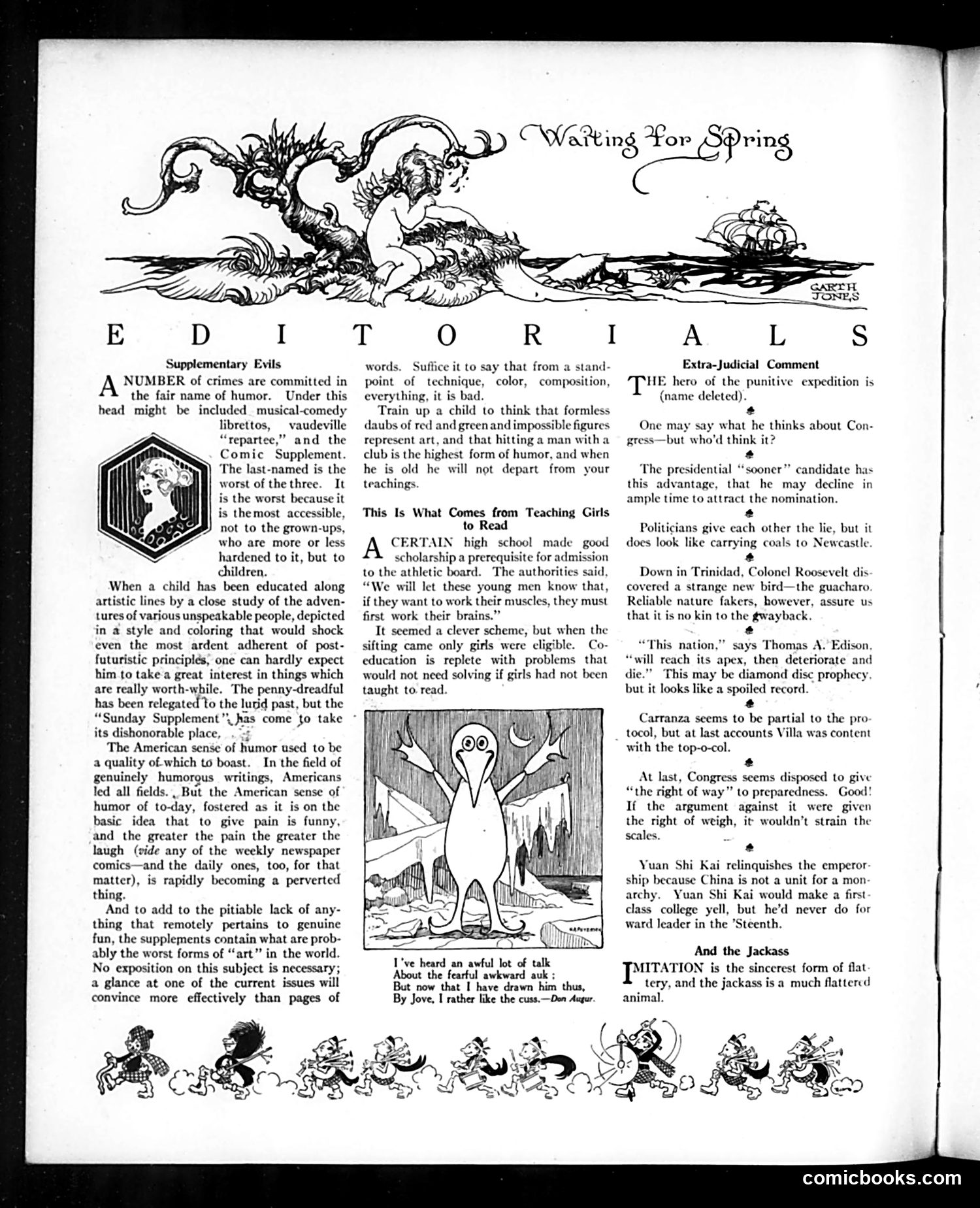
This Judge magazine editorial page critiques American humor and popular culture. The main cartoon depicts an awkward, elongated figure—likely representing poorly executed artistic humor or "formless daubs" mentioned in the text. The editorials mock: 1. **Supplementary Evils**: Criticizes librettos and vaudeville "regrets" as lowest-form humor accessible only to children, arguing genuine American humor should make pain funny rather than just depict unpleasant people. 2. **Teaching Girls to Read**: Satirizes a high school's claim that teaching boys to work muscles before brains is preferable. The irony: when only girls qualified for scholarships, education suddenly seemed unnecessary. 3. **Political Commentary**: Brief jabs at Congressional decisions, Edison's prophecies, and Yuan Shi Kai's actions in China. The page reflects early 20th-century debates about cultural standards and gender education.
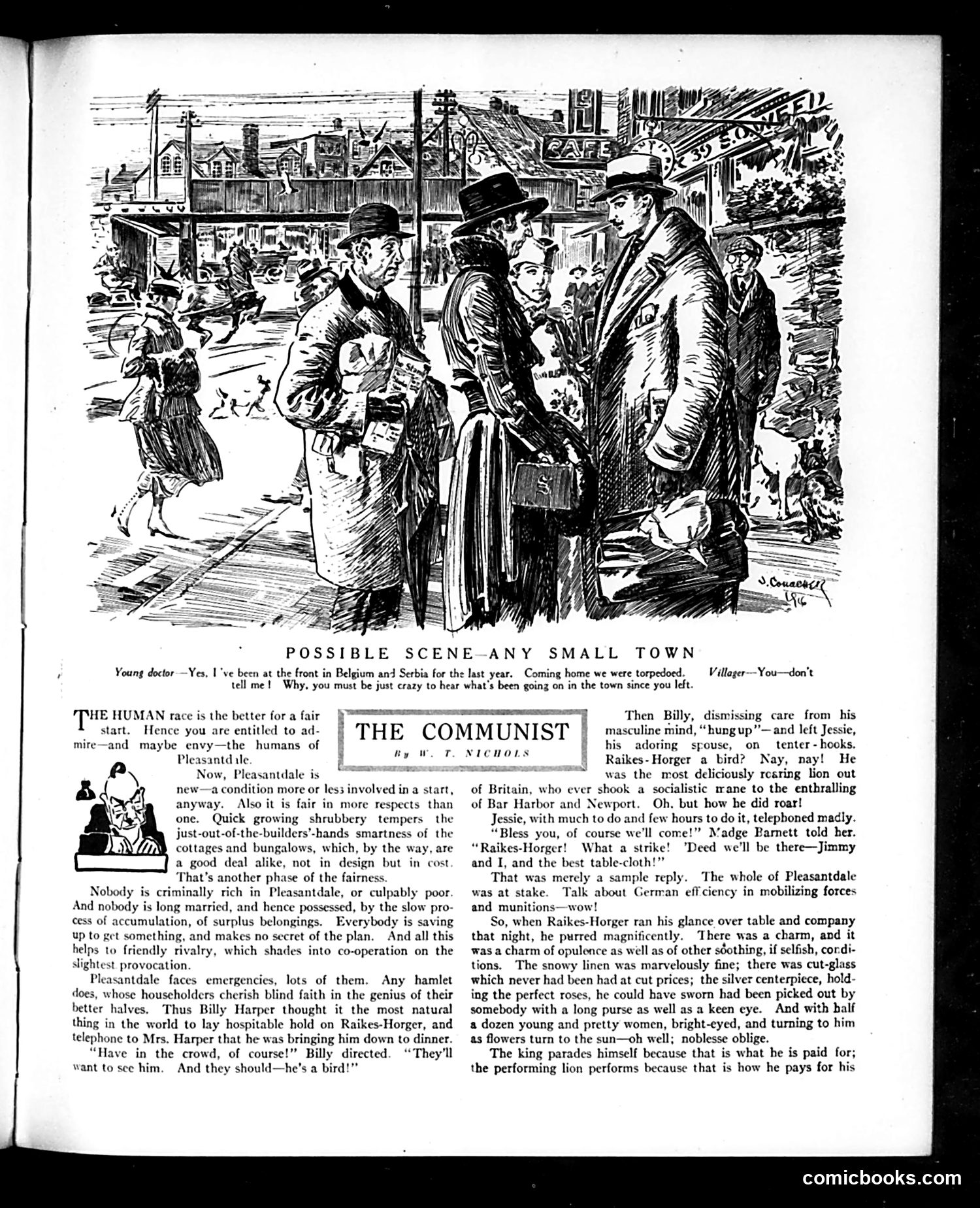
The top illustration depicts "A Possible Scene—Any Small Town," showing a young doctor returning from WWI service in Belgium and Serbia, shell-shocked and traumatized. He's being questioned by villagers about his experiences. The accompanying story, "The Communist" by H.T. Nichols, satirizes post-war American anxieties about socialism. It follows Billy Harper, a working-class man in "Pleasantdale" who becomes radicalized after observing wealth inequality. The narrative mocks both communist ideology and the town's dismissive attitude toward labor concerns, suggesting that communism attracts ordinary citizens through legitimate grievances about economic fairness rather than ideological conversion. The satire targets early 1920s American fears of Bolshevism while questioning whether such movements arise from genuine social problems.
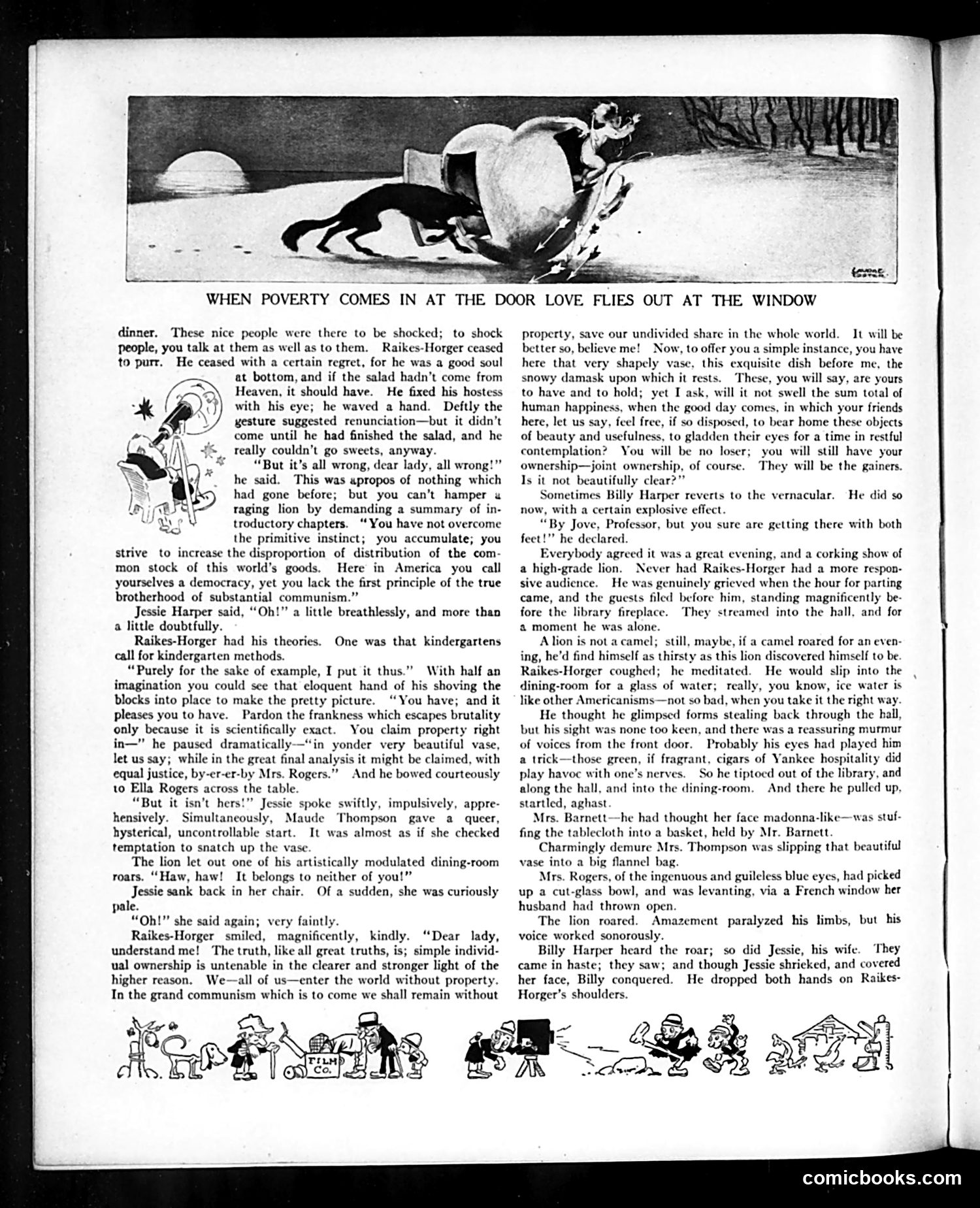
This page satirizes a wealthy socialist intellectual ("Raikes-Horger") lecturing his dinner hosts about communal property ownership. The cartoon's title—"When Poverty Comes In at the Door Love Flies Out at the Window"—suggests the hypocrisy: while preaching that private property should be surrendered to collective ownership, Raikes-Horger himself is comfortable in the wealthy household. The satire targets "parlor socialism"—fashionable radical rhetoric adopted by privileged people who have no intention of actually surrendering their possessions. When he argues that the beautiful vase shouldn't belong to anyone individually, the guests are visibly uncomfortable, and one woman (*Maude Thompson*) appears tempted to steal it, exposing the logical absurdity of his position. Judge mocks both the pretentious intellectual and the naive wealthy, suggesting socialism's appeal relies on theoretical abstraction divorced from human nature and actual practice.
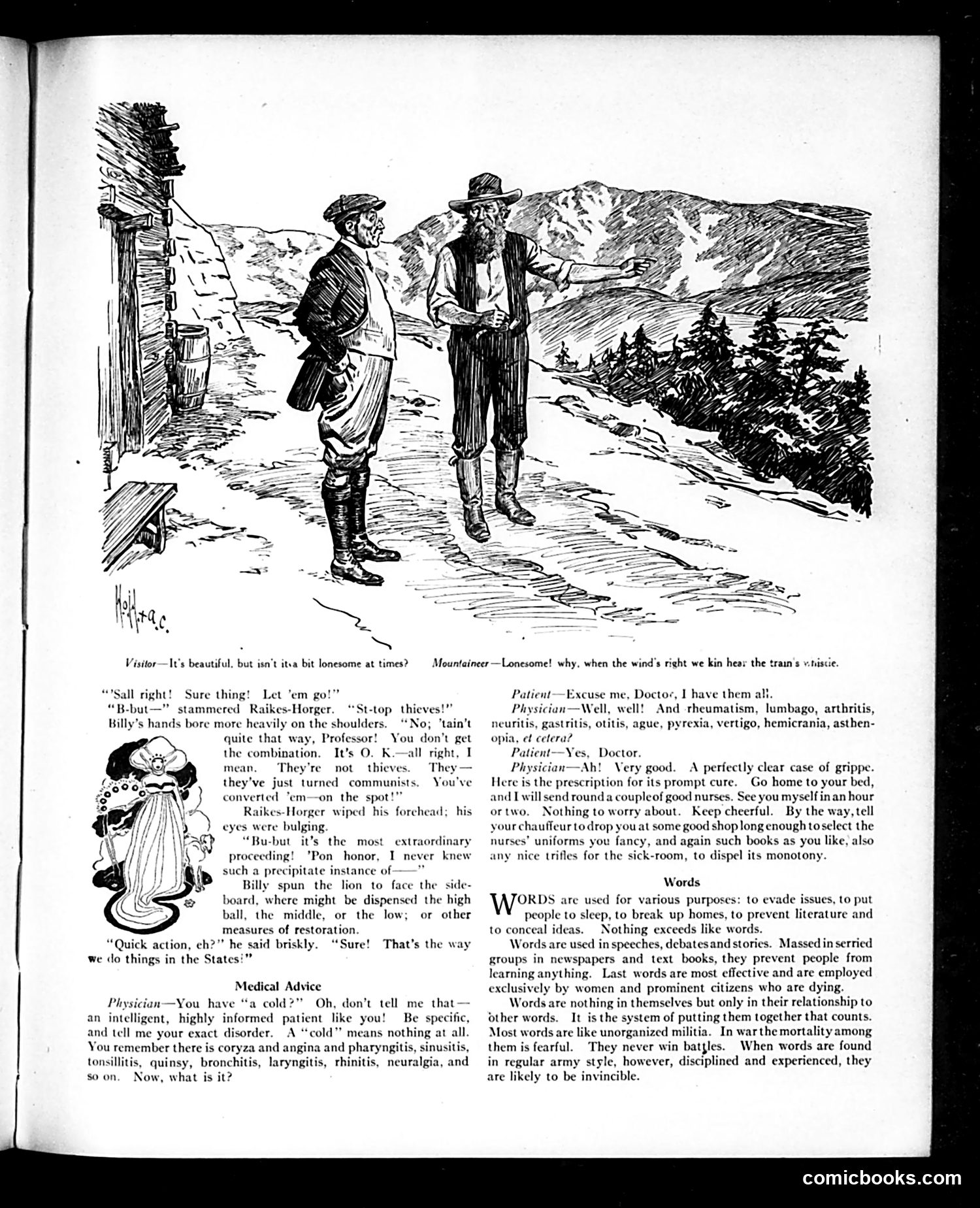
**Top Cartoon:** A convert to communism ("converted 'em—on the spot!") has stolen from a visitor's home. The satire targets early 20th-century American anxieties about communism as a corrupting ideology that turns respectable people into thieves. The irony: a European intellectual (likely Professor Raikes-Horger) inadvertently radicalized someone through abstract philosophy, leading to practical criminality. This reflects Judge's conservative stance mocking both communist ideology and naive intellectuals. **Bottom Section:** "Medical Advice" lampoons pretentious doctors who use obscure Latin medical terminology (coryza, angina, pharyngitis, etc.) to impress patients rather than diagnose clearly. The patient's admission of having *all* these conditions simultaneously exposes the doctor's superficiality. The punchline—prescribing rest, nurses in fancy uniforms, and leisure reading—suggests wealthy patients receive performative rather than genuine medical care. This is social satire on class-based medical practice and professional pomposity.
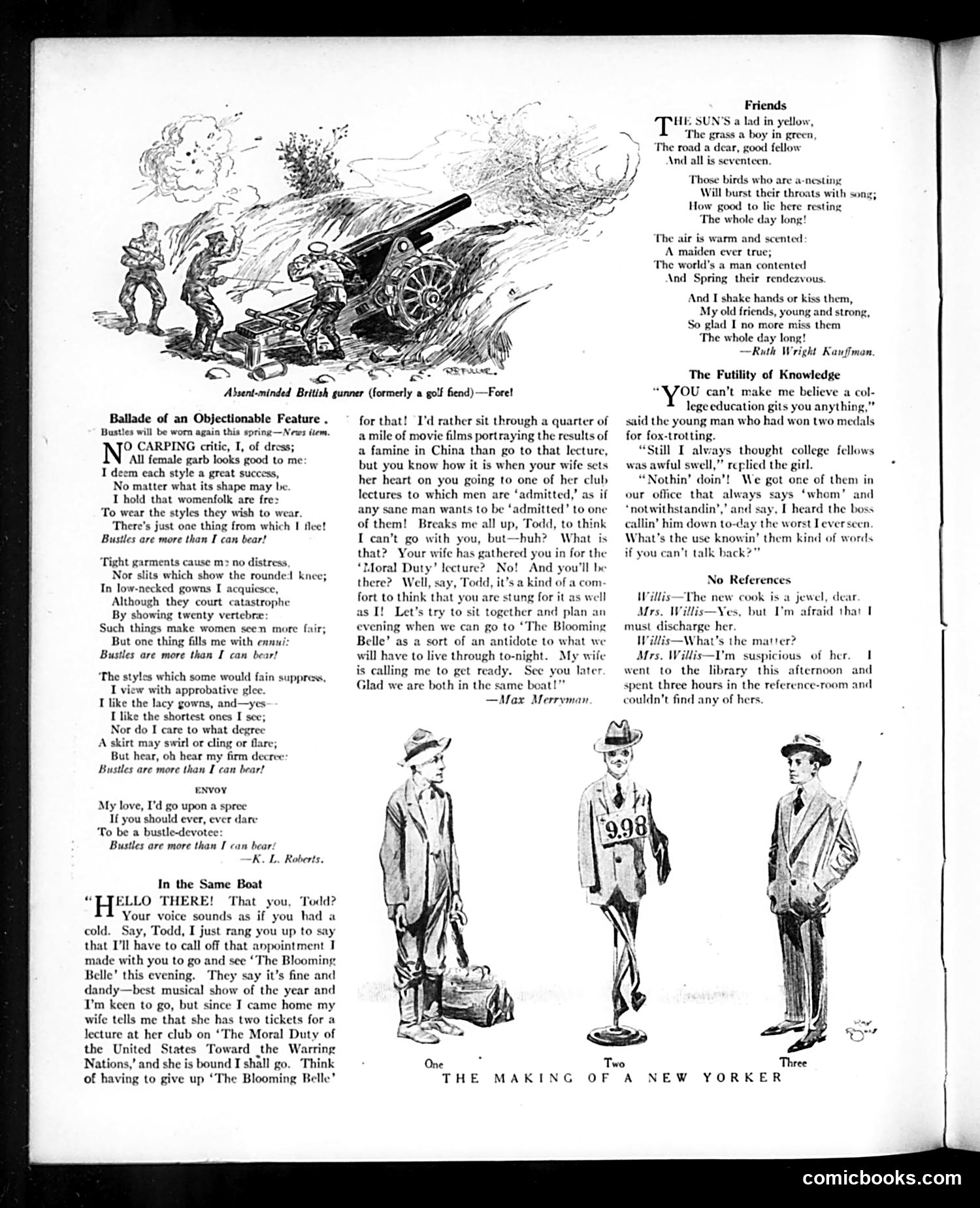
This page contains several satirical pieces typical of early 20th-century American humor: **"Ballade of an Objectionable Feature"** mocks the return of bustles in women's fashion. The poet claims acceptance of all female styles—tight garments, short skirts, low necklines—yet draws the line at bustles, expressing exasperation through the repeated refrain "Bustles are more than I can bear!" The satire lies in the contradiction: he accepts genuinely controversial fashions but rejects the bustle specifically. **"In the Same Boat"** depicts two men commiserating over being forced by their wives to attend a tedious lecture on "The Moral Duty of the United States Toward the Warring Nations" instead of seeing the musical show "The Blooming Belle." The humor targets henpecked husbands and wives who use their club activities to enforce mandatory attendance at dull, morally improving events. **"The Futility of Knowledge"** satirizes a college-educated young man who won dance medals but mocks grammar and proper speech. A girl expresses admiration for college men, but he argues that knowing formal grammar ("whom," "notwithstanding") is useless if you can't speak colloquially—poking fun at impractical education.
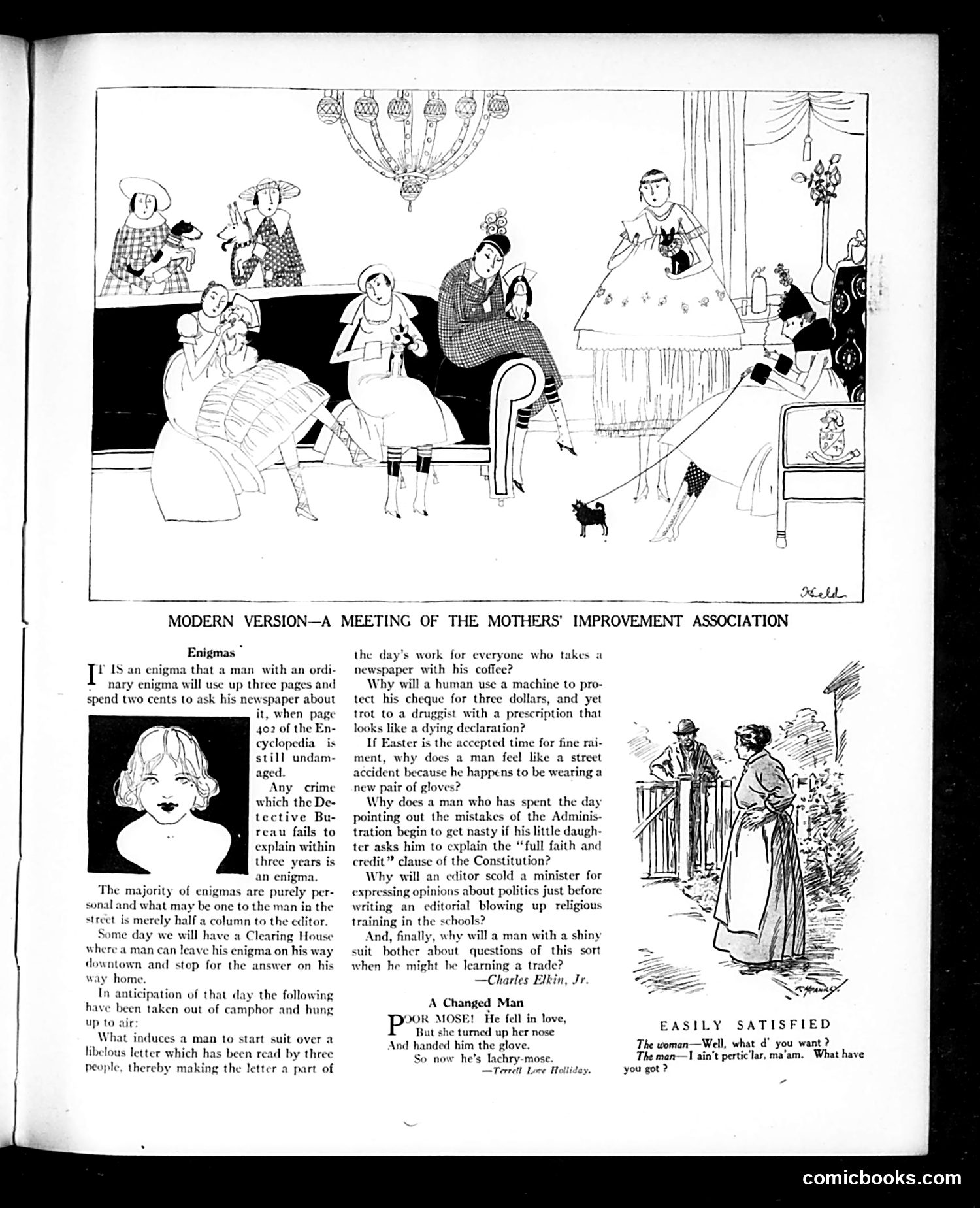
**Top Cartoon:** "Modern Version—A Meeting of the Mothers' Improvement Association" depicts women (mothers' club members) gathered in a domestic setting, socializing while attending to children and pets. The satire targets the Progressive Era trend of women's civic organizations claiming to improve society, suggesting they're more focused on gossip and socializing than actual reform work. **Text Section "Enigmas":** A humorous column by Charles Elkin Jr. listing absurd contradictions in everyday behavior—why people consult newspapers over encyclopedias, why men fret over new gloves, why fathers resist explaining the Constitution to daughters. The satire mocks human irrationality and hypocrisy, particularly targeting male inconsistency in logic and civic engagement. **"A Changed Man":** A brief verse about a man who became tearful ("lachry-mose") after romantic rejection. **"Easily Satisfied":** A working-class joke where a man shows no preference when asking what's available—suggesting contentment or lack of ambition. The page satirizes middle-class social pretensions and human behavioral contradictions typical of Judge's humor.
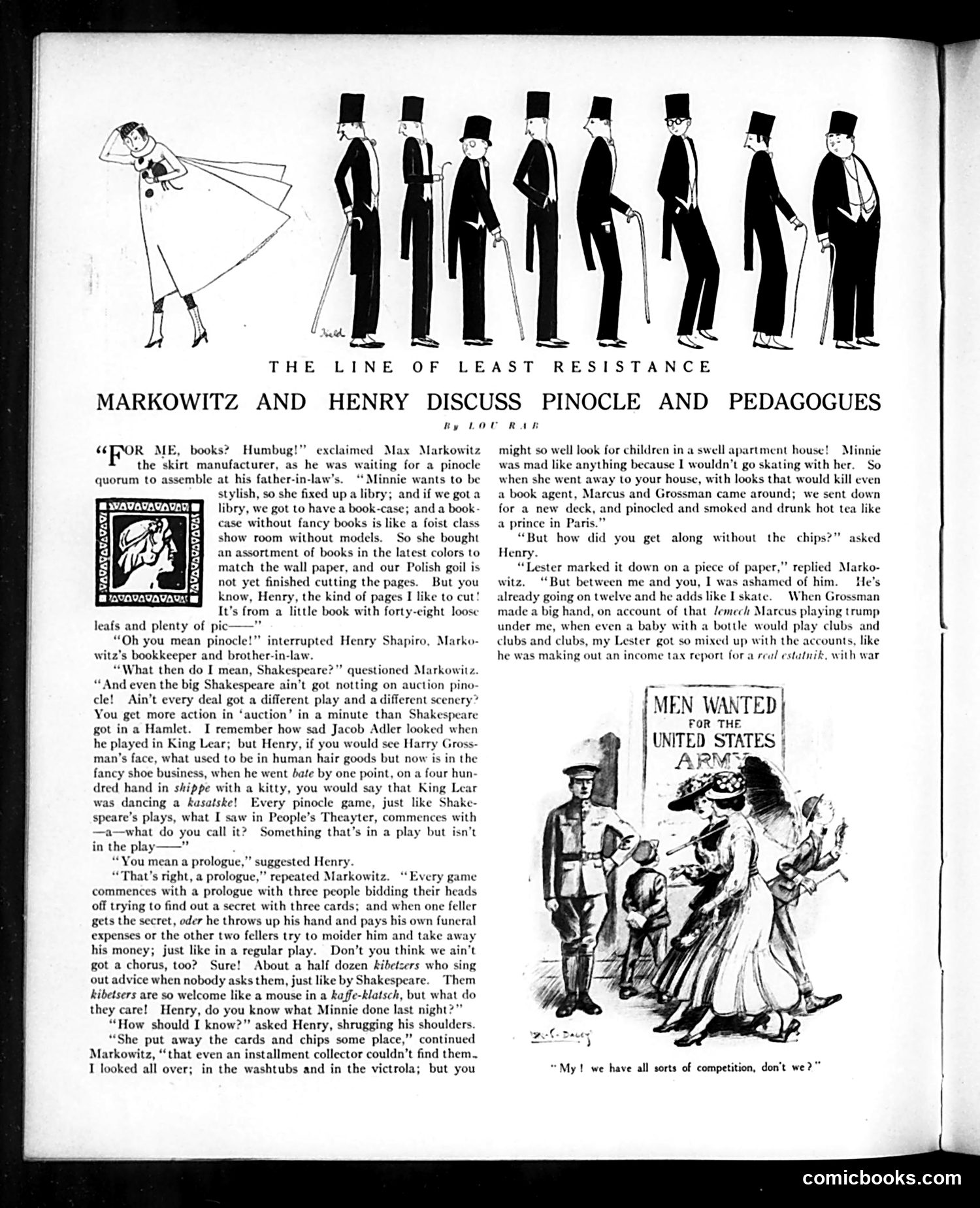
This Judge magazine page satirizes Jewish immigrant life in early 20th-century America through a dialogue between Max Markowitz (a skirt manufacturer) and Henry Shapiro (his bookkeeper and brother-in-law). **The Satire:** Markowitz complains that his wife Minnie bought fancy books solely to match wallpaper—not to read. The men then compare pinochle (a card game) to Shakespeare's theatrical works, arguing the card game offers superior drama and action. This mocks both the pretensions of newly wealthy immigrants adopting "cultured" furnishings and their preference for gambling entertainment over genuine literature. **Key References:** "Pinocle" is a popular working-class card game; mentions of Jacob Adler and King Lear reference Yiddish theater; "kibitzers" are unsolicited advice-givers; the anecdote about hiding chips from his wife and using his young son (Lester) as an accountant reinforces stereotypes about Jewish families and financial dealings. The accompanying Army recruitment ad provides period context but appears unrelated editorially.
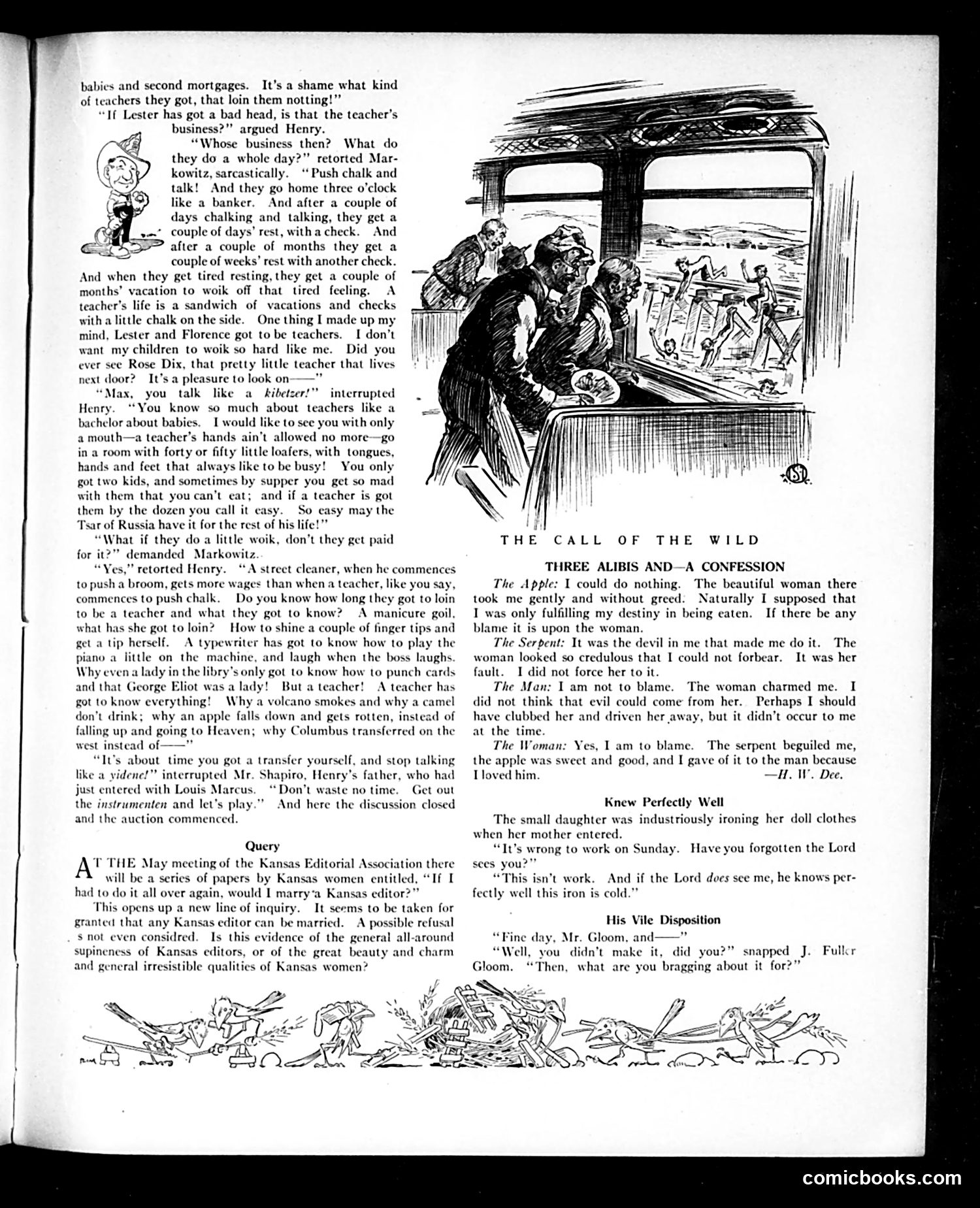
This page satirizes **immigrant working-class perspectives on American labor and education**. The main dialogue features characters with Yiddish-inflected English (Markowitz, Henry) debating whether teachers have easy jobs. Markowitz argues teachers work minimally—just "push chalk and talk"—then enjoy constant vacations and checks. Henry counters that teachers actually work exhaustingly hard, managing dozens of rowdy children and needing extensive education. The satire targets **class resentment and ignorance**: Markowitz's dismissive view reflects working-class frustration with visible leisure time, while Henry's defense exposes the actual demands teachers face. The "kibitzer" (busybody) insult adds authentic ethnic humor. Below, a separate section titled "Three Alibis—A Confession" humorously reframes the Adam and Eve story as three perspectives avoiding blame for the Fall, likely mocking how people rationalize moral failures. The Kansas Editorial Association query about marrying editors is lighter social satire about regional gender dynamics.
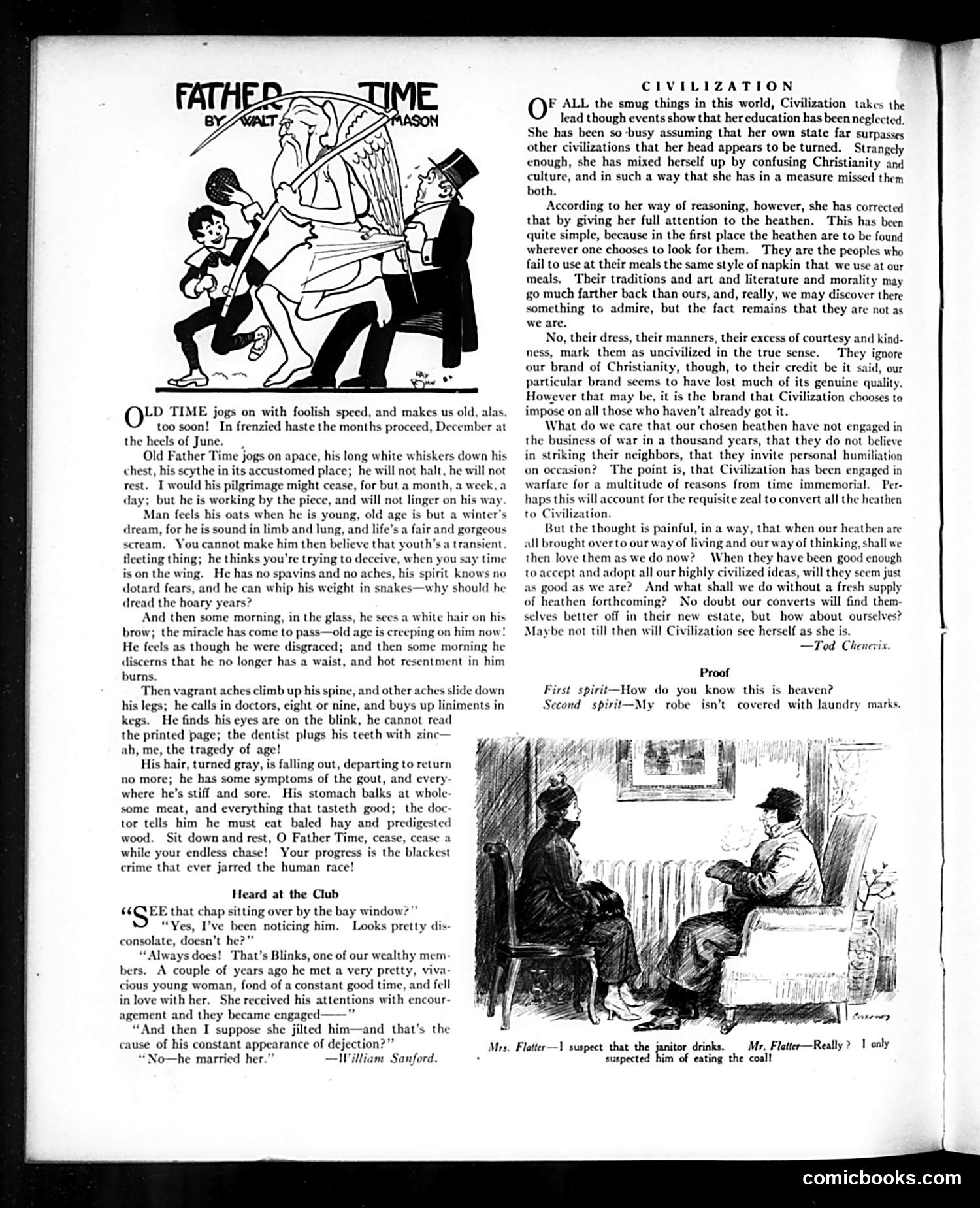
**"Father Time" (top):** This poem by Walt Mason uses personified Father Time as a vehicle for lamenting aging. The cartoon shows Time as a skeletal, scythe-carrying figure, with men clinging to him desperately—likely representing humanity's futile struggle against mortality and decay. The piece catalogs aging's indignities (gray hair, dental problems, digestive issues) with dark humor typical of early 20th-century magazine satire. **"Civilization" (right column):** This editorial piece critiques Western "civilization's" self-satisfied hypocrisy. It argues that while Westerners pride themselves on superiority over "heathen" peoples, they've confused Christianity with mere cultural etiquette (napkin usage, dress codes). The author suggests non-Western civilizations possess equally valid moral and artistic traditions, exposing the arrogance underlying colonial-era assumptions about civilizational hierarchy. **"Heard at the Club":** A brief society joke about Blinks, a wealthy man whose misery stems not from romantic rejection but from actually marrying his love interest—suggesting marriage itself is the punchline.
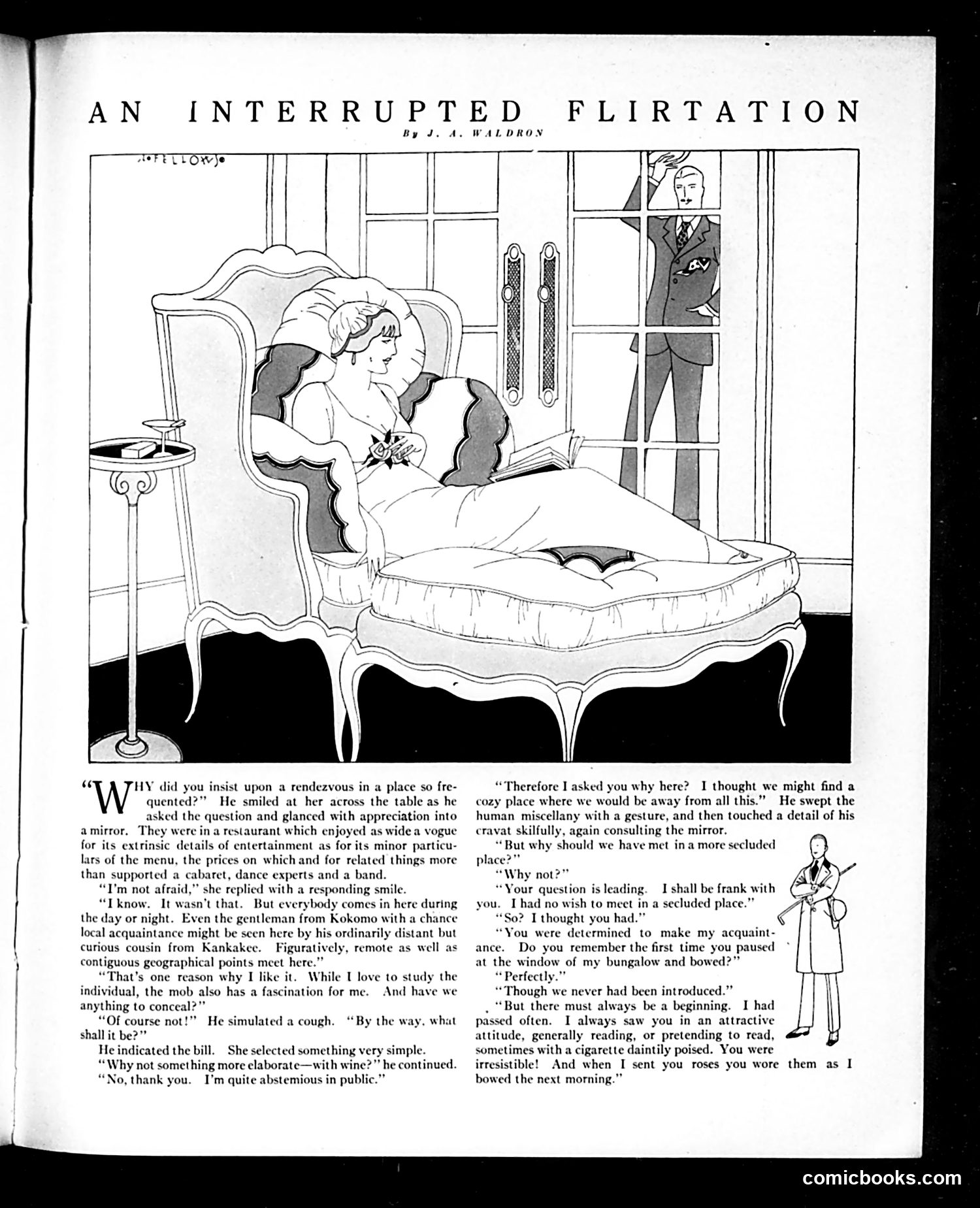
This is a humorous domestic drama about a man attempting to seduce a woman. The satire targets masculine vanity and deception: the man repeatedly consults a mirror while flirting, suggesting his self-absorption undermines his seduction attempt. The joke centers on social hypocrisy. He proposes meeting in a secluded location, but she calls him out—she *insisted* on the public restaurant specifically because she saw through his intentions. She then reveals she's been watching him from her bungalow window and that his romantic gestures (roses) were transparent attempts at manipulation. The humor lies in the woman's superior awareness and control. When he orders elaborate food and wine to impress her, she deliberately chooses something simple, further deflating his efforts. The "interruption" (suggested by the man visible outside the window) prevents whatever he was building toward, making his elaborate scheming pointless. The cartoon mocks early 20th-century male courtship rituals and male assumption that women are easily manipulated.
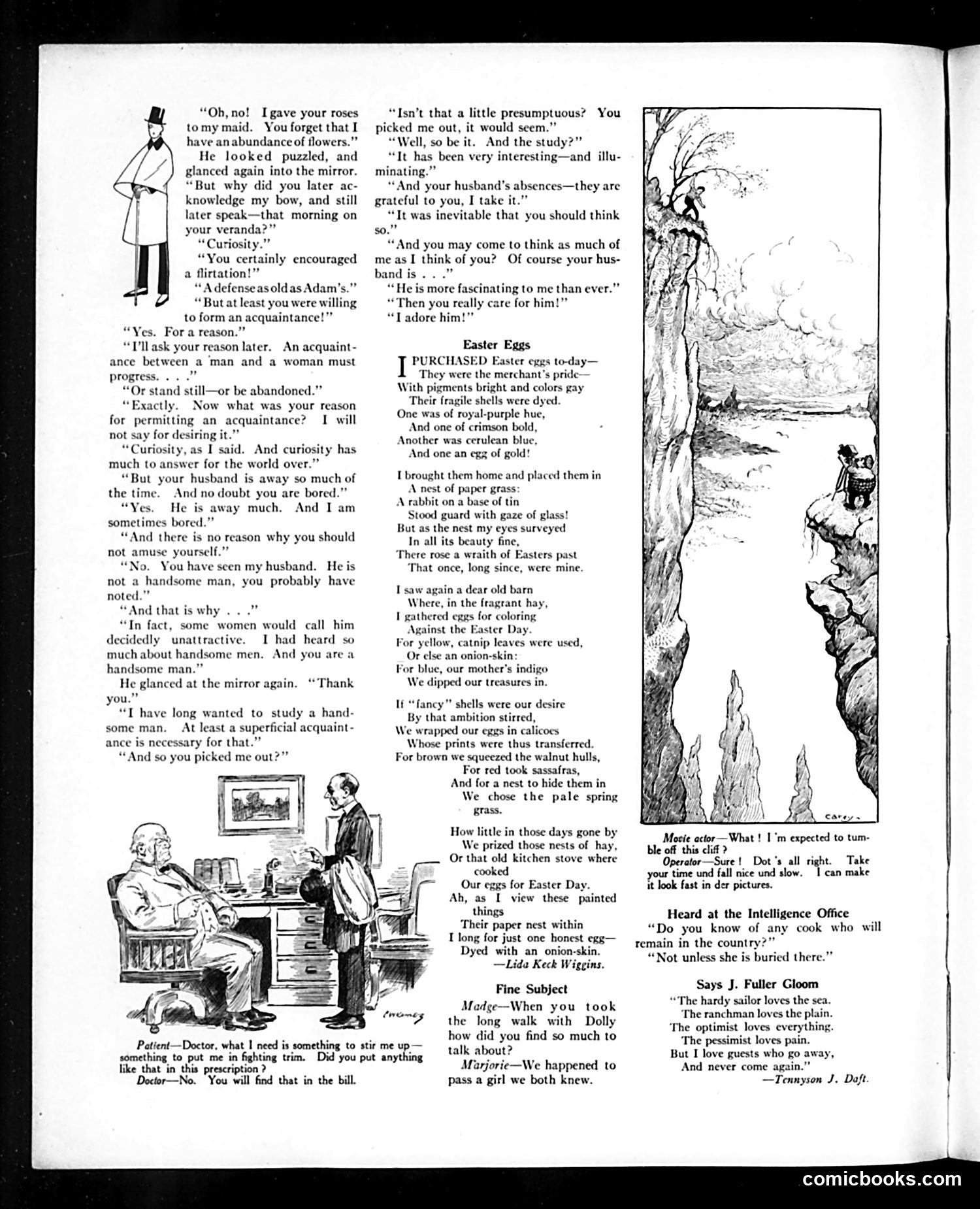
This page contains several distinct pieces of satirical content: **Main Dialogue Story** (top left): A flirtation scene where a woman admits she cultivated an acquaintance with a handsome man purely out of curiosity—to study "a handsome man" as a specimen. The satire targets vanity: the man repeatedly glances at mirrors while being essentially used as an object of study. The woman's ultimate revelation that she "adores" her less-handsome husband undercuts the man's ego entirely. **"Easter Eggs" Poem** (center/right): Nostalgic verse contrasting commercialized Easter eggs (dyed in merchant's pigments, artificial nests) with childhood memories of hand-dyed eggs using natural materials (onion-skins, indigo, walnut hulls). The satire critiques modern consumer culture's replacement of homemade, authentic traditions. **Bottom cartoons**: A patient-doctor exchange satirizes medical bills (the "cure" is in the cost, not medicine), and a brief joke about film production fakery. The page exemplifies Judge's satirical approach: mocking vanity, commercialism, and modern affectation through wit and nostalgic contrast.
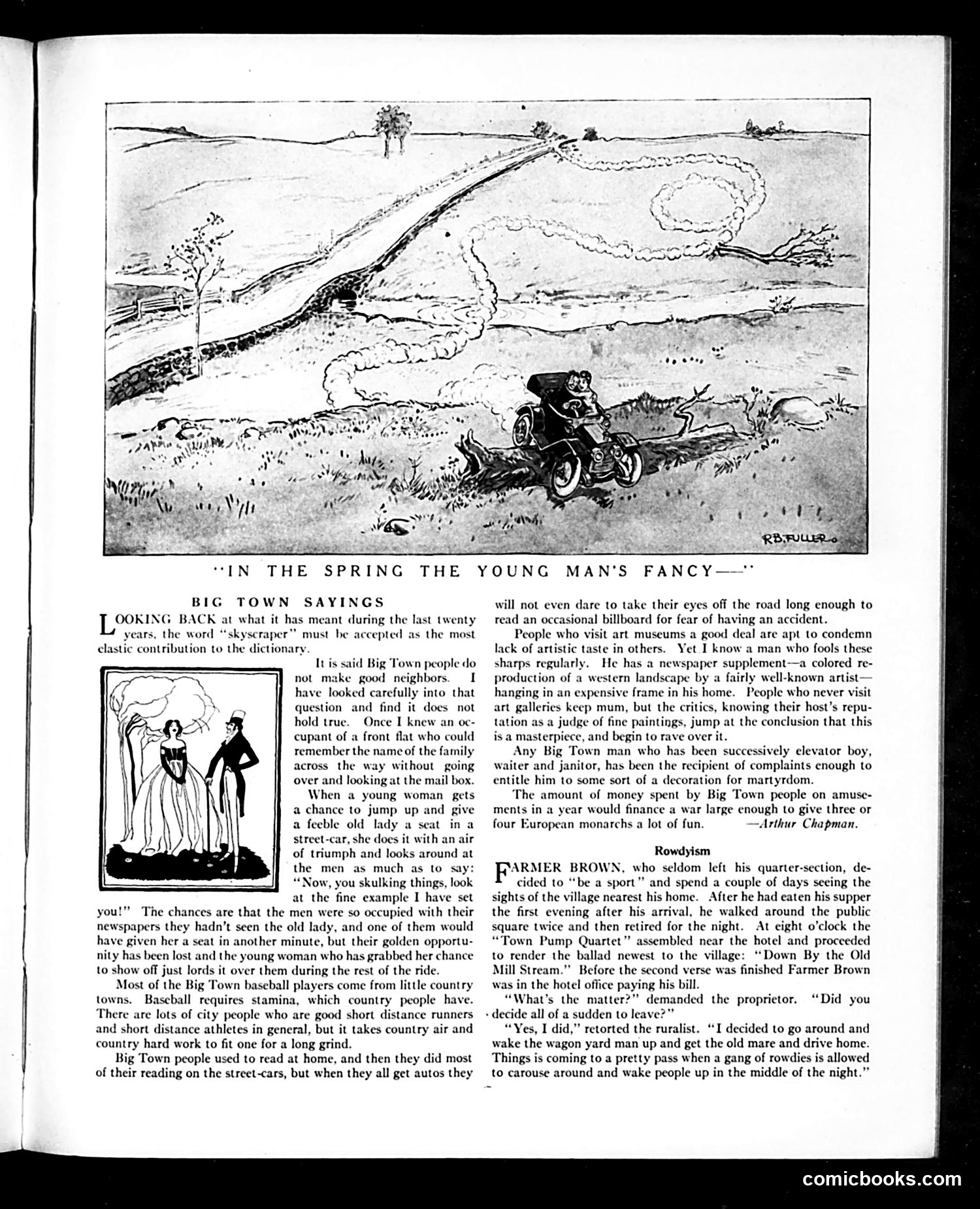
This page from *Judge* contains two satirical pieces mocking urban American behavior circa early 1900s. **Top cartoon**: Illustrates the section "Big Town Sayings"—a series of observations about city dwellers' social hypocrisy. The drawing shows a man in an automobile, referencing the text's point that car owners are too focused on driving to read billboards, unlike street-car passengers. The overall commentary criticizes Big Town people for performative kindness (like young women theatrically offering seats to elderly ladies), artistic pretension (owning reproduction landscapes to fool art critics), and neglecting home reading for street-car literature. **Bottom section ("Rowdyism")**: A rural farmer visits a small town, experiences rowdy nightlife (a quartet singing loudly at night), and immediately flees—rejecting "sport" and urban disorder for rural peace. The humor targets small-town rowdiness as intolerable, contrasting with the upper section's urban critiques. Together, these pieces satirize both city and country life's failings, suggesting nowhere escapes American social absurdity.
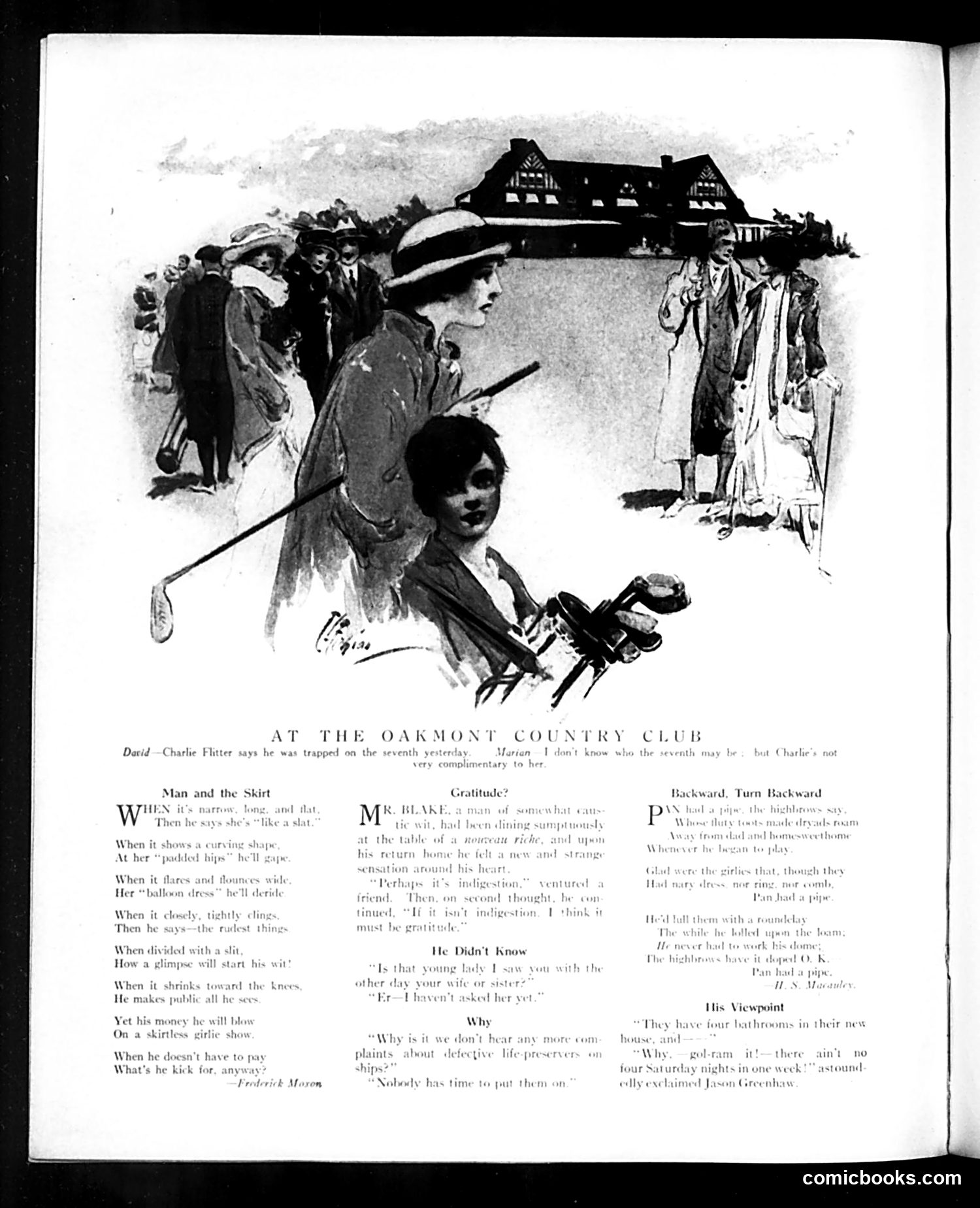
This page features social satire about gender dynamics and fashion, centered on the "skirt" — likely referring to the increasingly shorter women's hemlines of the 1920s era (the "flapper" period). The main illustration depicts a woman in modern dress at an exclusive country club, surrounded by disapproving onlookers and a grand building. The satirical poems mock both the new fashion and male reactions to it: - "Man and the Skirt" humorously catalogs how men complain about women's clothing choices — the skirt's shape, how it moves, its brevity — yet contradictorily desire to see it. - The other verses ("Gratitude?" "Backward, Turn Backward") appear to satirize men's nostalgia for "proper" old-fashioned dress while simultaneously being fascinated by modern women's appearance. The satire targets masculine hypocrisy: men simultaneously criticizing women for immodesty while being unable to look away. It reflects early-20th-century anxieties about changing gender norms and women's increasing social freedom.
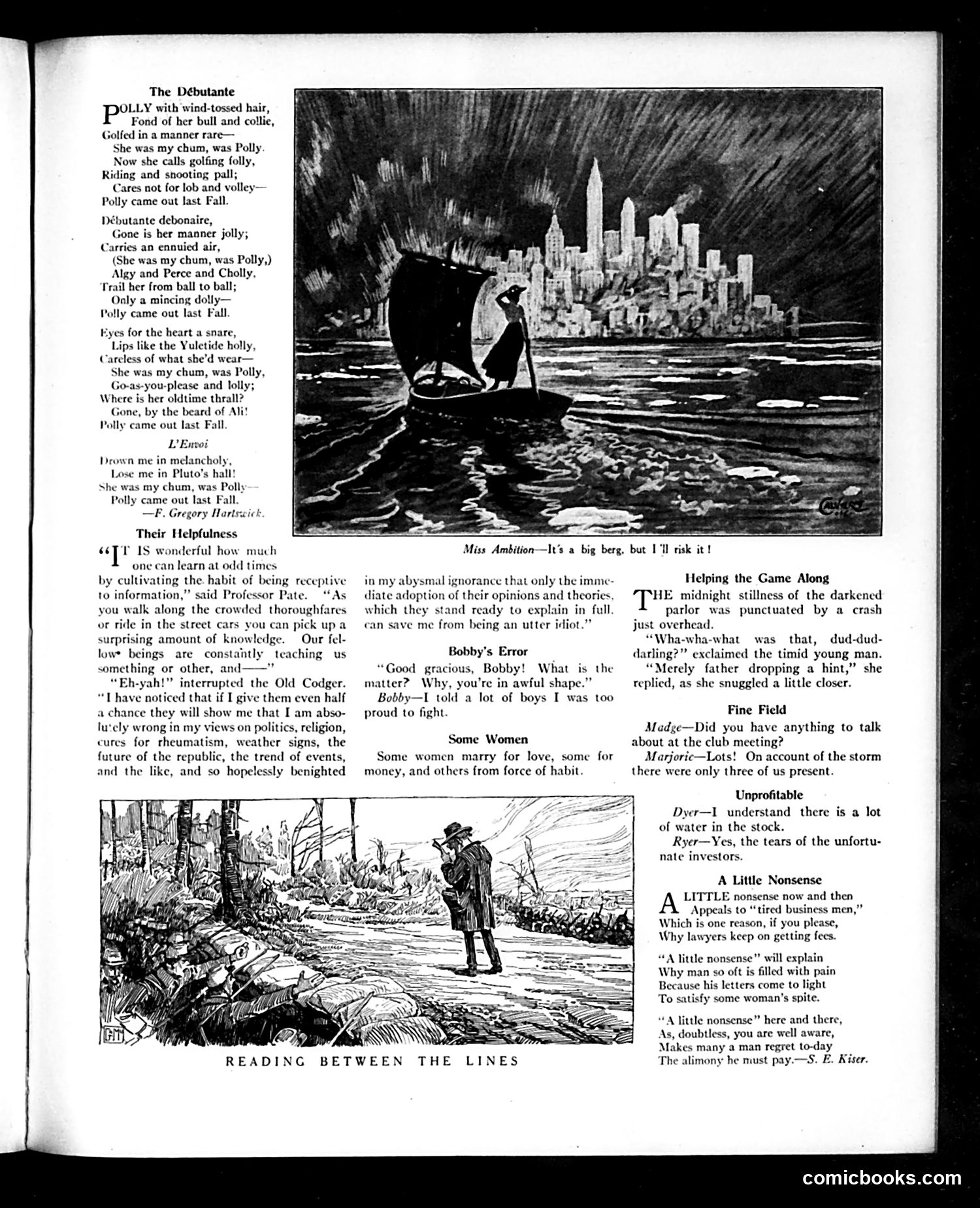
This page contains multiple satirical pieces typical of early 20th-century American humor: **"The Débutante"** (poem with illustration): A nostalgic critique of upper-class coming-of-age rituals. The poem laments how "Polly," once an athletic, carefree girl who golfed and rode horses, transforms into an affected debutante after her formal "coming out." She now affects boredom ("ennuied air"), chases eligible suitors (Algy, Perce, Cholly), and abandons her genuine interests—satirizing how the marriage market corrupts authentic female personalities. **The remaining short pieces** mock various social types: pompous professors dispensing unwanted advice; young men's romantic anxieties; women's gossip; stock market fraud; and marital/legal entanglements. The overall theme: satirizing upper-class pretension, social rituals, and the gap between genuine character and social performance. The humor relies on recognizing these familiar social types and their hypocrisies.
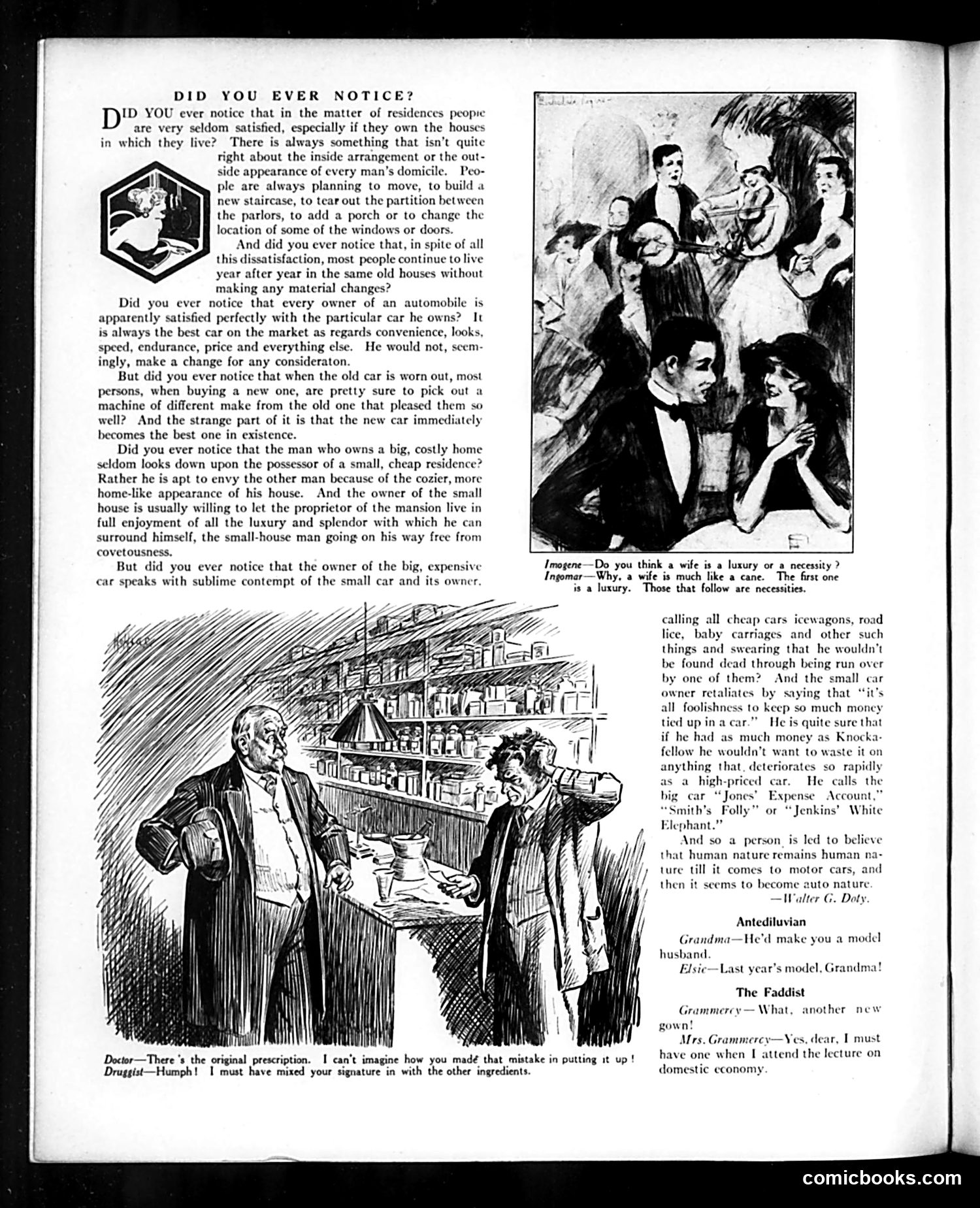
This essay-cartoon contrasts human nature regarding homes versus automobiles. The author observes that homeowners perpetually complain about their residences yet rarely renovate, accepting stagnation despite dissatisfaction. With cars, however, behavior reverses: owners claim absolute satisfaction with their current vehicle—until purchasing a new one of *different make*, which immediately becomes "the best one in existence." Most strikingly, the piece notes wealthy homeowners don't resent modest neighbors; small-house owners feel no envy. But expensive-car owners *despise* cheap-car owners, calling them "ice wagons" and "road lice," while small-car owners mock wealthy drivers as wasteful (referencing "Jones' Expense Account," "Smith's Folly"). The satire exposes automobile ownership as breeding *class contempt* uniquely—transforming human nature into what the author calls "auto nature." Cars apparently trigger status anxiety and snobbery absent in real estate, revealing early-20th-century anxieties about automobiles as status symbols.
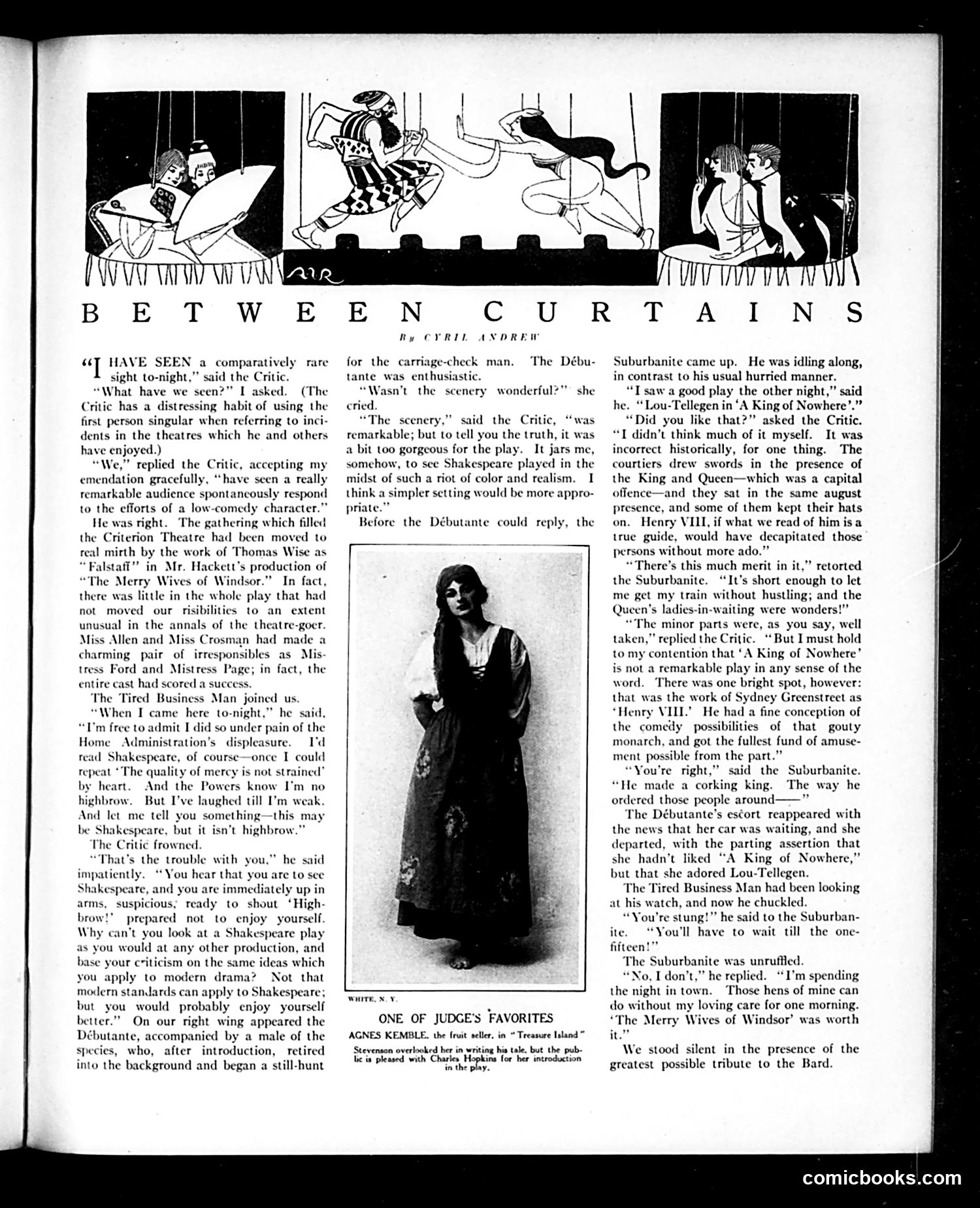
This article by Cyril Andrew satirizes different types of theater audiences and their approaches to Shakespeare. The Critic represents pretentious, overly analytical theatergoers who dismiss plays for historical inaccuracies and excessive scenery. The Tired Business Man embodies the ordinary worker forced by Home Administration policy (likely Prohibition-era restrictions on leisure) to attend theater, who simply enjoys the show without intellectual pretense. The Suburbanite exemplifies pedantic audiences who nitpick historical details while missing entertainment value. The satire's point: audiences shouldn't approach Shakespeare with defensive snobbery or exhausting fact-checking, but rather as accessible entertainment. The piece mocks the Critic's insistence that modern critical standards shouldn't apply to Shakespeare—suggesting some contemporaries overthought classic theater, preventing genuine enjoyment. The accompanying illustration shows theatrical performers and audience members in period dress.
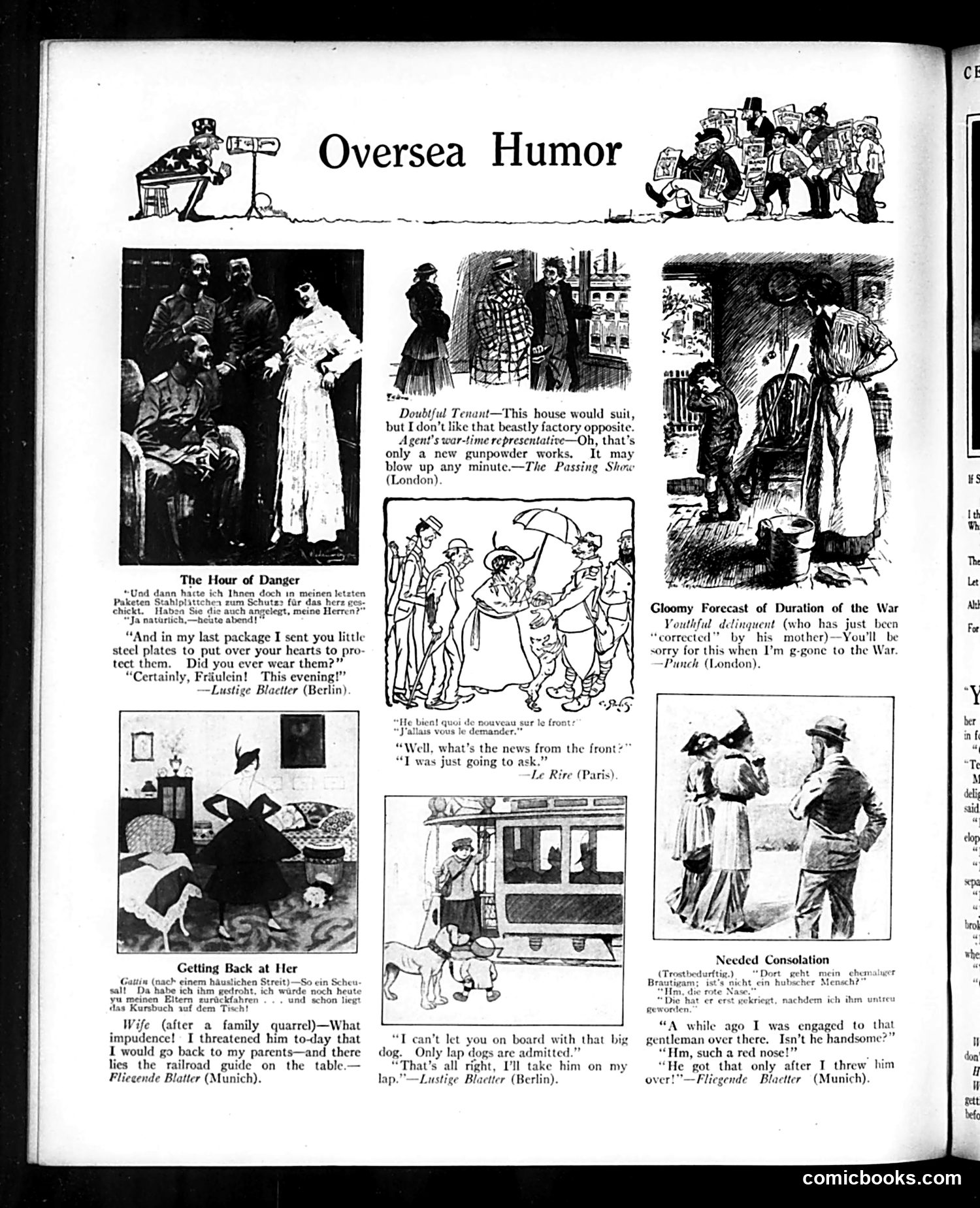
This page collects humorous cartoons from European publications during World War I, showcasing how different nations joked about wartime anxieties. **Key themes:** - **"The Hour of Danger"** (Berlin): Satirizes paranoia about enemy attack; a woman receives "steel plates" for heart protection—absurd but reflects genuine civilian fear. - **"Doubtful Tenant"** (London): Dark humor about munitions factories near housing; the agent casually mentions a gunpowder works might "blow up any minute." - **"Gloomy Forecast"** (Punch, London): A child threatens to join the war after punishment—gallows humor about conscription. - **"Getting Back at Her"** (Munich): Domestic squabble humor; unrelated to war but shows ordinary life continued. - **"Needed Consolation"** (Munich): A woman asks if her fiancé is handsome; his red nose comes from being thrown—pre-war comedic violence. The collection demonstrates how Allied and Central European publications used humor to process wartime stress and uncertainty.
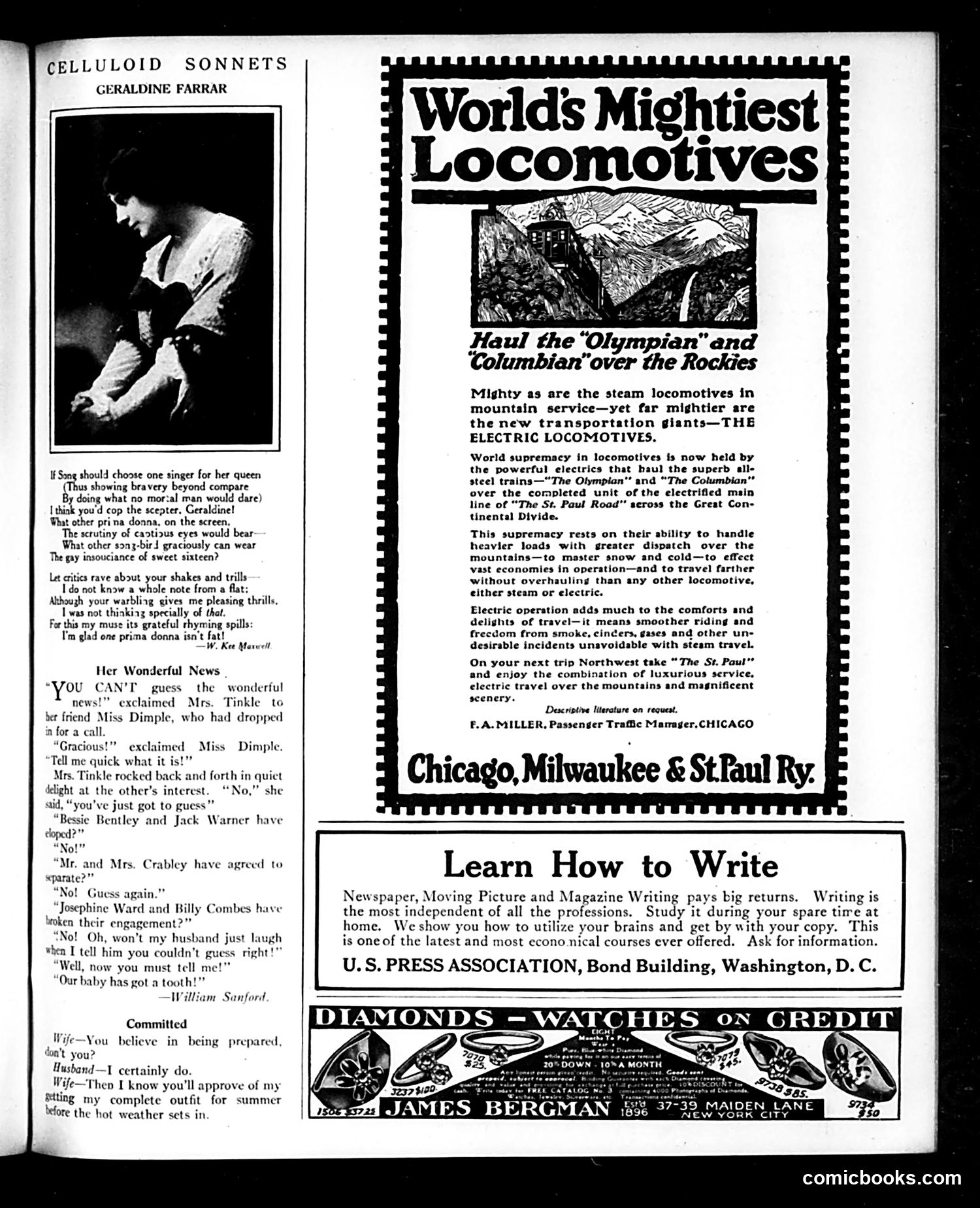
This page contains primarily **advertisements and light domestic humor** rather than political satire. The "Celluloid Sonnets" section celebrates **Geraldine Farrar**, a famous opera singer of the era, with humorous verse praising her vocal talent and appearance (notably, that she isn't overweight—a backhanded compliment typical of the period). The "Her Wonderful News" dialogue is genteel domestic comedy: Mrs. Tinkle teases Miss Dimple with gossip, building suspense before revealing anticlimactically that her baby cut a tooth. The major content is **commercial advertising**: a full-page railroad ad promoting the Chicago, Milwaukee & St. Paul Railway's new electric locomotives ("The Olympian" and "Columbian"), emphasizing their superiority over steam engines in mountain travel. Below that are ads for writing courses and jewelry on credit. The small "Committed" joke satirizes husbands' domestic anxiety—a husband agrees to prepare for summer, assuming his wife means practical matters, only to discover she means buying new clothes. No significant political content is present on this page.
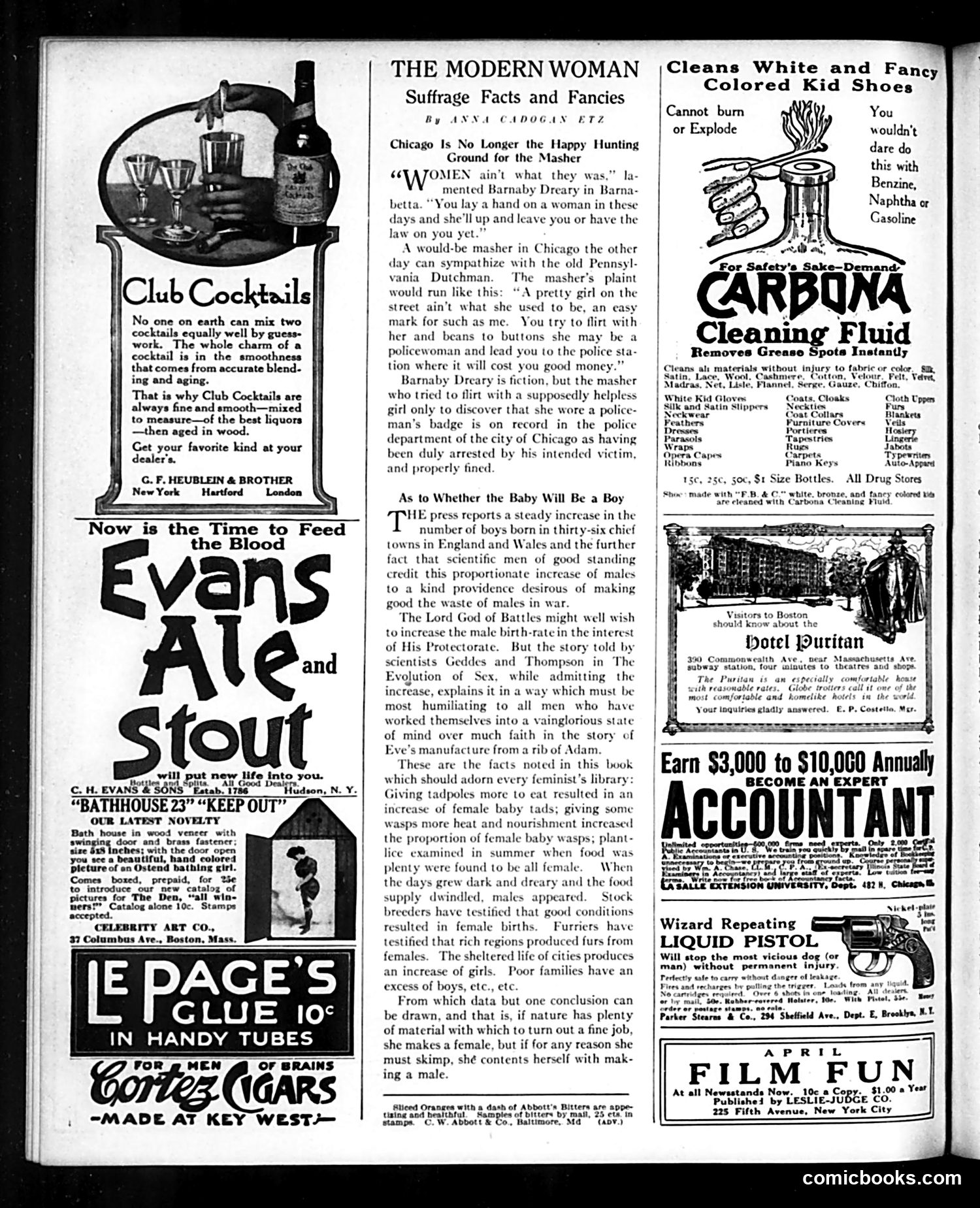
This page satirizes early 20th-century women's changing social power, particularly through suffrage activism. The main article "Chicago Is No Longer the Happy Hunting Ground for the Masher" mocks traditional male street harassment ("mashing") by highlighting a real case where a man attempted to flirt with a woman who turned out to be a plainclothes policewoman—arresting and fining him instead. The satire cuts both ways: it ridicules men losing their former social dominance while simultaneously mocking women's newfound authority. The second article uses pseudo-scientific claims about tadpoles and animals to argue that females are merely the "default" outcome when conditions are easy—implying women's advancement stems from comfort rather than merit. The advertisement-heavy page reflects Judge's commercial nature, with competing brands (Evans Ale, Carbona Cleaning Fluid, Hotel Puritan) occupying equal space. This juxtaposition of serious political commentary with mundane product pitches was typical of early 20th-century satirical magazines.
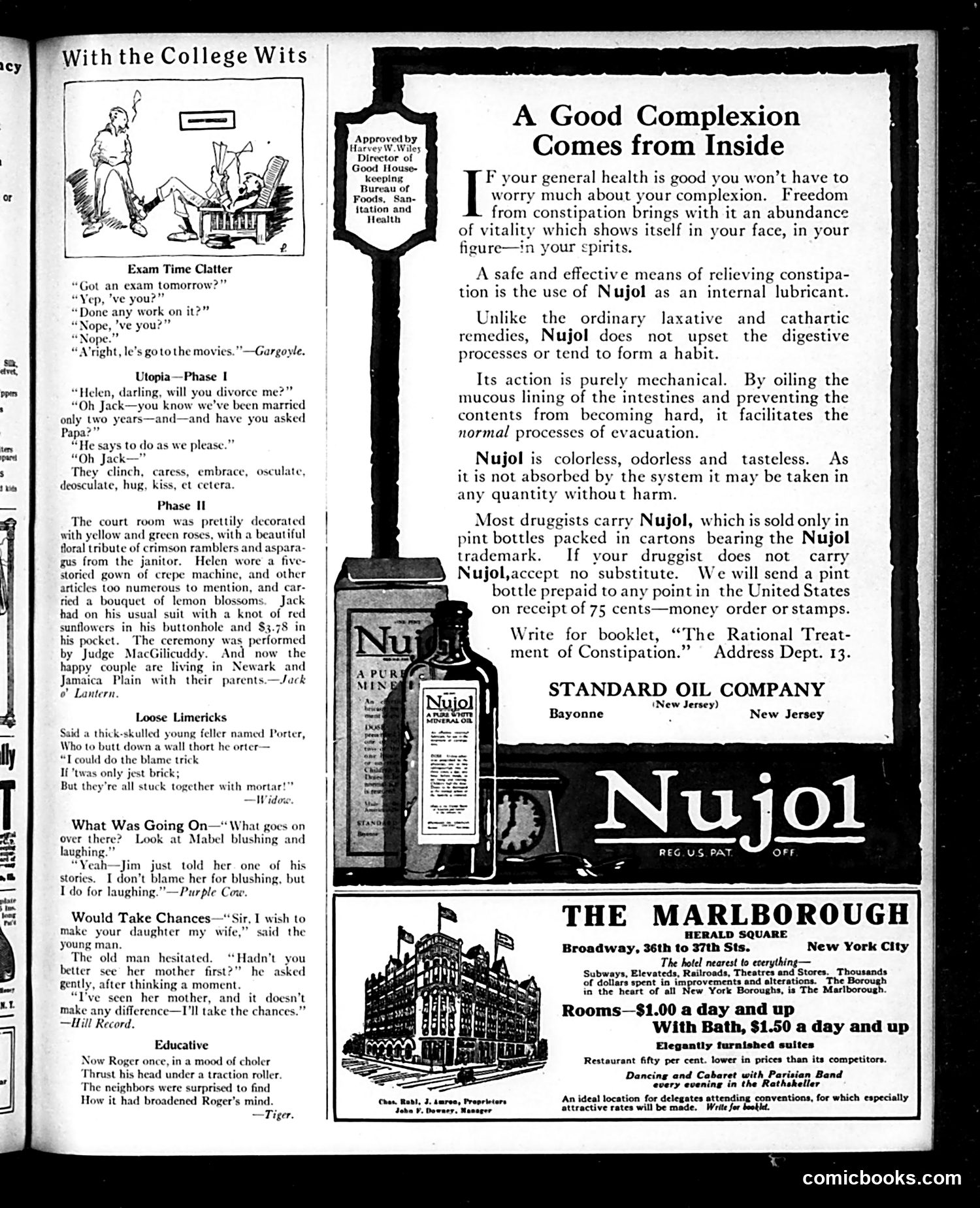
This page from *Judge* magazine contains several elements: **The cartoons/humor pieces** ("Exam Time Chatter," "Utopia," "Loose Limericks," etc.) are light college-humor sketches typical of the era—depicting students procrastinating before exams, a comedic courtroom divorce scene with excessive romantic gestures, and puns about everyday situations. These satirize young people's behavior and social conventions with gentle mockery. **The dominant content is advertising**: A full-page Nujol advertisement promoting a mineral oil laxative, and ads for The Marlborough Hotel in New York City. The Nujol ad connects good health and appearance—a marketing strategy linking constipation relief to facial beauty and vitality, reflecting early 20th-century preoccupations with digestive health. The humor and ads together reflect 1920s consumer culture and college life, with no apparent political satire on this particular page.
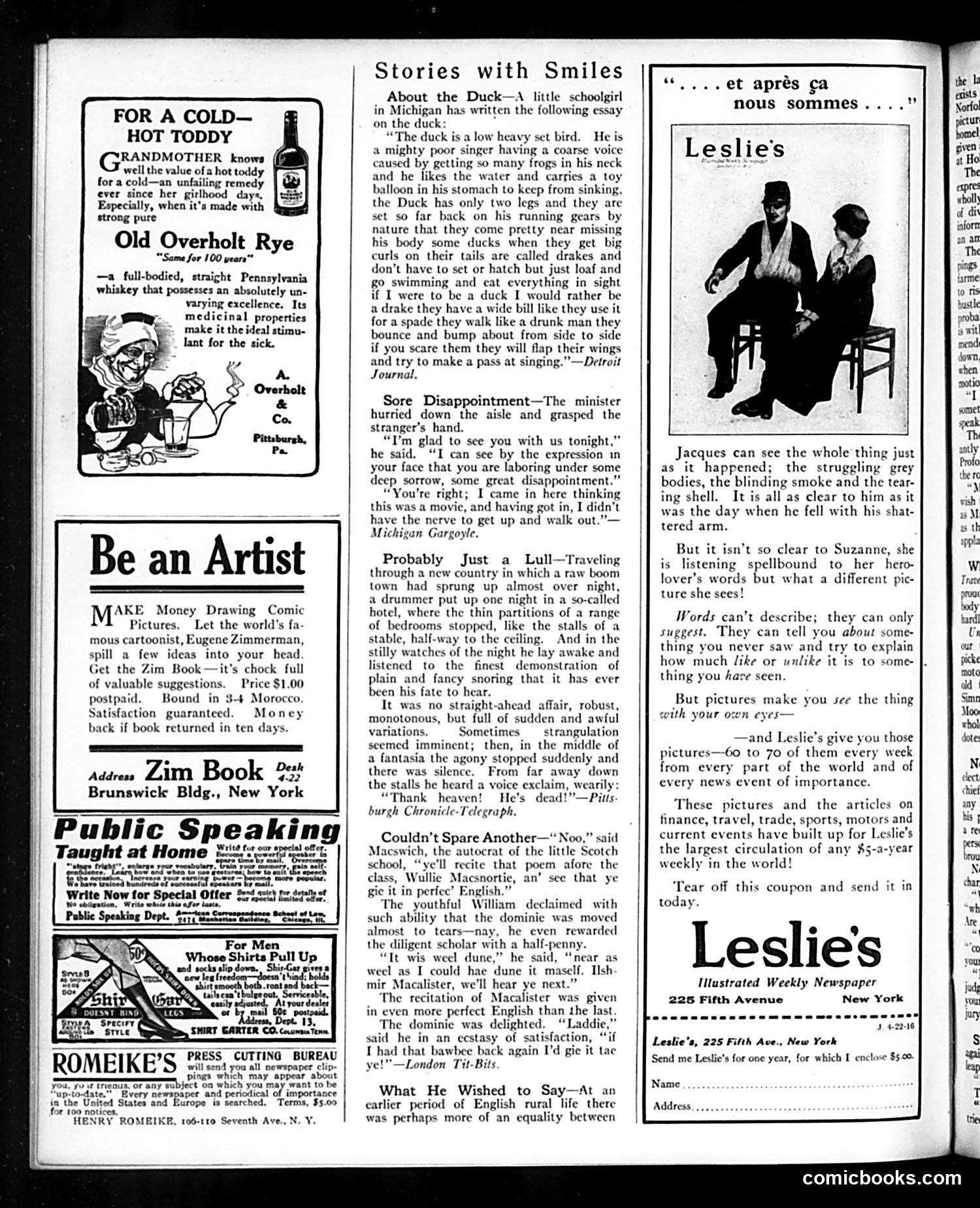
This page is primarily **advertisements and humorous filler content** rather than political satire. The main elements are: **Advertisements:** Old Overholt Rye whiskey (marketed as medicinal), a correspondence course on cartooning, public speaking lessons, and a press-clipping bureau service. **"Stories with Smiles" section:** Lighthearted humor pieces including: - A child's essay on ducks (misspelled and naive) - A joke about someone mistaking a church for a movie theater - Anecdotes about loud snoring and a Scottish schoolmaster **Leslie's magazine promotion:** A mid-page image showing what appears to be a dramatic scene with the caption emphasizing that pictures convey emotion better than words. The page reflects early 20th-century American popular humor and advertising—folksy jokes, temperance-era spirits marketing (alcohol presented as health remedy), and correspondence-school self-improvement schemes. There is no identifiable political commentary or caricature of named figures.
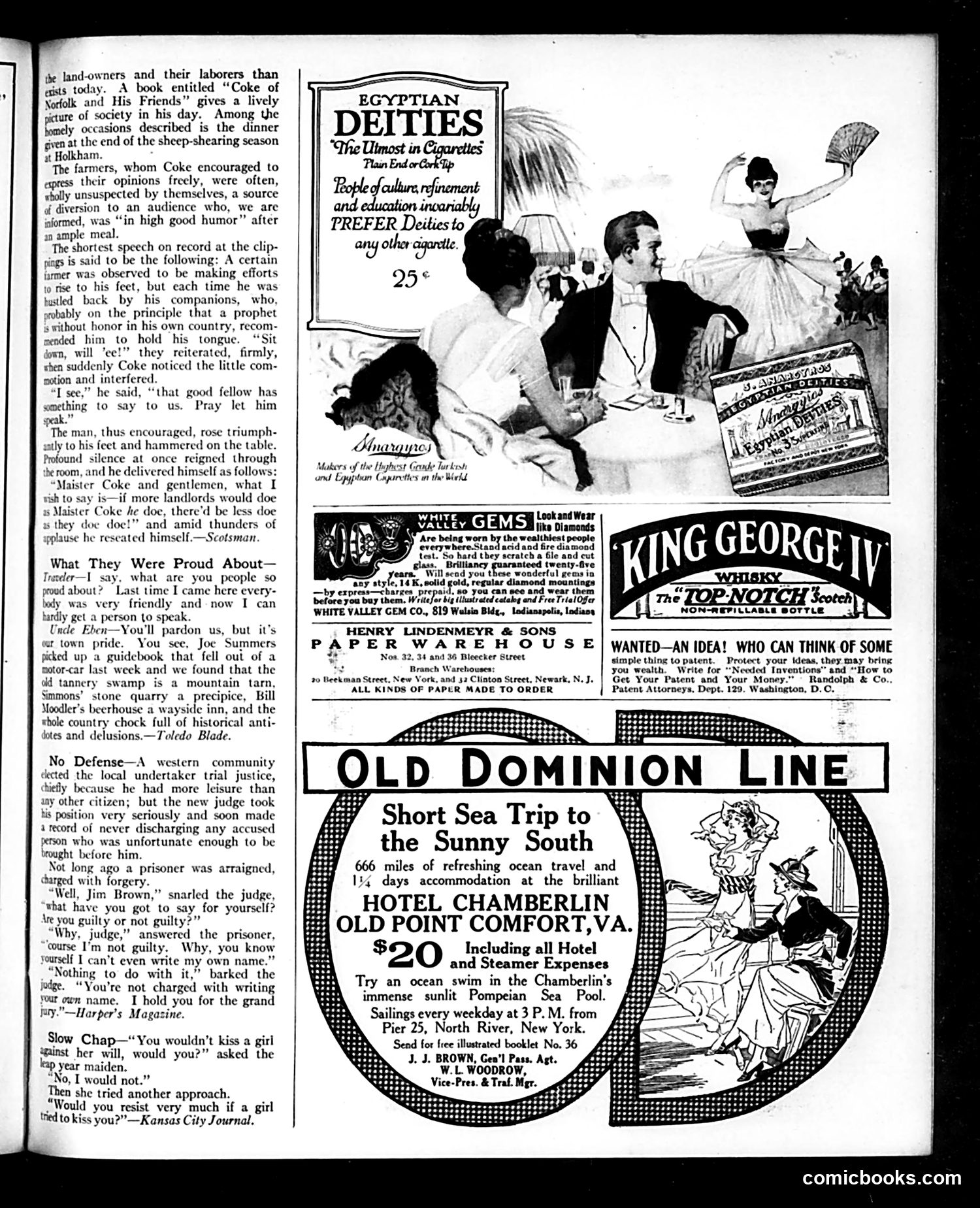
This page is primarily **advertisements and humorous anecdotes**, not political cartoons. The main content includes: **Text pieces**: Short humor columns about farmer life under "Coke of Norfolk" (historical English landowner); a dialogue about small-town pride; and a story about a lenient judge—typical of Judge magazine's light social satire. **Advertisements**: The Egyptian Deities cigarette ad (top right) uses exotic imagery to sell luxury products; White Valley Gems promises authenticity to wealthy buyers; King George IV whisky; patent/invention services; and a steamship vacation to Virginia. The humor is gentle and focused on rural/small-town American life rather than sharp political critique. The page reflects early 20th-century commercial culture and leisure aspirations of the middle class, with advertising integrated throughout editorial content—standard for the era's magazines.
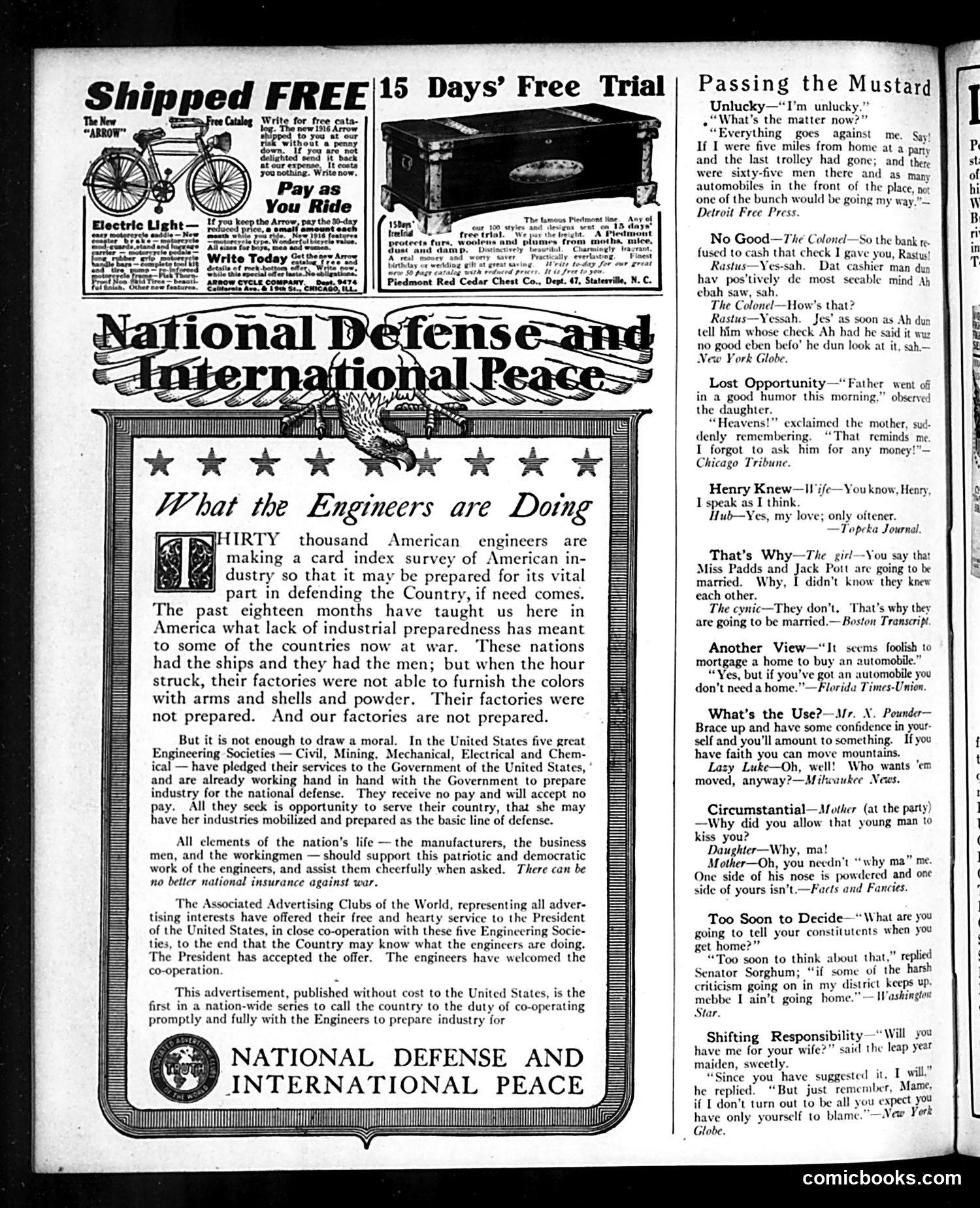
This page combines patriotic war-preparedness messaging with humorous "overhead conversations" typical of early 20th-century American magazines. **Main Content:** The large central advertisement promotes engineers' voluntary industrial survey to prepare American manufacturing for potential war involvement. Five engineering societies pledge unpaid service to the government. Published without cost, it's positioned as part of a national campaign urging industrial mobilization—reflecting pre-WWI American concerns about unpreparedness after observing European conflicts. **Accompanying Humor:** The right column contains brief jokes about everyday life: unlucky circumstances, a Black character (rendered in period dialect) being denied a bank check, marital dynamics, and automotive culture. These are gentle social observations rather than sharp satire—typical filler content for Judge magazine. **Historical Context:** The page reflects America's anxiety about industrial capacity during the pre-1917 period when European war threatened American interests, combined with Judge's traditional role mixing patriotic appeals with light domestic humor for middle-class readers.
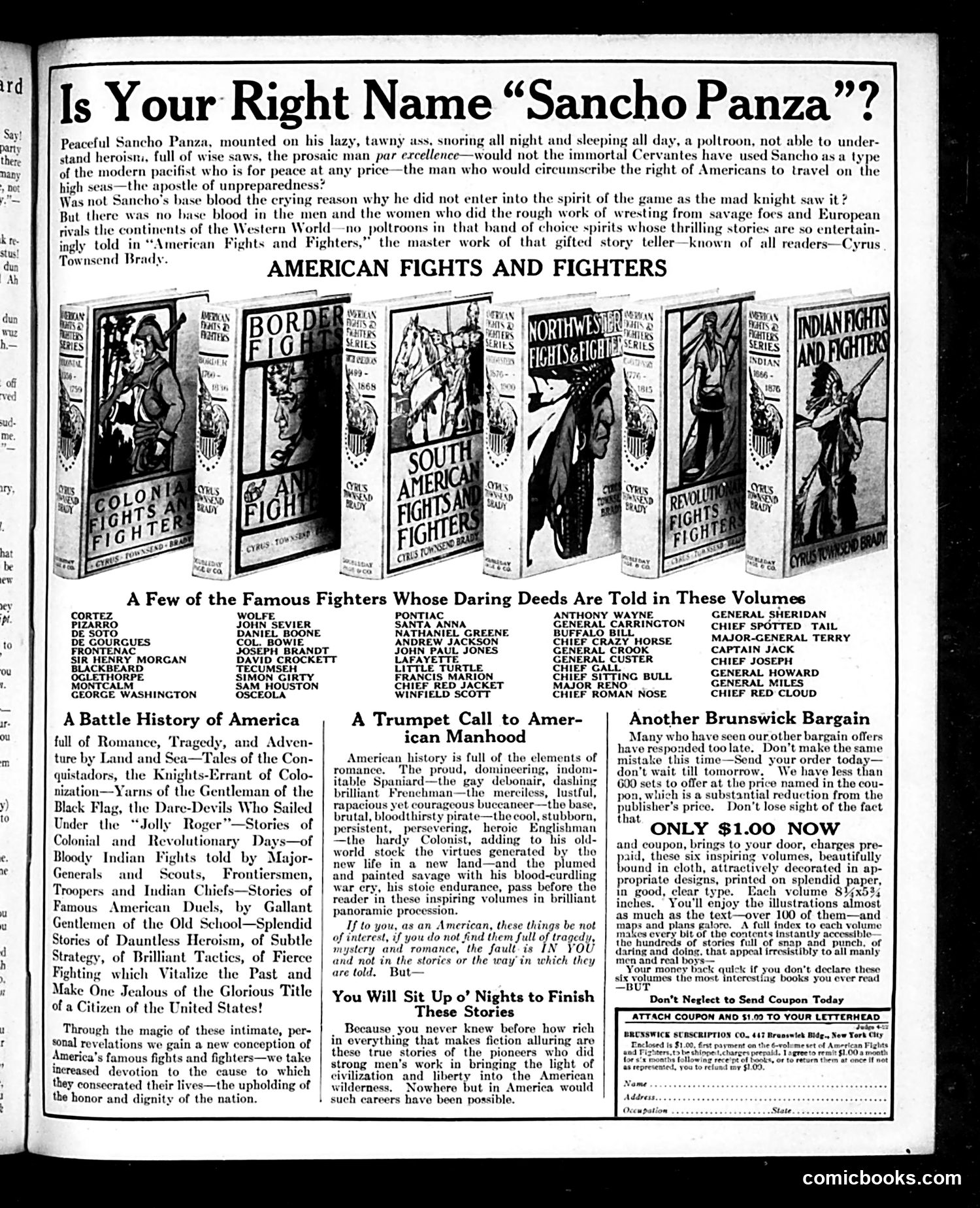
This page combines editorial argument with advertising. The headline sarcastically compares American pacifists to Sancho Panza—Don Quixote's cowardly squire—suggesting that those opposing American military preparedness and unrestricted naval travel lack the heroic courage of America's historical fighters. The editorial, attributed to Townsend Brady, contrasts "base blood" (cowardice) with the martial vigor of American colonials, revolutionaries, and frontier figures. It's a pre-WWI argument for military strength and interventionism. The bulk of the page advertises a book series called "American Fights and Fighters," listing famous American military and frontier figures (Washington, Paul Jones, Crockett, etc.). The accompanying sales pitch frames these historical narratives as inspiring tales of national vigor, positioning the books as a patriotic investment at $1.00 each. The satire targets pacifists and isolationists by associating their position with literary cowardice, while the advertising exploits nationalist sentiment.
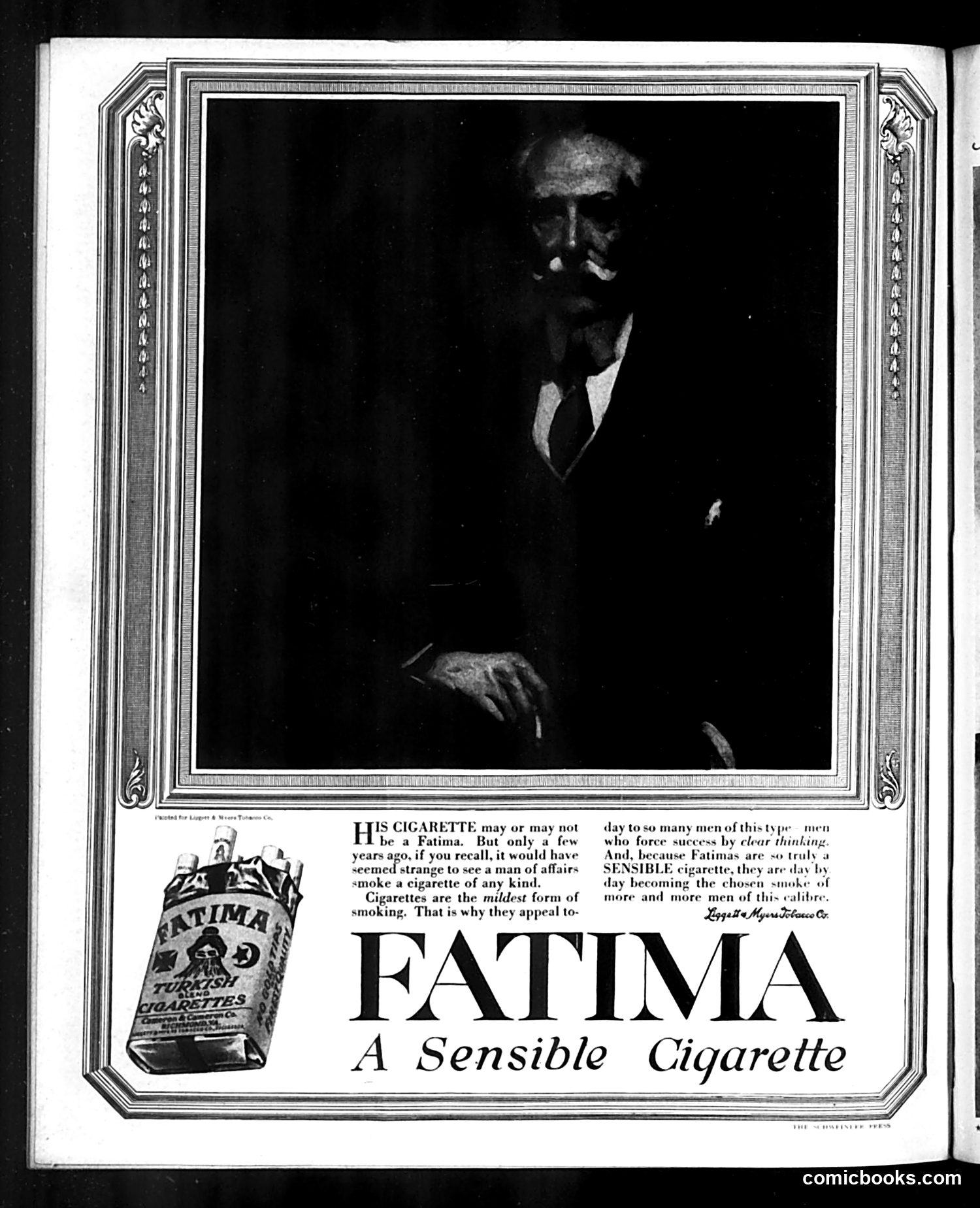
This page is primarily a **cigarette advertisement** for "Fatima: A Sensible Cigarette," not a political cartoon. The image shows a formal portrait of a distinguished older man in formal attire smoking a cigarette. The ad copy argues that cigarettes are "the mildest form of smoking" and appeals to men of "caliber" and "clear thinking" who choose Fatima brand. The satire lies in the *claim itself*: advertising cigarettes as "sensible" and promoting smoking to intellectual, successful men. By modern standards, this reveals early 20th-century advertising's brazen health claims and targeting of educated audiences—what we'd now recognize as deceptive marketing. The "sensible" framing is the joke's irony, though Judge magazine appears to be presenting it straightforwardly as advertising.