
Judge, 1916-04-22 · page 26 of 28
Judge — April 22, 1916 — page 26: what you’re looking at
What you’re looking at
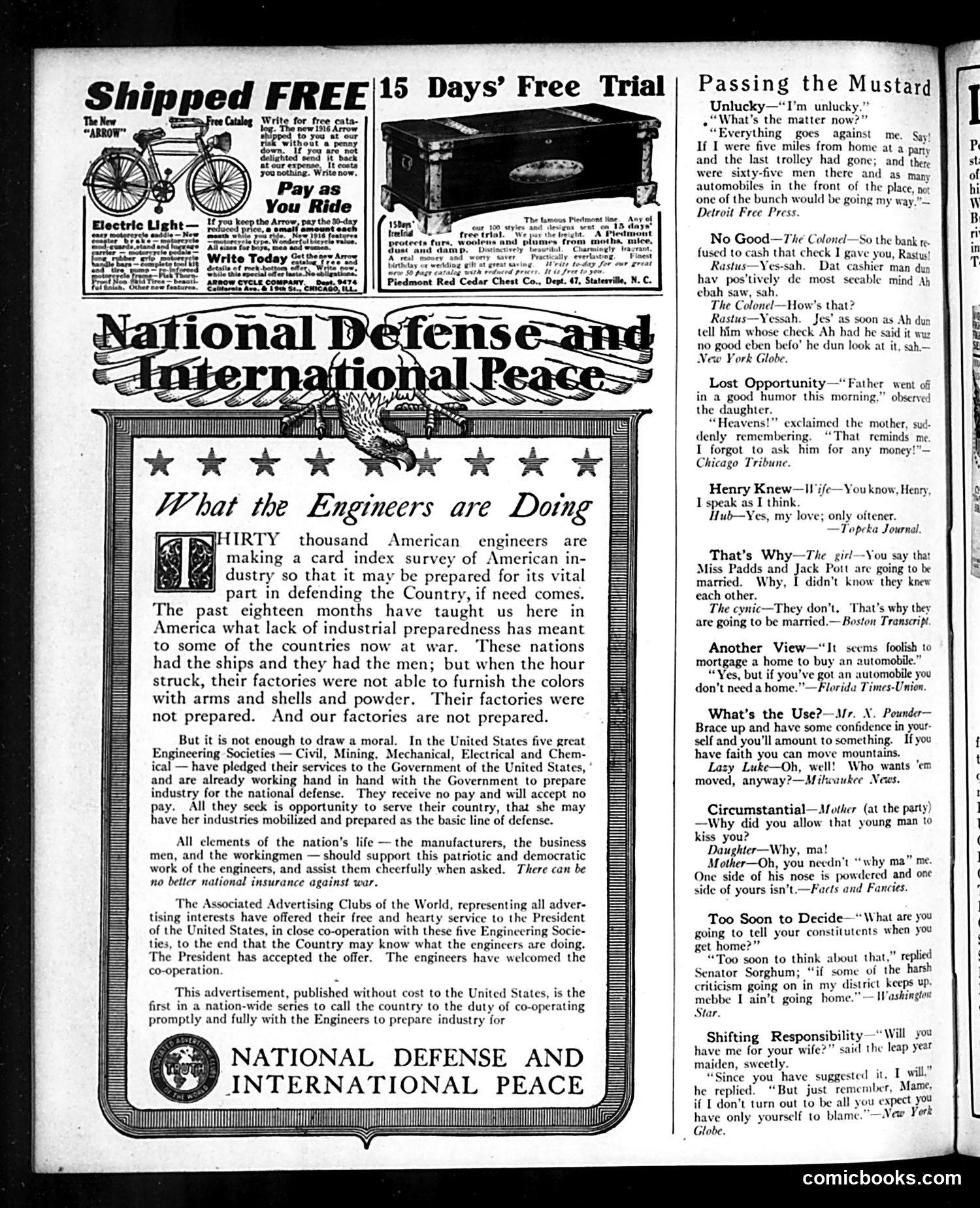
This page combines patriotic war-preparedness messaging with humorous "overhead conversations" typical of early 20th-century American magazines. **Main Content:** The large central advertisement promotes engineers' voluntary industrial survey to prepare American manufacturing for potential war involvement. Five engineering societies pledge unpaid service to the government. Published without cost, it's positioned as part of a national campaign urging industrial mobilization—reflecting pre-WWI American concerns about unpreparedness after observing European conflicts. **Accompanying Humor:** The right column contains brief jokes about everyday life: unlucky circumstances, a Black character (rendered in period dialect) being denied a bank check, marital dynamics, and automotive culture. These are gentle social observations rather than sharp satire—typical filler content for Judge magazine. **Historical Context:** The page reflects America's anxiety about industrial capacity during the pre-1917 period when European war threatened American interests, combined with Judge's traditional role mixing patriotic appeals with light domestic humor for middle-class readers.
📄 Transcribed text from this page (OCR, searchable)
Machine-transcribed from the original scan — historical spelling and the odd misread are preserved.
Shipped FREE|15 Days’ Free Trial Catalog Write for tree cata. 16 Arrow iihout™ cue o Gown. If y delighted ond t back at cur expense, It costs you nothing. Write now. Electric Lght— nh Fata sears Sard Sasi = Writ ao oe fey Se YP hat the Engineers are doin JHIRTY thousand American engineers are making a card index survey of American in- dustry so that it may be prepared for its vital part in defending the Country, if need comes. The past eighteen months have taught us here in America what lack of industrial preparedness has meant to some of the countries now at war. These nations had the ships and they had the men; but when the hour struck, their factories were not able to furnish the colors with arms and shells and powder. Their factories were not prepared. And our factories are not prepared. But it is not enough to draw a moral. In the United States five great Engineering Societies — Civil, Mining, Mechanical, Electrical and Chem- ical — have pledged their services to the Government of the United States, * and are already working hand in hand with the Government to prepare industry for the national defense. They receive no pay and will accept no pay. All they seek is opportunity to serve their country, that she may have her industries mobilized and prepared as the basic line of defense. All elements of the nation’s life —the manufacturers, the business men, and the workingmen — should support this patriotic and democratic work of the engineers, and assist them cheerfully when asked. There can be no better national insurance against war. The Associated Advertising Clubs of the World, representing all adver- tising interests have offered their free and hearty service to the President of the United States, in close co-operation with these five ties, to the end that the Country may know what the engine The President has accepted the offer. The engineers have welcomed the co-operation. This advertisement, published without cost to the United States, is the first in a nation-wide series to call the country to the duty of co-operating promptly and fully with the Engineers to prepare industry for & 2) NATIONAL DEFENSE AND 9 INTERNATIONAL PEACE Passing the Mustard Unlucky—“I'm unlucky. o What’ 's the matter now?” “Everything goes against me. Say! If I were five miles from home at a pany and the last trolley had gone; and there were sixty-five men there and as many automobiles in the front of the place, one of the bunch would be going my way. Detroit Free Press. No Good—The Colonel—So the bank re fused to ca ash that check 1 ga ! Rastus- ly de most s The C ‘otonel How’s that? Rastus—Yessah. Jes’ as soon as Ah dun tell him whose check Ah had he it no good eben befo’ he dun look at it, s New York Globe. Lost Opportunity—‘ Father went off in a good humor this morning,” observed the daughter. “Heavens!” exclaimed the mother, sud- denly rememberin “That reminds me I forgot to ask him for any money!”— Chicago Tribune. Henry Knew—Il ife—You know, Henry, I speak as I think. Hub—Yes, my love; only oftener. —Topcka Journal. That’s Why—The_gir!—You say that Miss Padds and Jack Pott are going to be married. Why, I didn't know they knew each other. The cynic—They don’t. ‘That's why they are going to be married.— Boston Transcript. Another View—“It scems foolish to mortgage a home to buy an automobile.” “Yes, but if you ve got n automobile you don’t need a home.” —Florida Times-Union. What’s the Use?—Mr. X. Pounder— Brace up and have some confidence in your- self and you'll amount to something. Ifyou have faith you can move mountains. Lazy Luke—Oh, well! Who wants ‘em moved, anyway?—Mihwaukee News. Circumstantial—AMother (at the party) —Why did you allow that young man to kiss you? Daughter—Why, ma! Mother—Oh, you needn't “why ma” me. One side of his nose is powdered and one side of yours isn’t. on Pacls and Fancies. Too Soon to Decide—* What are you going to tell your constitutents when you get home?” “Too soon to think about that,” replied Senator Sorghum; “if some of the harsh ism going on in my district keeps up. mebbe I ain't going home.” — Waskingtoe Star. Shifting Responsibility “Will you have me for your wife?” said the leap year maiden, sweetly. ; ince you have suggested it, I wil he replied. “But just remember, Mame, if I don’t turn out to be all you expect you have only yourself to blame.” —New York ccc ll — ——Vv ed _ Globe. comicbooks.com