
Judge, 1916-04-22 · page 15 of 28
Judge — April 22, 1916 — page 15: what you’re looking at
What you’re looking at
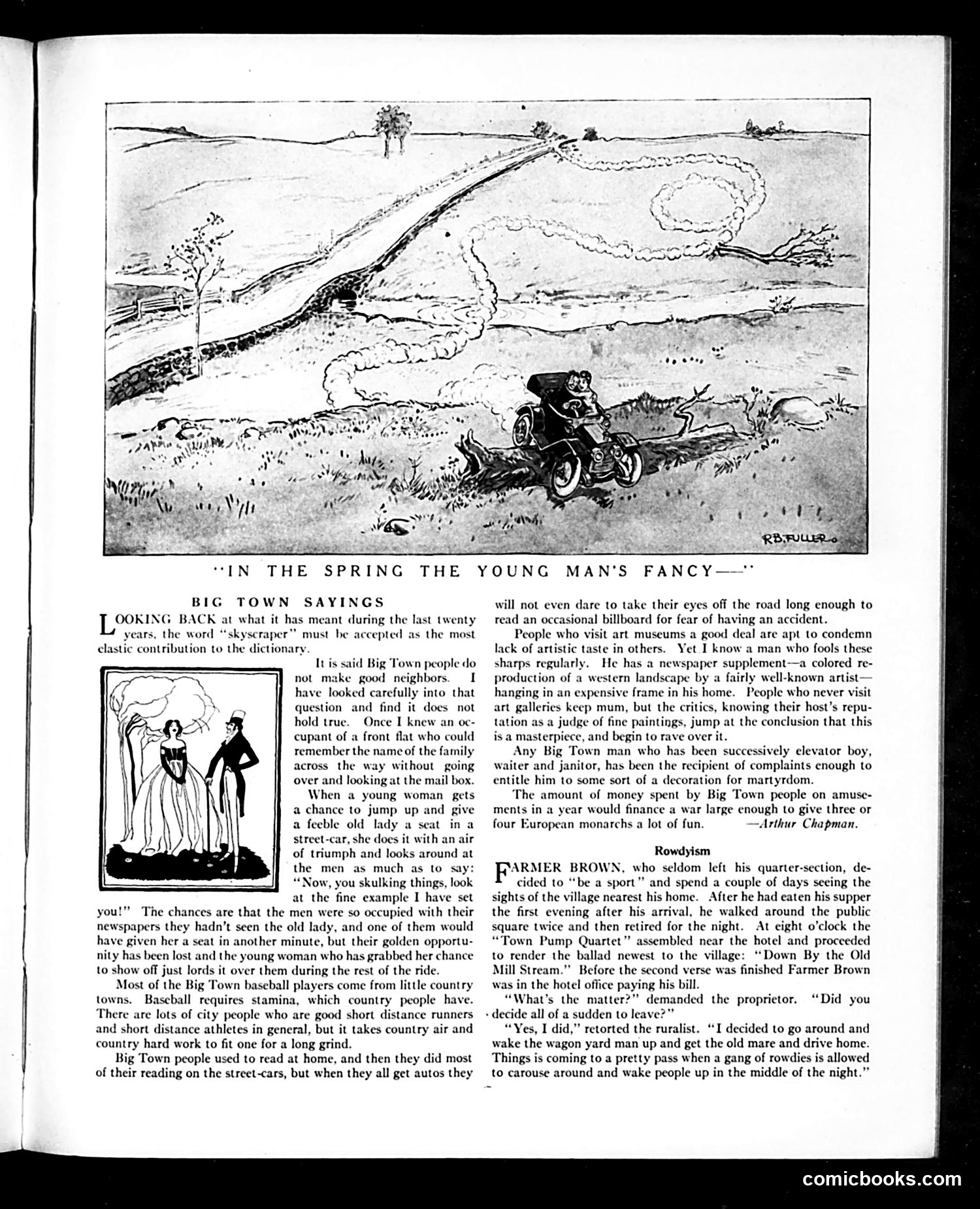
This page from *Judge* contains two satirical pieces mocking urban American behavior circa early 1900s. **Top cartoon**: Illustrates the section "Big Town Sayings"—a series of observations about city dwellers' social hypocrisy. The drawing shows a man in an automobile, referencing the text's point that car owners are too focused on driving to read billboards, unlike street-car passengers. The overall commentary criticizes Big Town people for performative kindness (like young women theatrically offering seats to elderly ladies), artistic pretension (owning reproduction landscapes to fool art critics), and neglecting home reading for street-car literature. **Bottom section ("Rowdyism")**: A rural farmer visits a small town, experiences rowdy nightlife (a quartet singing loudly at night), and immediately flees—rejecting "sport" and urban disorder for rural peace. The humor targets small-town rowdiness as intolerable, contrasting with the upper section's urban critiques. Together, these pieces satirize both city and country life's failings, suggesting nowhere escapes American social absurdity.
📄 Transcribed text from this page (OCR, searchable)
Machine-transcribed from the original scan — historical spelling and the odd misread are preserved.
HR patie Nites leet “IN THE SPRING THE YOUNG MAN'S FANCY——" BIG TOWN SAYINGS OOKING BACK at what it has meant during the last twenty s. the word “skyscraper” must be accepted as the most contribution to the dictionary It is said Big Town people do not make good neighbors. I have looked carefully into that question and find it does not hold true. Once I knew an oc- cupant of a front flat who could remember the name of the family across the way without going over and looking at the mail box. When a young woman gets a chance to jump up and a feeble old lady ina street-car, she doe han air of triumph and looks around at the men as much as to say: “Now, you skulking things, look at the fine example I have set you!” The chances are that the men were so occupied with their newspapers they hadn’t seen the old lady, and one of them would have given her a seat in another jute, but their golden opportu- nity has been lost and the young woman who has grabbed her chance to show off just lords it over them during the rest of the ride. Most of the Big Town baseball players come from little country towns. Baseball requires stamina, which country people have. There are lots of city people who are good short distance runners and short distance athletes in general, but it takes country air and country hard work to fit one for a long grind. Big Town people used to read at home, and then they did most of their reading on the street-cars, but when they all get autos they will not even dare to take their eyes off the road long enough to read an occasional billboard for fear of having an accident. People who visit art museums a good deal are apt to condemn lack of artistic taste in others. Yet I know a man who fools these sharps regularly. He has a newspaper supplement—a colored re- production of a western landscape b rly well-known artist hanging in an expensive frame in his home. People who never visit art galleries keep mum, but the critics, knowing their host’s repu- tation as a judge of fine paintings, jump at the conclusion that this is a masterpiece, and begin to rave over it. Any Big Town man who has been successively elevator boy, iter and janitor, has been the recipient of complaints enough to entitle him to some sort of a decoration for martyrdom. The amount of money spent by Big Town people on amuse- ments in a year would finance a war large enough to give three or four European monarchs a lot of fun. —Arthur Chapman. Rowdyism RMER BROWN, who seldom left his quarter-section, de- cided to “be a sport” and spend a couple of days seeing the sights of the village nearest his home. After he had eaten his supper the first evening after his arrival, he walked around the public square twice and then retired for the night. At eight o'clock the “Town Pump Quartet” assembled near the hotel and proceeded to render the ballad newest to the village: ‘‘Down By the Old Mill Stream.” Before the second verse was finished Farmer Brown was in the hotel office paying his bill. “What's the matter?” demanded the proprietor. “Did you + decide all of a sudden to leave?” “Yes, I did,” retorted the ruralist. “I decided to go around and wake the wagon yard man up and get the old mare and drive home. Things is coming to a pretty pass when a gang of rowdies is allowed to carouse around and wake people up in the middle of the night.” comicbooks.com