
Judge, 1916-04-22 · page 18 of 28
Judge — April 22, 1916 — page 18: what you’re looking at
What you’re looking at
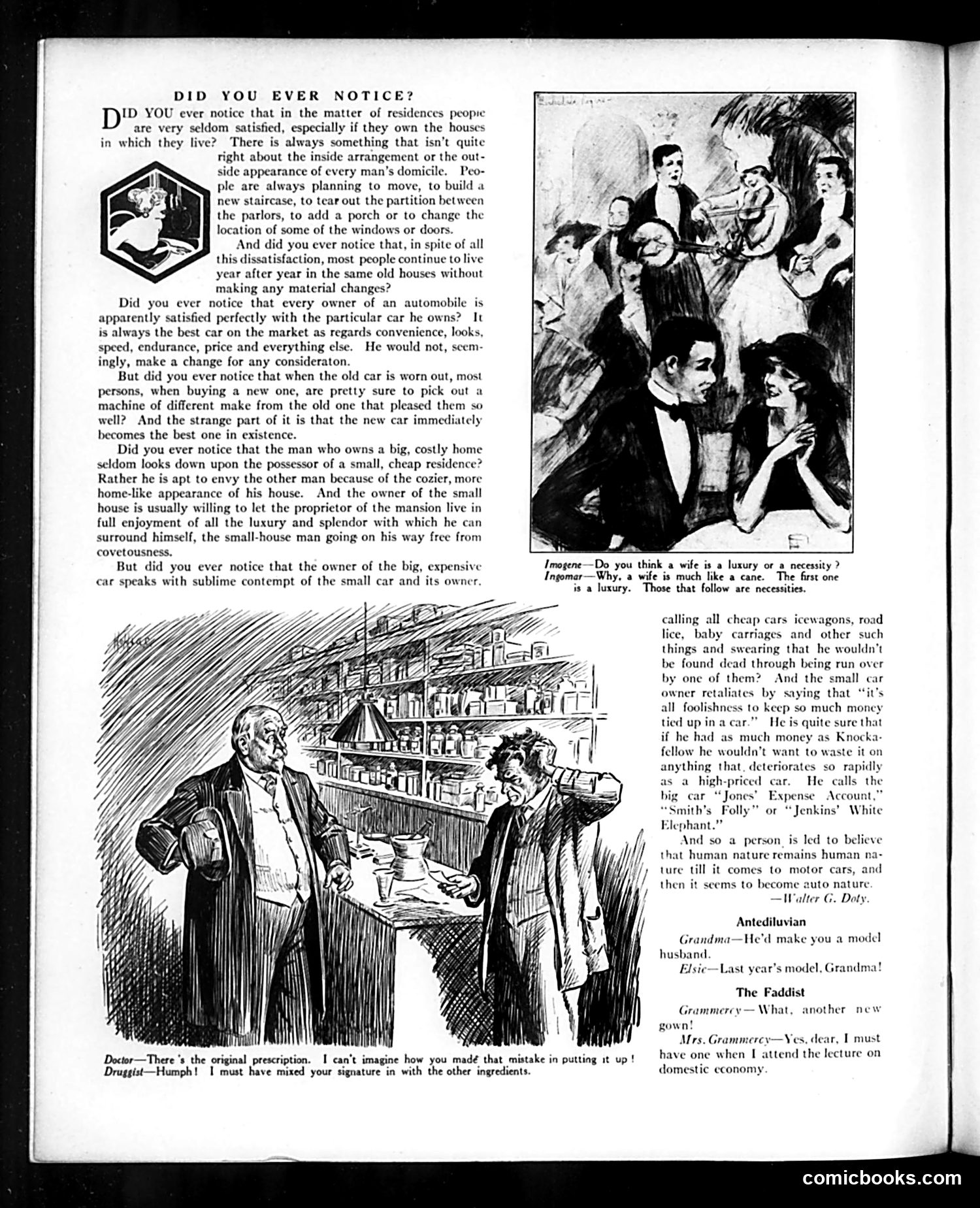
This essay-cartoon contrasts human nature regarding homes versus automobiles. The author observes that homeowners perpetually complain about their residences yet rarely renovate, accepting stagnation despite dissatisfaction. With cars, however, behavior reverses: owners claim absolute satisfaction with their current vehicle—until purchasing a new one of *different make*, which immediately becomes "the best one in existence." Most strikingly, the piece notes wealthy homeowners don't resent modest neighbors; small-house owners feel no envy. But expensive-car owners *despise* cheap-car owners, calling them "ice wagons" and "road lice," while small-car owners mock wealthy drivers as wasteful (referencing "Jones' Expense Account," "Smith's Folly"). The satire exposes automobile ownership as breeding *class contempt* uniquely—transforming human nature into what the author calls "auto nature." Cars apparently trigger status anxiety and snobbery absent in real estate, revealing early-20th-century anxieties about automobiles as status symbols.
📄 Transcribed text from this page (OCR, searchable)
Machine-transcribed from the original scan — historical spelling and the odd misread are preserved.
DID YOU EVER NOTICE? ID YOU ever notice that in the matter of residences peopie are very seldom satisfied, especially if they own the houses in which they live? There is always something that isn’t quite right about the inside arrangement or the out- side appearance of every man’s domicile. Peo- ple are always planning to move, to build a new staircase, to tear out the partition between the parlors, to add a porch or to change the location of some of the windows or doors. And did you ever notice that, in spite of all this dissatisfaction, most people continue to live year after year in the same old houses without making any material changes? Did you ever notice that every owner of an automobile is apparently satisfied perfectly with the particular car he owns? It is always the best car on the market as regards convenience, looks, speed, endurance, price and everything else. He would not, scem- ingly, make a change for any consideraton. But did you ever notice that when the old car is worn out, most persons, when buying a new one, are pretty sure to pick out a machine of different make from the old one that pleased them so well? And the strange part of it is that the new car immediately becomes the best one in existence. Did you ever notice that the man who owns a big, costly home seldom looks down upon the possessor of a small, cheap residence? Rather he is apt to envy the other man because of the cozier, more home-like appearance of his house. And the owner of the small house is usually willing to let the proprietor of the mansion live in full enjoyment of all the luxury and splendor with which he can surround himself, the small-house man going on his way free from covetousness. But did you ever notice that the owner of the big, expensive car speaks with sublime contempt of the small car and its owner. Ingomar—Why, a wife is much like a cane. The first one is a luxury. Those that follow are necessities. Imogene—Do you think a wife is a luxury or a necessity ? calling all cheap cars icewagons, road lice, baby carriages and other such things and swearing that he wouldn’t be found dead through being run over by one of them? And the small car owner retaliates by saying that ‘it's all foolishness to keep so much money tied up in a car.” He is quite sure that if he had as much money as Knocka- fellow he wouldn't want to waste it on anything that, deteriorates so rapidly as a high-priced car. He calls the big car “Jones’ Expense Account,” mith’s Folly” or ‘Jenkins’ White Elephant.” And so a person. is led to believe that human nature remains human na- ture till it comes to motor cars, and then it seems to become auto nature —Walter G. Doty Antediluvian -He'd make you a model dl Elsie—Last year’s model, Grandma! The Faddist Grammercy — What, another new gown! Mrs. Grammerey—Y es, dear, T must have one when I attend the lecture on Doctor—There ‘s the original prescription. I can’t imagine how you madé that mistake in putting it up ! y domestic economy. Druggist—Humph! 1 must have mixed your signature in with the other ingredients. comicbooks.com