
Judge, 1916-04-22 · page 19 of 28
Judge — April 22, 1916 — page 19: what you’re looking at
What you’re looking at
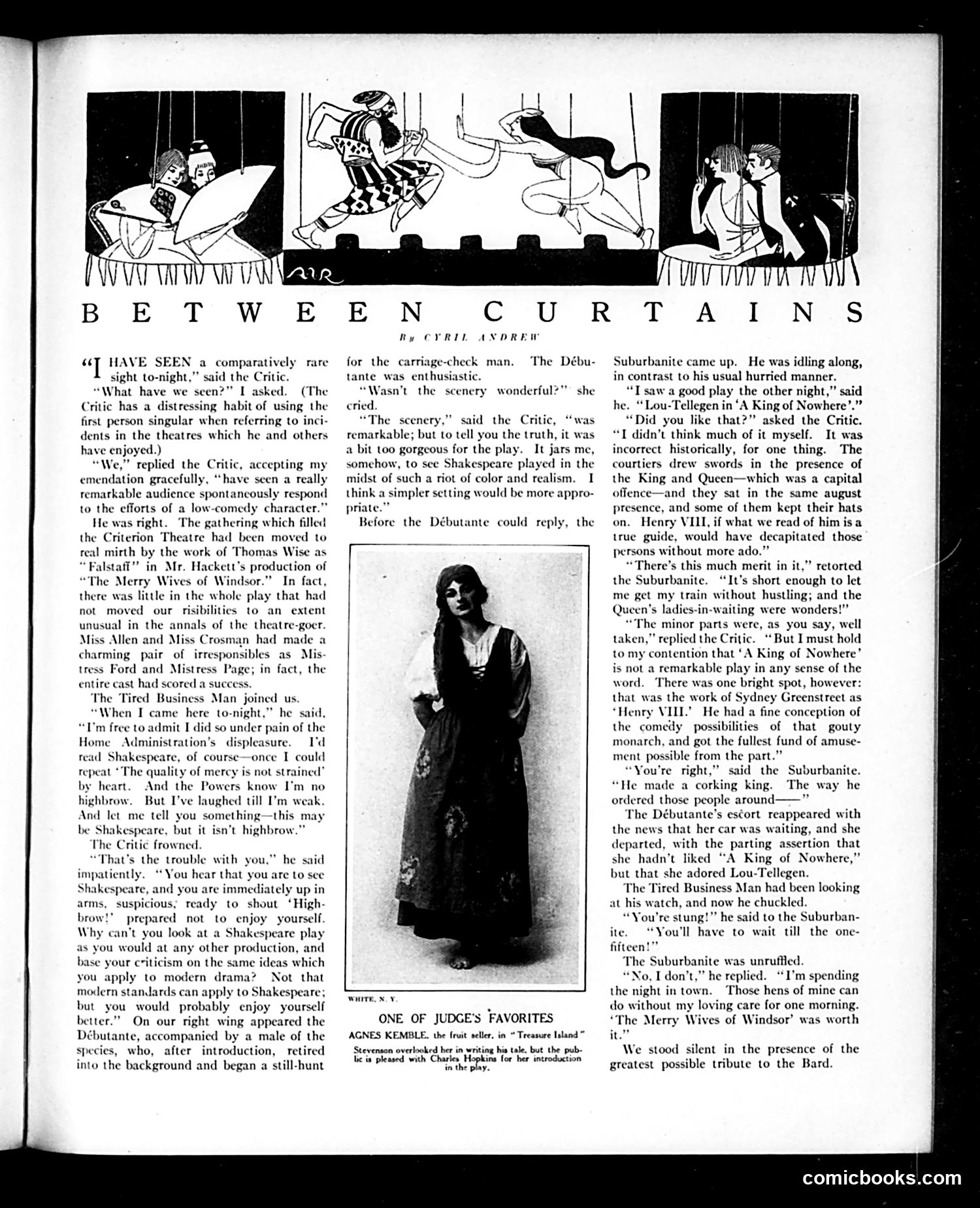
This article by Cyril Andrew satirizes different types of theater audiences and their approaches to Shakespeare. The Critic represents pretentious, overly analytical theatergoers who dismiss plays for historical inaccuracies and excessive scenery. The Tired Business Man embodies the ordinary worker forced by Home Administration policy (likely Prohibition-era restrictions on leisure) to attend theater, who simply enjoys the show without intellectual pretense. The Suburbanite exemplifies pedantic audiences who nitpick historical details while missing entertainment value. The satire's point: audiences shouldn't approach Shakespeare with defensive snobbery or exhausting fact-checking, but rather as accessible entertainment. The piece mocks the Critic's insistence that modern critical standards shouldn't apply to Shakespeare—suggesting some contemporaries overthought classic theater, preventing genuine enjoyment. The accompanying illustration shows theatrical performers and audience members in period dress.
📄 Transcribed text from this page (OCR, searchable)
Machine-transcribed from the original scan — historical spelling and the odd misread are preserved.
a comparatively rare sight to-night,” said the Critic. What have we seen?” I asked. (The Critic has a distressing habit of using the first person singular when referring to inci- dents in the theatres which he and others have enjoyed.) “We,” replied the Critic, accepting my emendation gracefully, “have seen a really remarkable audience spontancously respond to the efforts of a low-comedy character.” He was right. The gathering which filled the Criterion Theatre had been moved to al mirth by the work of Thomas Wise as Istaff” in Mr. Hackett’s production of “The Merry Wives of Windsor.” In fact, there was little in the whole play that had not moved our risibilities to an extent unusual in the annals of the theatre-gocr. Miss Allen and Miss Crosman had made charming pair of irresponsibles Mis tress Ford and Mistress Page; in fact, the entire ¢ aud scored a success. The Tired Business Man joined us. “When I came here to-night,” he said, “L'm free to admit I did so under pain of the Home Administration's displeasure. I'd read Shakespeare, of course—once I could repeat ‘The quality of mercy is not strained’ by heart. And the Powers know I'm no highbrow. But I've laughed till I’m weak. And let me tell you something—this may be Shakespeare, but it isn’t highbrow.” The Critic frowned. “That's the trouble with you,” he said impatiently. ‘You hear that you are to see Shakespeare, and you are immediately up in arms, suspicious, ready to shout ‘High- brow!’ prepared not to enjoy yourself, Why can’t you look at a Shakespeare play as you would at any other production, and base your criticism on the same ideas which you apply to modern drama? Not that modern standards can apply to Shakespeare; but you would probably enjoy yourself better.” On our right wing appeared the Débutante, ompanied Lt male of the species, who, after introduction, retired into the background and began a still-hunt Ry CYRIL ANDREW for the carriage-check man. The Débu- inte was enthusiastic. Wasn't the scenery cried. “The scenery,” said the Critic, ‘was remarkable; but to tell you the truth, it w a bit too gorgeous for the play. It jars me, somehow, to see Shakespeare played in the midst of such a riot of color and realism. 1 think a simpler setting would be more appro- priate Before the Débutante could reply, the wonderful?” she WHITE, X.Y ONE OF JUDGE'S FAVORITES AGNES KEMBLE. the fruit seller, in * Treasure Island ~ Stevenson overlooked her in writing his tale, but the pub- ttc is pleased with Charles Hopkine for her introduction in the play. Suburbanite came up. He was idling along, in contrast to his usual hurried manner. “T saw a good play the other night,” said he. “Lou-Tellegen in ‘A King of Nowhere’.” “Did you like that?” asked the Critic. “IT didn’t think much of it myself. It was incorrect historically, for one thing. The courtiers drew swords in the presence of the King and Queen—which was a capital offence—and they sat in the same august presence, and some of them kept their hats on. Henry VILL, if what we read of him isa true guide, would have decapitated those persons without more ado.” “There's this much merit in it,” retorted the Suburbanite. “‘It’s short enough to let me get my train without hustling; and the Queen’s ladies-in-waiting were wonders!” “The minor parts were, as you say, well taken,” replied the Critic.“ But I must hold to my contention that ‘A King of Nowhere’ is not a remarkable play in any sense of the word. There was one bright spot, however: that was the work of Sydney Greenstreet ‘Henry VILL’ He had a fine conception of the comedy possibilities of that gouty monarch, and got the fullest fund of amus ment possible from the part.” “You're right,” said the Suburbanit “He made a corking king. The way he ordered those people around ——” The Débutante’s escort reappeared with the news that her car was waiting, and she departed, with the parting assertion that she hadn't liked “A King of Nowhere, but that she adored Lou-Tellegen. The Tired Business Man had been looking at his watch, and now he chuckled. “You're stung!” he said to the Suburban- ite. “You'll have to wait till the one- fifteen!” The Suburbanite was unruffled. “No, I don’t,” he replied. “I’m spending the night in town. Those hens of mine can do without my loving care for one morning. ‘The Merry Wives of Windsor’ was worth it.” We stood silent in the presence of the greatest possible tribute to the Bard. comicbooks.com