
Judge, 1916-04-22 · page 14 of 28
Judge — April 22, 1916 — page 14: what you’re looking at
What you’re looking at
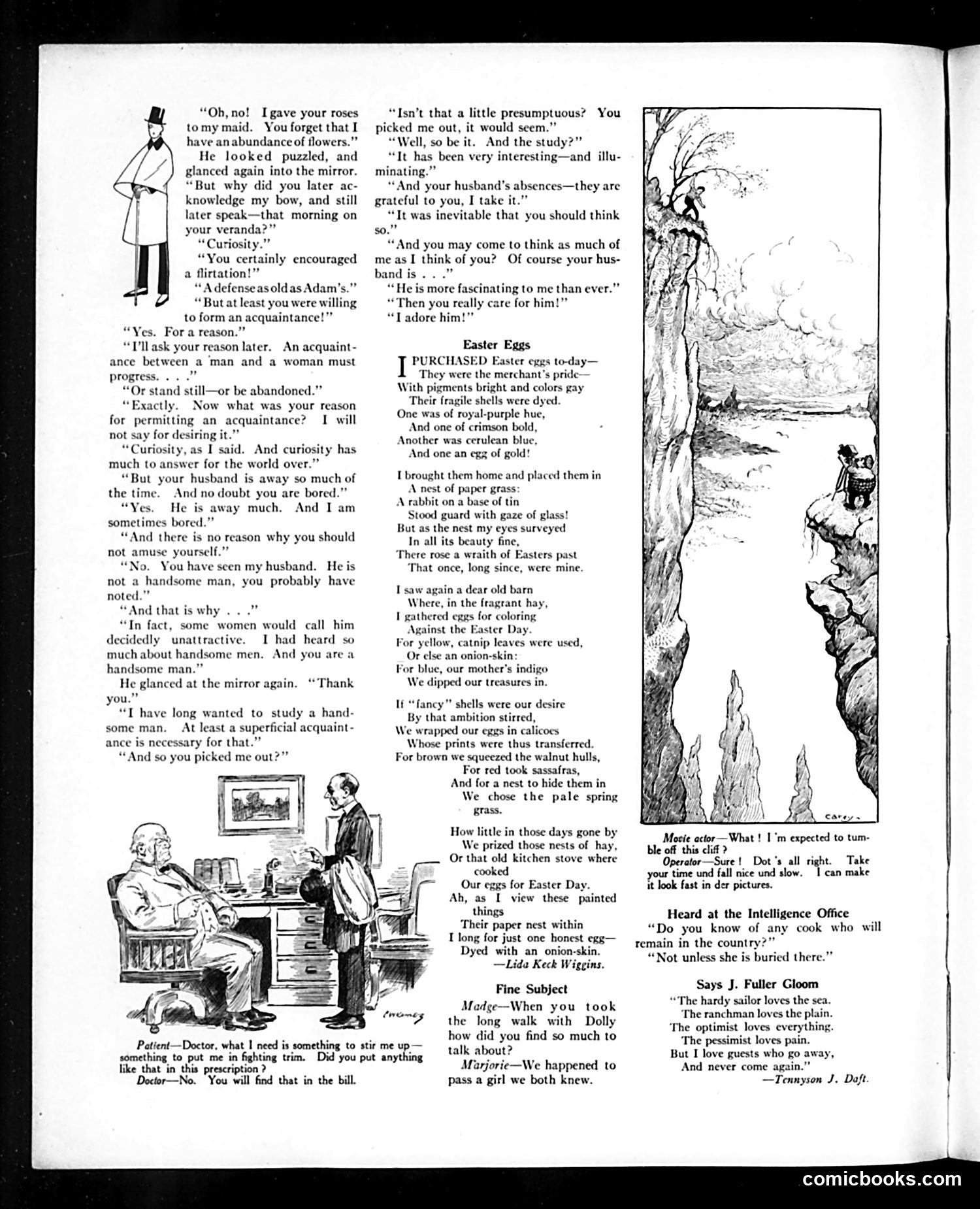
This page contains several distinct pieces of satirical content: **Main Dialogue Story** (top left): A flirtation scene where a woman admits she cultivated an acquaintance with a handsome man purely out of curiosity—to study "a handsome man" as a specimen. The satire targets vanity: the man repeatedly glances at mirrors while being essentially used as an object of study. The woman's ultimate revelation that she "adores" her less-handsome husband undercuts the man's ego entirely. **"Easter Eggs" Poem** (center/right): Nostalgic verse contrasting commercialized Easter eggs (dyed in merchant's pigments, artificial nests) with childhood memories of hand-dyed eggs using natural materials (onion-skins, indigo, walnut hulls). The satire critiques modern consumer culture's replacement of homemade, authentic traditions. **Bottom cartoons**: A patient-doctor exchange satirizes medical bills (the "cure" is in the cost, not medicine), and a brief joke about film production fakery. The page exemplifies Judge's satirical approach: mocking vanity, commercialism, and modern affectation through wit and nostalgic contrast.
📄 Transcribed text from this page (OCR, searchable)
Machine-transcribed from the original scan — historical spelling and the odd misread are preserved.
“Oh,no! Igave your roses tomy maid. You forget that I have anabundance of flowers.” He looked puzzled, and glanced again into the mirror. “But why did you later ac- knowledge my bow, and still later speak—that morning on your veranda?” “Curiosity. “You certainly encouraged a flirtation!” “A defenseasoldas Adams.’ “Butat least you were willing to form an acquaintance!” “Yes. For a reason.” “V'llask your reason later. An acquaint- ance between a man and a woman must progress... .”” “Or stand still—or be abandoned. “Exactl. Now what was your reason for permitting an acquaintance? I will not say for desiring it.” “Curiosity, as I said. And curi much to answer for the world over, “But your husband is away so much of the time. And no doubt you are bored.” “Yes, He is away much. And I am ity has sometimes borec is no reason why you should “And there not amuse yourself. “No. You have scen my husband. He is not a handsome man, you probably have noted.” “And that is why . . . “In fact, some women would call him decidedly unattractive. I had heard so much about handsome men. And you are a handsome man.” He glanced at the mirror again. you.” “T have long wanted to study a hand- some man. At least a superficial acquaint- ance is necessary for that.”” “And so you picked me out?” “Thank = Patient—Doctor, what I need is something to stir me up — something to put me in fighting trim. Did you put anything like that in this prescription ? Dector—No. You will find that in the bill. “Isn't that a little presumptuous? You picked me out, it would seem.” “Well, so be it. And the study?” “Tt has been very interesting—and illu- minating.” “And your husband's at grateful to you, I take it.” “Tt was inevitable that you should think sences—they are And you may come to think as much of me as I think of you? Of course your hus- band is...” “He is more fascinating to me than ever.” “Then you really care for him!” “T adore him! Easter Eggs PURCHASED Easter ¢ They were the merchant's pride— With pigments bright and colors gay Their fragile shells were dyed. One was of royal-purple hue, And one of crimson bold, Another was cerulean blue, ‘And one an egg of gold! T brought them home and placed them in A nest of paper grass: A rabbit on a base of tin Stood guard with gaze of glass! But as the nest my eyes surveyed In all its beauty fine, There rose a wraith of Easters past That once, long since, were mine. na dear old barn , in the fragrant hay, I gathered eggs for coloring Against the Easter Day. For yellow, catnip leaves were used, Or else an onion-skin: For blue, our mother’s indigo We dipped our treasures in. lf “fancy” shells were our desire By that ambition stirred, We wrapped our eggs in calicoes Whose prints were thus transferred. For brown we squeezed the walnut hulls, For red took sassafras, And for a nest to hide them in We chose the pale spring grass. How little in those days gone by We prized those nests of hay, Or that old kitchen stove where cooked Our eggs for Easter Day. Ab, as I view these painted things ‘Their paper nest within I long for just one honest egg— Dyed with an onion-skin. —Lida Keck Wiggins. Fine Subject Madge—When you took the long walk with Dolly how did you find so much to talk about? Marjorie—We happened to pass a girl we both knew. Mosie actor —What ! I'm expected to tum- ble off this cliff > Dot's all right. Take Operator—Sure | your time und fall nice und slow. 1 can make it look fast in der pictures. Heard at the Intelligence Office “Do you know of any cook who will remain in the country “Not unless she is buried there.” Says J. Fuller Gloom “The hardy sailor loves the sea. ‘The ranchman loves the plain. ‘The optimist loves everything. ‘The pessimist loves pain. But I love guests who go away, And never come again.” —Tennyson J. Daft. comicbooks.com