
Judge, 1916-04-22 · page 12 of 28
Judge — April 22, 1916 — page 12: what you’re looking at
What you’re looking at
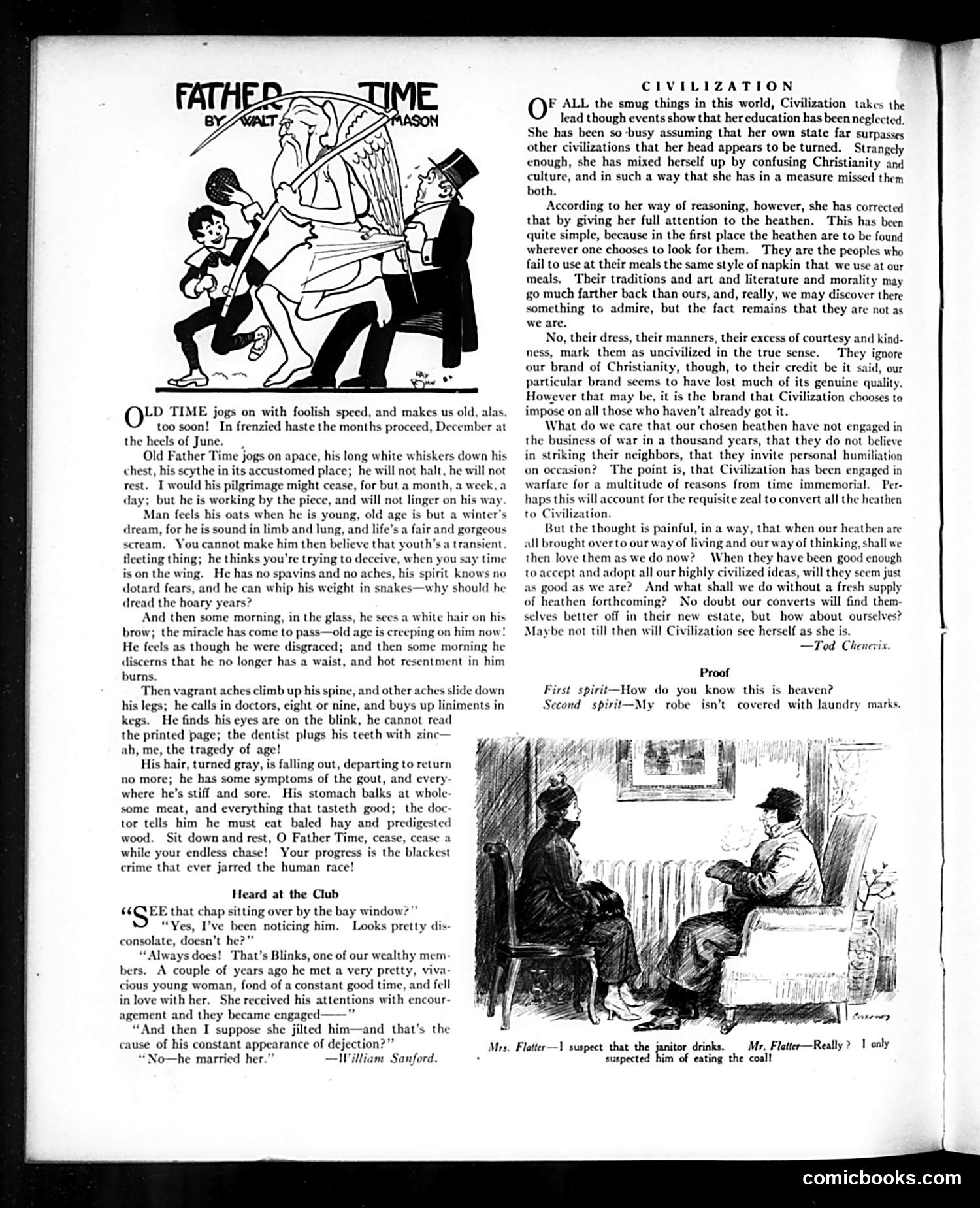
**"Father Time" (top):** This poem by Walt Mason uses personified Father Time as a vehicle for lamenting aging. The cartoon shows Time as a skeletal, scythe-carrying figure, with men clinging to him desperately—likely representing humanity's futile struggle against mortality and decay. The piece catalogs aging's indignities (gray hair, dental problems, digestive issues) with dark humor typical of early 20th-century magazine satire. **"Civilization" (right column):** This editorial piece critiques Western "civilization's" self-satisfied hypocrisy. It argues that while Westerners pride themselves on superiority over "heathen" peoples, they've confused Christianity with mere cultural etiquette (napkin usage, dress codes). The author suggests non-Western civilizations possess equally valid moral and artistic traditions, exposing the arrogance underlying colonial-era assumptions about civilizational hierarchy. **"Heard at the Club":** A brief society joke about Blinks, a wealthy man whose misery stems not from romantic rejection but from actually marrying his love interest—suggesting marriage itself is the punchline.
📄 Transcribed text from this page (OCR, searchable)
Machine-transcribed from the original scan — historical spelling and the odd misread are preserved.
LD TIME jogs on with foolish speed, and makes us old, alas, too soon! In frenzied haste the months proceed, December at the heels of June. Old Father Time jogs on apace, his long white whiskers down his chest, his scythe in its accustomed place; he will not halt, he will not rest. I would his pilgrimage might cease, for but a month, a week, a day; but he is working by the piece, and will not linger on his way Man feels his oats when he is young, old age is but a winter's dream, for he is sound in limb and lung, and life’s a fair and gorgeous scream. You cannot make him then believe that youth’s a transient. fleeting thing; he thinks you're trying to deccive, when you say time ison the wing. He has no spavins and no ache: his spirit knows no dotard fears, and he can whip his weight in snakes—why should he dread the hoary years? And then some morning, in the glass, he sees a white hair on his brow; the miracle has come to pass—old age is creeping on him now! He feels as though he were disgraced; and then some morning he discerns that he no longer has a ist, and hot resentment in him burns. Then vagrant aches climb up his spine, and other aches slide down his legs; he calls in doctors, eight or nine, and buys up liniments in kegs. He finds his eyes are on the blink, he cannot read the printed page; the dentist plugs his teeth with zinc— ah, me, the tragedy of age! His hair, turned gray, is falling out, departing to return no more; he has some symptoms of the gout, and every- where he’s stiff and sore. His stomach balks at whole- some meat, and everything that tasteth good; the doc- tor tells him he must eat baled hay and predigested wood. Sit down and rest, O Father Time, cease, cease a while your endless chase! Your progress is the blackest crime that ever jarred the human race! Heard at the Club SSGEE that chap sitting over by the bay window?” “Yes, I’ve been noticing him. Looks pretty dis- consolate, doesn’t he?” “Always does! That’s Blinks, one of our wealthy mem- bers. A couple of years ago he met a very pretty, vi cious young woman, fond of a constant good time, and fell in love with her. She received his attentions with encour- agement and they became engaged — “And then I suppose she jilted him—and that’s the cause of his constant appearance of dejection?” “No—he married her.” —William Sanford. Mrs. Flatter—I1 suspect that the CIVILIZATION oF ALL the smug things in this world, Civilization takes the lead though events show that her education has been neglected. She has been so -busy assuming that her own state far surpasses other civilizations that her head appears to be turned. Strangely enough, she has mixed herself up by confusing Christianity and culture, and in such a way that she has in a measure missed them both. According to her way of reasoning, however, she has corrected that by giving her full attention to the heathen. This has been quite simple, because in the first place the heathen are to be found wherever one chooses to look for them. They are the peoples who fail to use at their meals the same style of napkin that we use at our meals, Their traditions and art and literature and morality may go much farther back than ours, and, really, we may discover there something to admire, but the fact remains that they are not as we are. No, their dress, their manners, their excess of courtesy and kind- ness, mark them as uncivilized in the true sense. They ignore our brand of Christianity, though, to their credit be it said, our particular brand seems to have lost much of its genuine quality. However that may be, it is the brand that Civilization chooses to impose on all those who haven't already got it. What do we care that our chosen heathen have not engaged in the business of war in a thousand years, that they do not believe in striking their neighbors, that they invite personal humiliation on occasion? The point is, that lization has been engaged in warfare for a multitude of reasons from time immemorial. Per- haps this will account for the requisite zeal to convert all the heathen to Civilization. But the thought is painful, in a way, that when our heathen are all brought over to our way of living and our way of thinking, shall we then love them as we do now? When they have been good enough to accept and adopt all our highly civilized ideas, will they scem just as good as we are? And what shall we do without a fresh supply of heathen forthcoming? No doubt our converts will find them- selves better off in their new estate, but how about ourselves? aybe not till then will Civilization see herself as she is. —Tod Chenevix. Proof How do you know this is heaven? First spirit —My robe isn’t covered with laundry marks. itor drinks. Mr. Flatter—Really ? | only suspected him of eating the coal! comicbooks.com