
A complete issue · 28 pages · 1916
Judge — April 15, 1916
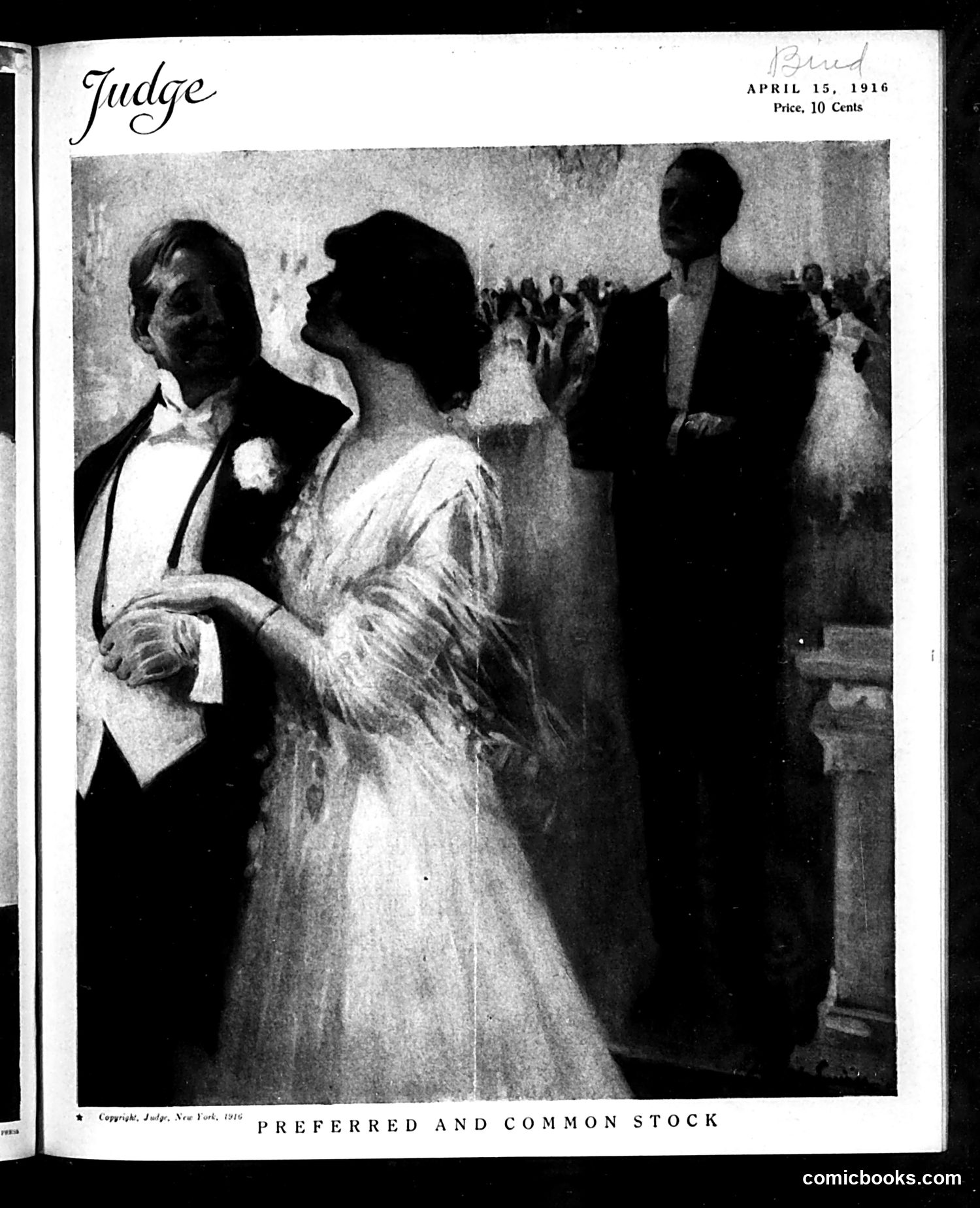
This Judge magazine page from April 15, 1916 uses financial terminology as satire. The caption "Preferred and Common Stock" appears to reference social class divisions, likely mocking wealth inequality or snobbery in American society. The image shows formally dressed figures at what appears to be a social gathering or event. The "preferred stock" likely refers to the well-dressed couple in foreground (man in tuxedo, woman in elegant gown), while the "common stock" appears to be the less distinct figures in the background crowd. The satire suggests that American society was stratified like corporate stock classes—some people treated as premium/superior while others remained ordinary or lower-class. This reflects early 20th-century social anxieties about class mobility and wealth disparity.
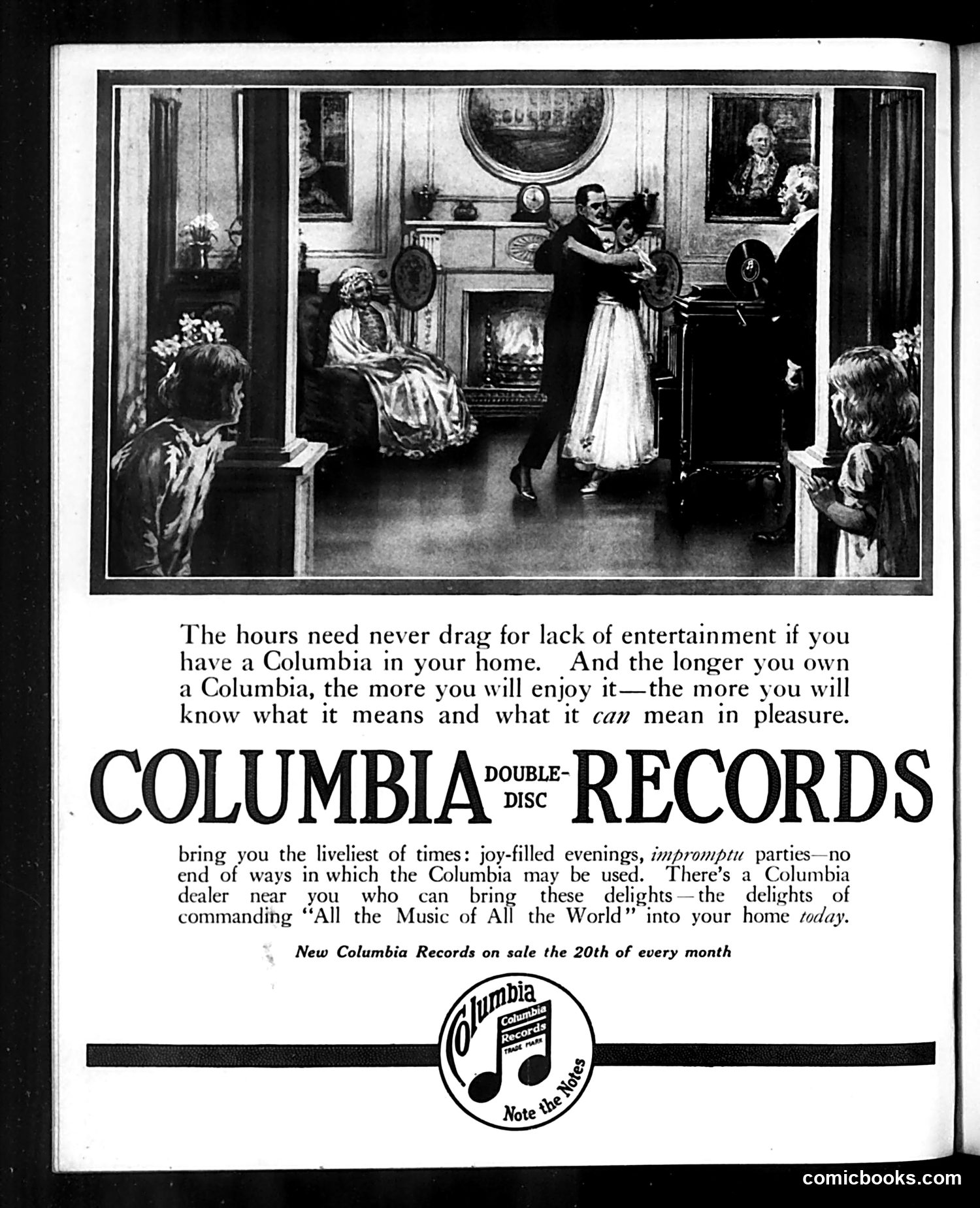
This page is **primarily an advertisement**, not satire or political commentary. It's a Columbia Records ad promoting their double-disc phonograph records for home entertainment. The image depicts an elegant drawing-room scene where guests enjoy music played on a Columbia device. The accompanying text emphasizes how owning a Columbia record player brings "joy-filled evenings" and "impromptu parties" to the home, positioning recorded music as essential entertainment. The ad uses aspirational imagery—well-dressed figures in a refined interior—to appeal to middle-class consumers. The tagline about commanding "All the Music of All the World" suggests the phonograph as a gateway to cosmopolitan culture. The note about new records arriving "the 20th of every month" indicates Columbia's marketing strategy of regular new releases. This reflects early 20th-century consumer culture promoting home entertainment technology.
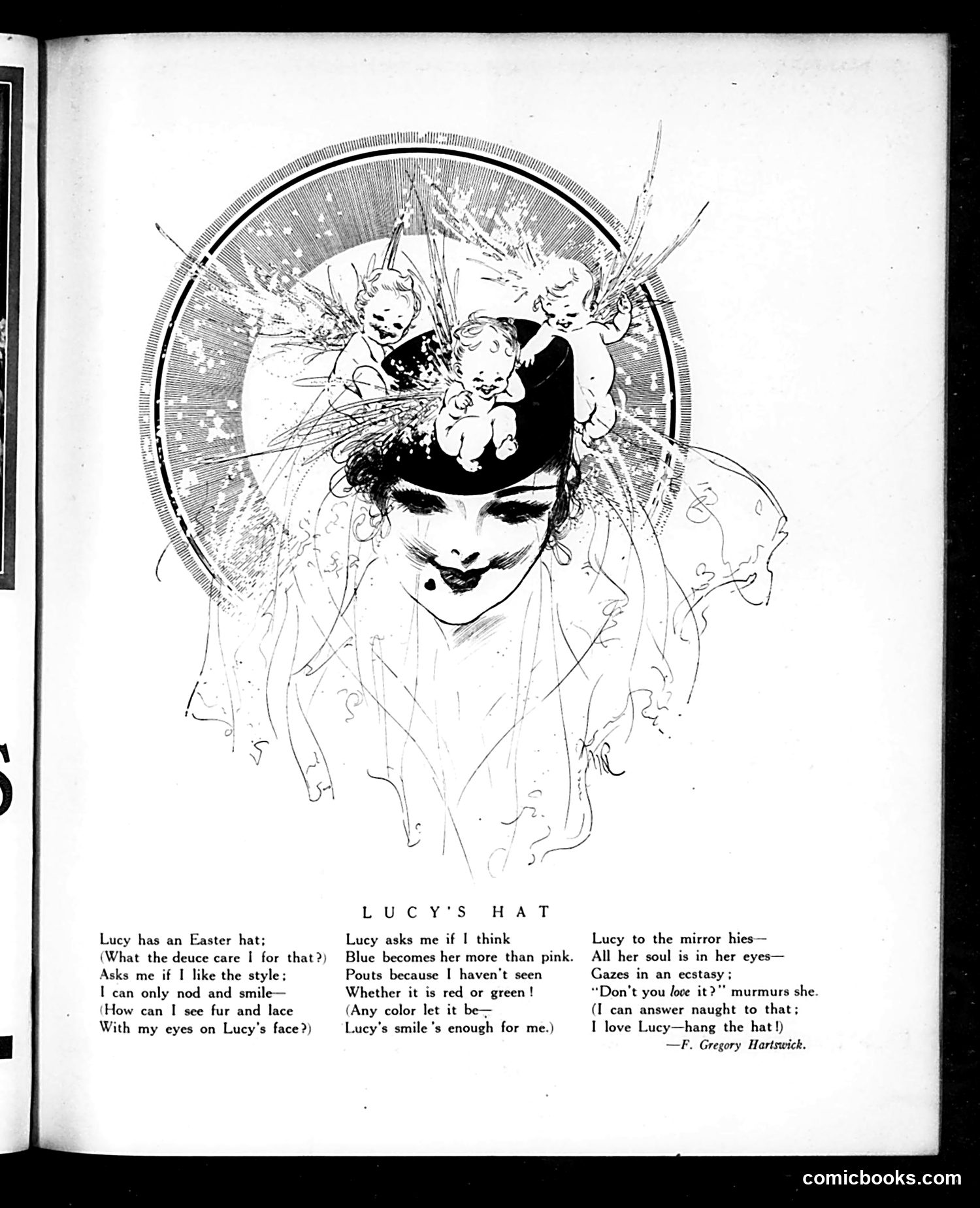
This page features an illustration and poem by F. Gregory Hartswick about a woman named Lucy and her Easter hat. The image shows a stylized female head with an elaborate hat topped with cherubs/putti and radiating lines suggesting spiritual or whimsical significance. The poem is a lighthearted romantic piece where the speaker claims indifference to fashion details (fur, lace, hat style, or color) because Lucy herself captivates him completely. His eyes rest on her face, not her accessories. This represents typical early 20th-century Judge content: witty, illustration-driven humor about courtship and fashion. The piece gently mocks both elaborate millinery fashion and romantic sentimentality through its exaggerated visual presentation and the speaker's affected devotion.
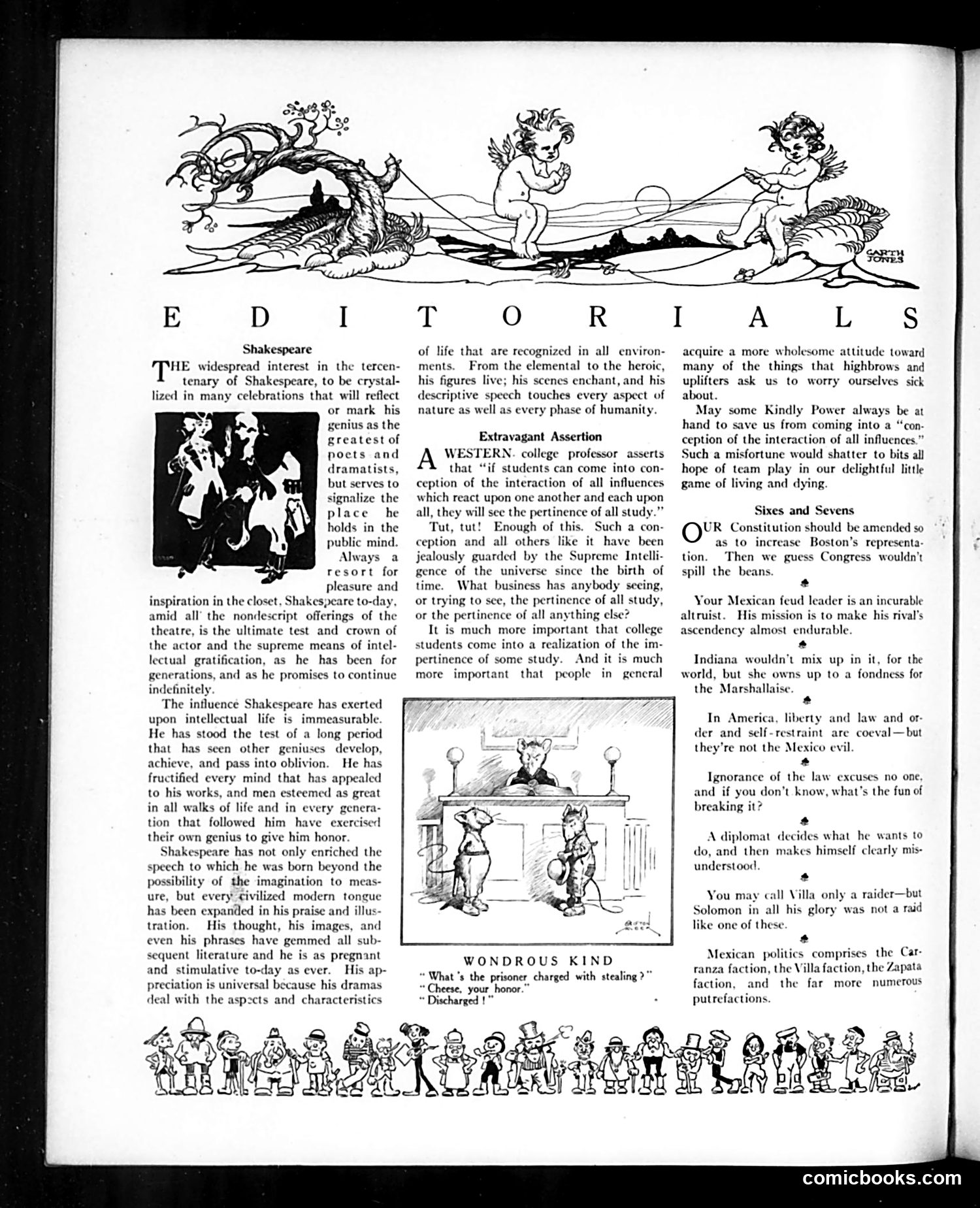
This page combines a Shakespeare tribute with political satire. The main cartoon titled "Wondrous Kind" depicts a courtroom scene where a judge appears to be ruling on a case involving theft charges. The dialogue—"What's the charge against him?" "Cheese, your honor" "Discharged!"—satirizes judicial leniency, suggesting judges dismiss minor property crimes too easily. The surrounding editorial text discusses Shakespeare's literary influence. However, the page's right column contains sharp jabs at contemporary politics: mocking a Western college professor's idealism, criticizing Mexican political factions (Carranza, Villa, Zapata), and commenting on American-Mexican relations—likely referencing the Mexican Revolution era tensions. The overall effect juxtaposes cultural refinement (Shakespeare) against political chaos and judicial incompetence.
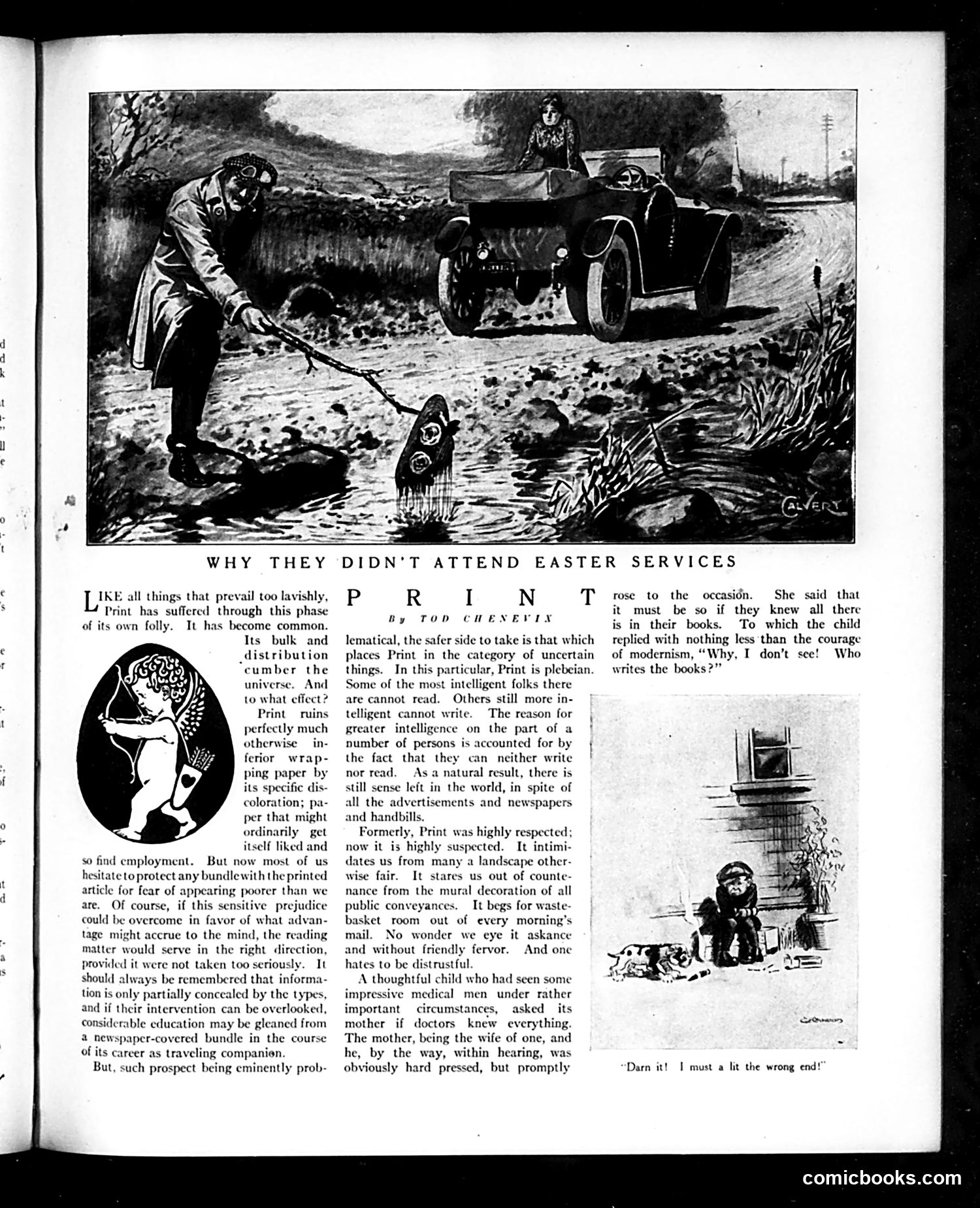
This satirical piece criticizes Print media's decline in respectability and influence. The article argues that Print—once highly respected—is now suspected and avoided, even by intelligent people who either can't read or won't read. The top illustration depicts a drowning figure being rescued from water, suggesting Print has become a liability rather than a respectable companion. The text mocks Print's current state: it appears in wastebins, clutters public spaces, and carries unwanted advertisements. The accompanying smaller cartoon shows a child at a flooded window, with the caption "Darn it! I must a lit the wrong end!"—apparently illustrating foolish misuse. The satire suggests Print journalism's loss of credibility has made it socially embarrassing, even keeping families away from church services.
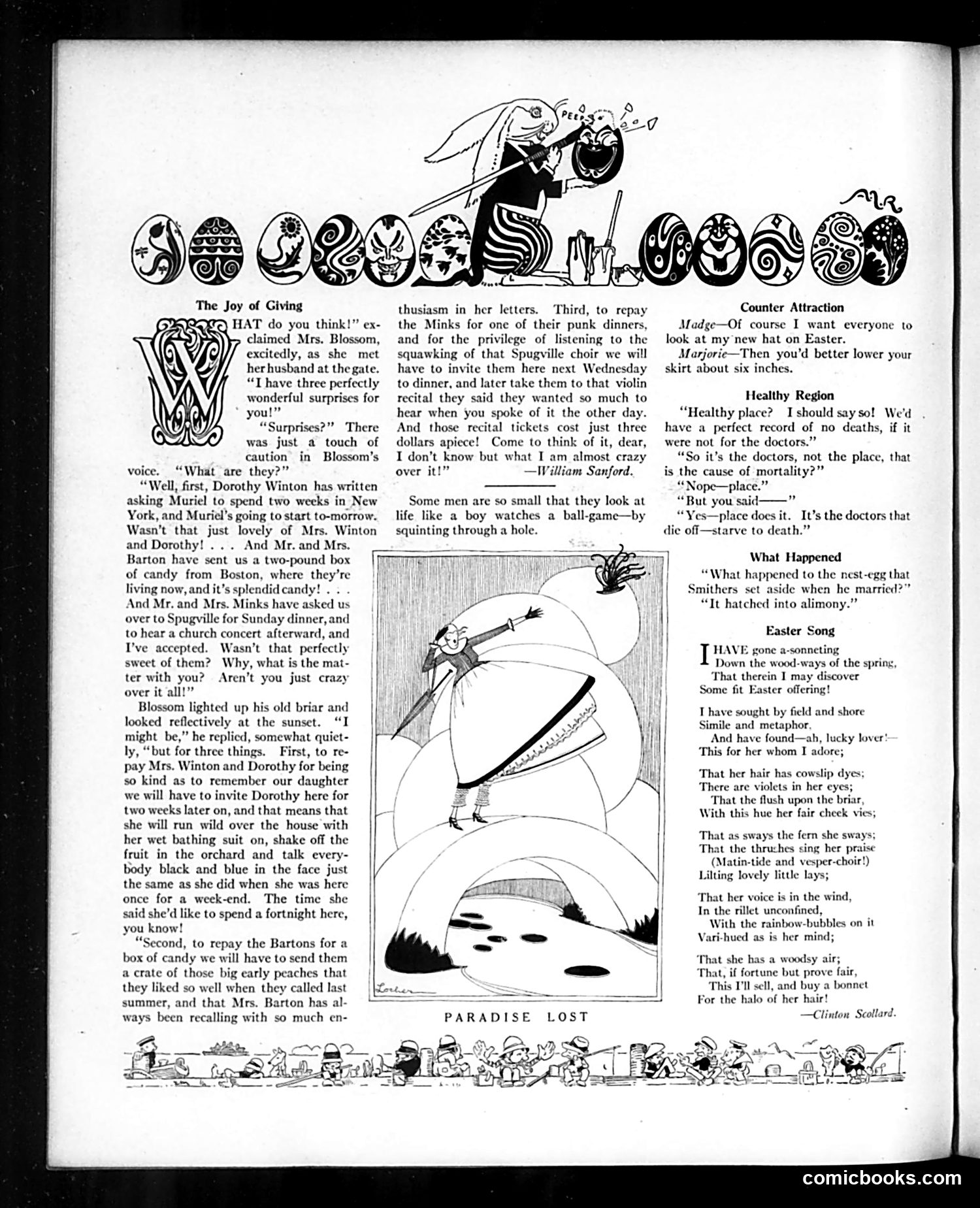
This page satirizes the social obligation trap of gift-giving among middle-class Americans. Mrs. Blossom excitedly announces three "wonderful surprises"—guests invited to visit and entertain them. Her husband Mr. Blossom, however, reveals the bitter reality: each kindness *requires* reciprocal repayment, often at greater expense or inconvenience. The joke exposes how social courtesies become financial and social burdens. The Wintons' invitation means hosting their daughter (described as destructive and loud); the Bartons' candy requires sending expensive peaches; the Minks' dinner invitation necessitates hosting them *and* buying expensive concert tickets. The satire targets the exhausting performativity of genteel society—how generosity becomes transactional obligation rather than genuine kindness. "The Joy of Giving" is ironic: there's no joy, only anxiety and expense. The accompanying vignettes (about hats, doctors, and alimony) reinforce themes of social pretense and hidden costs.
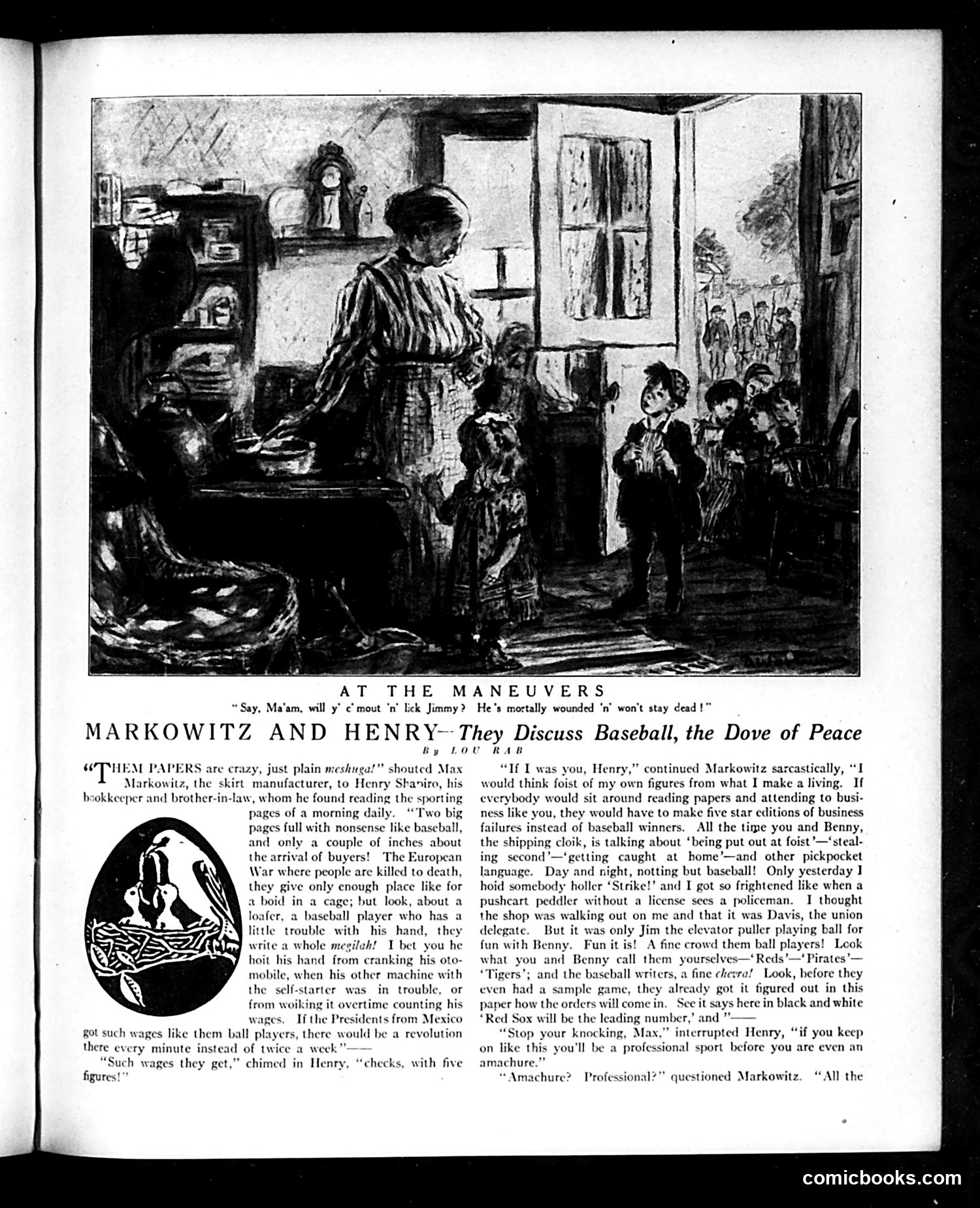
This is a humorous dialogue between two Jewish businessmen (identified by Yiddish-inflected speech) debating the cultural obsession with baseball. Max Markowitz, a skirt manufacturer, complains that newspapers devote more coverage to baseball players and their trivial injuries than to the serious European War (likely WWI). He mocks baseball players' high wages and the sport's triviality. Henry Shapiro, his bookkeeper brother-in-law, responds that Markowitz himself is becoming "a professional sport" through his constant complaining—a play on the word "amachure" (amateur). The satire critiques early 20th-century American priorities: the disproportionate media and public attention given to sports over serious world events, and the phenomenon of working-class enthusiasm for baseball as escape or entertainment. The Yiddish dialect humor was typical Judge magazine fare targeting immigrant populations.
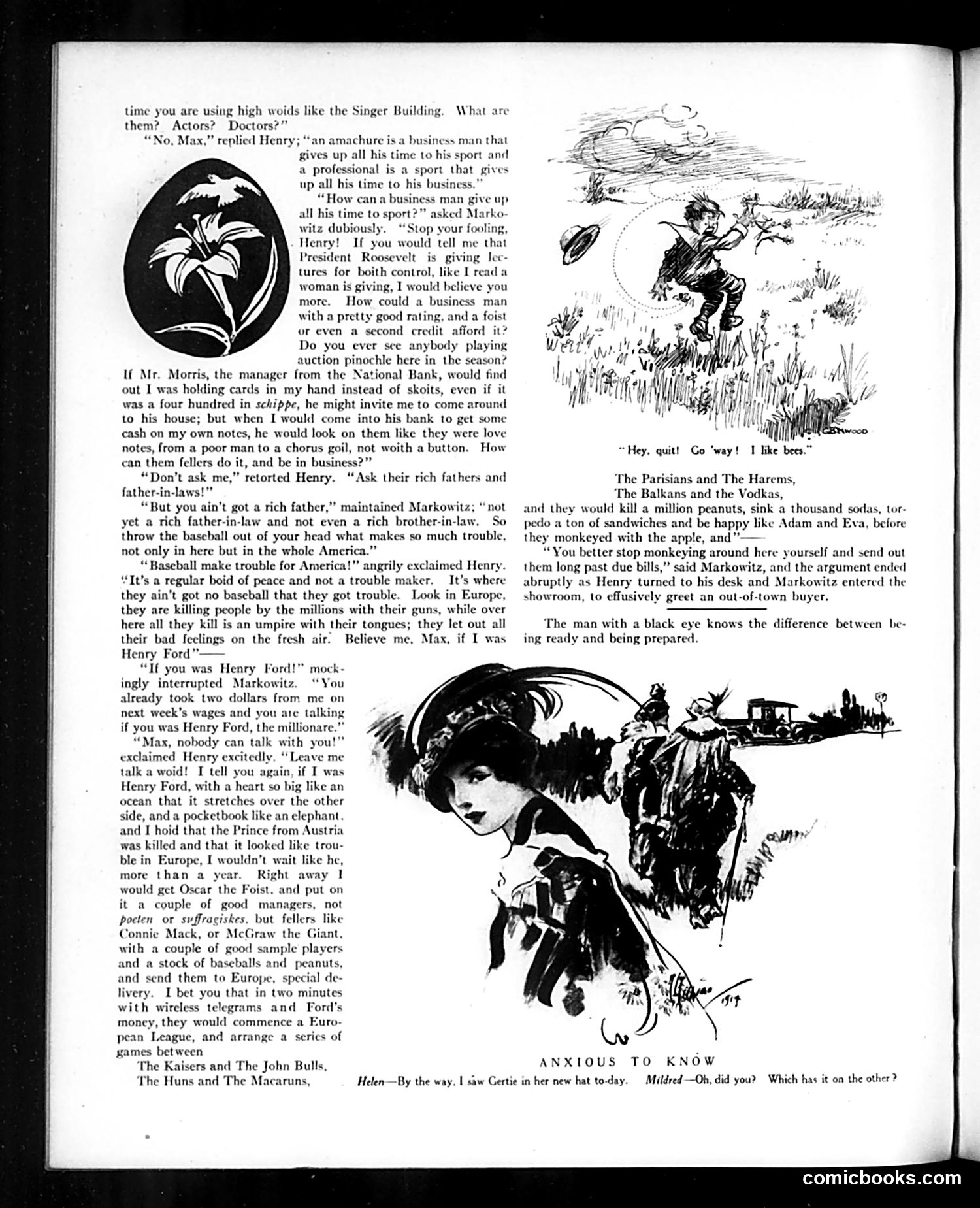
This page contains a dialogue satirizing immigrant attitudes toward American leisure, wealth, and business during the early 1900s. Two characters—Henry and Markowitz (identifiable as Jewish immigrants by their Yiddish-inflected English)—debate whether businessmen can afford to play sports. Henry defends baseball as harmless entertainment, contrasting it with European warfare (likely referencing pre-WWI tensions). He then fantasizes about being Henry Ford, proposing to use Ford's wealth and baseball to prevent European conflict by exporting the sport—a satirical suggestion that American capitalism and sports could solve global problems. The satire targets both immigrants' outsider perspective on American business culture and the era's naïve belief that commerce and entertainment could transcend serious political crises. The bottom cartoon ("Anxious to Know") appears unrelated—a brief joke about women's hats.
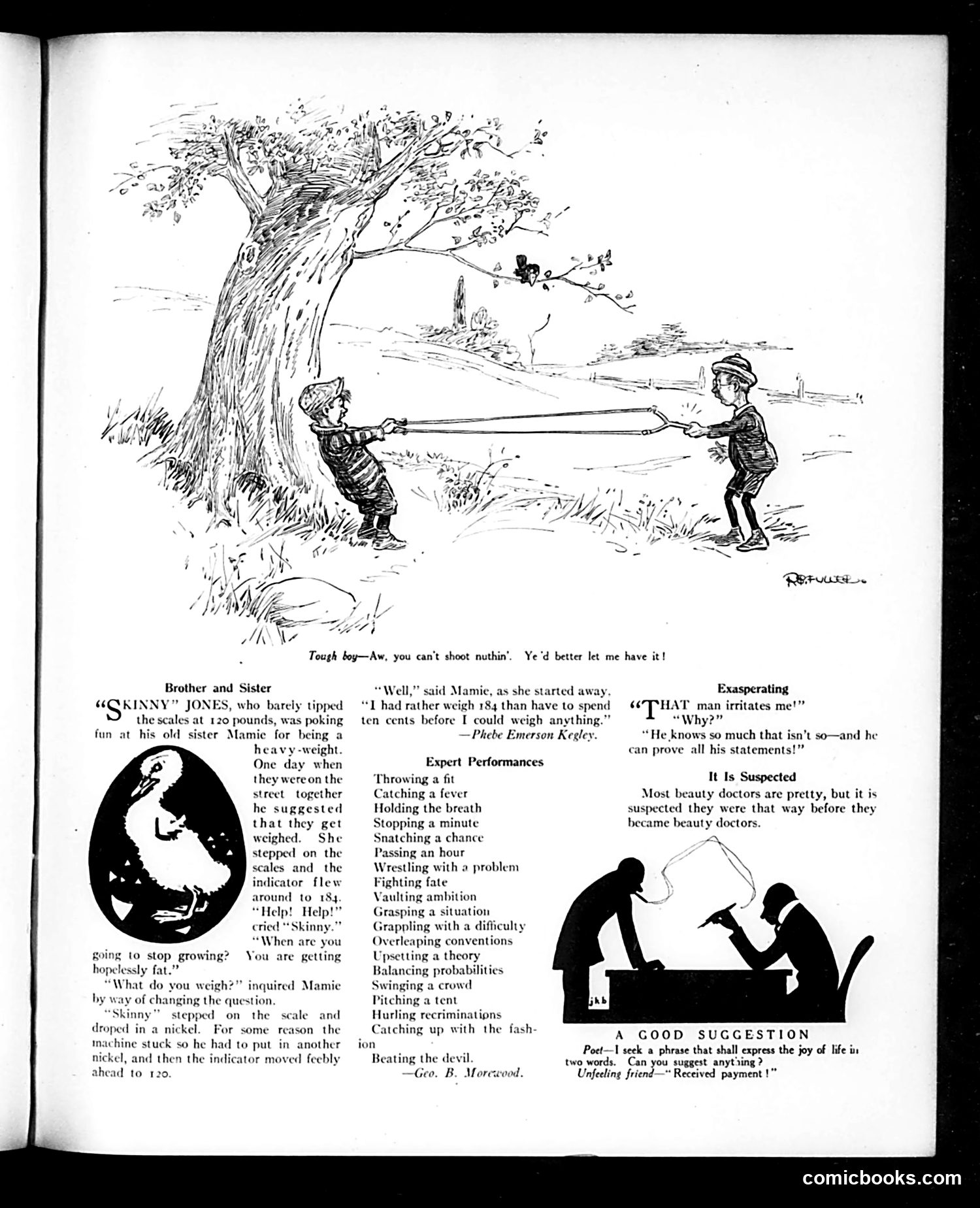
This page contains several humorous short pieces typical of early 20th-century satirical magazines: **"Brother and Sister"** mocks the hypocrisy of weight-shaming. "Skinny" Jones ridicules his sister Mamie for weighing 184 pounds, but when weighed himself, the scale requires two nickels to register his 120 pounds—suggesting the scale is broken or he's so light it barely registers. Mamie's retort—she'd rather weigh more than pay for the indignity—turns the joke on him. **"Expert Performances"** is a wordplay list where common phrases are literalized (wrestling with a problem, vaulting ambition, etc.). **"Exasperating"** and **"It Is Suspected"** are brief satirical observations about annoying people and beauty doctors respectively. **"A Good Suggestion"** jokes that a poet seeking to express "the joy of life" in two words receives the cynical answer "Received payment"—mocking both poetic pretension and financial self-interest. The top cartoon shows children playing tug-of-war near a gnarled tree, with one taunting the other about marksmanship—straightforward childhood humor.
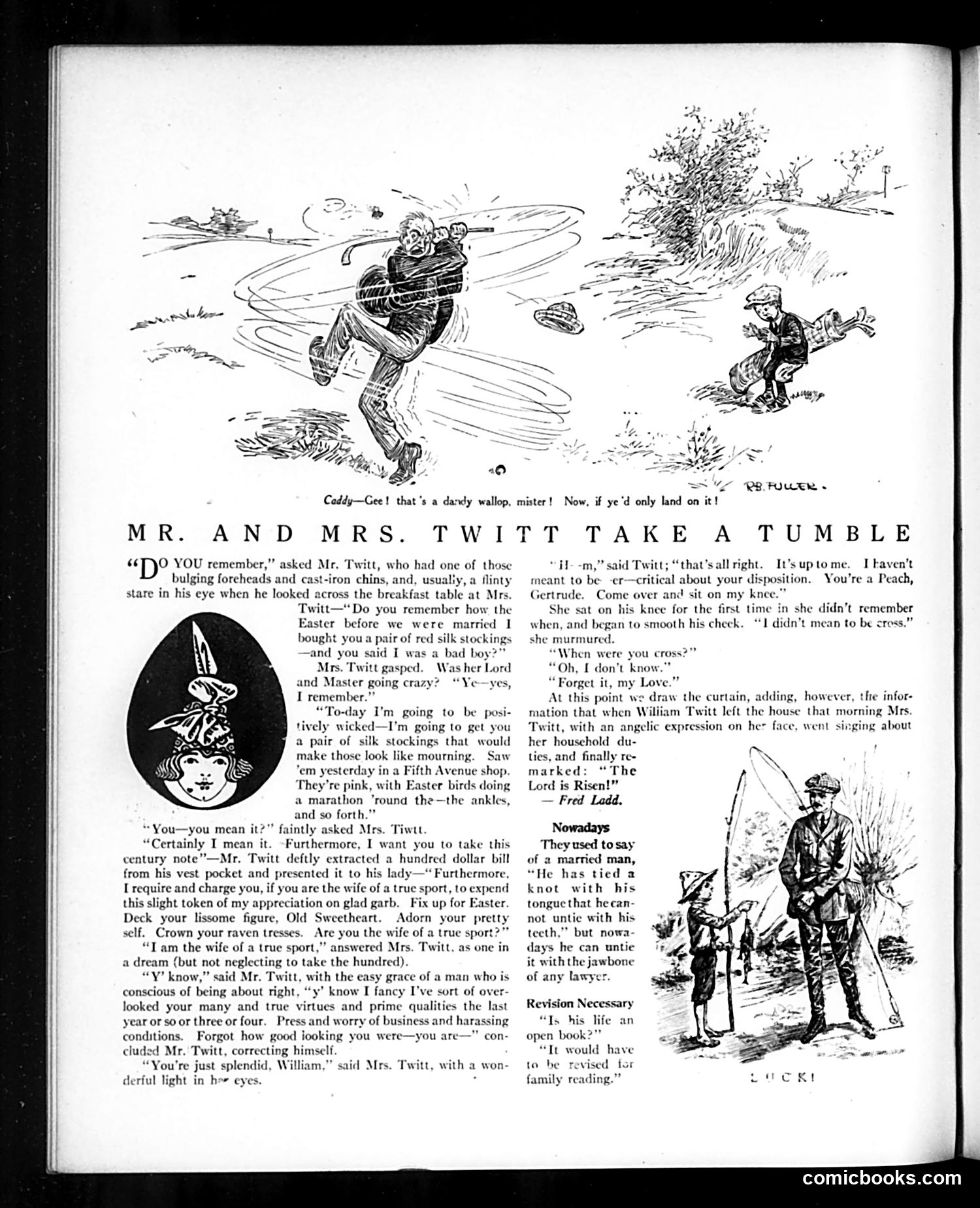
This humorous story satirizes early 20th-century marriage dynamics and male behavior. Mr. Twitt, characterized by a brutish appearance ("bulging forehead and cast-iron chin"), attempts to win back his wife's affection through lavish spending—a hundred-dollar bill and expensive pink silk stockings—after neglecting her for years due to "press and worry of business." The satire targets husbands who believe money can solve marital problems and erase their indifference. Mrs. Twitt's immediate emotional transformation upon receiving gifts mocks both her superficiality and the transactional nature of contemporary marriages. The sidebar joke about lawyers "untying knots" with "jawbones" references divorce proceedings, implying such reconciliations are often temporary. The overall message: material gestures cannot truly repair damaged relationships—though apparently they work quite well in the short term.
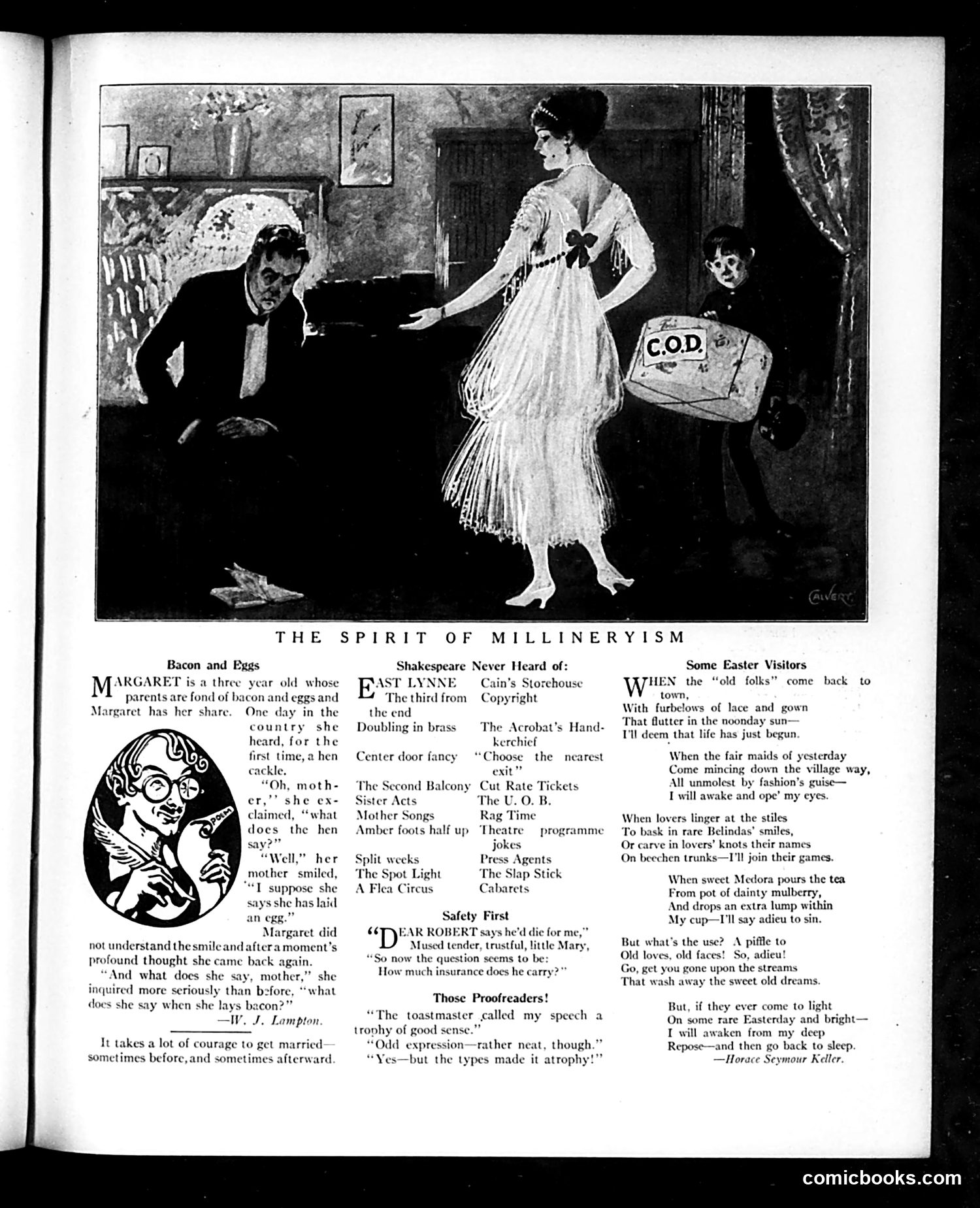
This page satirizes early 20th-century fashion obsession, particularly women's elaborate millinery (hats and bonnets). The title illustration shows a woman in an elegant gown with a large bow, flanked by a man and child—suggesting how fashion dominates domestic life. The cartoon critiques how women prioritize fashionable dress over practicality. The accompanying humor pieces reinforce this: jokes about hen-laying "bacon," Shakespeare never writing about modern theatrical fads (ragtime, cabaret acts), and insurance company jokes mock contemporary social pretensions. The poem "Some Easter Visitors" nostalgically contrasts past simplicity with present fashion-consciousness—women now "mincing" in stylish clothes, their natural beauty obscured by artifice. The satire targets not just women but broader consumer culture: the rise of fashion magazines, theatrical trends, and insurance advertising as signs of modern society's superficiality. The repeated message: fashionable appearance now trumps substance.
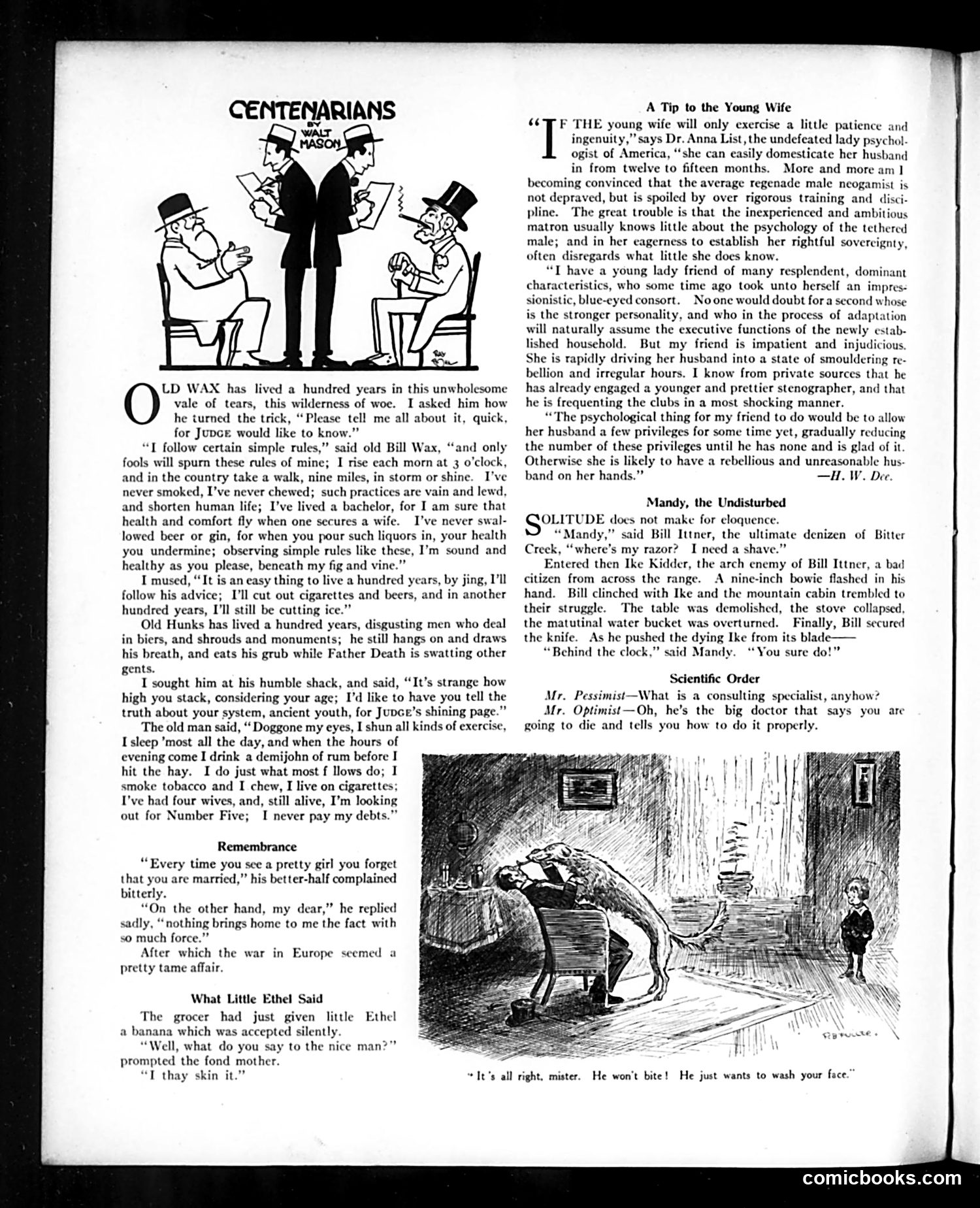
This page contains several satirical pieces mocking common social types and marital dynamics of the era. **"Centenarians" (main cartoon):** The cartoon depicts the contradiction between two centenarians' claimed longevity secrets. "Old Bill Wax" attributes his 100 years to rigid discipline—early rising, no smoking/drinking, bachelorhood. The punchline reveals this is false: the *actual* centenarian does the opposite—drinks heavily, smokes, remarried multiple times, sleeps late, avoids exercise—yet thrives. The satire mocks both health faddism and moralizing advice that contradicts reality. **"A Tip to the Young Wife":** Dr. Anna List (a fictional "lady psychologist") advises wives on "domesticating" husbands, claiming they're merely "spoiled" rather than depraved. She cites a case where a domineering wife is driving her husband toward infidelity with a stenographer. The satire targets both pseudo-scientific marriage advice and the era's anxieties about women's control in marriage. **Minor items:** Brief humorous anecdotes about forgetting pretty girls and a child's response to a grocer complete the page.
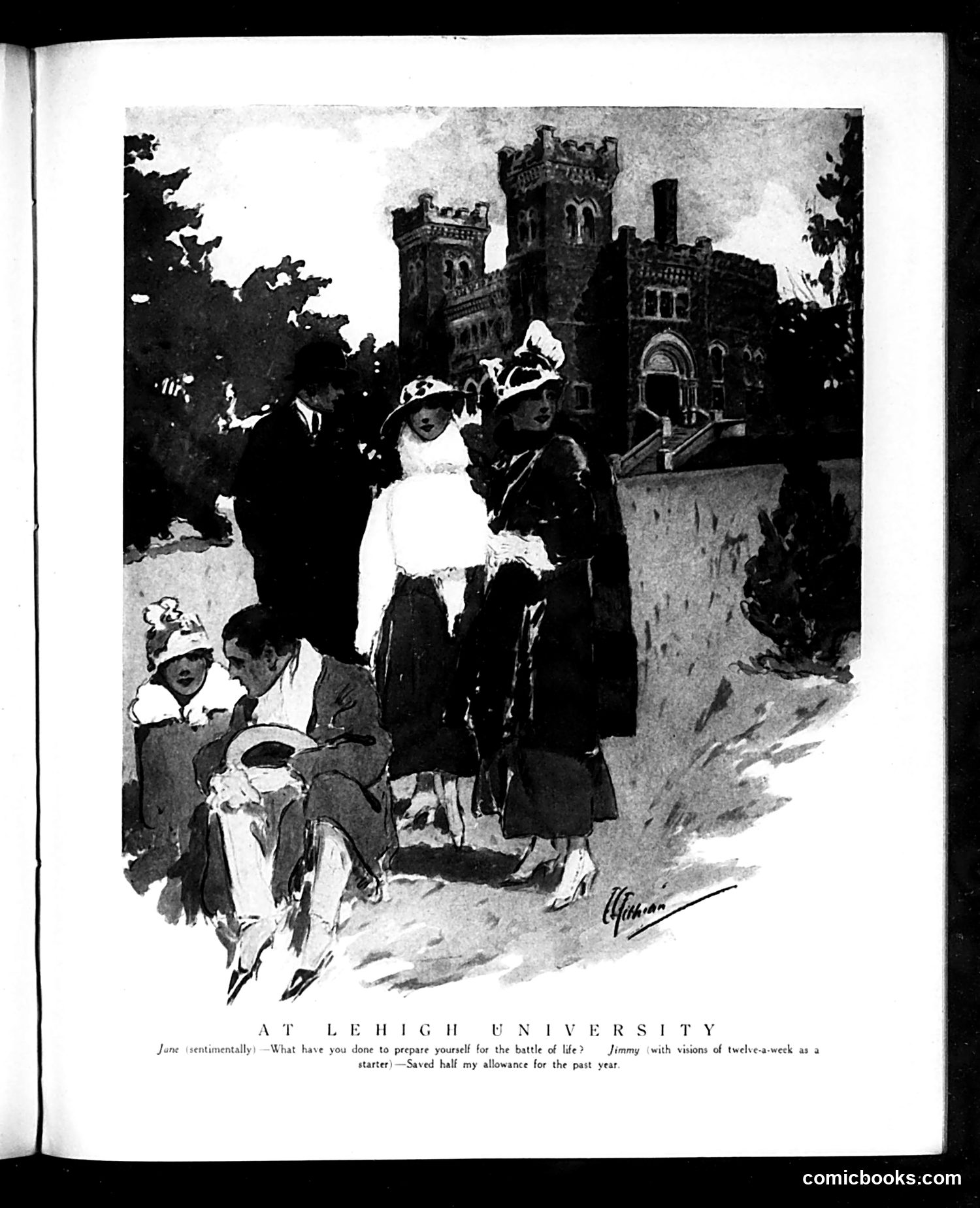
This cartoon satirizes the gap between idealistic parental expectations and students' actual priorities. Jane asks Jimmy the earnest question about preparing for life's challenges—a common refrain from concerned parents or mentors. Jimmy's response reveals the joke: his grand preparation amounts to saving half his allowance for a year, imagining a twelve-week vacation as his "starter" for adult life. The backdrop of the imposing university castle emphasizes the serious institution contrasted with Jimmy's trivial, leisure-focused accomplishment. The satire targets young people's perceived lack of ambition and seriousness, suggesting students prioritize pleasure and time off over genuine self-improvement or career preparation. This reflects early 20th-century anxieties about youth frivolousness.
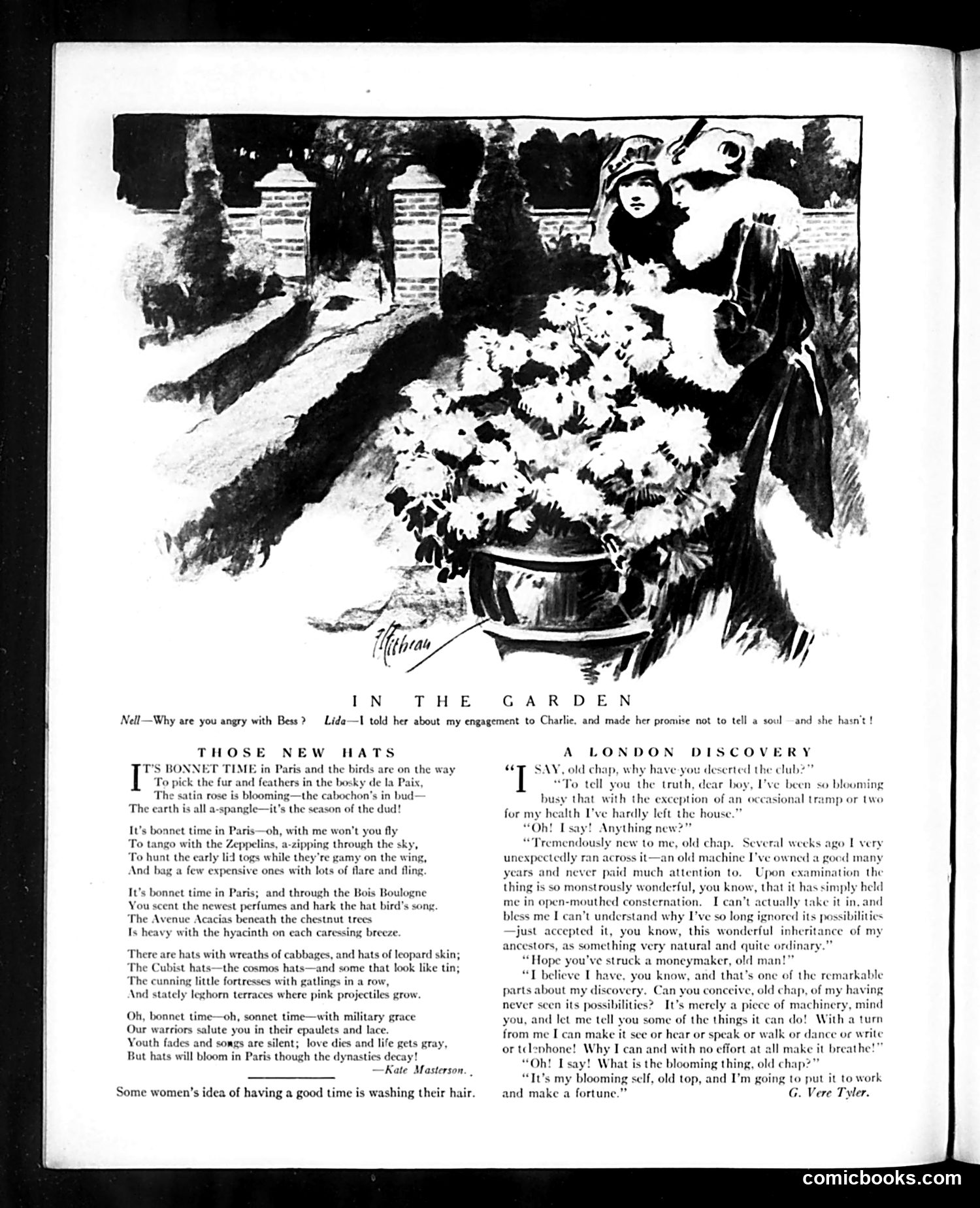
This page contains two separate humorous pieces from Judge magazine: **"In the Garden"** (top): A brief comic dialogue where Nell asks Lida why she's angry with Bess. Lida reveals she told Bess about her engagement to Charlie in confidence, but Bess kept the secret—which apparently upsets Lida. The joke is the absurd logic: Lida is angry *because* Bess *didn't* break her promise, suggesting Lida wanted gossip to spread. **"Those New Hats"** and **"A London Discovery"** (bottom sections): Poetry and dialogue satirizing fashionable excess. The hat poem mocks Parisian women's extravagant, absurd millinery (hats decorated with vegetables, animal skins, military fortifications). "A London Discovery" is a dialogue where a man reveals he's been obsessed with a "wonderful machine" he inherited—which turns out to be himself. He plans to monetize his own abilities. Both pieces gently mock upper-class preoccupation with frivolous pursuits and self-regard.
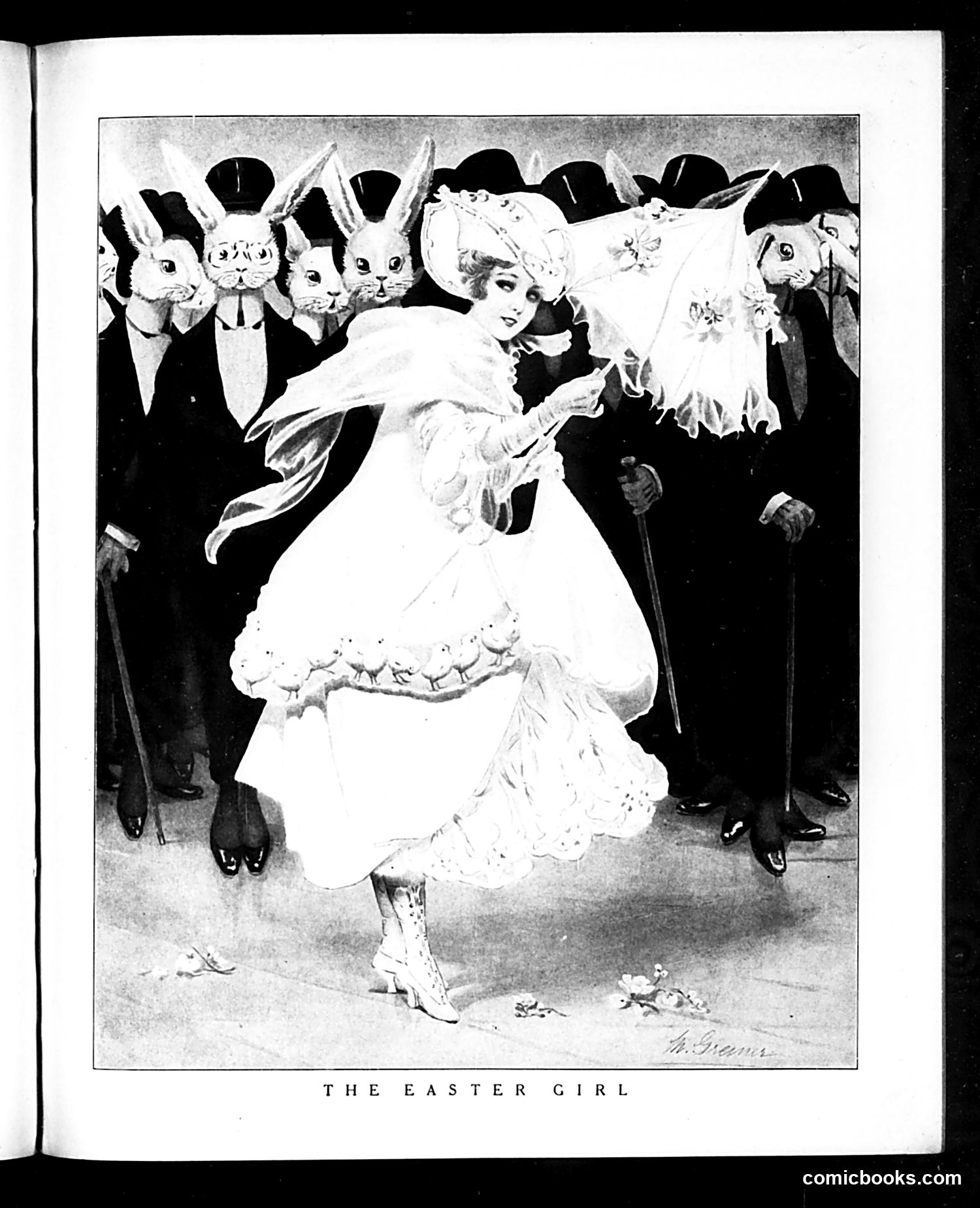
This illustration depicts a fashionably dressed young woman in an elaborate white Easter outfit—complete with feathered hat, flowing gown, and decorative details—dancing or posing energetically among formally dressed men wearing top hats and holding canes. The men have animal heads (appearing to be rabbits or hares), a visual pun connecting them to Easter imagery. The satire likely mocks the commercialization of Easter and the conspicuous consumption of fashionable clothing associated with the holiday, particularly among affluent women. The "Easter Girl" stereotype involved displaying new spring fashions, often extravagantly, as a status marker. The anthropomorphic animals may satirize the men as foolish admirers or the absurdity of the social rituals surrounding Easter fashion parades.
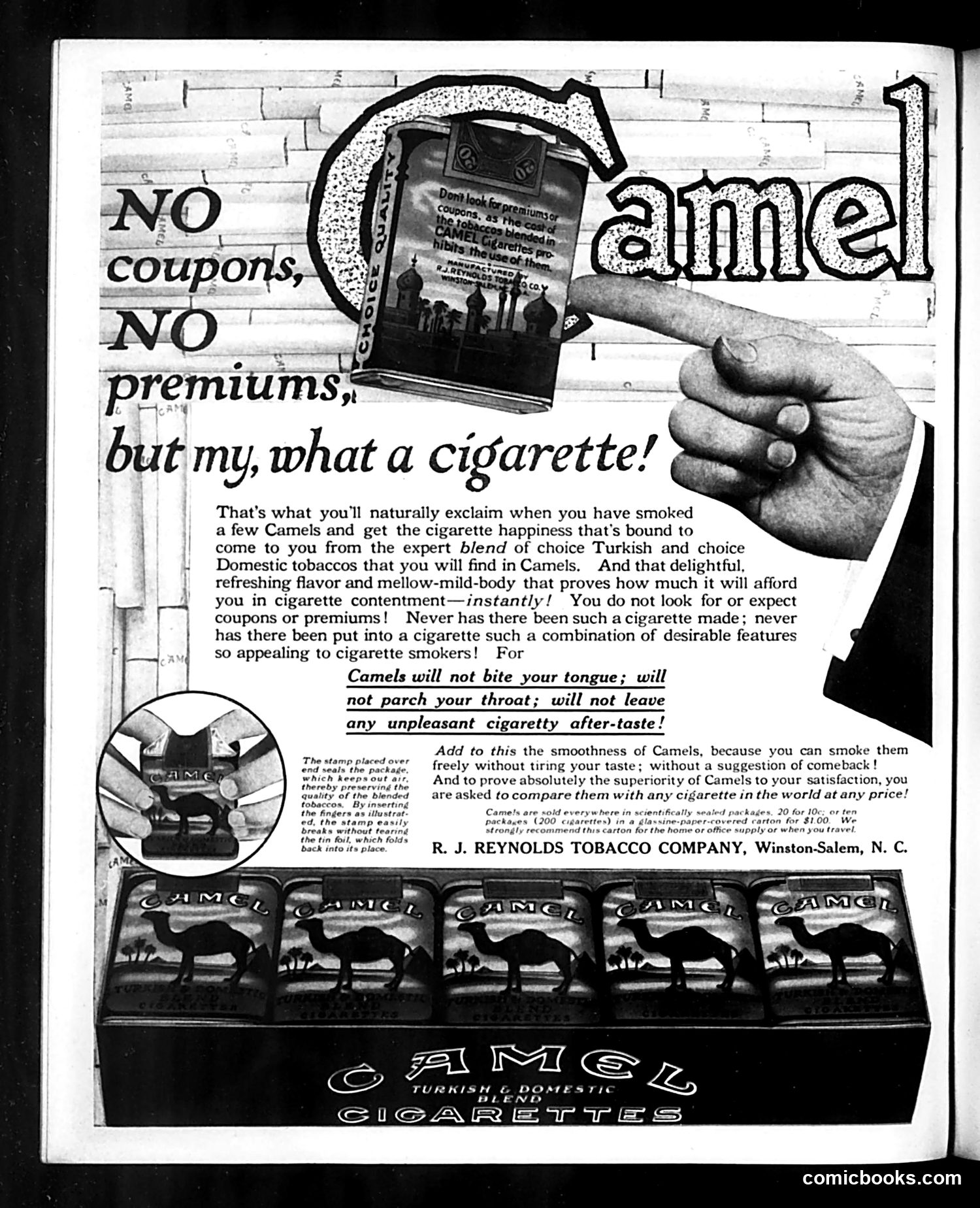
This is a **cigarette advertisement**, not political satire. It's a 1920s Camel brand ad from R.J. Reynolds Tobacco Company emphasizing that their product needs no gimmicks. The headline "NO coupons, NO premiums, but my, what a cigarette!" is the core message: Camels compete on quality alone, unlike competitors offering trading stamps or gift premiums to attract buyers. The hand holding a Camel pack and the circular detail showing how the package's stamp works reinforce this point about direct product appeal. The ad promises Camels won't "bite your tongue," "parch your throat," or leave "unpleasant cigaretty after-taste"—reassuring smokers about the brand's mildness. The comparison challenge ("compare them with any cigarette in the world at any price!") is a common advertising tactic of the era. This reflects early 20th-century cigarette marketing before health warnings, when quality claims focused purely on taste and smoothness.
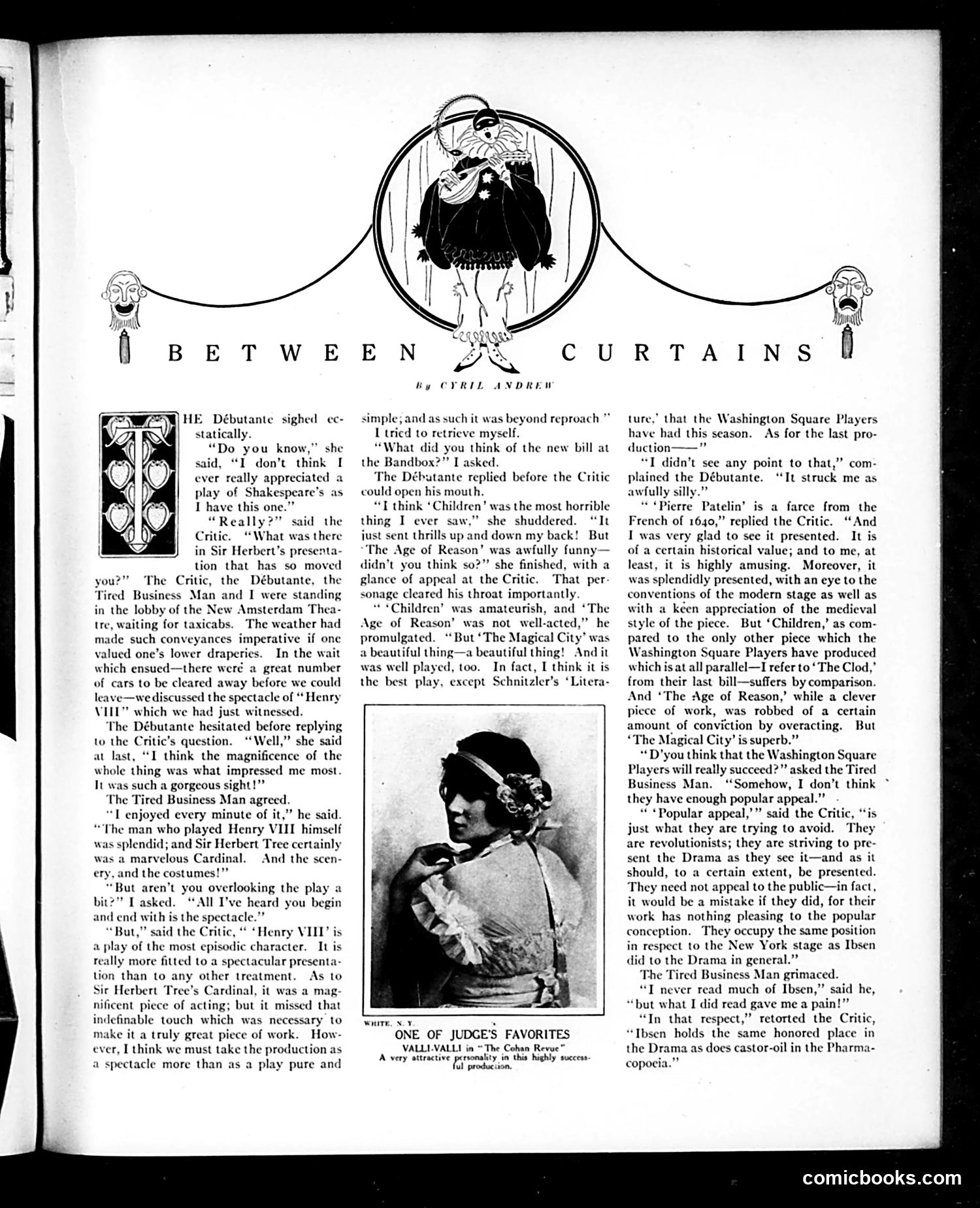
This page satirizes the pretension and superficiality of theater criticism and audiences in early 1910s New York. The article, written by Cyril Andrew, depicts four theatergoers discussing productions they've just seen, including Sir Herbert Tree's "Henry VIII" and plays at the Washington Square Players. The satire targets how audiences and critics prioritize spectacle over substance. The "Débutante" admits she appreciated Shakespeare mainly for the "magnificence" and "gorgeous sight," while the "Critic" delivers pompous judgments—praising Tree's Cardinal while dismissing other works with affected authority. The "Tired Business Man" represents the average patron simply enjoying entertainment. The joke is that genuine artistic merit gets obscured by pretense: the Critic evaluates plays based on production values and historical significance rather than dramatic quality, while the Débutante responds emotionally without understanding the material. The accompanying photograph shows Valli-Valli from "The Cohan Revue," representing the commercial theater world being discussed.
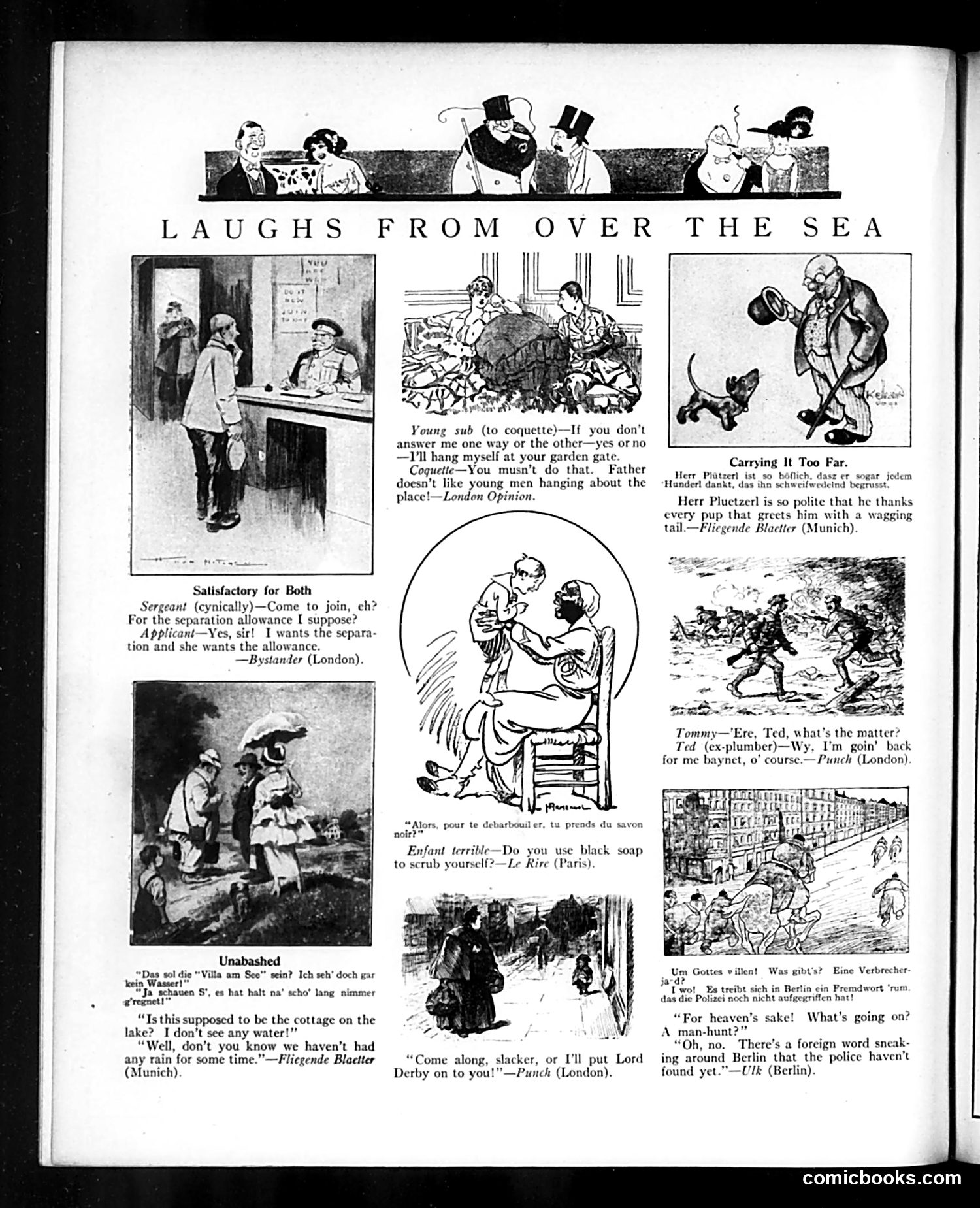
This page collects humorous shorts from European satirical publications (London Opinion, Punch, Le Rire, Fliegende Blätter, and Ütá), translated for American readers. The jokes reflect World War I-era concerns: a soldier enlists partly for the separation allowance (military pay to support dependents), suggesting financial desperation. A drought joke plays on regional hardship. A flirtation joke uses dark humor about suicide. A "slacker" reference targets those avoiding military service—a serious social stigma of the WWI period. Several jokes involve polite behavior and crude language, typical of period comedy. The final Berlin joke likely references wartime spy anxieties or foreign infiltration fears. The page demonstrates how Judge republished European humor to entertain American audiences, showing common wartime anxieties and social attitudes across the Atlantic during the 1910s.
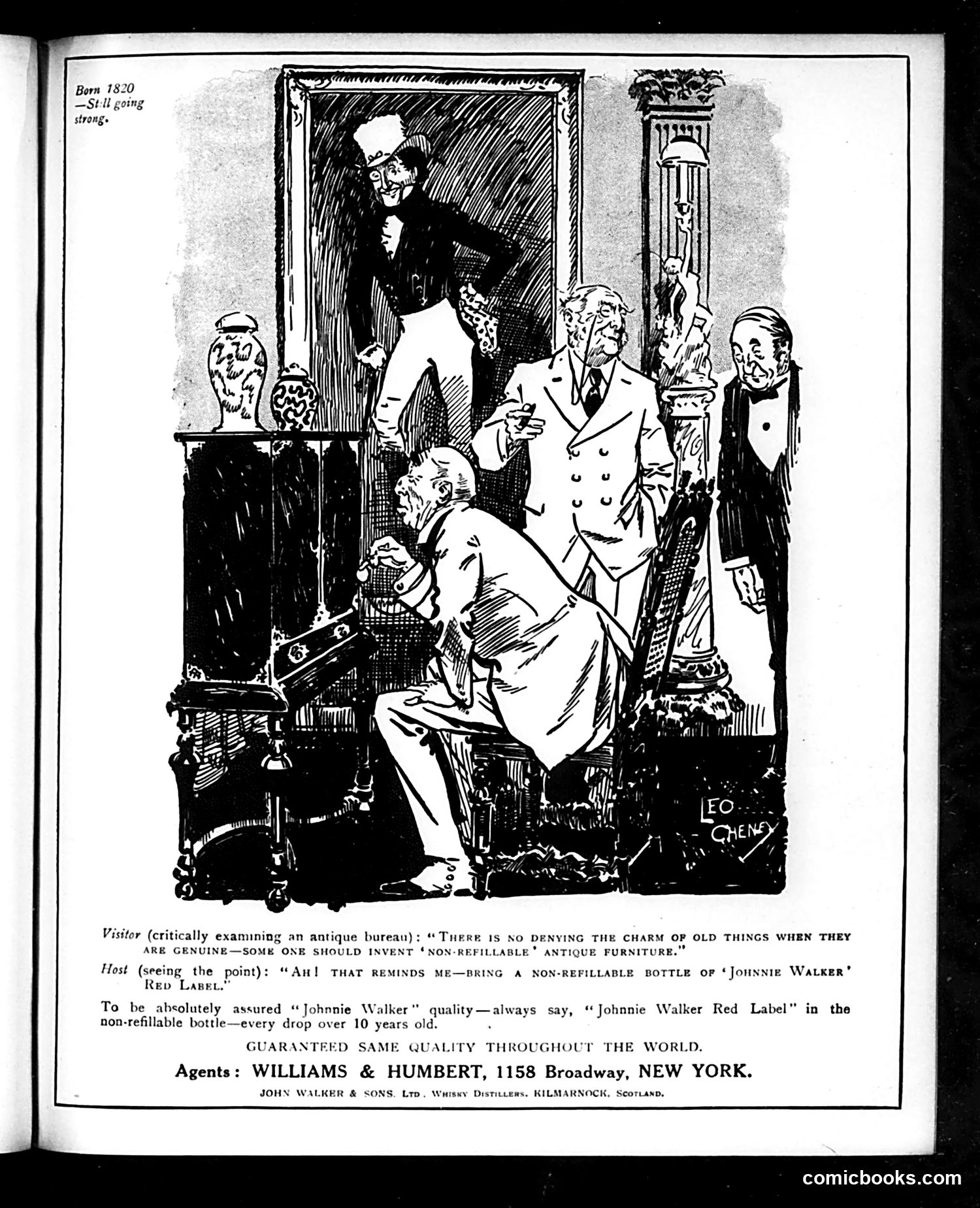
This is primarily a **Johnnie Walker whisky advertisement** dressed up as social commentary. The cartoon shows a visitor examining antique furniture in a wealthy home, remarking that genuine old things have charm—but someone should invent "non-refillable" fake antiques to prevent fraud. The host seizes on this idea to pivot to whisky: he can guarantee "Johnnie Walker Red Label" quality because it comes in non-refillable bottles, ensuring the contents are genuinely aged over 10 years rather than being counterfeit or diluted. The joke relies on drawing a parallel between antique furniture fraud (a known problem in high-society circles) and whisky adulteration—a legitimate concern for spirit drinkers in this era. By positioning Johnnie Walker's sealed bottles as a solution to consumer deception, the ad makes the product seem trustworthy and sophisticated. The text notes the brand was "Born 1820—Still going strong," emphasizing heritage and reliability to the Judge magazine's affluent readership.
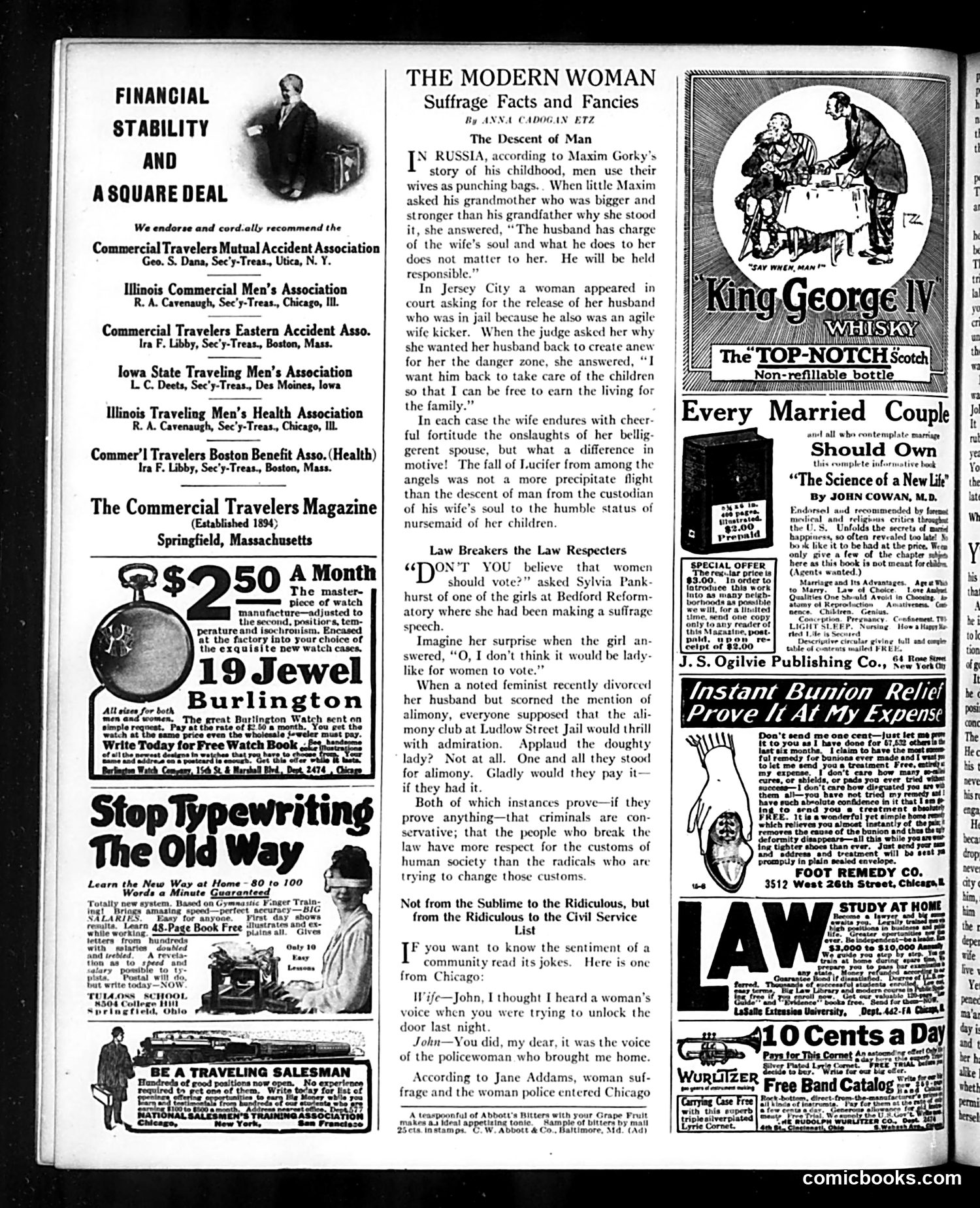
This page satirizes the women's suffrage movement through several anecdotes. The column, by Anna Cadogan Utz, presents itself as defending traditional gender roles against feminist demands. The opening story contrasts a Russian wife who accepts spousal abuse as her duty with a Jersey City woman who wants her abusive husband released only for childcare—suggesting women's liberation creates confusion and hypocrisy. The "Law Breakers the Law Respecters" section mocks feminists through two examples: a reformatory girl who finds voting "unladylike" (ironic undercutting of suffragettes' claims), and a divorced feminist who rejects alimony while incarcerated women support it. The author argues criminals respect traditional customs more than "radicals" seeking change. The satire's point: suffragists are hypocritical social agitators whose ideology contradicts women's actual values and behavior.
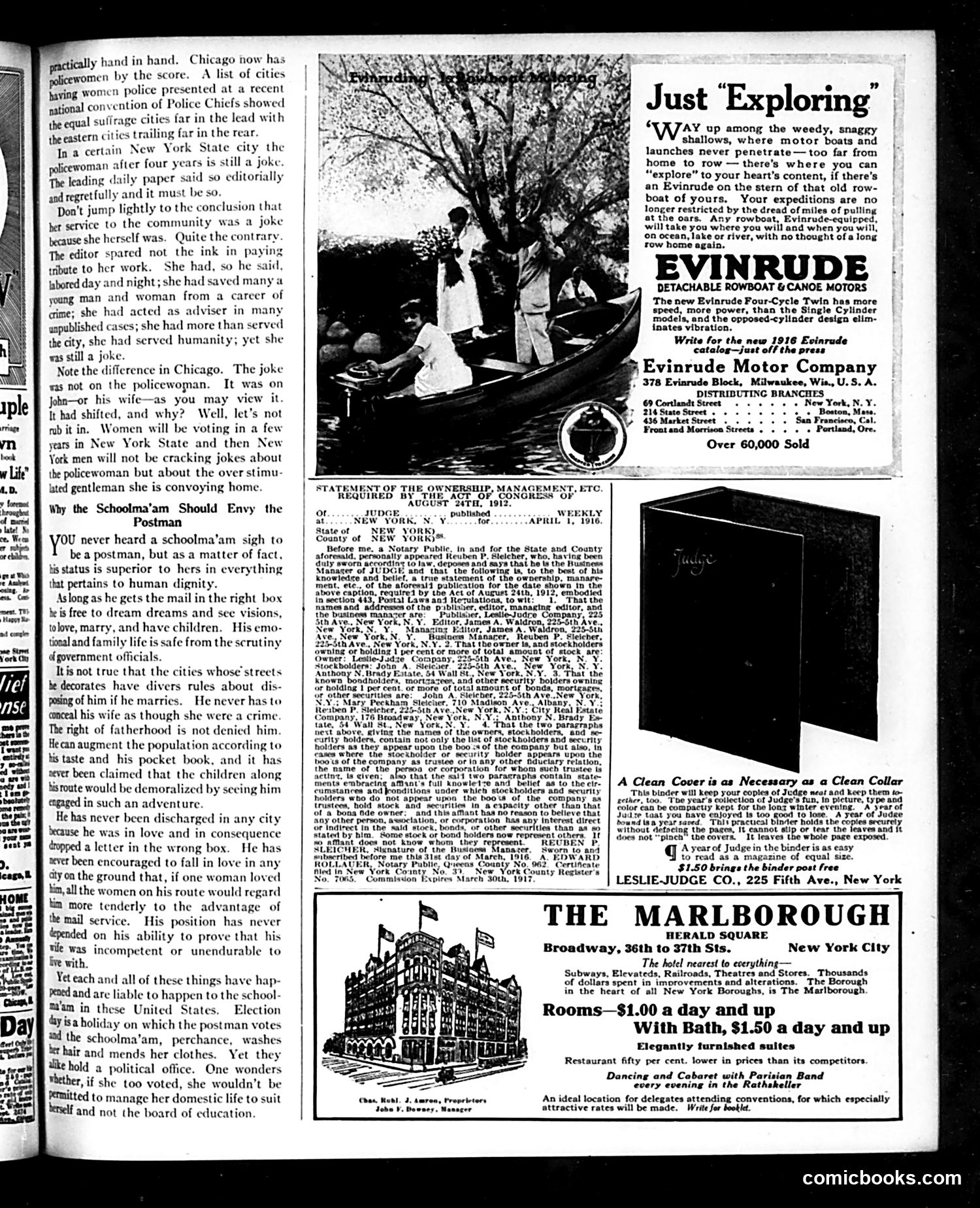
This page contains two distinct editorial pieces critiquing gender discrimination in American institutions. **"The Schoolma'am Should Envy the Postman"** argues that female teachers lack basic human dignity afforded to male postal workers. While both hold government positions, teachers face invasive scrutiny of their personal lives—restrictions on marriage, motherhood, and romantic relationships—justified by claims that such conduct would "demoralize" students. Male postal workers enjoy the same civil service employment without these constraints. The satire's point: women are denied rights to emotional and family life that men take for granted, despite holding comparable public jobs. The preceding section compares treatment of female police officers across cities, noting that in Chicago (which had woman suffrage), the "joke" shifted from ridiculing the policewoman herself to mocking the men she arrests—suggesting that granting women actual authority changes social attitudes. Both pieces argue that women's exclusion from full civic participation (voting, personal autonomy) contradicts their assignment of public responsibilities. **The advertisements** (Evinrude motors, The Marlborough Hotel, Judge binder) are typical period commercial content.
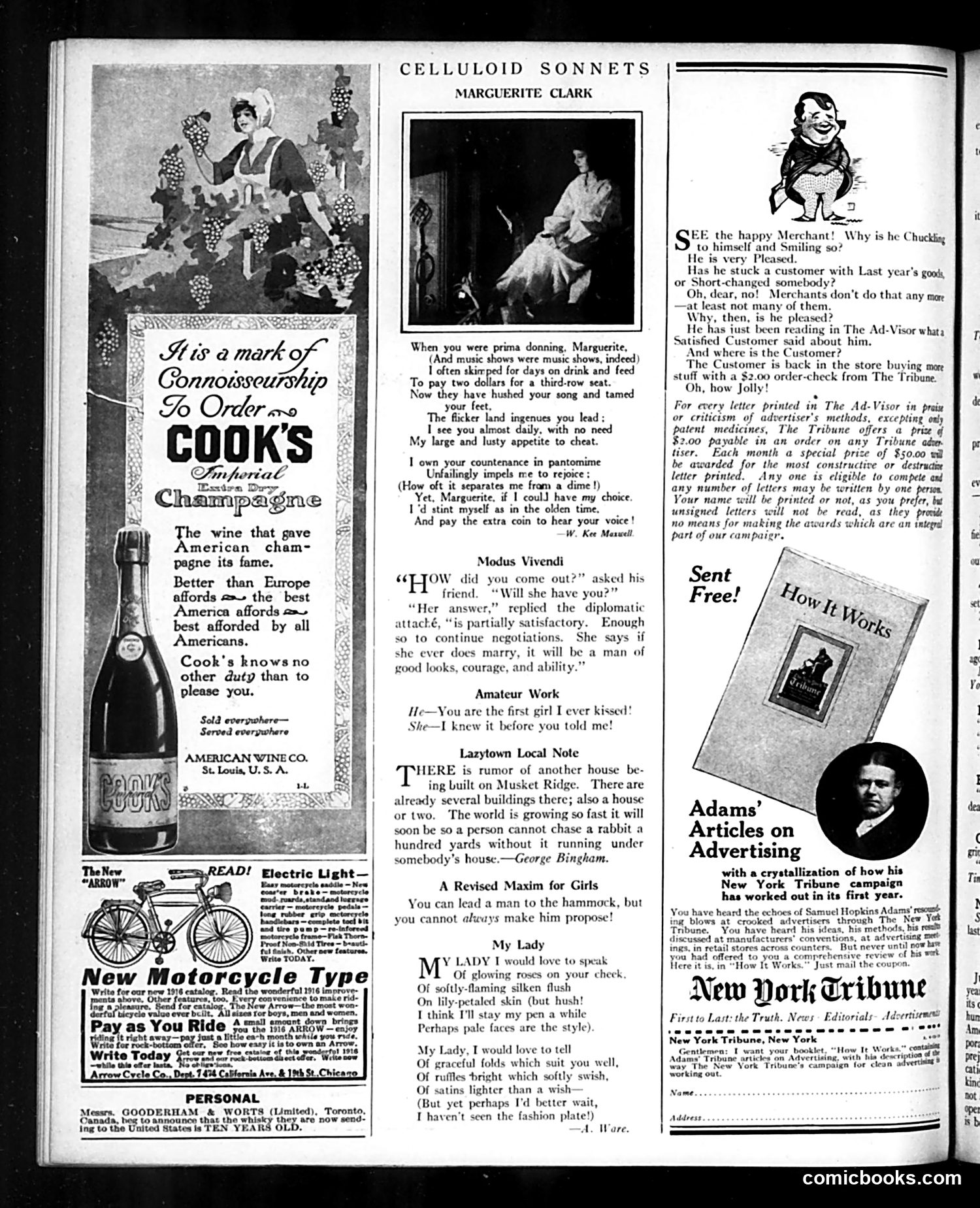
This page from *Judge* magazine mixes advertisements with light satirical poetry and humor pieces. The key content: **"Celluloid Sonnets"** features a poem about actress Marguerite Clark, who transitioned from live theater to silent films ("the flicker land"). The poet laments that while he now sees her daily in movies (cheaply), he misses paying for live theater tickets to hear her actual voice—a poignant commentary on what cinema replaced. **Other brief pieces** include mild romantic humor ("Modus Vivendi," "Amateur Work") and a "Lazytown Local Note" mocking small-town development. **The satire is gentle**: mostly about romance, changing entertainment technology, and consumer culture. The adjacent advertisements (Cook's Champagne, bicycles, motorcycles) reflect early 1900s consumer goods. The page captures an era when silent film was still novel enough to merit nostalgic reflection on live performance's loss—particularly the inability to hear performers' voices.
This page from *Judge* magazine presents a collection of brief humorous anecdotes rather than political cartoons. The jokes exploit **wordplay and social observation** typical of early 20th-century American humor. Key jokes include: - A fisherman claiming "no gross income" but "all net" (pun on fishing nets) - A performer of escapes demanding advance rent payment (ironic mistrust) - A theater manager dismissing Hamlet audiences as "deadheads" (theater patrons) - A farmer's wife serving as a scarecrow - References to early telephone technology ("line busy") The **right-side advertisements** for Wilson whiskey and Cascade whiskey dominate visually, promoting "moderation" and "efficiency"—language reflecting **Prohibition-era messaging** where alcohol advertisers defended their product by emphasizing restraint and propriety. The page reflects pre-Prohibition American attitudes mixing humor with implicit endorsement of drinking culture through advertising framing.
This page is primarily **advertising and promotional content** rather than editorial cartoons or political satire. The left side features ads for Gold Seal Champagne, Sunny Brook Whiskey, bicycles, and patent services—all typical of early 20th-century trade publications. The center section, "With the College Wits," contains **light humor and jokes** rather than political commentary. These are brief, humorous sketches (like fleas mourning a dead dog, a seance punchline, and misheard phone numbers) aimed at general amusement. The bylines reference publications like *Awgwan* and *Chaparral*. The right side prominently promotes **Leslie's Illustrated Weekly Newspaper**, emphasizing its photo journalism capabilities and wide circulation. This suggests *Judge* itself was positioned among competing illustrated weeklies in the era of early photojournalism. **Overall**: This appears to be a standard issue of *Judge* magazine, functioning primarily as an advertising and entertainment vehicle rather than a platform for serious political satire.
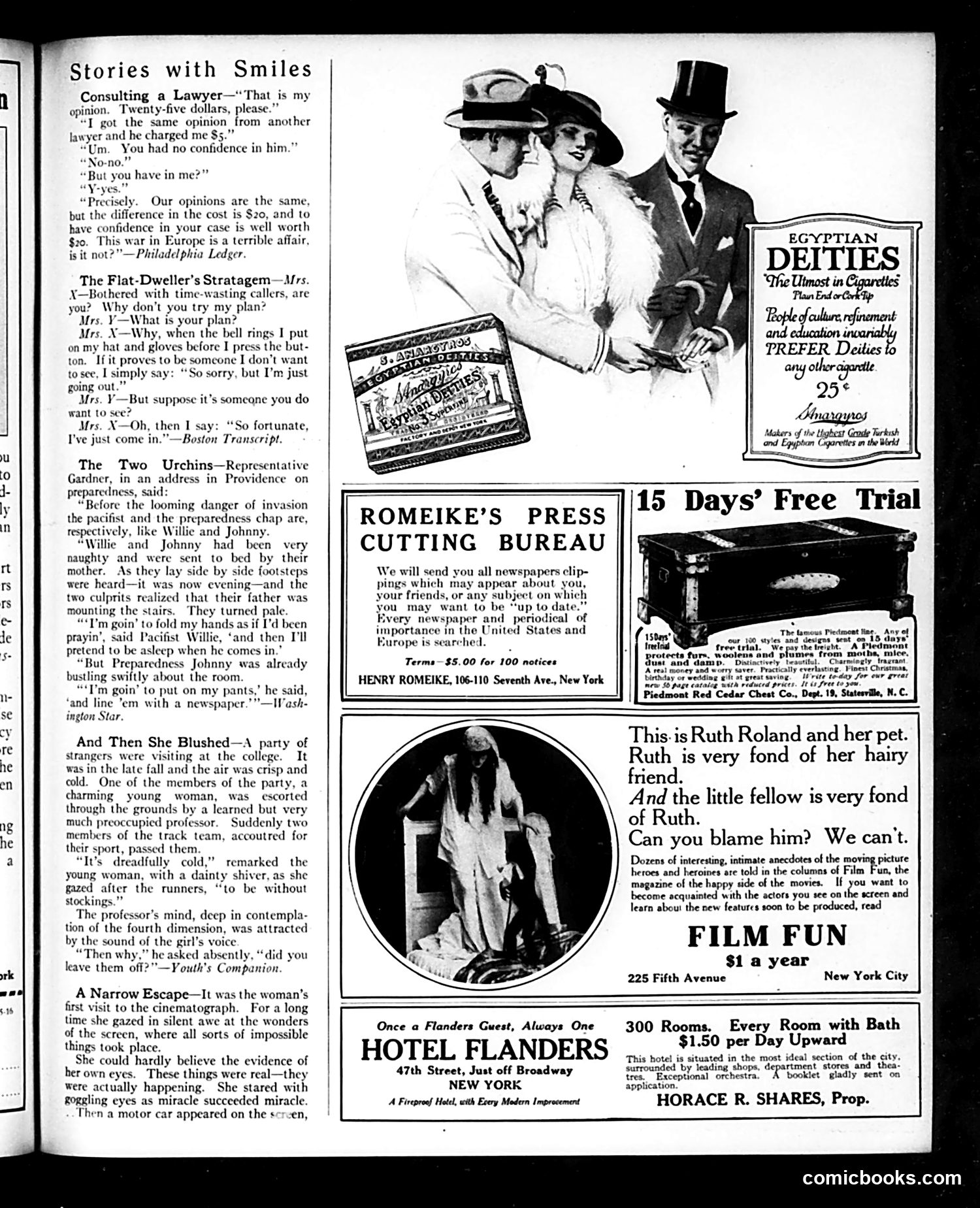
This page from *Judge* magazine contains humorous short anecdotes rather than political cartoons. The "Stories with Smiles" section offers social satire through brief comic vignettes: **"Consulting a Lawyer"** mocks the legal profession's fee structure—a lawyer charges $25 for an opinion identical to one costing $5 elsewhere, justifying the markup through client confidence rather than expertise. **"The Flat-Dweller's Stratagem"** satirizes urban etiquette: a woman uses hat-and-glove preparation to appear perpetually "going out," enabling her to refuse unwanted visitors while remaining available to desired ones. **"The Two Urchins"** uses a Representative Gardner's preparedness speech analogy: pacifists pray passively while preparedness advocates actively prepare—a reference to early-1910s U.S. military readiness debates. **"And Then She Blushed"** jokes about an absent-minded professor who, deep in mathematical thought, fails to register that a young woman just admitted to not wearing stockings—a risqué comment for the era. The remaining anecdotes employ similar mild social humor typical of early-20th-century magazine comedy.
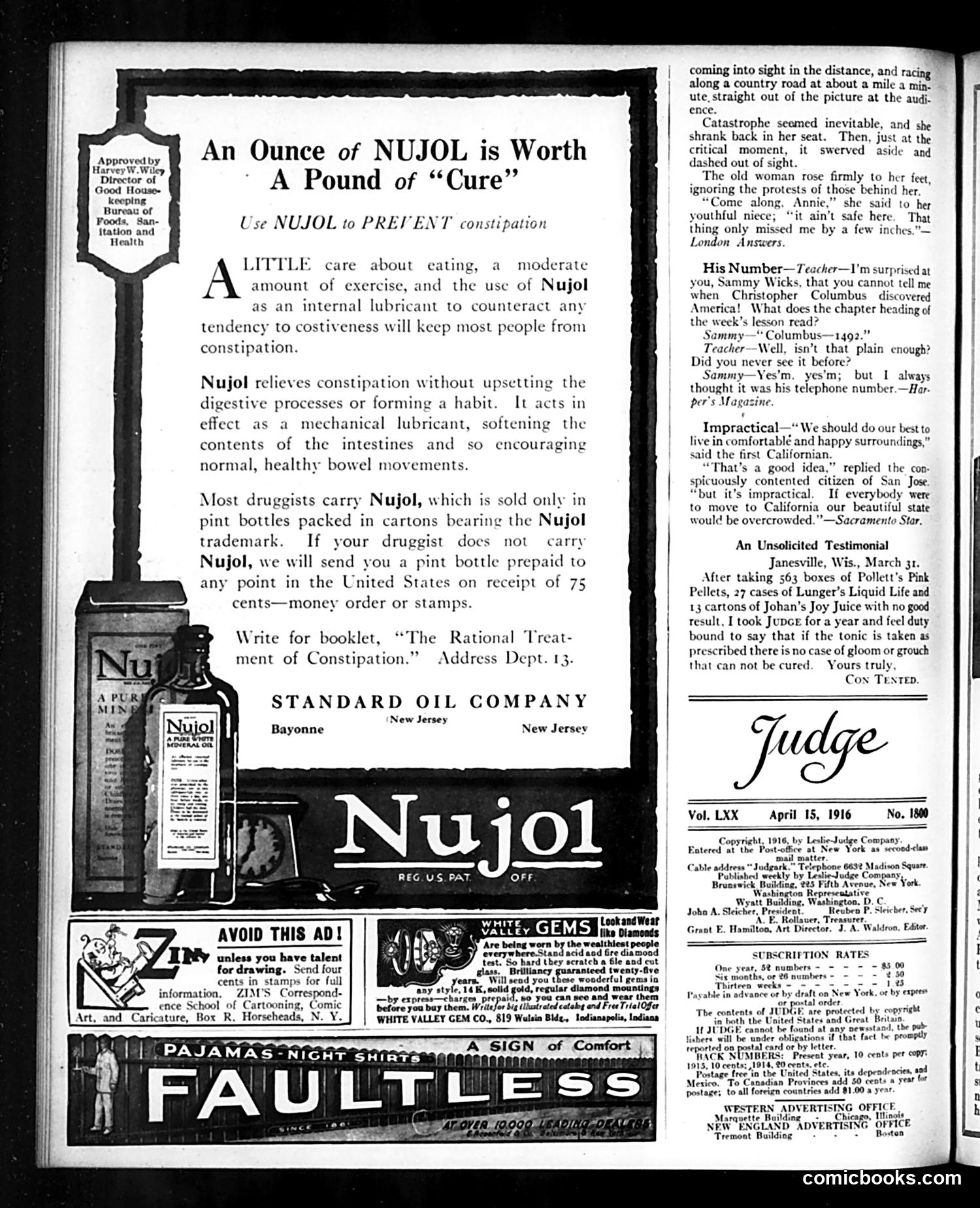
This page is primarily **advertising and humor content** rather than political satire. The dominant feature is a large **Nujol advertisement**, endorsed by Harvey W. Wiley (director of the Good Housekeeping Bureau), promoting mineral oil as a constipation remedy. The ad uses the catchphrase "An Ounce of Nujol is Worth a Pound of 'Cure'"—playing on the proverb about prevention. Below are smaller **humorous anecdotes**: one about a woman nearly hit by a car; another about a student confusing Columbus's date (1492) with a telephone number; and a California joke about overpopulation. At the bottom are advertisements for other products (gems, pajamas, a cartooning school). This reflects early 20th-century advertising's heavy presence in magazines and the era's frank discussion of digestive health.
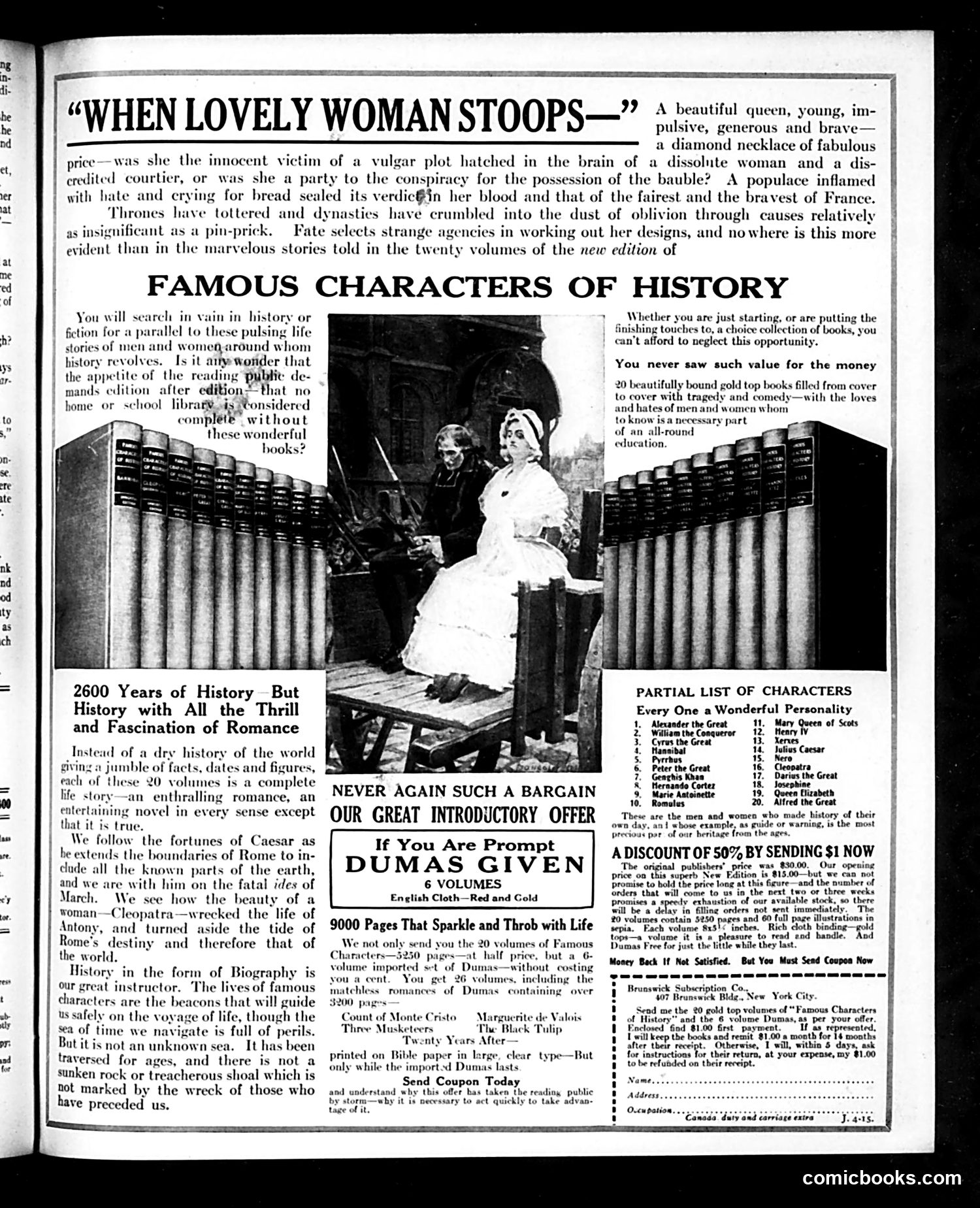
This is primarily **advertising**, not political satire. The page promotes a 20-volume encyclopedia titled "Famous Characters of History" by Alexandre Dumas, marketed as a general knowledge set. The opening text alludes to **Marie Antoinette** and the French Revolution (references to "a beautiful queen," "a diamond necklace," and royal intrigue), using her dramatic story as a hook to sell the concept that history is inherently romantic and compelling. The advertisement's appeal is straightforward: it pitches history as biography rather than dry dates, arguing that understanding famous lives educates readers about human nature. The "50% discount" offer and emphasis on "9000 pages" are sales tactics. **For modern readers:** This reflects early 20th-century educational marketing—selling self-improvement and cultural refinement through home library ownership. The gendered language ("when lovely woman stoops") and emphasis on romance/tragedy were designed to appeal to middle-class readers, particularly women, seeking intellectual respectability.
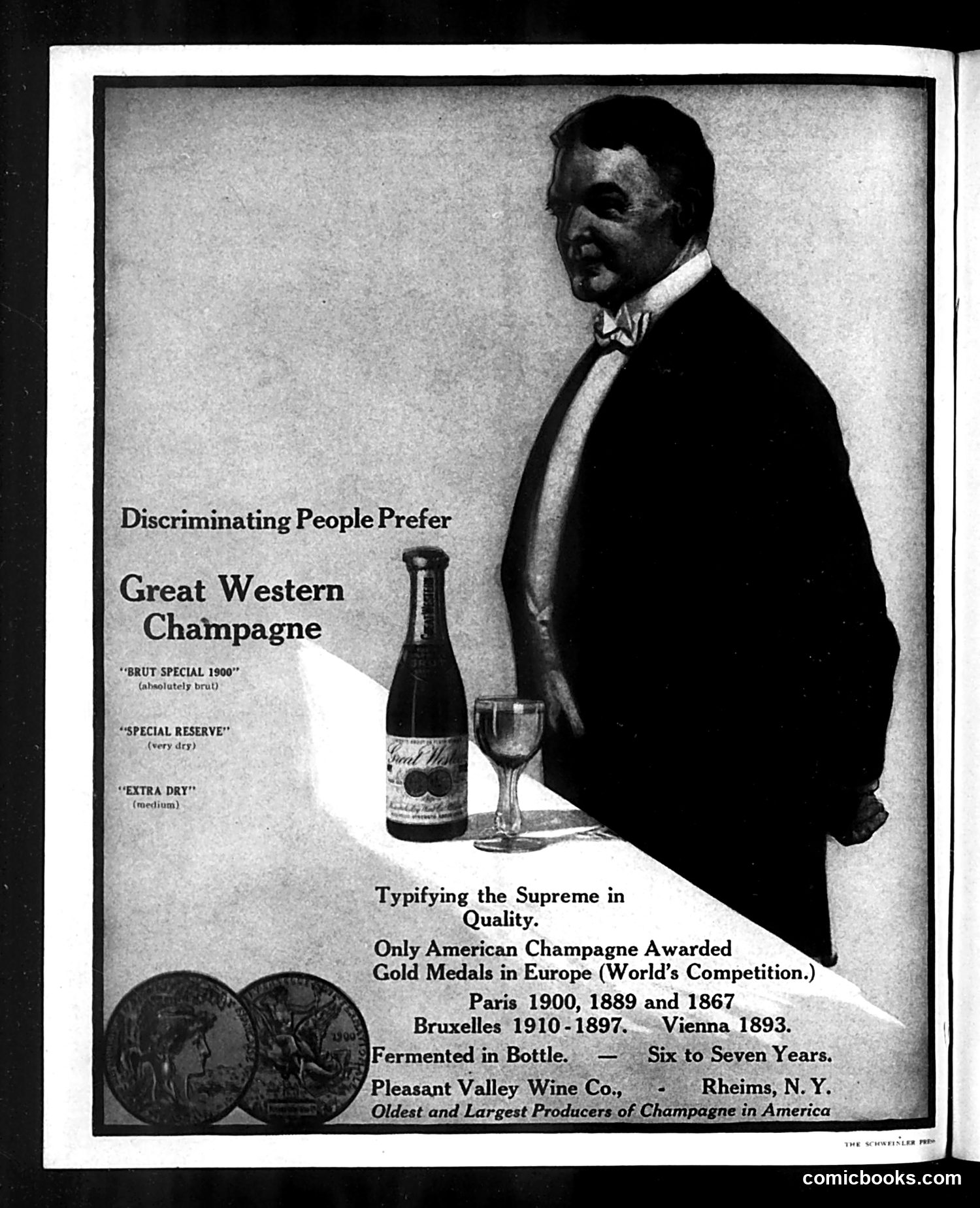
This is a **straightforward advertisement**, not a political cartoon or satire. It appears in *Judge* magazine, but functions as paid promotional content for Great Western Champagne by Pleasant Valley Wine Co. of Rheims, New York. The advertisement features a formally dressed man in profile (likely representing a sophisticated, discriminating consumer) alongside a champagne bottle and glass. The visual conveys elegance and refinement. The copy emphasizes quality through multiple product variants ("Brut Special," "Special Reserve," "Extra Dry") and lists international gold medal competitions, positioning this American champagne as comparable to European imports. The headline "Discriminating People Prefer" appeals to status-conscious readers. The claim of being "Oldest and Largest Producers of Champagne in America" establishes market dominance. This reflects early 1900s American commercial aspiration—domestic wine producers competing directly with European prestige goods.