
Judge, 1916-04-15 · page 11 of 28
Judge — April 15, 1916 — page 11: what you’re looking at
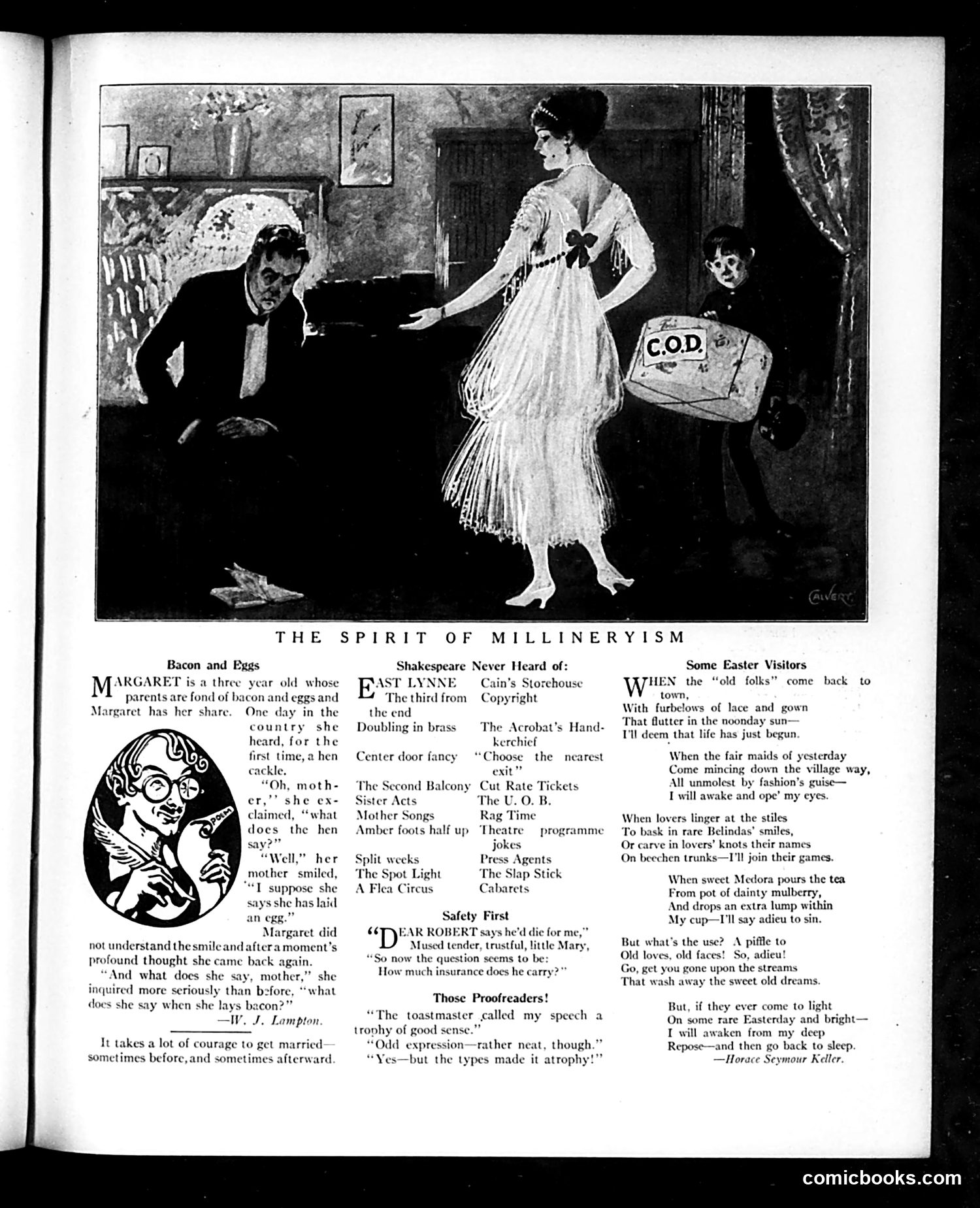
What you’re looking at
This page satirizes early 20th-century fashion obsession, particularly women's elaborate millinery (hats and bonnets). The title illustration shows a woman in an elegant gown with a large bow, flanked by a man and child—suggesting how fashion dominates domestic life. The cartoon critiques how women prioritize fashionable dress over practicality. The accompanying humor pieces reinforce this: jokes about hen-laying "bacon," Shakespeare never writing about modern theatrical fads (ragtime, cabaret acts), and insurance company jokes mock contemporary social pretensions. The poem "Some Easter Visitors" nostalgically contrasts past simplicity with present fashion-consciousness—women now "mincing" in stylish clothes, their natural beauty obscured by artifice. The satire targets not just women but broader consumer culture: the rise of fashion magazines, theatrical trends, and insurance advertising as signs of modern society's superficiality. The repeated message: fashionable appearance now trumps substance.
📄 Transcribed text from this page (OCR, searchable)
Machine-transcribed from the original scan — historical spelling and the odd misread are preserved.
THE SPIRIT OF MILLINERYISM Bacon and Eggs ARGARET is a three year old whose arents are fond of bacon and eggs and Margaret has her share. One day in the country she heard, for the first time, 2 hen cackle, “Oh, moth- er,’’ shee claimed, “what does the hen 319 “Well,” her mother smiled, ““T suppose she says she has laid Margaret did not understand the smile and aftera moment’s profound thought she came back again. “And what docs she say, mother,” she inquired more seriously than before, “what does she say when she lays bacon?” —W. J. Lampton It takes a lot of courage to get married sometimes before, and sometimes afterward. Shakespeare Never Heard of: E* L S ‘ain’s Storchouse The third from Copyright the end Doubling in brass The Acrobat’s Hand- kerchief “Choose the exit” The Second Balcony Cut Rate Tickets Sister Acts The U. O. B. Mother Songs Rag Time Amber foots half up Theatre jokes Press Agents The Slap Stick Cabarets Center door fancy nearest programme Split weeks The Spot Light A Flea Circus Safety First 66) EAR ROBERT says he'd die for me,” Mused tender, trustful, little Mary, “So now the question seems to be How much insurance does he carry?” Those Proofreaders! “The toastmaster called my speech a trophy of good sense.” “Odd expression—rather neat, though.” “Yes—but the types made it atrophy!”” Some Easter Visitors HEN the “old folks’ come back to town, With furbelows of lace and gown That flutter in the noonday sun— Tl deem that life has just begun When the fair maids of yesterday Come mincing down the village way, All unmolest by fashion’s guise— I will awake and ope’ my eyes. When lovers linger at the stiles To bask in rare Belindas’ smil Or carve in lovers’ knots their names On beechen trunks—I'll join their games. When sweet Medora pours the tea From pot of dainty mulberry, And drops an extra lump within My cup—I'll say adieu to sin. But what's the use? A pifile to Old loves, old fa adieu! So, get you gone upon the streams That wash away the sweet old dreams. But, if they ever come to light On some rare Easterday and bright— aken from my deep nd then go back to sleep. —Horace Seymour Keller. comicbooks.com