
Judge, 1916-04-15 · page 6 of 28
Judge — April 15, 1916 — page 6: what you’re looking at
What you’re looking at
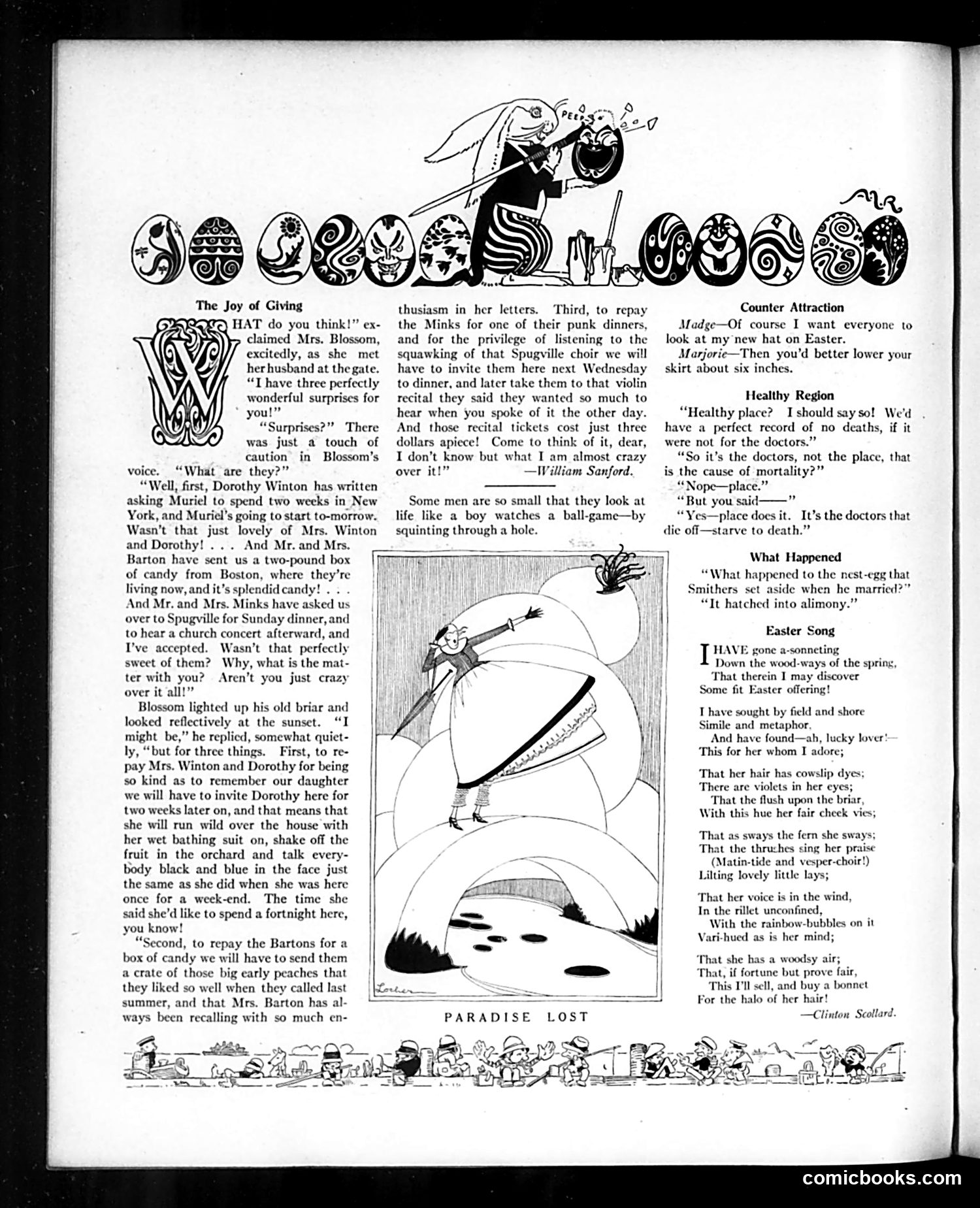
This page satirizes the social obligation trap of gift-giving among middle-class Americans. Mrs. Blossom excitedly announces three "wonderful surprises"—guests invited to visit and entertain them. Her husband Mr. Blossom, however, reveals the bitter reality: each kindness *requires* reciprocal repayment, often at greater expense or inconvenience. The joke exposes how social courtesies become financial and social burdens. The Wintons' invitation means hosting their daughter (described as destructive and loud); the Bartons' candy requires sending expensive peaches; the Minks' dinner invitation necessitates hosting them *and* buying expensive concert tickets. The satire targets the exhausting performativity of genteel society—how generosity becomes transactional obligation rather than genuine kindness. "The Joy of Giving" is ironic: there's no joy, only anxiety and expense. The accompanying vignettes (about hats, doctors, and alimony) reinforce themes of social pretense and hidden costs.
📄 Transcribed text from this page (OCR, searchable)
Machine-transcribed from the original scan — historical spelling and the odd misread are preserved.
The Joy of Giving HAT do you think!” ex- claimed Mrs. Blossom, excitedly, as she met herhusband at the gate. “T have three perfectly wonderful surprises for you!” “Surprise: ” There was just a touch of caution voice. “What are they?” in Blossom’s “Well, first, Dorothy Winton has written asking Muriel to spend two weeks in New Yor! nd Muriel’s going to start to-morrow. Wasn't that just lovely of Mrs. Winton and Dorothy! ... And Mr. and Mrs. Barton have sent us a two-pound box of candy from Boston, where they’re living now, and it’s splendidcandy! . . And Mr. and Mrs. Minks have asked us over to Spugville for Sunday dinner, and to hear a church concert afterward, and I've accepted. Wasn’t that perfectly sweet of them? Why, what is the mat- ter with you? Aren’t you just crazy over it all!” Blossom lighted up his old briar and looked reflectively at the sunset. “I might be,” he replicd, somewhat quiet- ly, “but for three things. First, to re- pay Mrs. Winton and Dorothy for being so kind as to remember our daughter we will have to invite Dorothy here for two weeks later on, and that means that she will run wild over the house with her wet bathing suit on, shake off the fruit in the orchard and talk evei body black and blue in the face just the same as she did when she was here once for a week-end. The time she said she'd like to spend a fortnight here, you know! “Second, to repay the Bartons for a box of candy we will have to send them a crate of those big early peaches that they liked so well when they called last summer, and that Mrs. Barton has al- ways been recalling with so much en- thusiasm in her letters. Third, to repay the Minks for one of their punk dinners, and for the privilege of listening to the squawking of that Spugville choir we will have to invite them here next Wednesday to dinner, and later take them to that violin recital they said they wanted so much to hear when you spoke of it the other day. And those recital tickets cost just three dollars apiece! Come to think of it, dear, I don’t know but wi I am almost crazy over it!” —William Sanford. Some men are so small that they look at life like a boy watches a ball-game—by squinting through a hole. Counter Attraction Madge—Of course I want everyone to look at my new hat on Easter. Marjorie—Then you'd better lower your skirt about six inches. Healthy Region “Healthy place? I should say so! We'd have a perfect record of no deaths, if it were not for the doctors.” “So it’s the doctors, not the place, that is the cause of mortality?” “Nope—place.” “But you said: “Yes—place does it. It’s the doctors that die ofi—starve to death.” What Happened “What happened to the nest-egg that Smithers set aside when he married?” “It hatched into alimony.” Easter Song HAVE gone a-sonneting Down the wood-ways of the spring, That therein I ma Some fit Easter offering! T have sought by field and shore Simile and metaphor. And have found—ah, lucky lover! This for her whom I adore; ‘That her hair has cowslip dyes; There are violets in her eyes; ‘That the flush upon the briar, With this hue her fair cheek vies; That as sways the fern she sways; That the thruches sing her praise (Matin-tide and vesper-choir!) Lilting lovely little lays; That her voice is in the wind, In the rillet unconfined, With the rainbow-bubbles on it Vari-hued as is her mind; ‘That she has a woodsy air ‘That, if fortune but prove fair, This I'll sell, and buy a bonnet For the halo of her hair! —Clinton Scollard. comicbooks.com