
Judge, 1916-04-15 · page 5 of 28
Judge — April 15, 1916 — page 5: what you’re looking at
What you’re looking at
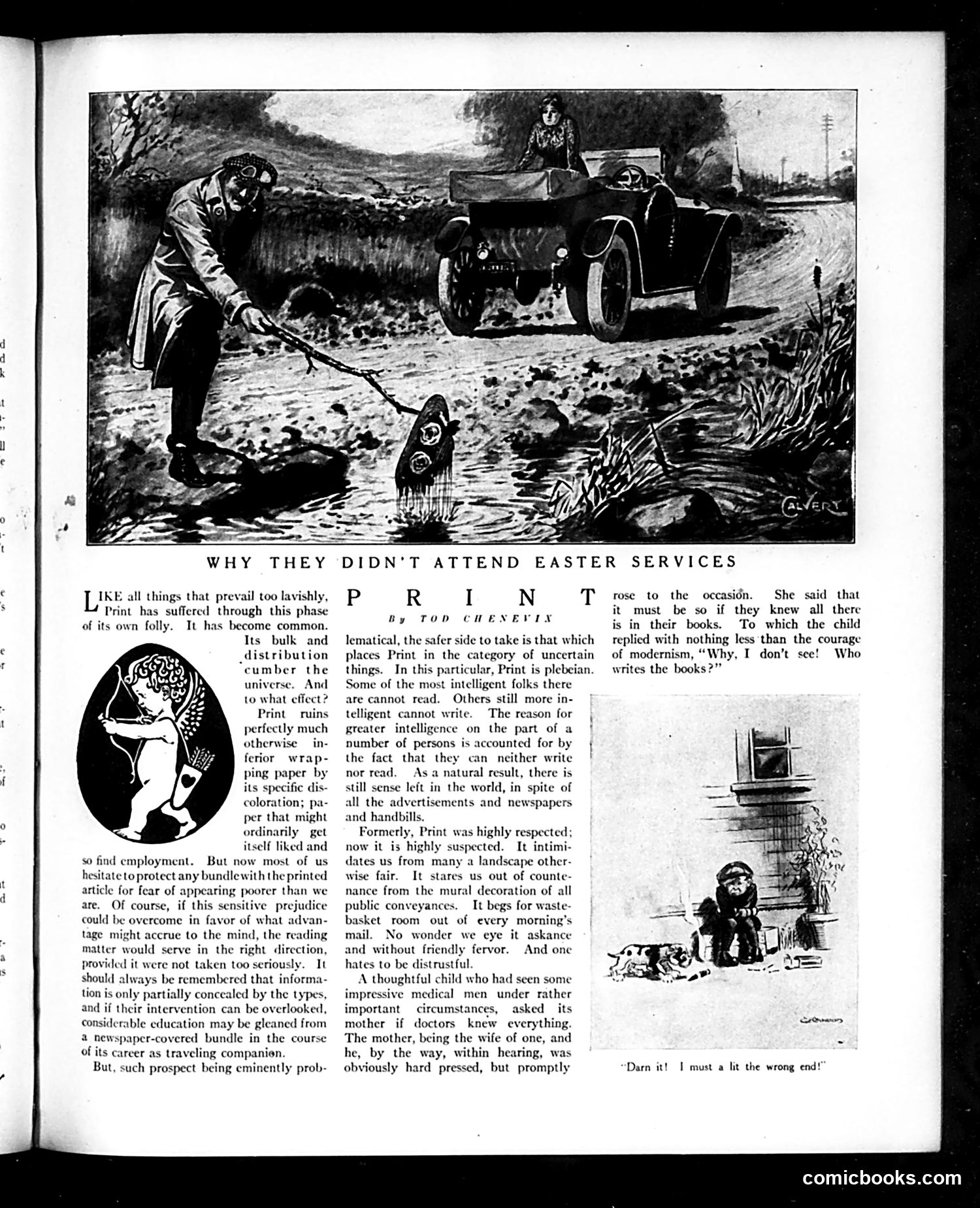
This satirical piece criticizes Print media's decline in respectability and influence. The article argues that Print—once highly respected—is now suspected and avoided, even by intelligent people who either can't read or won't read. The top illustration depicts a drowning figure being rescued from water, suggesting Print has become a liability rather than a respectable companion. The text mocks Print's current state: it appears in wastebins, clutters public spaces, and carries unwanted advertisements. The accompanying smaller cartoon shows a child at a flooded window, with the caption "Darn it! I must a lit the wrong end!"—apparently illustrating foolish misuse. The satire suggests Print journalism's loss of credibility has made it socially embarrassing, even keeping families away from church services.
📄 Transcribed text from this page (OCR, searchable)
Machine-transcribed from the original scan — historical spelling and the odd misread are preserved.
IKE all things that prevail too lavishly, P R I N T rose to the occasid She said that Print has suffered through this phase hy top CHENEYIN it must be so if they knew all there of its own folly. It has become common. # el = is in their books. To which the child Its bulk and — lematical, the safer side to take is that which replied with nothing less ‘than the courage distribution “cumber the universe. And to what effect? Print ruins perfectly much otherwise — in- ferior wrap- ping paper by its specific dis- coloration; pa- per that might ordinarily get itself liked and so find employment. But now most of us hesitate to protect any bundlewith the printed article for fear of appearing poorer than we are. Of course, if this sensitive prejudice could be overcome in favor of what advan- tage might accrue to the mind, the reading matter would serve in the right direction, provided it were not taken too seriously. It should always be remembered that informa- tion is only partially concealed by the types, and if their intervention can be overlooked, considerable education may be gleaned from a newspaper-covered bundle in the course of its career as traveling companien. But, such prospect being eminently prob- places Print in the category of uncertain things. In this particular, Print is plebeian. Some of the most intelligent folks there are cannot read. Others still more in- telligent cannot write. The reason for greater intelligence on the part of a pumber of persons is accounted for by the fact that they can neither write nor read. As a natural result, there is still sense left in the world, in spite of all the advertisements and newspapers and handbi Formerly, Print was highly respected; now it is highly suspected. It intimi- dates us from many a landscape other- wise fair. It stares us out of counte- nance from the mural decoration of all public conveyances. It begs for waste- basket room out of every morning’s mail. No wonder we eye it askance and without friendly fervor. And one hates to be distrustful. A thoughtful child who had seen some impressive medical men under rather important circumstances, asked _ its mother if doctors knew everything. The mother, being the wife of one, and he, by the way, within hearing, was obviously hard pressed, but promptly of modernism, “Why, I don’t sce! Who writes the books?” Darn it! I must a lit the wrong end!" comicbooks.com