
Judge, 1916-04-15 · page 17 of 28
Judge — April 15, 1916 — page 17: what you’re looking at
What you’re looking at
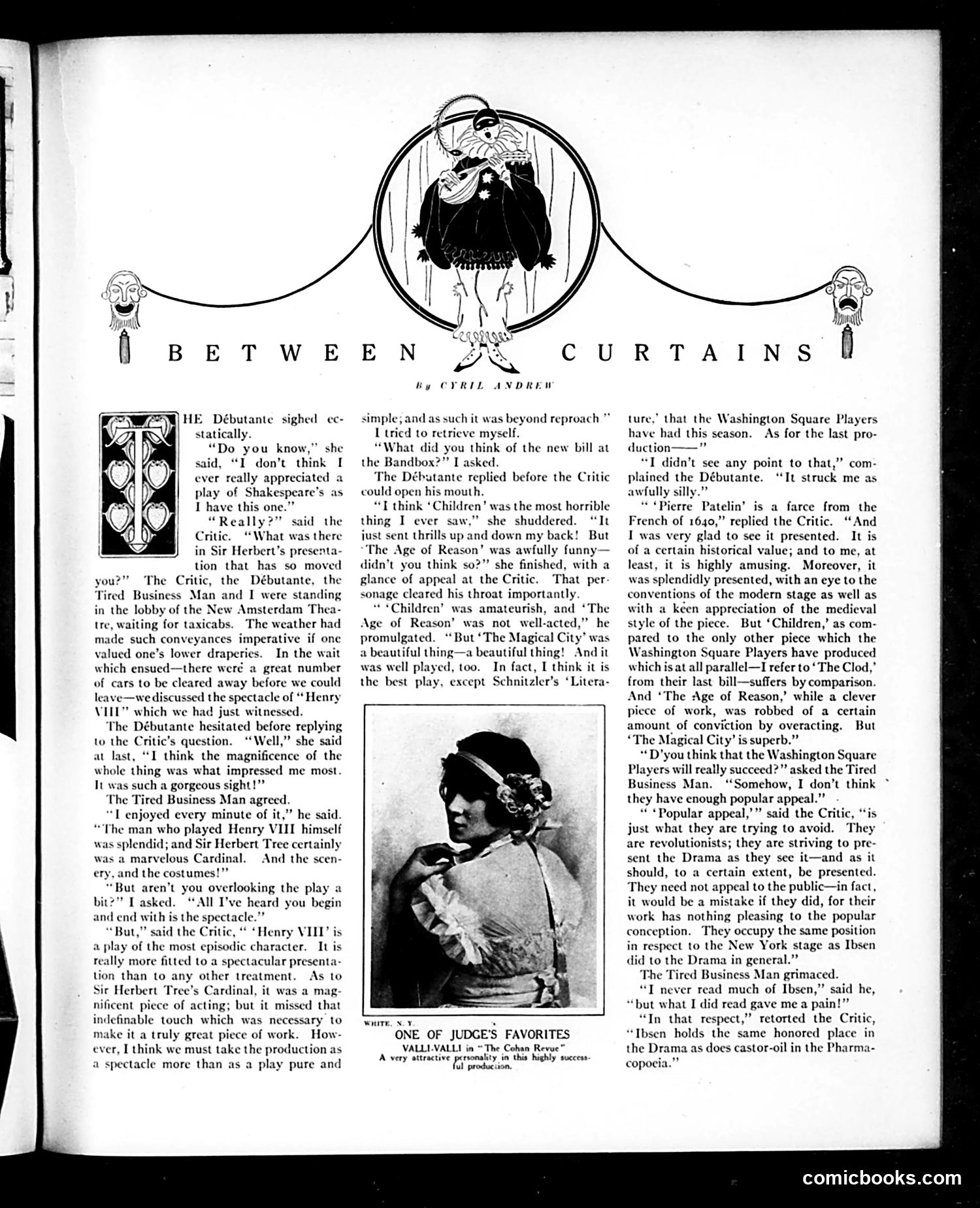
This page satirizes the pretension and superficiality of theater criticism and audiences in early 1910s New York. The article, written by Cyril Andrew, depicts four theatergoers discussing productions they've just seen, including Sir Herbert Tree's "Henry VIII" and plays at the Washington Square Players. The satire targets how audiences and critics prioritize spectacle over substance. The "Débutante" admits she appreciated Shakespeare mainly for the "magnificence" and "gorgeous sight," while the "Critic" delivers pompous judgments—praising Tree's Cardinal while dismissing other works with affected authority. The "Tired Business Man" represents the average patron simply enjoying entertainment. The joke is that genuine artistic merit gets obscured by pretense: the Critic evaluates plays based on production values and historical significance rather than dramatic quality, while the Débutante responds emotionally without understanding the material. The accompanying photograph shows Valli-Valli from "The Cohan Revue," representing the commercial theater world being discussed.
📄 Transcribed text from this page (OCR, searchable)
Machine-transcribed from the original scan — historical spelling and the odd misread are preserved.
BETWE statically. “Do you know,” she said, “I don’t think I ever really appreciated a play of Shakespeare’s as I have this one.” “Really?” said the Crit “What was there in Sir Herbert’s presenta- tion that has so moved you?” The Critic, the Débutante, the Tired Business Man and I were standing in the lobby of the New Amsterdam Thea- tre, waiting for taxicabs. The weather had made such conveyances imperative if one valued one’s lower draperies. In the wait which ensued—there were a great number of cars to be cleared away before we could leave—we discussed the spectacle of “ Henry VILL” which we had just witnessed. The Débutante hesitated before replying to the Critic’s question. ‘*Well,” she said at last, “I think the magnificence of the whole thing what impressed me most. It was such a gorgeous sight!” The Tired Business Man agreed. “TL enjoyed every minute of it,” he said “The man who played Henry VIL himself was splendid; and Sir Herbert Tree certainly was a marvelous Cardinal. And the scen- ery, and the costumes! "” But aren't you overlooking the play a bit?” T asked. “All I've heard you begin and end with is the spectacle.”” “But,” said the Critic, “ ‘Henry VID’ is a play of the most episodic character. It is really more fitted to a spectacular presenta- tion than to any other treatment. As to Sir Herbert Tree's Cardinal, it w mag- ificent piece of acting; but it missed that indefinable touch which was necessary to make it a truly great piece of work. How- ever, I think we must take the production as a spectacle more than as a play pure and By CYRIL ANDREW simple; and as such it was beyond reproach ” L tricd to retrieve myself. “What did you think of the new bill at the Bandbox?” I asked. The Débutante replied before the Critic could open his mouth. “T think ‘Children’ was the most horrible thing I ever saw,” she shuddered. “It just sent thrills up and down my back! But ‘The Age of Reason’ was awfully funny didn’t you think so?” she finished, with a glance of appeal at the Critic. That per sonage cleared his throat importantly. “ ‘Children’ was amateurish, and ‘The Age of Reason’ was not well-acted,” he promulgated. “But ‘The Magical City’ was a beautiful thing—a beautiful thing! And it was well played, too. In fact, I think it is the best pla cept Schnitzler’s ‘Litera- WHITE, N.Y . ONE OF JUDGE'S FAVORITES VALLL-VALLI in “The Cohan Revue” A very attractive personaty in this highly success ful production. Apa CURTAINS ture,” that the Washington Square Players have had this season. As for the last pro- duction——” “I didn’t see any point to that,” com- plained the Débutante. ‘It struck me as awfully silly.” “Pierre Patelin’ is a farce from the French of 1640,” replied the Critic. “And I was very glad to see it presented. It is of a certain historical value; and to me, at least, it is highly amusing. Moreover, it was splendidly presented, with an eye to the conventions of the modern stage as well as with a keen appreciation of the medieval style of the piece. But ‘Children,’ as com- pared to the only other piece which the Washington Square Players have produced which is at all parallel—I refer to ‘The Clod,’ from their last bill—suffers by comparison. And ‘The sAge of Reason,’ while a clever piece of work, was robbed of a certain amount of conviction by overacting. But ‘The Magical City’ is superb.” “D'you think that the Washington Square a will really succeed?” asked the Tired s Man. “Somehow, I don’t think they have enough popular appeal.” “*Popular appeal,’” said the Critic, “is just what they are trying to avoid. They are revolutionists; they are striving to pre- sent the Drama as they see it—and as it should, to a certain extent, be presented. They need not appeal to the public—in fact, it would be a mistake if they did, for their work has nothing pleasing to the popular conception. They occupy the same position in respect to the New York stage as Ibsen did to the Drama in general. The Tired Business Man grimaced. “In read much of Ibsen,” said he, “but what I did read gave me a pain!” “In that respect,” retorted the Critic, “Ibsen holds the same honored place in the Drama as does castor-oil in the Pharma- copocia. comicbooks.com