
Judge, 1916-04-15 · page 7 of 28
Judge — April 15, 1916 — page 7: what you’re looking at
What you’re looking at
This is a humorous dialogue between two Jewish businessmen (identified by Yiddish-inflected speech) debating the cultural obsession with baseball. Max Markowitz, a skirt manufacturer, complains that newspapers devote more coverage to baseball players and their trivial injuries than to the serious European War (likely WWI). He mocks baseball players' high wages and the sport's triviality. Henry Shapiro, his bookkeeper brother-in-law, responds that Markowitz himself is becoming "a professional sport" through his constant complaining—a play on the word "amachure" (amateur). The satire critiques early 20th-century American priorities: the disproportionate media and public attention given to sports over serious world events, and the phenomenon of working-class enthusiasm for baseball as escape or entertainment. The Yiddish dialect humor was typical Judge magazine fare targeting immigrant populations.
📄 Transcribed text from this page (OCR, searchable)
Machine-transcribed from the original scan — historical spelling and the odd misread are preserved.
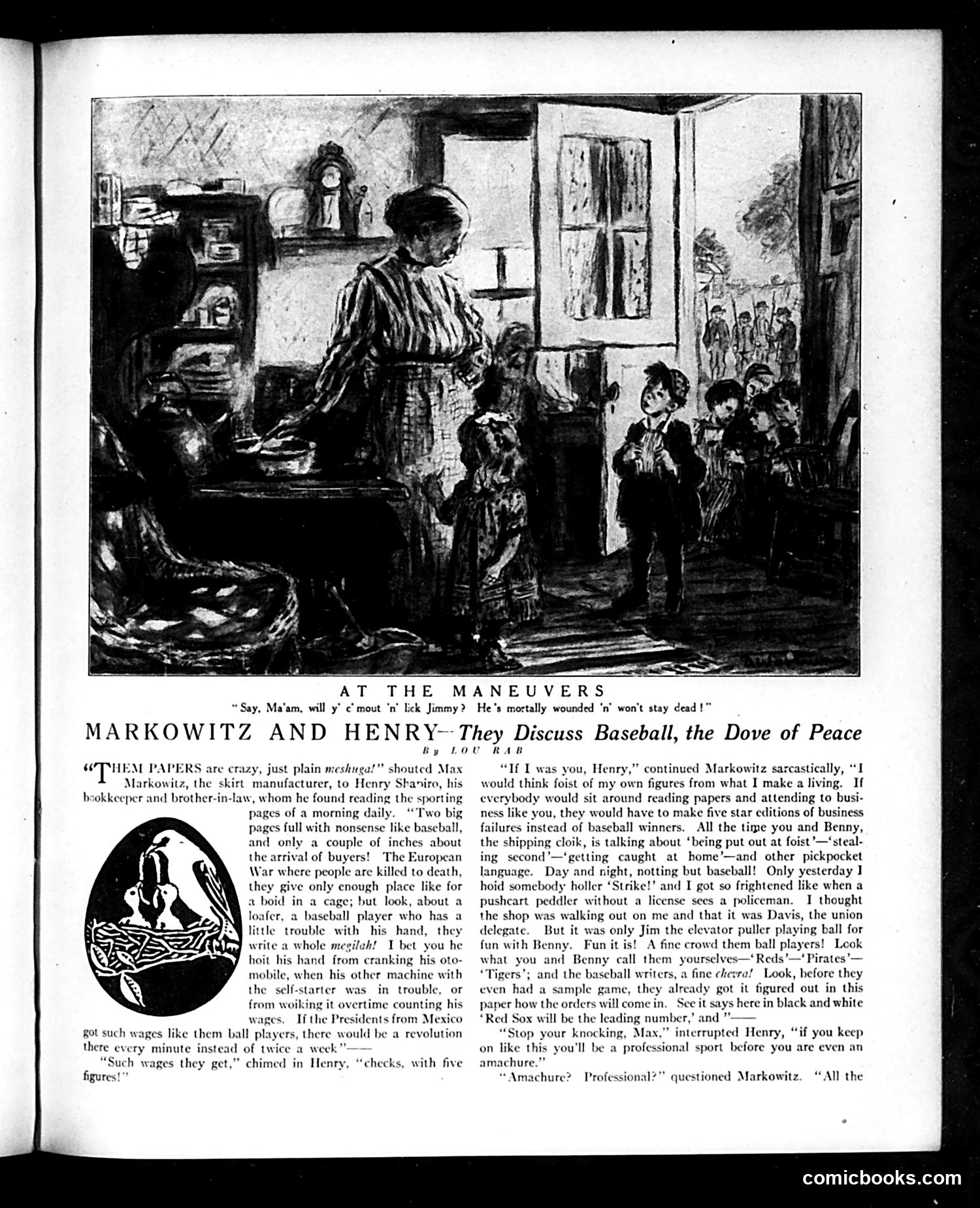
AT THE MANEUVERS “Say, Ma'am, will y’ c’ mout ‘n’ lick Jimmy? He's mortally wounded 'n’ won't stay dead!” MARKOWITZ AND HENRY- They Discuss Baseball, the Dove of Peace By Lou re crazy, just plain meshuga!” shouted Max Markowitz, the skirt manufacturer, to Henry Shaniro, his bookkeeper and brother-in-law, whom he found reading the sport pages of a morning daily. “Two bi; ense like baseball, ya couple of inches about the arrival of buyers! The European War where people are killed to death, they give only enough place like for a boid in a cage; but look, about a loafer, a baseball player who has a little trouble with his hand, they write a whole megilah! I bet you he hoit his hand from cranking his oto- mobile, when his other machine with the self-starter was in trouble, or from woiking it overtime counting his wages. If the Presidents from Mexico got such wages like them ball players, there would be a revolution there every minute instead of twice a week” “Such wages they get,” chimed in Henry, “ figures!” checks, with five RAB “If I was you, Henry,” continued Markowitz sarcastically, “I would think foist of my own figures from what I make a living. If would sit around reading papers and attending to busi- u, they would have to make five star editions of business stead of baseball winners. All the time you and Benny, the shipping cloik, is talking about ‘being put out at foist’—‘steal- ing second’—‘getting caught at home’—and other pickpocket language. Day and night, notting but baseball! Only yesterday I hoid somebody holler ‘Strike!’ and I got so frightened like when a pushcart peddler without a license sees a policeman. I thought the shop was walking out on me and that it was D. , the union delegate. But it was only Jim the elevator puller playing ball for fun with Benny. Fun it is! A fine crowd them ball players! Look what you and Benny call them yourselves—‘ Reds’—‘Pirat ‘Tigers’; and the baseball writers, a fine chevra! Look, before they even had a sample game, they alre: got it figured out in this paper how the orders will come in. 'ys here in black and white *Red Sox will be the leading number,’ and ”—— “Stop your knocking, Max,” interrupted Henry, “if you keep on like this you'll be a professional sport before you are even an amachure.”” “ Amachure? Professional?” questioned Markowitz. “All the comicbooks.com