
Judge, 1916-04-15 · page 8 of 28
Judge — April 15, 1916 — page 8: what you’re looking at
What you’re looking at
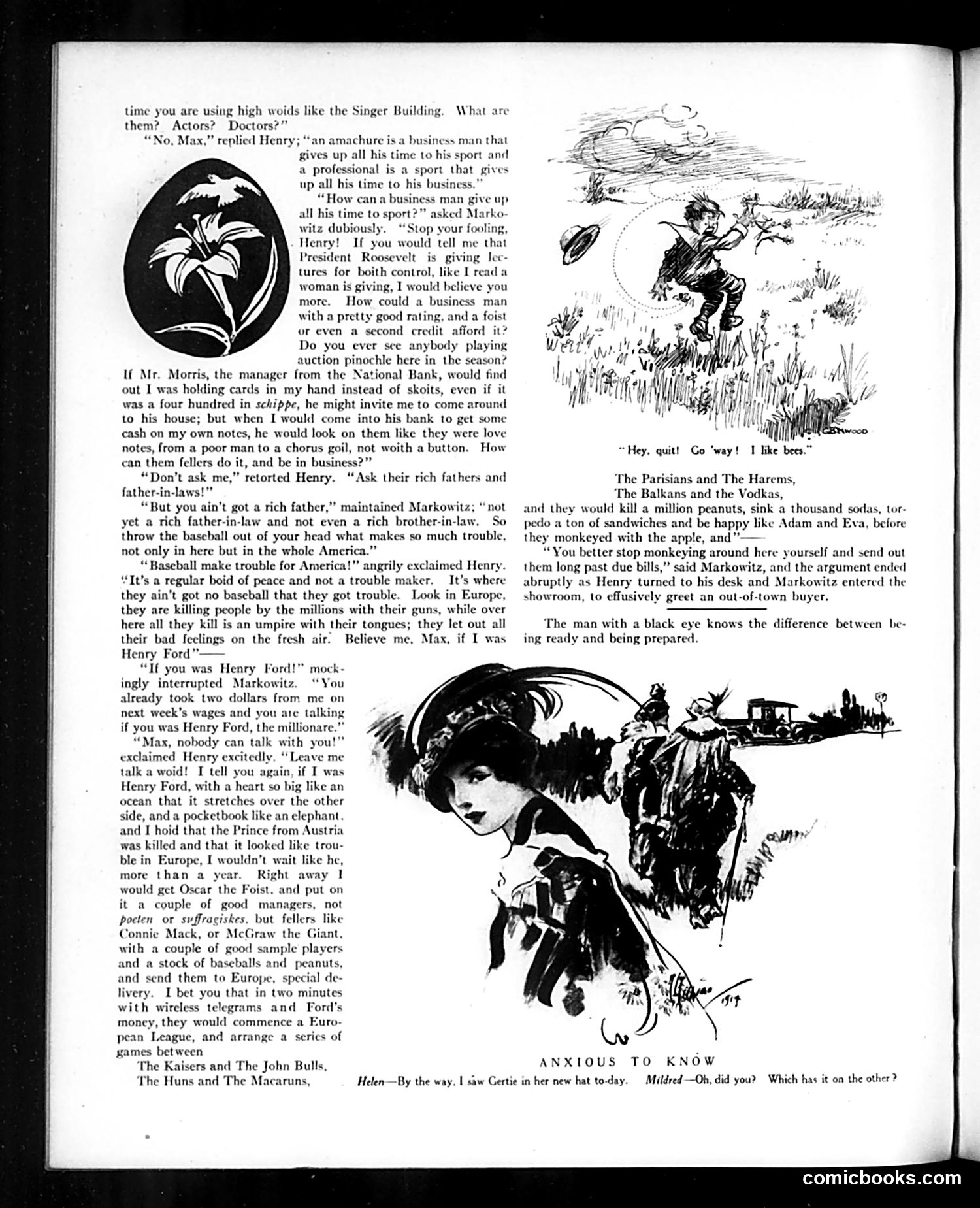
This page contains a dialogue satirizing immigrant attitudes toward American leisure, wealth, and business during the early 1900s. Two characters—Henry and Markowitz (identifiable as Jewish immigrants by their Yiddish-inflected English)—debate whether businessmen can afford to play sports. Henry defends baseball as harmless entertainment, contrasting it with European warfare (likely referencing pre-WWI tensions). He then fantasizes about being Henry Ford, proposing to use Ford's wealth and baseball to prevent European conflict by exporting the sport—a satirical suggestion that American capitalism and sports could solve global problems. The satire targets both immigrants' outsider perspective on American business culture and the era's naïve belief that commerce and entertainment could transcend serious political crises. The bottom cartoon ("Anxious to Know") appears unrelated—a brief joke about women's hats.
📄 Transcribed text from this page (OCR, searchable)
Machine-transcribed from the original scan — historical spelling and the odd misread are preserved.
time you are using high woids like the Singer Building. What are them? Actors? Doctors? “No, Max,” replied Henry in amachure is a business man that gives up all his time to his sport and a professional is a sport that gives up all his time to his business.” “How cana business man give up all his time to sport?” asked Marko. witz dubiously. ‘Stop your fooling, Henry! If you would tell me that President Roosevelt is giving lec- tures for boith control, like I read a woman is giving, I would believe you more. How could a business man with a pretty good rating, and a foist or even a second credit afford it? Do you ever sce anybody playing auction pinochle here in the season? If Mr. Morris, the manager from the National Bank, would find out I was holding cards in my hand instead of skoits, even if it was a four hundred in schippe, he might invite me to come around to his house; but when I would come into his bank to get some cash on my own notes, he would look on them like they were love notes, from a poor man to a chorus goil, not woith a button. How can them fellers do it, and be in business?” “Don’t ask me,” retorted Henry. ‘Ask their rich fathers and father-in-laws!"” “But you ain’t got a rich father,”’ maintained Markowitz; “not yet a rich father-in-law and not even a rich brother-in-law. So throw the baseball out of your head what makes so much trouble, not only in here but in the whole America.” “Baseball make trouble for Ameri angrily exclaimed Henry. “It’s a regular boid of peace and not a trouble maker. It’s where they ain't got no baseball that they got trouble. Look in Europe, they are killing people by the millions with their guns, while over here all they kill is an umpire with their tongues; they their bad feelings on the fresh air. Believe me, Ma Henry Ford"’—— “If you was Henry ingly interrupted Markowitz already took two dollars from me on next week’s wages and you are talking if you was Henry Ford, the millionare. “Max, nobody can talk with you! exclaimed Henry excitedly. “Leave me talk a woid! I tell you again, if I was Henry Ford, with a heart so big like an ocean that it stretches over the other side, and a pocketbook like an elephant. and I hoid that the Prince from Austria was killed and that it looked like trou- ble in Europe, I wouldn’t wait like he, more than a year. Right away I would get Oscar the Foist. and put on ita couple of good managers, not pocten or suffragiskes, but fellers like Connie Mack, or McGraw the Giant, with a couple of good sample players and a stock of baseballs and peanuts, and send them to Europe, special de- livery. I bet you that in two minutes with wireless telegrams and Ford's money, they would commence a Euro- pean League, and arrange a series of games between he Kaisers and The John Bulls, mock- Hey, quit! Go ‘way! I like bees.” The Parisians and The Harems, The Balkans and the Vod y would kill a million peanuts, sink a thousand sodas, tor- before and the pedo a ton of sandwiches and be happy like Adam and F they monkeyed with the apple, and’’— “You better stop monkeying around here yourself and send out them long past duc bills,” said Markowitz, and the argument ended abruptly as Henry turned to his desk and Markowitz entered the showroom, to effusively greet an out-of-town buyer. The man with a black eye knows the difference between be- ing ready and being prepared. ANXIOUS TO KNOW Mildred —Oh, did you? Which has it on the other ? Helen—By the way. | saw Gertie in her new hat to-day. The Huns and The Macaruns, comicbooks.com