
A complete issue · 28 pages · 1916
Judge — January 29, 1916
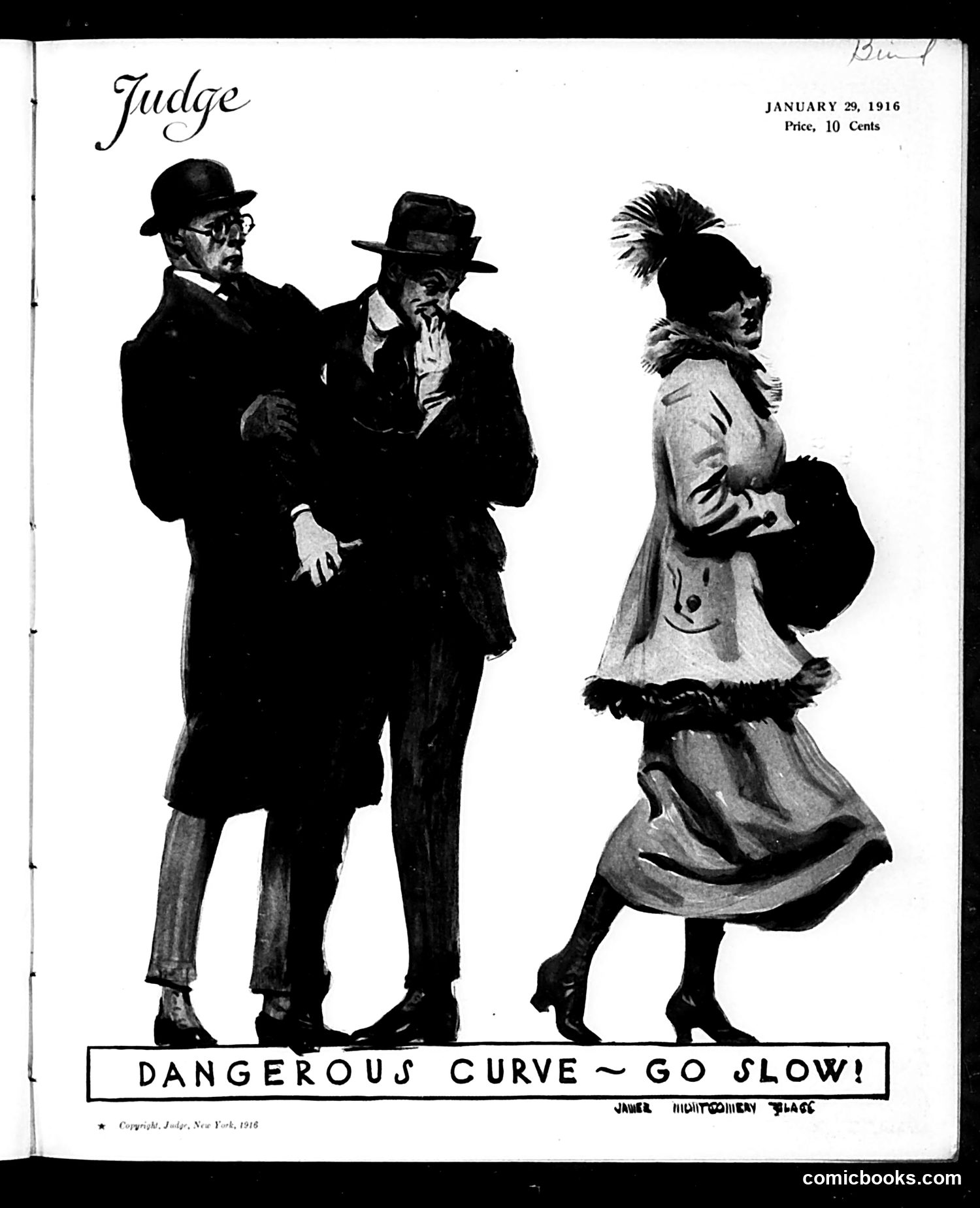
This January 1916 Judge magazine cartoon is a traffic safety warning rendered as social satire. Two men in dark suits and bowler hats appear to be apprehending or escorting a young woman in a light dress past a "dangerous curve." The humor operates on multiple levels: literally, it warns drivers about hazardous road conditions; figuratively, the "dangerous curve" references the woman's body. The men's stern expressions and restraining posture suggest they're protecting her from or protecting others from her—satirizing anxieties about female sexuality and public morality that dominated early 20th-century discourse. The cartoon reflects contemporary concerns about women's increasing independence and visibility in public spaces, rendered as a traffic-safety joke.
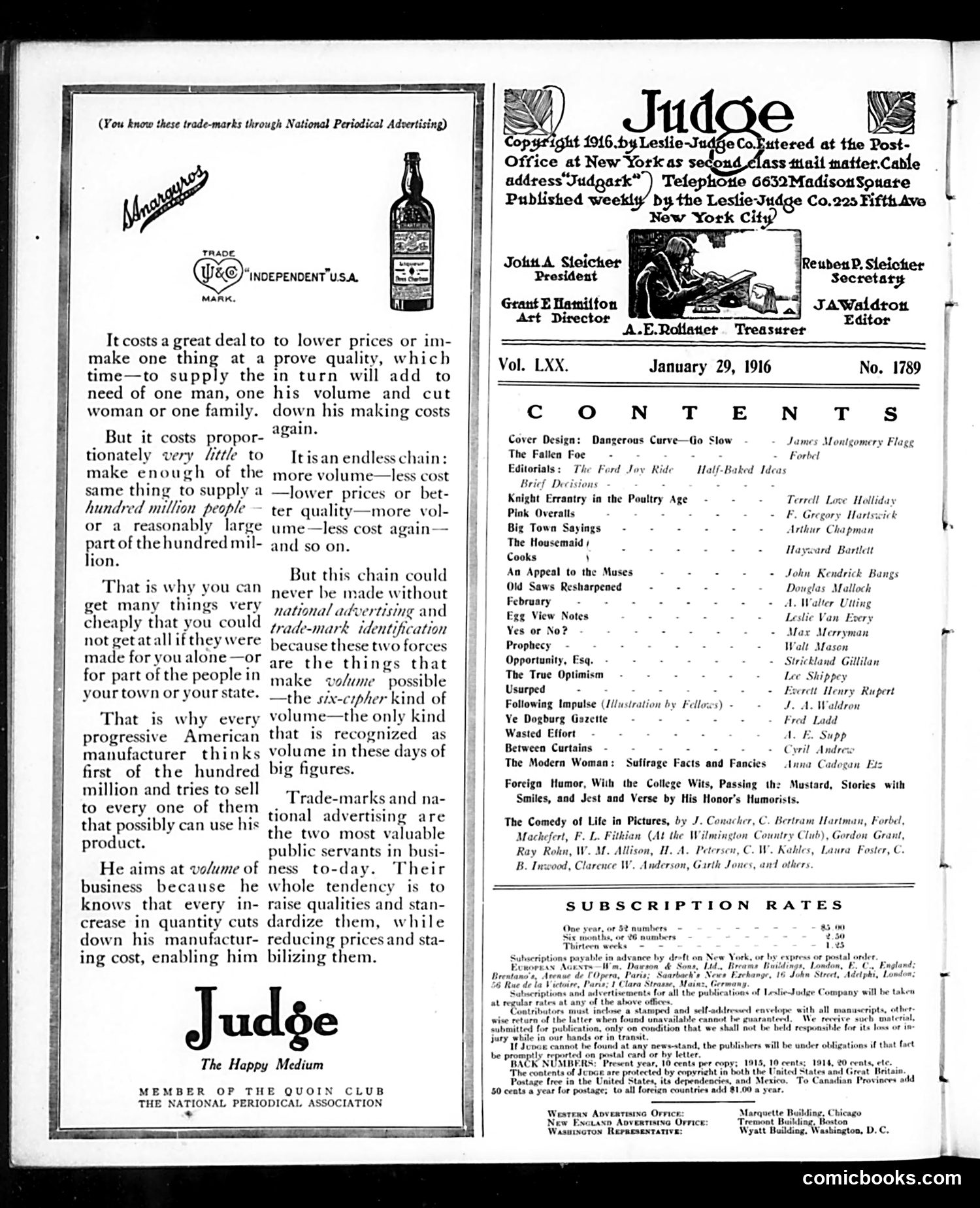
This page is primarily **advertising for Judge magazine itself**, not political satire. The left side contains an advertisement for "Judôe: The Happy Medium," promoting the magazine as a member of the Quorin Club and National Periodical Association. The ad discusses business strategy: how achieving high volume sales allows manufacturers to lower prices while maintaining profits—a "chain" of economic efficiency. The copy emphasizes that trademarks and national advertising are essential tools for modern American businesses to reach mass markets. The right side lists the magazine's **table of contents** for this 1916 issue, featuring various humorous articles and illustrations typical of Judge's satirical format. This is essentially a **trade publication advertisement**, not political commentary.
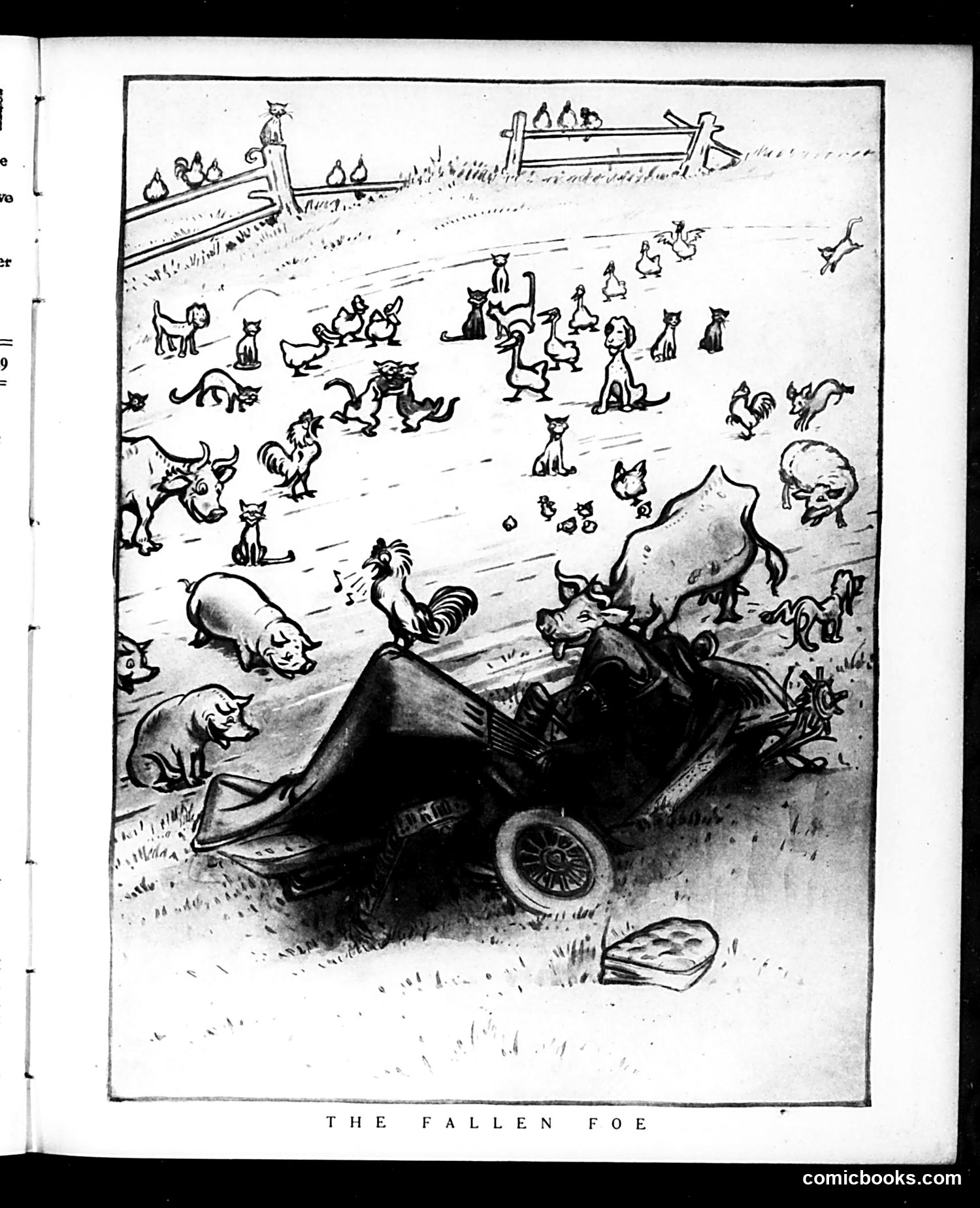
This cartoon depicts a man who has crashed his automobile in a rural setting, surrounded by farm animals (cattle, pigs, chickens, roosters, and dogs). The title "The Fallen Foe" suggests the automobile itself is being satirized as the "enemy." The joke appears to be commentary on early automotive dangers and the hazards cars posed to rural communities—both literally (through accidents) and socially (disrupting traditional agrarian life). The man's crash amid livestock emphasizes the collision between modern mechanized transportation and pastoral life. Without additional context about the specific Judge issue date, the precise identity of any political figure remains unclear, though the cartoon likely reflects widespread anxieties about automobiles' rapid integration into American society in the early 20th century.
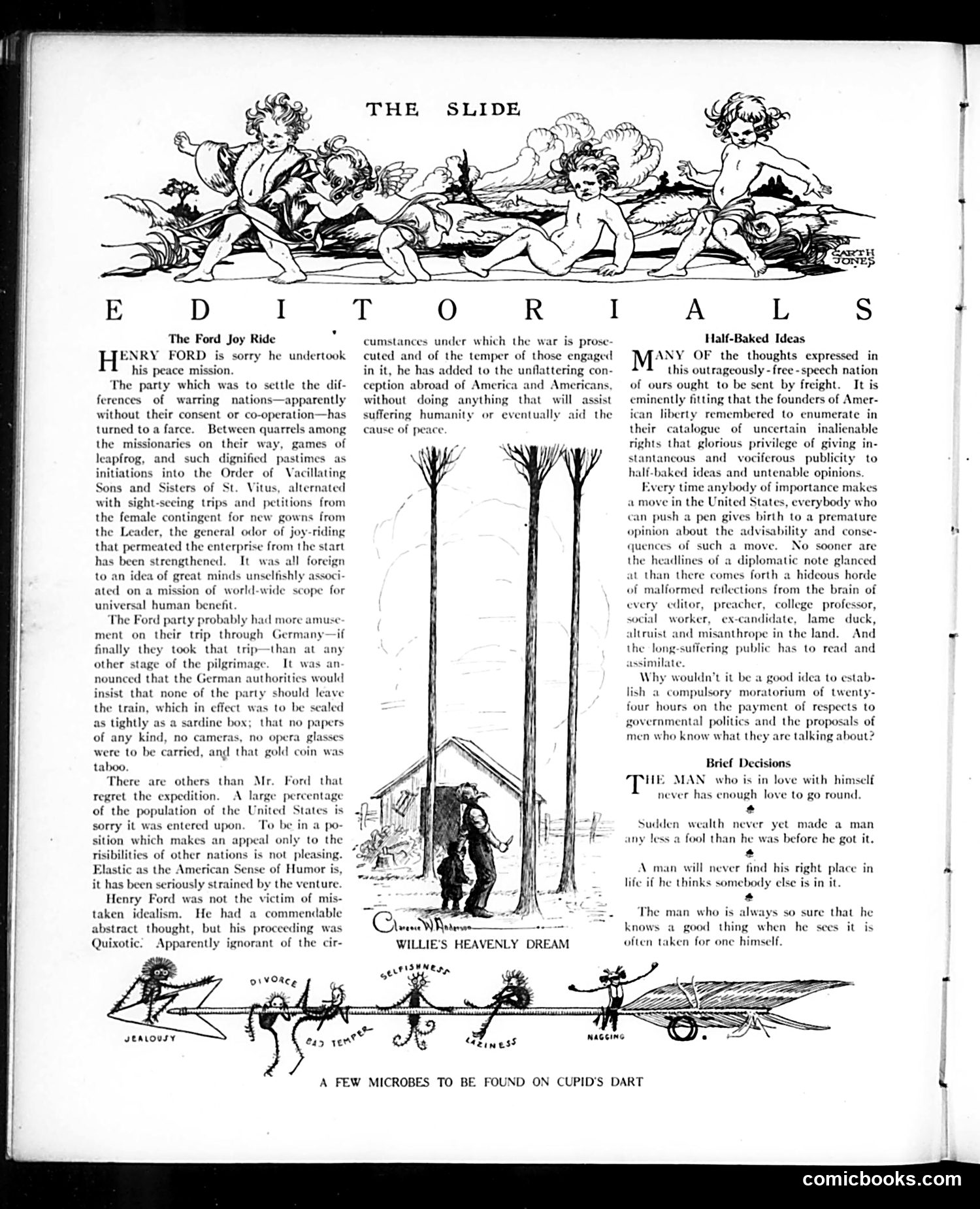
This satirical Judge page critiques Henry Ford's 1915-1916 "Peace Mission"—his famous ship voyage to Europe aimed at ending World War I. The left column mocks Ford's naive pacifism, describing German authorities' dismissal of his efforts and the German demand that the entire Ford party be sealed in a train car like "a sardine box." The satire portrays Ford as an absurd idealist whose mission proved ineffective. The central illustration "Willie's Heavenly Dream" depicts a figure (likely Kaiser Wilhelm II) sheltering under trees, suggesting his illusory hopes for peace. The bottom panel "A Few Microbes to Be Found on Cupid's Dart" uses medical imagery to mock romantic/peace initiatives as spreading social diseases like divorce, jealousy, and cruelty. The "Half-Baked Ideas" and "Brief Decisions" columns continue skewering American public discourse and moral certainty.
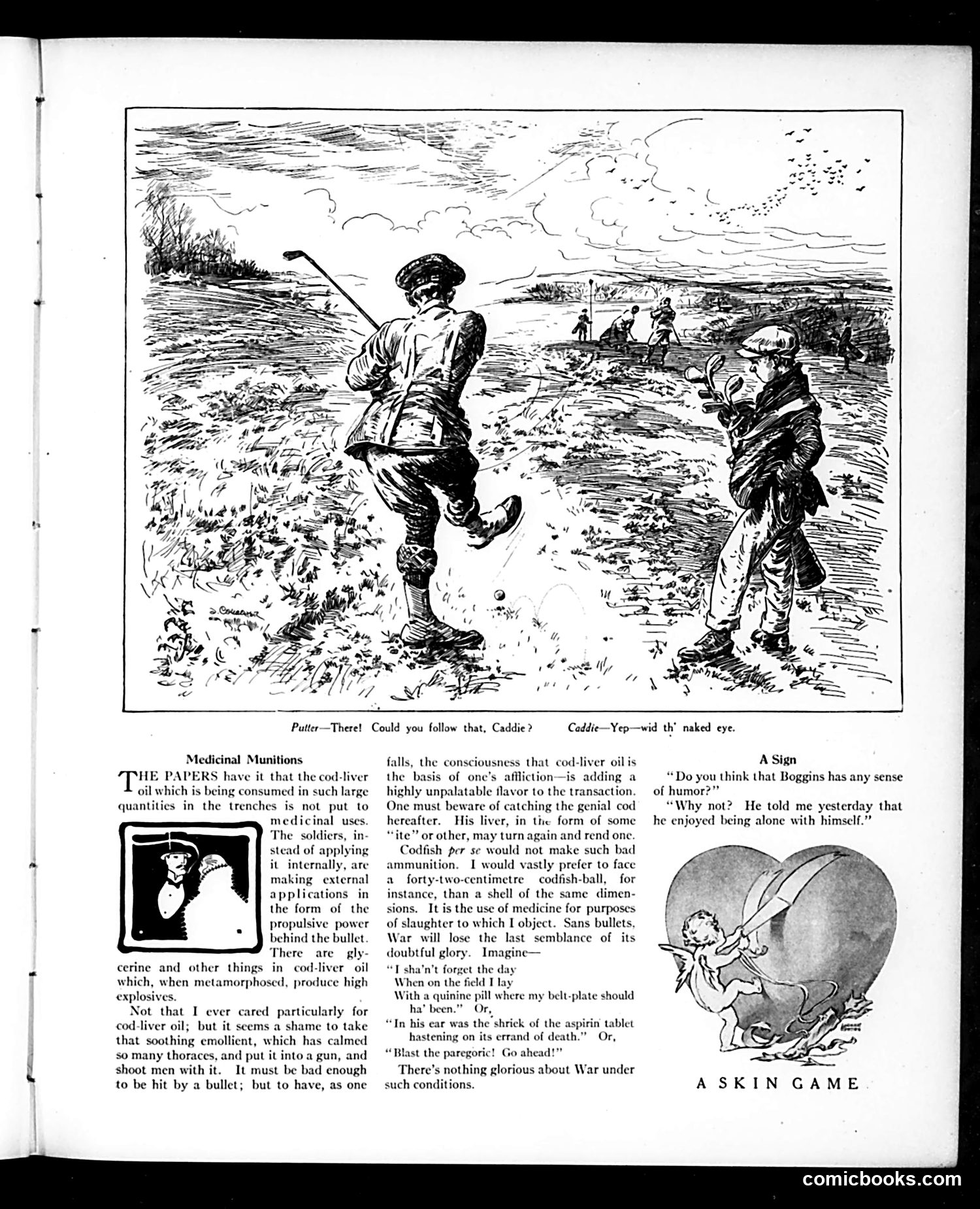
**The Golf Cartoon ("Putter—There! Could you follow that, Caddie?"):** This depicts two golfers in a match, with one executing an impressive putt while his caddie watches. The joke plays on golf terminology and the caddie's reaction—it's a straightforward sports humor piece about demonstrating skill on the course, with no apparent political content. **The Articles:** "Medicinal Munitions" discusses cod-liver oil's military and medical uses during wartime, sarcastically noting that bullets and pills both "kill." "A Sign" makes light humor about a character named Hoggins lacking humor. "A Skin Game" (with accompanying illustration) appears to be another brief humorous anecdote. These are **general-interest humor pieces** rather than political satire—typical Judge magazine content from the WWI era.
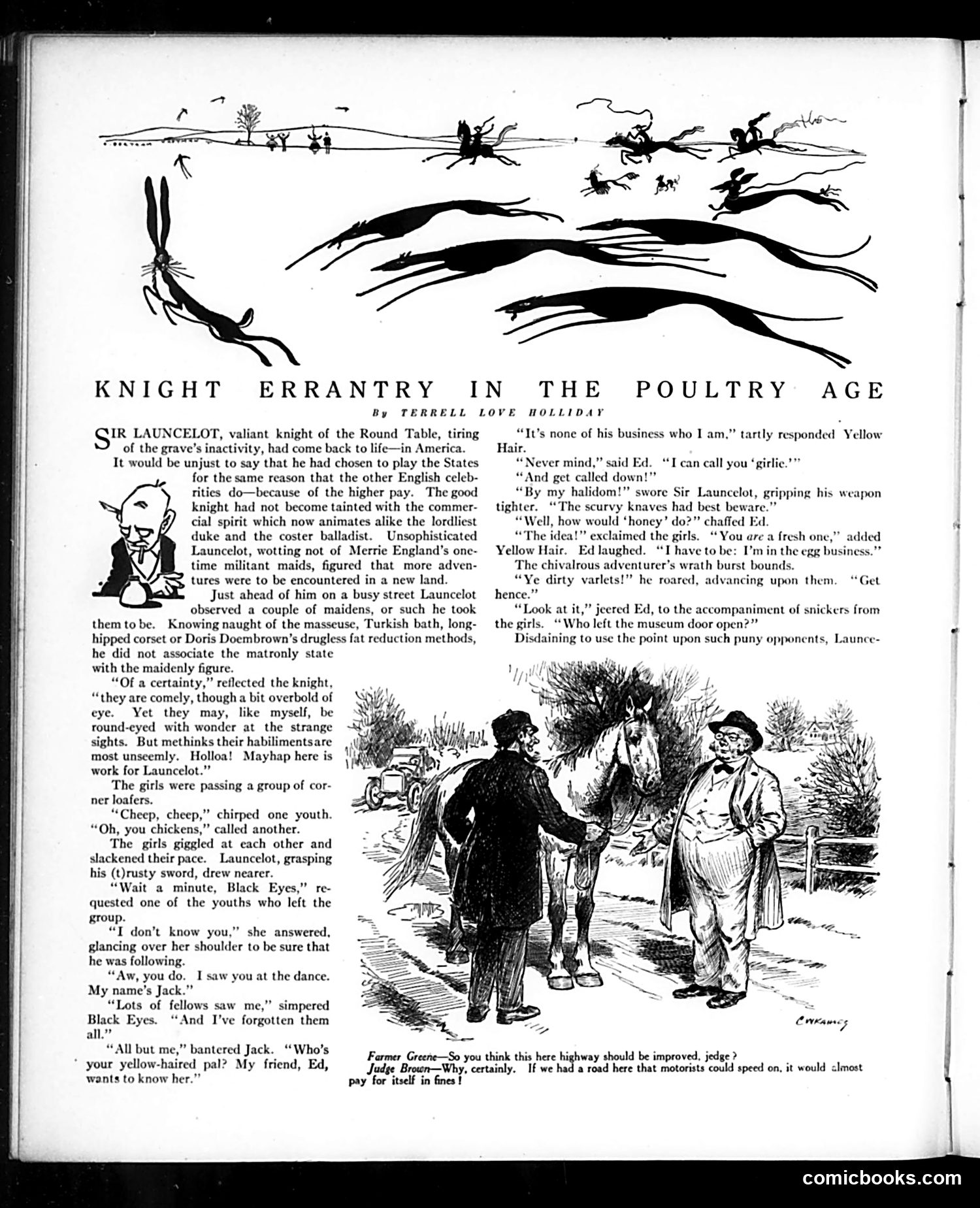
This satirical story parodies medieval romance by transplanting Sir Lancelot to modern America. The joke centers on cultural clash: the noble knight, expecting chivalric adventure, encounters street harassment and modern dating customs instead. When Lancelot witnesses young women being catcalled by corner loafers ("Cheep, cheep"), he draws his sword to defend them—a heroic response rendered absurd by the mundane setting. The women aren't distressed; they flirt back, with one man claiming to be in "the egg business." The satire mocks both outdated chivalry (Lancelot's misplaced gallantry) and modern America's irreverence toward traditional courtship. Lancelot becomes a museum curiosity—literally, someone suggests "the museum door" was left open. The "Poultry Age" title suggests America has reduced romance to something as common and undignified as chickens. The cartoon ridicules American modernity's brashness while questioning whether old-world honor has any relevance.
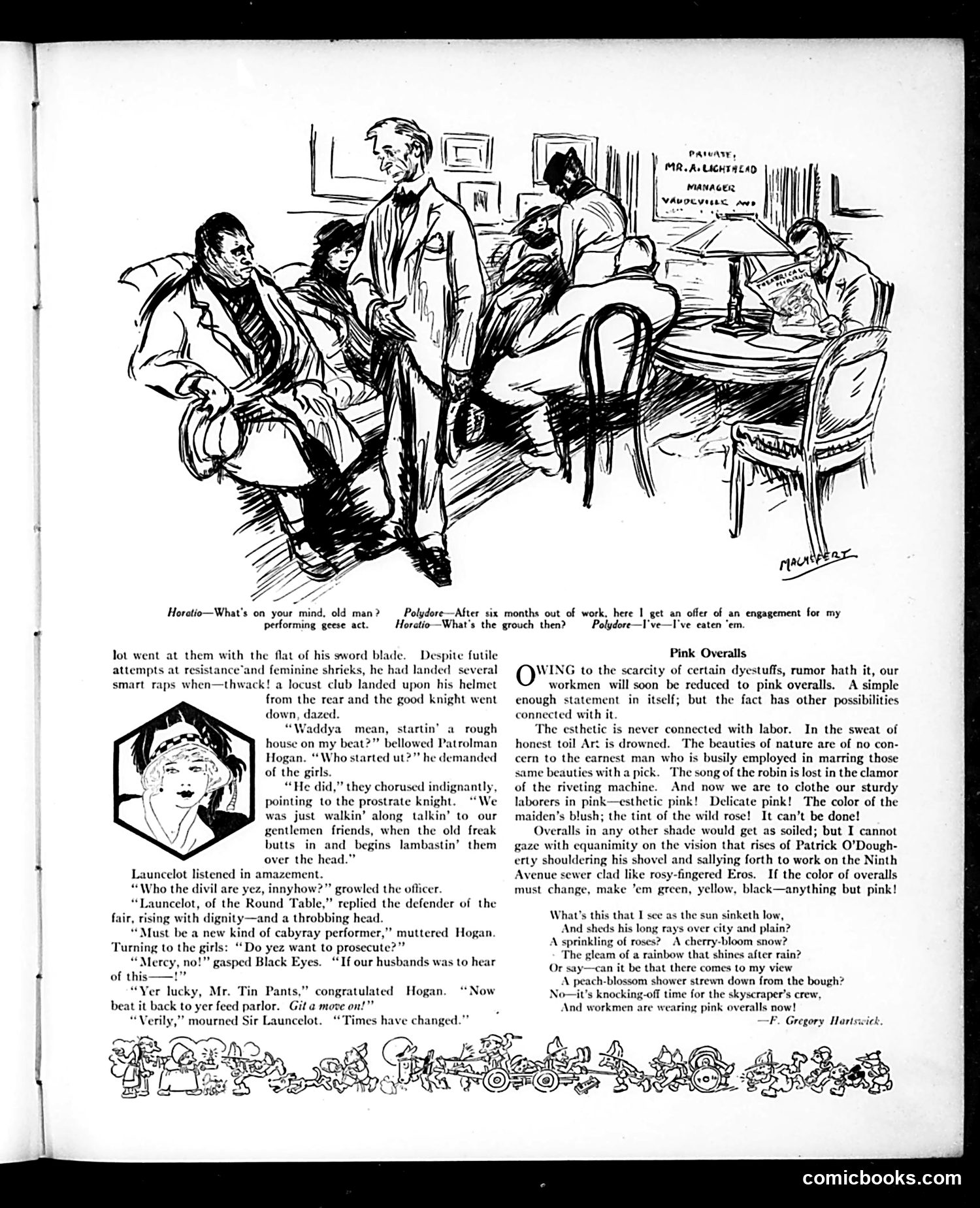
This page contains two satirical pieces from Judge magazine: **Top cartoon:** A comedic sketch mocking a medieval knight (Launcelot of the Round Table) arrested by a New York patrolman. The satire operates on class/cultural collision: a chivalric legend attempts to defend women from "improper" men, but gets arrested instead. The officer dismisses him as a "cabyray performer" (cabaret act)—the joke being that high-minded medieval virtue looks absurd in modern urban immigrant working-class reality, where the women are actually willing companions of their "gentlemen friends." **"Pink Overalls" piece:** A satirical essay protesting rumors that wartime fabric shortages will force factory workers to wear pink work clothes. The satire is ironic: the author mock-laments that "esthetic" pink would be inappropriately beautiful for manual laborers—suggesting that beauty and labor are incompatible, that working-class dignity requires drabness. The poem's final image of workers in pink at day's end is presented as absurdly, inappropriately lovely. Both pieces employ working-class characters and immigrant dialects for humor.
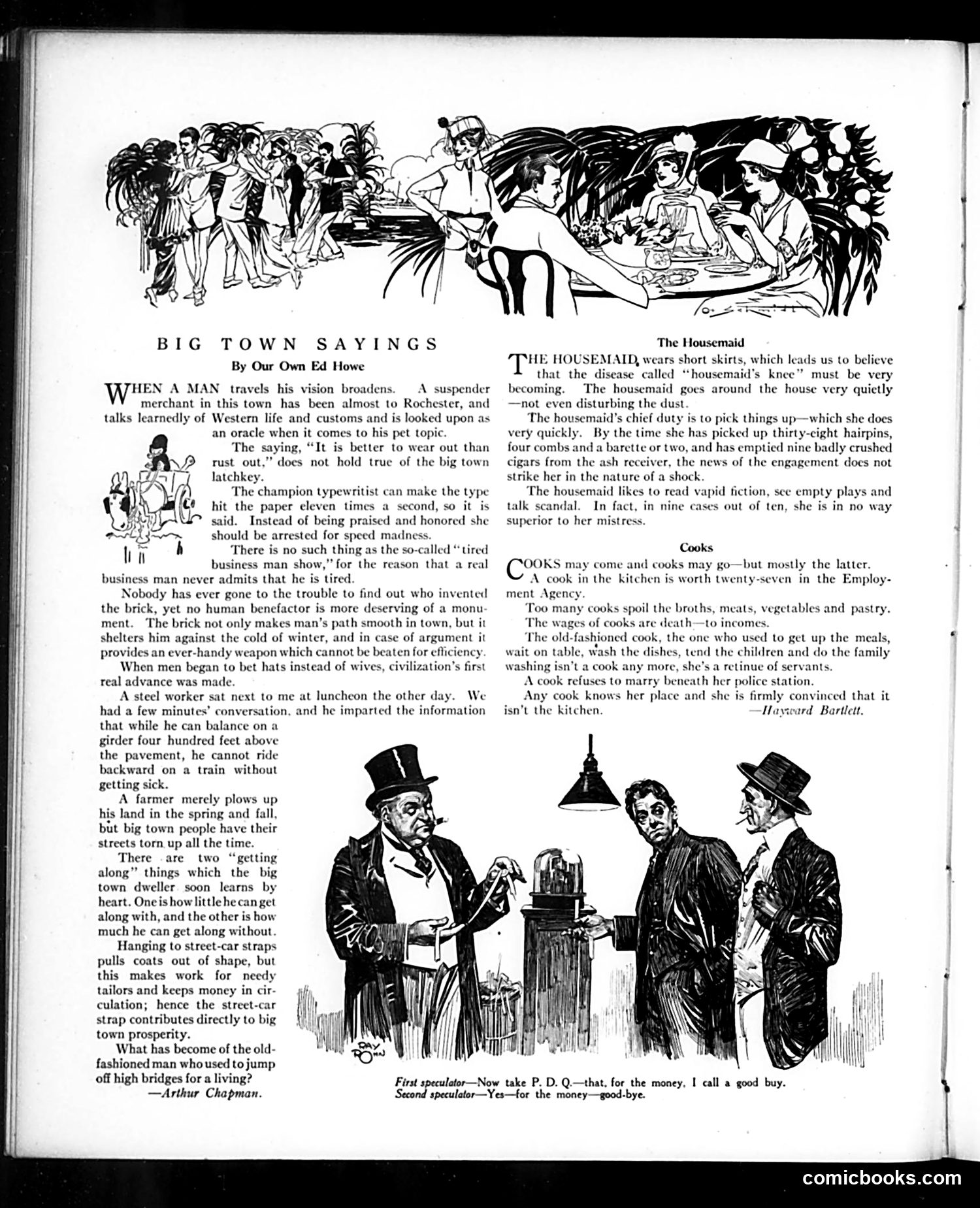
This page from *Judge* magazine presents satirical observations about early 20th-century urban American life through three sections. **"Big Town Sayings" (by Ed Howe)** offers humorous social commentary on city dwellers' pretensions and contradictions—a traveler who barely left town claims expertise on Western life; a champion typist should be "arrested for speed madness"; street repairs constantly disrupt big-city life. **"The Housemaid"** mocks both the servant class and their employers, sarcastically praising housemaids' short skirts while suggesting they're lazy ("not even disturbing the dust") and intellectually inferior to their mistresses. **"Cooks"** laments the servant shortage and rising labor costs—good cooks are scarce and expensive, while modern cooks expect easier work than their predecessors. **The cartoon** shows two "speculators" discussing a dubious investment (P.D.Q.), with the second man bidding farewell immediately after agreeing to buy—satirizing get-rich-quick schemes and con artists common in the period. The page reflects anxieties about servant labor scarcity, urban change, and financial speculation in this era.
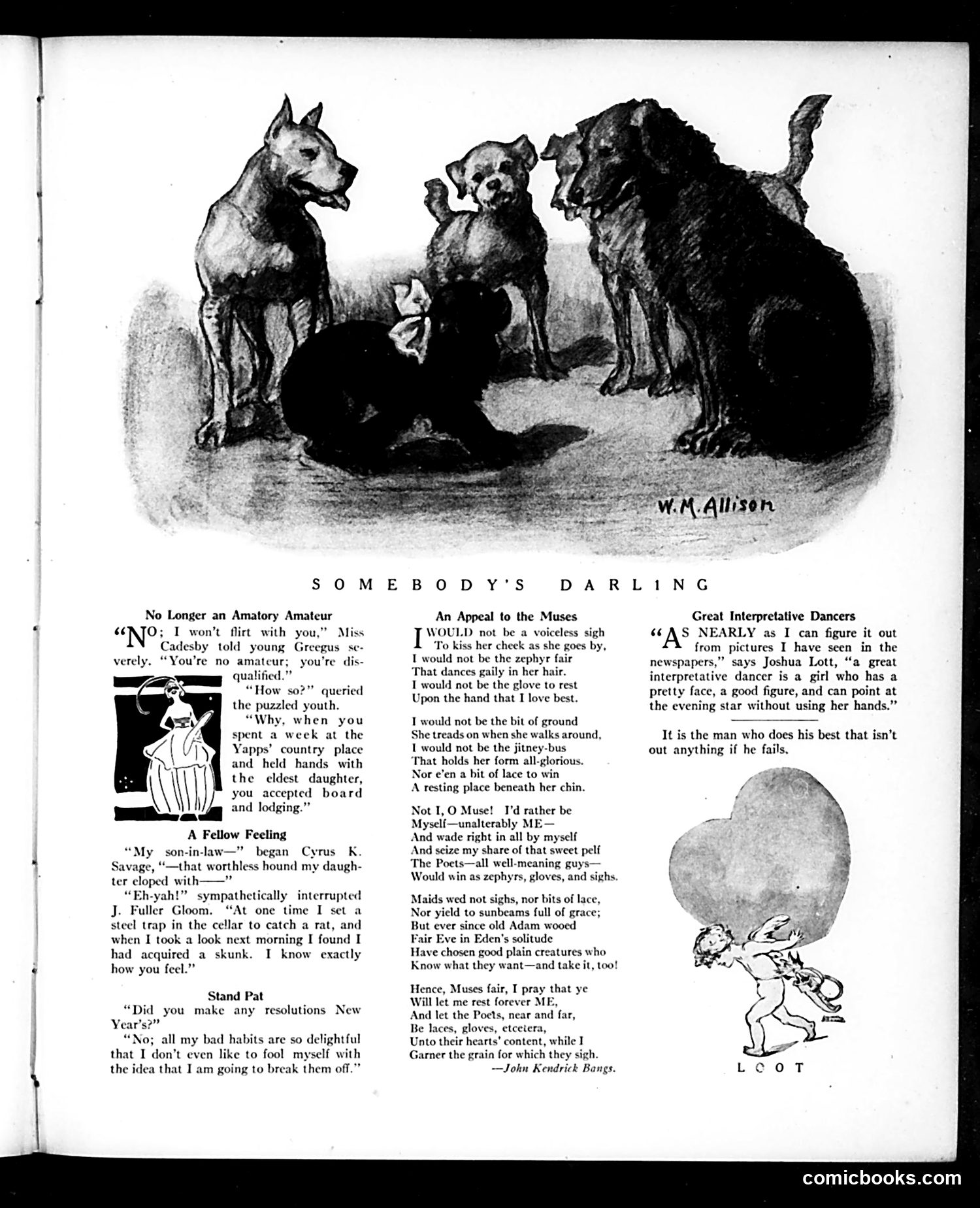
This page from *Judge* magazine contains several brief satirical sketches about romantic and social behavior, plus a poem mocking pretentious artistic aspirations. **"No Longer an Amatory Amateur"** jokes that a young man who held hands with a girl during a house visit has crossed from amateur to professional flirtation—implying he's now obligated, having accepted "board and lodging." **"A Fellow Feeling"** compares a father-in-law's worthless son-in-law to an unwanted skunk caught in a rat trap—a darkly humorous analogy about unpleasant surprises. **"An Appeal to the Muses"** satirizes romantic poetry's impracticality. The poem mocks poets who wish to be ethereal things (zephyrs, gloves, sighs) to win women, arguing plainly that women actually want practical, straightforward men who seize what they want—not poetic fantasies. This ridicules Victorian sentimental verse. **"Great Interpretative Dancers"** mocks modern interpretative dance as requiring only beauty, figure, and dramatic gestures (pointing at stars) without actual skill. The top illustration depicts dogs confronting a cat—likely supporting one of these themes about conflict or awkward encounters.
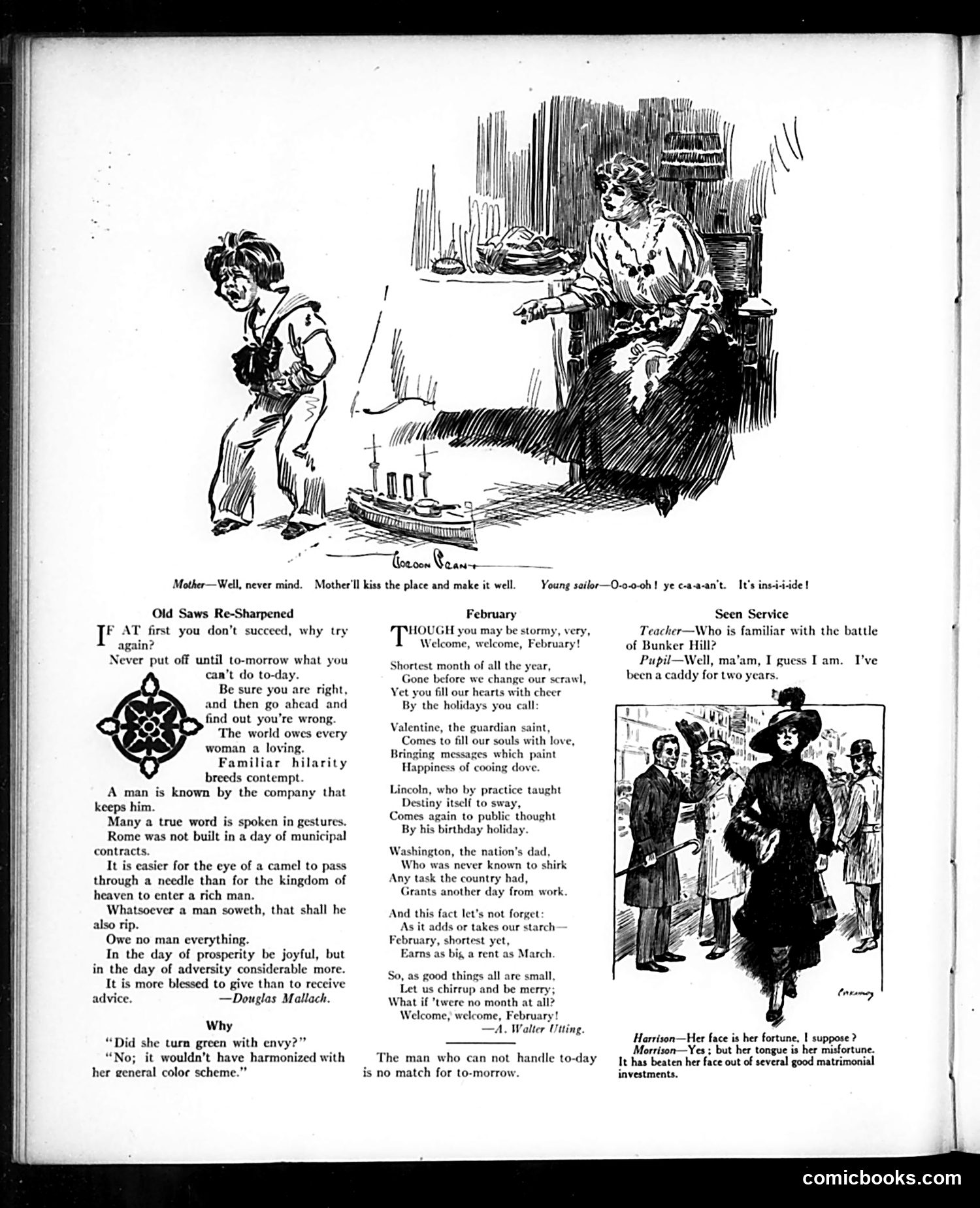
This page from *Judge* contains multiple satirical pieces typical of the magazine's format: **"Old Saws Re-Sharpened"** parodies familiar proverbs by twisting their meanings for comic effect—"Whatsoever a man soweth, that shall he also rip" inverts the original biblical wisdom into absurdity. **"February"** is a celebratory poem about the month, noting holidays (Valentine's Day, Lincoln's and Washington's birthdays) and acknowledging February as the shortest month that nonetheless commands full rent. **The vignettes** are brief jokes: a child's mishap being kissed better; a sailor's seasickness ("it's inside"); a teacher asking about Bunker Hill, with a student claiming familiarity because he worked as a caddy; and a joke about a woman whose sharp tongue has ruined her marriage prospects despite her attractive face. The drawings use period illustration style typical of early-to-mid 20th century American humor magazines. The humor relies on wordplay, domestic scenarios, and social observation rather than overt political satire.
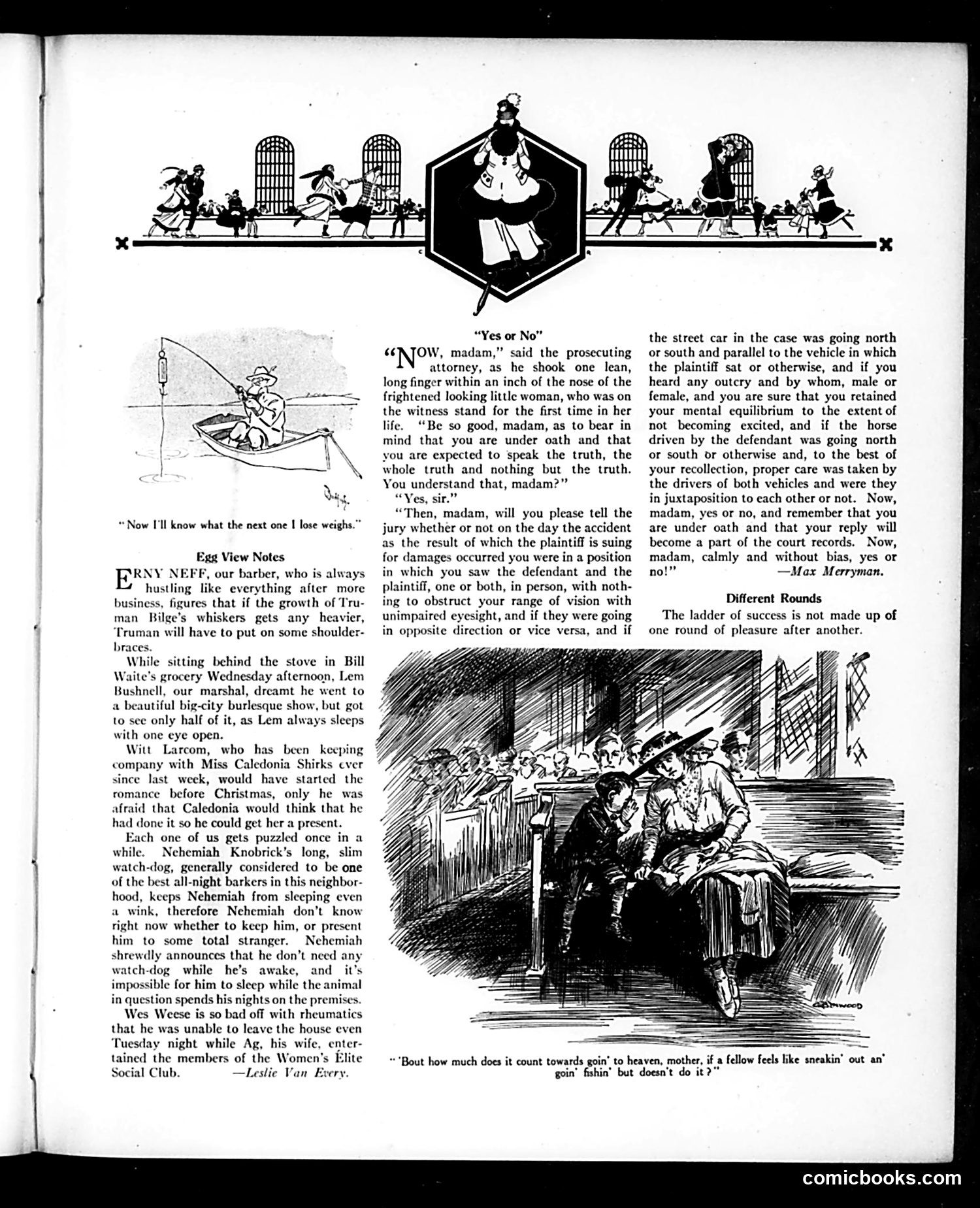
This page from *Judge* magazine contains two satirical pieces: **"Yes or No"** (main cartoon) mocks overly complicated legal questioning. A prosecuting attorney badgers a nervous witness with an absurdly long, convoluted question about a traffic accident—asking her to simultaneously confirm she saw both parties, heard outcries, noted vehicle directions, observed the defendant's horse, and assessed proper care—then demands a simple "yes or no" answer. The satire targets the legal system's tendency to ask impossibly complex questions while demanding simple answers, making honest testimony nearly impossible. **"Egg View Notes"** (sidebar) consists of brief, lighthearted observations about small-town characters and their quirks—a barber worried about a customer's heavy beard growth, a marshal who sleeps with one eye open, romantic hesitations, and a troublesome watchdog. These are gentle, folksy anecdotes poking fun at rural American life. The bottom caption shows a child asking his mother about moral credit for *wanting* to go fishing but resisting temptation—gentle religious satire.
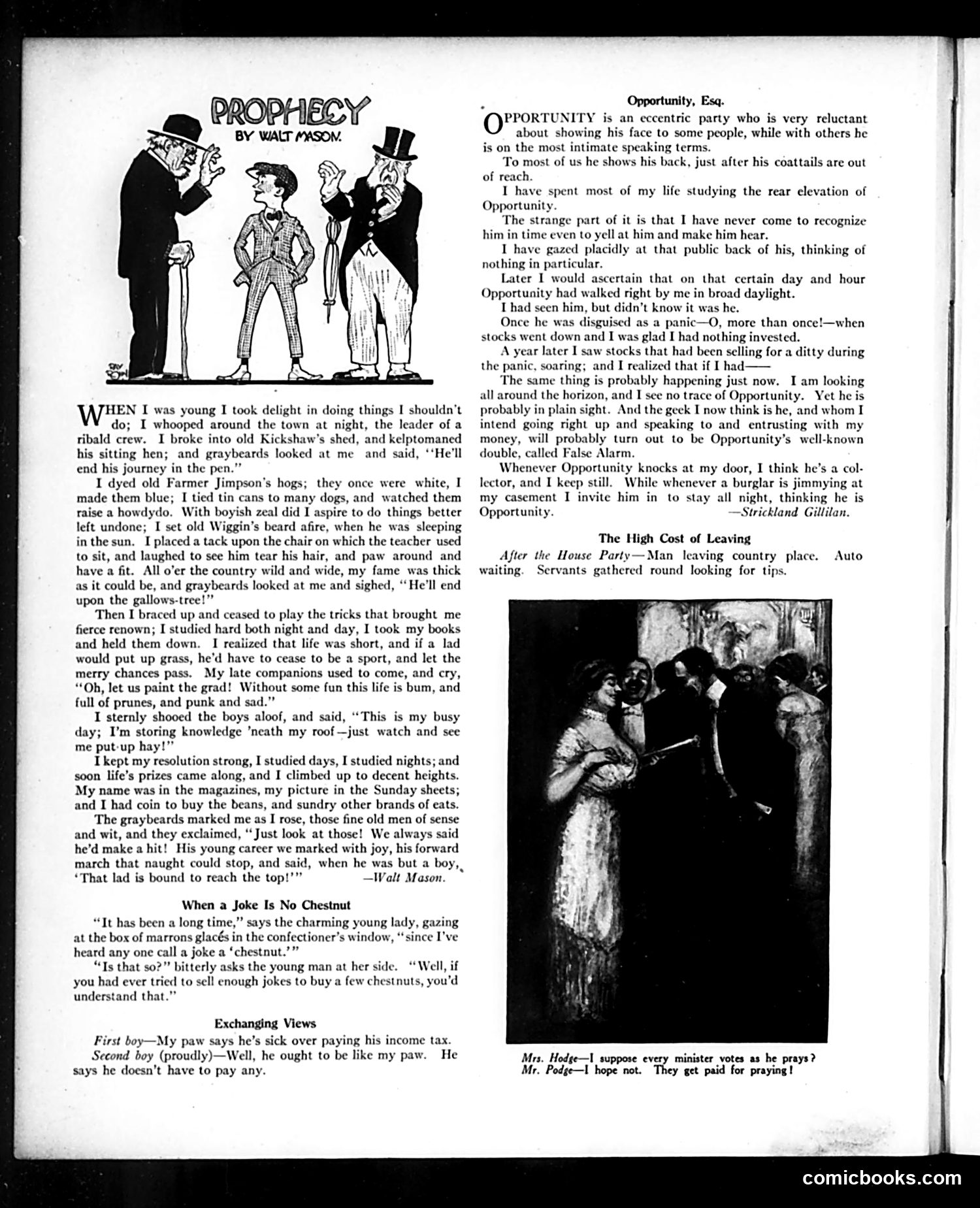
This page contains three distinct pieces of satirical content: **"Prophecy" by Walt Mason** (main poem with cartoon): A cautionary tale about a mischievous youth who reforms through self-discipline and study, eventually achieving success. The irony is that the "graybeards" (older townspeople) who predicted he'd hang now credit themselves with recognizing his potential all along—they take credit for his success despite having written him off as a criminal. It satirizes how people rewrite history to appear prescient. **"When a Joke Is No Chestnut"**: A brief joke mocking struggling humorists—a young man bitterly suggests that only someone desperately poor (trying to sell jokes to buy chestnuts, a cheap food) would still use the outdated term "chestnut" for a stale joke. **"Exchanging Views"**: Tax humor contrasting fathers—one complains about income tax obligations; the other proudly admits he doesn't pay any, implying tax evasion. The "Opportunity" essay discusses how success appears to pass people by because they fail to recognize it when present.
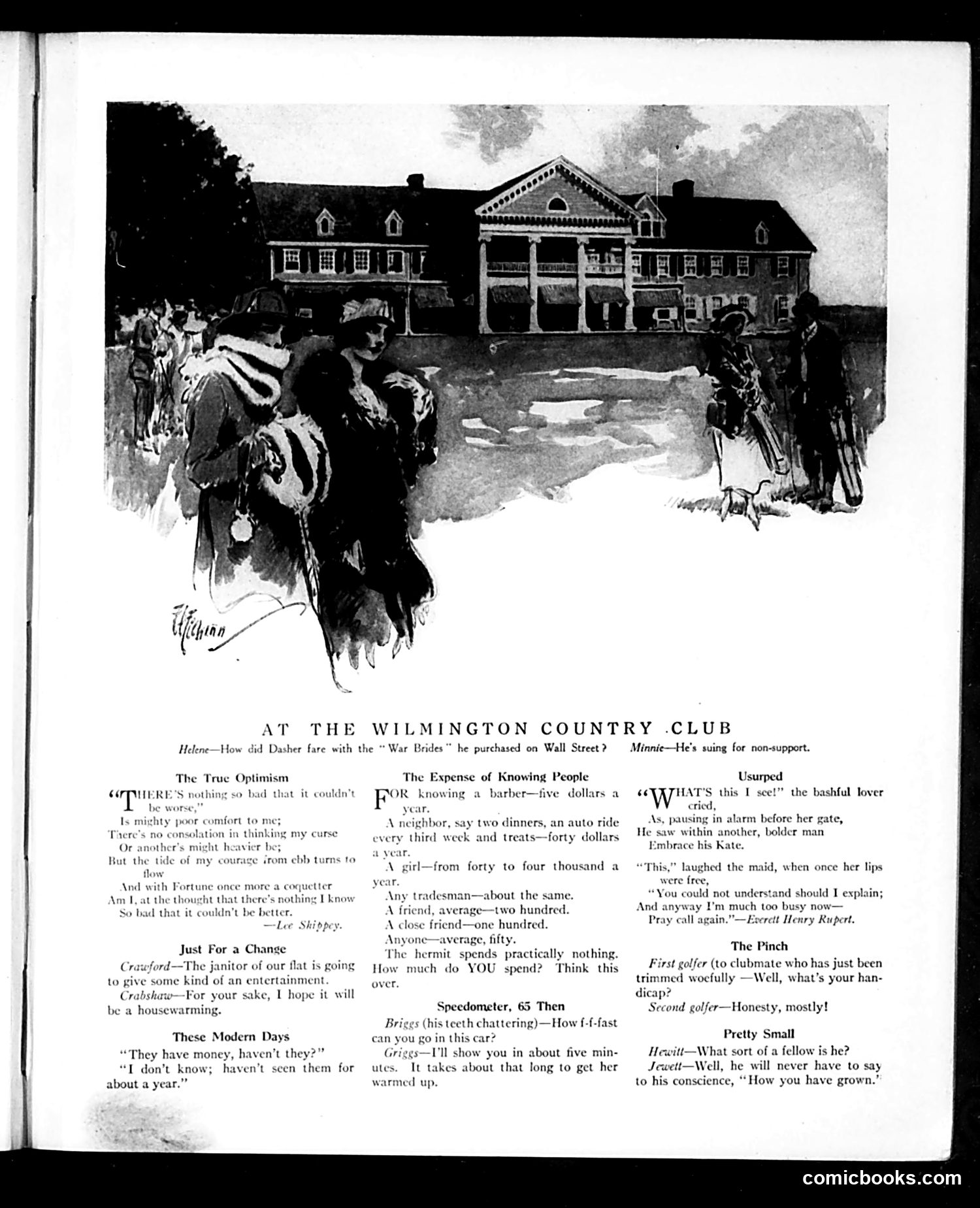
This page from *Judge* magazine presents satirical humor about wealthy leisure-class life. The illustration depicts an elegant country club setting where well-dressed socialites gather. The jokes mock the expense and absurdity of maintaining upper-class social status. "The Expense of Knowing People" lists the cumulative costs of various relationships—from a barber ($5/year) to a girlfriend ($40-4,000/year)—suggesting that social climbing and romance are financially exhausting pursuits. Other quips target modern contradictions: wealthy people who haven't been seen in a year, the pretense of optimism amid financial strain, and the hollow morality of the wealthy ("Honesty, mostly!"). The "War Brides" reference appears to reference women purchased or courted opportunistically. Overall, the satire targets Gilded Age excess, social climbing, and the financial precarity masquerading as wealth among the country-club set.
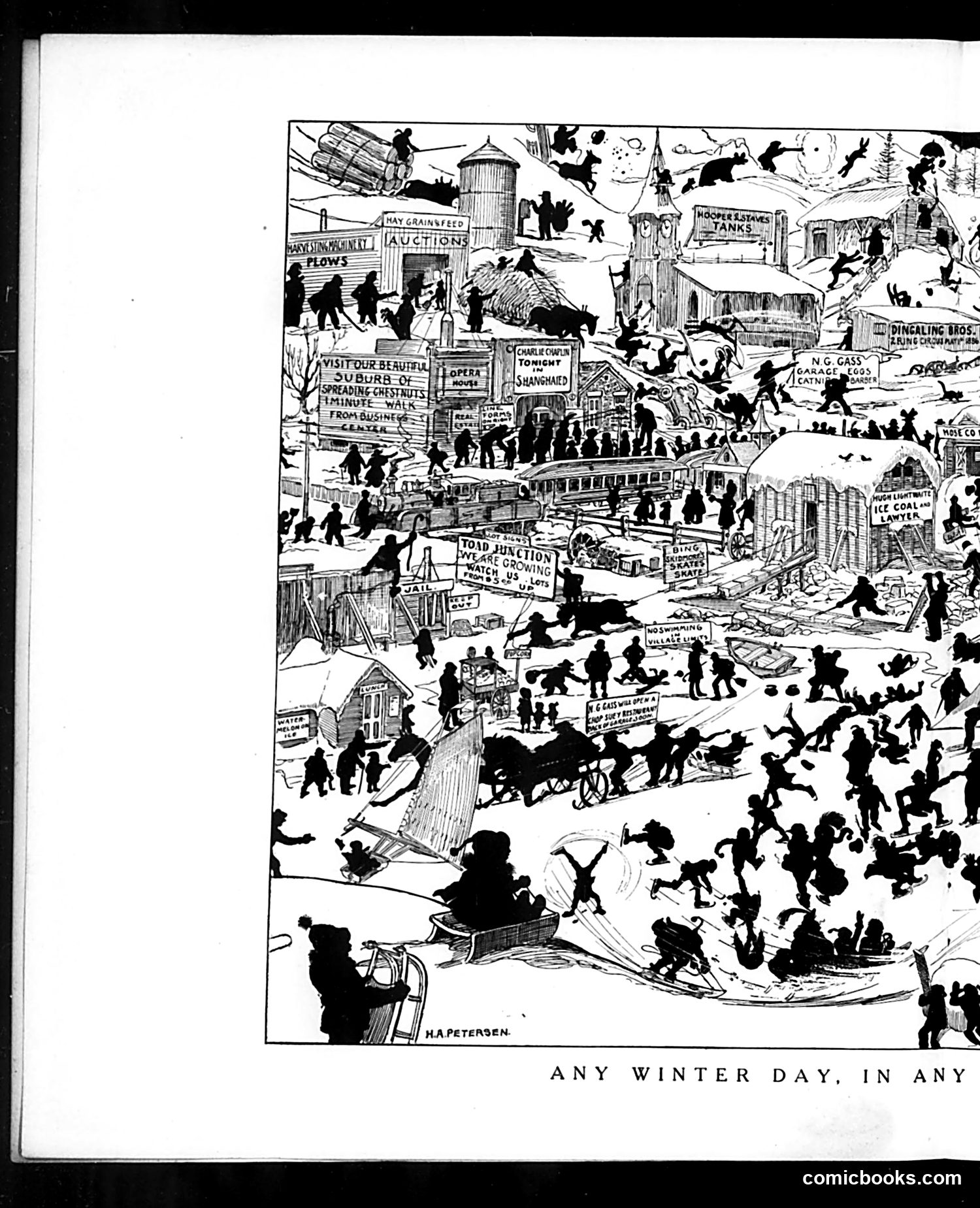
This is a detailed winter scene illustration by H.A. Petersen showing a busy town during winter activities. The image depicts numerous people engaged in sledding, ice skating, and other cold-weather recreation across a snowy landscape. Various establishments are labeled throughout—including "Charlestown Opera House," "Hooper & Stokes Tanks," "Dingeling Bros.," and other businesses—suggesting this represents a typical American town experiencing winter entertainment and commerce. The caption "ANY WINTER DAY, IN ANY" (text cuts off) indicates this is likely presenting a satirical commentary on winter leisure culture, possibly mocking the chaotic or overly commercialized nature of winter activities in American towns. The black silhouettes and crowded composition emphasize the bustling, perhaps absurd abundance of winter pursuits available to townspeople. Without the complete caption, the specific satirical target remains unclear, though it appears to critique winter entertainment's prominence in urban life.
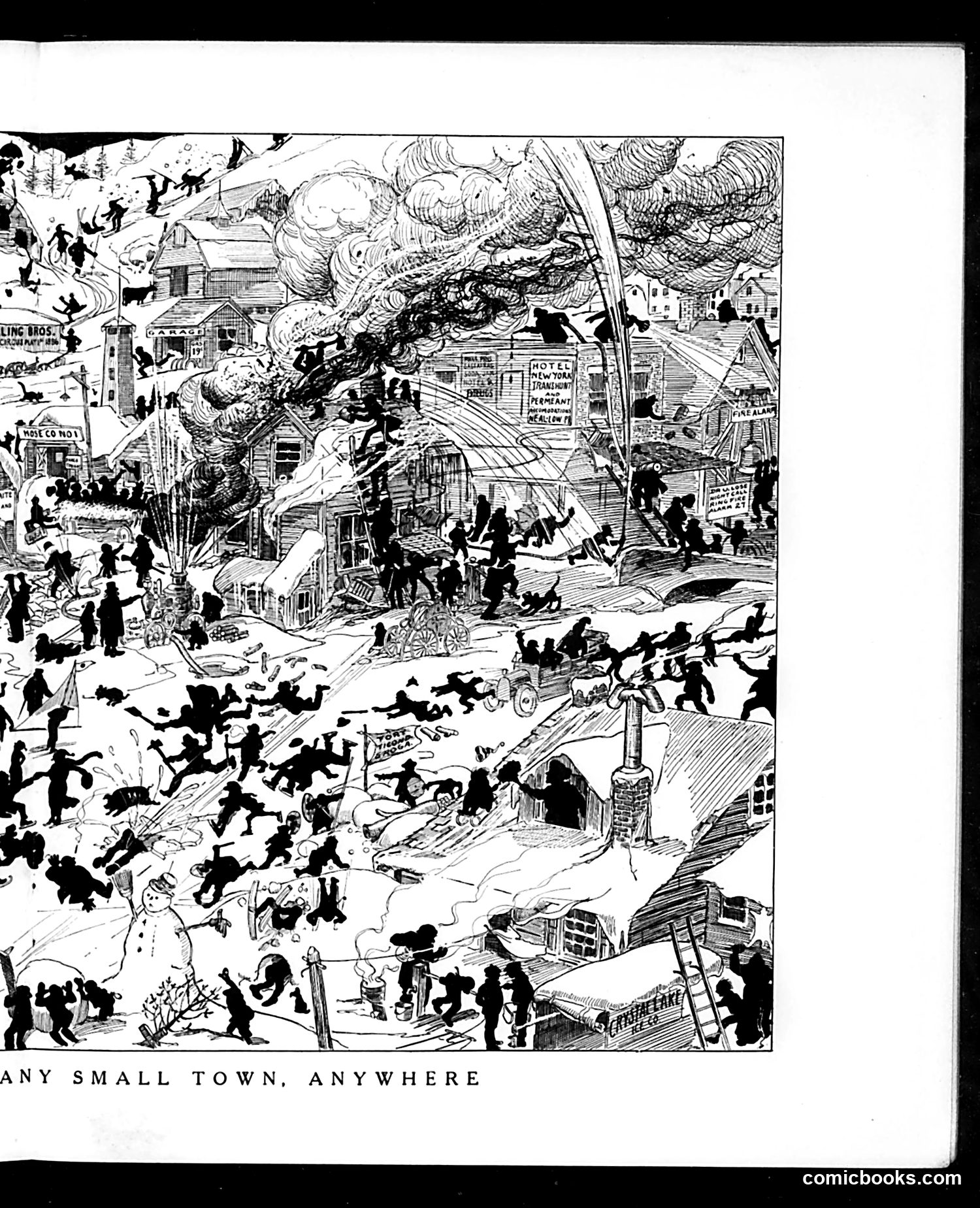
This appears to be a satirical illustration depicting chaos and disaster in a small American town. The image shows massive destruction—a large tornado or cyclone dominates the center, with buildings collapsing, people fleeing in panic, and general mayhem throughout the scene. Various storefronts and structures are visible amid the destruction. The caption "ANY SMALL TOWN, ANYWHERE" suggests the cartoon satirizes the vulnerability of small-town America to natural disasters or perhaps critiques how such communities are portrayed in popular media as perpetually disaster-prone or chaotic. Without additional context or visible bylines, the specific satirical target remains unclear—whether this mocks media sensationalism, comments on actual disaster preparedness, or addresses another contemporary concern of Judge magazine's era. The exaggerated style is typical of early-to-mid 20th century American satirical cartooning.
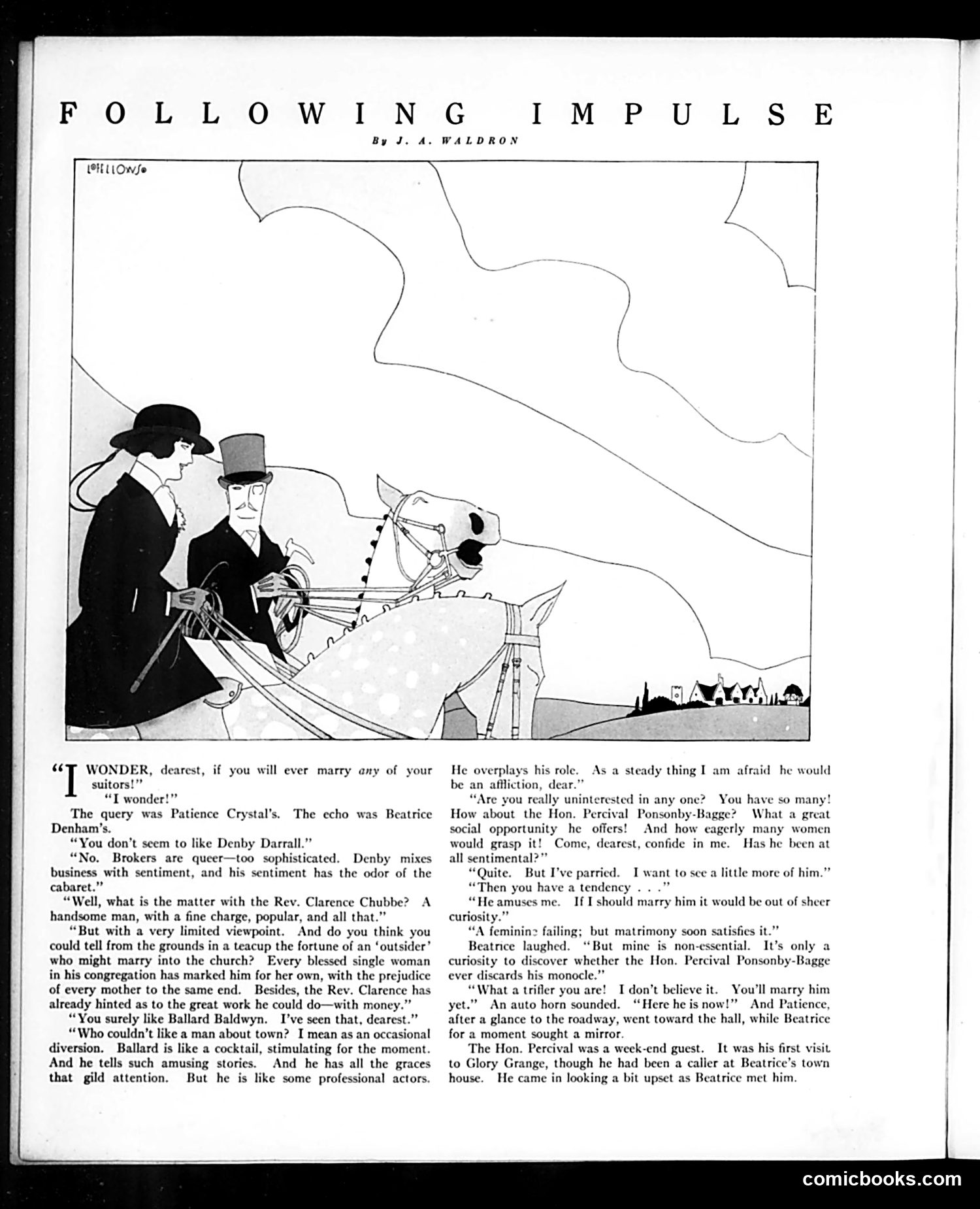
This is a society comedy about marriage prospects among the upper classes. Two women—Patience Crystal and Beatrice Denham—discuss Beatrice's various suitors: Denby Darrall (a broker mixing business with sentiment), Rev. Clarence Chubbe (a clergyman with limited views), Ballard Baldwyn (a charming but superficial man-about-town), and the Hon. Percival Ponsonby-Bagge (a wealthy gentleman guest). The satire targets Victorian/Edwardian marriage conventions and women's limited options. Beatrice dismisses each suitor for revealing character flaws—sentimentality, narrow-mindedness, superficiality, or pretension. Her interest in the Hon. Percival stems from mere curiosity about whether he removes his monocle, mocking the triviality of upper-class romance. The illustration shows an automobile arriving, suggesting modernity challenging traditional courtship. The story suggests women follow romantic "impulse" rather than rational judgment when choosing husbands.
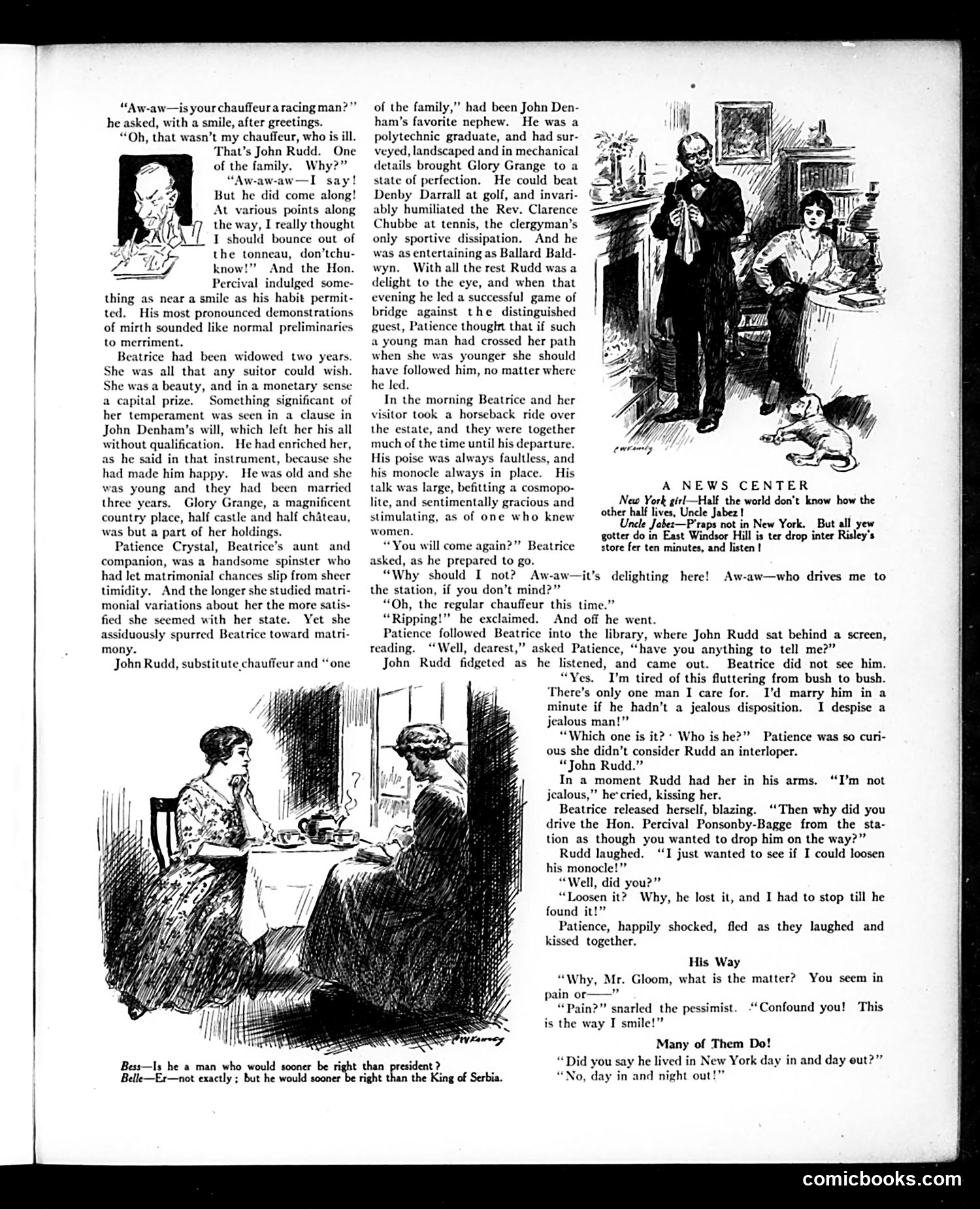
This page from *Judge* magazine satirizes the British aristocratic class through contrasting characters. The distinguished foreign visitor ("the Hon.") speaks in exaggerated affected English ("Aw-aw," "Ripping!"), embodying upper-class pretension. John Rudd, Beatrice's late husband's nephew—educated, athletic, mechanically talented, and genuinely charming—represents the competent modern man transcending class boundaries. The satire targets aristocratic snobbery: the Hon. mistakes Rudd for a mere chauffeur, yet Rudd's actual abilities (surveying, landscaping, sports prowess) exceed the visitor's accomplishments. The romance plot where Beatrice chooses Rudd over her snobbish suitor satirizes the declining relevance of hereditary aristocracy in favor of merit and genuine character. The bottom anecdote about a "News Center" reinforces class commentary—rural gossip spreads as efficiently as urban information networks, undercutting pretensions about social hierarchy and knowledge distribution.
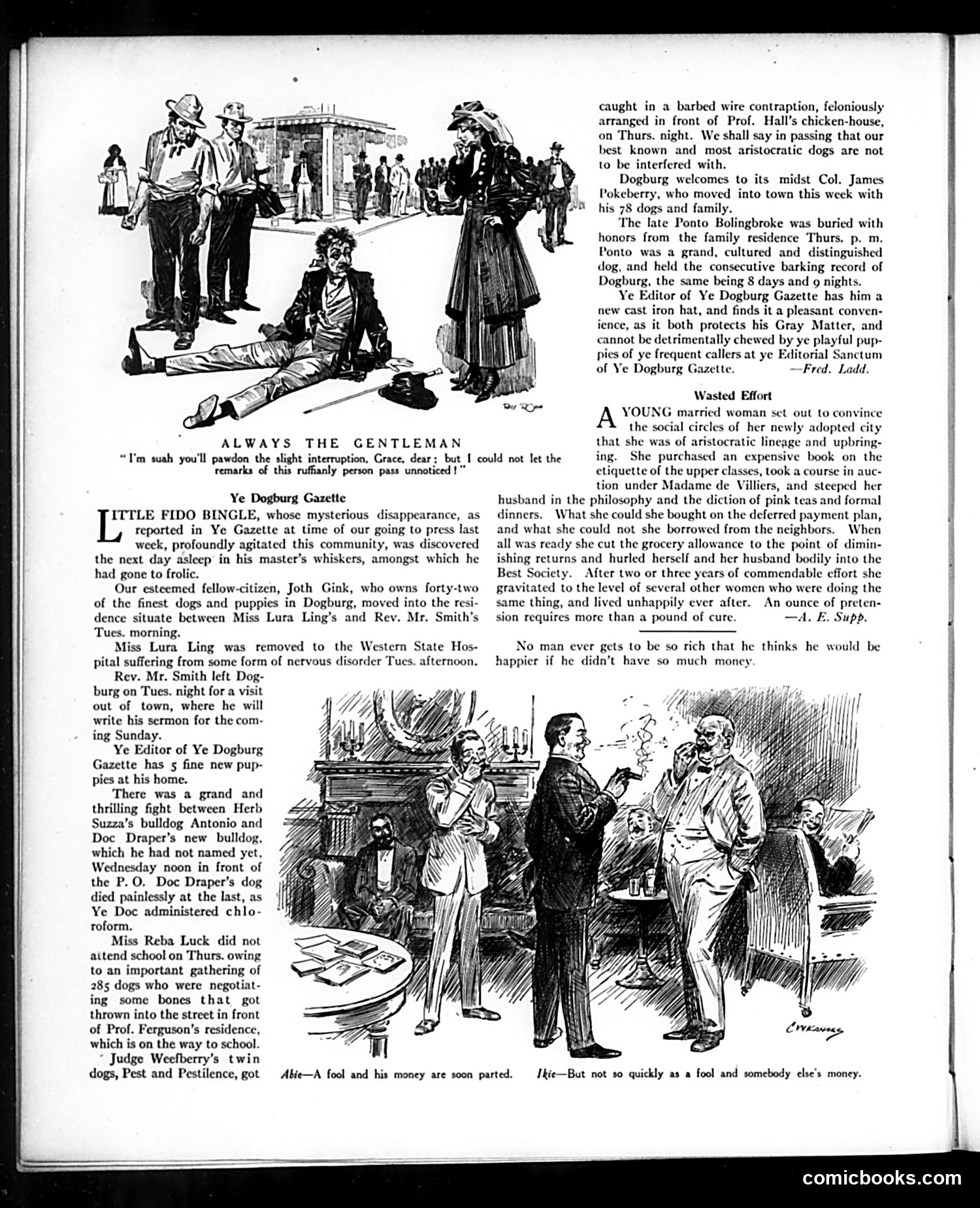
**"Always the Gentleman" cartoon:** This depicts a confrontation where a well-dressed man interrupts to defend a woman's honor from a "ruffianly person," maintaining genteel composure despite the conflict. The satire mocks performative upper-class propriety—the gentleman's elaborate apology for the "interruption" while defending honor reflects how wealthy society prioritized social etiquette over practical concerns. **"Ye Dogburg Gazette" section:** This is a humorous fake-newspaper parody treating dogs as citizens of a town. It satirizes small-town gossip columns by reporting trivial canine events (a lost dog, neighborhood dog acquisitions, dog fights, a funeral with "barking record") with mock-serious journalism. The humor lies in elevating pet drama to civic importance. **"Wasted Effort":** This mocks social climbing. A woman spends lavishly on etiquette lessons and borrowed finery to enter high society, sacrifices her household budget, but ultimately gravitates back to her actual social level after exhausting effort. The satire targets the futility of attempting class ascension through mere performance of manners. Both pieces critique artificial social pretension—whether through exaggerated gentility or desperate status-seeking.
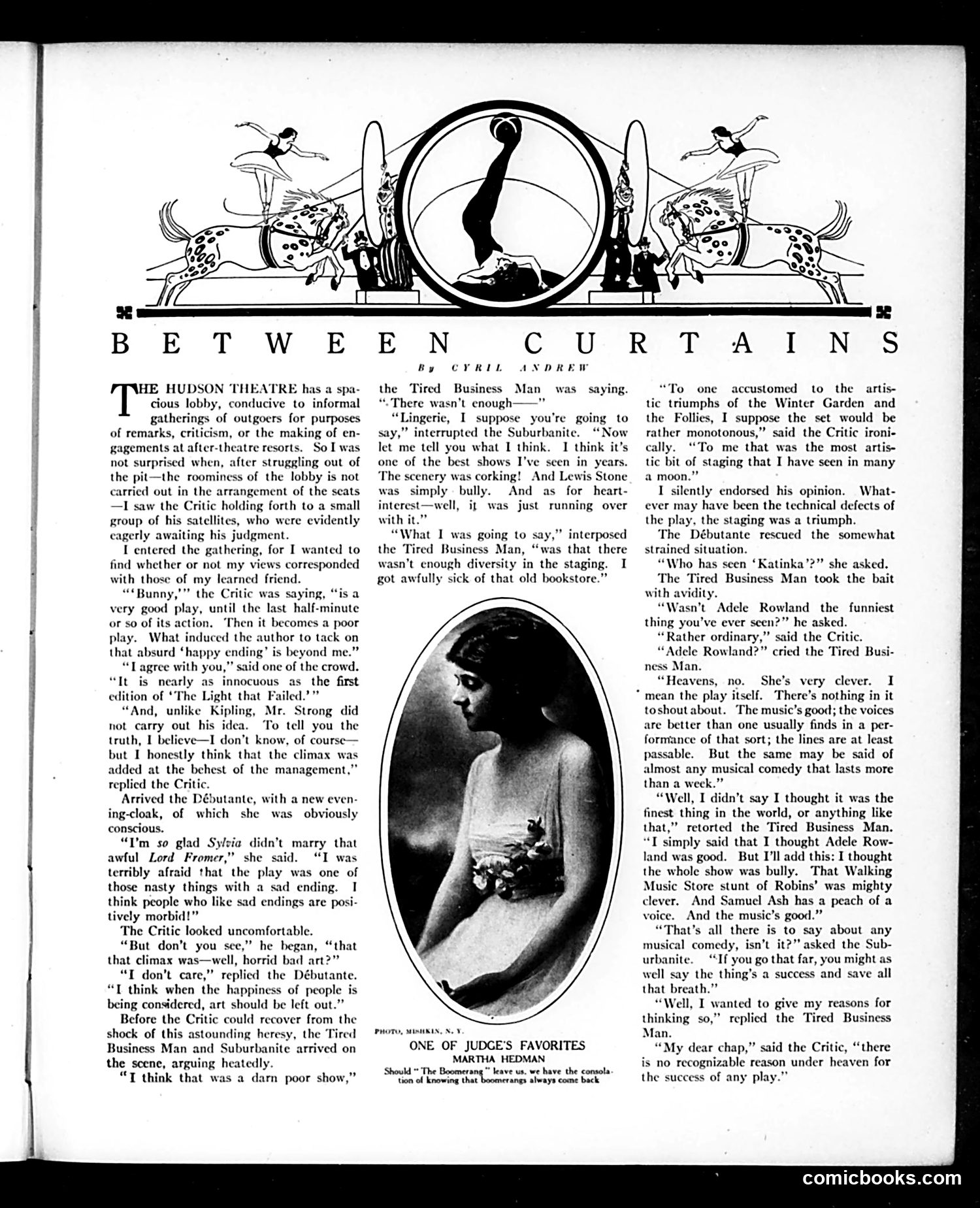
This Judge magazine article satirizes theatrical criticism and audience taste through a post-show lobby conversation. The "Critic" (a recurring character) argues that a play's happy ending is "horrid bad art," added by management against the playwright's better judgment. The satire targets the conflict between artistic merit and popular entertainment. A naive young woman ("the Débutante") defends the happy ending because it made her happy—prioritizing audience satisfaction over artistic integrity. The "Tired Business Man" and "Suburbanite" dispute the show's staging diversity, while the Critic dismissively praises the set design as superior artistry. The joke: the Critic claims refined aesthetic standards, yet his judgments seem arbitrary and elitist. The image of Martha Hedman (an actress of the era) represents the theatrical world being critiqued. The satire mocks both pretentious critics who dismiss popular entertainment and audiences who prioritize comfort over art—suggesting neither perspective fully captures theatrical value.
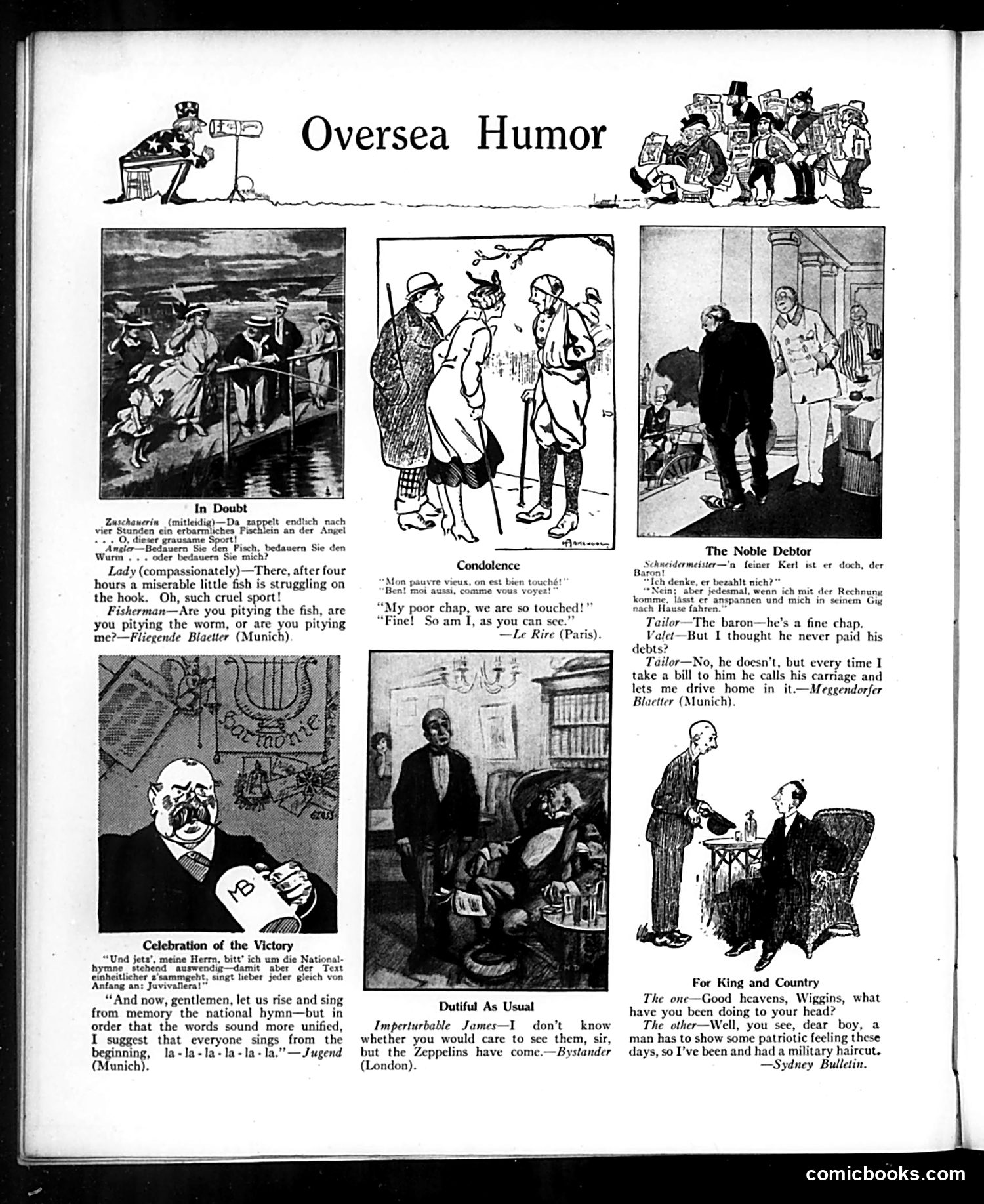
This page collects satirical cartoons from European magazines, mocking social pretenses and wartime behaviors. **Key cartoons:** 1. **"In Doubt"** (top left): A German cartoon mocking sentimental animal lovers—the lady pities the fish on the hook, but the fisherman sardonically asks if she's really pitying *him* (implying his suffering matters more). 2. **"The Noble Debtor"** (top right): A tailor discusses a baron who never pays bills, yet always invites the tailor to ride home in his carriage—mocking aristocratic deadbeats who offer hollow gestures instead of payment. 3. **"Celebration of the Victory"** (bottom left): German officials suggest singing the national anthem in unison "from the beginning" so words sound unified—satirizing forced patriotic conformity. 4. **"Dutiful As Usual"** (bottom center): References Zeppelin airships, suggesting British indifference to German air raids. 5. **"For King and Country"** (bottom right): A man sports a military haircut as patriotic display, mocking superficial wartime gestures. The page satirizes pretense, incompetence, and hollow patriotism across European society during what appears to be WWI-era.
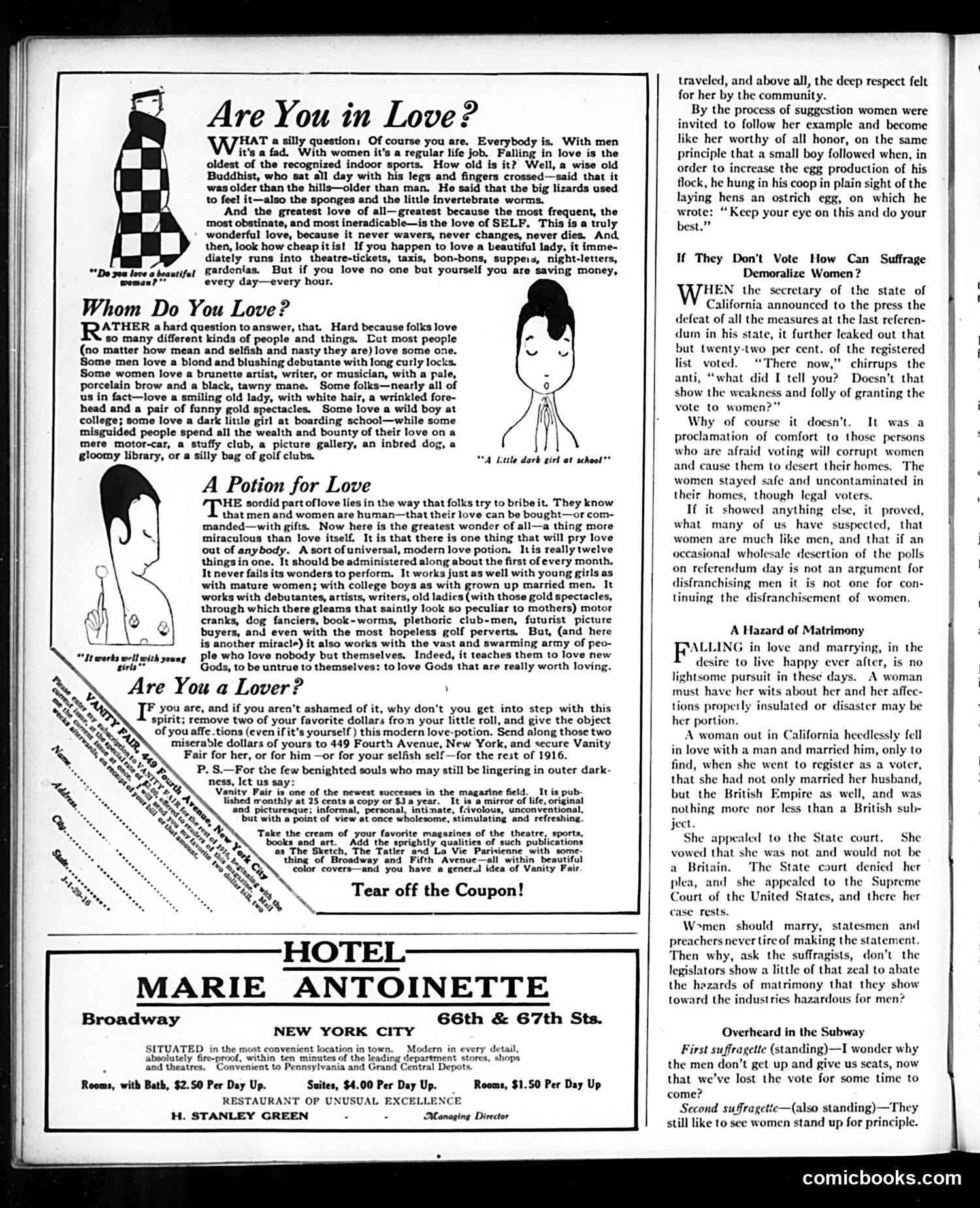
This page from Judge magazine satirizes romantic love and courtship customs of the 1910s. The central articles mock how love, theoretically universal and timeless (traced humorously back to "big lizards"), becomes mercenary and ridiculous in practice. The cartoons feature simple line-drawn figures illustrating how people express love through material consumption—theater tickets, candy, automobiles, golf clubs—rather than genuine affection. The satire suggests that self-love is the only constant emotion. The "potion for love" is revealed as the magazine *Vanity Fair* itself, a newly launched luxury publication. The joke positions the magazine as the ultimate remedy for modern romantic needs, working equally on debutantes, artists, and even selfish people. The article essentially advertises Vanity Fair by mocking contemporary courtship while implying that subscribing to the magazine is the solution to romantic fulfillment—witty self-promotion disguised as social commentary.
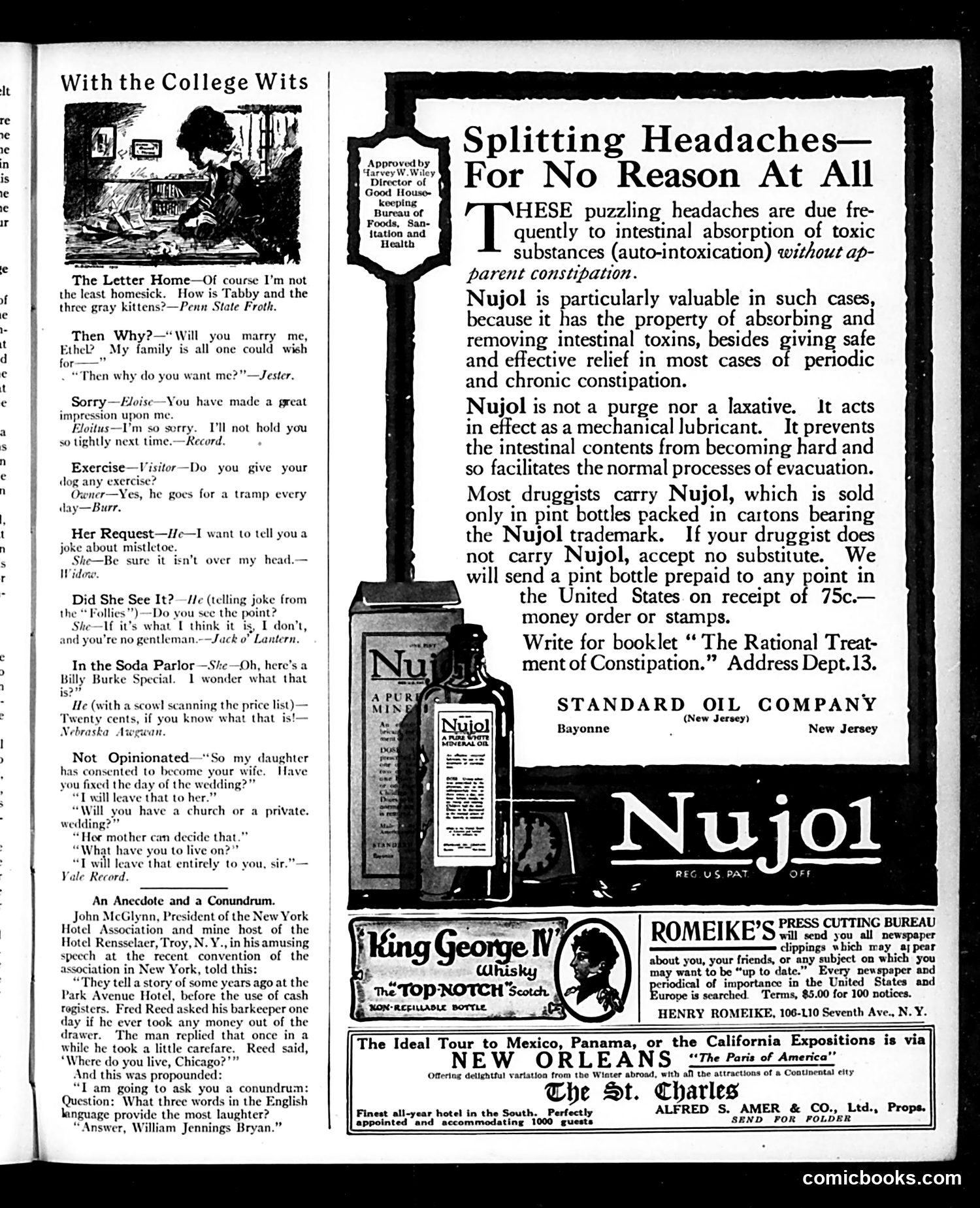
This is primarily an **advertising page** from Judge magazine disguised as editorial content. The left column contains brief college humor jokes ("With the College Wits") — standard collegiate publication fare about dating, exercise, and courtship mishaps that would appeal to Judge's educated, upper-class readership. The main content is a **full-page advertisement for Nujol**, a mineral oil laxative made by Standard Oil Company. The ad claims Nujol treats mysterious headaches caused by intestinal "auto-intoxication" (self-poisoning from constipation), framing it as a "mechanical lubricant" rather than a purge. This reflects **early 20th-century patent medicine marketing**: vague ailments blamed on bowel dysfunction, pseudo-scientific claims, and aggressive direct-mail sales (75¢ mail order). The page also includes smaller ads for whisky, a newspaper clipping service, and a New Orleans hotel—typical of Judge's revenue model: prestigious editorial wrapped around lucrative pharmaceutical and luxury product advertising.
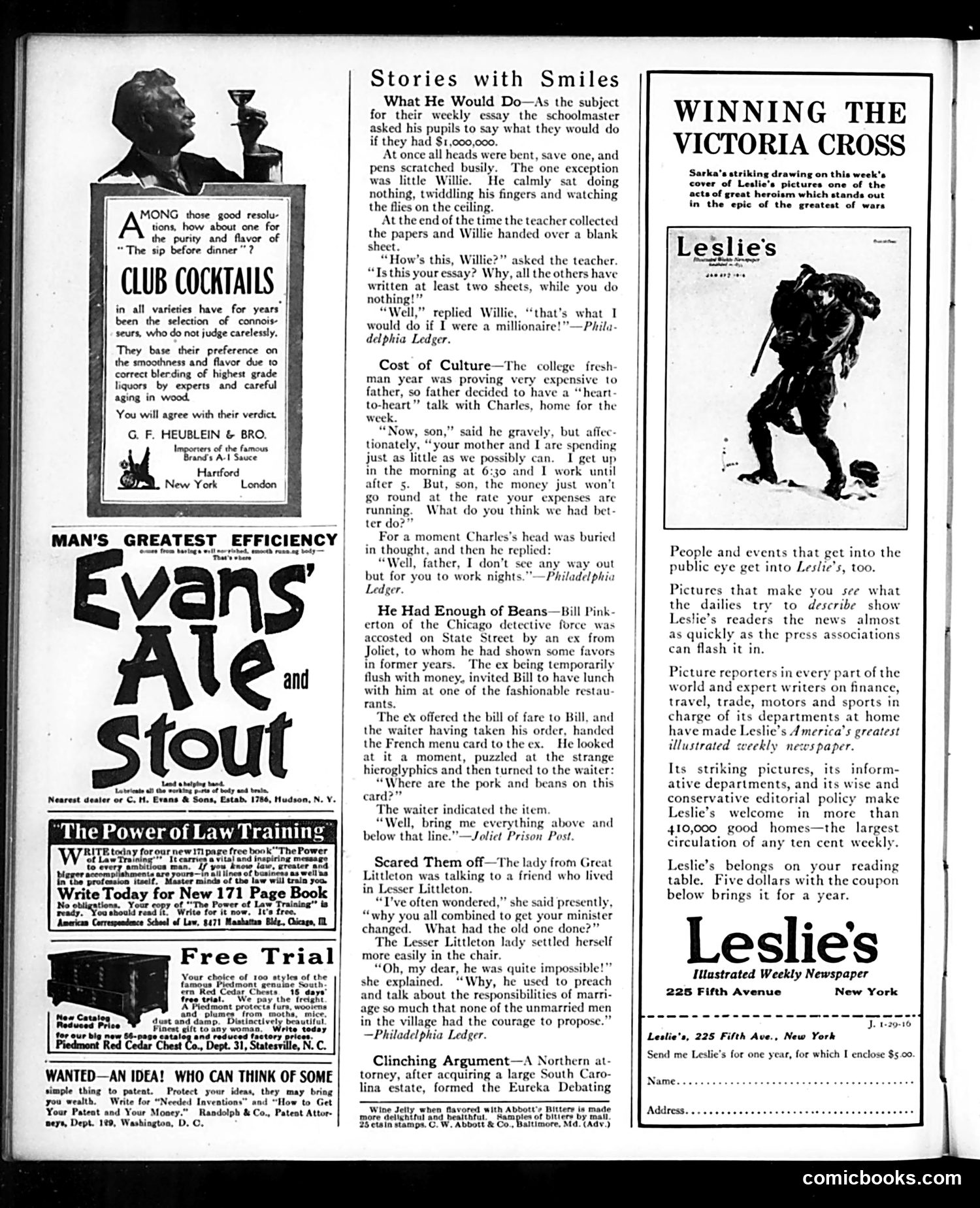
This page is primarily **advertising and light humor** rather than political satire. The main content consists of: **Advertisements** dominate: Club Cocktails (spirits), Evans Ale and Stout (beer), law training courses, and patent attorney services—typical early 20th-century periodical fare. **"Stories with Smiles"** features four brief, wholesome jokes: - A schoolboy's blank essay about spending a million dollars - A college student suggesting his father work nights to afford tuition - A former convict ordering "pork and beans" at a fancy restaurant (playing on working-class ignorance of French menus) - A minister's preaching on marriage responsibilities driving away unmarried parishioners These are **gentle social humor**—poking fun at youth, class differences, and small-town life—rather than sharp political commentary. The jokes assume readers recognize familiar social scenarios: parental sacrifice, educational expense, class pretension, and rural innocence. The page reflects Judge's lighter editorial content alongside commercial messaging typical of satirical magazines of this era.
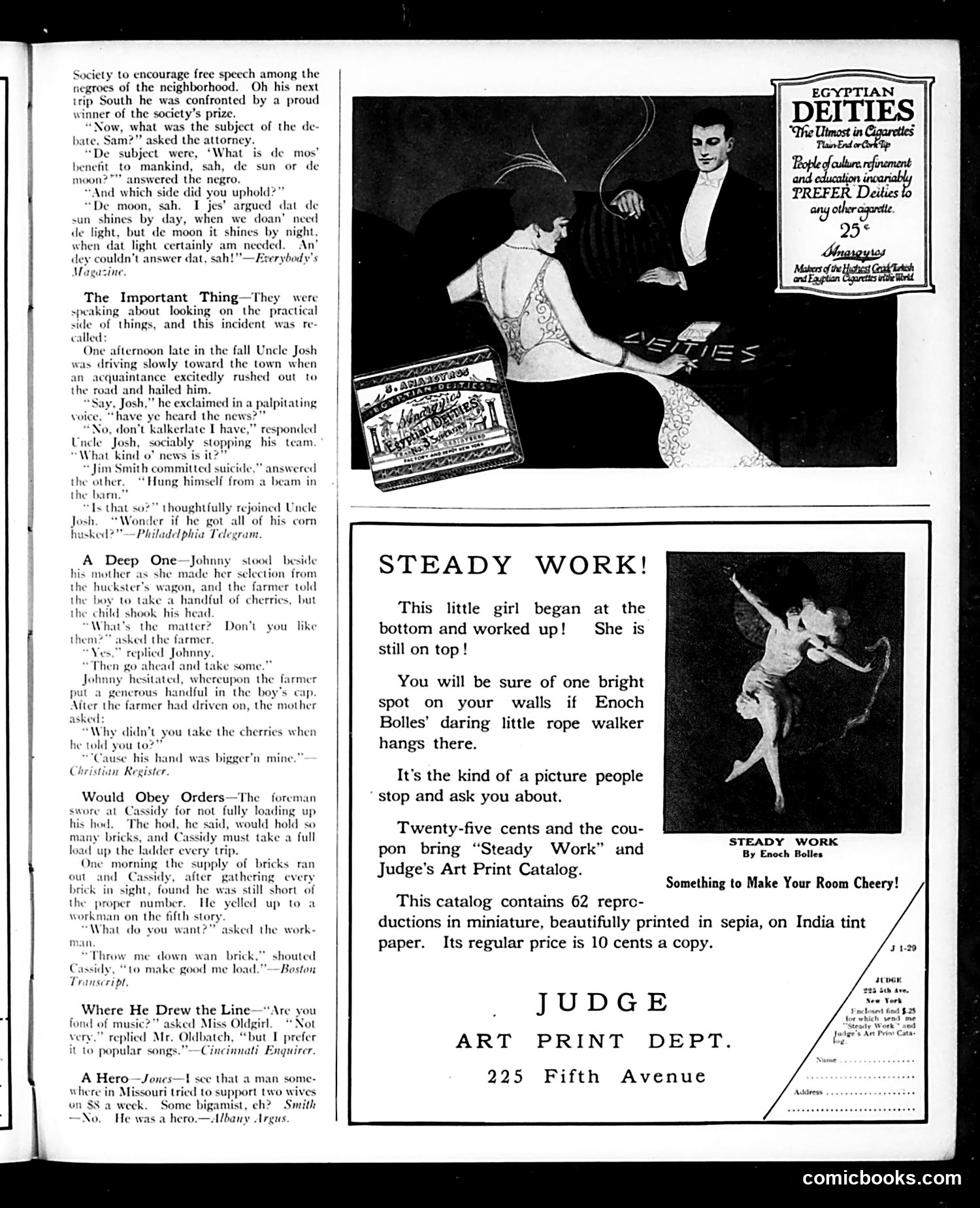
This page contains short satirical anecdotes typical of Judge's humor, plus an advertisement for art prints. The main jokes employ period stereotypes and racial humor (common in early 20th-century satire): 1. **"Free Speech" anecdote**: Mocks both a Northern "society" promoting Black oratory and the Black speaker himself—the humor relies on dialect and the supposed illogic of arguing the moon is more useful than the sun. 2. **Uncle Josh stories**: Rural/folksy humor where practical-minded country people miss social niceties. One features a man's suicide; the other a child's shrewd refusal of cherries (his hand was smaller than the farmer's). 3. **Working-class anecdotes**: Brief jokes about laborers and social pretension. The **"Steady Work" advertisement** promotes an art print by Enoch Bolles depicting a female acrobat/rope walker—positioned as decorative wall art for 25 cents. This reflects period attitudes toward both entertainment and gender display. The page is primarily **comedic content and advertising** rather than political commentary.
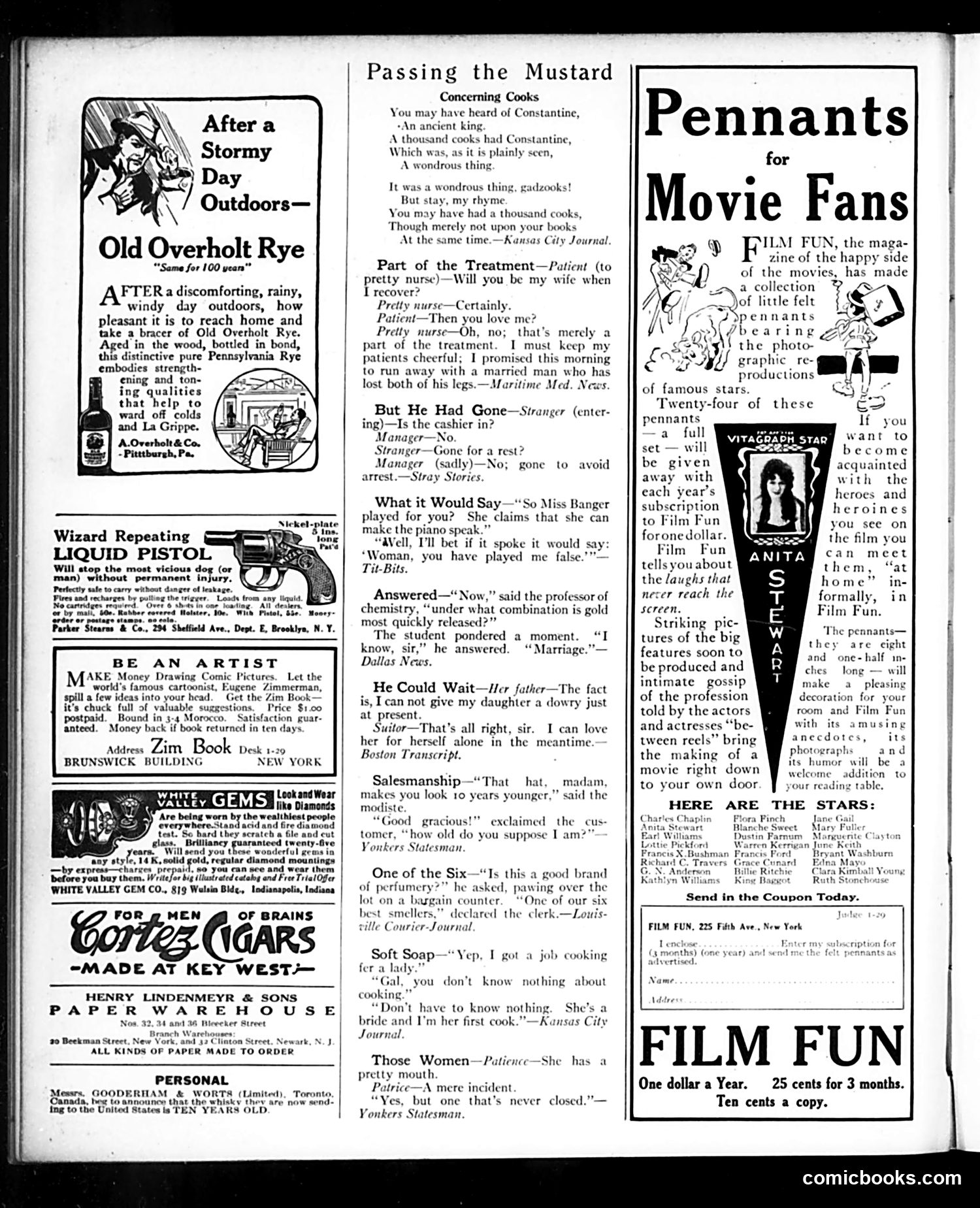
This page is primarily **advertising and humor content** rather than political satire. The main elements include: **Advertisements:** - Old Overholt Rye whiskey (top left) - A "Wizard Repeating" pistol - White Valley Gems (fake diamonds) - Paper warehouse services - Various other products **Humor Section ("Passing the Mustard"):** A collection of short jokes and anecdotes mocking social situations. Examples include a nurse telling a patient she'll marry him only as "treatment," a chemistry student answering that marriage releases gold fastest, and a hat salesman's flattery backfiring when a customer reveals her actual age. **Magazine Advertisement:** "Film Fun" magazine advertises movie star pennants and subscriptions, featuring silent film actors (though specific names are difficult to confirm from the image). The page reflects **early 20th-century attitudes** toward courtship, gender relations, and consumer culture, but contains no identifiable political commentary or caricatures of public figures.
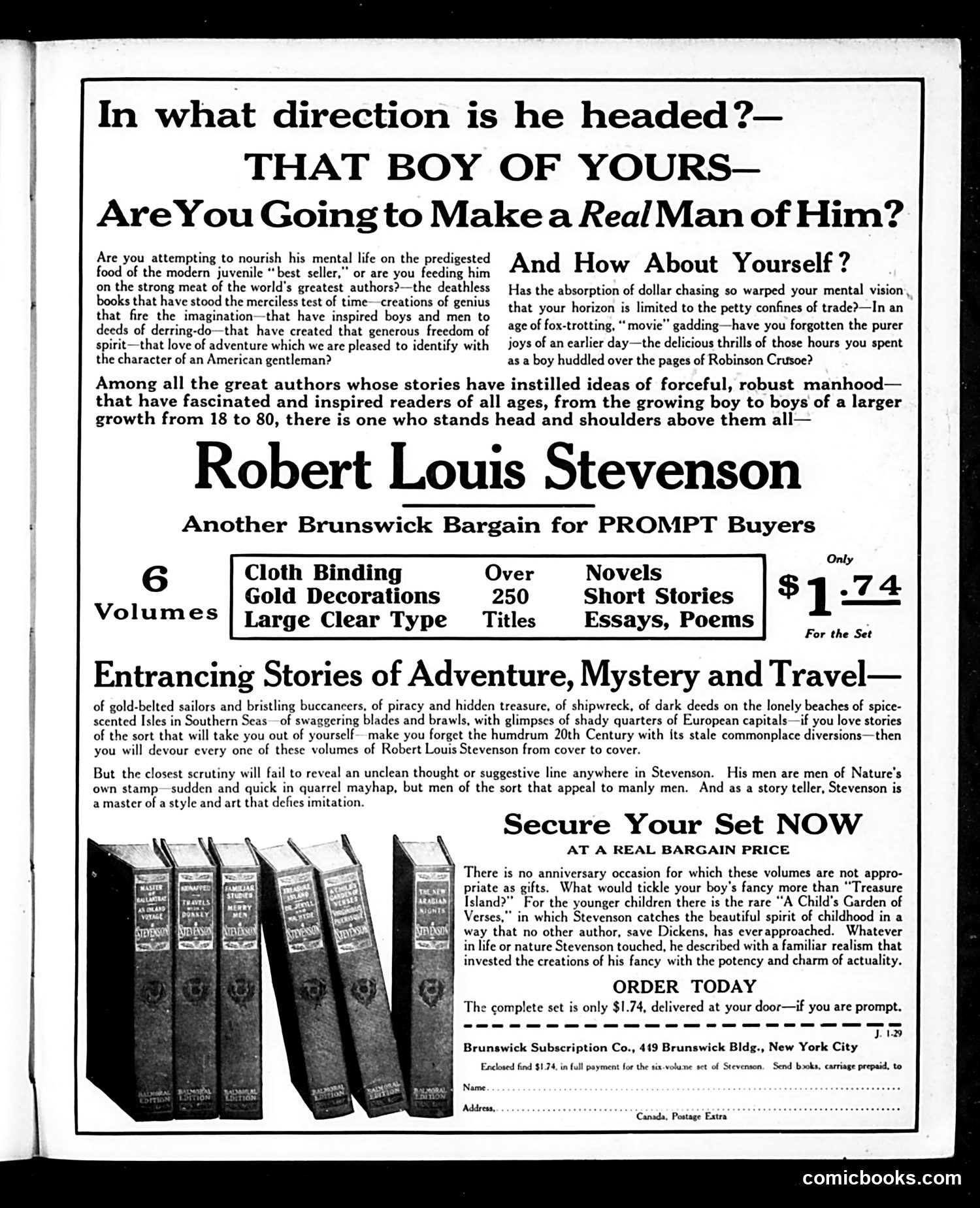
This is primarily a **book advertisement**, not a political cartoon. It's a Brunswick Subscription Company ad promoting a six-volume set of Robert Louis Stevenson's works for $1.74. The rhetorical strategy employs **moral anxiety about modern youth**: the ad opens with pointed questions attacking parents who feed children "predigested" modern "best sellers" rather than classics. It similarly shames adults absorbed in "dollar chasing" and frivolous pursuits ("fox-trotting," "movie gadding"), contrasting this with the "purer joys" of reading Stevenson in boyhood. The ad positions Stevenson as a moral corrective—his adventure tales supposedly inspire "forceful, robust manhood" without containing "an unclean thought," making him ideal for building character across all ages (18-80). **Historical context**: This likely dates to the 1920s-1930s, when modernist entertainment (cinema, jazz culture) sparked conservative concerns about declining literary values and traditional masculinity. The ad weaponizes these anxieties to sell books.

This is **not a cartoon or satire**—it's a straightforward cigarette advertisement from *Judge* magazine. The page promotes Camel cigarettes by R.J. Reynolds Tobacco Co., emphasizing their Turkish-and-domestic blend as superior to straight tobacco varieties. The ad highlights marketing claims typical of early 20th-century tobacco advertising: the product is "free from bite, parch and any unpleasant cigarette after-taste," won't "tire your taste," and requires no coupons or premiums (a competitive advantage at the time). A diagram shows the innovative "scientifically sealed" package design with a stamp seal. For modern readers: this represents an era when cigarette advertising was legal and unregulated, making unsubstantiated health and quality claims openly in major publications. The emphasis on "quality" and "mildness" reflects tobacco companies' early strategies to differentiate products before health warnings existed.