
Judge, 1916-01-29 · page 8 of 28
Judge — January 29, 1916 — page 8: what you’re looking at
What you’re looking at
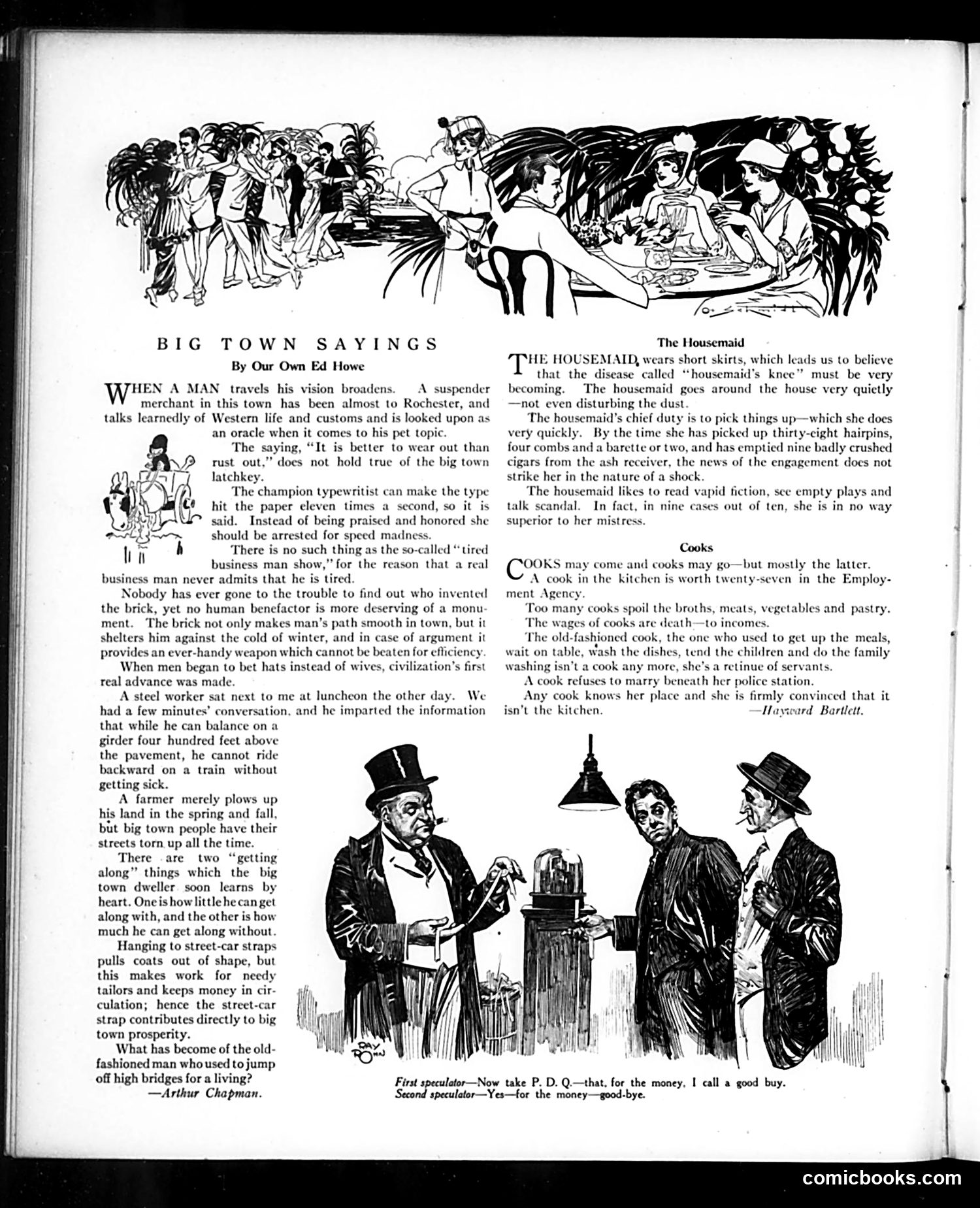
This page from *Judge* magazine presents satirical observations about early 20th-century urban American life through three sections. **"Big Town Sayings" (by Ed Howe)** offers humorous social commentary on city dwellers' pretensions and contradictions—a traveler who barely left town claims expertise on Western life; a champion typist should be "arrested for speed madness"; street repairs constantly disrupt big-city life. **"The Housemaid"** mocks both the servant class and their employers, sarcastically praising housemaids' short skirts while suggesting they're lazy ("not even disturbing the dust") and intellectually inferior to their mistresses. **"Cooks"** laments the servant shortage and rising labor costs—good cooks are scarce and expensive, while modern cooks expect easier work than their predecessors. **The cartoon** shows two "speculators" discussing a dubious investment (P.D.Q.), with the second man bidding farewell immediately after agreeing to buy—satirizing get-rich-quick schemes and con artists common in the period. The page reflects anxieties about servant labor scarcity, urban change, and financial speculation in this era.
📄 Transcribed text from this page (OCR, searchable)
Machine-transcribed from the original scan — historical spelling and the odd misread are preserved.
BIG TOWN SAYINGS By Our Own Ed Howe WHEN A MAN travels his vision broadens. A suspender merchant in this town has been almost to Rochester, and talks learnedly of Western life and customs and is looked upon as an oracle when it comes to his pet topic The ing, “It is better to wear out than rust out,” does not hold true of the big town latchkey. The champion typewritist can make the type hit the paper eleven times a second, so it is said. Instead of being praised and honored she should be arrested for speed madness. There is no such thing as the so-called “ tired business man show,” for the reason that a real business man never admits that he is tired Nobody has ever gone to the trouble to find out who invented the brick, yet no human benefactor is more deserving of a monu ment. The brick not only makes man’s path smooth in town, but it shelters him against the cold of winter, and in case of argument it provides an ever-handy weapon which cannot be beaten for efficiency When men began to bet hats instead of wives, civilization’s first real advance was made. A steel wor! sat next me at luncheon the other day. We had a few minutes’ conversation, and he imparted the information that while he can balance on a girder four hundred feet above the pavement, he cannot ride backward on a train without getting sick. A farmer merely plows up his land in the spring and fall, but big town people have their streets torn up all the time. There .are two “getting along” things which the big town dweller soon learns by heart. One is how little he can get along with, and the other is how much he can get along without Hanging to street-car straps pulls coats out of shape, but this makes work for needy tailors and keeps money in cir- culation; hence the street-car strap contributes directly to big town prosperity. What has become of the old- fashioned man who used to jump The Housemaid HE HOUSEMAID, wears short skirts, which leads us to believe that the disease called ‘“housemaid’s knee" must be very becomin, The housemaid goes around the house very quietly —not even disturbing the dust The housemaid’s chief duty is to pick things up—which she does very quickly. By the time she has picked up thirty-cight hairpins, four combs and a barette or two, and has emptied nine badly crushed cigars from the ash receiver, the news of the engagement does not strike her in the nature of a shock The housemaid likes to read vapid fiction, see empty plays and talk scandal. In fact, in nine cases out of ten, she is in no way superior to her mistress. Cooks OOKS may come and cooks may go—but mostly the latter. A cook in the kitchen is worth twenty-seven in the Employ- ment Agency. Too many cooks spoil the broths, meats, vegetables and pastry. ‘The wages of cooks are death—to incomes. The old-fashioned cook, the one who used to get up the meals, wait on table, wash the dishes, tend the children and do the family washing isn’t a cook any more, she’s a retinue of servants. A cook refuses to marry beneath her police station. Any cook knows her place and she is firmly convinced that it isn’t the kitchen. Hayward Bartlett, off high bridges for a living? —Arthur Chapman. First speculator—Now take P. D. Q—that, for the money, I call a good buy. Second speculator—Yes—for the money—good-bye. comicbooks.com