
Judge, 1916-01-29 · page 22 of 28
Judge — January 29, 1916 — page 22: what you’re looking at
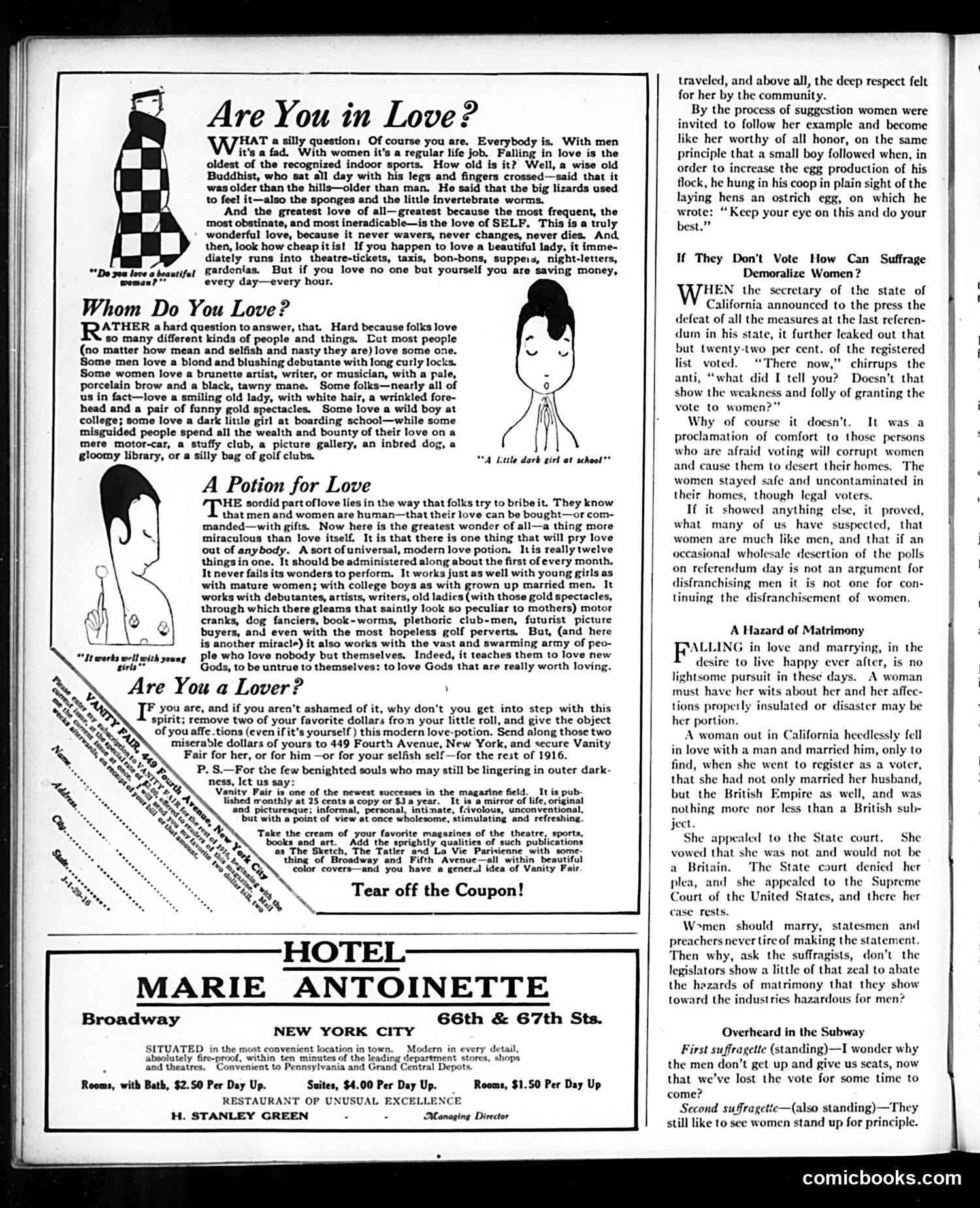
What you’re looking at
This page from Judge magazine satirizes romantic love and courtship customs of the 1910s. The central articles mock how love, theoretically universal and timeless (traced humorously back to "big lizards"), becomes mercenary and ridiculous in practice. The cartoons feature simple line-drawn figures illustrating how people express love through material consumption—theater tickets, candy, automobiles, golf clubs—rather than genuine affection. The satire suggests that self-love is the only constant emotion. The "potion for love" is revealed as the magazine *Vanity Fair* itself, a newly launched luxury publication. The joke positions the magazine as the ultimate remedy for modern romantic needs, working equally on debutantes, artists, and even selfish people. The article essentially advertises Vanity Fair by mocking contemporary courtship while implying that subscribing to the magazine is the solution to romantic fulfillment—witty self-promotion disguised as social commentary.
📄 Transcribed text from this page (OCR, searchable)
Machine-transcribed from the original scan — historical spelling and the odd misread are preserved.
Are You in Love? VWWIEAT 2 silly question: Of course you are. Everybody is. With men it's a fad, With women it’s a regular life job, Falling in love is the oldest of the recognized indoor sports. How old is it? Well, a wise old Buddhist, who sat all day with his legs and fingers crossed—said that it was older than the hills—older than man. He said that the big lizards used to feel it—also the sponges and the little invertebrate worms. And the greatest love of all—greatest because the most frequent, the most obstinate, and most ineradicable—is the love of SELF, This is a truly wonderful love, because it never wavers, never changes, never dies. And then, look how cheapitis! If you happen to love a beautiful lady, it imme- diately runs into theatre-tickets, taxis, bon-bons, suppeis, night-letters, “De you love @ beastifal ‘woman? every day—every hour. Whom Do You Love? Some women love a brunette artist, writer, or musician, with a p. porcelain brow and a black, tawny mane. |Some folks—nearly all of us in fact—love a smiling old lady, with white hair, a wrinkled fore- head and a pair of fanny gold spectacles. Some love a wild boy at college; some love a dark little girl at boarding school—while some misguided people spend all the wealth and bounty of their love on a mere motor-car, a stuffy club, a picture gallery, an inbred dog, a gloomy library, or a silly bag of golf clubs. A Potion for Love AT HE sordid part oftove lies in the way that folks try to bribe it. They know that men and women are human—that their love can be bought—or com- manded—with gifts. Now here is the greatest wonder of all—a thing more miraculous than love itself. It is that there is one thing that will pry love out of anybody. A sort of universal, modern love potion. Itis really twelve things in one. It should be administered along about the first of every month. It never fails its wonders to perform. It works just as well with young girls as with mature women; with college boys as with grown up married men. It works with debutantes, artists, writers, old ladics (with those gold spectacles, through which there gleams that saintly look so peculiar to mothers) motor cranks, dog fanciers, book-worms, plethoric club-men, futurist picture \ be f buyers, and even with the most hopeless golf perverts. But, (and here ae is another miracle) it also works with the vast and swarming army of peo- “Tt works well with young ple who love nobody but themselves. Indeed, it teaches them to love new sirls”* Gods, to be untrue to themselves: to love Gods that are really worth loving. Are You a Lover? ' JF x0 are, and if you aren't ashamed of it, why don’t you get into step with this spirit; remove two of your favorite dollars fron your little roll, and give the object of you affe.tions (even if it’s yourself ) this modern love-potion. Send along those two miserable dollars of yours to 449 Fourth Avenue, New York, and secure Vanity Fair for her, or for him —or for your selfish self—for the rest of 1916. P. S.—For the few benighted souls who may still be lingering in outer dark- ness, Iet us say: Vanity Fair is one of the newest successes in the magarine field. lished rronthly at 25 cents a copy or $3.0 year. ‘and picturesque; informal, personal, intimate, f- but with a point of view at once wholesome, stimulating and refreshi Take the cream of your favorite magazines of the theatre, spor books and art. Add the sprightly qualities of such publicati ‘The Sketch, The Tatler and La Vie Parisienne with soms thing of Broadway and Fifth Avenue—all within beautiful color covers—and you have a general idea of Vanity Fair Tear off the Coupon! "A Little dark girl at school** gardenias. But if you love no one but yourself you are saving money, MARIE ANTOINETTE Broadway 66th & 67th Sts. NEW YORK CITY SITUATED in the most convenient location in town. Modern in every detail, absolutely fire-proof, within ten minutes of the leading department stores, shops and theatres. Convenient to Pennsylvania and Grand Central Depots. Rooms, with Bath, $2.50 Per Day Up. Suites, $4.00 Per Day Up. RESTAURANT OP UNUSUAL EXCELLE? H. STANLEY GREEN - - ‘ACanaging Director Rooms, $1.50 Per Day Up traveled, and above all, the deep respect felt for her by the community. By the process of suggestion women were invited to follow her example and become like her worthy of all honor, on the same principle that a small boy followed when, in order to increase the egg production of his flock, he hung in his coop in plain sight of the laying hens an ostrich egg, on which he wrote: “Keep your eye on this and do your best. If They Don’t Vote How Can Suffrage Demoralize Women? HEN the secretary of the state of California announced to the press the defeat of all the measures at the last referen- dum in his state, it further leaked out that but twenty-two per cent. of the registered list. voted. “There now,” chirrups the anti, “what did I tell you? Doesn’t that show the weakness and folly of granting the vote to women?” Why of course it doesn’t. It was a proclamation of comfort to those persons who are afraid voting will corrupt: women and cause them to desert their homes. The ed safe and uncontaminated in their homes, though legal voters. If it showed anything else, it proved, what many of us have suspected, that women are much like men, and that if an occasional wholesale desertion of the polls on referendum day is not an argument for disfranchising men it is not one for con- tinuing the disfranchisement of women. A Hazard of Matrimony ‘ALLING in love and marrying, in the desire to live happy ever after, is no lightsome pursuit in these days. A woman must have her wits about her and her affec- tions properly insulated or disaster may be her portion. A woman out in California heedlessly fell in love with a man and married him, only to find, when she went to register as a voter, that she had not only married her husband, but the British Empire as well, and was nothing more nor less than a British sub- he appealed to the State court. She vowed that she was not and would not be Britain. The State court denied her plea, and she appealed to the Supreme Court of the United States, and there her case rests. Women should marry, statesmen and preachers never tire of making the statement. Then why, ask the suffragists, don’t the legislators show a little of that zeal to abate the hazards of matrimony that they show toward the industries hazardous for men? Overheard in the Subway First suffragette (standing)—I wonder why the men don’t get up and give us seats, now that we've lost the vote for some time to come? Second suffragette—(also standing)—They still like to see women stand up for principle. comicbooks.com