
Judge, 1916-01-29 · page 12 of 28
Judge — January 29, 1916 — page 12: what you’re looking at
What you’re looking at
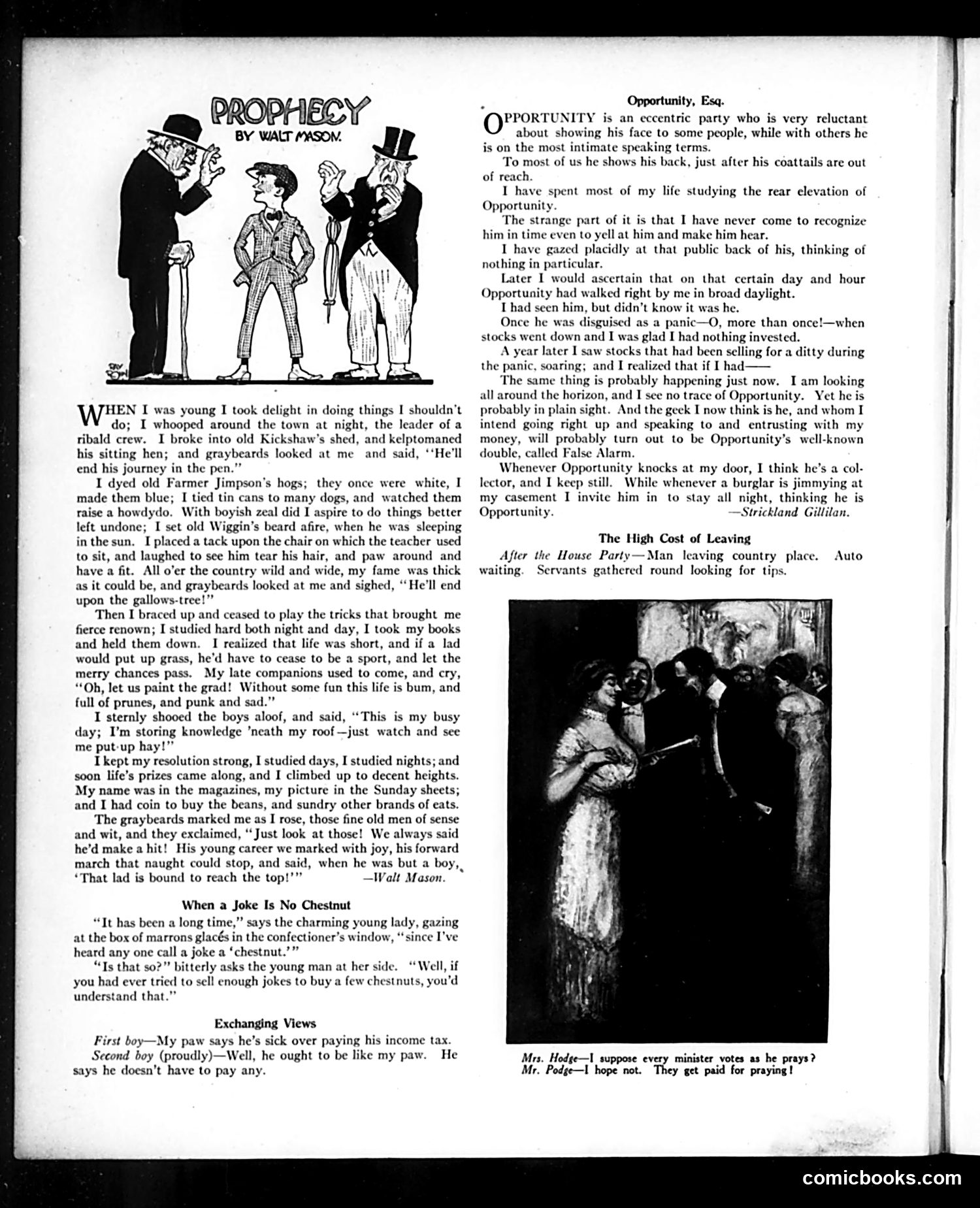
This page contains three distinct pieces of satirical content: **"Prophecy" by Walt Mason** (main poem with cartoon): A cautionary tale about a mischievous youth who reforms through self-discipline and study, eventually achieving success. The irony is that the "graybeards" (older townspeople) who predicted he'd hang now credit themselves with recognizing his potential all along—they take credit for his success despite having written him off as a criminal. It satirizes how people rewrite history to appear prescient. **"When a Joke Is No Chestnut"**: A brief joke mocking struggling humorists—a young man bitterly suggests that only someone desperately poor (trying to sell jokes to buy chestnuts, a cheap food) would still use the outdated term "chestnut" for a stale joke. **"Exchanging Views"**: Tax humor contrasting fathers—one complains about income tax obligations; the other proudly admits he doesn't pay any, implying tax evasion. The "Opportunity" essay discusses how success appears to pass people by because they fail to recognize it when present.
📄 Transcribed text from this page (OCR, searchable)
Machine-transcribed from the original scan — historical spelling and the odd misread are preserved.
WEEN I was young I took delight in doing things I shouldn't do; I whooped around the town at night, the leader of a ribald crew. I broke into old Kickshaw’s shed, and kelptomaned his sitting hen; and graybeards looked at me and said, ‘‘He'll end his journey in the pen.” I dyed old Farmer Jimpson’s hogs; they once were white, I made them blue; I tied tin cans to many dogs, and watched them raise a howdydo. With boyish zeal did I ire to do things better left undone; I set old Wiggin’s beard afire, when he was sleeping in the sun. I placed a tack upon the chair on which the teacher used to sit, and laughed to see him tear his hair, and paw around and have a fit. All o’er the country wild and wide, my fame was thick as it could be, and graybeards looked at me and sighed, “He'll end upon the gallows-tree!” Then I braced up and ceased to play the tricks that brought me fierce renown; I studied hard both night and day, I took my books and held them down. I realized that life was short, and if a lad would put up grass, he’d have to cease to be a sport, and let the merry chances pass. My late companions used to come, and cry, “Oh, let us paint the grad! Without some fun this life is bum, and full of prunes, and punk and sad.” I sternly shooed the boys aloof, and said, day; I’m storing knowledge ’neath my roof —just me put-up hay!”” I kept my resolution strong, I studied days, I studied nights; and soon life’s prizes came along, and I climbed up to decent heights. My name was in the magazines, my picture in the Sunday sheets; and I had coin to buy the beans, and sundry other brands of eats. The graybeards marked me as I rose, those fine old men of sense and wit, and they exclaimed, ‘Just look at those! We always said he’d make a hit! His young career we marked with joy, his forward march that naught could stop, and said, when he was but a boy, . ‘That lad is bound to reach the top!’”” —Walt Mason. my busy ch and see When a Joke Is No Chestnut “It has been a long time,” says the charming young lady, gazing at the box of marrons glacés in the confectioner’s window, “since I've heard any one call a joke a ‘chestnut.’” “Ts that so?” bitterly asks the young man at her side.“ Well, if you had ever tried to sell enough jokes to buy a few chestnuts, you'd understand that.” Exchanging Views First boy—My paw says he’s sick over paying his income tax. Second boy (proudly)—Well, he ought to be like my paw. He says he doesn’t have to pay any. Opportunity, Esq. QPPORTONTTY is an eccentric party who is very reluctant about showing his face to some people, while with others he is on the most intimate speaking terms. To most of us he shows his back, just after his coattails are out of reach. I have spent most of my life studying the rear elevation of Opportunity. The strange part of it is that I have never come to recognize him in time even to yell at him and make him hear. I ed placidly at that public back of his, thinking of nothing in particular. Later I would as Opportunity had walked right by me I had seen him, but didn’t know Once he was disguised as a panic—O, more than once!—when stocks went down and I was glad I had nothing invested. A year later I saw stocks that had been selling for a ditty during the panic, soarin; nd I realized that if I had— The same thing is probably happening just now. Iam looking all around the horizon, and I see no trace of Opportunity. Yet he is probably in plain sight. And the I now think is he, and whom I intend going right up and speaking to and entrusting with my money, will probably turn out to be Opportunity’s well-known double, called False Alarm. Whenever Opportunity knocks at my door, I think h lector, and I keep While whenever a burglar is my casement I invite him in to stay all night, thinking he is Opportunity. Strickland Gillilan. ertain that on that certain day and hour n broad daylight. The High Cost of Leaving After the House Party—Man leaving country place. waiting. Servants gathered round looking for tips. Auto Mrs. Hodge—I suppose every minister votes as he prays? Mr. Podge—I hope not. They get paid for praying! comicbooks.com