
Judge, 1916-01-29 · page 25 of 28
Judge — January 29, 1916 — page 25: what you’re looking at
What you’re looking at
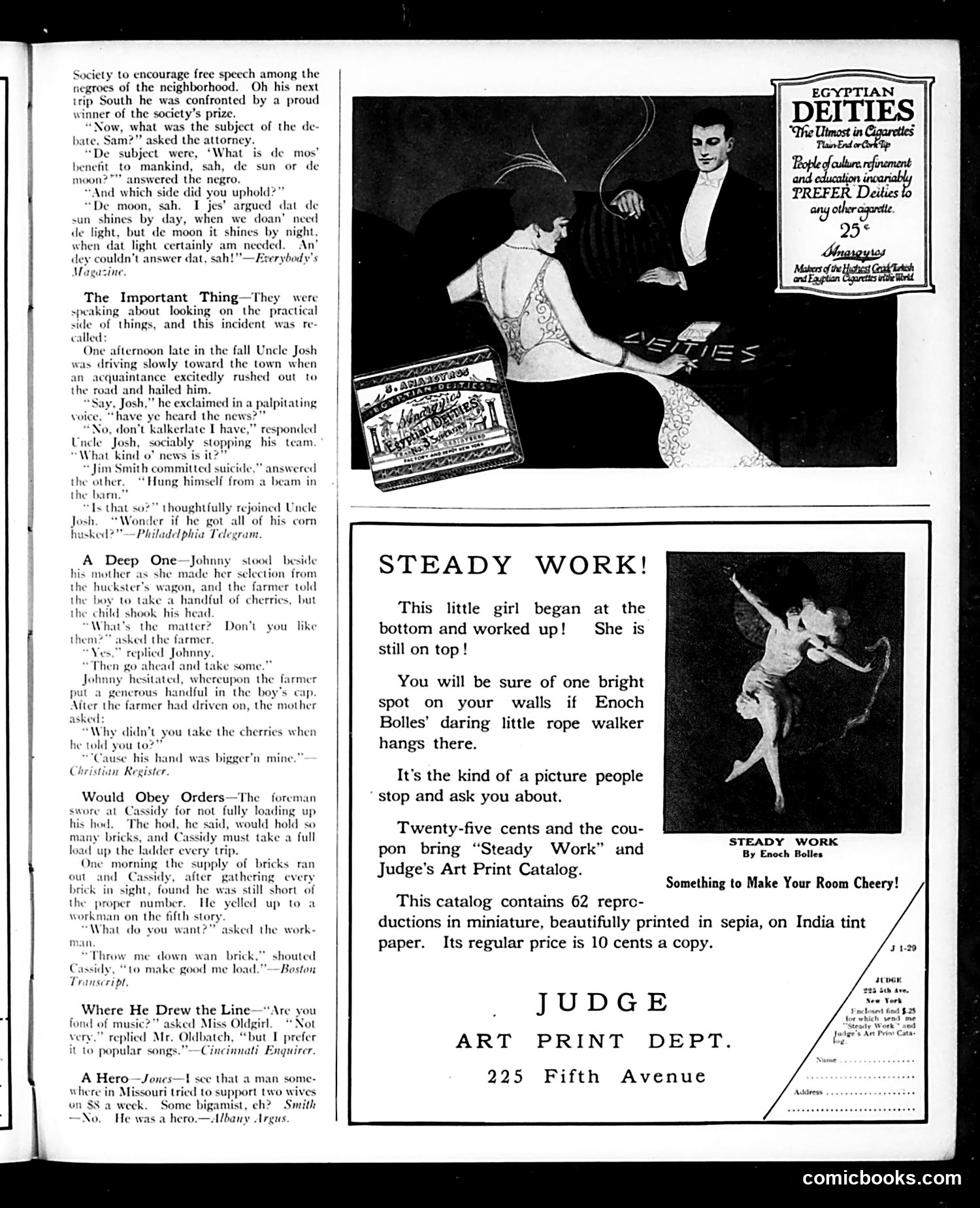
This page contains short satirical anecdotes typical of Judge's humor, plus an advertisement for art prints. The main jokes employ period stereotypes and racial humor (common in early 20th-century satire): 1. **"Free Speech" anecdote**: Mocks both a Northern "society" promoting Black oratory and the Black speaker himself—the humor relies on dialect and the supposed illogic of arguing the moon is more useful than the sun. 2. **Uncle Josh stories**: Rural/folksy humor where practical-minded country people miss social niceties. One features a man's suicide; the other a child's shrewd refusal of cherries (his hand was smaller than the farmer's). 3. **Working-class anecdotes**: Brief jokes about laborers and social pretension. The **"Steady Work" advertisement** promotes an art print by Enoch Bolles depicting a female acrobat/rope walker—positioned as decorative wall art for 25 cents. This reflects period attitudes toward both entertainment and gender display. The page is primarily **comedic content and advertising** rather than political commentary.
📄 Transcribed text from this page (OCR, searchable)
Machine-transcribed from the original scan — historical spelling and the odd misread are preserved.
iety to encourage free specch among the — {| negroes of the neighborhood. Oh his next trip South he was confronted by a proud winner of the society’s prize. “Now, what was the subject of the de- Sam?” asked the attorney. subject were, ‘What’ is de mos’ benefit to mankind, sah, de sun or de moon? nswered the negro. “And which side did you uphold?” “De moon, sah. I jes’ argued dat de sun shines by day, when we doan’ need de light, but de moon it shines by night when dat light certainly am_need An’ ley couldn’t answer dat, sah!” ybod y's The Important Thing—They were | speaking about looking on the practical side of things, and this incident was re: called: One afternoon late in the fall Uncle Josh was driving slowly toward the town when an acquaintance excitedly rushed out to the road and hailed him. josh,” he exclaimed in a palpitating voice, “have ye heard the news? “No, don’t kalkerlate I have,” responded Uncle Josh, sociably stopping his team What kind 0” news is it?” m Smith committed suicide,” answered ther. “Hung himself from a beam in barn.” > that so?” thoughtfully rejoined Uncle Jer if he got all of his corn Philadelphia Telegram A Deep One—Johnny stood beside his mother as she made her selection from the huckster’s wagon, and the farmer told the boy to take a handful of cherries, but the child shook his head. | What's the matter? Don't: you like them sked the farmer. Yes.” replied Johnny. “Then go ahead and take some.” Johnny hesitated, whereupon the farmer put a generous handful in the boy's cap After the farmer had driven on, the mother Why didn’t you take the cherries when he told you to?” ‘Cause his hand was bigger’n mine nn Register Would Obey Orders—The foreman swore at Cassidy for not fully loading up his hod. The hod, he said, would hold so | many bricks, and Cassidy must take a full | load up the ladder every trip. One morning the supply of bricks ran out and Cassidy, after. gathering every brick in sight, found he was still short of the proper number. He yelled up to a workman on the fifth story. What do you want?” asked the work- man. “Throw me down wan_ brick,” shouted Cassidy, “to make good me load.”—Boston Transcript. Chr Where He Drew the Line—‘Are you fond of music?” asked Miss Oldgirl. “* Not very,” replied Mr. Oldbatch, “but I prefer it to popular songs." —Cincinnati Enquirer. A Hero—Jones—I sce that a man some- where in Missouri tried to support two wives a week. Some bigamist, eh? Smith He was a hero.—Albany Argus: —No, STEADY WORK! This little girl began at the bottom and worked up! She is still on top! You will be sure of one bright spot on your walls if Enoch Bolles’ daring little rope walker hangs there. It’s the kind of a picture people stop and ask you about. Twenty-five cents and the cou- pon bring “Steady Work” and Judge's Art Print Catalog. This catalog contains 62 repre- ductions in miniature, beautifully printed in sepia, on India tint paper. Its regular price is 10 cents a copy. JUDGE ART PRINT DEPT. 225 Fifth Avenue Something to Make Your Room Cheery! STEADY WORK By Enoch Bolles comicbooks.com