
Judge, 1916-01-29 · page 20 of 28
Judge — January 29, 1916 — page 20: what you’re looking at
What you’re looking at
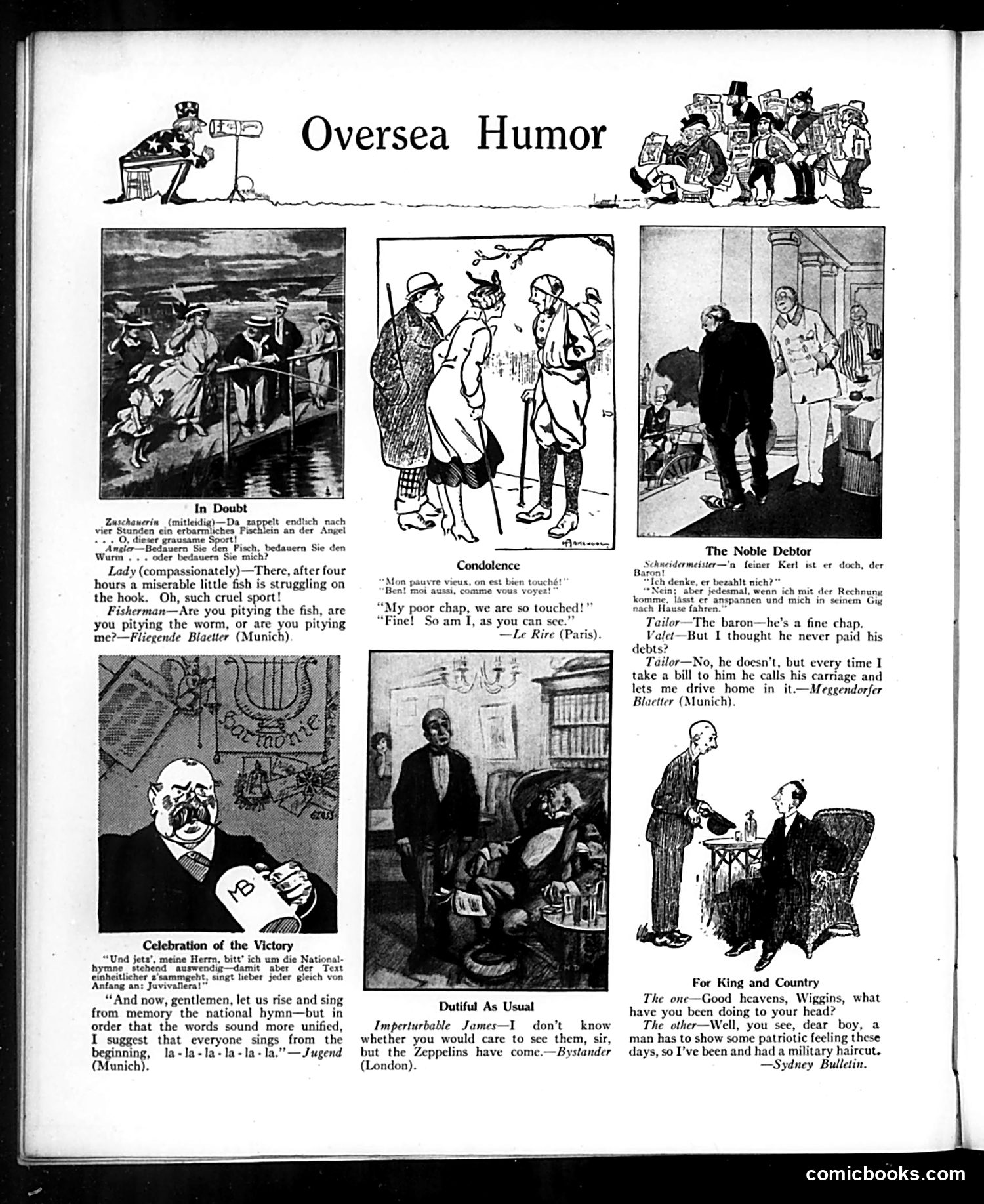
This page collects satirical cartoons from European magazines, mocking social pretenses and wartime behaviors. **Key cartoons:** 1. **"In Doubt"** (top left): A German cartoon mocking sentimental animal lovers—the lady pities the fish on the hook, but the fisherman sardonically asks if she's really pitying *him* (implying his suffering matters more). 2. **"The Noble Debtor"** (top right): A tailor discusses a baron who never pays bills, yet always invites the tailor to ride home in his carriage—mocking aristocratic deadbeats who offer hollow gestures instead of payment. 3. **"Celebration of the Victory"** (bottom left): German officials suggest singing the national anthem in unison "from the beginning" so words sound unified—satirizing forced patriotic conformity. 4. **"Dutiful As Usual"** (bottom center): References Zeppelin airships, suggesting British indifference to German air raids. 5. **"For King and Country"** (bottom right): A man sports a military haircut as patriotic display, mocking superficial wartime gestures. The page satirizes pretense, incompetence, and hollow patriotism across European society during what appears to be WWI-era.
📄 Transcribed text from this page (OCR, searchable)
Machine-transcribed from the original scan — historical spelling and the odd misread are preserved.
Zaschancrin (mitleidig)—Da_sappelt endich nach vier Stunden ein erbarmliches Fischlein an der Angel yf - + O, dieser grausame Sport! ‘Angler—Bedauern Sic den Pisch, bedauern Sie den Wurm . . . oder bedauern Sie mich? Lady (compassionately)—There, after four hours a miserable little fish is struggling on the hook. Oh, such cruel sport! Fisherman—Are you pitying the fish, you pitying the worm, or are you pitying me?—Fliegende Blaetter (Munich) The Noble Debtor Condolence Mon pauvre vieux, on est bien touché! Ben! moi aussi, comme vous voyer! Schneidermeister—'n einer Kerl ist er doch, der | Baron! h denke, er bezahit nich?” : aber jedesmal, wenn ich mit der Rechnung sst er anspannen und mich in seinem Gig, fahren.” are “My poor chap, we are so touched!” “Fine! So am I, as you can see.” Tailor—The baron—he's a fine chap. —Le Rire (Paris). Valet—But I thought he never paid his debts? Tailor—No, he doesn't, but every time I take a bill to him he calls his carriage and lets me drive home in. it.—Meggendorfer Blactter (Munich). sos Celebration of the Victory “Und jets’, meine Herm, bitt’ ich um die National hymne stehend auswendig—damit aber der Text einheitlicher 2’sammgeht, singt lieber jeder gleich von For King and Country Anfang an: Juvivafiera! “And now, gentlemen, let us rise and sing The one—Good heavens, Wiggins, what from memory the national hymn—but in Dutiful As Usual have you been doing to your head? order that the words sound more unified, Imperturbable James—I don’t know The other—Well, you see, dear boy, a I suggest that everyone sings from the whether you would care to see them, sir, man has to show some patriotic feeling these beginning, la-la-la-la-la-la.”—Jugend but the Zeppelins have come.—Bystander days, so I’ve been and had a military haircut. | (Munich). (London). —Sydney Bulletin. comicbooks.com