
A complete issue · 28 pages · 1915
Judge — December 4, 1915
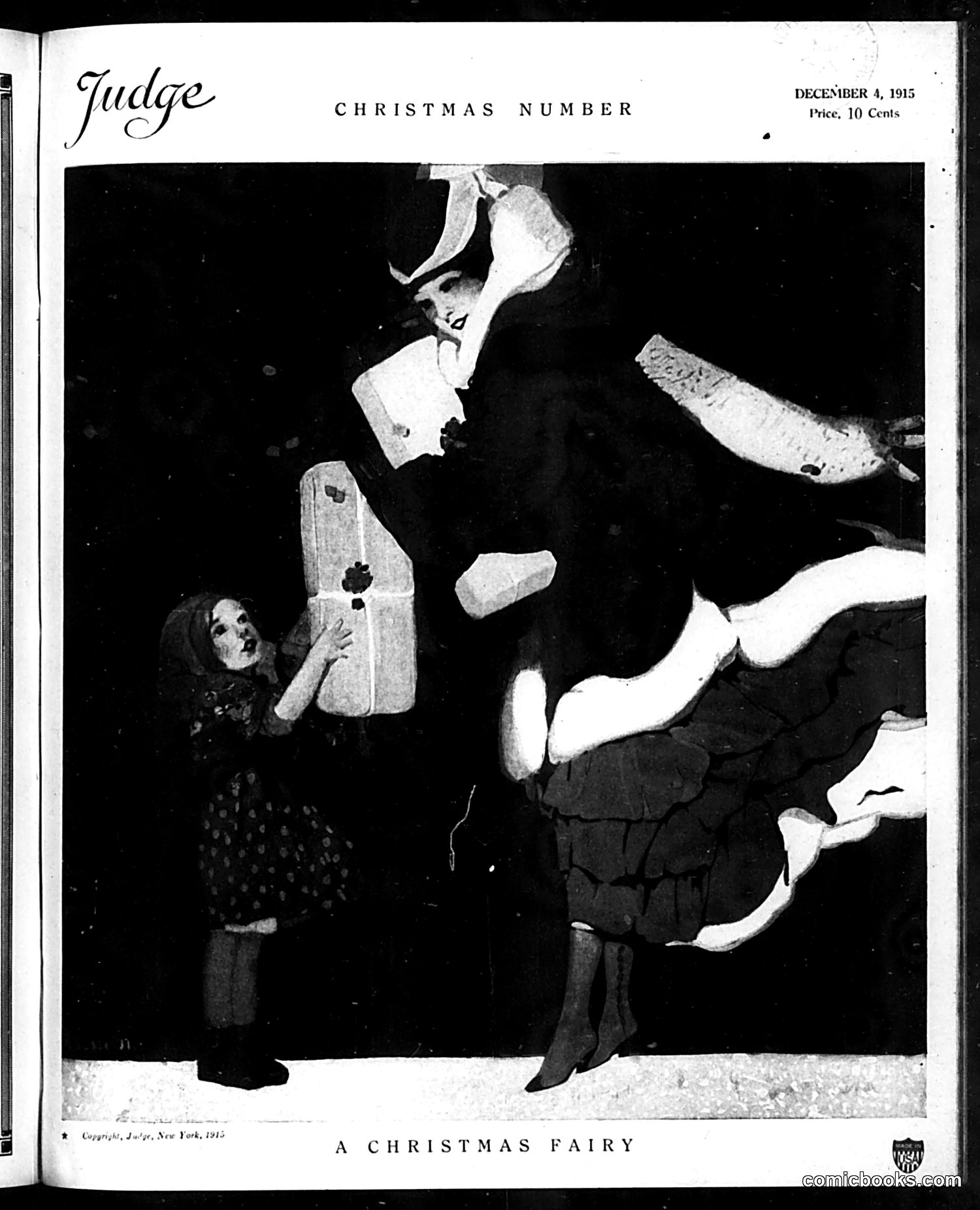
This illustration depicts a whimsical Christmas scene titled "A Christmas Fairy." A figure in black clothing with wings appears to be suspended or flying, juggling or tossing what seem to be wrapped packages or presents. A small child below looks up in wonder at this magical figure. The image represents a fantastical Christmas spirit—likely personifying generosity, wonder, or the magic of the holiday season. The fairy figure distributes gifts to delighted children below, embodying traditional Victorian and early 20th-century Christmas imagery celebrating abundance and childlike joy. As a Christmas-themed cover for Judge's holiday issue (priced at 10 cents), this page emphasizes festive entertainment and wholesome family values typical of American satirical magazines' holiday editions during this era.
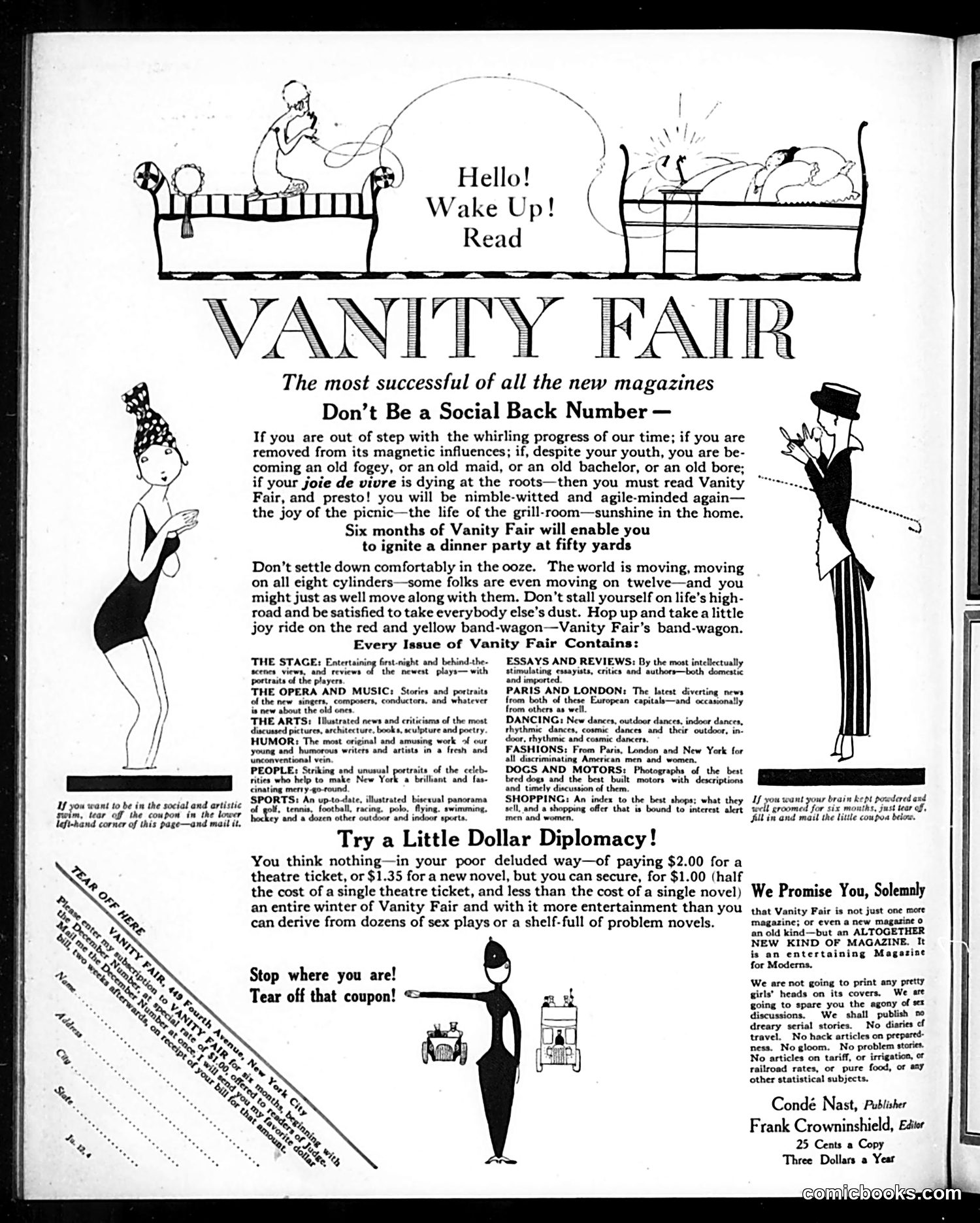
This page is primarily an **advertisement for Vanity Fair magazine**, not political satire. The image shows stylized figures illustrating the magazine's content and appeal. The central message targets readers feeling socially outdated: "Don't Be a Social Back Number." It promises that six months of Vanity Fair will keep readers current with modern trends in theater, music, essays, fashion, and dancing. The accompanying illustrations—a woman in 1920s dress and a tall, thin man in formal wear—represent the magazine's fashionable, urbane audience. The "Little Dollar Diplomacy" section humorously suggests Vanity Fair offers superior entertainment value compared to theater tickets or novels at comparable prices. Publisher Frank Crowninshield emphasizes the magazine's commitment to sophisticated content: no "pretty girls," problem stories, or sentimental material—positioning Vanity Fair as intellectually serious entertainment for the modern reader.
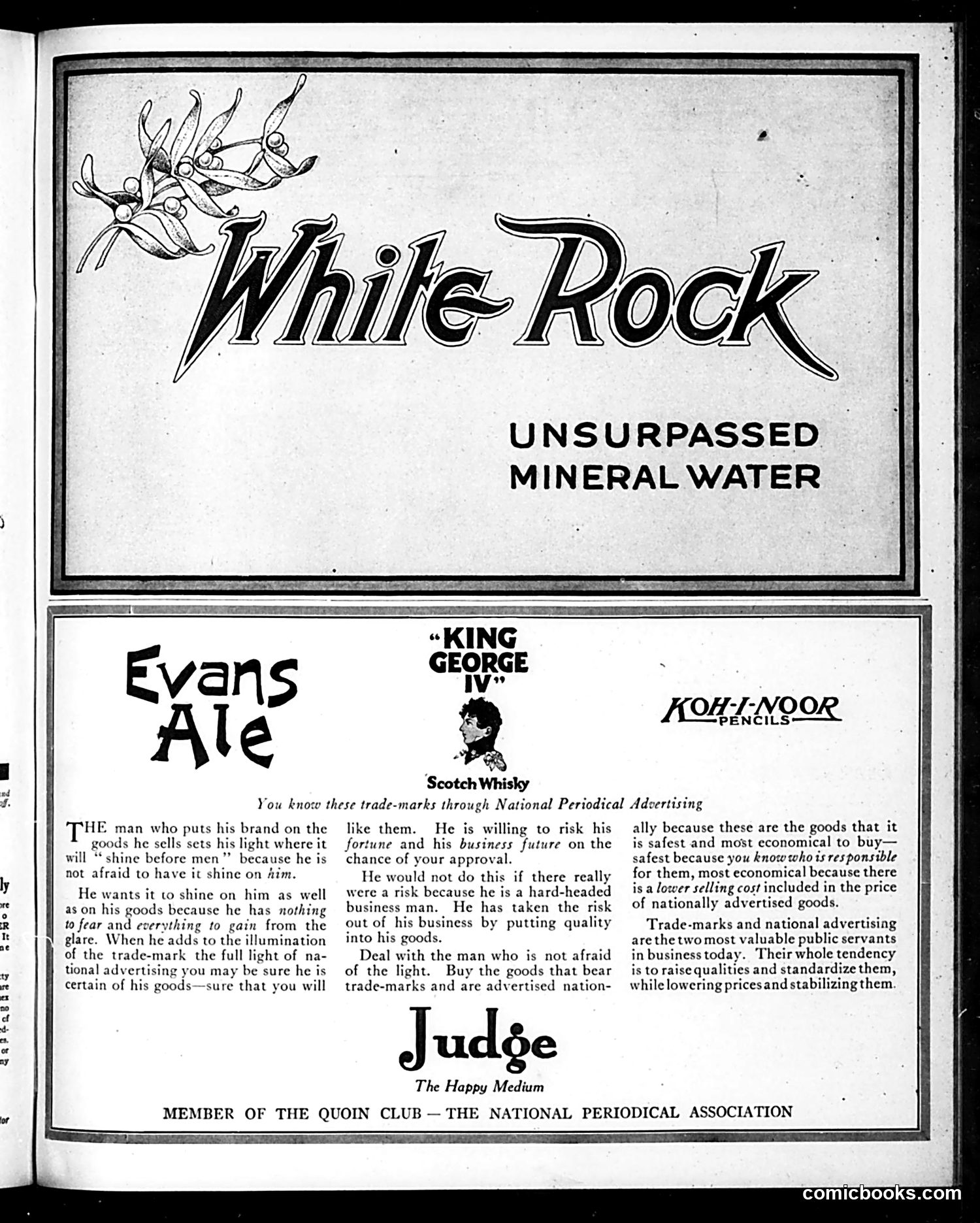
This page is primarily **advertising rather than editorial content**. The top features an ad for "White Rock" mineral water with their distinctive logo. Below are four separate product advertisements: - Evans Ale - King George IV Scotch Whisky - Koh-i-Noor Pencils - Judge magazine itself (described as "The Happy Medium") The central text block discusses **trade-marks and national advertising**, arguing that branded goods represent quality and that consumers benefit from nationally-advertised products because they're "safest and most economical to buy." This appears to be Judge magazine promoting the value of advertising itself—essentially self-promotional content justifying why advertisers should support publications like Judge. There are **no political cartoons or satirical commentary visible** on this particular page. It's a straightforward advertising section from the magazine.
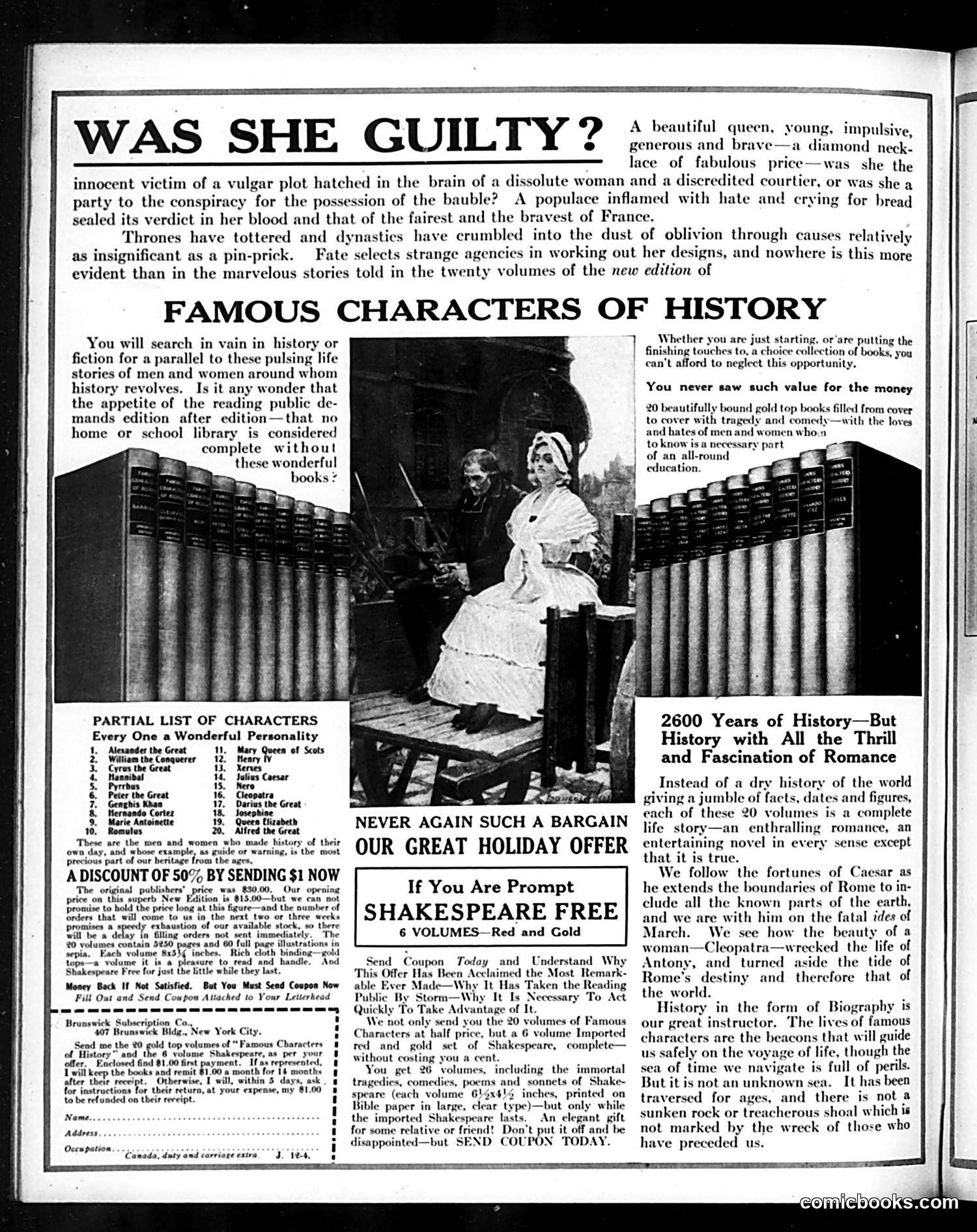
This page is primarily **advertising**, not satire or political commentary. The headline "WAS SHE GUILTY?" appears to reference a historical figure or scandal, likely meant to intrigue readers, but the page's main purpose is selling a 20-volume book set titled "Famous Characters of History." The central image shows a woman in period costume (appears 18th-century dress) surrounded by book spines, illustrating the encyclopedia's scope. The advertisement promises "2600 Years of History" combined with romantic narrative appeal. The "Our Great Holiday Offer" promotes a 50% discount and includes "Shakespeare Free" as an incentive. This is a direct-mail marketing campaign, with tear-out coupons for ordering. The "Partial List of Characters" names historical figures like Alexander the Great and Mary Queen of Scots—subjects covered in the volumes.
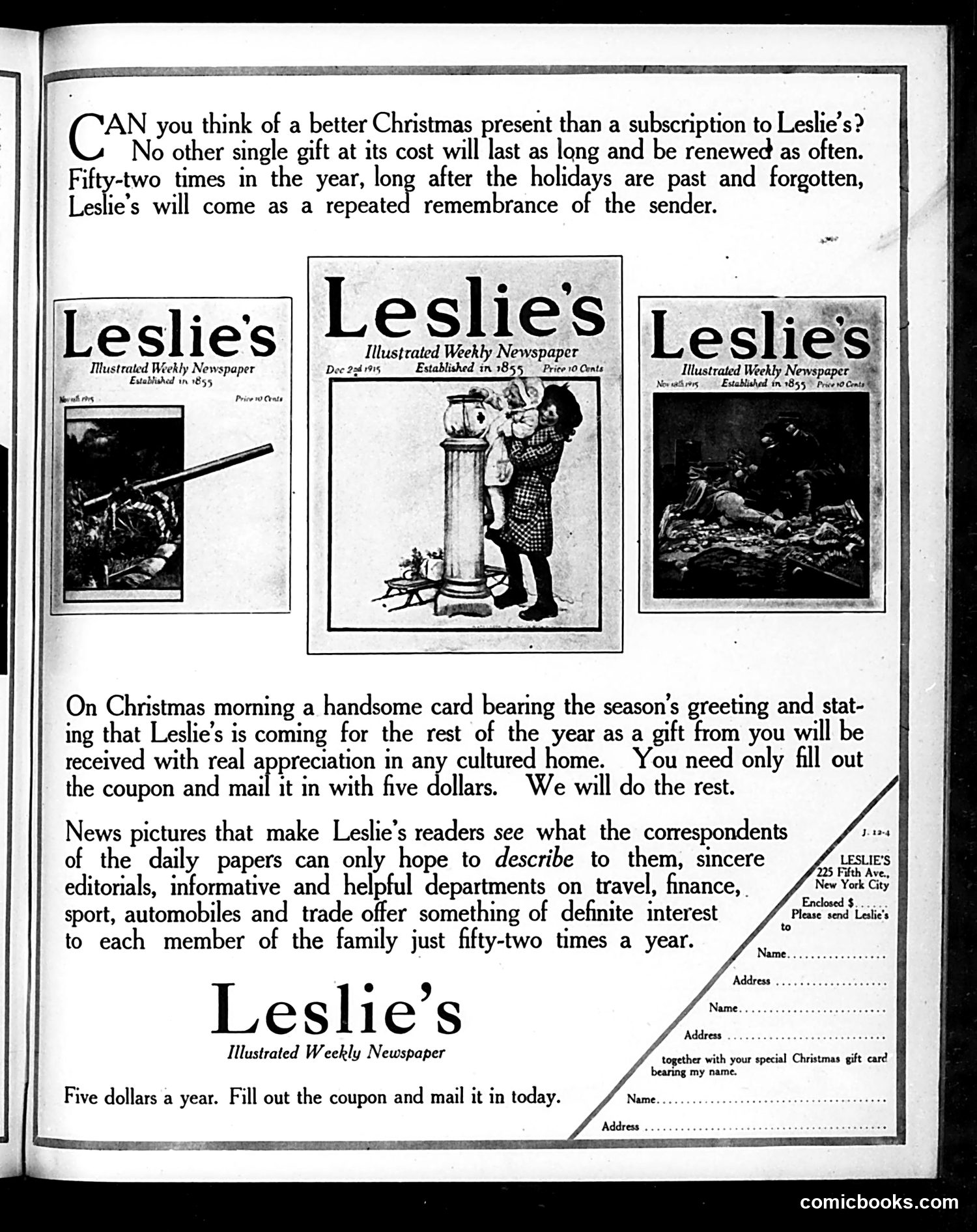
This page is **primarily an advertisement**, not satirical content. It's a Christmas gift subscription pitch for *Leslie's Illustrated Weekly Newspaper*, promoting a year-long subscription (52 issues) for five dollars as an ideal present. The ad emphasizes the magazine's value: it arrives 52 times annually, providing "news pictures," travel and finance coverage, and sports content that appeal to "each member of the family." The central illustration shows a child receiving a gift box at Christmas, while side images display typical magazine covers. The marketing angle suggests that unlike traditional gifts, a subscription provides lasting value and repeated reminders of the giver's thoughtfulness throughout the year. This reflects early-twentieth-century magazine subscription promotion strategies.
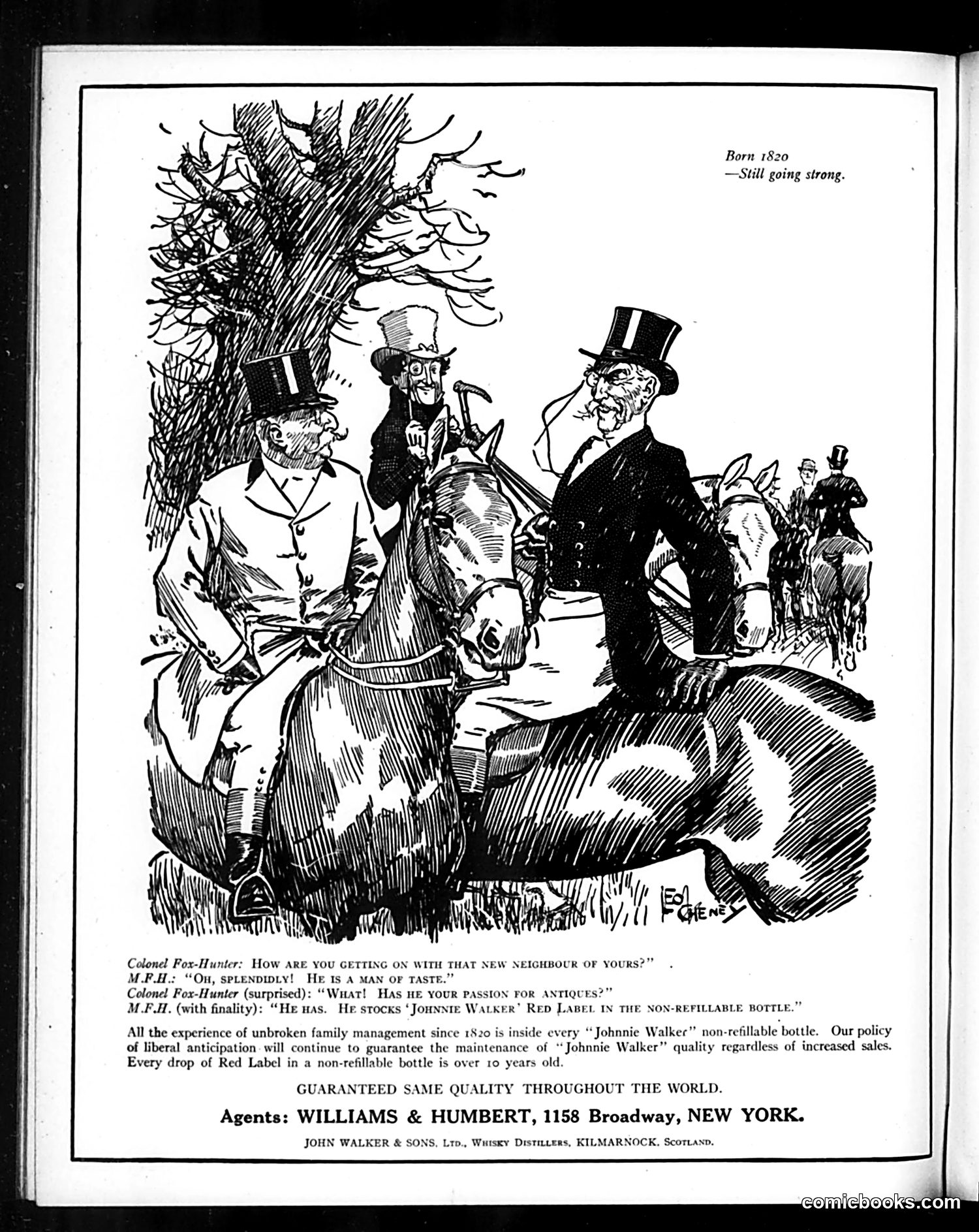
This is primarily a **Johnnie Walker whisky advertisement** disguised as satirical content. The cartoon depicts two gentlemen on horseback—a Colonel Fox-Hunter and an M.F.H. (Master of Fox Hounds)—discussing a new neighbor. The "joke" is that the neighbor's refined taste is demonstrated by stocking Johnnie Walker Red Label in non-refillable bottles, equating whisky preference with social sophistication and "antique" quality. The reference to "born 1820—still going strong" emphasizes the brand's long heritage and consistency. The text emphasizes that Johnnie Walker maintains quality standards since its founding in 1820, with every bottle containing whisky over 10 years old. The non-refillable bottle was apparently a selling point, suggesting authenticity and preventing counterfeiting. This represents early 20th-century brand advertising that merged product promotion with genteel humor targeting affluent readers of Judge magazine.
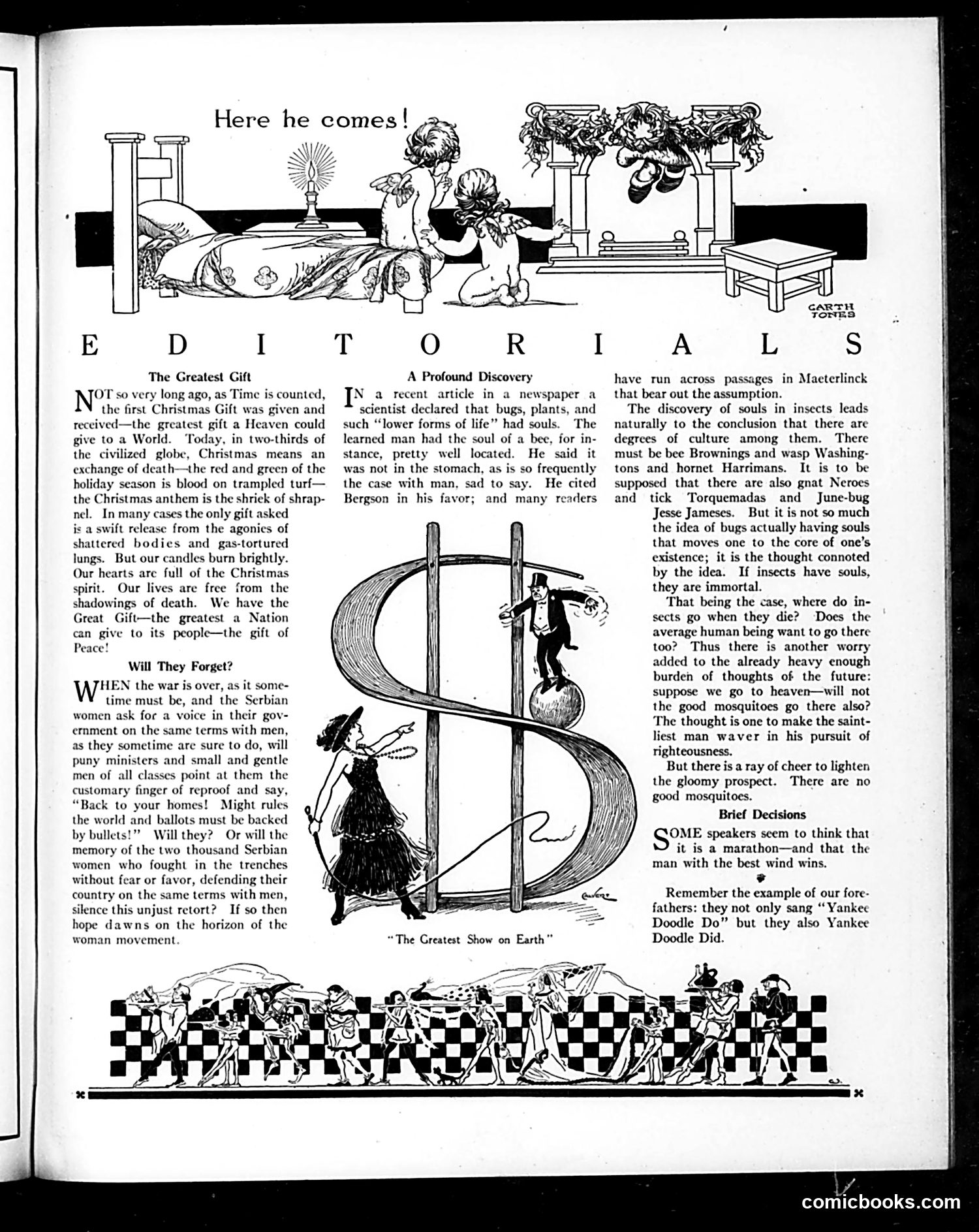
This page contains three separate editorial commentaries typical of Judge's satirical style: **"The Greatest Gift"** laments that Christmas 1918 (implied by WWI references) brings death rather than peace, yet argues Americans should be grateful for the "gift of peace" they enjoy while Serbs suffer in trenches. **"Will They Forget?"** advocates women's suffrage by referencing Serbian women fighting in WWI trenches. The satire challenges whether post-war governments will grant women voting rights or dismiss them with "back to your homes"—suggesting male leaders should remember women's wartime sacrifice. **"A Profound Discovery"** mocks a pseudo-scientific claim that insects possess souls, humorously extrapolating that insects must therefore have an afterlife. The punchline—"There are no good mosquitoes"—offers dark comic relief to the period's anxieties about mortality and eternity. All three pieces reflect post-WWI concerns: war's brutality, women's emerging political demands, and philosophical uncertainty about life's meaning.
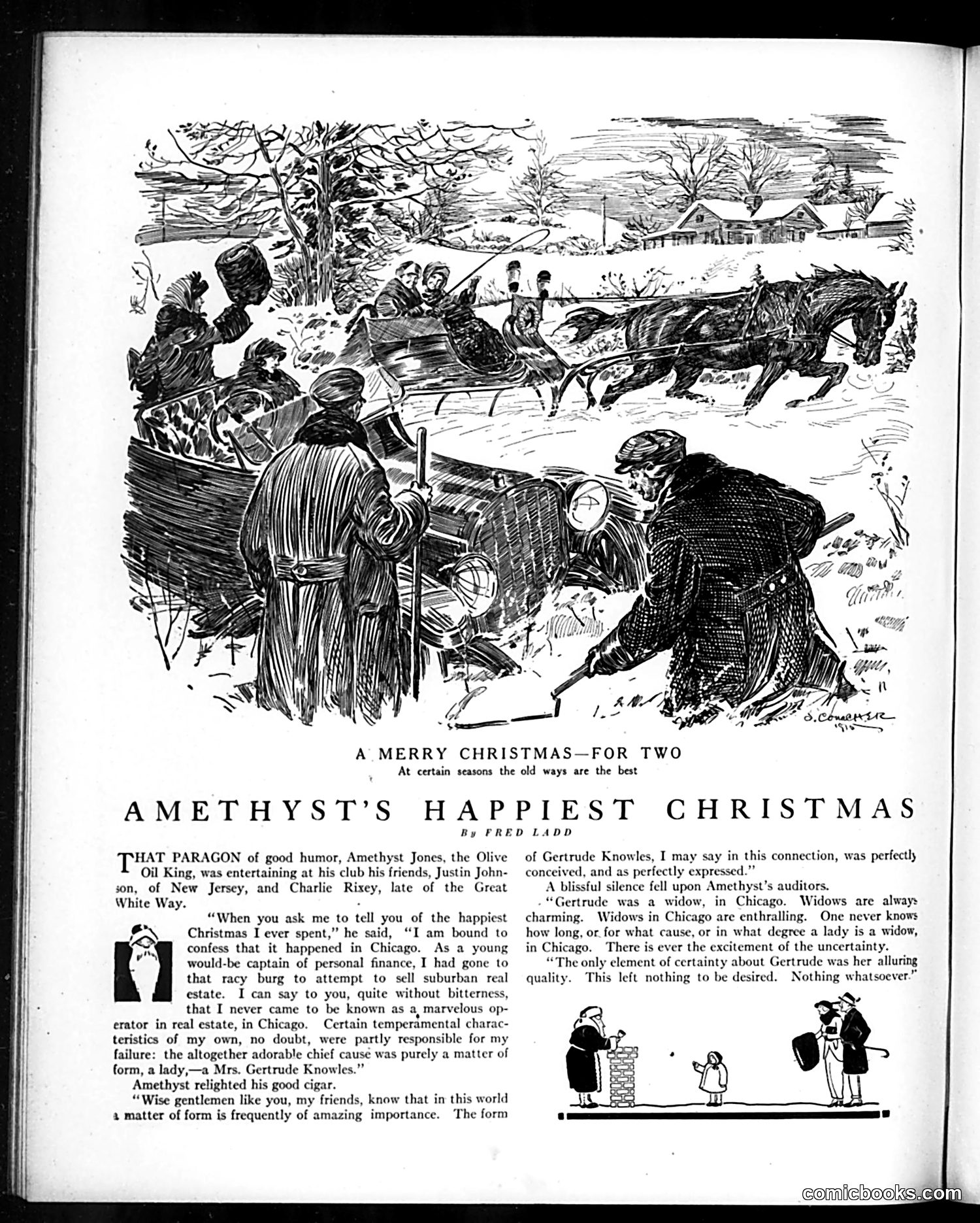
This is a fictional story by Fred Ladd about Amethyst Jones, a wealthy "Olive Oil King," recounting his happiest Christmas to club friends. The narrative frames a romantic reminiscence: as a young would-be businessman in Chicago, Jones pursued a wealthy widow named Gertrude Knowles. The satire targets wealthy clubmen's pretentious storytelling and their romanticization of past conquests. Jones emphasizes "form" and "manner" repeatedly—how appearance matters more than substance in high society. His detailed praise of Gertrude focuses entirely on her "alluring quality" and the "uncertainty" of her widow status, suggesting shallow materialism masked by gentlemanly sentimentality. The top illustration shows a winter sleigh scene, contrasting old-fashioned romance with modern automobiles in the background—supporting the story's nostalgic tone about "the old ways." The satire gently mocks how wealthy men construct self-flattering narratives about their romantic pasts while revealing their actual superficiality and social pretension.
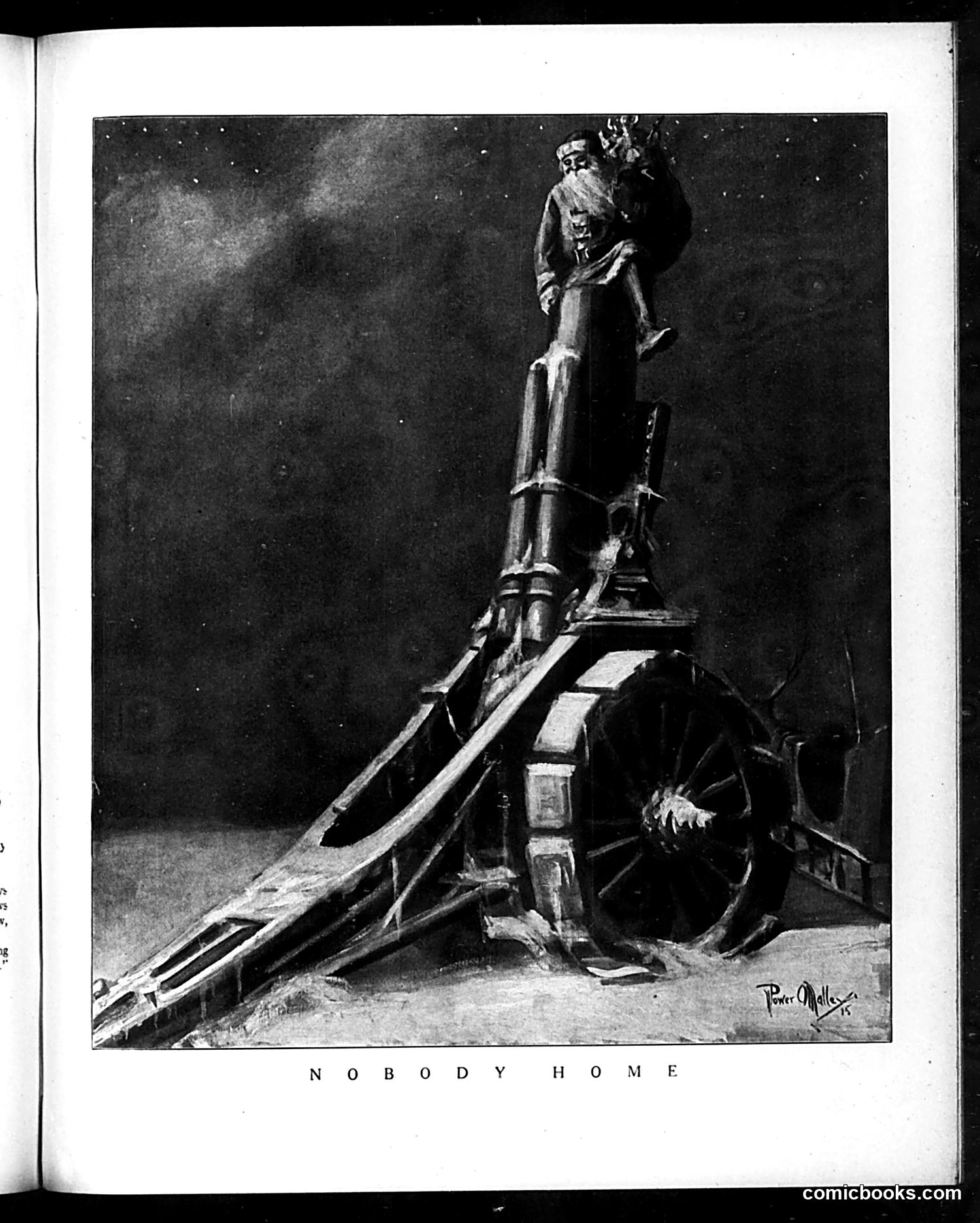
This political cartoon depicts a figure sitting atop a large cannon or artillery piece, with a cannon wheel visible below. The caption reads "NOBODY HOME," suggesting the person's head is empty—a common satirical device implying lack of intelligence or judgment. Without clearer identification of the specific figure or visible dating, the exact political target remains unclear. However, the imagery strongly suggests criticism of a contemporary political or military leader for making reckless decisions. The cannon symbolizes military power or aggressive policy, while "nobody home" implies the wielder lacks the sense to use such power responsibly. The artist's signature appears at bottom right.
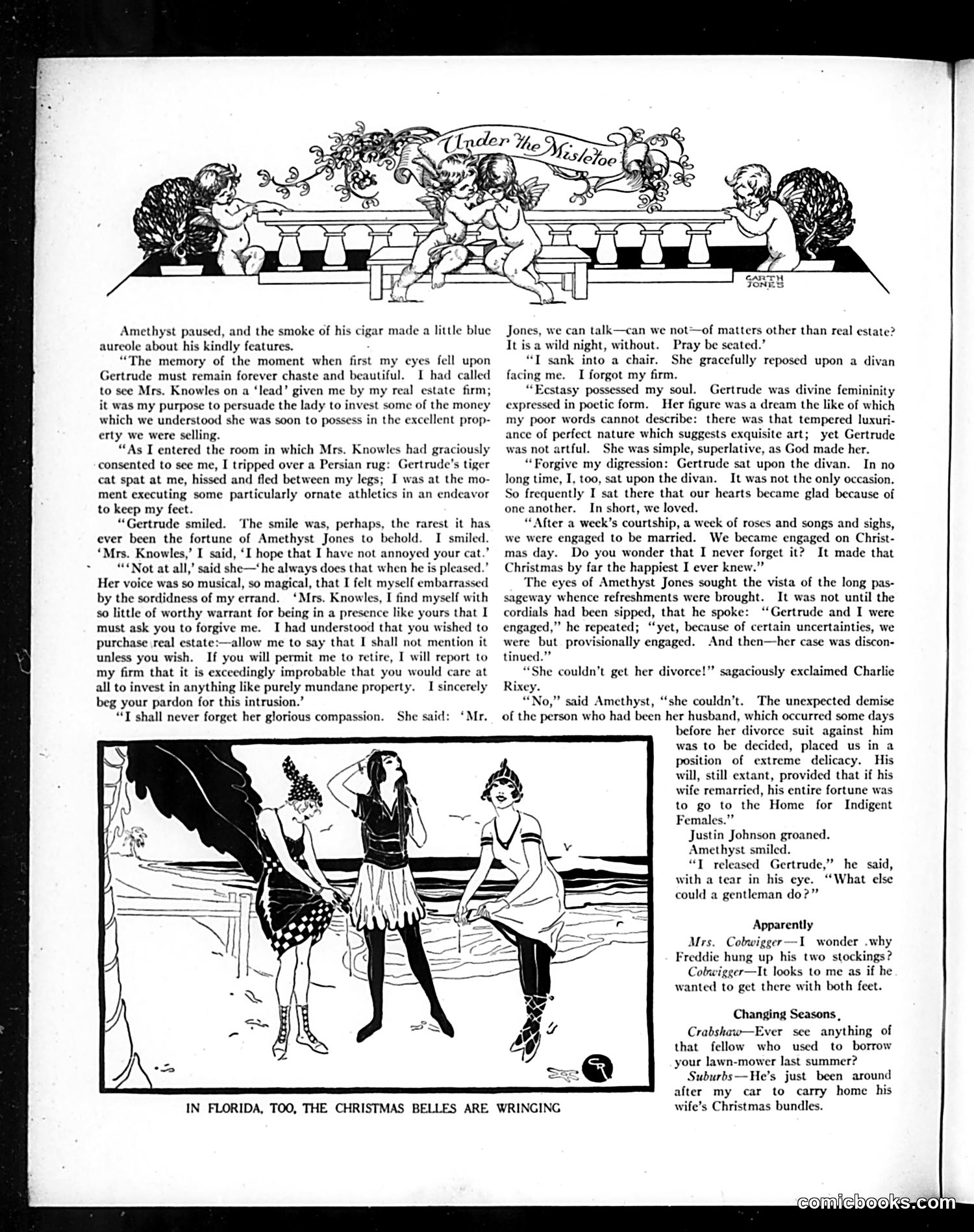
This page presents a romantic story told by the character Amethyst Jones to justify his failure to marry Gertrude. The narrative is sentimental and self-aggrandizing—Jones portrays himself as a noble gentleman who sacrificed his happiness rather than compromise Gertrude's late husband's fortune (which would revert to a "Home for Indigent Females" if she remarried). The satire targets **sentimental Victorian romance fiction** and male self-pity. Jones's elaborate, flowery language about their "chaste" meeting and week-long courtship, combined with his tearful renunciation, parodies the melodramatic romance novels popular in the era. The humor lies in his obvious self-deception: he presents abandoning an engagement as noble sacrifice while remaining emotionally attached. The illustration showing three young women in festive dress relates to the title "Under the Mistletoe"—Christmas romance—and mocks the sentimental courtship rituals Jones describes. The page satirizes how men romanticize their own passivity as gentlemanly virtue.
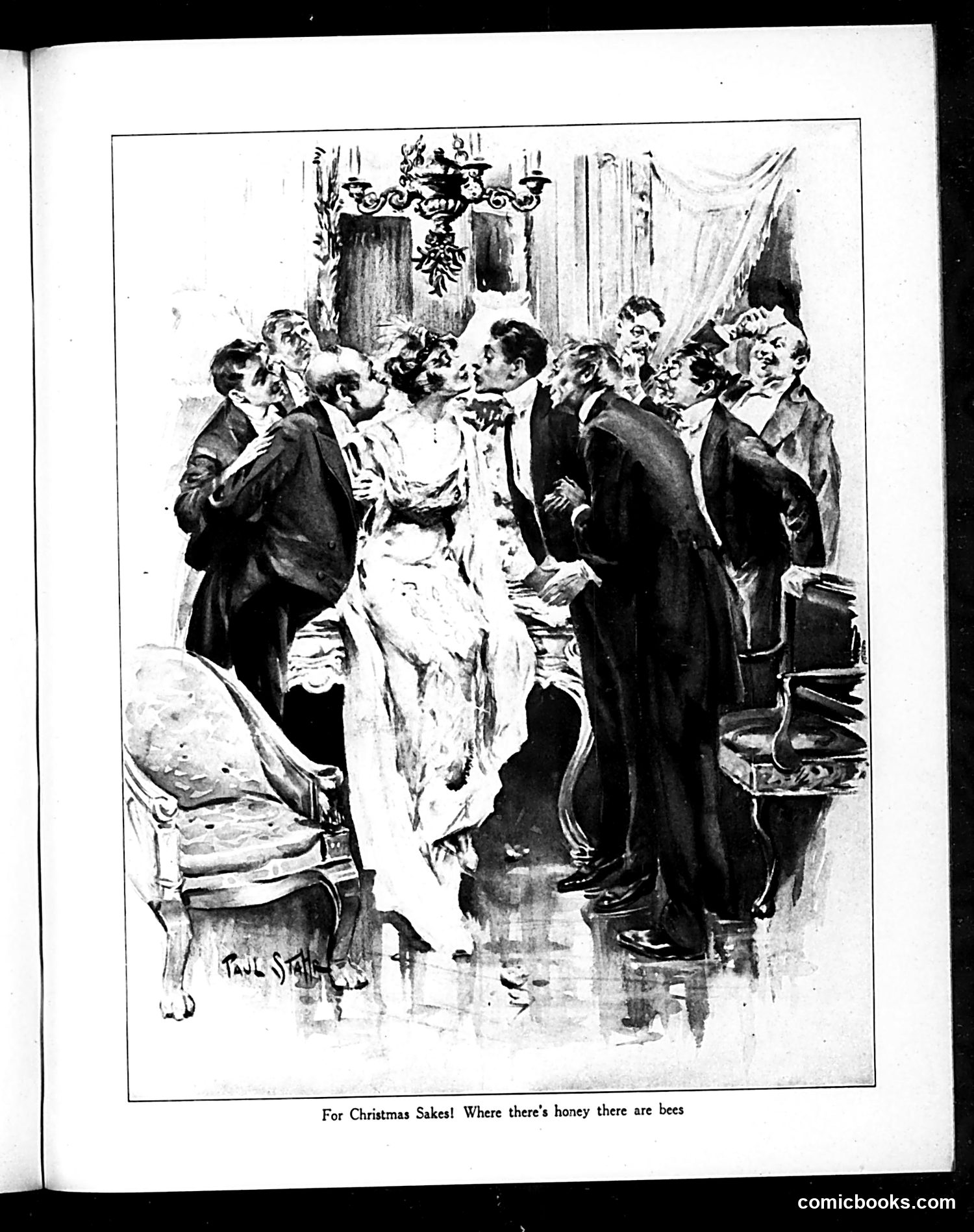
This illustration shows a woman in an elegant white dress surrounded by numerous men in formal attire in what appears to be a parlor or drawing room setting. The caption "For Christmas Sakes! Where there's honey there are bees" employs a common metaphor: the woman is "honey" (attractive, desirable) and the men are "bees" (drawn to her). The satire appears to mock the social dynamics of holiday gatherings or courtship rituals, where an attractive woman becomes the center of male attention. The cramped composition—with men clustered around her from all angles—exaggerates the competitive jostling for her attention and affection. This reflects early 20th-century social commentary on gender dynamics and romantic pursuit, presented with mild humor rather than harsh critique. The "Christmas Sakes" reference suggests this is seasonal social satire.
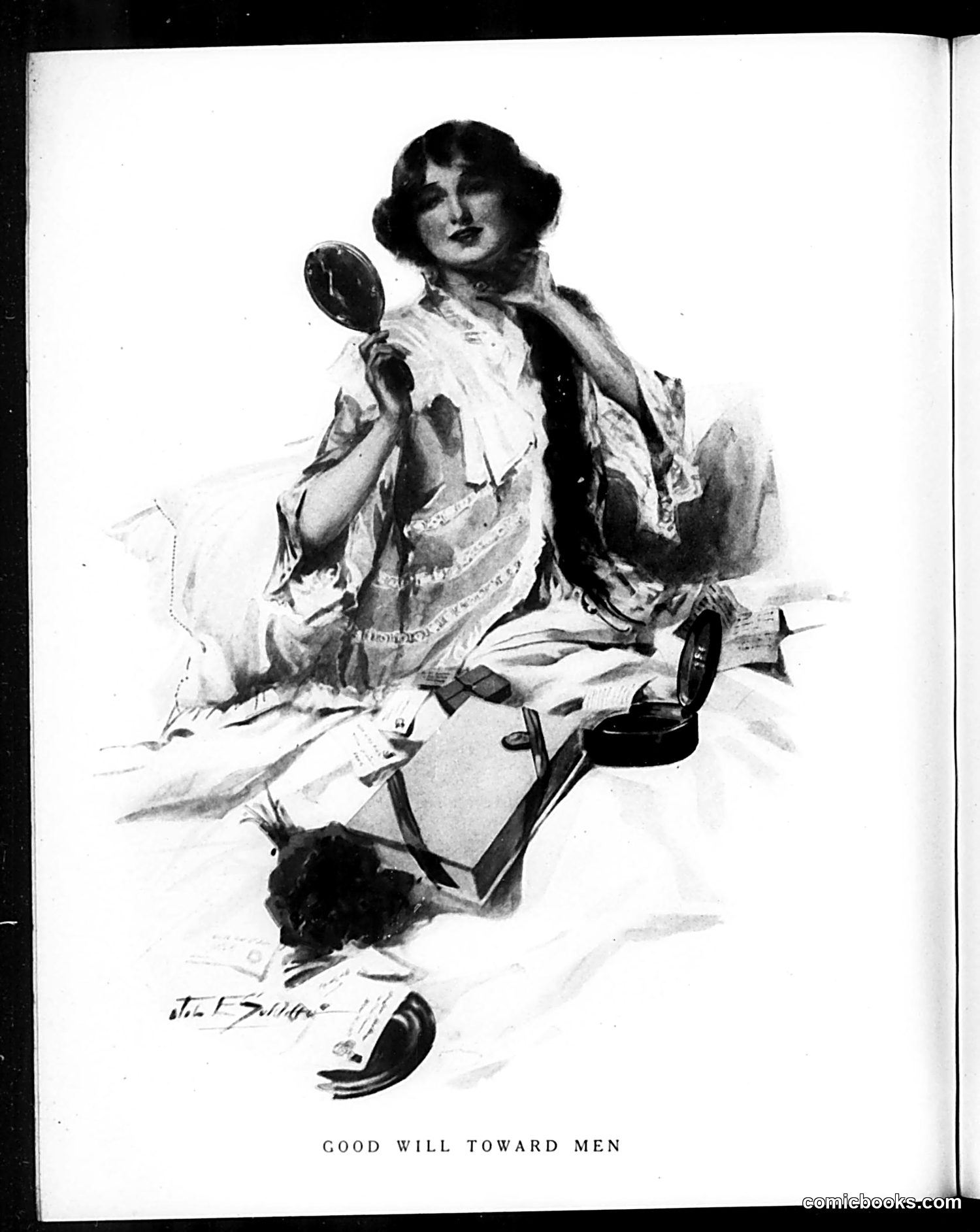
This illustration, titled "Good Will Toward Men," appears to be a satirical drawing from Judge magazine depicting a woman in a reclining pose surrounded by cosmetics and beauty items (hand mirror, powder compact, etc.). The caption suggests ironic commentary on female vanity or superficiality presented as "goodwill." The artwork style and presentation suggest early-to-mid 20th century social satire, likely critiquing women's preoccupation with appearance and beauty routines. The juxtaposition of the grandiose phrase "Good Will Toward Men" with the self-focused grooming activity implies satirical commentary—suggesting that women's "goodwill" toward men is merely superficial beauty preparation rather than genuine kindness or moral virtue. Without additional context or artist attribution visible, the specific target of satire remains somewhat unclear.
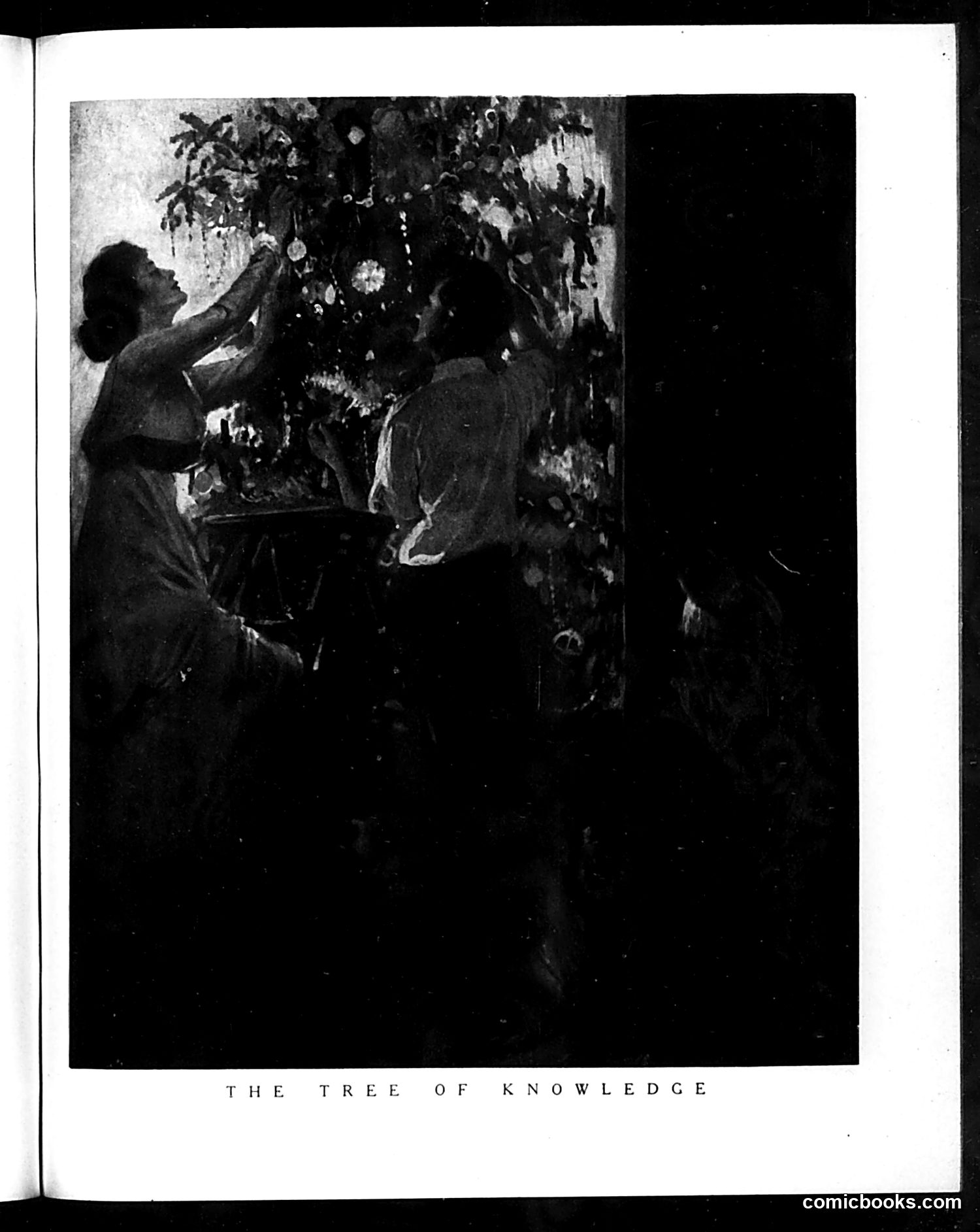
This illustration depicts two figures harvesting fruit from a decorative tree laden with ornaments and foliage. The caption "THE TREE OF KNOWLEDGE" suggests an allegorical reference to the Biblical tree from Genesis, but applied to secular learning or intellectual pursuit. The figures appear to be gathering or plucking from the branches, likely representing the acquisition of knowledge or education. The ornate, abundant nature of the tree suggests the richness of available learning. Without additional context from the magazine issue, the specific satirical point remains unclear—it could critique education systems, intellectual pretension, or the selective nature of what counts as "knowledge" in their era. The image's tone appears more illustrative than sharply satirical.
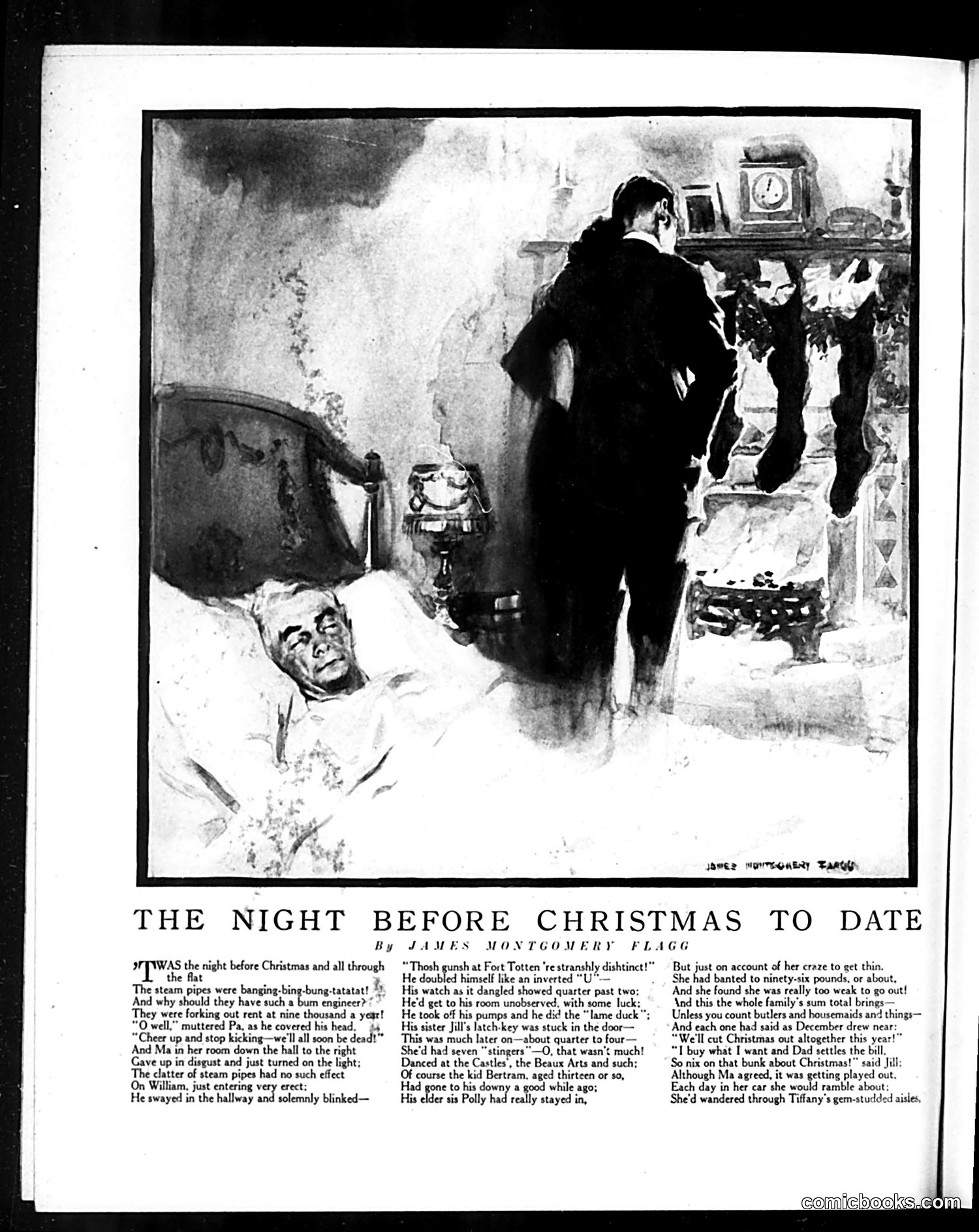
This is a satirical parody of the classic Christmas poem, reimagining it for a wealthy but dysfunctional modern family. The illustration shows a sickbed scene—likely depicting the father ill or hungover—while the narrative describes the family's jaded materialism. The satire targets upper-class indulgence: they pay "nine thousand a year" in rent yet complain about steam pipes; family members are either drunk ("seven stingers"), obsessing over weight loss ("banted to ninety-six pounds"), or out carousing at fashionable venues (the Castles' dance hall, Beaux Arts). Despite their wealth, nobody wants to celebrate Christmas—they've agreed to "cut Christmas out altogether"—yet they immediately contradict themselves, with shopping at Tiffany's and the daughter asserting she'll buy whatever she wants. The joke is that modern wealthy society has lost the spirit of Christmas to shallow consumerism and self-indulgence.
This page from *Judge* magazine contains two satirical pieces addressing early-20th-century social anxieties. The top narrative mocks the burden of gift-giving: a wealthy woman exhausts herself shopping for presents, then adopts orphans as charity—only to be disappointed by their appearance. Her children's extravagant Christmas wishes (cars, diamonds, allowances) contrast sharply with their parents' modest childhood desires, satirizing consumer excess and ingratitude. The bottom section, titled "A Day with the Idiot," uses a fictional legal proceeding to ridicule proposed "Eugenic marriage" reforms. A cleryman suggests couples obtain health certificates and financial guarantees before marriage, addressing concerns about heredity and economic fitness. The "Idiot" character argues these bureaucratic requirements are impractical and insulting, particularly for those marrying for love rather than eugenics. Together, these pieces critique contemporary anxieties about consumerism, heredity science, and marriage's economic dimensions—reflecting Progressive-era debates over social control and "scientific" approaches to personal life.
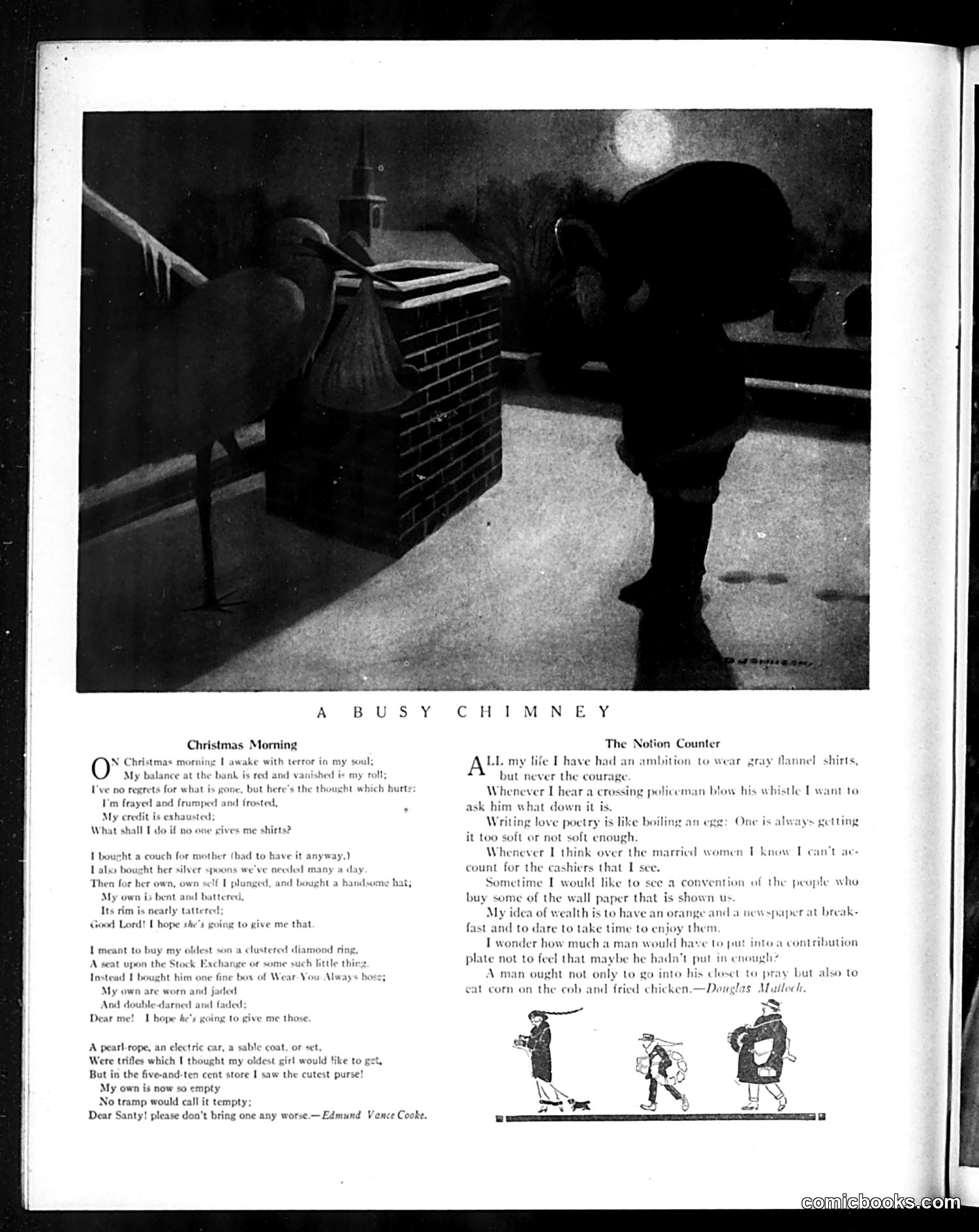
This page satirizes pre-Christmas financial anxiety among the middle class. The left column ("Christmas Morning") features confessional poems from people who've overspent on gifts for others while their own possessions deteriorate—a mother who bought her mother a couch but owns a "tattered" rim (possibly a hat), someone who purchased silver spoons instead of a diamond brooch they desperately wanted. The satire targets the social pressure to give generously while hoping recipients reciprocate with better gifts. The repeated refrain "I hope she's going to give me that" reveals the transactional nature of gift-giving. "The Notion Counter" (right) offers humorous asides on life's small ambitions—wearing gray flannel shirts, enjoying leisurely breakfasts, eating corn on the cob—emphasizing how modest pleasures matter more than wealth. The cartoon above depicts silhouetted figures on a rooftop with a chimney, likely illustrating Santa's journey, connecting to the Christmas theme of expecting gifts to solve one's problems.
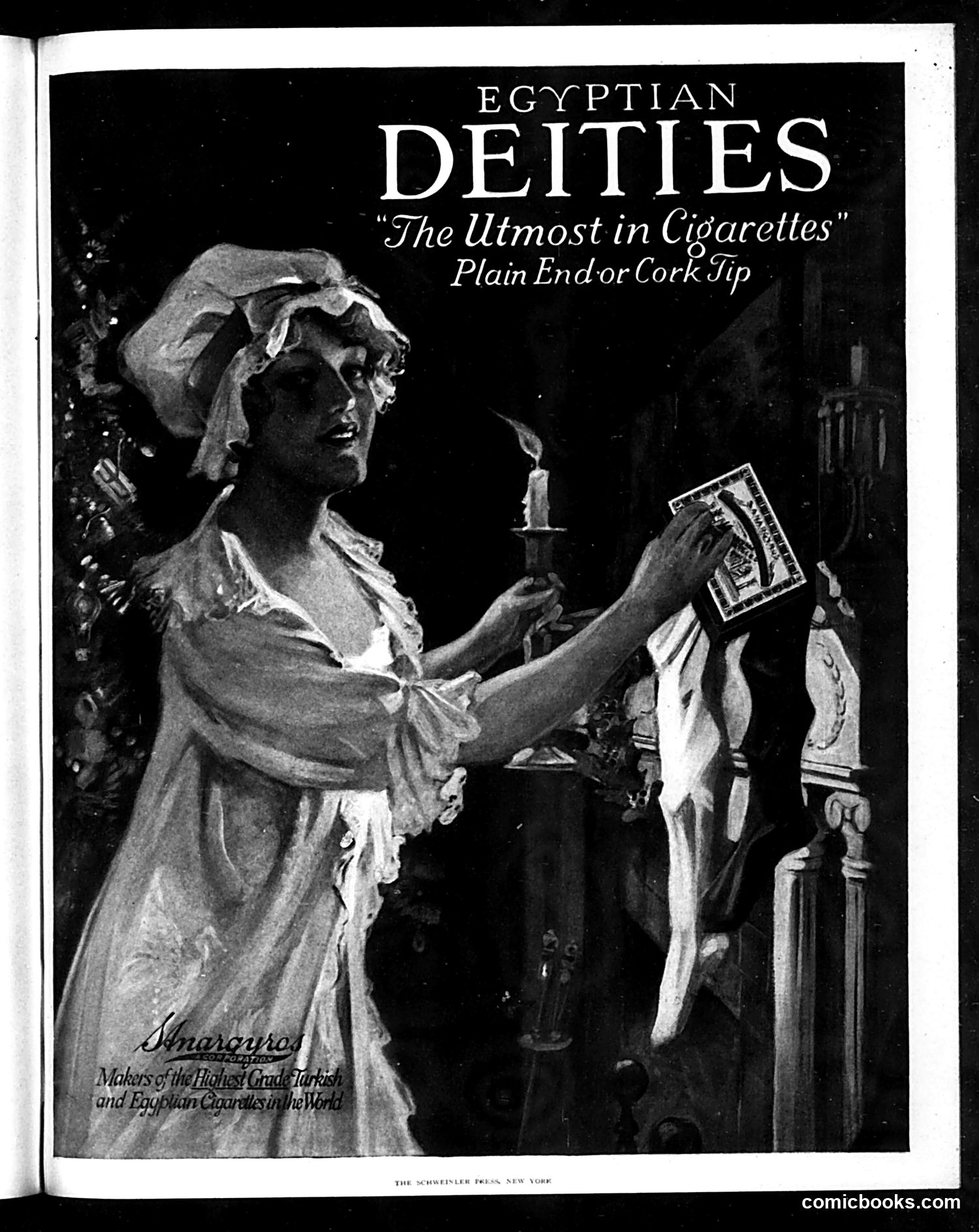
This is a **cigarette advertisement**, not a political cartoon. The page depicts a classical female figure (styled as an "Egyptian Deity") in Greco-Roman dress, holding a candle and a package of Egyptian Deities cigarettes. The advertiser is Imperianos, identified as "Makers of the Highest Grade Turkish and Egyptian Cigarettes in the World." The ad uses exotic, aspirational imagery—linking cigarettes to ancient Egyptian mystique and classical beauty—a common early 20th-century marketing strategy. The "Plain End or Cork Tip" notation indicates product variants. There is no satire or political commentary present; this is straightforward commercial promotion exploiting period fascination with Orientalism and classical aesthetics to sell tobacco products.
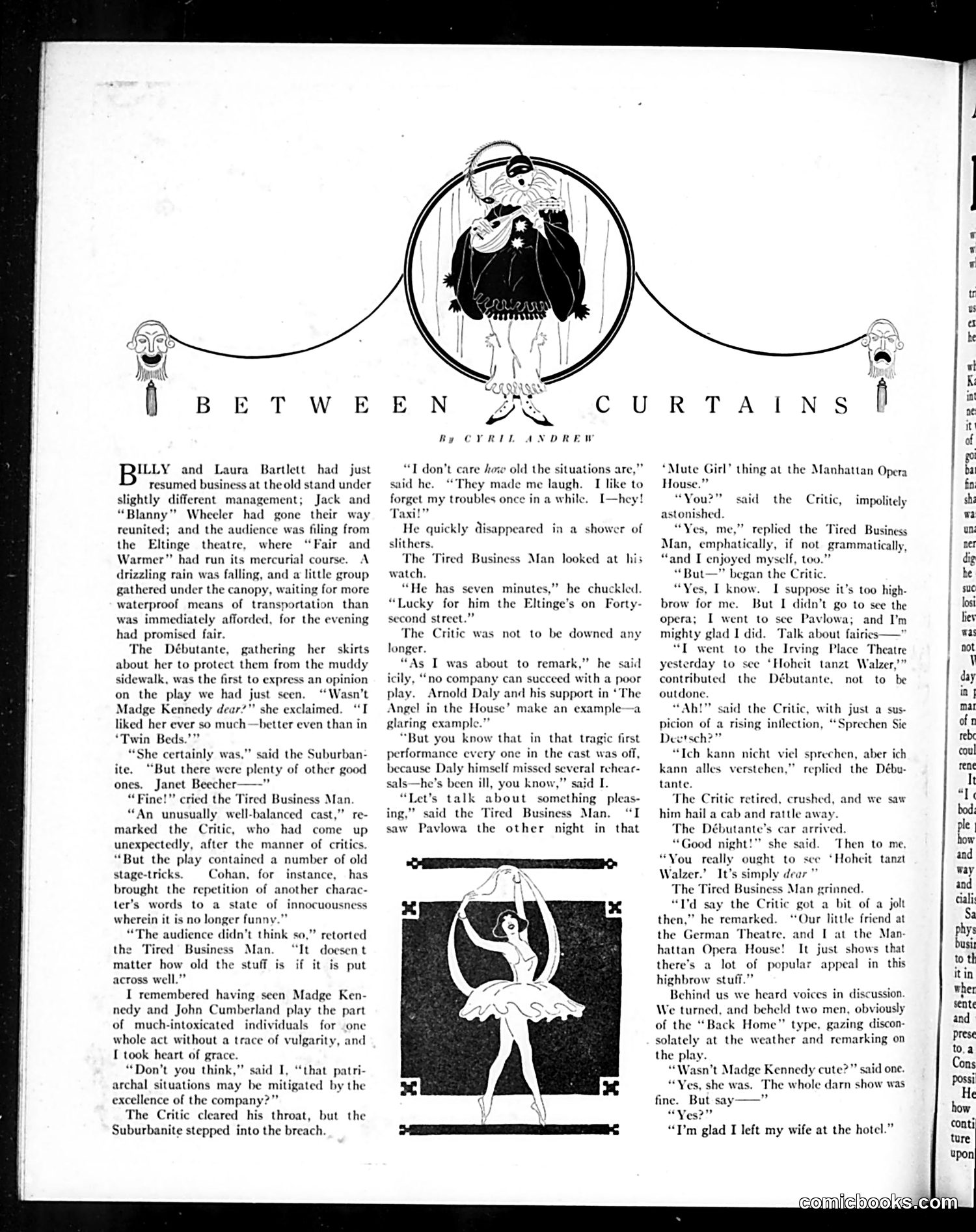
This is a social satire about theatrical taste and cultural pretension in early 1900s New York. The story depicts a conversation between four theater-goers leaving the Eltinge Theatre: a Débutante, a Suburbanite, a Tired Business Man, and a Critic. The central joke: The Critic dismisses popular entertainment as artistically inferior, citing technical flaws and "old stage-tricks." The other characters defend accessible theater that brings them joy. When the Débutante casually mentions attending a ballet by the famous Russian dancer Pavlowa and then drops German phrases about a German theater production, she inadvertently silences the Critic—revealing his cultural snobbery is merely performative posturing. The satire targets intellectual elitism: those who claim superior taste while the "ordinary" audience actually enjoys quality entertainment. The Tired Business Man's final observation—that popular appeal exists even in "highbrow stuff"—encapsulates Judge magazine's skepticism toward critics who gatekeep culture. The decorative illustration of a ballet dancer reinforces the Pavlowa reference.
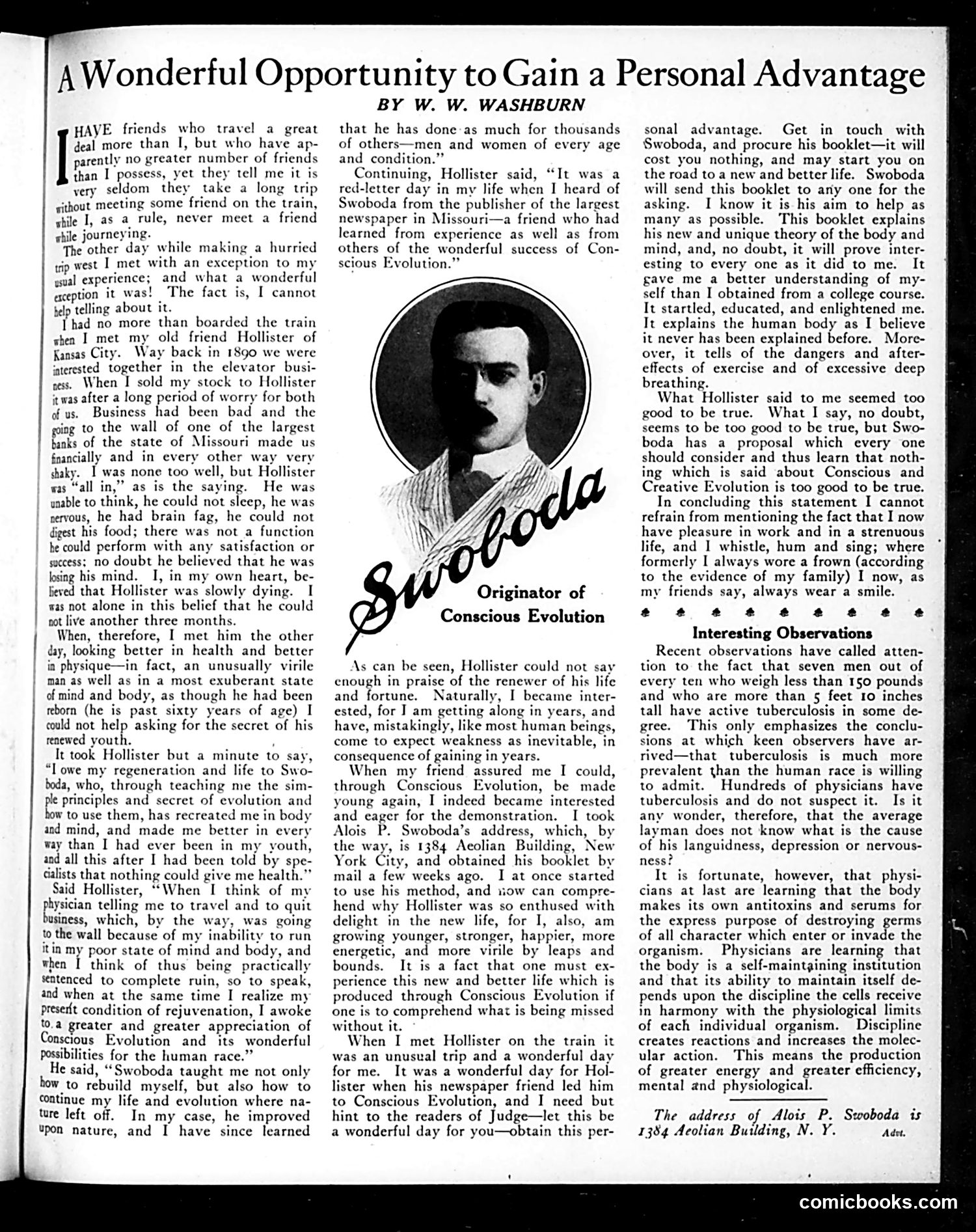
This is **advertorial content** disguised as a personal testimonial article. The "story" describes a man named Hollister who was physically and mentally broken in 1890 but appears rejuvenated years later after learning "Conscious Evolution" from someone named Swoboda. The page is essentially a **paid advertisement for Swoboda's self-help method**, presented as a narrative to make it seem like genuine editorial content rather than marketing. The photograph labeled "Originator of Conscious Evolution" is Swoboda himself. The satirical or critical angle—if any—is **unclear from this excerpt alone**. Judge magazine was known for satire, but this particular piece reads straightforwardly as promotional material for Swoboda's teachings about "Conscious Evolution," a pseudo-scientific wellness philosophy popular in the early 1900s. The address at the bottom (1384 Aeolian Building, N.Y.) confirms this is direct advertising designed to attract customers to Swoboda's services.
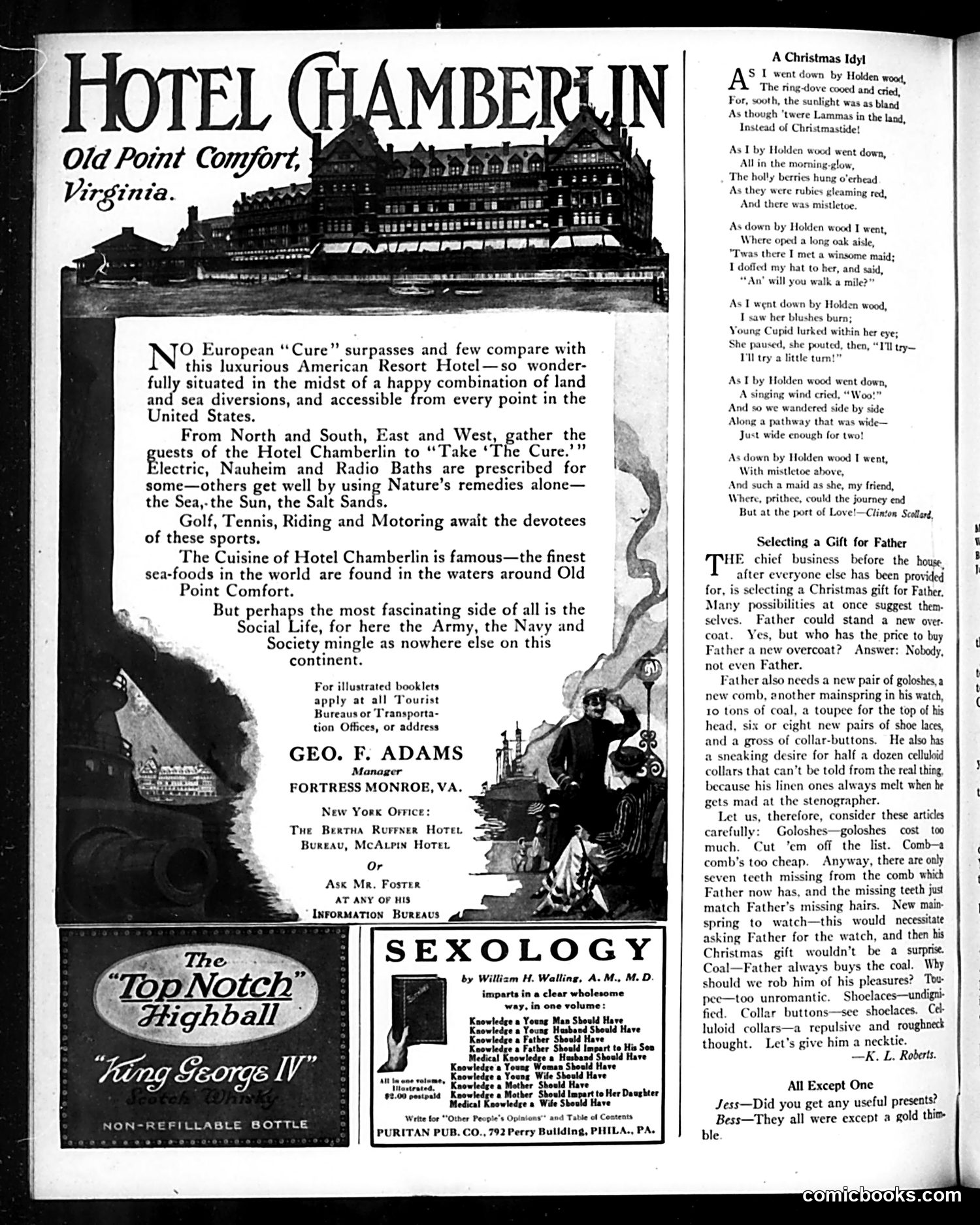
This page is primarily **advertising and light humor content** rather than political satire. The major elements are: **Hotel Chamberlin Advertisement**: Promotes a Virginia resort hotel as an American alternative to European spas, emphasizing its appeal to military and society circles—reflecting early 20th-century leisure culture for the affluent. **"A Christmas Idyl"**: A sentimental romantic poem about a man meeting a young woman while walking through woods, using Victorian pastoral conventions. **"Selecting a Gift for Father"**: Humorous prose satirizing the difficulty of buying meaningful Christmas gifts for fathers. The joke is that fathers need many things (goloshes, comb repairs, coal) but these are either too expensive or too cheap/impractical—poking fun at the commercialization of gift-giving and the challenge of pleasing fathers specifically. **Sexology Book Advertisement**: Promotes a medical/educational text on sexual knowledge, reflecting early 20th-century attitudes toward sex education as a serious health matter. The page reflects genteel middle-class concerns of the era: leisure travel, romantic courtship, gift-giving conventions, and emerging openness about sex education.
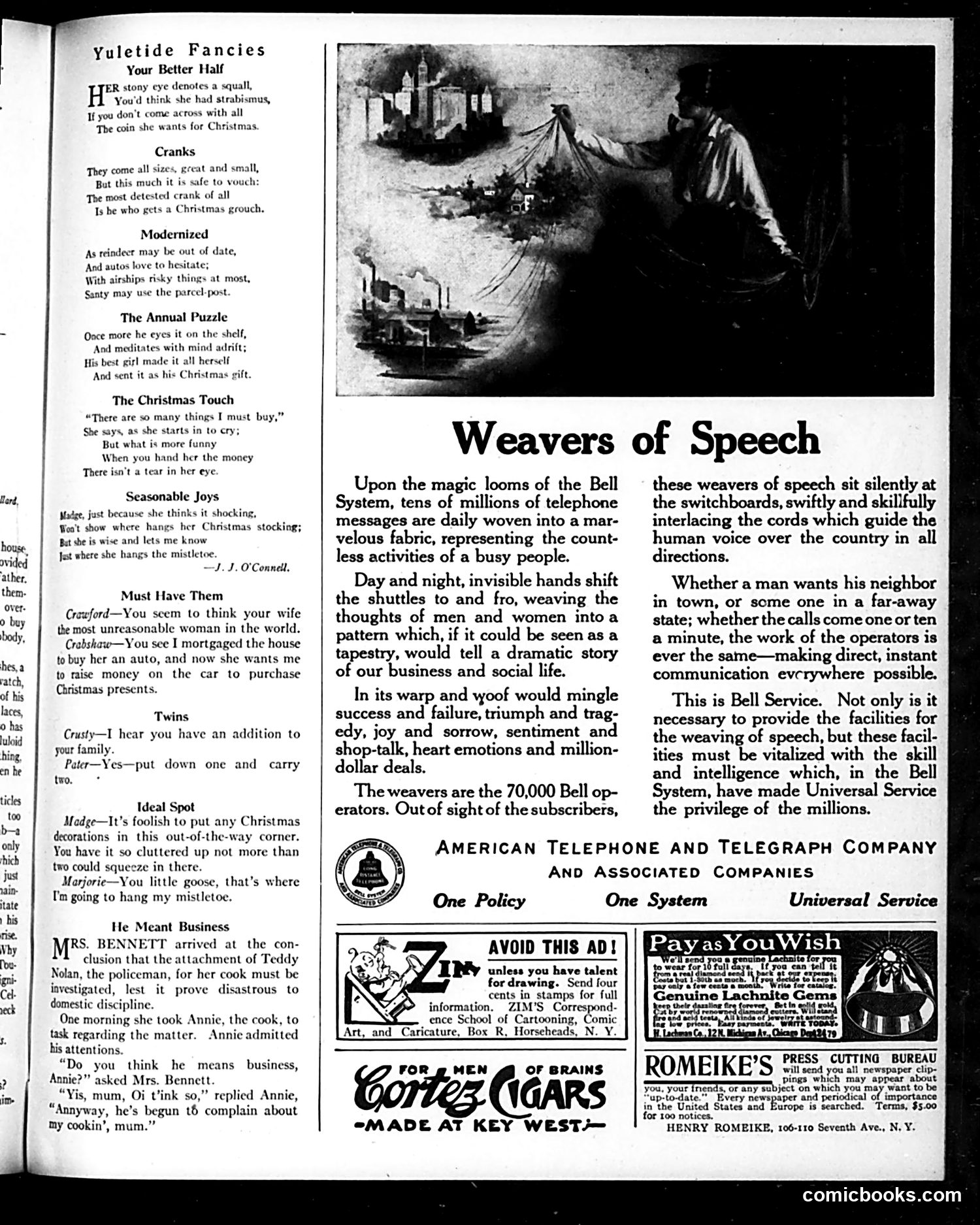
This page is primarily a **Bell System advertisement** celebrating telephone operators as skilled professionals. The large central image and accompanying text use poetic language ("magic looms," "weaving") to metaphorically describe how 70,000 telephone operators manually connect calls across America. The ad emphasizes operators' invisible labor—they work "out of sight of the subscribers" yet enable instant communication nationwide. This was necessary context in the 1920s, when telephone switching required human operators at physical switchboards to manually plug in connections. The satire is subtle: the ad romanticizes what was actually monotonous, low-wage labor performed primarily by women. By framing operators as skilled "weavers" creating a beautiful "tapestry" of American life, Bell System dignifies routine work while promoting the company's service as essential infrastructure. The surrounding short humorous items (left column) about Christmas gift-giving and marriage are filler typical of Judge magazine's satirical format—unrelated to the advertisement.
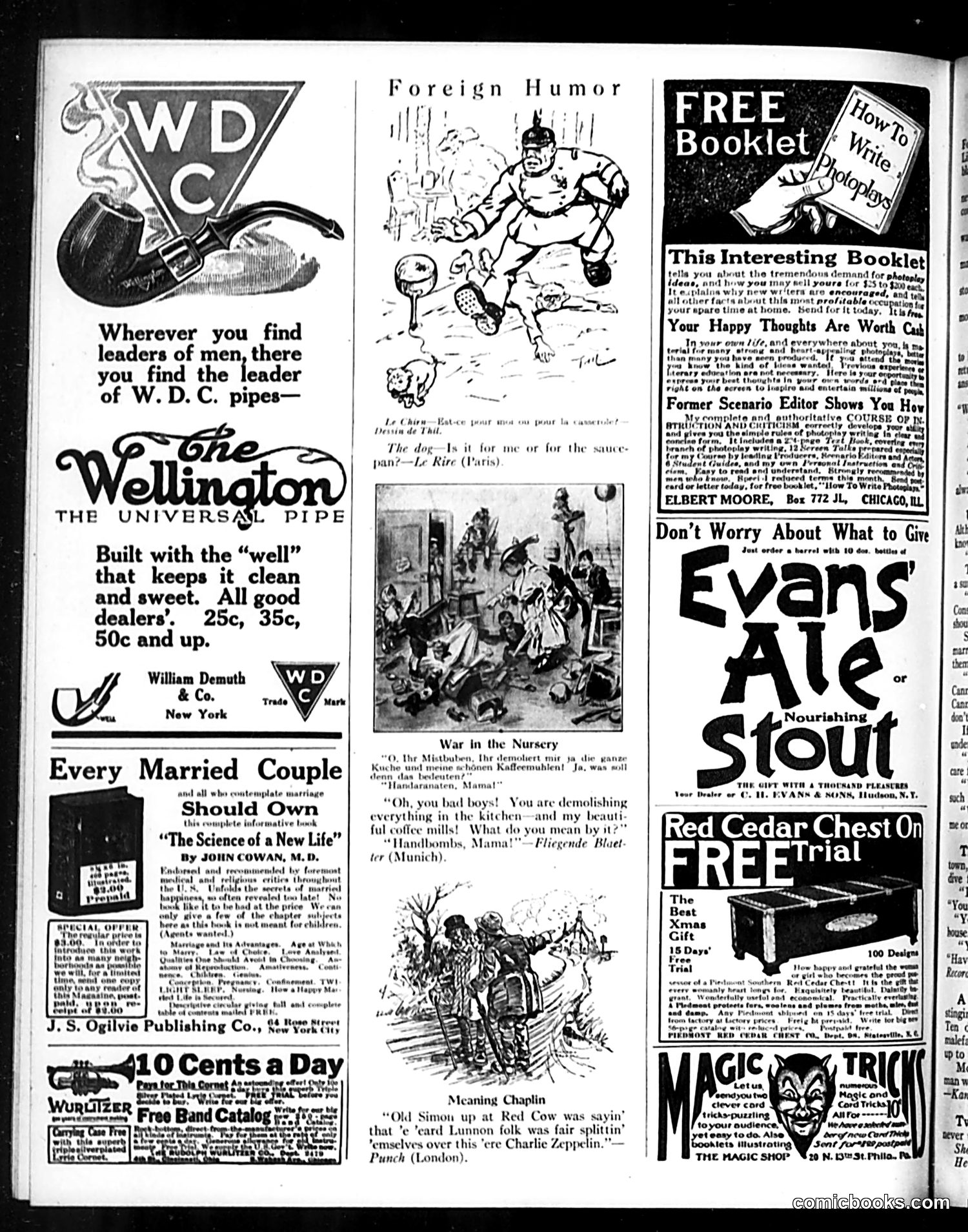
This page is primarily **advertising and fillers**, not satirical cartoons requiring political interpretation. The "Foreign Humor" section reprints brief jokes from European magazines (Le Rire, Fliegende Blätter, Punch) in English translation—typical Judge filler content. These include: - A dog-and-cookpot joke - German children playing "handbombs" (toy hand grenades) in a kitchen, referencing WWI imagery - A cockney reference to "Charlie Chaplin," likely the famous actor/comedian whose popularity was international by this era The cartoons here are simple domestic humor: children wreaking havoc, a man in military gear kicking a small person. They illustrate the translated European jokes but contain no deeper political satire. **The bulk of the page is commercial advertising**: Wellington pipes, marriage instruction books, Evans Ale, a Red Cedar Chest, and magic tricks. This reflects Judge's mixed-content format of satirical articles alongside paid advertisements supporting the publication.
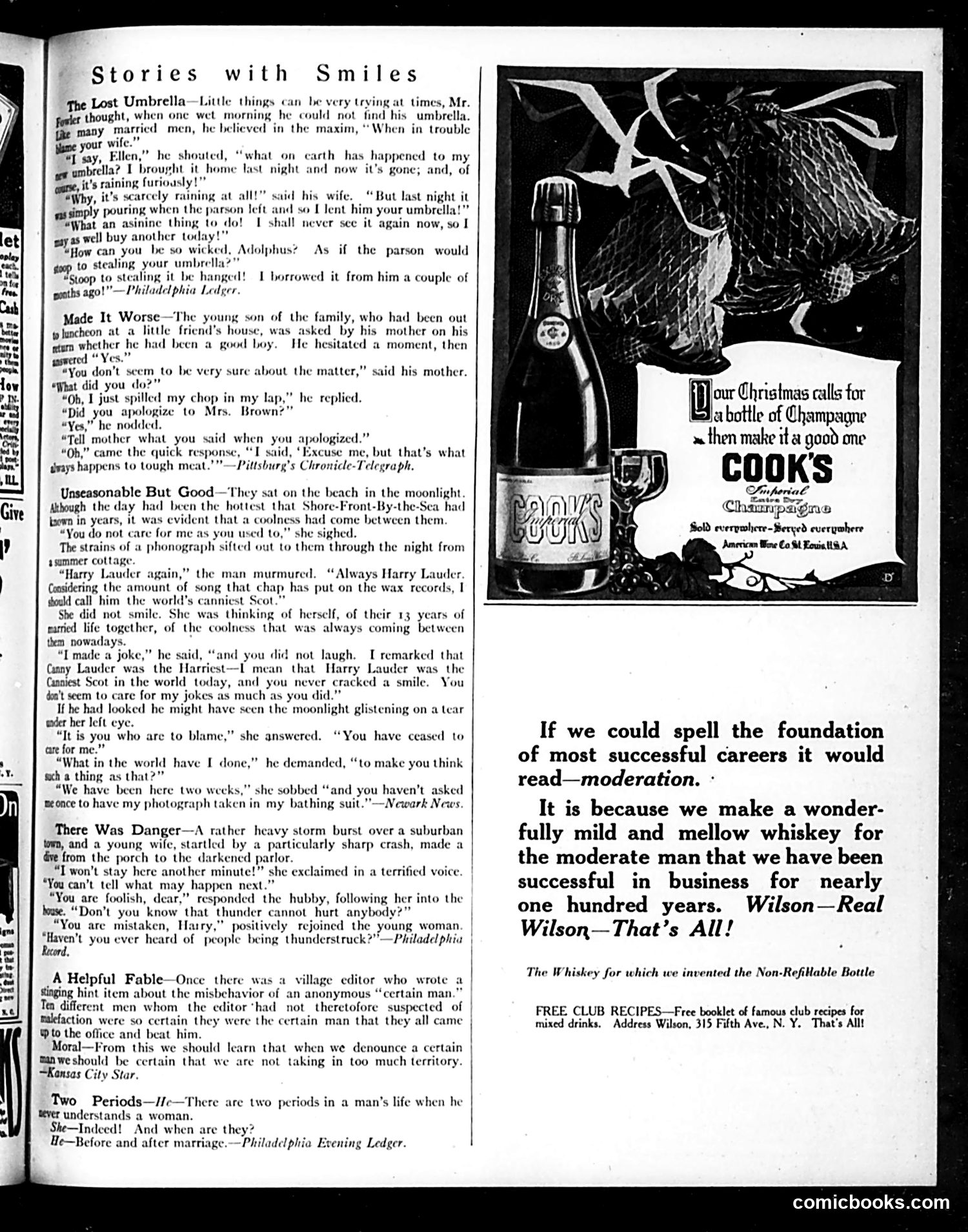
This page from *Judge* magazine presents a collection of short humorous anecdotes titled "Stories with Smiles"—satirical commentary on marriage and domestic life common to early 20th-century American humor. The jokes target predictable marital conflicts: a husband's lost umbrella (blamed on lending it to the parson, whom he'd borrowed from earlier—circular logic); a child's clumsy dinner apology; and a cooling marriage where the wife feels neglected after 13 years. The final anecdote mocks a wife's irrational fear during a thunderstorm. These are gentle domestic satires exploiting gender stereotypes and marital tensions typical of the era's comedic sensibilities—portraying husbands as exasperated, wives as illogical or emotionally unstable. The facing page contains a *Cook's Champagne* advertisement and a *Wilson whiskey* ad emphasizing "moderation," which ironically contextualizes these alcohol-adjacent leisure scenarios as aspirational modern life.
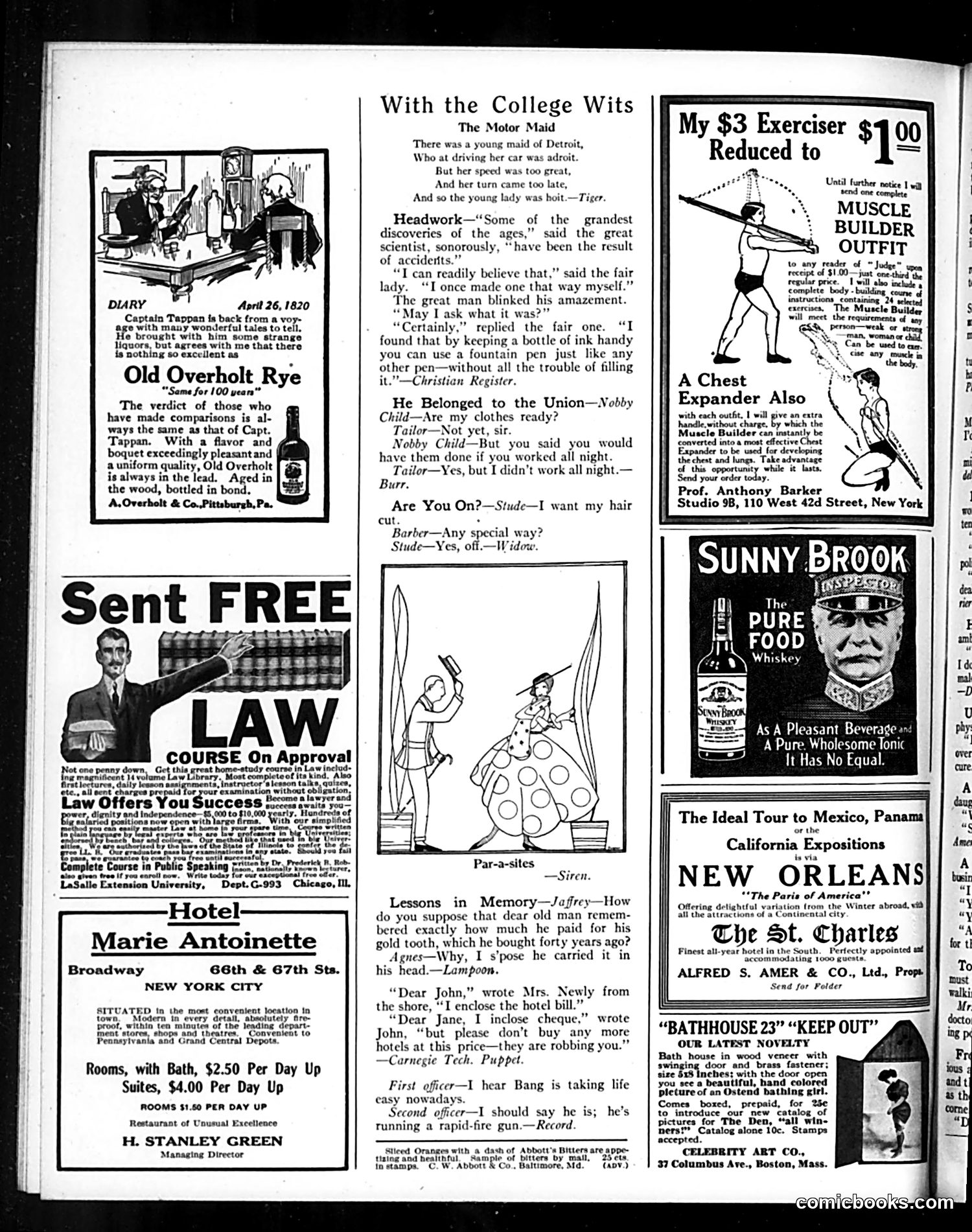
This is primarily an **advertising page** from Judge magazine (dated April 26, 1820 in the header, though the OCR likely contains errors). The page contains several brief humorous anecdotes ("With the College Wits") interspersed with period advertisements. The humor relies on **early 20th-century wordplay and social situations**: - "The Motor Maid" satirizes women drivers as reckless - Several jokes play on double meanings (a woman "inventing" the fountain pen by using ink; "headwork" puns; a tailor's union excuses) - "Par-a-sites" appears to reference parasitic relationships, illustrated with figures on a large mushroom The advertisements reflect era-typical concerns: mail-order law courses, hotel accommodations, exercise equipment ("Muscle Builder"), whiskey, and patent medicines. The **Hotel Marie Antoinette** ad shows this was New York luxury tourism marketing. The satirical content is light and social rather than overtly political—targeting contemporary anxieties about modern technology (automobiles), labor unions, and gender roles.
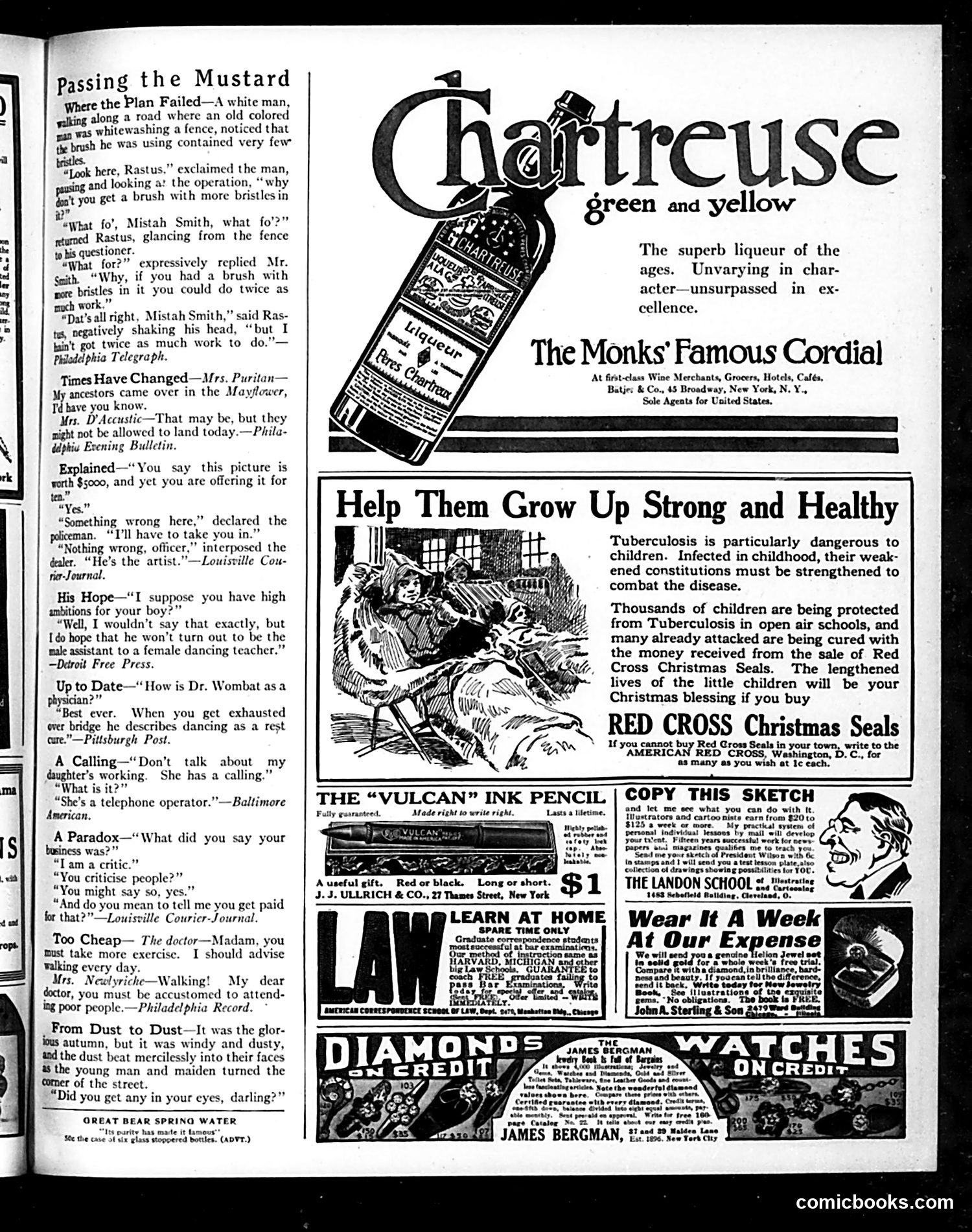
This page from Judge magazine consists primarily of **short humorous anecdotes** rather than political cartoons. The jokes employ period racial stereotypes and social commentary typical of early 20th-century American humor. **Key Content:** - "Passing the Mustard" depicts a conversation between a white man and a Black worker ("Rastus") about whitewashing efficiency—the humor relies on a racial stereotype of lazy labor - "Times Have Changed" contrasts Puritan ancestry with modern immigration restrictions - Several brief jokes about doctors, telephone operators, critics, and wealthy people avoiding exercise The remainder consists of **advertisements**: Chartreuse liqueur, Red Cross Christmas Seals for tuberculosis prevention, ink pencils, correspondence courses, and jewelry/watches on credit. **Historical context:** The racial dialect humor and stereotypical portrayals reflect attitudes normalized in mainstream publications of this era, though deeply offensive by modern standards. The tuberculosis awareness campaign represents genuine public health messaging of the period.
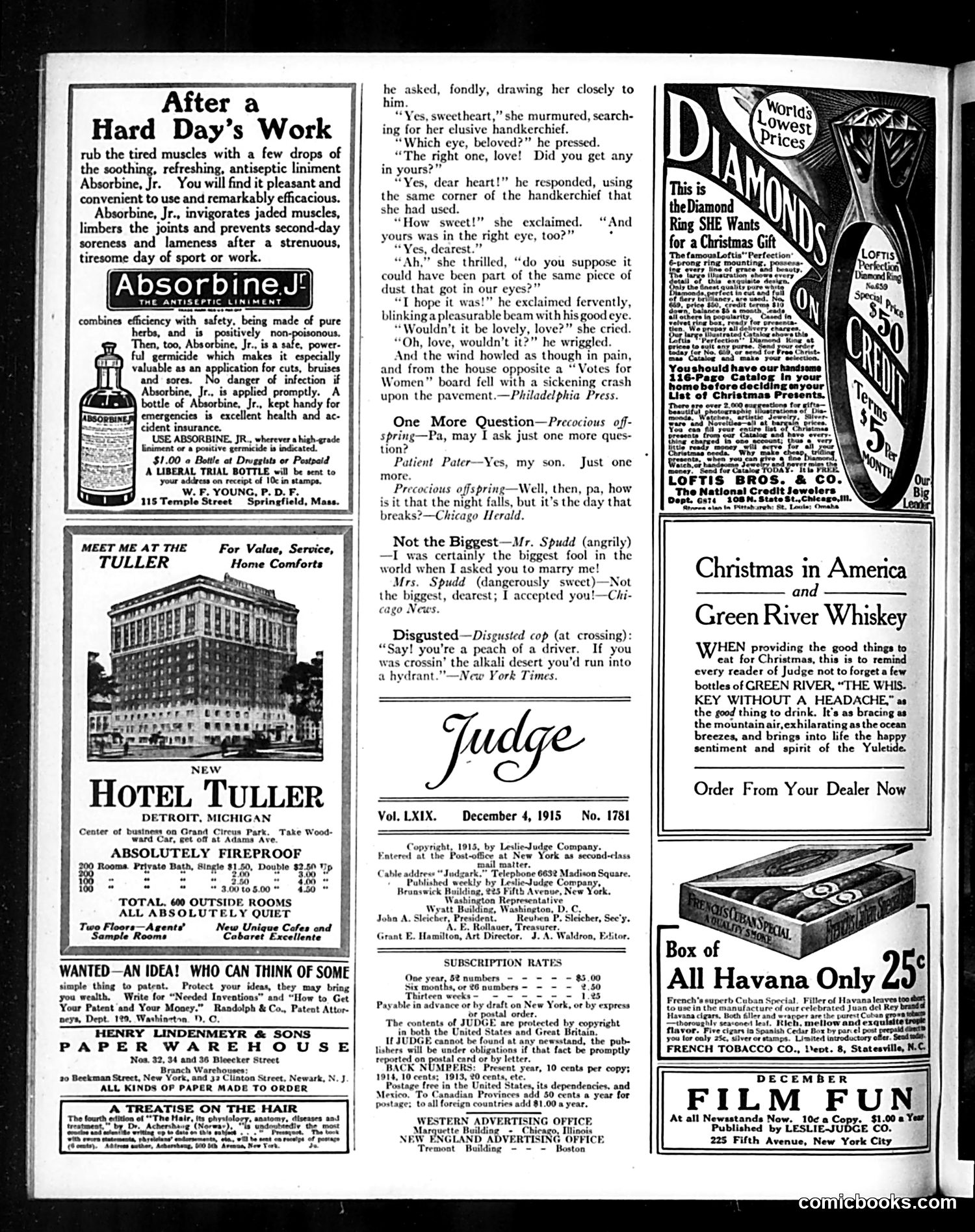
This page is primarily **advertisements and filler content** rather than political satire. The main elements are: **Advertisements:** Absorbine Jr. liniment, Hotel Tuller (Detroit), patent attorney services, paper warehouse, and hair treatment products dominate the layout. **Humor sections:** Several brief jokes appear, including: - A romantic couple discovering they shared dust in their eyes—romantic sentimentality undercut by reference to a "Votes for Women" board falling nearby (mocking suffragist activism) - A child asking why "night falls" but "day breaks" (wordplay joke) - Marital humor about the wife being the "biggest fool" for accepting the husband's proposal **Overall:** This is a typical Judge issue mixing ads with light domestic humor and gentle satire. The suffrage reference suggests contemporary debate over women's voting rights, but the page itself isn't primarily political commentary.
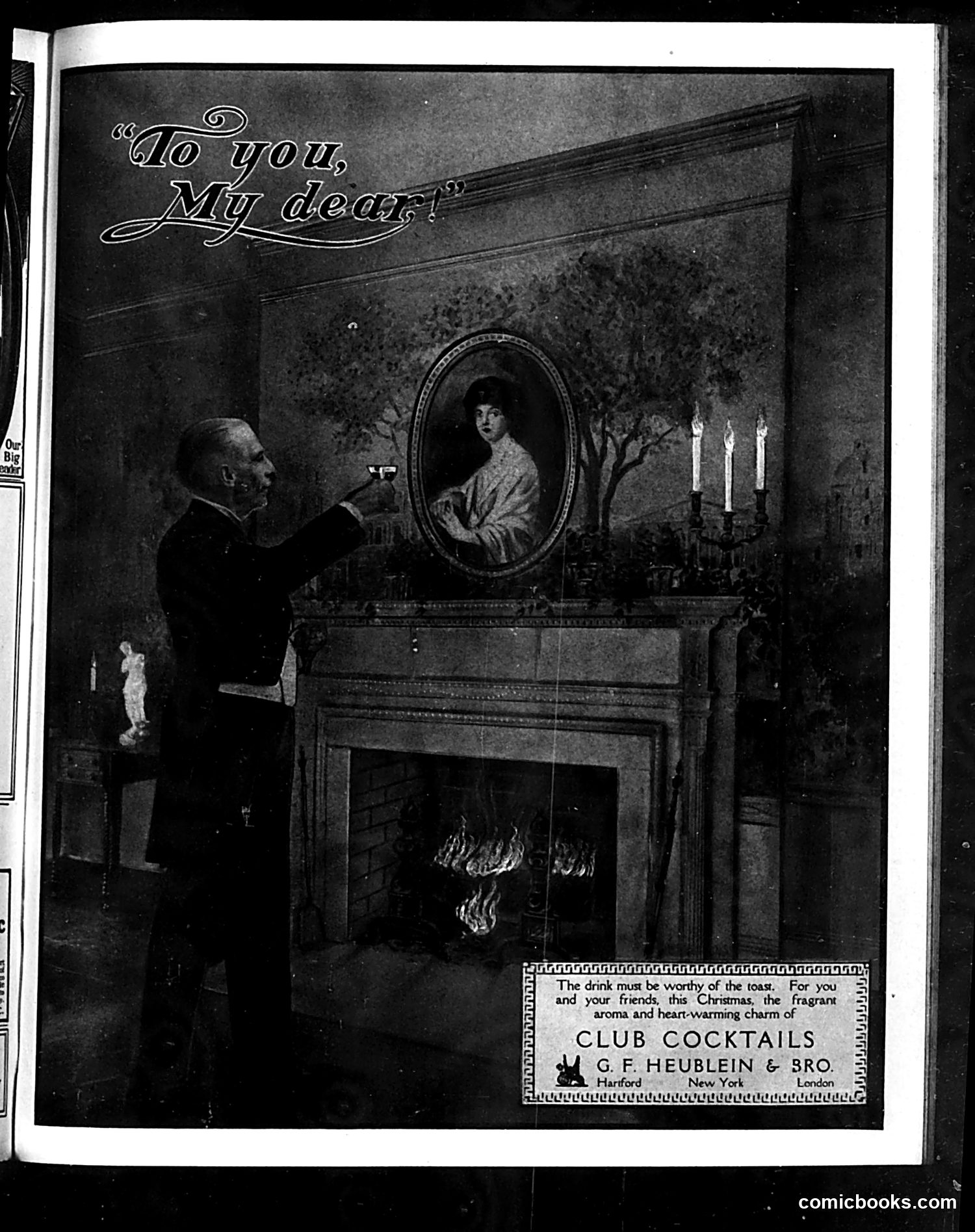
This is a Christmas-themed advertisement rather than political satire. The image shows a man in formal attire toasting to a woman's portrait above a fireplace, with candles and a fire visible. The caption "To you, My dear!" suggests romantic sentiment. The ad promotes Club Cocktails by G.F. Heublein & Bro., a real spirits company with locations in Hartford, New York, and London. The marketing pitch claims their cocktails are appropriately "worthy of the toast" and possess "fragrant aroma and heart-warming charm" — positioning premium cocktails as suitable gifts for Christmas celebrations among friends. This reflects early 20th-century advertising that associated quality spirits with sophistication, romance, and holiday tradition.
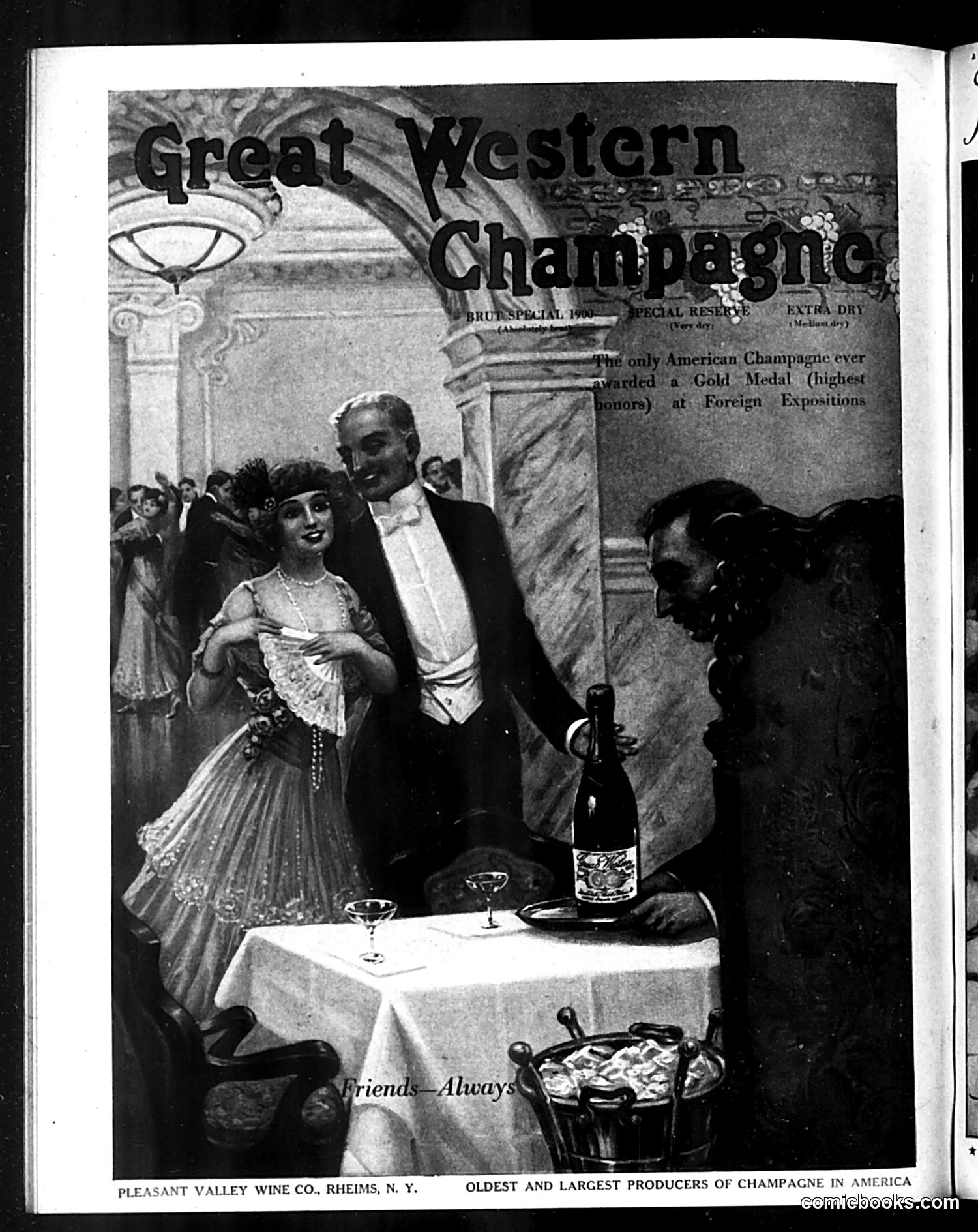
This is primarily an **advertisement for Pleasant Valley Wine Company**, a New York champagne producer claiming to be "oldest and largest producers of champagne in America." The ad features an elegant formal dinner scene with well-dressed guests in what appears to be a luxurious interior. The marketing message emphasizes prestige: the champagne allegedly won a Gold Medal (highest honors) at Foreign Expositions and is "the only American Champagne ever awarded" such recognition. The tagline "Friends Always" suggests the product's role in social gatherings. The illustration depicts aspirational consumption—elegantly dressed people enjoying champagne at a refined event—reflecting early 20th-century American aspirations toward European sophistication. This was a straightforward luxury goods advertisement rather than political satire.