
Judge, 1915-12-04 · page 18 of 28
Judge — December 4, 1915 — page 18: what you’re looking at
What you’re looking at
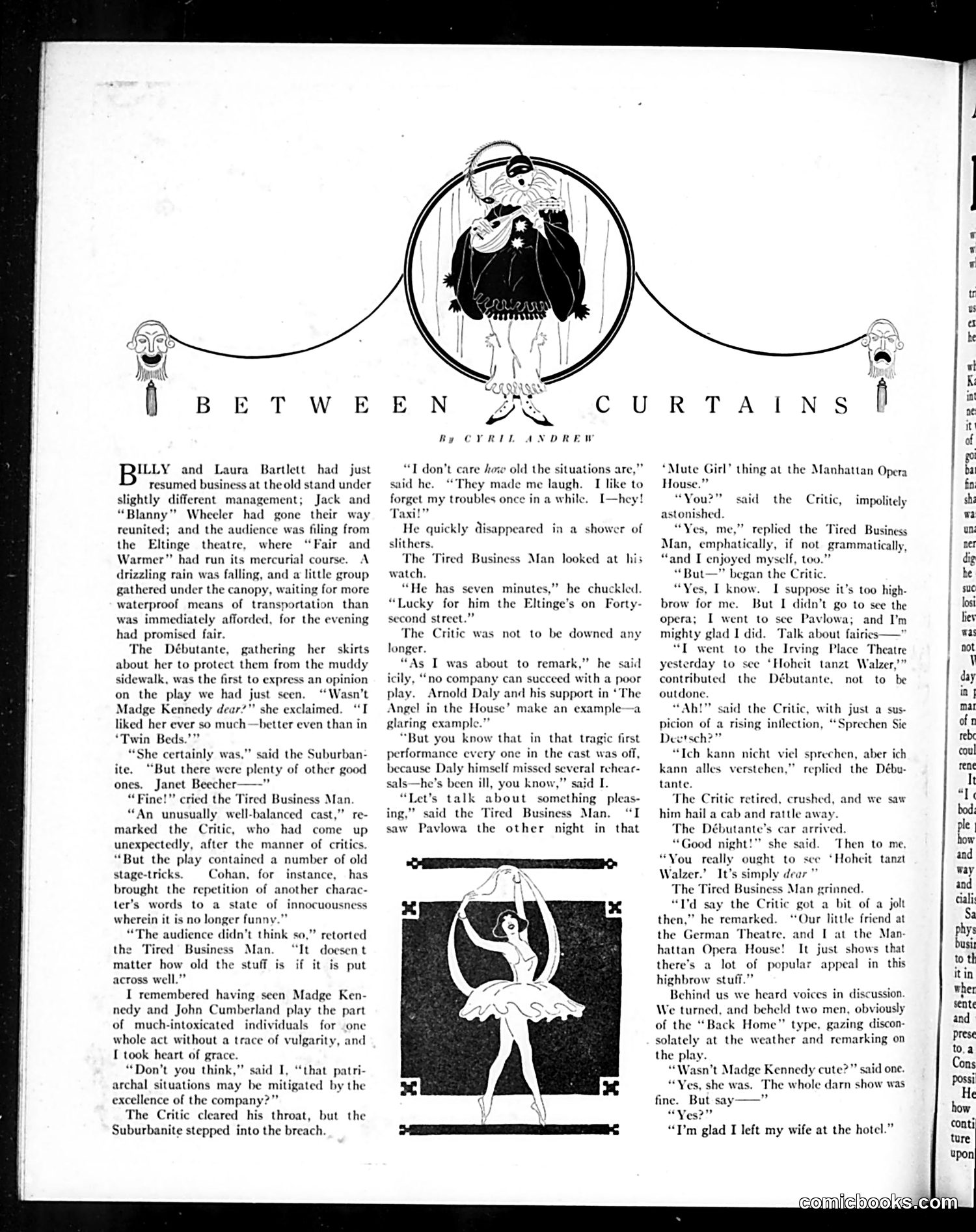
This is a social satire about theatrical taste and cultural pretension in early 1900s New York. The story depicts a conversation between four theater-goers leaving the Eltinge Theatre: a Débutante, a Suburbanite, a Tired Business Man, and a Critic. The central joke: The Critic dismisses popular entertainment as artistically inferior, citing technical flaws and "old stage-tricks." The other characters defend accessible theater that brings them joy. When the Débutante casually mentions attending a ballet by the famous Russian dancer Pavlowa and then drops German phrases about a German theater production, she inadvertently silences the Critic—revealing his cultural snobbery is merely performative posturing. The satire targets intellectual elitism: those who claim superior taste while the "ordinary" audience actually enjoys quality entertainment. The Tired Business Man's final observation—that popular appeal exists even in "highbrow stuff"—encapsulates Judge magazine's skepticism toward critics who gatekeep culture. The decorative illustration of a ballet dancer reinforces the Pavlowa reference.
📄 Transcribed text from this page (OCR, searchable)
Machine-transcribed from the original scan — historical spelling and the odd misread are preserved.
ILLY and Laura Bartlett had just resumed business at the old stand under lifferent_ management; Jack and Wheeler had gone their way reunited; and the audience was filing from the Eltinge theatre, where air and Warmer” had run its mercurial course. A drizzling rain was falling, and a little group gathered under the canopy, waiting for more waterproof means of transportation than was immediately afforded, for the evening had promised fair. The Débutante, gathering her skirts about her to protect them from the muddy sidewalk, was the first to express an opinion on the play we had just seen. “Wasn't Madge Kennedy dear?” she exclaimed. “I liked her ever so much—better even than in ‘Twin Beds.’” “She certainly was.” said the Suburban- ite. “But there were plenty of other good ones. Janet Beecher “3 ine!" cried the Tired Business Man n unusually well-balanced cast,” re- marked the Critic, who had come up unexpectedly, after the manner of critics. “But the play contained a number of old stage-tricks. Cohan, for instance, has brought the repetition of another charac- ter’s words to a state of innocuousness wherein it is no longer funny.” The audience didn’t think so,” retorted the Tired Business Man. “It de matter how old the stuff is if it across well.” I remembered having seen Madge Ken- nedy and John Cumberland play the part of much-intoxicated individuals for one whole act without a trace of vulgarity, and [ took heart of grace “Don’t you thin! said I, “that patri- archal situations may be mitigated by the excellence of the company: The Critic cleared his throat, but the Suburbanite stepped into the breach. re how old the situations are,” They made me laugh. I like to I—hey! “T don't said he. forget my troubles once in a while. He quickly disappeared in a shower of ithe! The Tired Business Man looked at his watch. “He has seven minutes,” he chuckled. “Lucky for him the Eltinge’s on Forty- second street.”” he Critic was not to be downed ar longer. As I was about to remark,” he said icily, “no company can succeed with a poor play. Arnold Daly and his support in ‘The Angel in the House’ make an example—a glaring example.” “But you know that in that t first performance every one in the cast was off, because I himself missed several reheac- sals—he’s been ill, you know,” said I. talk bout something pleas- ing,” said the Tired Business Man. “I avlowa the other night in that “Mute Girl’ thing at the Manhattan Opera House.” “You?” astonished. said the Critic, impolitely ’ replied the Tired Business ly, if not grammatically, ed myself, too.” 7 “But—" began the Critic. “Yes, I know. I suppose it’s too high- brow for me. But I didn’t go to see the opera; I went to sce Pavlowa; and I'm mighty glad I did. Talk about fairies——" “T went to the Irving Place Theatre yesterday to see ‘Hohcit tanzt- Walzer,” contributed the Débutante, not to be outdone. Ah!” said the Critic, with just a su picion of a rising inflection, “Sprechen S| Deetsch?” “Ich kann nicht viel sprechen, aber ich kann alles verstehen,” replied the Débu- tante. The Critic retired, crushed, and we saw him hail a cab and rattle away he Débutante’s car arrived. “Good night!” she said. Then to me, “You really ought to sce ‘Hoheit tanzt Wal It’s simply dear ” The Tired Business Man grinned. “I'd say the Critic got a bit of a jolt then,” he remarked. “Our little friend at the German Theatre, and [ at the Man- hattan Opera House! It just shows that there's a lot of popular appeal in this highbrow stuff.” Behind us we heard voices in discussion. We turned, and beheld two men, obviously of the “Back Home” type, gazing discon- solately at the weather and remarking on the play “Wasn't Madge Kennedy cute?” said one. “Yes, she was. The whole darn show was fine. But say——” “Yes? “I'm glad I left my wife at the hotel.”