
Judge, 1915-12-04 · page 23 of 28
Judge — December 4, 1915 — page 23: what you’re looking at
What you’re looking at
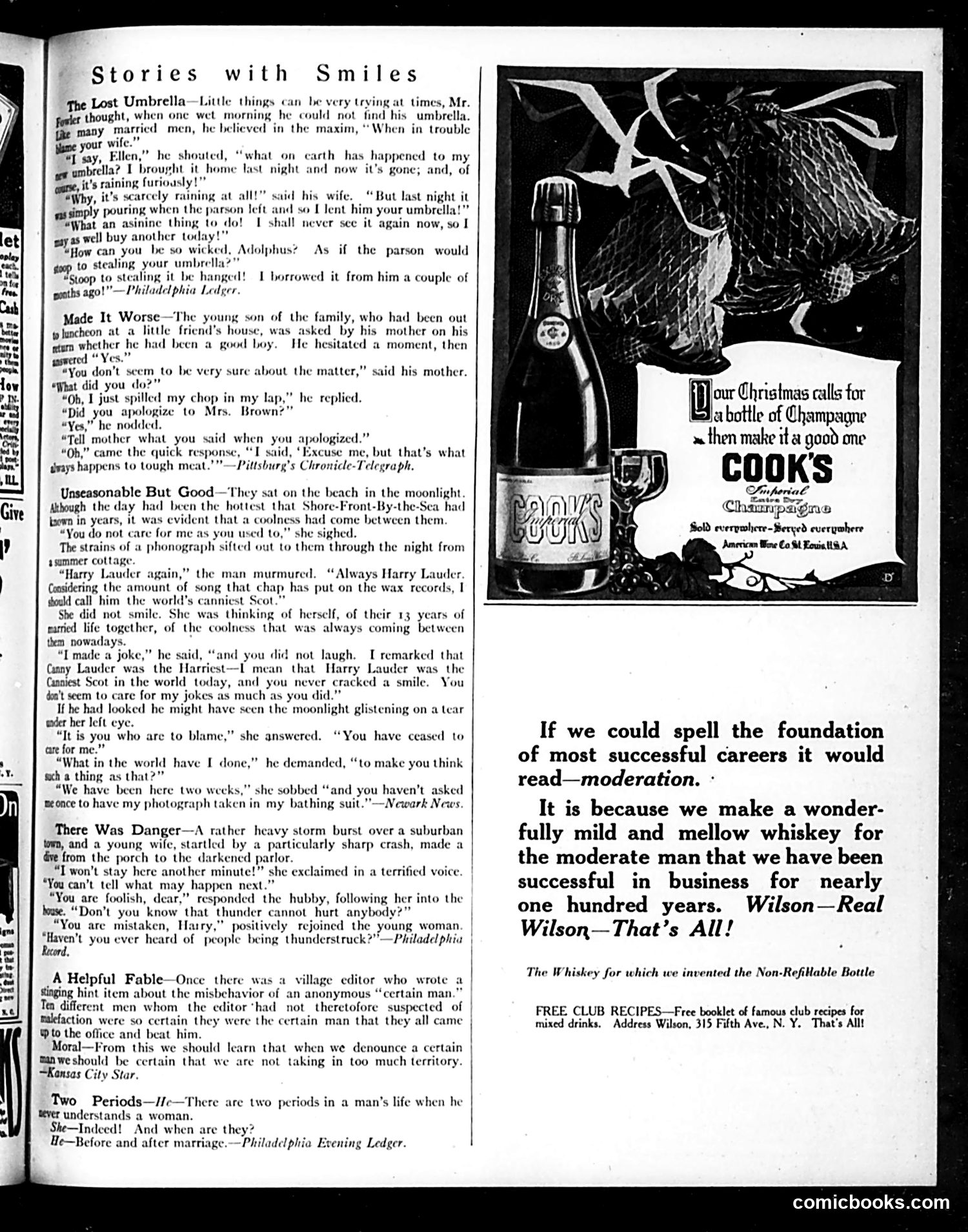
This page from *Judge* magazine presents a collection of short humorous anecdotes titled "Stories with Smiles"—satirical commentary on marriage and domestic life common to early 20th-century American humor. The jokes target predictable marital conflicts: a husband's lost umbrella (blamed on lending it to the parson, whom he'd borrowed from earlier—circular logic); a child's clumsy dinner apology; and a cooling marriage where the wife feels neglected after 13 years. The final anecdote mocks a wife's irrational fear during a thunderstorm. These are gentle domestic satires exploiting gender stereotypes and marital tensions typical of the era's comedic sensibilities—portraying husbands as exasperated, wives as illogical or emotionally unstable. The facing page contains a *Cook's Champagne* advertisement and a *Wilson whiskey* ad emphasizing "moderation," which ironically contextualizes these alcohol-adjacent leisure scenarios as aspirational modern life.
📄 Transcribed text from this page (OCR, searchable)
Machine-transcribed from the original scan — historical spelling and the odd misread are preserved.
Stories with Smiles Lost Umbrella—Little things can be very trying at times, Mr. , when one wet morning he could not find his umbrella. arried men, he believed in the maxim, “When in trouble what on carth has happened to my last night and now it’s gon and, of Tsay, Ellen,” he shouted, smbrcla? I brought it home , it’s raining furiously!” *Why, it’s scarcely raining at all!” said his wife, “But last night it assimply pouring when the parson left and so I lent him your umbrella! “What an annie thing to lo! I shall never see it again now, so I well buy another toda: Pow can voll he so wicked, Adolphus? As if the parson would gop to stealing your umbrella?” , “Stoop to stealing it be hanged! 1 borrowed it from him a couple of pooths ago!” —Philadel phia Ledger. Made It Worse—The young son of the family, who had been out luncheon at a little friend’s house, was asked by his mother on his et whether he had been a good boy. He hesitated a moment, then fpwered “Ye “You don't seem to be very sure about the matter, 5Fe: said his mother. 1 *What did you do?” : ae te ‘eh I fast spilled my chop in my lap,” he replied. our Christmas calls for ott “Did, you apologize to Mrs. Brown?” Ja botlle of Champagne “Yes,” he nodded, ret roother what you sald when you apologized.” a then make it a good one “Ob,” came the quick response, “I said, ‘Excuse me, but that’s what smays happens to tough meat." —Pittshurg’s Chronicle-Telegraph, Aetied F Unseasonable But Good—They sat on the beach in the moonlight. Give | stough the day had been the, hottest that Sho Front By-the- Se had f Chaar. paen ® foown in years, it was evident that a coolness had come between them. we _ _% “You do not care for me as you u she sighed. Sold everywhere-Beryed everywhere The strains of a phonograph sifted out to them through the night from asummer cottage. “Harry Lauder again,” the man murmured. “Always Harry Lauder. Considering the amount of song that chap has put on the wax records, | sould call him the world’s canniest Scot. She did not smile. She was thinking of herself, of their 13 years of married life together, of the coolness that was always coming between and you did not laugh. [ remarked that —l mean that Harry Lauder was the Canniest Scot in the world tox and you never cracked a smile. You ée't seem to care for my jokes as much’as you did.” If he had looked he might have seen the moonlight glistening on a tear wider her left eye. . “It is you who are to blame,” she answered. “You have ceased to If we could spell the foundation are for me.”” : Gj “What in the world have I done,” he demanded, “to make you think of most successful careers it would sch a thing as that?” read—moderation. : “We have been here two weeks,” she sobbed ‘and you haven't asked neonce to have my photograph taken in my bathing suit.”—Newark News It is because we make /acwonders There Was Danger—A rather heavy storm burst over a suburban fully mild and mellow whiskey for tom, and a young wife, startled by a particularly sharp crash, made a de from the porch to the darkened parlor. the moderate man that we have been “I won't stay here another minute!” she exclaimed in a terrified voice “You can't tell what may, happen next.” ‘ successful in business for nearly "You are foolish, dear,” responded the hubby, following her into the 5 tmase. “Don't you know that thunder cannot hurt anybody | one hundred years. Wilson—Real ung, woman Wilson—That’s All! “You are mistaken, Harry,” positively rejoined the y aye you ever heard of people being thunderstruck?*—Philadel phia cord, A Helpful Fable—Once there was a village editor who wrestle a The Whiskey for which we invented the Non-Refilable Bottle singing hint item about the misbehavior of an anonymous ‘‘ A man Ten different men whom the editor ‘had not_ theretofore suspected of | FREE CLUB RECIPES—Free booklet of famous club recipes for talefaction were so certain they were the certain man that they all came | mixed drinks. Address Wilson, 315 Fifth Ave. N.Y. That's All! ® to the office and beat him. | Moral—From this we should learn that when we denounce a certai tanweshould be certain that we are not taking in too much territory. “Kansas City Star. Two Periods—/Mc—There are two periods in a man’s life when he fever understands a woman. She—Indeed! And when are they? He—Before and after marriage. —Philadelphia svening Ledger. comicbooks.com