
Judge, 1915-12-04 · page 7 of 28
Judge — December 4, 1915 — page 7: what you’re looking at
What you’re looking at
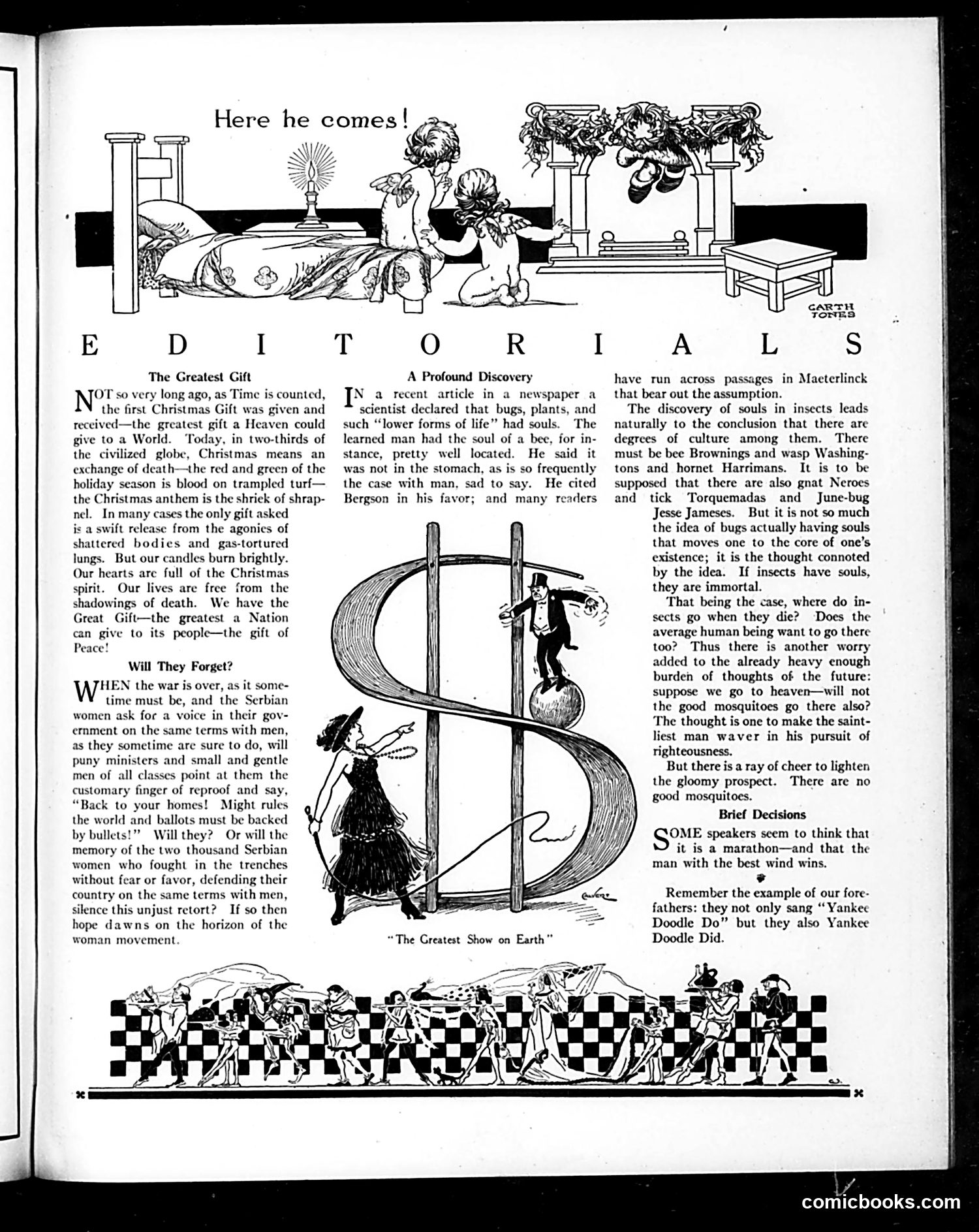
This page contains three separate editorial commentaries typical of Judge's satirical style: **"The Greatest Gift"** laments that Christmas 1918 (implied by WWI references) brings death rather than peace, yet argues Americans should be grateful for the "gift of peace" they enjoy while Serbs suffer in trenches. **"Will They Forget?"** advocates women's suffrage by referencing Serbian women fighting in WWI trenches. The satire challenges whether post-war governments will grant women voting rights or dismiss them with "back to your homes"—suggesting male leaders should remember women's wartime sacrifice. **"A Profound Discovery"** mocks a pseudo-scientific claim that insects possess souls, humorously extrapolating that insects must therefore have an afterlife. The punchline—"There are no good mosquitoes"—offers dark comic relief to the period's anxieties about mortality and eternity. All three pieces reflect post-WWI concerns: war's brutality, women's emerging political demands, and philosophical uncertainty about life's meaning.
📄 Transcribed text from this page (OCR, searchable)
Machine-transcribed from the original scan — historical spelling and the odd misread are preserved.
Here he comes! The Greatest Gift ‘OT so very long ago, as Time the first Christmas Gift was received—the greatest gift a Heaven could give to a World. ‘Today, in two-thirds of the civilized globe, Christmas means an exchange of death—the red and green of the holiday season is blood on trampled turf— the Christmas anthem is the shriek of shrap- nel. In many cases the only gift asked is a swift release from the agonies of shattered bodi and _ gas-tortured lungs. But our candles burn brightly. Our hearts are full of the Christmas spirit. Our lives are free from the shadowings of death. We have the Great Gift—the greatest a Nation can give to its people—the gift of Peace! Will They Forget? HEN the war is over, as it some- time must be, and the Serbian women ask for a voice in their gov- ernment on the same terms with men, as they sometime are sure to do, will puny ministers and small and gentle men of all classes point at them the customary finger of reproof and say, “Back to your homes! Might rules the world and ballots must be backed by bullets!” Will they? Or will the memory of the two thousand Serbian women who fought in the trenches without fear or favor, defending their country on the same terms with men, silence this unjust retort? If so then hope dawns on the horizon of the woman movement. A Profound Discovery N a recent article in a newspaper a scientist declared that bugs, plants, and such “lower forms of life” had souls. The learned man had the soul of a bee, for in- stance, pretty well located. He said it was not in the stomach, as is so frequently the case with man, sad to say. He cited Bergson in his favor; and many readers have run across passages in Maeterlinck that bear out the assumption. The discovery of souls in insects leads naturally to the conclusion that there are degrees of culture among them. There must be bee Brownings and wasp Washing- tons and hornet Harrimans. It is to be supposed that there are also gnat Neroes and tick Torquemadas and June-bug Jesse Jameses. But it is not so much the idea of bugs actually having souls that moves one to the core of one’s existence; it is the thought connoted by the idea. If insects have souls, they are immortal. That being the case, where do in- sects go when they die? Does the average human being want to go there too? Thus there is another worry added to the already heavy enough burden of thoughts of the future: suppose we go to heaven—will not the good mosquitoes go there also? The thought is one to make the saint- liest man waver in his pursuit of righteousness. But there is a ray of cheer to lighten the gloomy prospect. There are no good mosquitoes. Brief Decisions OME speakers seem to think that it is a marathon—and that the man with the best wind wins. * Remember the example of our fore- fathers: they not only sang ‘‘ Yankee Doodle Do” but they also Yankee Doodle Did. , comicbooks.com