
A complete issue · 28 pages · 1915
Judge — October 30, 1915
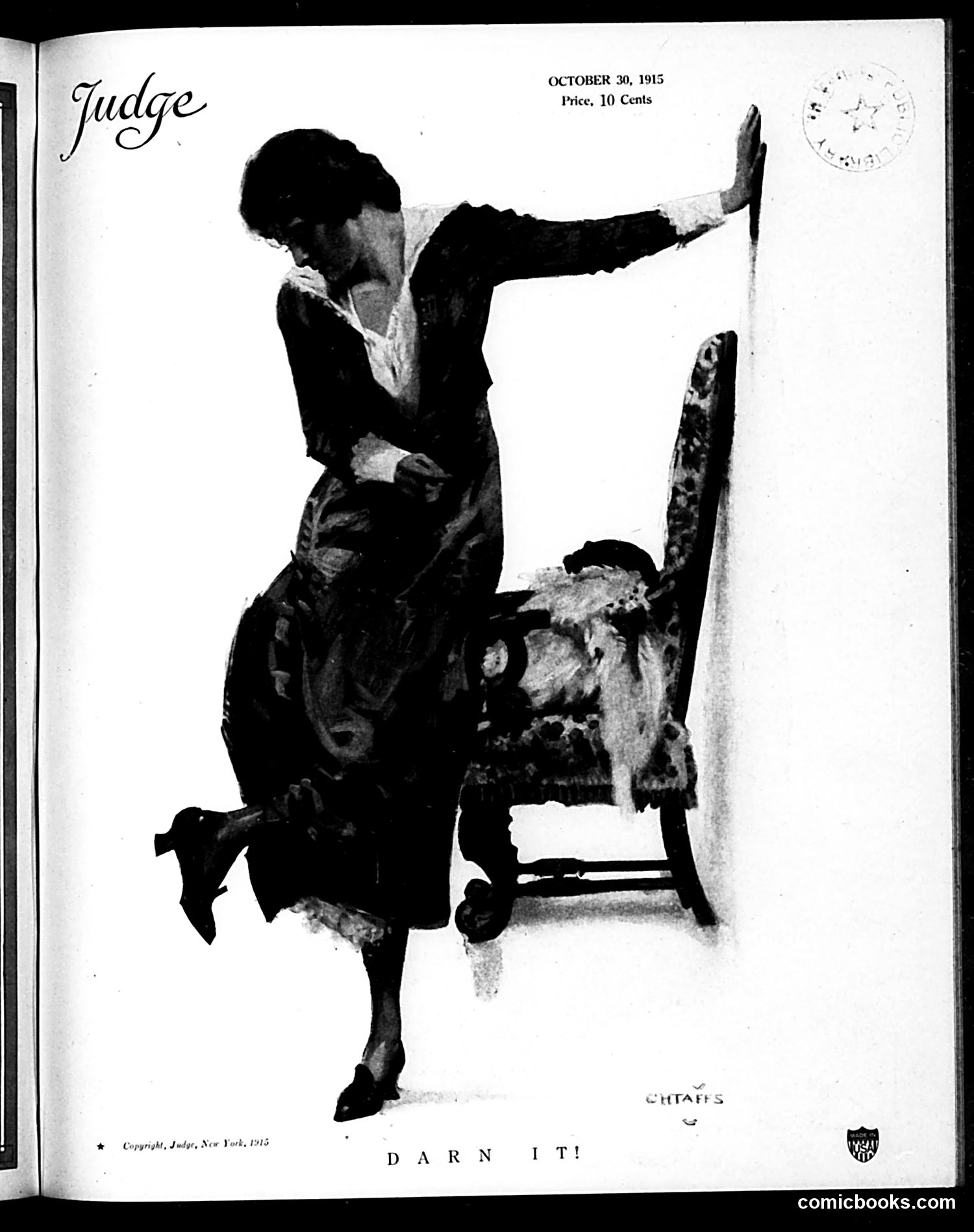
This cover satirizes a woman performing an acrobatic stunt on a chair—balancing precariously while kicking her leg high. The title "DARN IT!" suggests frustration or exasperation. The cartoon likely comments on women's changing social roles and fashion around 1915. The woman's active, physically daring pose contrasts sharply with Victorian expectations of feminine decorum. Her abbreviated skirt and athletic posture would have seemed scandalous to contemporary readers. The satire appears directed at **either** the absurdity of women adopting "unladylike" behavior, **or** mocking conservative anxieties about women's liberation and modern dress. The exaggerated, undignified pose emphasizes the satirical intent—Judge was poking fun at something about female behavior or social attitudes of the era, though whether mocking the women or their critics remains deliberately ambiguous.
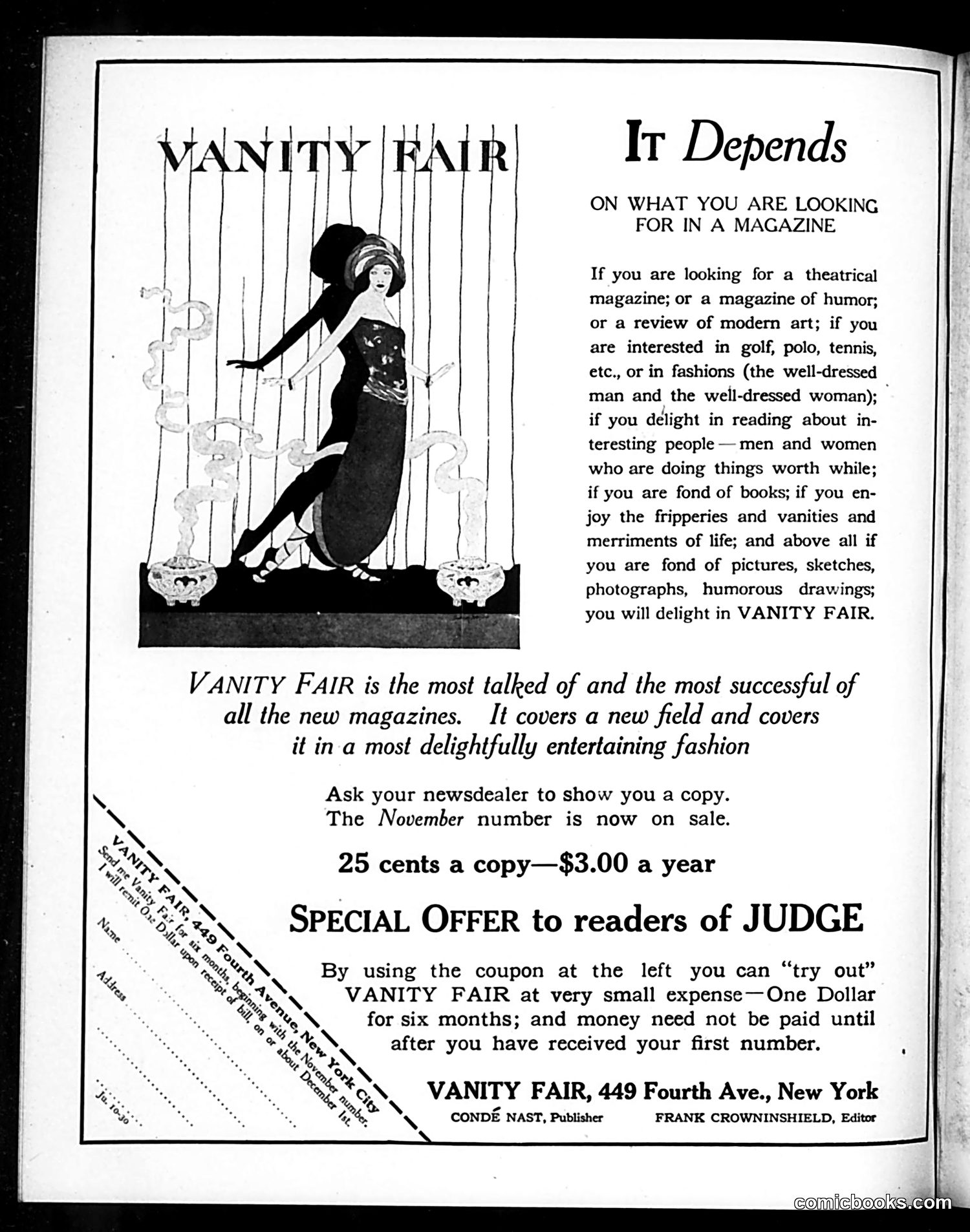
This page is primarily a **magazine advertisement**, not political satire. It promotes *Vanity Fair*, a new publication from Condé Nast, positioned as a sophisticated lifestyle magazine for affluent readers interested in theater, humor, fashion, sports, and society figures. The stylized illustration depicts a **fashionable 1920s woman** in an elegant black dress with headpiece, surrounded by hanging light fixtures—representing the magazine's focus on modern entertainment and high society. The text emphasizes *Vanity Fair* covers "a new field" in "entertaining fashion" and appeals to readers seeking art, books, and humorous content. A special coupon offers Judge magazine readers a trial subscription for one dollar for six months. Pricing: 25 cents per copy, $3 yearly.
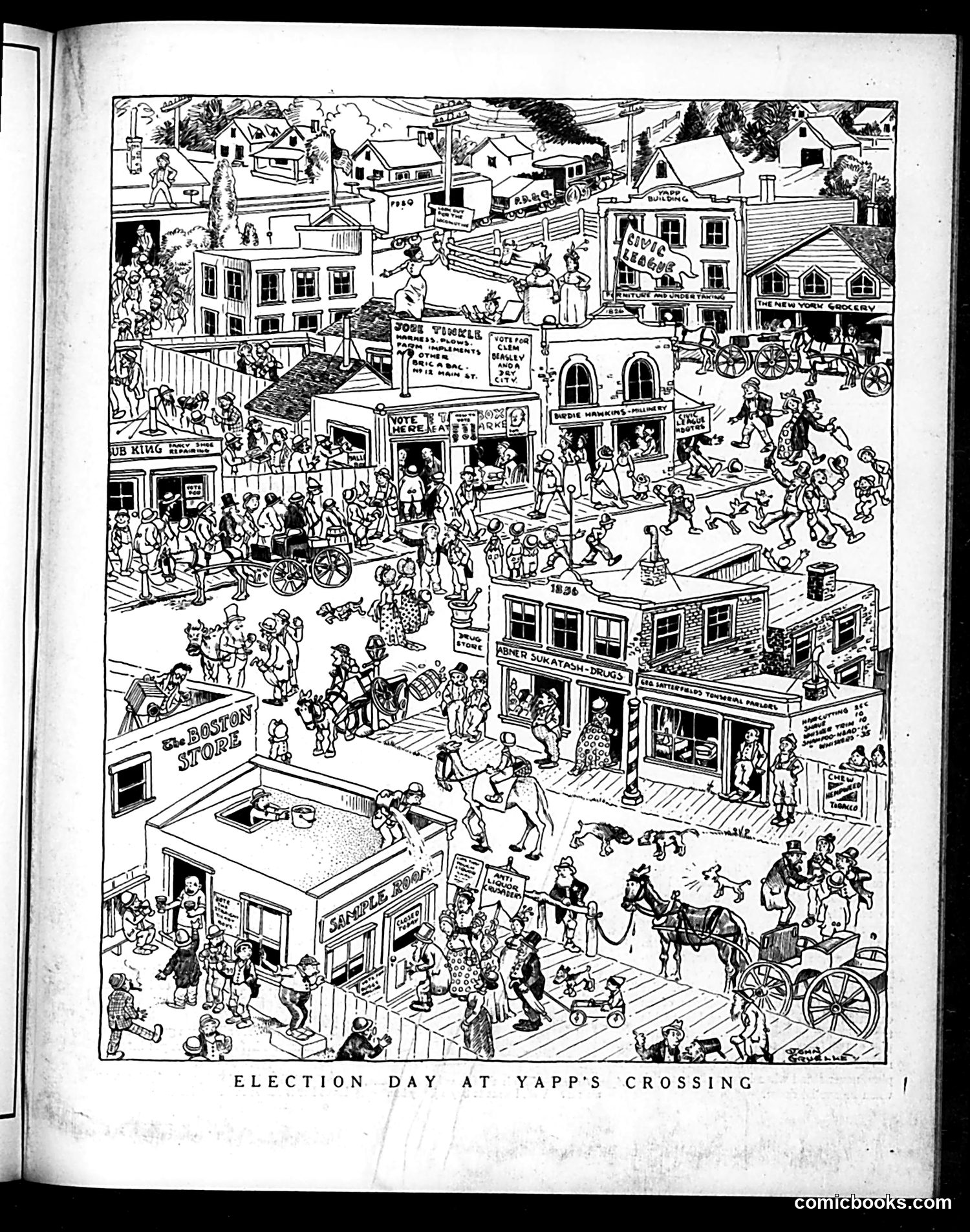
This is a busy satirical scene depicting a small-town election day, likely from the early 20th century. The illustration shows a crowded street scene with numerous storefronts, including "El Boston Store" and what appears to be various commercial establishments. The satire seems to mock the chaos and spectacle of American election day activities in rural or small-town America—showing everyday life, commerce, and social activity all converging around the voting process. The large crowd, diverse activities (children playing, people socializing, commercial transactions), and bustling energy suggest Judge magazine is satirizing how election day disrupts normal community life or perhaps critiquing the carnival-like atmosphere surrounding political participation. Without clearer text on individual storefront signs or specific political references visible in the image, the precise satirical target remains somewhat unclear, though the general commentary appears to be on small-town American electoral culture.
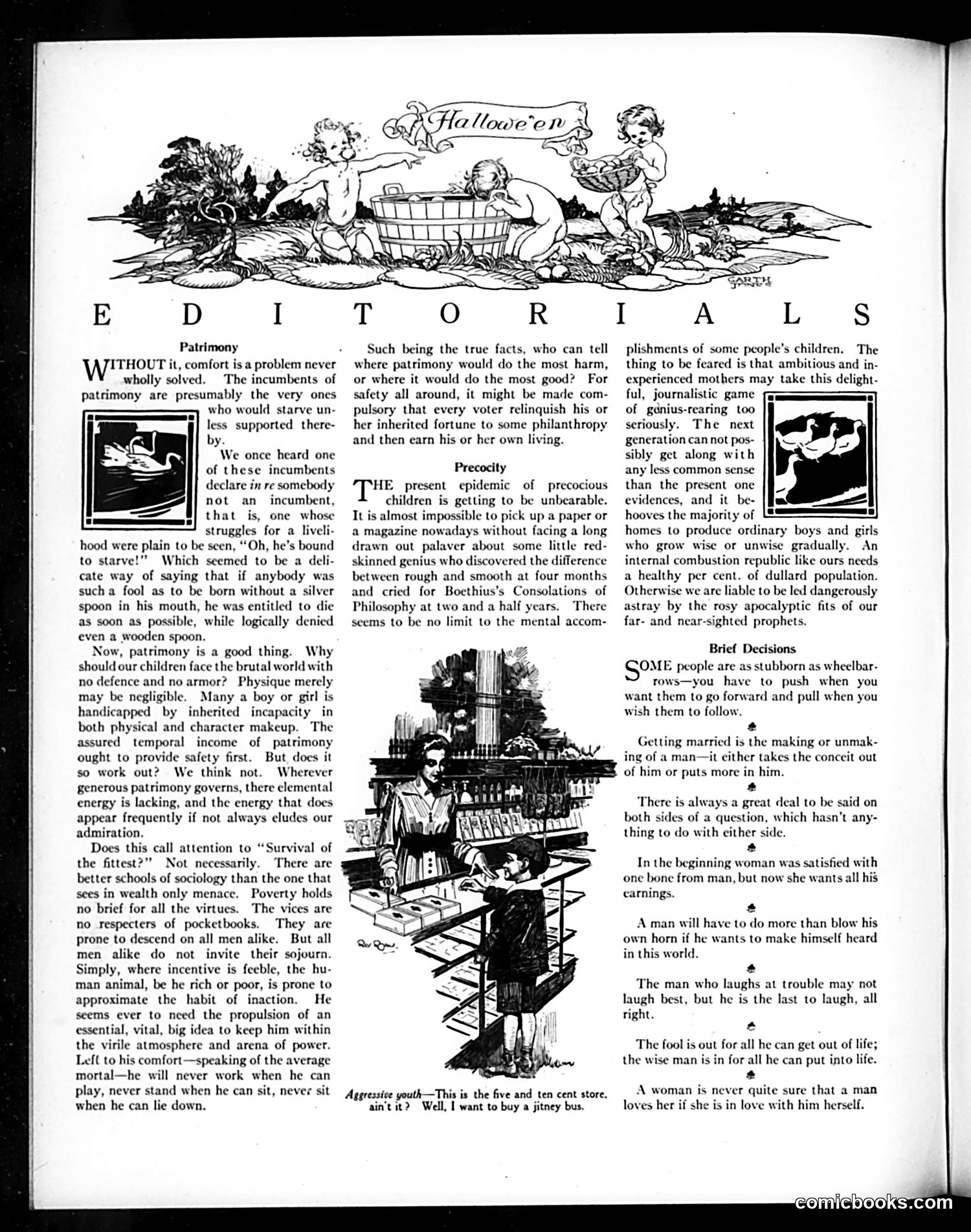
This is a "Hallowe'en Editorials" page featuring three distinct sections: **Left column ("Patrimony")**: Satirizes inherited wealth. The text argues that children of the poor face brutal survival struggles without safety nets, while wealthy heirs receive unearned security. The satire criticizes the hypocrisy of a system that abandons poor children to destitution while protecting rich ones through inheritance. **Center illustration**: Shows a woman at a printing press or similar machinery—likely commenting on women entering industrial/professional work, a contemporary social concern. **Right column ("Precocity")**: Attacks "precocious" children—those developing too quickly intellectually or morally. The author warns that ambitious journalists and reformers risk raising dangerously independent-thinking youth who challenge social norms, threatening established order. The page reflects Progressive Era debates about class inequality, child welfare, and social change.
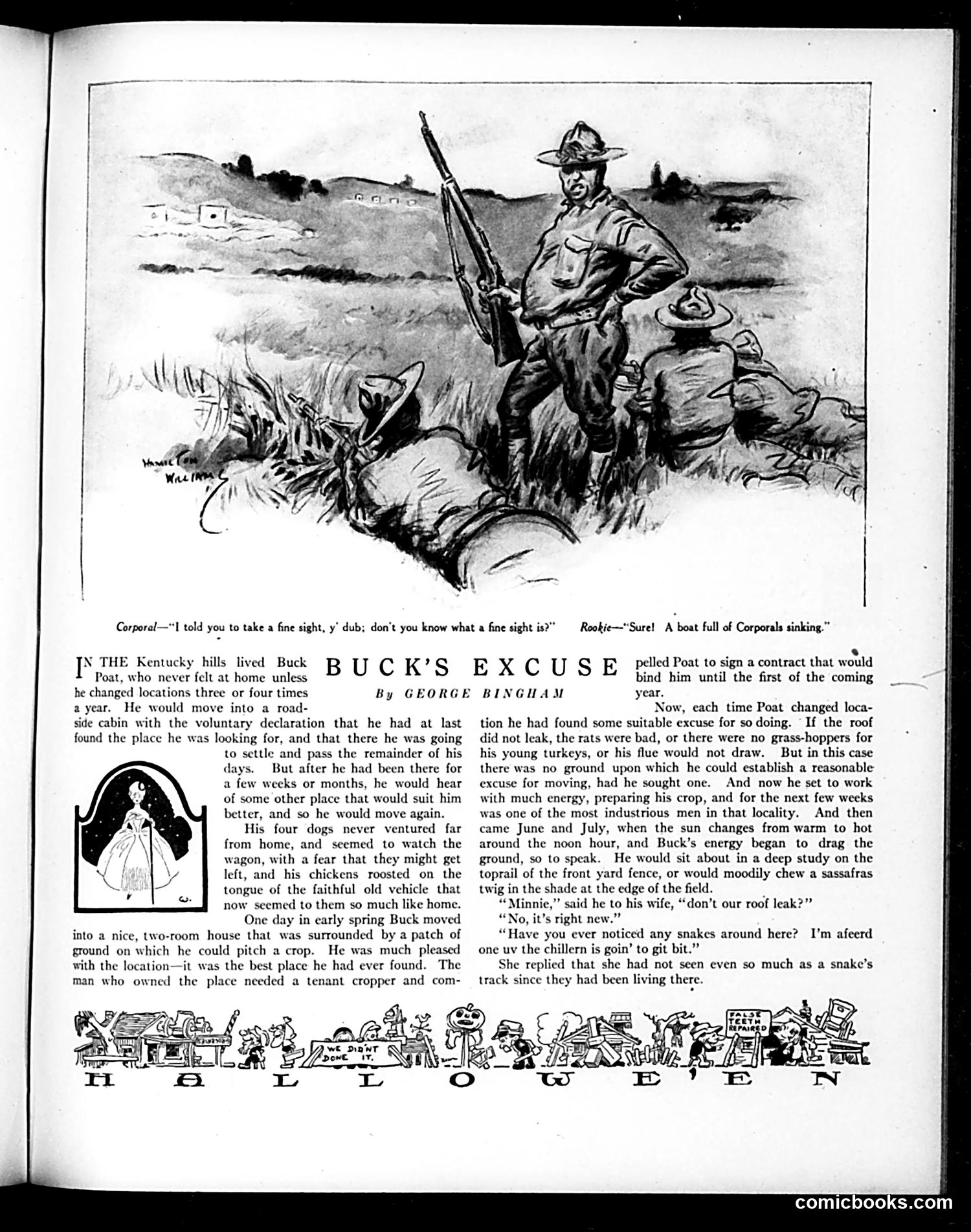
This story illustrates rural life in the Kentucky hills through the character Buck Poat, an itinerant farmer who constantly relocates with thin pretexts. The narrative satirizes a type of perpetually restless person who claims each new location will be permanent, only to move again within months. The opening illustration shows a soldier and rookie discussing a sinking boat—likely referencing military service or duty. The main story depicts Buck's latest excuse for relocating: he claims his current property lacks suitable conditions for farming (poor drainage, snakes, inadequate shelter for livestock). The humor derives from the transparent nature of these excuses and Buck's wife Minnie's skeptical responses, suggesting Buck's chronic inability or unwillingness to establish roots anywhere.
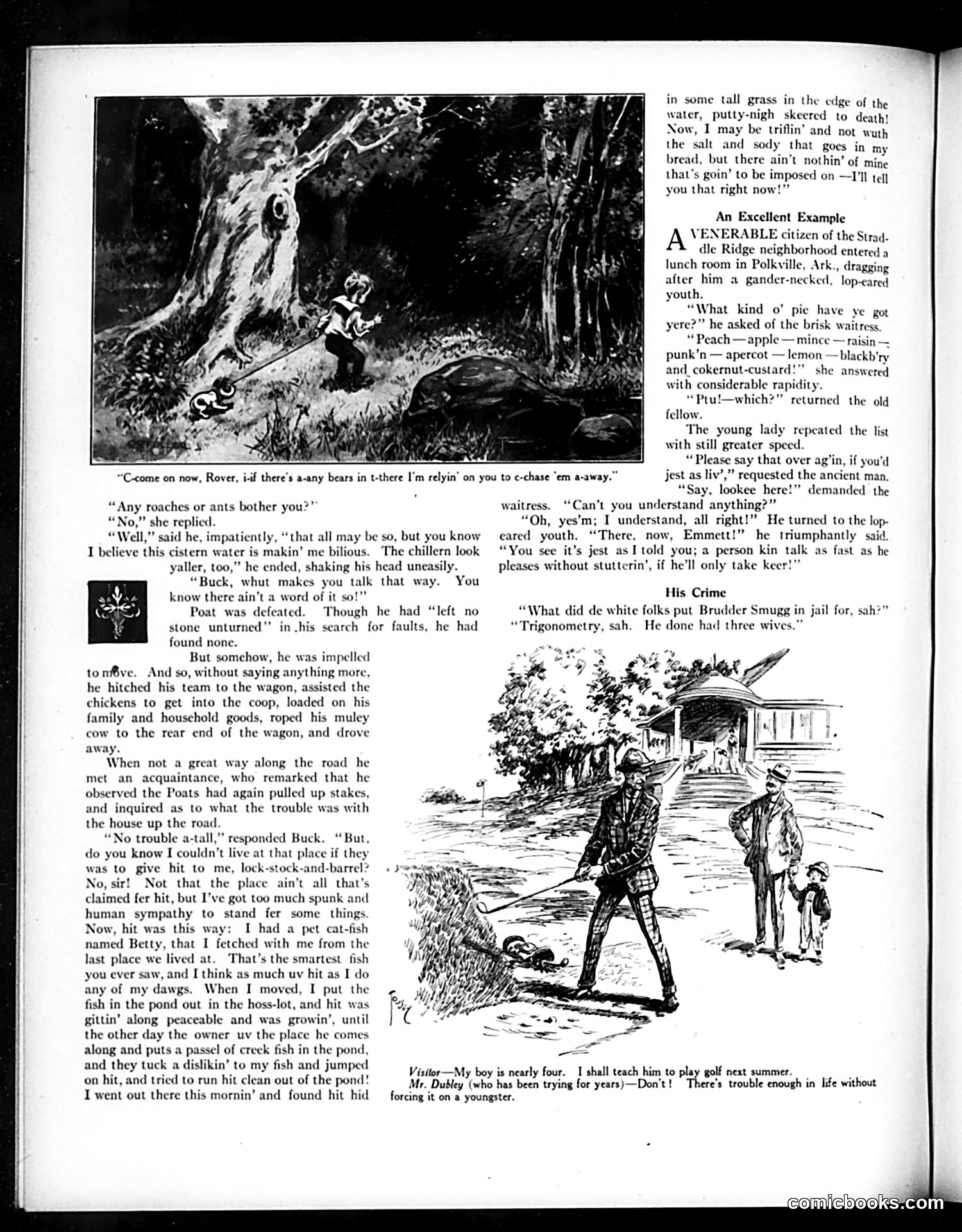
This page contains two humorous rural dialect stories satirizing rural American speech and behavior, plus one brief joke about race and crime. **"An Excellent Example"** mocks a country man's inability to understand rapid speech—a waitress lists pie varieties so quickly he can't comprehend her. The joke's point: his slow-talking grandson, by contrast, speaks so deliberately that even a stutterer can understand him clearly. The satire targets rural ignorance and slow cognition. **"His Crime"** is a brief, darkly comic racial stereotype: a Black man named "Brudder Smugg" is jailed for "trigonometry"—a play on words suggesting marital infidelity ("three wives") rather than the mathematical term. This reflects era-typical racist humor in mainstream publications. The larger story about "Buck" concerns a man who abandons his home because creek fish attacked his pet catfish—absurd reasoning that ridicules rural sentimentality and illogical decision-making. Overall, this page exemplifies Judge's humor targeting rural, uneducated Americans and racial stereotypes typical of early 20th-century American satire.
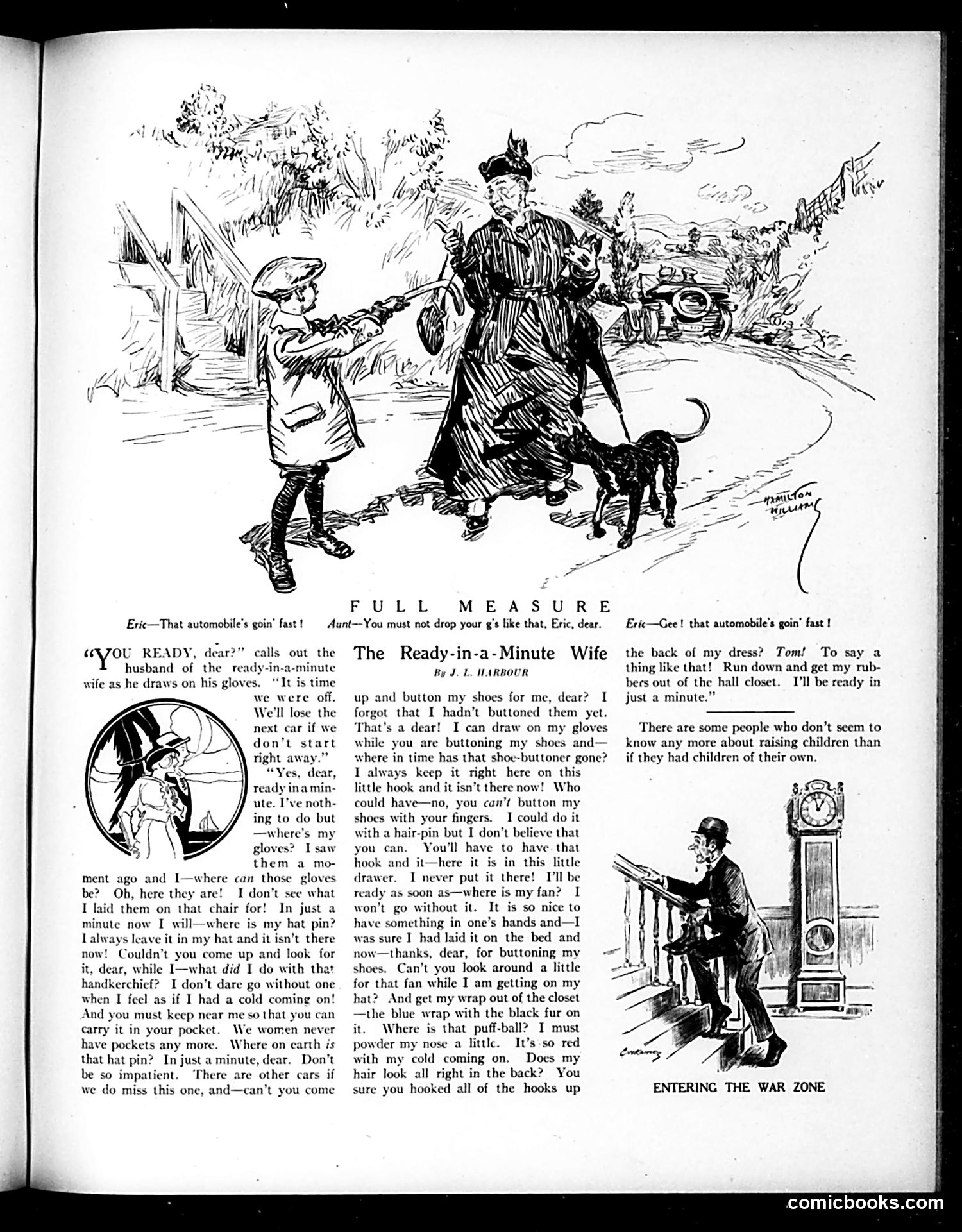
This satirical piece mocks the stereotype of wives who claim to be "ready in a minute" but endlessly delay departure through a cascade of last-minute requests. The husband waits while his wife searches for gloves, hat pins, handkerchiefs, shoe-buttoners, fans, and wraps—each discovery prompting another task. The joke captures early-20th-century gender dynamics: women lacked pockets, required assistance buttoning shoes, and relied on husbands to fetch items. The wife's constant refrain—"I'll be ready in just a minute"—contrasts sharply with the husband's repeated observation that the automobile is "going fast" (implying they're missing their departure window). The accompanying cartoon "Full Measure" and "Entering the War Zone" appear unrelated to this domestic humor, suggesting the page contains multiple satirical pieces typical of Judge magazine's format.
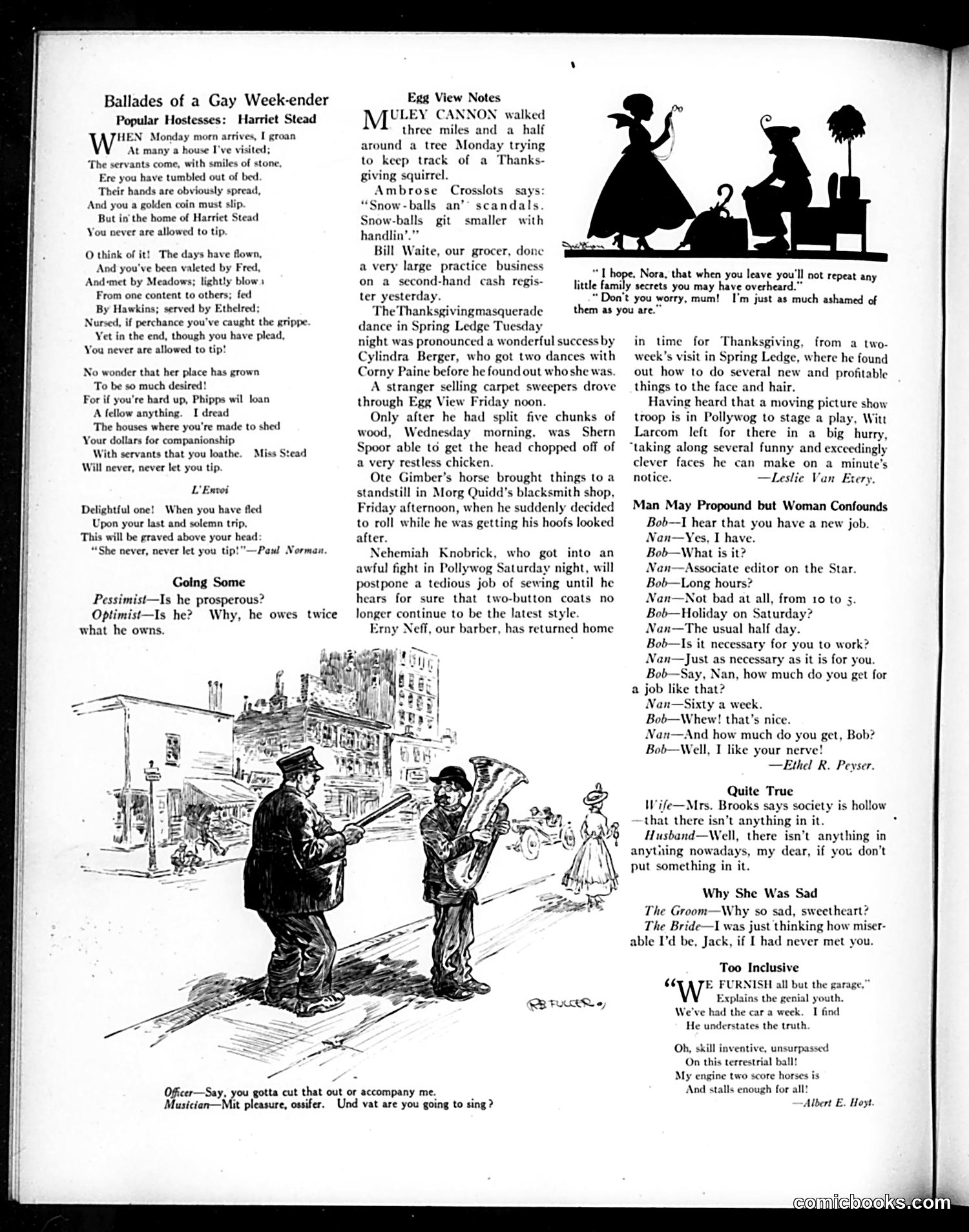
This page from *Judge* magazine contains satirical commentary on early 20th-century American social customs and gender dynamics. **"Ballades of a Gay Week-ender"** celebrates Harriet Stead as an exceptional hostess because she **doesn't allow guests to tip servants**—a sharp critique of the era's expectation that visitors financially supplement staff wages. The satire mocks how most hosts tolerate this exploitative practice, making Stead's prohibition genuinely remarkable. **"Egg View Notes"** offers rural small-town gossip presented as humorous local color, depicting quirky rural characters and minor incidents (a woman chasing a squirrel, a grocer using a broken register). **"Man May Propound but Woman Confounds"** uses a dialogue between Bob and Nan to satirize gender inequality: when Nan becomes a newspaper associate editor, Bob assumes she works from financial necessity rather than professional ambition—yet he himself works without justification being questioned. The humor exposes the double standard. **"Quite True"** presents a brief marital joke about society's hollowness, suggesting wives have the final word in domestic judgment. The cartoons support these themes through visual commentary on class and social pretension.
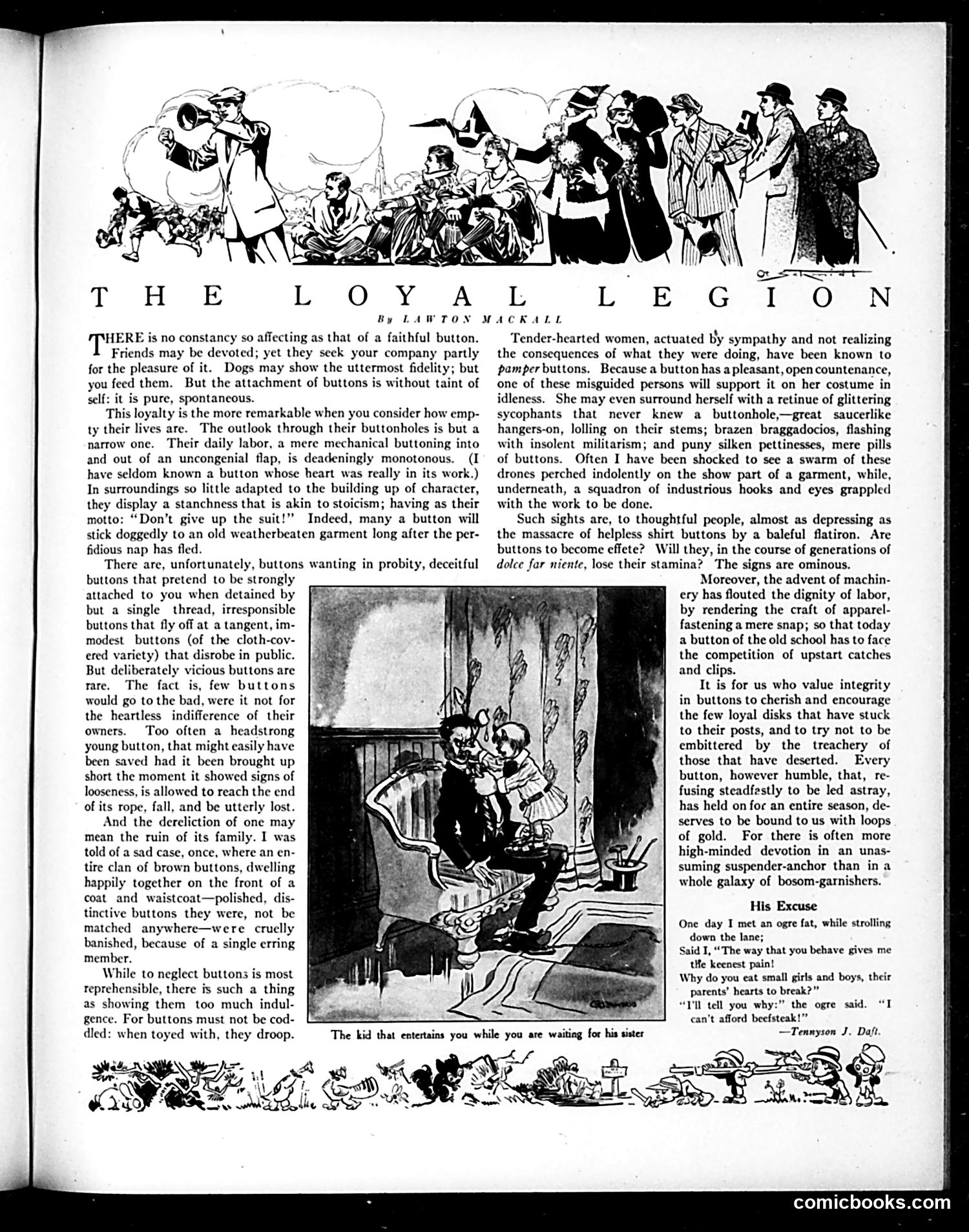
This is a humorous *mock-serious* essay anthropomorphizing buttons as characters deserving respect and loyalty. The satire works by treating buttons with exaggerated moral gravity—praising their "faithfulness," lamenting those who abandon their posts, and mourning buttons lost to wear. The central joke targets **human negligence and sentimentality**: the author criticizes both owners who carelessly lose buttons and sentimental women who "pamper" them with decorative hangers and ornaments rather than letting them do honest work. There's also social commentary about **industrialization**—new mechanical fasteners (clips, catches) threaten buttons' traditional dignity as craftsmen. The accompanying illustration shows a figure entertaining someone while waiting, satirizing idle, decorative dress accessories. The humor appeals to readers who value Victorian-era notions of duty, hard work, and straightforward practicality over frivolous ornamentation. It's gentle social criticism wrapped in absurdist fantasy.
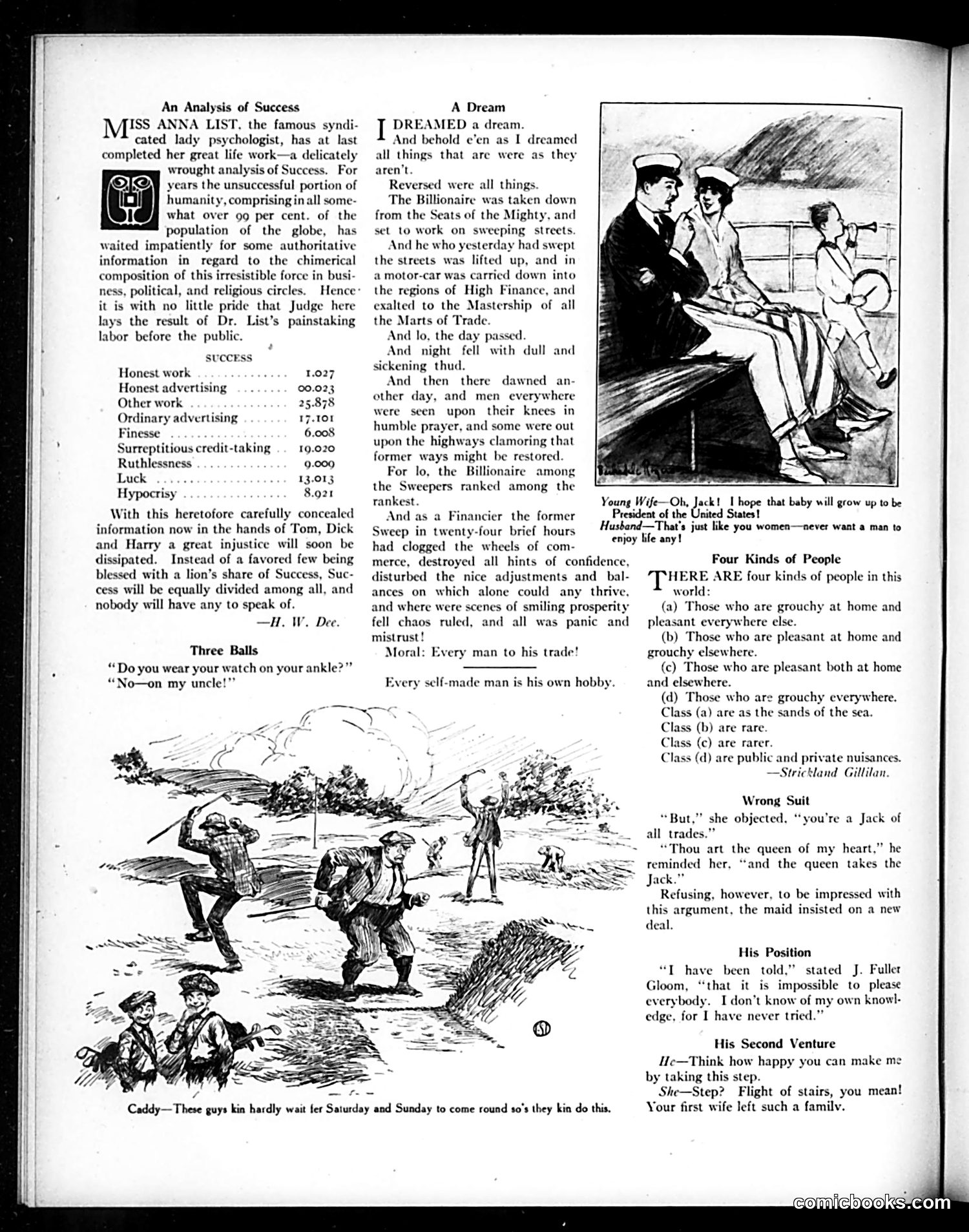
This page from the satirical magazine *Judge* contains several pieces mocking American social pretensions and class dynamics circa early 20th century. **"An Analysis of Success"** satirizes the notion that success can be scientifically reduced to percentages. The joke: honest work comprises only 1.027% of success, while hypocrisy (8.921%) and luck (13.013%) matter far more. The author mocks that once ordinary people understand this "formula," success will become democratized—and thus worthless. **"A Dream"** presents a fantasy of complete social reversal: billionaires sweep streets, street sweepers control finance. The moral punch: society requires hierarchy; disrupting it causes economic chaos. People immediately pray for restoration of the old order. **Other vignettes** include gentle domestic humor ("Three Balls" ankle-watch joke), a woman rejecting a suitor as unsuitable ("Wrong Suit"), and observations on human temperament. The overall tone reflects *Judge's* conservative satirical stance: critiquing both naive optimism about social mobility and the pretensions of the wealthy, while ultimately defending existing class structures as necessary.
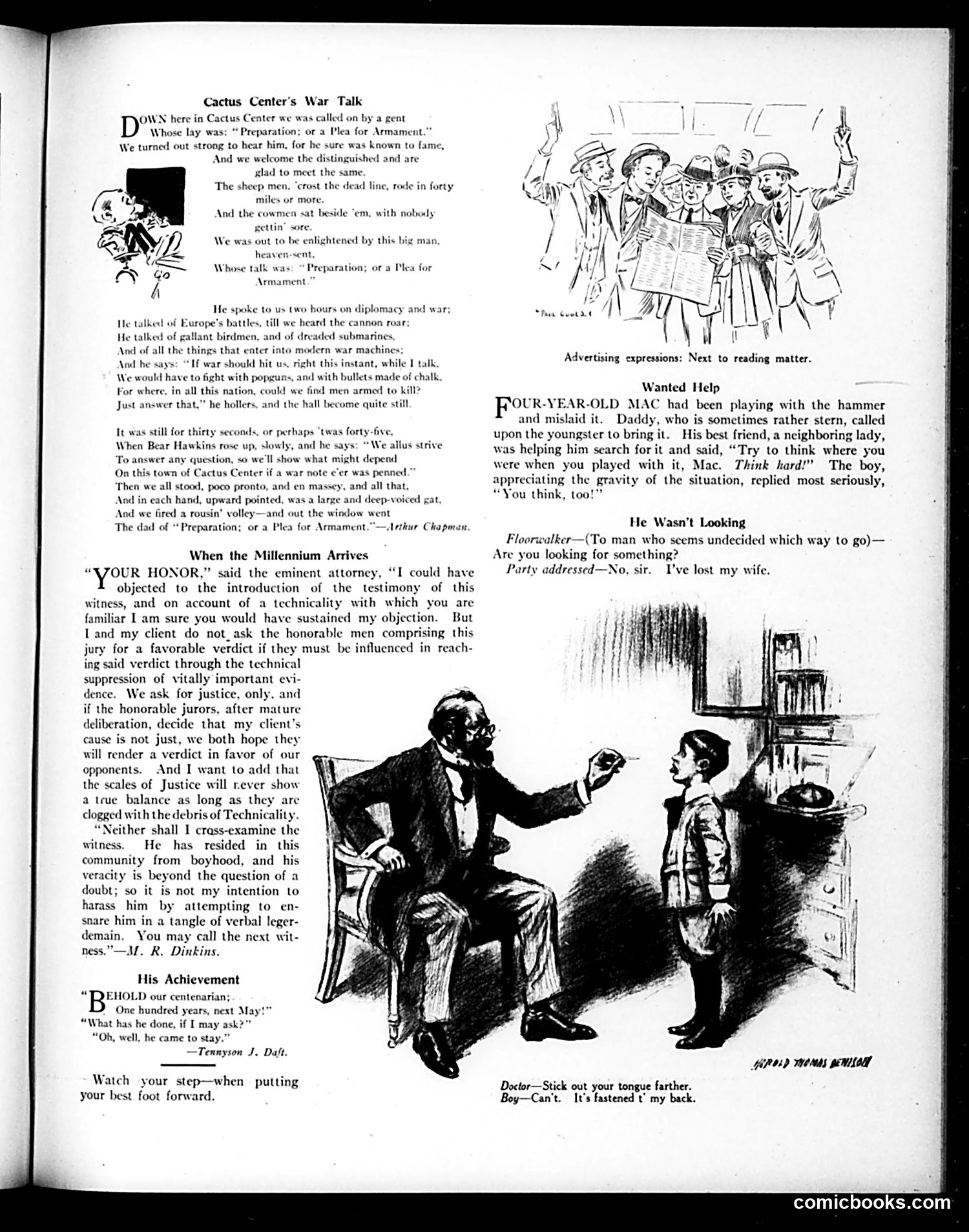
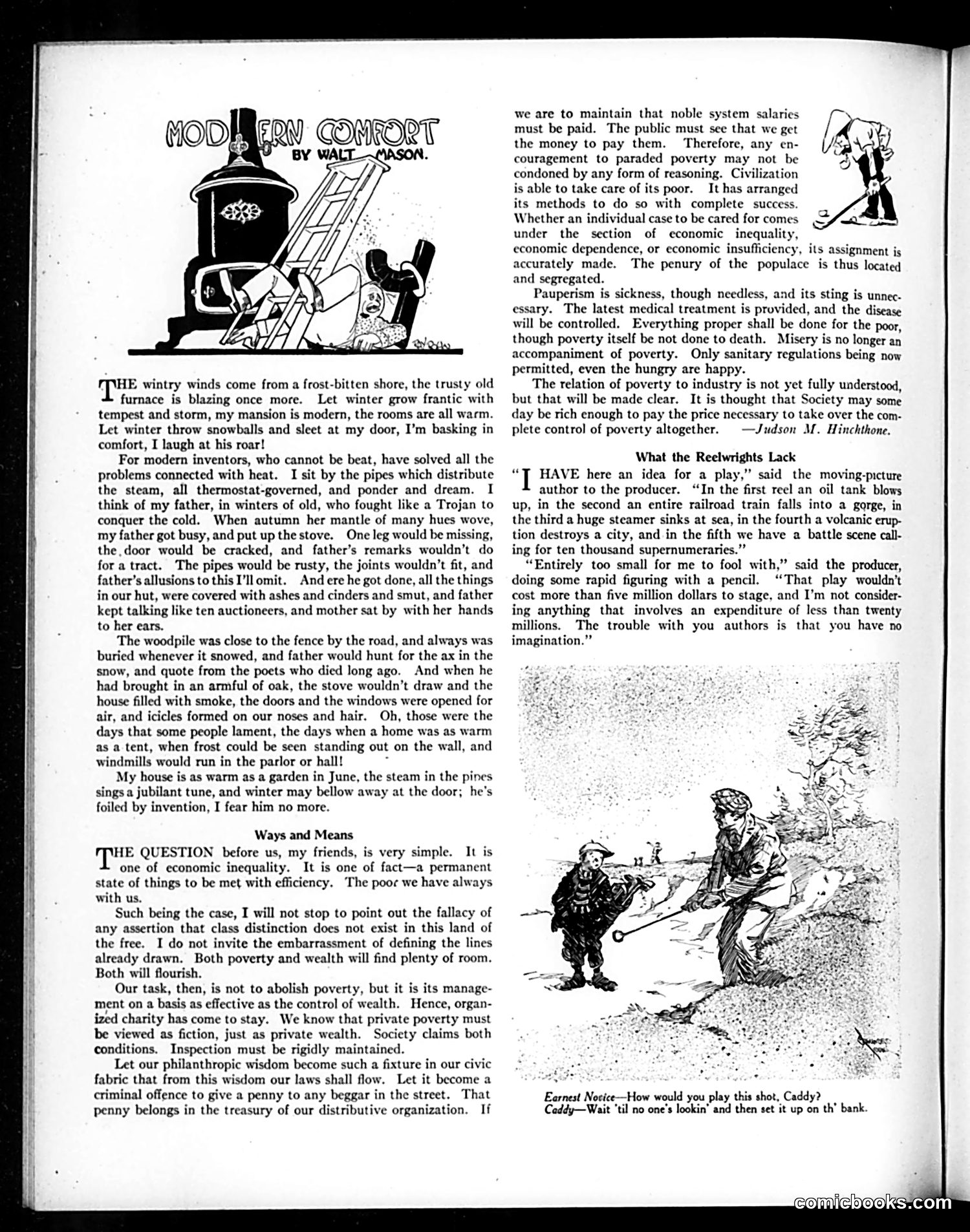
**Top Section ("Modern Comfort"):** This poem celebrates modern heating technology—steam furnaces and thermostats—contrasting comfortable contemporary living with the hardships of previous generations. The narrator mocks his father's struggle with old wood stoves: cracked doors, rusty pipes, smoke-filled houses, and frozen conditions. The satire is gentle: progress has genuinely improved domestic comfort. **Bottom Section ("Ways and Means"):** This is sharper social satire. The speaker argues that poverty is inevitable and shouldn't be "abolished" but rather "managed" through organized charity and government control. The radical proposal: make private charity illegal; all relief money should flow through official bureaucratic channels to pay administrative salaries. The satire targets Progressive-era charity reformers and bureaucrats who claimed to help the poor while primarily enriching themselves and expanding government power. The speaker's language—"inspection must be rigidly maintained"—exposes the paternalistic, controlling nature of such systems. Together, the page contrasts technological progress (genuinely beneficial) with social "progress" (self-serving bureaucracy disguised as charity).
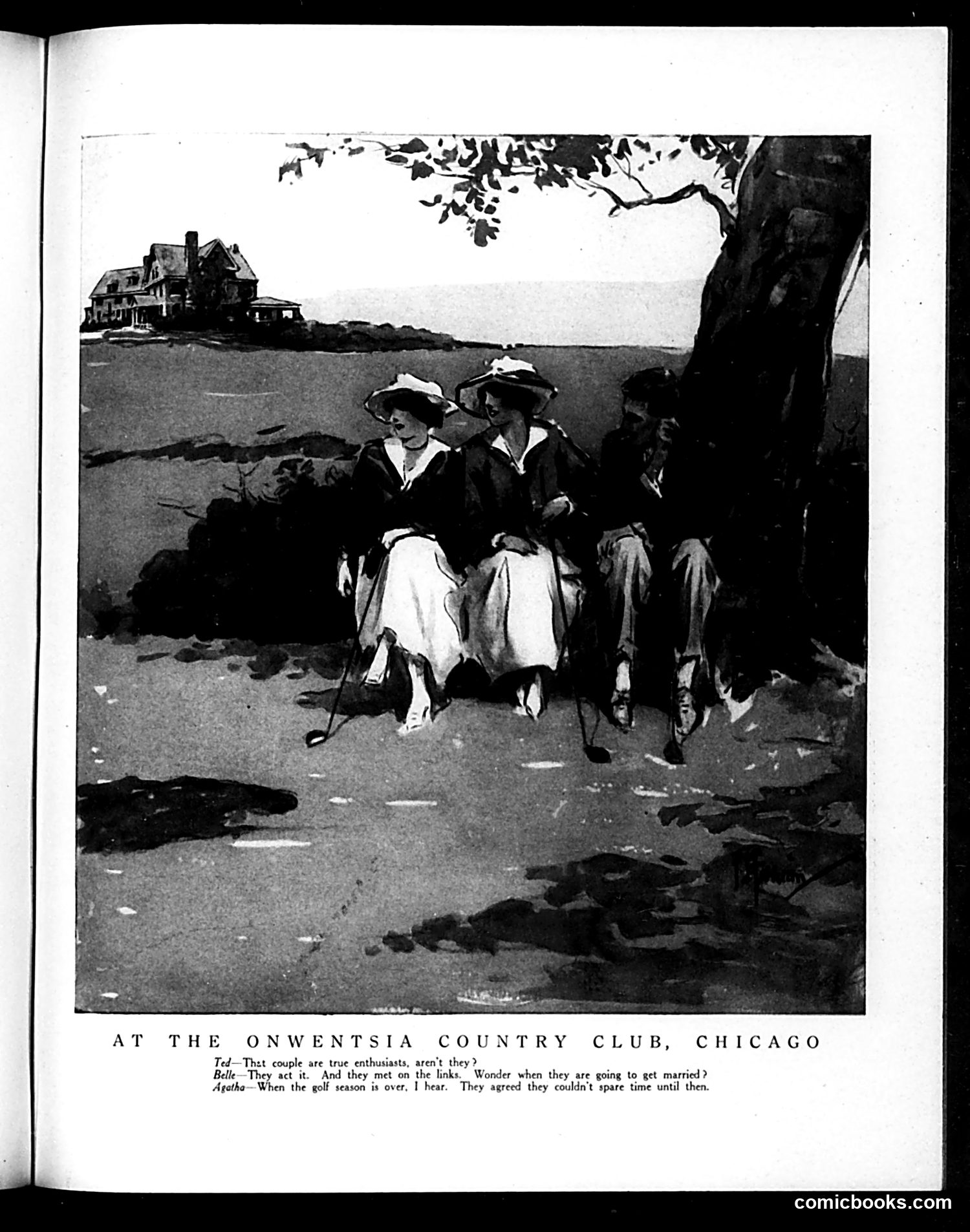
This is a satirical scene at an exclusive Chicago country club depicting the leisure priorities of wealthy Americans. Three women gossip about a couple who met playing golf and have postponed their wedding until after the golf season ends—implying that their passion for the sport exceeds their romantic commitment. The joke targets the upper class's obsession with golf as a social activity and status symbol during the early 20th century. By having the couple prioritize the golf season over marriage, the cartoon gently mocks the affluent for their skewed values: their recreational pursuits matter more than major life events. The setting—a country club with its manicured grounds and distant mansion—reinforces the exclusivity and self-absorption of this social circle.
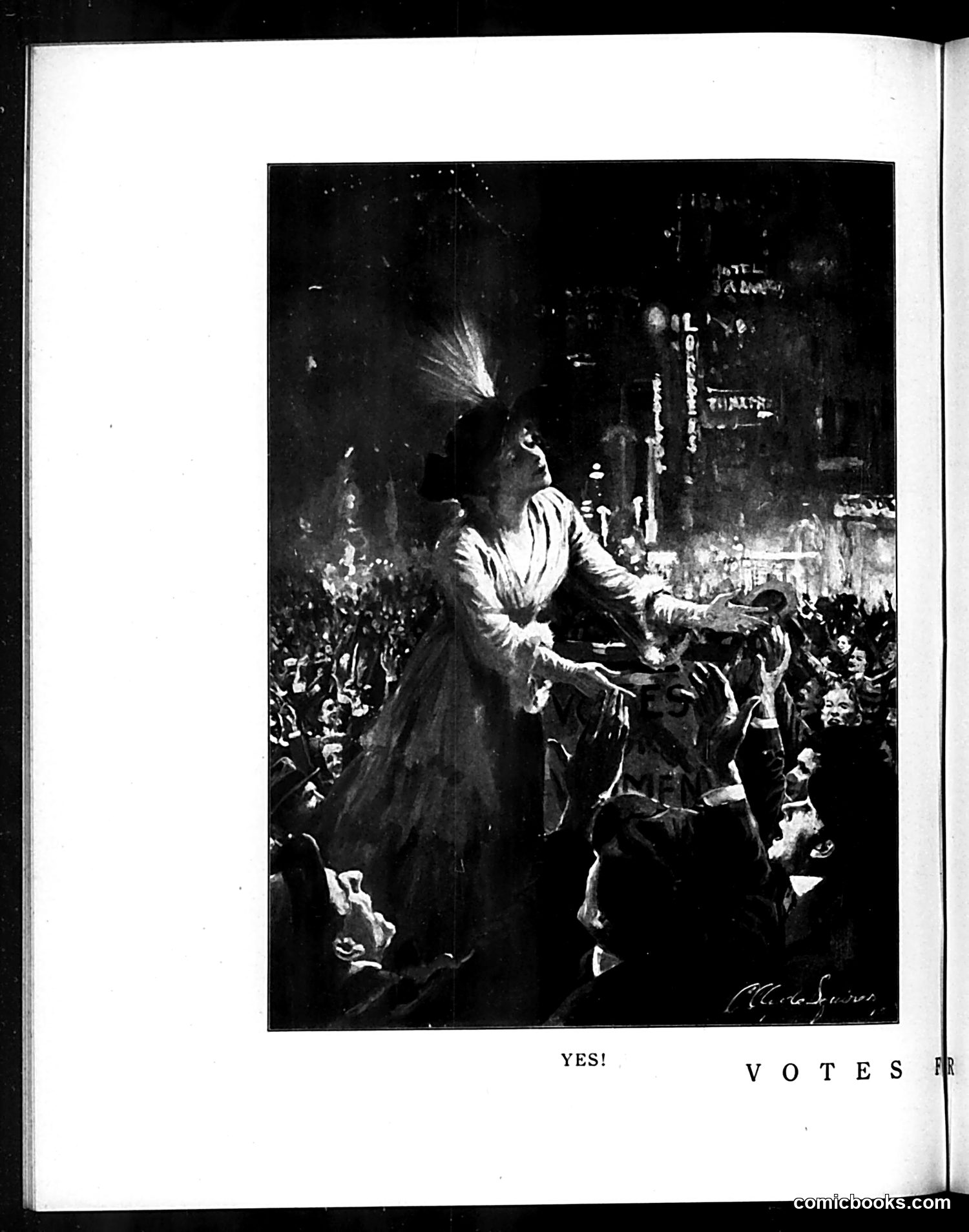
This appears to be a suffrage propaganda image from Judge magazine, likely early 20th century. The image shows a woman in light-colored clothing addressing a large crowd in an urban street setting at night, with buildings and signage visible in the background. The caption reads "YES! VOTES FOR" (text cut off), clearly advocating for women's voting rights. The woman appears to be a suffragist speaker or activist rallying public support for the cause. The dramatic nighttime urban setting and massive crowd suggest the growing political movement and public momentum behind women's suffrage during this era. The image serves as pro-suffrage propaganda, depicting women's enfranchisement as a popular, energetic cause worthy of public enthusiasm and support.
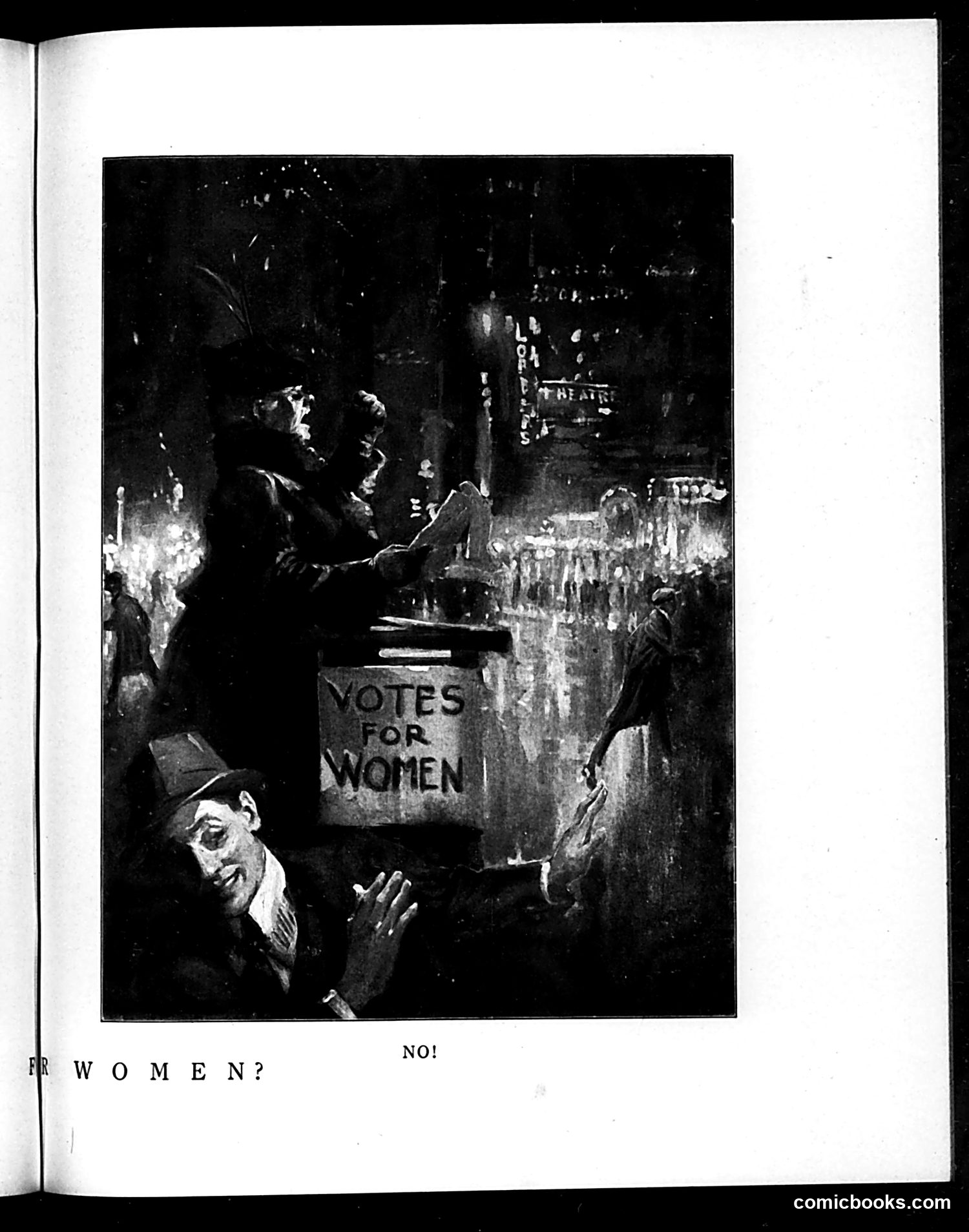
This is an anti-suffrage cartoon from *Judge* magazine opposing women's voting rights. The image depicts a nighttime street scene with a ballot box labeled "VOTES FOR WOMEN" surrounded by caricatured figures, some appearing grotesque or menacing. The page text asks "FOR WOMEN?" with the emphatic response "NO!" The cartoon employs visual rhetoric common to anti-suffrage propaganda: depicting voting women as attracting disorder, vice, or social chaos. The darkened, crowded setting and exaggerated character depictions suggest suffrage would introduce undesirable elements into the political process. This reflects the early 20th-century opposition to women's suffrage, which *Judge*—despite its satirical reputation—actively campaigned against before women gained voting rights in 1920.
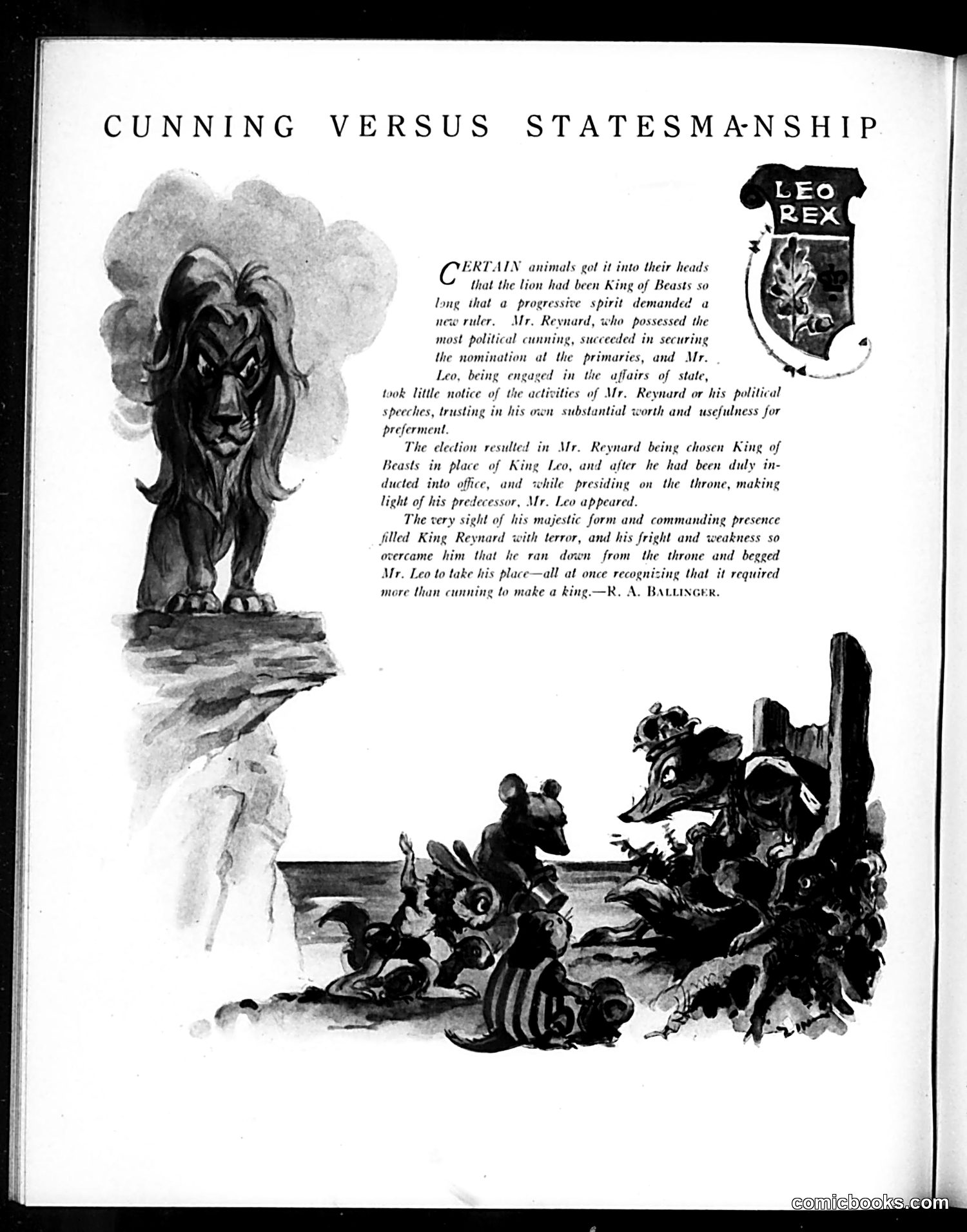
This allegorical fable compares political leadership styles using animal characters. Mr. Reynard (the fox—traditionally cunning in folklore) represents a scheming politician who wins election through manipulation and political maneuvering while Mr. Leo (the lion) represents an established, dignified leader focused on actual governance rather than campaigning. The satire argues that Reynard's political cunning secured the nomination at primaries, but once in power, his lack of genuine statesmanship becomes apparent. When Leo reappears, Reynard's weakness is exposed—he immediately surrenders the throne, recognizing that mere cunning cannot sustain legitimate authority. The cartoon criticizes politicians who prioritize electoral tactics over actual competence and character. It suggests that genuine leadership requires more than calculated maneuvering; it demands substantial worth and commanding presence. The moral: voters should value proven statesmanship over political cleverness.
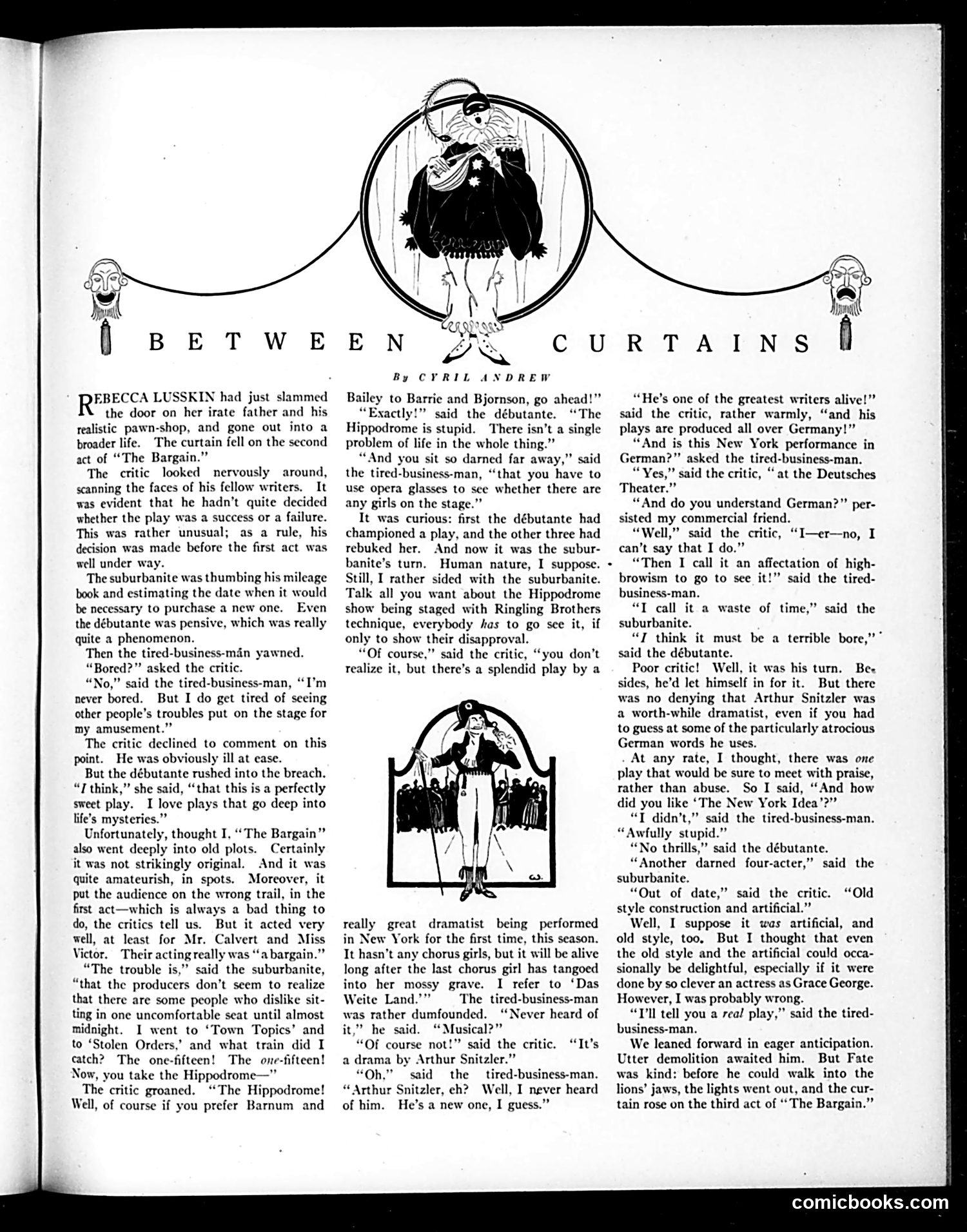
This is theater criticism satire by Cyril Andrew in *Judge* magazine. After a play called "The Bargain" closes, four characters debate its merit: a critic, a tired businessman, a débutante, and a suburbanite. The satire targets theatrical pretension. The critic champions "Das Weite Land" by Arthur Schnitzler—a serious European drama—as superior art. However, when pressed, he admits he doesn't understand German and is seeing it performed *in German* at a German theater. The tired businessman calls this "affectation," exposing the critic's snobbish posturing: he champions an incomprehensible play merely because it's highbrow and European, not because he can actually appreciate it. The cartoon mocks critics who adopt intellectual airs without genuine understanding, and the clash between "serious" theater advocates and audiences seeking accessible entertainment. The debate reflects early 20th-century cultural tensions between avant-garde European drama and popular American theater.
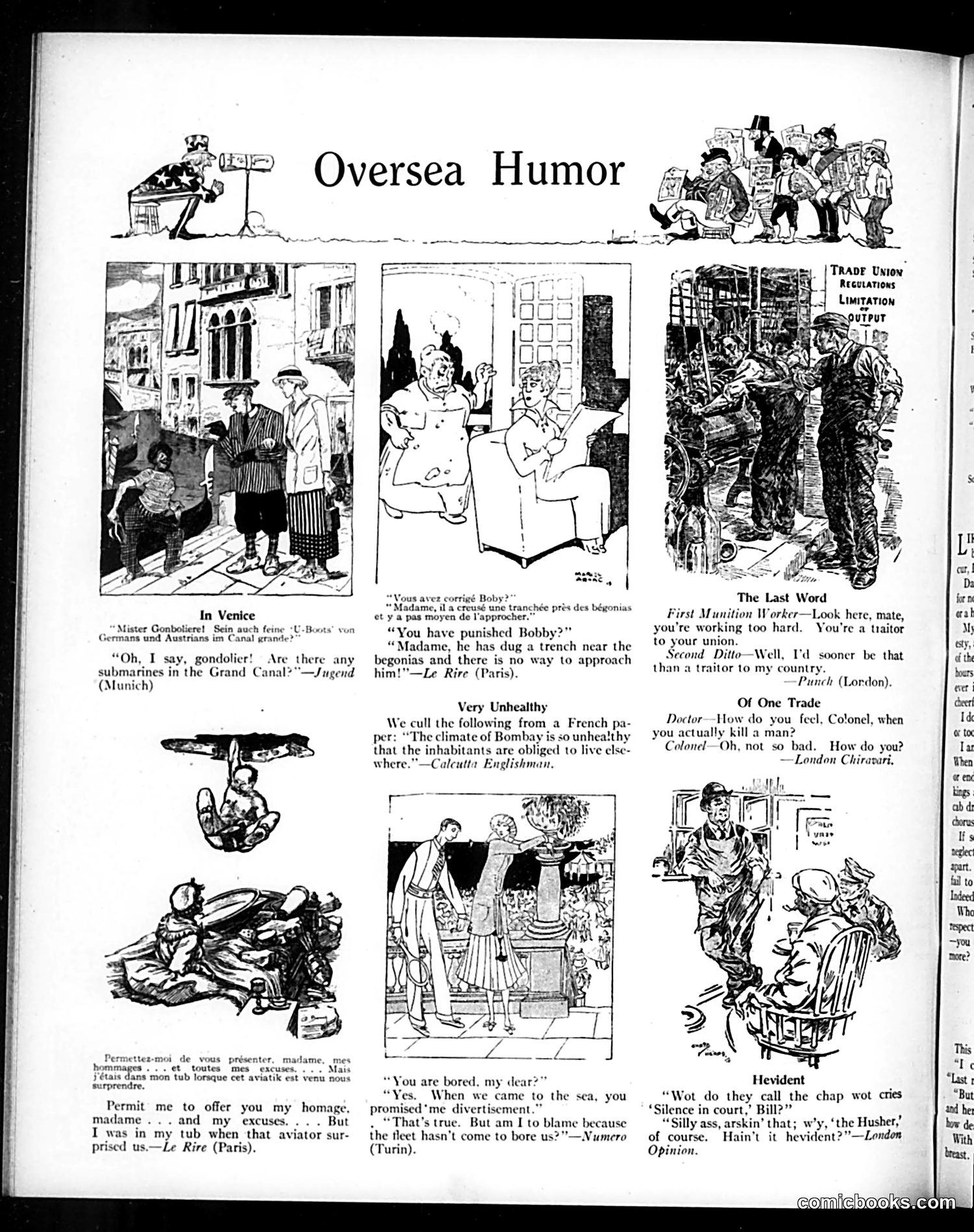
This page collects humorous anecdotes from European publications, reflecting early WWI anxieties and social commentary circa 1914-1918. **Key themes:** **Military anxieties:** The Venice cartoon jokes about German U-boats (submarines) in the Grand Canal—reflecting fears of German naval warfare. The French piece about a child digging trenches near begonias darkly references trench warfare's ubiquity in public consciousness. **Home front tensions:** A "Trade Union Regulations" cartoon satirizes labor disputes during wartime, pitting union loyalty against patriotic duty—a genuine social conflict of the period. **Gender and class humor:** Several jokes involve upper-class leisure (boredom, bathing) disrupted by war, and servants/working-class figures with comedic dialect. **Colonial commentary:** The Bombay climate joke reflects British imperial perspectives on India. The page demonstrates how wartime satire simultaneously mocked enemy threats, questioned civilian priorities, and reinforced class hierarchies through humor—typical of Judge magazine's middle-class satirical approach to global conflict.
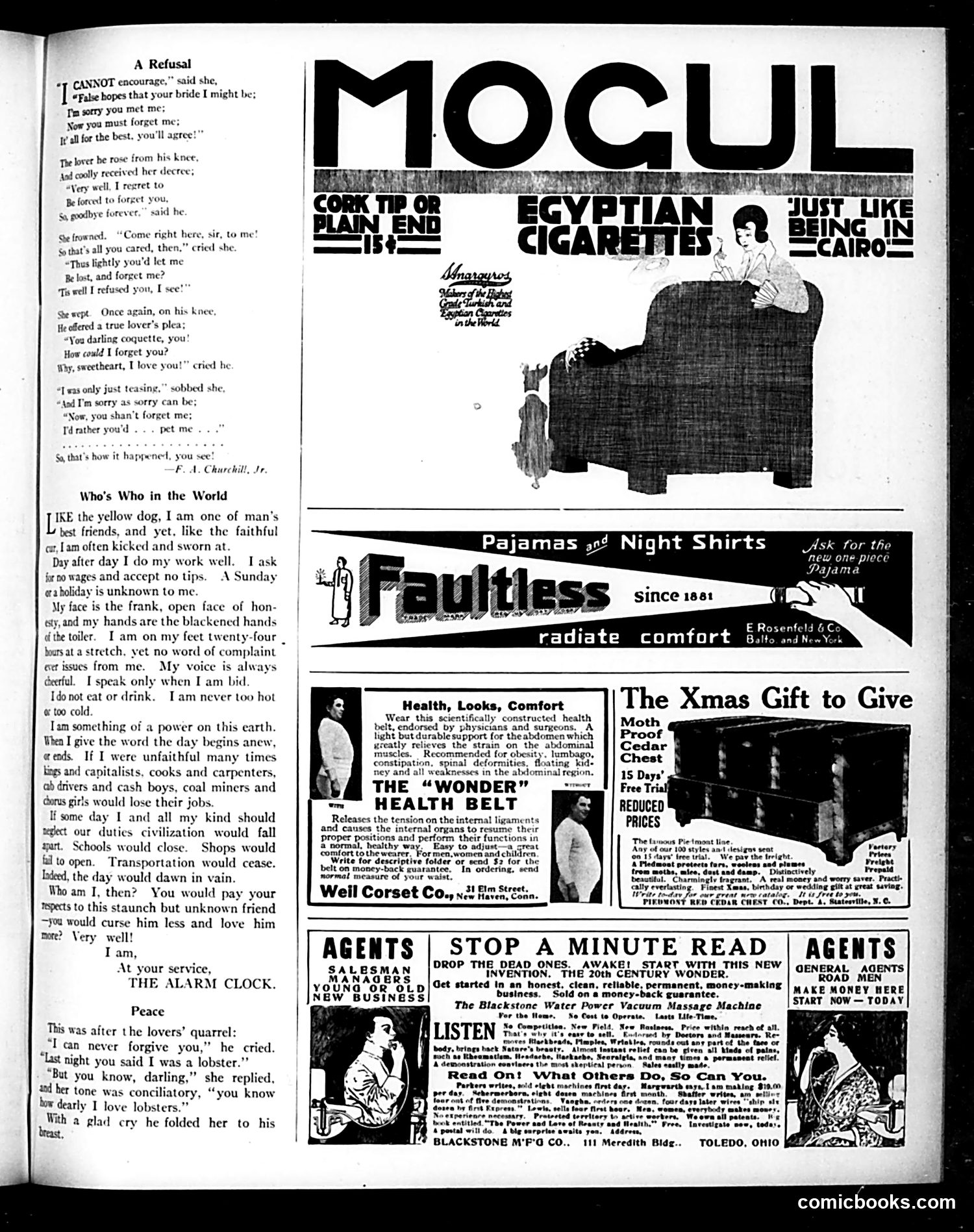
This page is primarily **advertisements and light fiction**, not political satire. The main content includes: **Fiction pieces:** "A Refusal" (a romantic story about a woman who rejects then reconsiiders a suitor) and "Who's Who in the World" (a personified essay where the Alarm Clock describes its importance to society). **Advertisements:** The page features multiple product ads typical of early 20th-century magazines—Egyptian cigarettes, Faultless pajamas, a "Wonder Health Belt" (a dubious medical device), cedar chests, and business opportunities. These ads reflect period consumer culture and pseudo-scientific health claims now recognized as fraudulent. **The humor** in the fiction is domestic and sentimental rather than political—focused on courtship dynamics and gentle satire of everyday life rather than current events or social commentary. The page demonstrates Judge's mixed format: entertainment and advertising revenue, with minimal political content visible here.
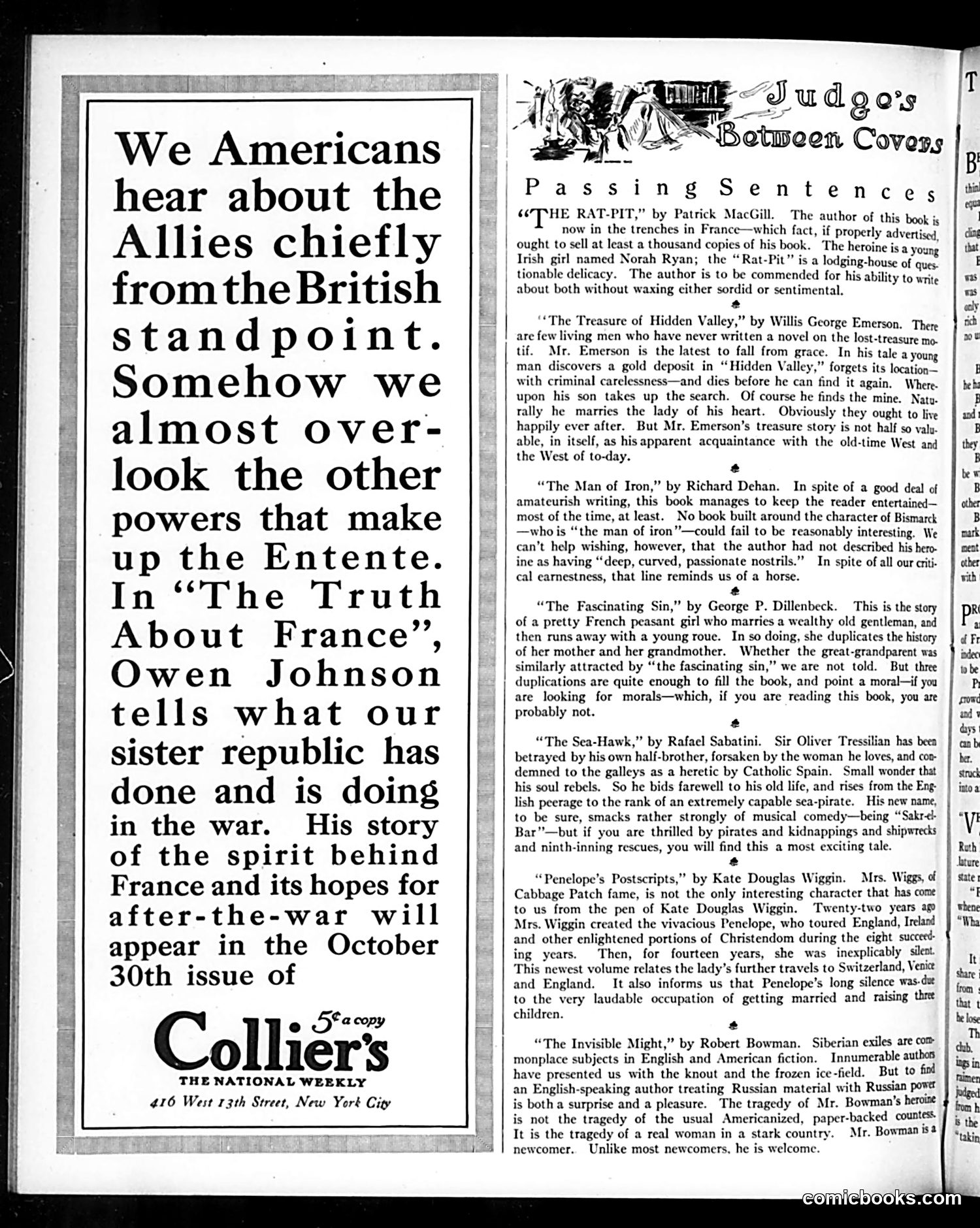
This page is primarily **advertising and book reviews**, not political satire. **Left side:** A Collier's magazine advertisement (5¢/copy) promoting an upcoming article by Owen Johnson titled "The Truth About France." The ad argues that Americans hear about WWI's Allied powers mainly through British perspectives and overlook France's role. Johnson's piece will reportedly address France's war efforts and post-war hopes, appearing October 30th. **Right side:** "Judge's Between Coves" book review column offering brief critical assessments of contemporary novels, including war-themed works like "The Rat-Pit" (set in French trenches) and "The Sea-Hawk" (adventure fiction). Reviews are mildly sarcastic but focus on literary merit rather than politics. **Context:** This appears from WWI-era American publishing, when magazines actively promoted war-related literature to American readers still debating U.S. involvement.
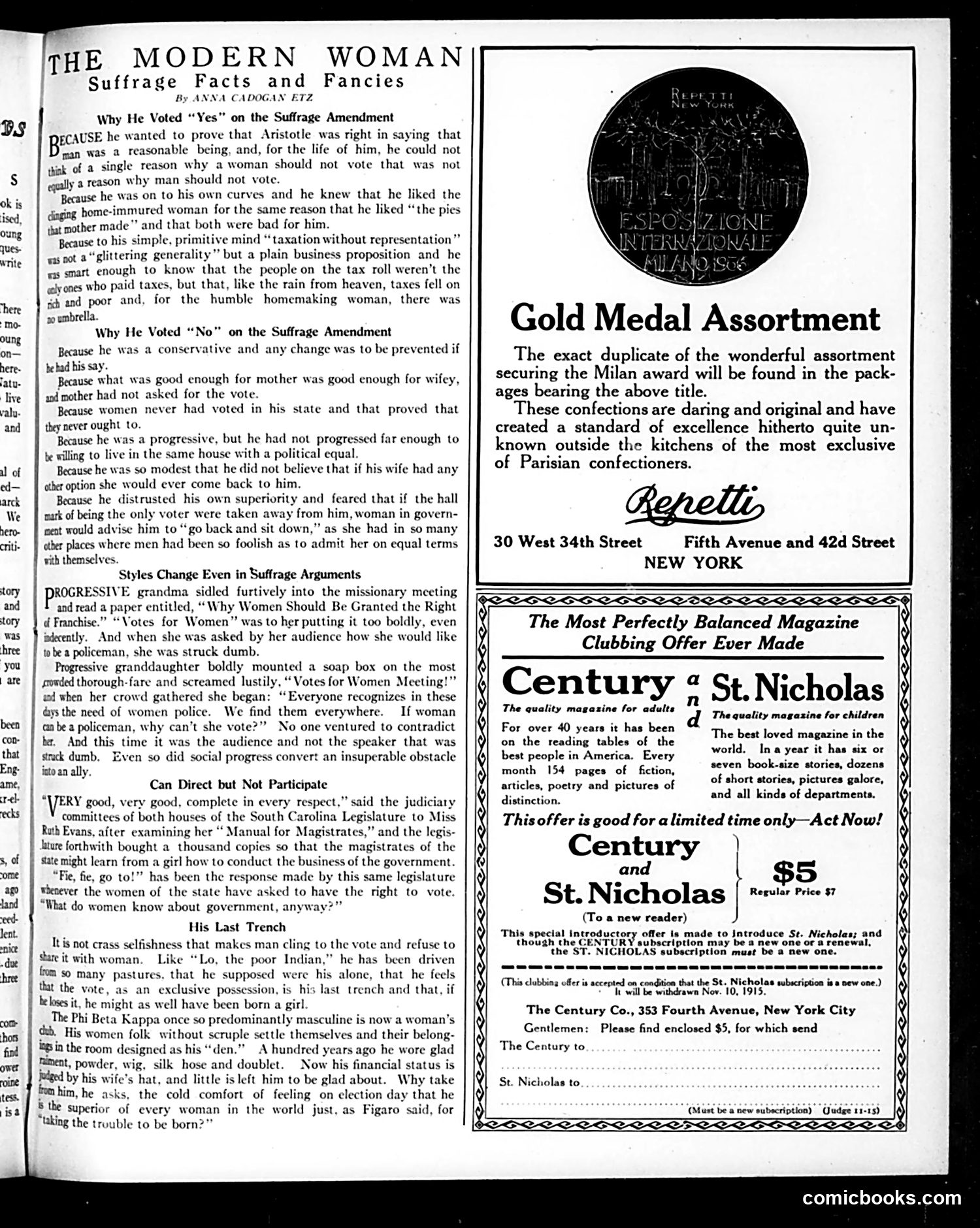
This satirical piece, written by Anna Cadogan Fitz, presents opposing arguments for and against women's suffrage through imagined male justifications—the humor lying in their internal contradictions and weak logic. **Arguments for "Yes":** Men voting for suffrage are portrayed as rational, noting woman's reasonableness, that taxation without representation is unjust business sense, and that denying women the vote is logically indefensible. **Arguments for "No":** Anti-suffrage voters are satirized as conservative, lazy, protective of male privilege, or afraid their wives might leave them if given equal political power—revealing misogyny masked as tradition. **The "Styles Change" section** contrasts old and new feminists: an earlier generation timidly framed suffrage as delicate advocacy; younger women boldly demand it as obvious justice. Both audiences remain silent, unable to contradict women's logic. **The South Carolina anecdote** exposes hypocrisy: legislators praise women's competence in a legal manual but refuse them voting rights, exposing that opposition rests on prejudice, not capability. The satire targets male resistance to equality as ultimately illogical and self-interested.
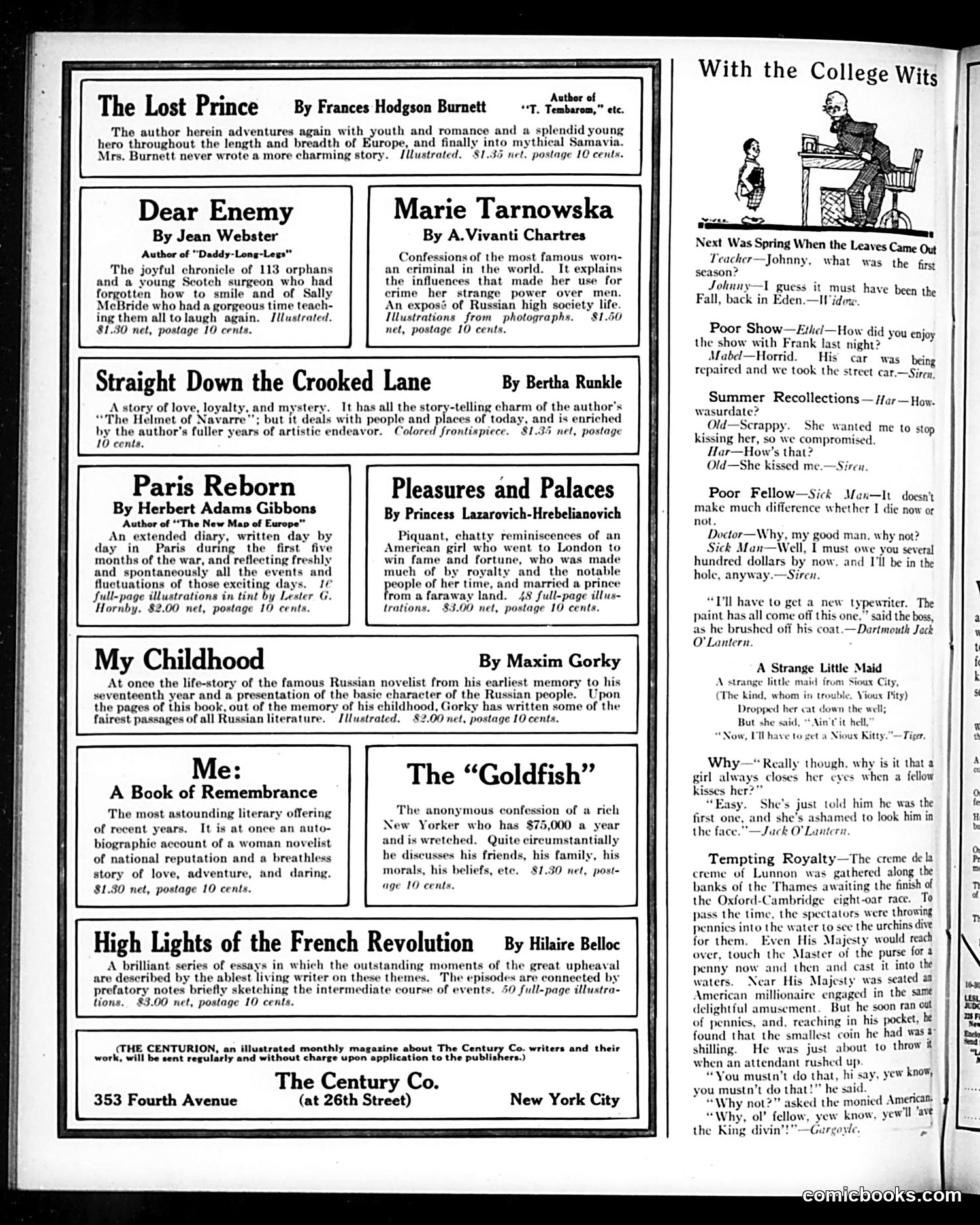
This is primarily a **book advertisement page** from The Century Co. publisher, not a political cartoon page. It showcases ten literary titles, mostly novels, published around World War I era. The right column contains "With the College Wits"—brief humorous student jokes rather than satire. These include: - A teacher-student exchange where Johnny suggests Fall was the first season "back in Eden" - A joke about attending a show with "Frank" and taking a street car - A quip about a "Poor Fellow" and a doctor discussing whether it matters if one dies now or later - A comment about kissing and shame These are lighthearted college humor pieces typical of Judge magazine's satirical tone, poking gentle fun at youth and romantic awkwardness rather than addressing serious political issues. The page reflects early 20th-century American literary publishing and student culture.
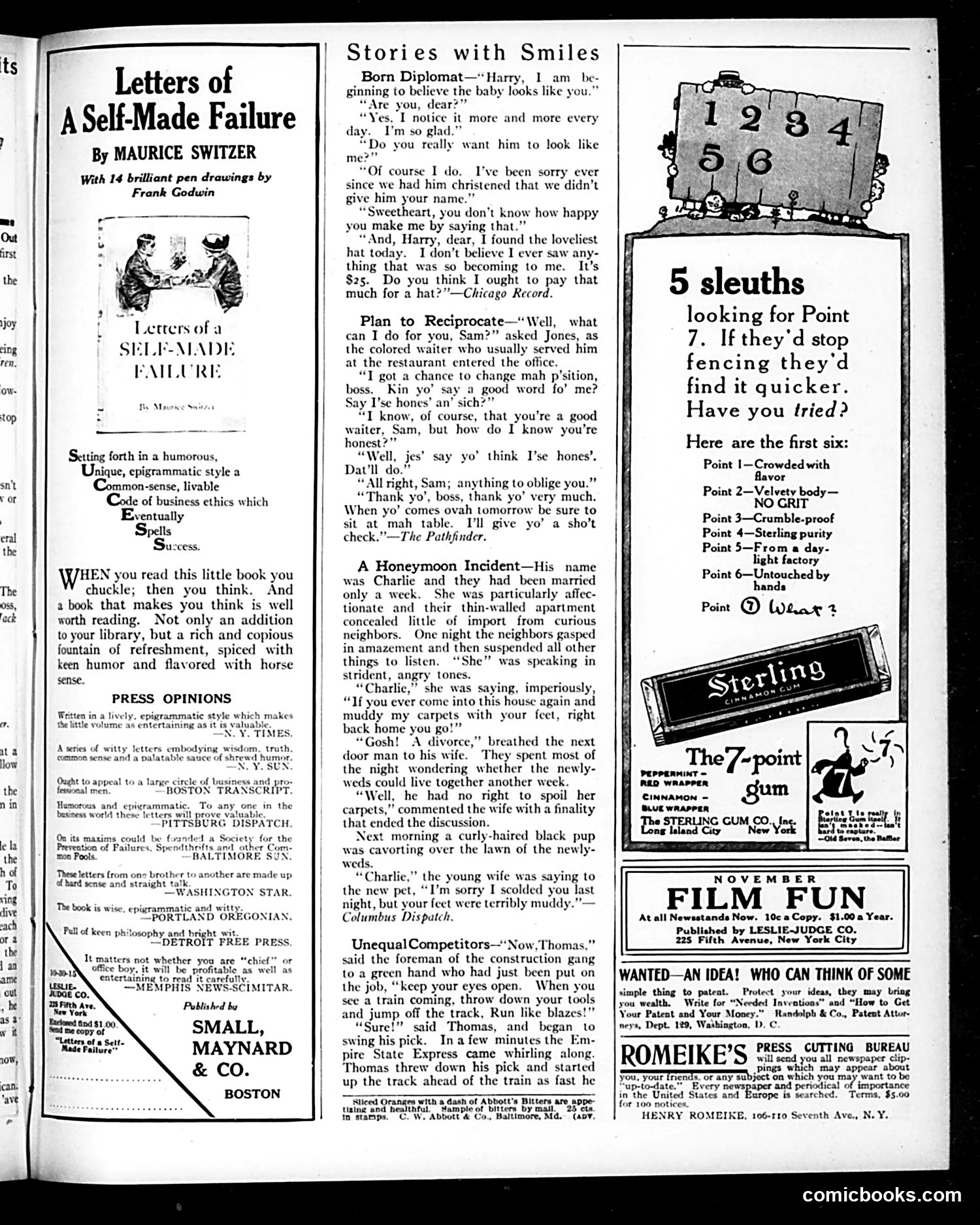
This page primarily contains **advertising and editorial content** for a book called *Letters of a Self-Made Failure* by Maurice Switzer, illustrated by Frank Godwin. The book presents humorous business ethics through letters, framed as satirical wisdom about success through failure. The **"Stories with Smiles"** section contains three light satirical anecdotes mocking social pretense and human nature: 1. A wife's backhanded compliment about her baby resembling her husband, then immediately asking for an expensive hat 2. A Black waiter's "reciprocal favor" scheme—offering to give his boss a short restaurant check in exchange for a job recommendation 3. A newlywed scolding her husband for muddy carpets (revealed to be their new puppy), illustrating marital misunderstanding The humor relies on familiar early-20th-century stereotypes and domestic comedy tropes. The page is primarily promotional material rather than political satire.
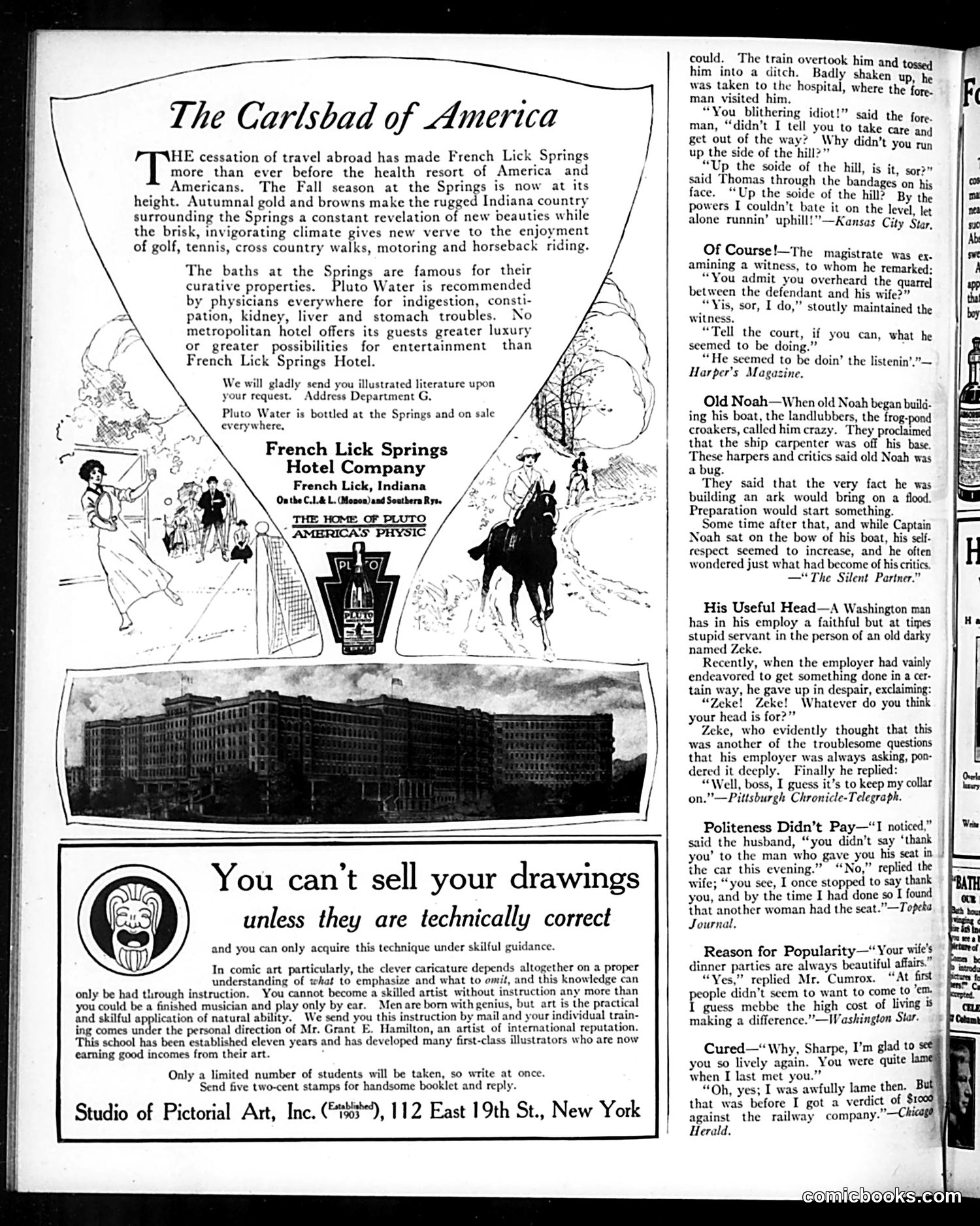
This page is primarily **advertising and humor filler** rather than political satire. The main content includes: **The Carlsbad of America (top):** An advertisement for French Lick Springs Hotel in Indiana, a health resort marketed as America's equivalent to the famous European spa town Carlsbad. It promotes the mineral waters' curative properties and the resort's recreational amenities, capitalizing on wartime travel restrictions that prevented Americans from visiting Europe. **Studio of Pictorial Art (center/bottom):** A vocational school advertisement emphasizing that cartooning requires formal training under Grant E. Hamilton, a professional illustrator. This speaks to early-20th-century professionalization of comic art. **Right column:** Unrelated humorous anecdotes about everyday situations—an Irish accident victim, courtroom testimony, Noah building an ark, and a servant's practicality—typical light filler material for satirical magazines of the era. The page reflects Judge's mixed business model: combining advertisements with short jokes and humorous stories to fill space between political cartoons.
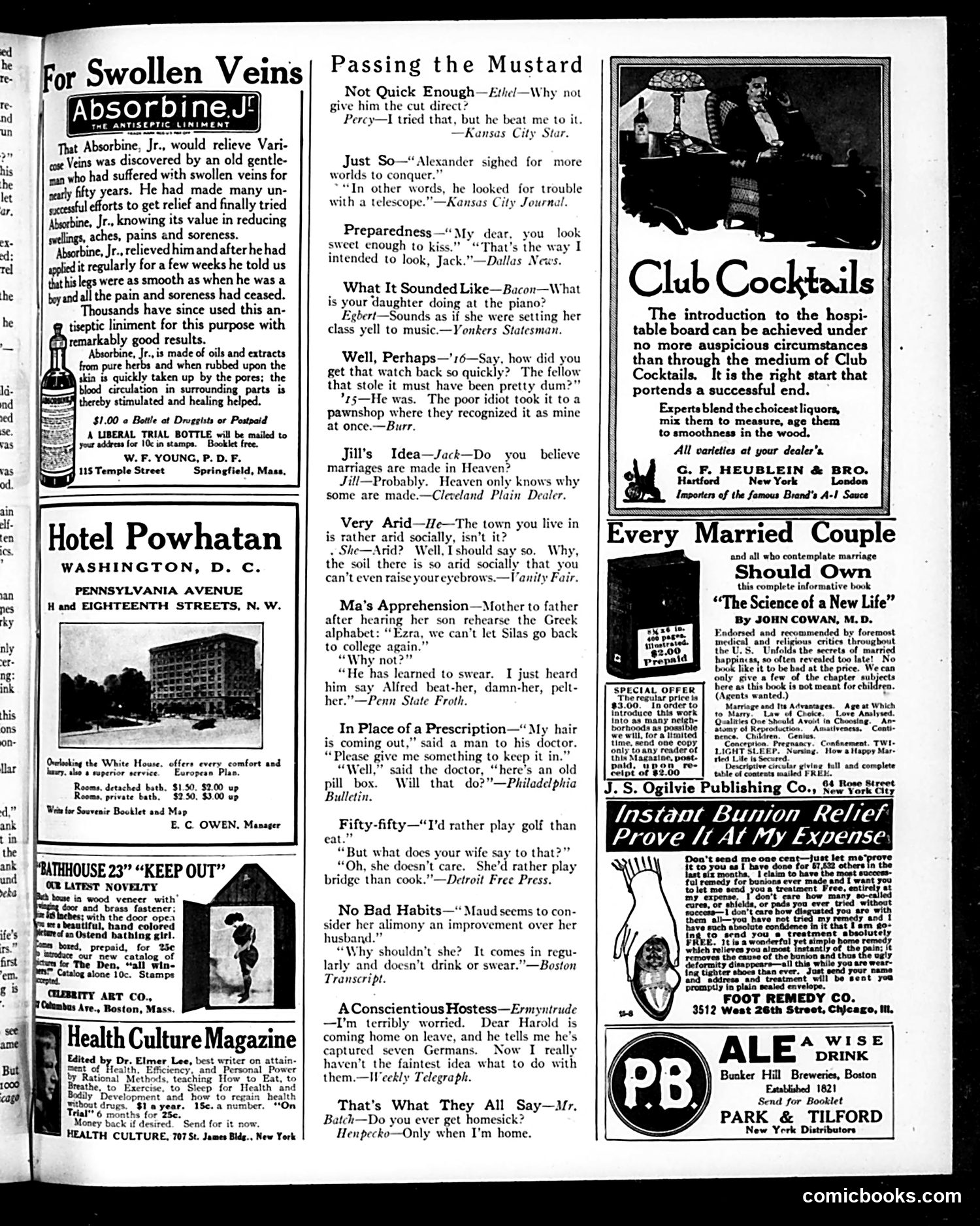
This page is primarily **advertising with humor interspersed** rather than political satire. The satirical content consists of brief joke exchanges titled "Passing the Mustard"—a common Judge format featuring short, punchy humorous anecdotes. The jokes reference relatable early 20th-century social situations: romantic dalliance ("Preparedness"), domestic absurdity (a son learning to swear before returning to college), and social awkwardness (arid small-town life, a piano student making noise). The largest visual element is the **Hotel Powhatan advertisement**, capitalizing on Washington D.C.'s prominence. Other ads promote **Absorbine Jr.** liniment, a health magazine, and novelty items—typical of Judge's revenue model. No specific political figures, events, or topical satire appear identifiable on this particular page. The humor is gentle, domestic, and timeless rather than rooted in contemporary politics or scandal.
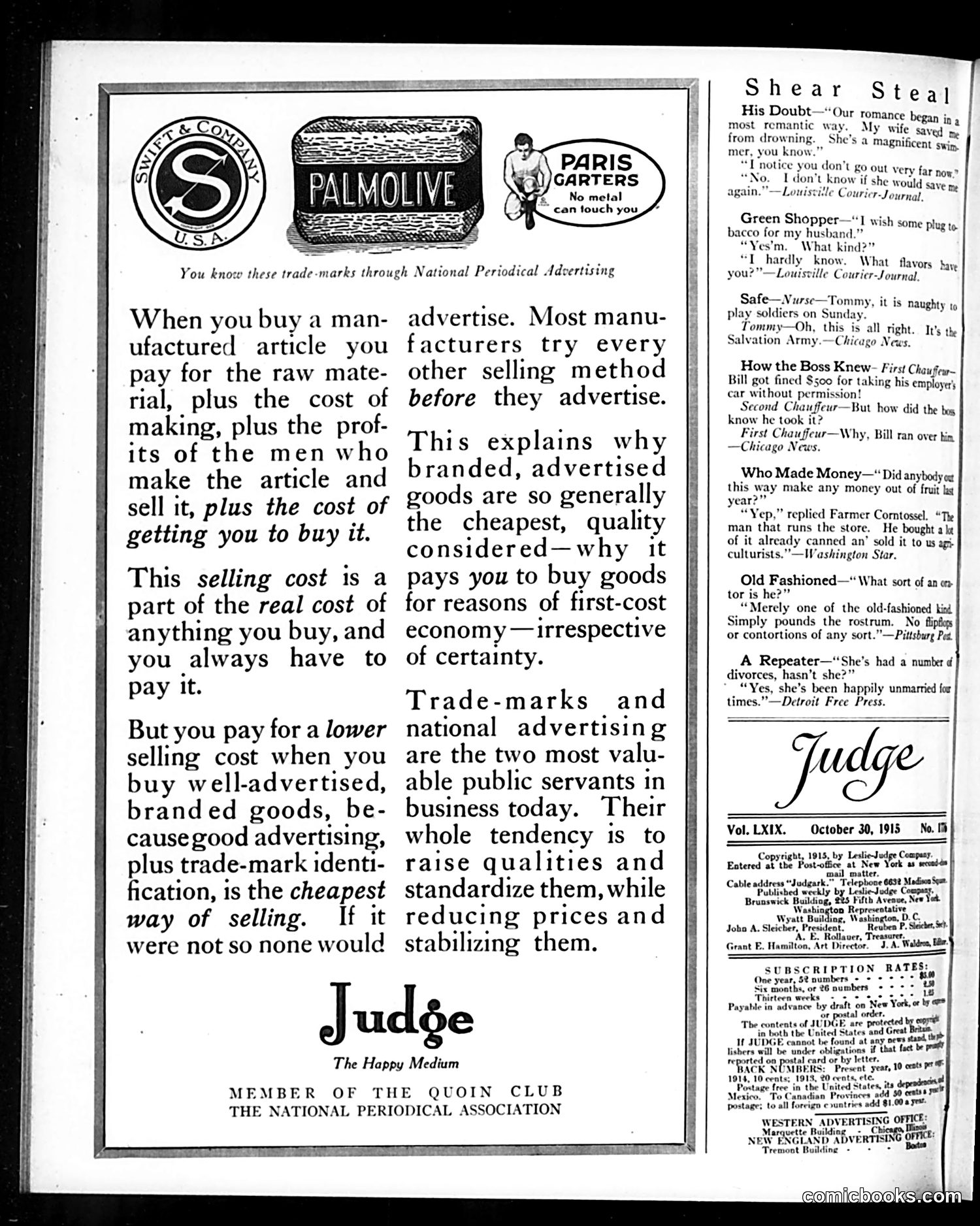
This page is primarily **advertising content** for Judge magazine itself, not a political cartoon. The left side features an extended advertisement arguing that national advertising and brand names reduce consumer costs through efficient selling methods—a pro-advertising argument common in early 20th-century business discourse. The right side contains brief **humor items** typical of Judge's satirical format: jokes about marital relationships, military discipline, automobile theft, farming economics, and divorce. These are light social observations rather than pointed political satire—they target everyday absurdities (a wife who's a poor swimmer, soldiers playing on Sunday, a farmer cheated by a store owner). The page demonstrates how Judge positioned itself as "The Happy Medium" for middle-class readers interested in business commentary and gentle social humor, while promoting the value of periodical advertising itself.
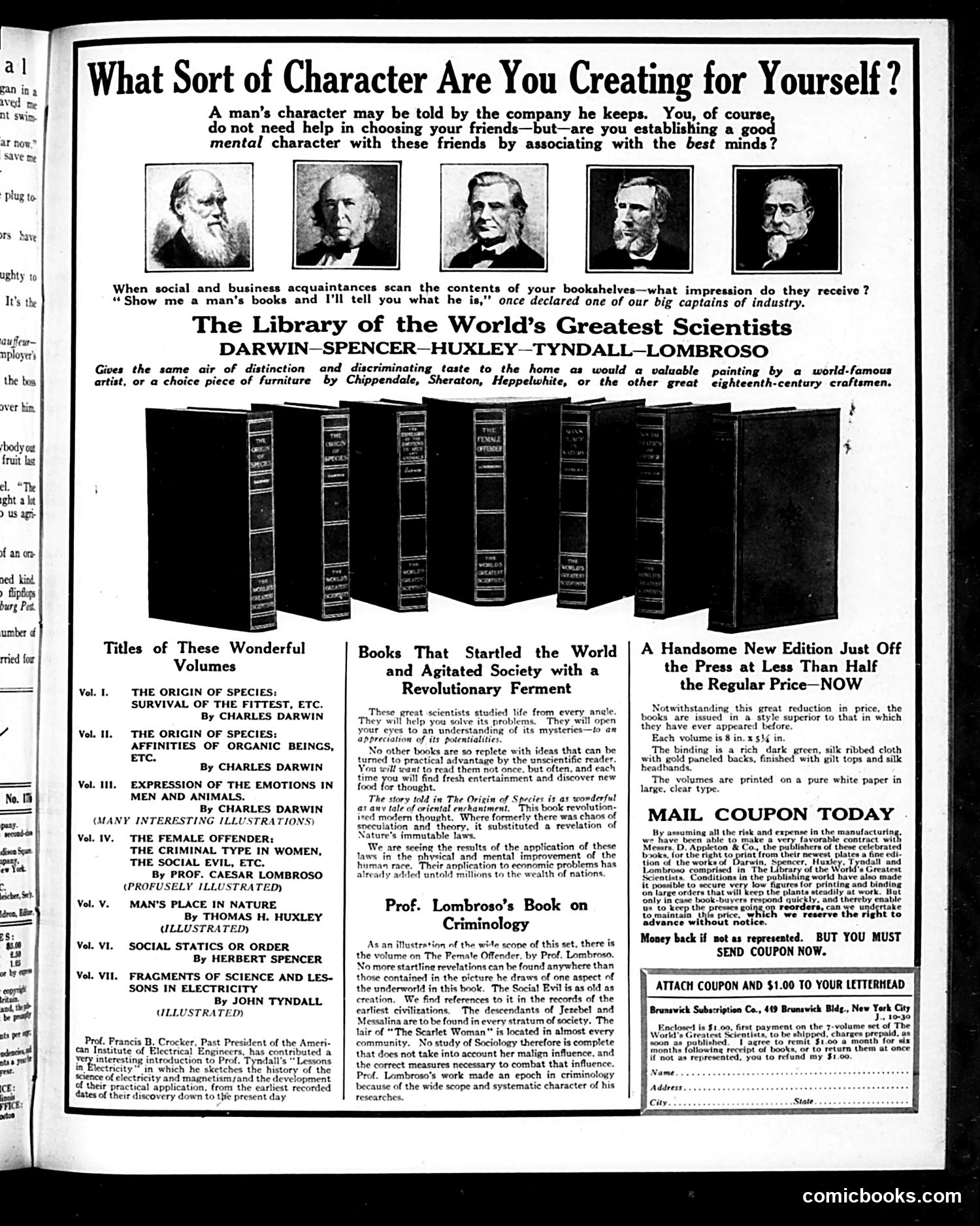
This is primarily a **book advertisement**, not a political cartoon. It promotes a subscription set of works by celebrated 19th-century scientists: Darwin, Spencer, Huxley, Tyndall, and Lombroso. **The Appeal**: The ad uses a genteel social argument—your bookshelf reveals your character to visitors. Owning these "greatest scientists'" works signals intellectual distinction and refined taste, comparable to owning fine furniture or paintings. **The Pitch**: These "revolutionary" books explain life's mysteries and offer practical wisdom for self-improvement. Notably, it highlights Lombroso's volume on criminology and "The Female Offender," positioning pseudoscientific theories about crime and gender as respectable knowledge. **Historical Context**: This reflects the late 19th/early 20th-century enthusiasm for scientific materialism and social Darwinism as markers of sophistication. The advertisement conflates reading about evolutionary theory with moral and social advancement—a now-discredited assumption that shaped harmful policies on criminology and gender.
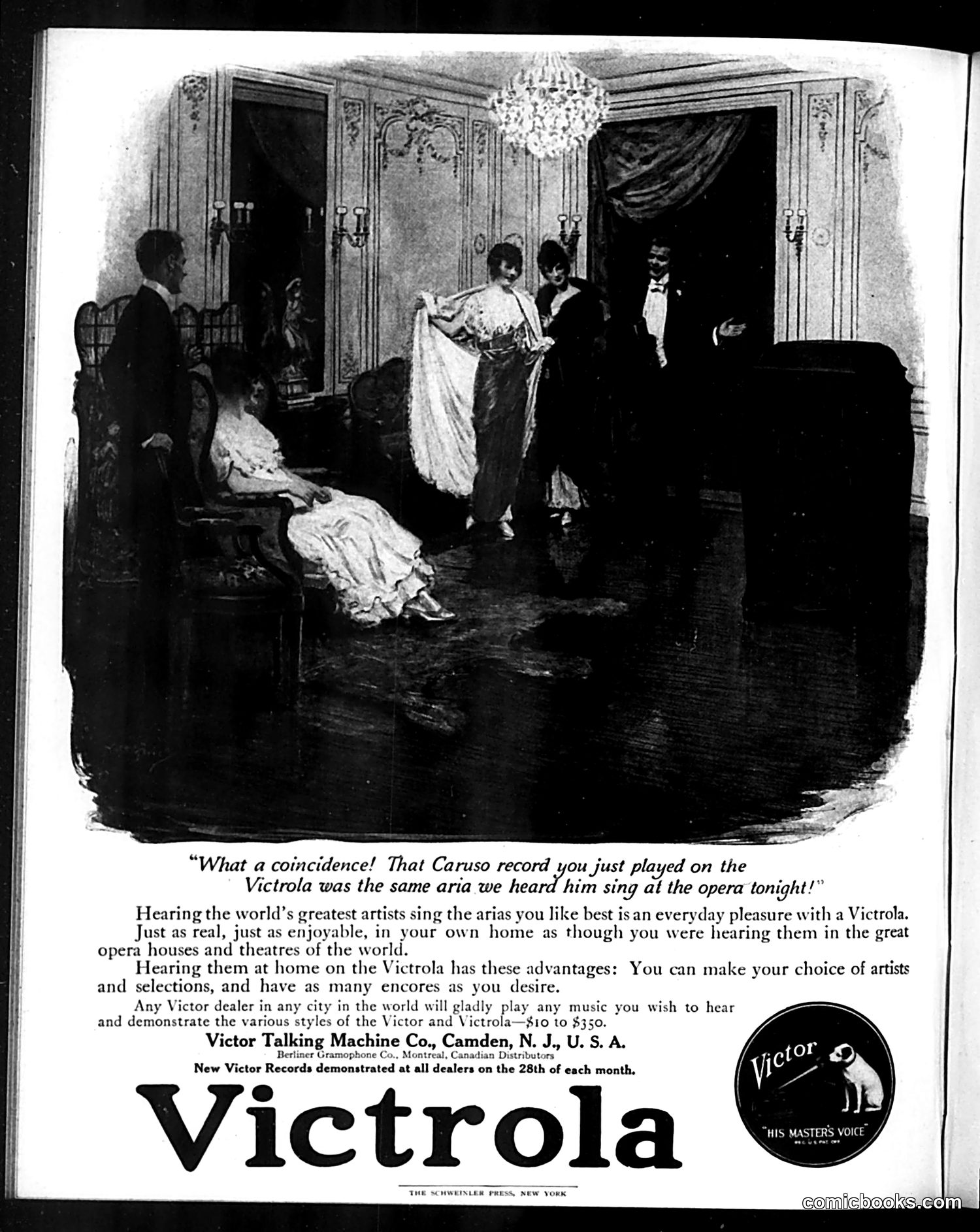
This is a **Victrola phonograph advertisement**, not political satire. The image depicts an elegant parlor scene where guests have just returned from the opera. The joke's premise: a woman remarks that the Caruso record playing on the Victrola is the same aria they heard the famous tenor Enrico Caruso perform live at the opera house that evening—suggesting the recording is so lifelike it rivals the real performance. The ad capitalizes on this to promote Victrola's superior sound quality and convenience: listeners can enjoy world-class opera singers in their homes, choose their preferred artists and encores, and experience "just as real, just as enjoyable" performances as attending grand opera houses. This was cutting-edge consumer technology for the era, positioned as a luxury item (priced $10–$350).