
Judge, 1915-10-30 · page 12 of 28
Judge — October 30, 1915 — page 12: what you’re looking at
What you’re looking at
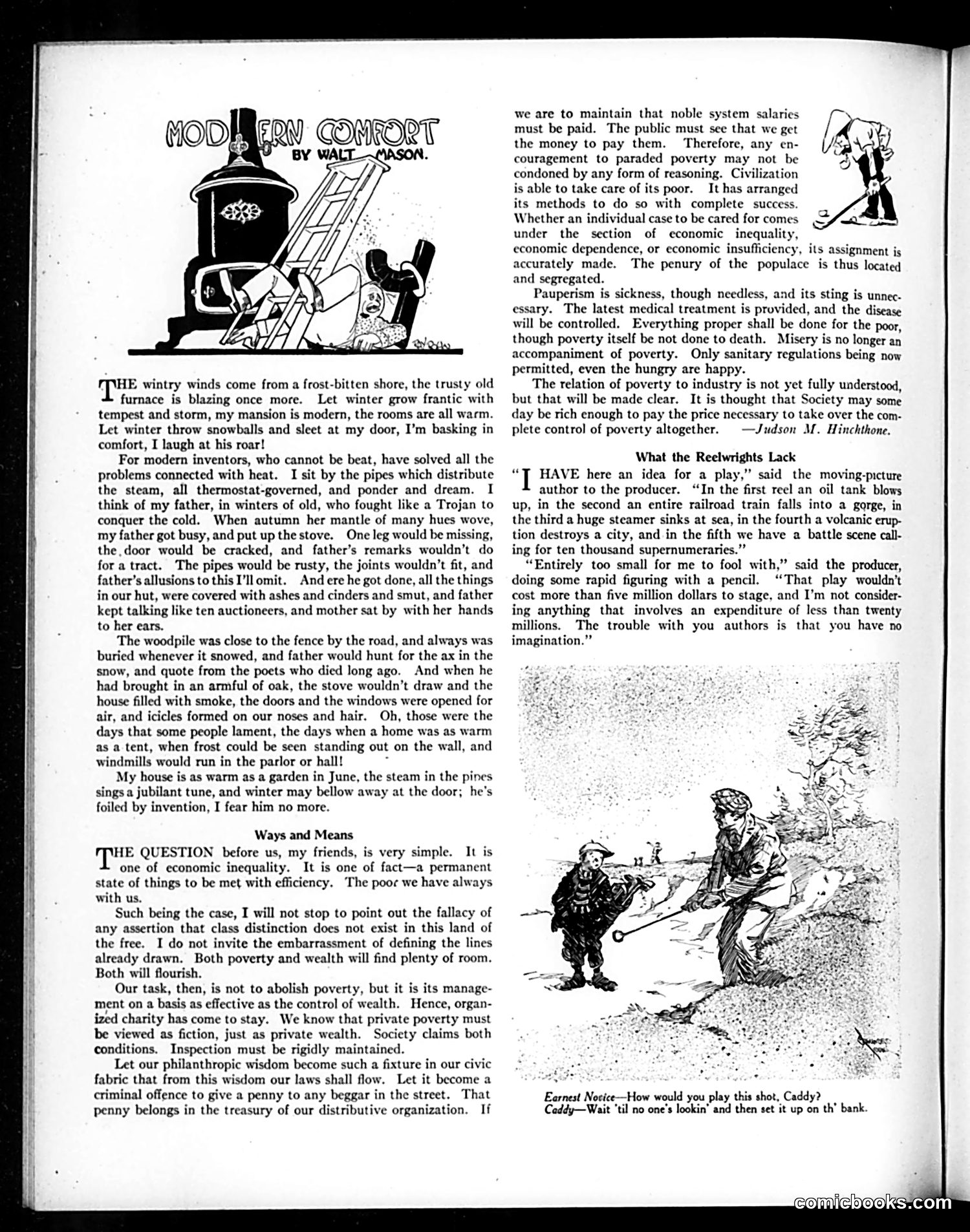
**Top Section ("Modern Comfort"):** This poem celebrates modern heating technology—steam furnaces and thermostats—contrasting comfortable contemporary living with the hardships of previous generations. The narrator mocks his father's struggle with old wood stoves: cracked doors, rusty pipes, smoke-filled houses, and frozen conditions. The satire is gentle: progress has genuinely improved domestic comfort. **Bottom Section ("Ways and Means"):** This is sharper social satire. The speaker argues that poverty is inevitable and shouldn't be "abolished" but rather "managed" through organized charity and government control. The radical proposal: make private charity illegal; all relief money should flow through official bureaucratic channels to pay administrative salaries. The satire targets Progressive-era charity reformers and bureaucrats who claimed to help the poor while primarily enriching themselves and expanding government power. The speaker's language—"inspection must be rigidly maintained"—exposes the paternalistic, controlling nature of such systems. Together, the page contrasts technological progress (genuinely beneficial) with social "progress" (self-serving bureaucracy disguised as charity).
📄 Transcribed text from this page (OCR, searchable)
Machine-transcribed from the original scan — historical spelling and the odd misread are preserved.
HE wintry winds come from a frost-bitten shore, the trusty furnace is blazing once more. Let winter grow frantic with tempest and storm, my mansion is modern, the rooms are all warm. Let winter throw snowballs and sleet at my door, I’m basking in comfort, I laugh at his roar! For modern inventors, who cannot be beat, have solved all the problems connected with heat. I sit by the pipes which distribute the steam, all thermostat-governed, and ponder and dream. I think of my father, in winters of old, who fought like a Trojan to conquer the cold. When autumn her mantle of many hues wove, my father got busy, and put up the stove. One leg would be missing, the, door would be cracked, and father’s remarks wouldn’t do for a tract. The pipes would be rusty, the joints wouldn’t fit, and father’s allusions to this I'll omit. And ere he got done, all the things in our hut, were covered with ashes and cinders and smut, and father kept talking like ten auctioneers, and mother sat by with her hands to her ears. The woodpile was close to the fence by the road, and always was buried whenever it snowed, and father would hunt for the ax in the snow, and quote from the poets who died long ago. And when he had brought in an armful of oak, the stove wouldn’t draw and the house filled with smoke, the doors and the windows were opened for air, and icicles formed on our noses and hair. Oh, those were the days that some people lament, the days when a home was as warm as a tent, when frost could be seen standing out on the wall, and windmills would run in the parlor or hall! . My house is as warm as a garden in June, the steam in the pines sings a jubilant tune, and winter may bellow away at the door; he's foiled by invention, I fear him no more. Ways and Means THE QUESTION before us, my friends, is very simple. It is one of economic inequality. It is one of fact—a permanent state of things to be met with efficiency. The poor we have always with us. Such being the case, I will not stop to point out the fallacy of any assertion that class distinction does not exist in this land of the free. I do not invite the embarrassment of defining the lines already drawn. Both poverty and wealth will find plenty of room. Both will flourish. Our task, then, is not to abolish poverty, but it is its manage- ment on a basis as effective as the control of wealth. Hence, organ- ized charity has come to stay. We know that private poverty must be viewed as fiction, just as private wealth. Society claims both conditions. Inspection must be rigidly maintained. Let our philanthropic wisdom become such a fixture in our civic fabric that from this wisdom our laws shall flow. Let it become a criminal offence to give a penny to any beggar in the street. That penny belongs in the treasury of our distributive organization. If we are to maintain that noble system salaries must be paid. The public must see that we get the money to pay them. Therefore, any en- couragement to paraded poverty may not be condoned by any form of reasoning. Civilization is able to take care of its poor. It has arranged its methods to do so with complete success. Whether an individual case to be cared for comes under the section of economic inequality, economic dependence, or economic insufficiency, its assignment is accurately made. The penury of the populace is thus located and segregated. Pauperism is sickness, though needless, and its sting is unnec- essary. The latest medical treatment is provided, and the disease will be controlled. Everything proper shall be done for the poor, though poverty itself be not done to death. Misery is no longer an accompaniment of poverty. Only sanitary regulations being now permitted, even the hungry are happy. The relation of poverty to industry is not yet fully understood, but that will be made clear. It is thought that Society may some day be rich enough to pay the price necessary to take over the com- plete control of poverty altogether. © —Judson M. Hinchthone. What the Reelwrights Lack “‘T HAVE here an idea for a play,” said the moving-picture author to the producer. “In the first reel an oil tank blows up, in the second an entire railroad train falls into a gorge, in the third a huge steamer sinks at sea, in the fourth a volcanic erup- tion destroys a city, and in the fifth we have a battle scene call- ing for ten thousand supernumeraries.”” “Entirely too small for me to fool with,” said the producer, doing some rapid figuring with a pencil. “That play wouldn't cost more than five million dollars to stage, and I’m not consider- ing anything that involves an expenditure of less than twenty millions. The trouble with you authors is that you have no imagination.” —How would you play this shot, Caddy? it ‘til no one’s lookin’ and then set it up on th’ bank.