
Judge, 1915-10-30 · page 9 of 28
Judge — October 30, 1915 — page 9: what you’re looking at
What you’re looking at
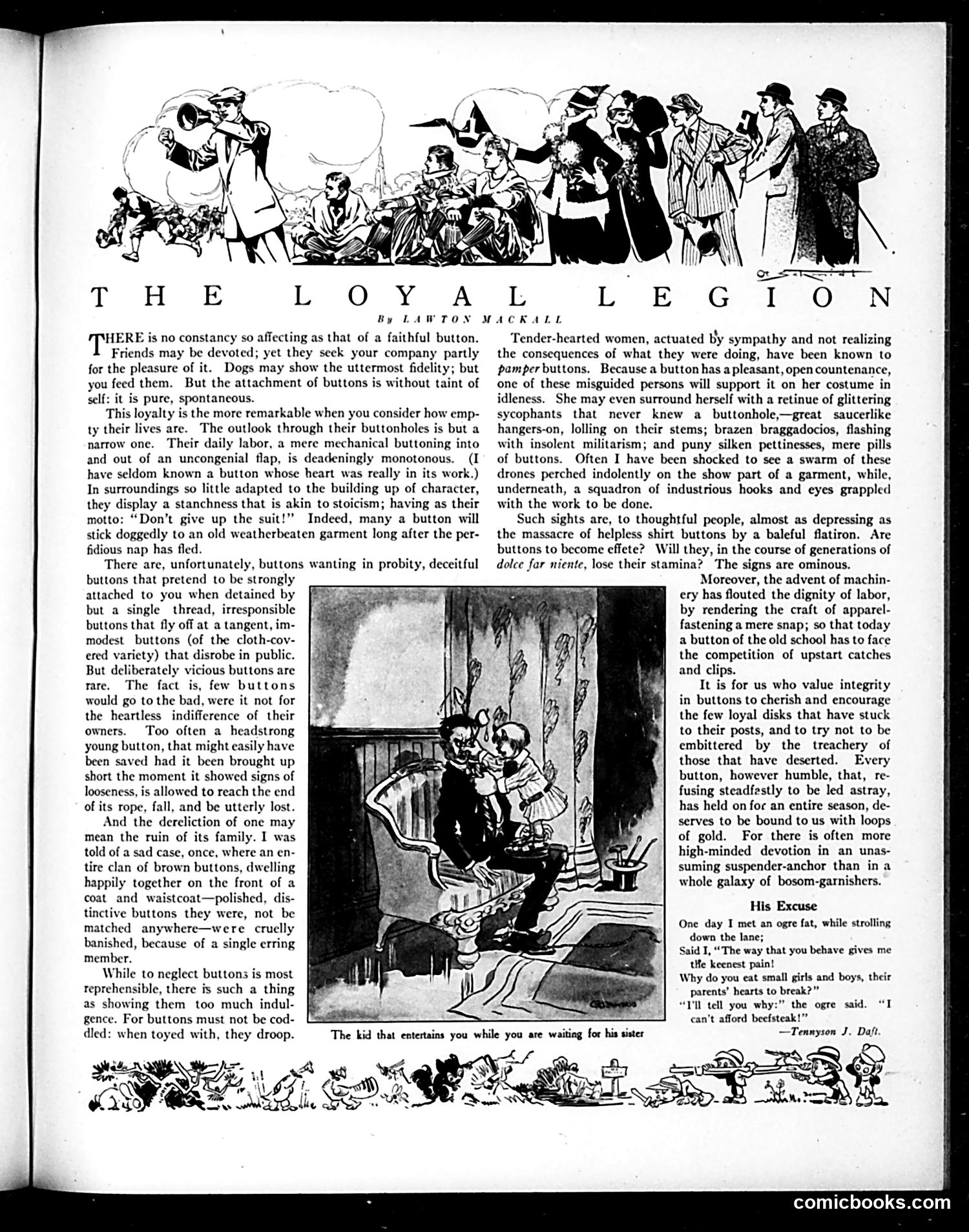
This is a humorous *mock-serious* essay anthropomorphizing buttons as characters deserving respect and loyalty. The satire works by treating buttons with exaggerated moral gravity—praising their "faithfulness," lamenting those who abandon their posts, and mourning buttons lost to wear. The central joke targets **human negligence and sentimentality**: the author criticizes both owners who carelessly lose buttons and sentimental women who "pamper" them with decorative hangers and ornaments rather than letting them do honest work. There's also social commentary about **industrialization**—new mechanical fasteners (clips, catches) threaten buttons' traditional dignity as craftsmen. The accompanying illustration shows a figure entertaining someone while waiting, satirizing idle, decorative dress accessories. The humor appeals to readers who value Victorian-era notions of duty, hard work, and straightforward practicality over frivolous ornamentation. It's gentle social criticism wrapped in absurdist fantasy.
📄 Transcribed text from this page (OCR, searchable)
Machine-transcribed from the original scan — historical spelling and the odd misread are preserved.
By LAWTON HERE is no constancy so affecting as that of a faithful button. Friends may be devoted; yet they seek your company partly for the pleasure of it. Dogs may show the uttermost fidelity; but you feed them. But the attachment of buttons is without taint of self: it is pure, spontancous. This loyalty is the more remarkable when you consider how emp- ty their lives are. The outlook through their buttonholes is but a narrow one. Their daily labor, a mere mechanical buttoning into and out of an uncongenial flap, is deadeningly monotonous. (I have seldom known a button whose heart was really in its work.) In surroundings so little adapted to the building up of character, they display a stanchness that is akin to stoicism; having as their motto: “Don’t give up the suit!” Indeed, many a button will stick doggedly to an old weatherbeaten garment long after the per- fidious nap has fled. There are, unfortunately, buttons wanting in probity, deceitful buttons that pretend to be strongly attached to you when detained by but a single thread, irresponsible buttons that fly off at a tangent, im- modest buttons (of the cloth-cov- ered variety) that disrobe in public. But deliberately vicious buttons are rare. The fact is, few buttons would go to the bad, were it not for the heartless indifference of their owners. Too often a headstrong young button, that might easily have been saved had it been brought up short the moment it showed signs of looseness, is allowed to reach the end of its rope, fall, and be utterly lost. And the dereliction of one may mean the ruin of its family. I was told of a sad case, once, where an en- tire clan of brown buttons, dwelling happily together on the front of a coat and waistcoat—polished, dis- tinctive buttons they were, not be matched anywhere—were cruelly banished, because of a single erring member. While to neglect buttons is most reprehensible, there is such a thing as showing them too much indul- gence. For buttons must not be cod- dled: when toyed with, they droop. es oS L LE GIO N Tender-hearted women, actuated By sympathy and not realizing the consequences of what they were doing, have been known to pamper buttons. Because a button has a pleasant, open countenance, one of these misguided persons will support it on her costume in idleness. She may even surround herself with a retinue of glittering sycophants that never knew a buttonhole,—great saucerlike hangers-on, lolling on their stems; brazen braggadocios, flashing with insolent militarism; and puny silken pettinesses, mere pills of buttons. Often I have been shocked to see a swarm of these drones perched indolently on the show part of a garment, while, underneath, a squadron of industrious hooks and eyes grappled with the work to be done. Such sights are, to thoughtful people, almost as depressing as the massacre of helpless shirt buttons by a baleful flatiron. Are buttons to become effete? Will they, in the course of generations of dolce far niente, lose their stamina? The signs are ominous. Moreover, the advent of machin- ery has flouted the dignity of labor, by rendering the craft of apparel- fastening a mere snap; so that today a button of the old school has to face the competition of upstart catches and clips. It is for us who value integrity in buttons to cherish and encourage the few loyal disks that have stuck to their posts, and to try not to be embittered by the treachery of those that have deserted. Every button, however humble, that, re- fusing steadfastly to be led astray, has held on for an entire season, de- serves to be bound to us with loops of gold. For there is often more high-minded devotion in an unas- suming suspender-anchor than in a whole galaxy of bosom-garnishers. His Excuse One day I met an ogre fat, while strolling down the lane; Said I, “The way that you behave gives me tife keenest pain! Why do you eat small girls and boys, their parents’ hearts to break?” “T'll tell you why:” the ogre said. can't afford beefsteak!” —Tennyson J. Daft. comicbooks.com