
Judge, 1915-10-30 · page 4 of 28
Judge — October 30, 1915 — page 4: what you’re looking at
What you’re looking at
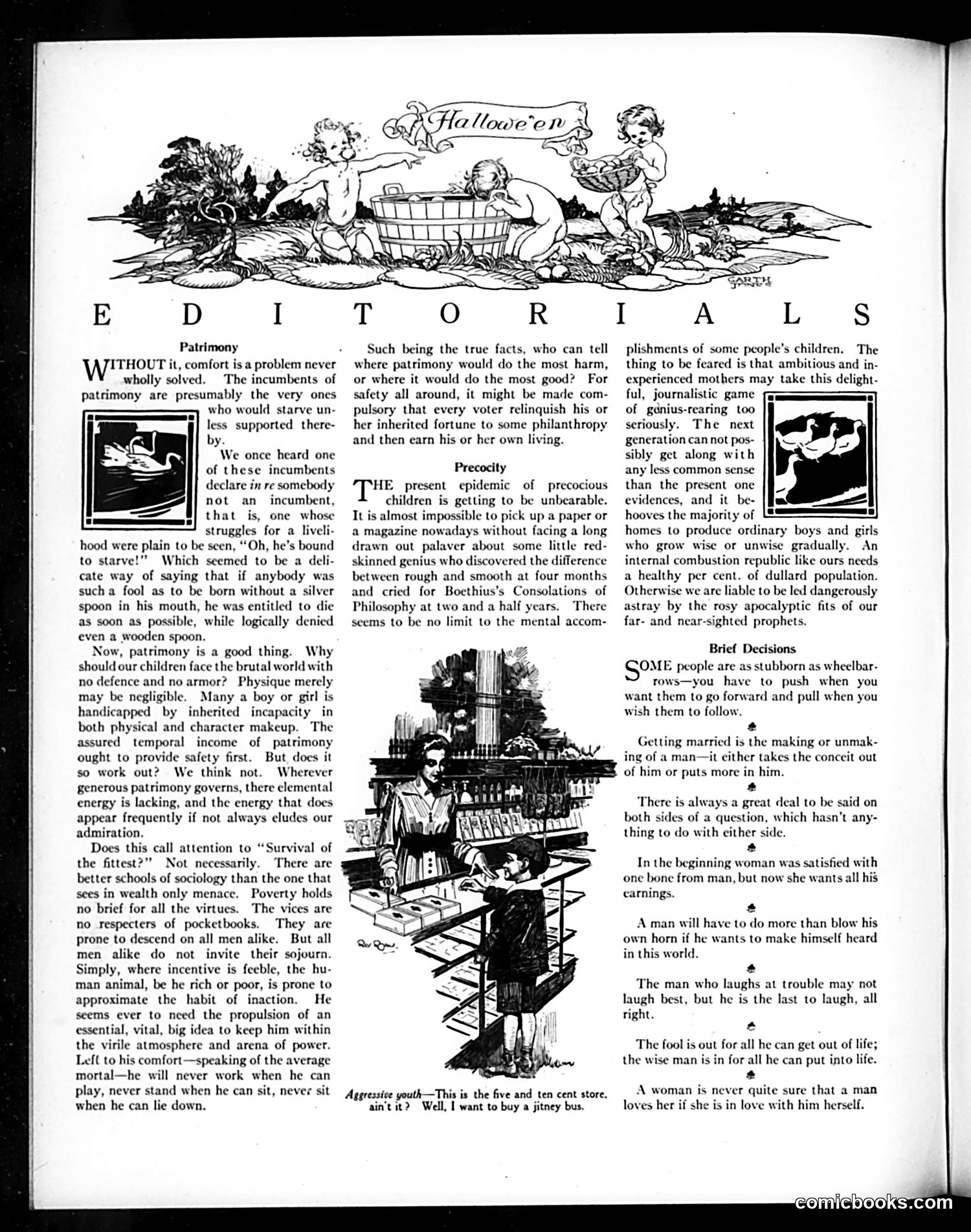
This is a "Hallowe'en Editorials" page featuring three distinct sections: **Left column ("Patrimony")**: Satirizes inherited wealth. The text argues that children of the poor face brutal survival struggles without safety nets, while wealthy heirs receive unearned security. The satire criticizes the hypocrisy of a system that abandons poor children to destitution while protecting rich ones through inheritance. **Center illustration**: Shows a woman at a printing press or similar machinery—likely commenting on women entering industrial/professional work, a contemporary social concern. **Right column ("Precocity")**: Attacks "precocious" children—those developing too quickly intellectually or morally. The author warns that ambitious journalists and reformers risk raising dangerously independent-thinking youth who challenge social norms, threatening established order. The page reflects Progressive Era debates about class inequality, child welfare, and social change.
📄 Transcribed text from this page (OCR, searchable)
Machine-transcribed from the original scan — historical spelling and the odd misread are preserved.
ITHOUT it, comfort is a problem never wholly solved. The incumbents of patrimony are presumably the very ones who would starve un- less supported there- by. We once heard one of these incumbents declare in re somebody not an_ incumbent, that is, one whose struggles for a liveli- hood were plain to be scen, “Oh, he’s bound to starve!" Which seemed to be a deli- cate way of saying that if anybody was such a fool as to be born without a silver spoon in his mouth, he was entitled to die as soon as possible, while logically denied even a wooden spoon. Now, patrimony is a good thing. Why should our children face the brutal world with no defence and no armor? Physique merely may be negligible. Many a boy or girl is handicapped by inherited incapacity in both physical and character makeup. The assured temporal income of patrimony ought to provide safety first. But, does it so work out? We think not. Wherever generous patrimony governs, there elemental energy is lacking, and the energy that does appear frequently if not always eludes our admiration. Does this call attention to “Survival of the fittest?” Not necessarily. There are better schools of sociology than the one that sees in wealth only menace. Poverty holds no brief for all the virtues. The vices are no respecters of pocketbooks. They are prone to descend on all men alike. But all men alike do not invite their sojourn. Simply, where incentive is feeble, the hu- man animal, be he rich or poor, is prone to approximate the habit of inaction. He seems ever to need the propulsion of an essential, vital, big idea to keep him within the virile atmosphere and arena of power. Left to his comfort—speaking of the average mortal—he will never work when he can play, never stand when he can sit, never sit when he can lie down. wearin Such being the true facts, who can tell where patrimony would do the most harm, or where it would do the most good? For safety all around, it might be made com- pulsory that every voter relinquish his or her inherited fortune to some philanthropy and then earn his or her own living. Precocity TH present epidemic of precocious children is getting to be unbearable. It is almost impossible to pick up a paper or a magazine nowadays without facing a long drawn out palaver about some little red- skinned genius who discovered the difference between rough and smooth at four months and cried for Boethius’s Consolations of Philosophy at two and a half y There seems to be no limit to the mental accom- Aggressive youth—This is the five and ten cent store, ain't it? Well, I want to buy a jitney bus. plishments of some people’s children. The thing to be feared is that ambitious and in- experienced mothers may take this delight- ful, journalistic game of génius-rearing too seriously. The next generation can not pos- sibly get along with any less common sense than the present one evidences, and it be- hooves the majority of homes to produce ordinary boys and girls who grow wise or unwise gradually. An internal combustion republic like ours needs a healthy per cent. of dullard population. Otherwise we are liable to be led dangerously astray by the rosy apocalyptic fits of our far- and near-sighted prophets. Brief Decisions SOME people are as stubborn as wheelbar- rows—you have to push when you want them to go forward and pull when you wish them to follow. 2 Getting married is the making or unmak- ing of a man—it either takes the conceit out of him or puts more in him. 2 There is always a great deal to be said on both sides of a question, which hasn't any- thing to do with cither side. 2 In the beginning woman was satisfied with one bone from man, but now she wants all his carnings. 2 A man will have to do more than blow his own horn if he wants to make himself heard in this world. ¢ The man who laughs at trouble may not laugh best, but he is the last to laugh, all right. Py The fool is out for all he can get out of life; the wise man is in for all he can put into life. 2 A woman is never quite sure that a man loves her if she is in love with him herself.