
Judge, 1915-10-30 · page 21 of 28
Judge — October 30, 1915 — page 21: what you’re looking at
What you’re looking at
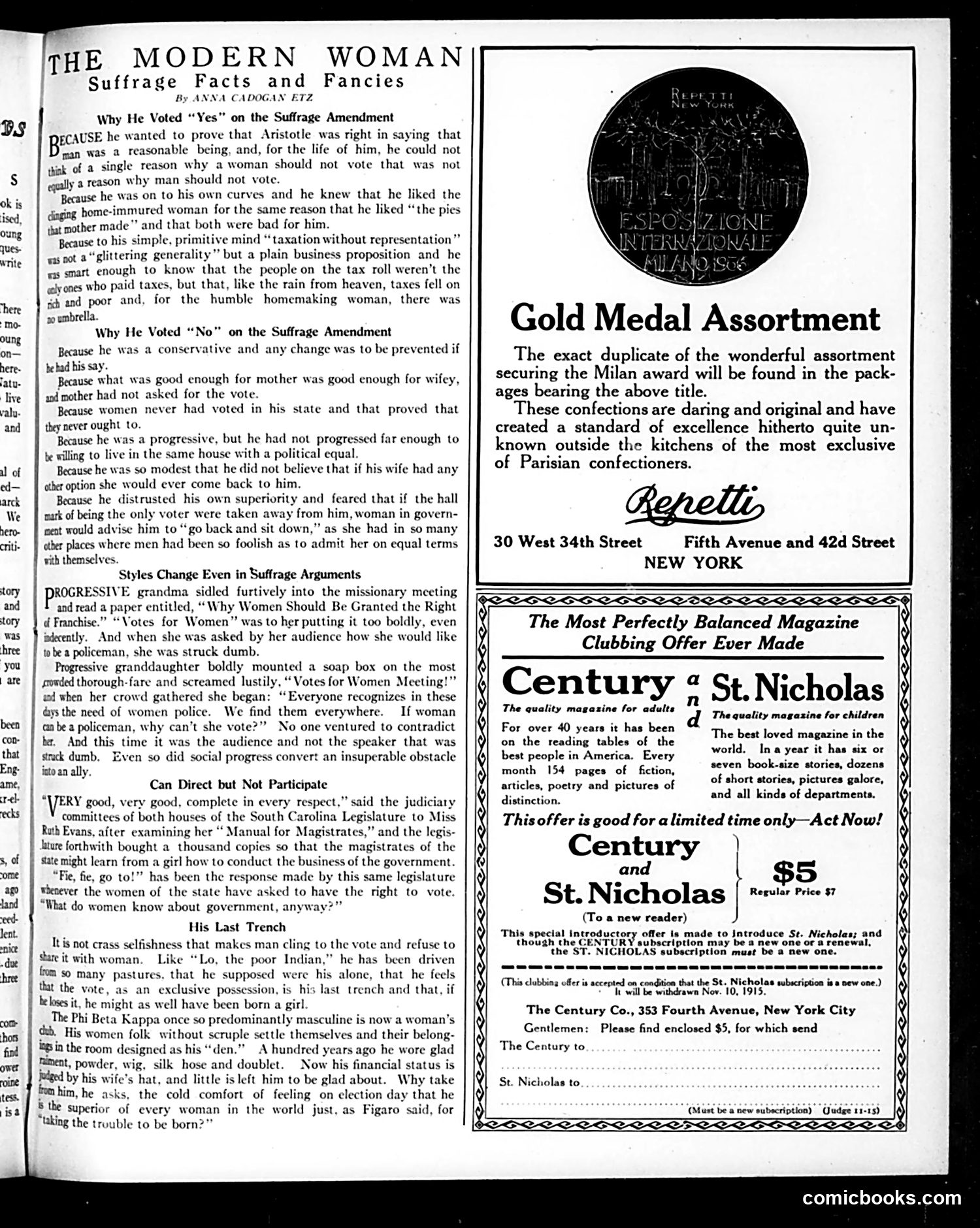
This satirical piece, written by Anna Cadogan Fitz, presents opposing arguments for and against women's suffrage through imagined male justifications—the humor lying in their internal contradictions and weak logic. **Arguments for "Yes":** Men voting for suffrage are portrayed as rational, noting woman's reasonableness, that taxation without representation is unjust business sense, and that denying women the vote is logically indefensible. **Arguments for "No":** Anti-suffrage voters are satirized as conservative, lazy, protective of male privilege, or afraid their wives might leave them if given equal political power—revealing misogyny masked as tradition. **The "Styles Change" section** contrasts old and new feminists: an earlier generation timidly framed suffrage as delicate advocacy; younger women boldly demand it as obvious justice. Both audiences remain silent, unable to contradict women's logic. **The South Carolina anecdote** exposes hypocrisy: legislators praise women's competence in a legal manual but refuse them voting rights, exposing that opposition rests on prejudice, not capability. The satire targets male resistance to equality as ultimately illogical and self-interested.
📄 Transcribed text from this page (OCR, searchable)
Machine-transcribed from the original scan — historical spelling and the odd misread are preserved.
THE MODERN WOMAN Suffrage Facts and Fancies By ANNA CADOGAN ETZ Why He Voted “Yes” on the Suffrage Amendment Bs ECAUSE he wanted to prove that Aristotle was right in saying that Be was a reasonable being, and, for the life of him, he could not think of a single reason why a woman should not vote that was not S cqally a reason w hy man should not vote. Because he was on to his own curves and he knew that he liked the isging home-immured woman for the same reason that he liked “the pies that mother made” and that both were bad for him. Because to his simple, primitive mind “taxation without representation” write as not a“glittering generali but a plain business proposition and he i is smart enough to know that the people on the tax roll weren't the eqly ones who paid taxes, but that, like the rain from heaven, taxes fell on h rch and poor and, for the humble homemaking woman, there was ng | umbrella. ; sa Why He Voted “No” on the Suffrage Amendment on— Because he was a conservative and any change was to be prevented if here- | bebad his say. Because What was good enough for mother was good enough for wifey, sod mother had not asked for the vote. valu- Because women never had voted in his state and that proved that andj} they never ought to. Because he was a progressive, but he had not progressed far enough to be willing to live in the same house with a political equal. al of Because he was so modest that he did not believe that if his wife had any ed— ether option she would ever come back to him. arck Because he distrusted his own superiority and feared that if the hall We | ark of being the only voter were taken away from him, woman in govern- hero | ment would advise him to “go back and sit down,” as she had in so many criti} other places where men had been so foolish as to admit her on equal terms with themselves. Styles Change Even in Suffrage Arguments tory ROGRESSIVE grandma sidled furtively into the missionary meeting and and read a paper entitled, “Why Women Should Be Granted the Right tory } o Franchise.” “Votes for Women” was to her putting it too boldly, even was} indecently. And when she was asked by her audience how she would like hree | tobe a policeman, she was struck dumb. you Progressive granddaughter boldly mounted a soap box on the most powded thorough-fare and screamed lustily, “ Votes for Women Meeting!” wd when her crowd gathered she began: “Everyone recognizes in these ys the need of women pol We find them everywhere. If woman ca bea policeman, why can’t she vote?” No one ventured to contradict he. And this time it was the audience and not the speaker that was sick dumb. Even so did social progress convert an insuperable obstacle ito an ally. Can Direct but Not Participate “very good, very good, complete in every respect,” said the judiciary committees of both houses of the South Carolina Legislature to Miss Roth Evans, after examining her “ Manual for Magistrates,” and the legis- hture forthwith bought a thousand copies so that the magistrates of the Sate might learn from a girl how to conduct the business of the government. “Fie, fie, go to!” has been the response made by this same legislature whenever the women of the state have asked to have the right to vote. “What do women know about government, anyway?” His Last Trench It is not crass selfishness that makes man cling to the vote and refuse to stare it with woman. Like “Lo, the poor Indian,” he has been driven } fom so many pastures. that he supposed were his alone, that he feels that the vote, as an exclusive possession, is his last trench and that, if heloses it, he might as well have been born a girl. The Phi Beta Kappa once so predominantly masculine is now a woman’s cx, His women folk without scruple settle themselves and their belong- Sp in the room designed as his “den.” A hundred years ago he wore glad Riment, powder, wig, silk hose and doublet. Now his financial status is higed by his wife’s hat, and little isleft him to be glad about. Why take fomhim, he asks, the cold comfort of feeling on election day that he S the superior of every woman in the world just, as Figaro said, for taking the trouble to be born?” Gold Medal Assortment The exact duplicate of the wonderful assortment securing the Milan award will be found in the pack- ages bearing the above title. These confections are daring and original and have created a standard of excellence hitherto quite un- known outside the kitchens of the most exclusive of Parisian confectioners. Repel, 30 West 34th Street Fifth Avenue and 42d Street NEW YORK S The Most Perfectly Balanced Magazine Clubbing Offer Ever Made Century ¢ St. Nicholas The quality magazine for adults d The quality ma; zine for children For over 40 years it has been on the reading tables of the best people in America. Every month 154 pages of fiction, articles, poetry and pictures of distinction. This offer is good for alimited time only—Act Now! Century ) and St. Nicholas (To a new reader) This special introductory offer is made to introduce St. Nicholas; and though the 'URY subscription may be a new one or a renewal, the ST. NICHOLAS subscription must be a new one. (This dubbing offer is accepted on condition that the St. Nichola: ee OO SE Sill be withdrawn Nov. 10, 1915. The Century Co., 353 Fourth Avenue, New York City Gentlemen: Please find enclosed $5, for which send The Century to The best loved magazine in the world. Ina year it has six or seven book-size stories, dozens of short stories, pictures galore, and all kinds of departments. Regular Price $7 subscription is a pew one.) St. Nicholas to "(tut be a new subscription) '” Uudge 11-15) > comicbooks.com