
Judge, 1915-10-30 · page 20 of 28
Judge — October 30, 1915 — page 20: what you’re looking at
What you’re looking at
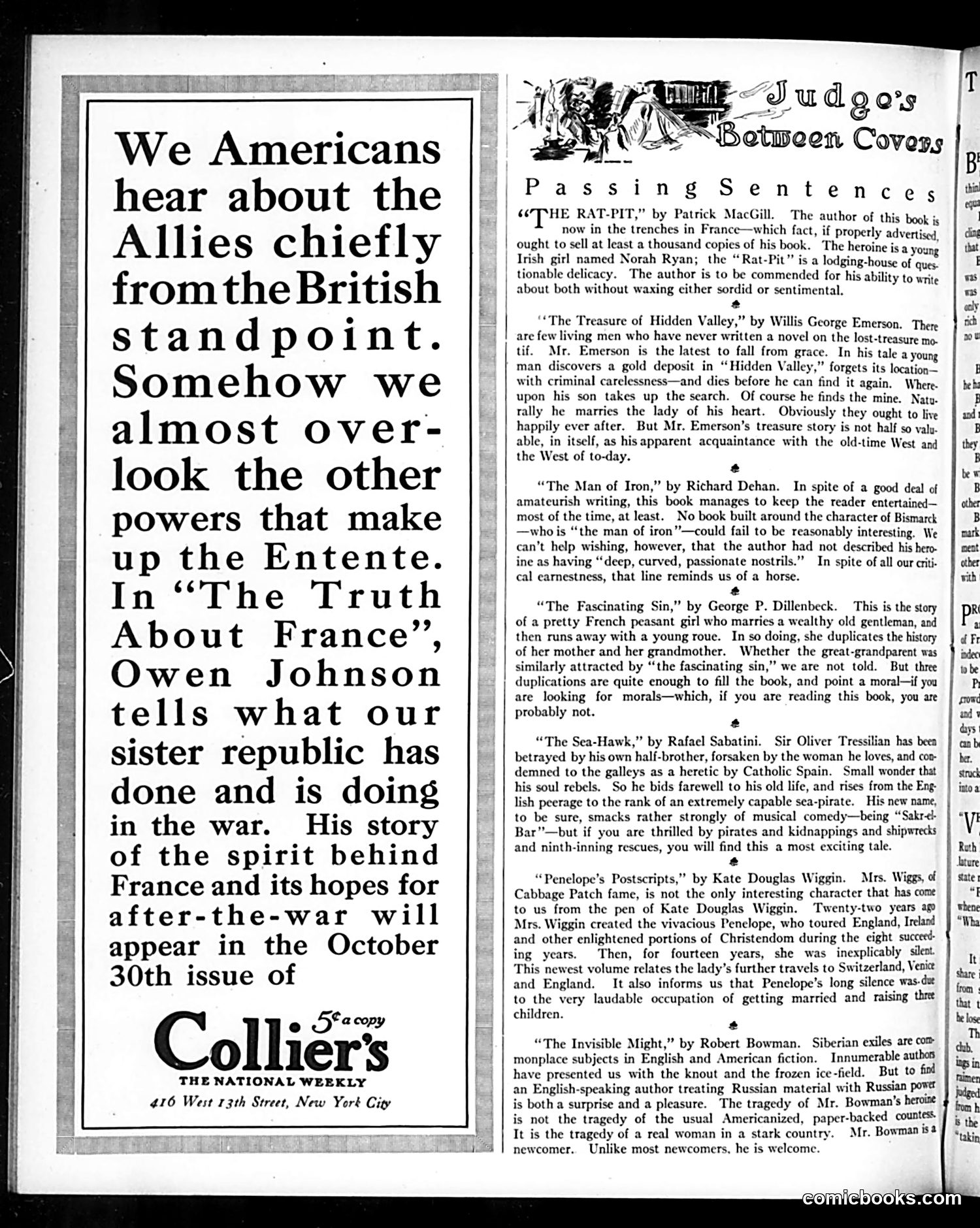
This page is primarily **advertising and book reviews**, not political satire. **Left side:** A Collier's magazine advertisement (5¢/copy) promoting an upcoming article by Owen Johnson titled "The Truth About France." The ad argues that Americans hear about WWI's Allied powers mainly through British perspectives and overlook France's role. Johnson's piece will reportedly address France's war efforts and post-war hopes, appearing October 30th. **Right side:** "Judge's Between Coves" book review column offering brief critical assessments of contemporary novels, including war-themed works like "The Rat-Pit" (set in French trenches) and "The Sea-Hawk" (adventure fiction). Reviews are mildly sarcastic but focus on literary merit rather than politics. **Context:** This appears from WWI-era American publishing, when magazines actively promoted war-related literature to American readers still debating U.S. involvement.
📄 Transcribed text from this page (OCR, searchable)
Machine-transcribed from the original scan — historical spelling and the odd misread are preserved.
aes EN eRe eae ee Bie dt | hel i BS IP aay —_— We Americans hear about the Allies chiefly fromthe British standpoint. Somehow we almost over- look the other powers that make up the Entente. In “The Truth About France’, Owen Johnson tells what our sister republic has done and is doing in the war. His story of the spirit behind France and its hopes for after-the-war will appear in the October 30th issue of @ Dracry ollier's THE NATIONAL WEEKLY 416 West 13th Street, New York Ciy | duplications are quite enough to fill the book, and point a moral—if you | P Sud go's “Betpeen Covoss Passing Sentences |# 6¢THE RAT-PIT,” by Patrick MacGill. The author of this book j | now in the trenches in France—which fact, if properly advertised, os ought to sell at least a thousand copies of his book. The heroine isa young | i! Irish girl named Norah Ryan; the “Rat-Pit” is a lodging-house of ques- E tionable delicacy. The author is to be commended for his ability to write ws about both without waxing cither sordid or sentimental. ms 2 aly ‘The Treasure of Hidden Valley,” by Willis George Emerson. There oh are few living men who have never written a novel on the lost-treasure mo- Ok tif. Mr. Emerson is the latest to fall from grace. In his tale @ young man discovers a gold deposit in “Hidden Valley,” forgets its location— E with criminal carelessness—and dies before he can find it again. Where | bebs upon his son takes up the search. Of course he finds the mine. Naty. E rally he marries the lady of his heart. Obviously they ought to live |) and: happily ever after. But Mr. Emerson’s treasure story is not half so valu- B able, in itself, as his apparent acquaintance with the old-time West and |} thy the West of to-day. B e bew “The Man of Iron,” by Richard Dehan. In spite of a good deal of B amateurish writing, this book manages to keep the reader entertained— | other most of the time, at least. No book built around the character of Bismarck B —who is “the man of iron”—could fail to be reasonably interesting. We | mark can’t help wishing, however, that the author had not described his hero- | meat ine as having “deep, curved, passionate nostrils.” In spite of all our criti.) ther cal earnestness, that line reminds us of a horse. with 2 “The Fascinating Sin,” by George P. Dillenbeck. This is the story Rt of a pretty French peasant girl who marries a wealthy old gentleman, and pe then runs away with a young rouc. In so doing, she duplicates the history} Fr of her mother and her grandmother. Whether the great-grandparent was} jndeo similarly attracted by “the fascinating sin,” we are not told. But three | be are looking for morals—which, if you are reading this book, you are probably not. + “The Sea-Hawk,” by Rafael Sabatini. Sir Oliver Tressilian has beea betrayed by his own half-brother, forsaken by the woman he loves, and con- demned to the galleys as a heretic by Catholic Spain. Small wonder that his soul rebels. So he bids farewell to his old life, and rises from the Eng- | intoa lish peerage to the rank of an extremely capable sea-pirate. His new name, to be sure, smacks rather strongly of musical comedy—being “Sakr-l- ‘V Bar”—but if you are thrilled by pirates and kidnappings and shipwrecks ' and ninth-inning rescues, you will find this a most exciting tale. Roth t } Jature “Penelope’s Postscripts,” by Kate Douglas Wiggin. Mrs. Wiggs, of | sate: Cabbage Patch fame, is not the only interesting character that has come “I to us from the pen of Kate Douglas Wiggin. Twenty-two years ag | whene Mrs. Wiggin created the vivacious Penelope, who toured England, Ireland} “Wha and other enlightened portions of Christendom during the eight succeed- ing years. Then, for fourteen years, she was inexplicably silent. It This newest volume relates the lady’s further travels to Switzerland, Venice py and England. It also informs us that Penclope’s long silence was-det fea to the very laudable occupation of getting married and raising thre | that t children. * 1 bebe : “The Invisible Might,” by Robert Bowman. Siberian exiles are com | ay monplace subjects in English and American fiction. Innumerable authors ings in have presented us with the knout and the frozen ice-field. But to flees an English-speaking author treating Russian material with Russian power jodged is both a surprise and a pleasure. The tragedy of Mr. Bowman's heroine from h is not the tragedy of the usual Americanized, paper-backed countess | i) It is the tragedy of a real woman in a stark country. Mr. Bowman is “takin newcomer. Unlike most newcomers, he is welcome.