
Judge, 1915-10-30 · page 22 of 28
Judge — October 30, 1915 — page 22: what you’re looking at
What you’re looking at
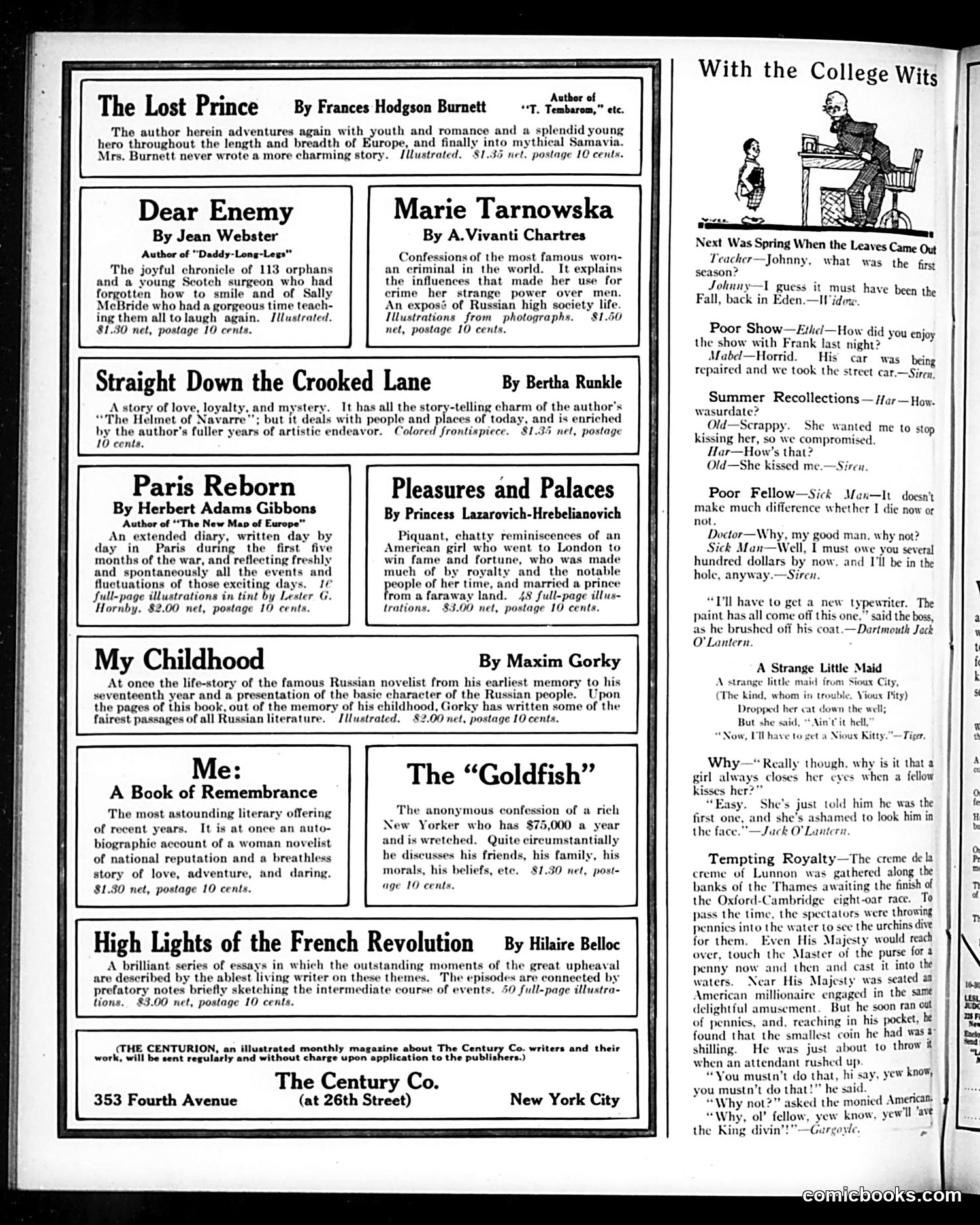
This is primarily a **book advertisement page** from The Century Co. publisher, not a political cartoon page. It showcases ten literary titles, mostly novels, published around World War I era. The right column contains "With the College Wits"—brief humorous student jokes rather than satire. These include: - A teacher-student exchange where Johnny suggests Fall was the first season "back in Eden" - A joke about attending a show with "Frank" and taking a street car - A quip about a "Poor Fellow" and a doctor discussing whether it matters if one dies now or later - A comment about kissing and shame These are lighthearted college humor pieces typical of Judge magazine's satirical tone, poking gentle fun at youth and romantic awkwardness rather than addressing serious political issues. The page reflects early 20th-century American literary publishing and student culture.
📄 Transcribed text from this page (OCR, searchable)
Machine-transcribed from the original scan — historical spelling and the odd misread are preserved.
The Lost Prince By Frances Hodgson Burnett Author of “‘T. Tembarom,” etc. The author herein adventures again with youth and romance and a splendid young hero throughout the length and breadth of Europe, and finally into mythical Samavia. Mrs. Burnett never wrote a more charming story. /llustrated. Dear Enemy By Jean Webster Author of “Daddy-Long-Legs” The joyful chronicle of 113 orphans and a young Scotch surgeon who had forgotten how to smile and of Sally MeBride who had a gorgeous time teach- ing them all tolaugh again. Jllustrated. $1.30 net, postage 10 cents. Straight Down the Crooked Lane It has all the story-telling charm of the author's A story of love, loyalty, and mystery. 35 net. postage 10 cents. Marie Tarnowska By A.Vivanti Chartres Confessions of the most famous worn- an criminal in the world. — It explains the influences that made her use for crime her strange power over men. An exposé of Russian high society life. Illustrations from photographs. $1.60 net, postage 10 cents. By Bertha Runkle “The Helmet of Navai ; but it deals with people and places of today, and is enriched by the author's fuller years of artistic endeavor. 10 cents. Paris Reborn By Herbert Adams Gibbons Author of “The New Map of Europe” An extended diary, written day by day in Paris during the first five months of the war, and reflecting freshly and spontaneously all the events and fluctuations of those exciting days. 1¢ Sull-page illustrations in tint by Lester G. Hornby. $2.00 net, postage 10 cents. My Childhood At once the life-story of the famous Russia Colored frontispiece. 81.35 net, postage Pleasures and Palaces By Princess Lazarovich-Hrebelianovich Piquant, chatty reminiscences of an American girl who went to London to win fame and fortune, who was made much of by royalty and the notable eople of her time, and married a prince rom a faraway land. 48 full-page illus- trations. 83.00 net, postage 10 cents. By Maxim Gorky novelist from his earliest memory to his seventeenth year and a presentation of the basic character of the Russian people. Upon the pages of this book, out of the memory of his childhood, Gorky has written some of the fairest passages of all Russian literature. Me: A Book of Remembrance The most astounding literary offering of recent years. It is at once an auto- biographic account of a woman novelist of national reputation and a breathless story of love, adventure, and daring. $1.30 net, postage 10 cents. High Lights of the French Revolution A brilliant series of essays in which the outstanding moments of the great upheaval are described by the ablest living writer on the Illustrated. 82.00 net, postage 10 cents. The “Goldfish” The anonymous confession of a rich New Yorker who has $75,000 a year and is wretched. Quite cireumstantially he discusses his friends, his fam morals, his beliefs, ete. $1.30 net, post- age 10 cents. By Hilaire Belloc e themes. The episodes are connected by prefatory notes briefly sketching the intermediate course of events. 50 full-page illustra- tions. $3.00 net, postage 10 cents. (THE CENTURION, an illustrated monthly ma; zine about The Century Co. writers and their work, will be sent regularly and without charge upon application to the publishers.) The Century Co. 353 Fourth Avenue (at 26th Street) New York City With the College Wits Next Was Spring When the Leaves Came Out Teacher—Johnny, what was wns J y was the first Johnny—I guess it must have Fall, back in Eden.—IWidee, "DE the Poor Show—Ethc!—How did you enjoy the show with Frank last night? Mabel—Horrid. His car w being repaired and we took the street car.—Siren, Summer Recollections — /far—Hovw. wasurdate? Old—Scrappy. She wanted me to stop kissing her, so we compromised. Har—How’s that? Old—She kissed me.—Siren. Poor Fellow—Sick Man—It doesn't make much difference whether I die now or not. Doctor—Why, my good man, why not? Sick Man—Well, I must owe you several hundred dollars by now, and I'll be in the hole, anyway.—Siren. “Dll have to get a new typewriter. The paint has all come off this one,” said the boss, as he brushed off his coat.—Dartmouth Jack O' Lantern A Strange Little Maid \ strange little maid from Sioux City, (The kind, whom in trouble, Vioux Pity) Dropped her cat down the well; But she said, “Ain't it hell, ‘ow, FW have to get a Nious Kitty."—Tiger, Why—* Really though, why is it that a closes her eves when a fellow She’s just told him he was the und she’s ashamed to look him in the face.” —Jack O' Lantern. Tempting Royalty—The creme dela creme of Lunnon was gathered along t banks of the Thames awaiting the finish of the Oxford-Cambridge eight-oar race. To pass the time, the spectators were throwing pennies into the water to see the urchins dive for them. Even His Majesty over, touch the Master of the purse for ¢ penny now and then and cast it into the waters. Near His Majesty was seated at American millionaire engaged in the same delightful amusement. But he soon ran out of pennies, and, reaching in his pocket, be found that the smallest coin he had was shilling. He was just about to throw # when an attendant rushed up. “You mustn't do that, hi say, yew know, you mustn’t do that!” he said _ “Why not?” asked the monied American, “Why, ol’ fellow, yew know, yew Il ‘ave the King divin’! —Gurgoxle. J