
A complete issue · 28 pages · 1915
Judge — October 23, 1915
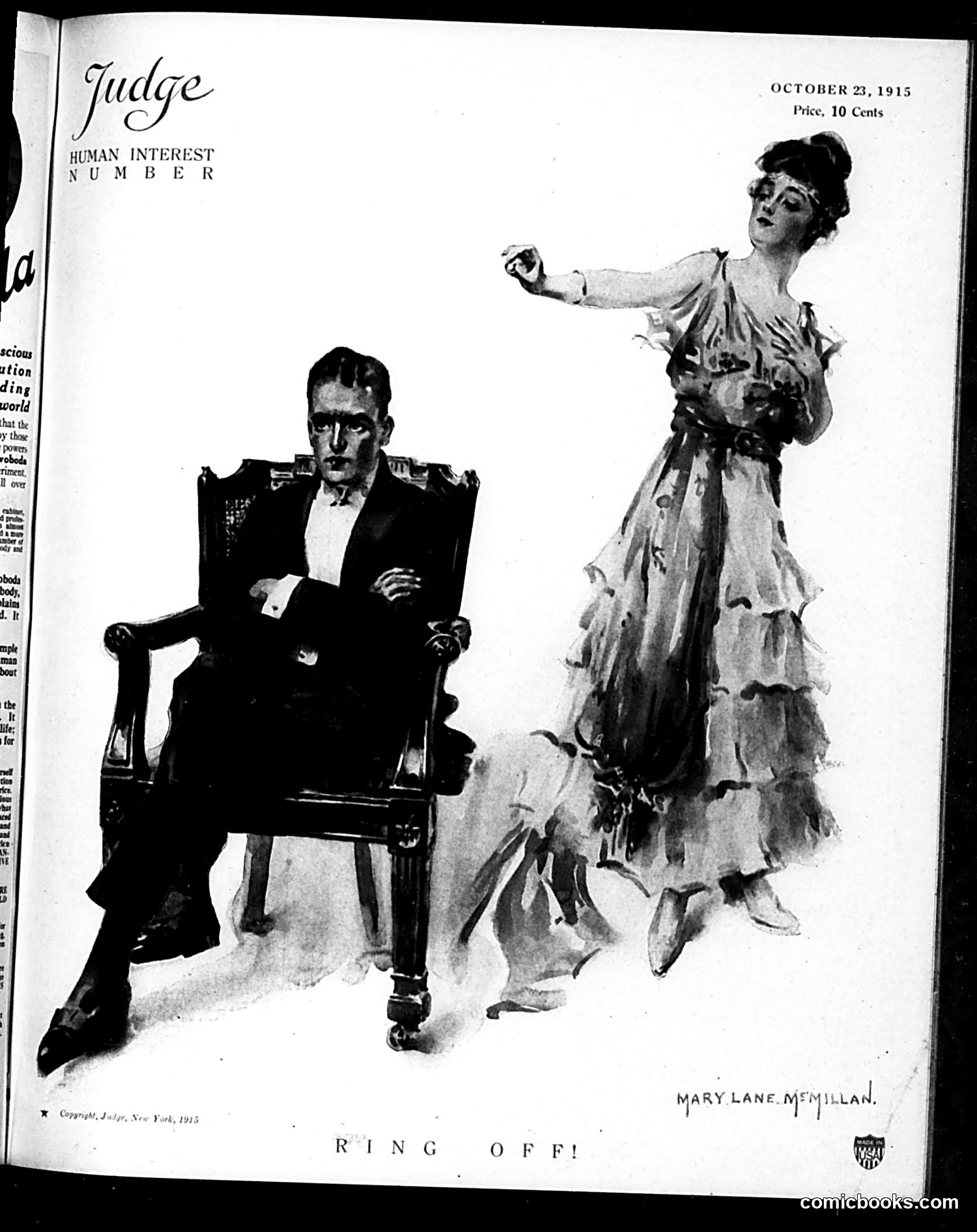
This cartoon by Mary Lane McMillan depicts a military officer seated while a woman gestures dramatically, appearing to scold or dismiss him. The title "Ring Off!" suggests a breaking of engagement or romantic relationship. The satire likely comments on wartime romance or military courtship during World War I (which the U.S. had not yet entered in October 1915, though the war was ongoing in Europe). The woman's animated posture and the officer's seated, somewhat chastened demeanor suggest she has authority in the relationship—perhaps satirizing contemporary debates about women's independence, courtship customs, or the impact of military service on domestic relationships. The specific identities of these figures remain unclear without additional context.
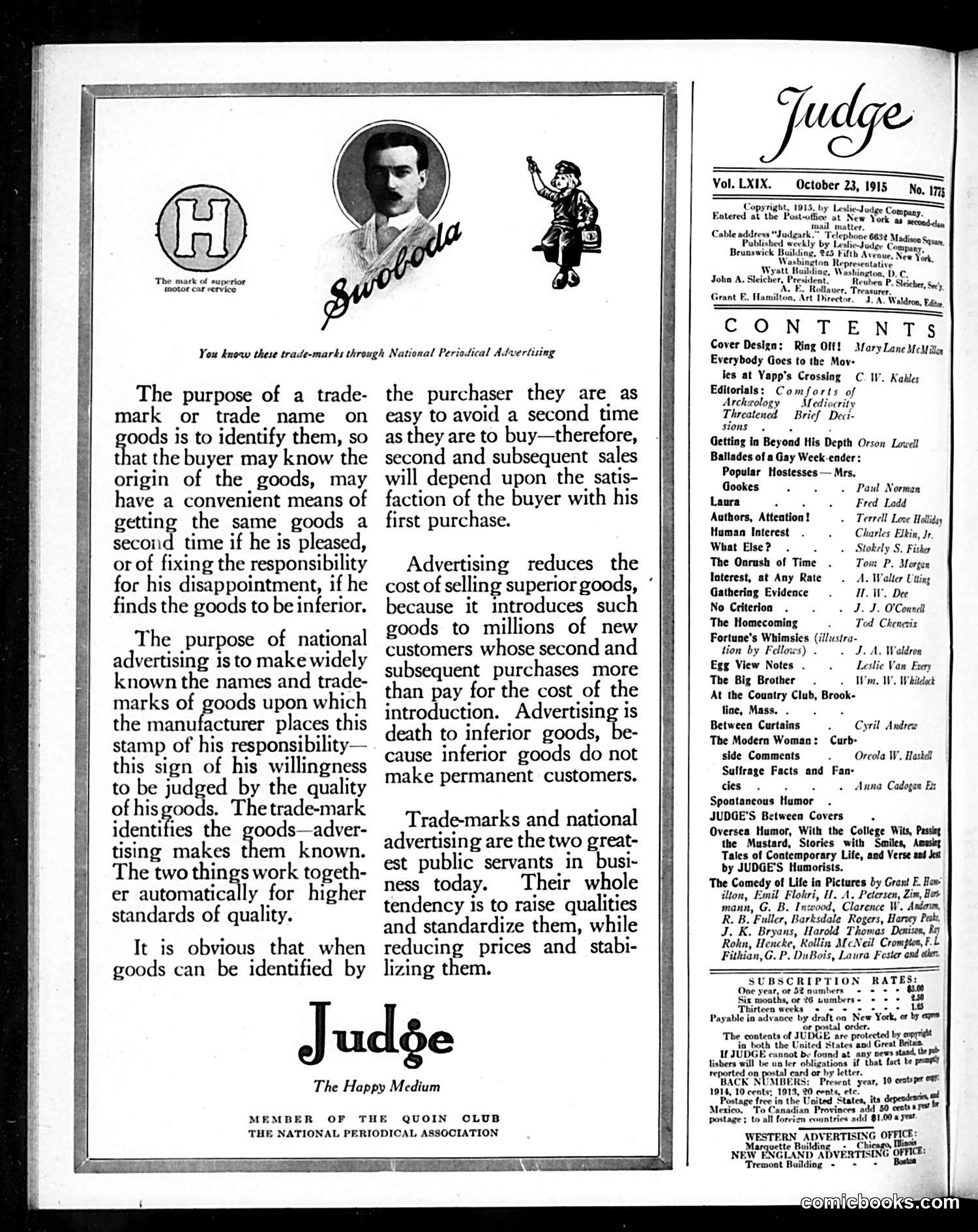
This page is primarily **editorial content about trademarks and advertising**, not political satire. The left side features three trademark examples (an "H" mark, a "Sariola" brand portrait, and what appears to be a mascot figure) illustrating the editorial's main argument: that trademarks and national advertising work together to guarantee product quality and standardize goods while reducing prices. The accompanying text argues advertising benefits consumers by introducing quality products to new customers, making repeat purchases reliable. This reflects **early 20th-century pro-business perspectives** on advertising's role in commerce. The right page shows Judge's table of contents for this issue. There is **no apparent political cartoon or satire** on this particular spread—it's a straightforward commercial/editorial discussion.
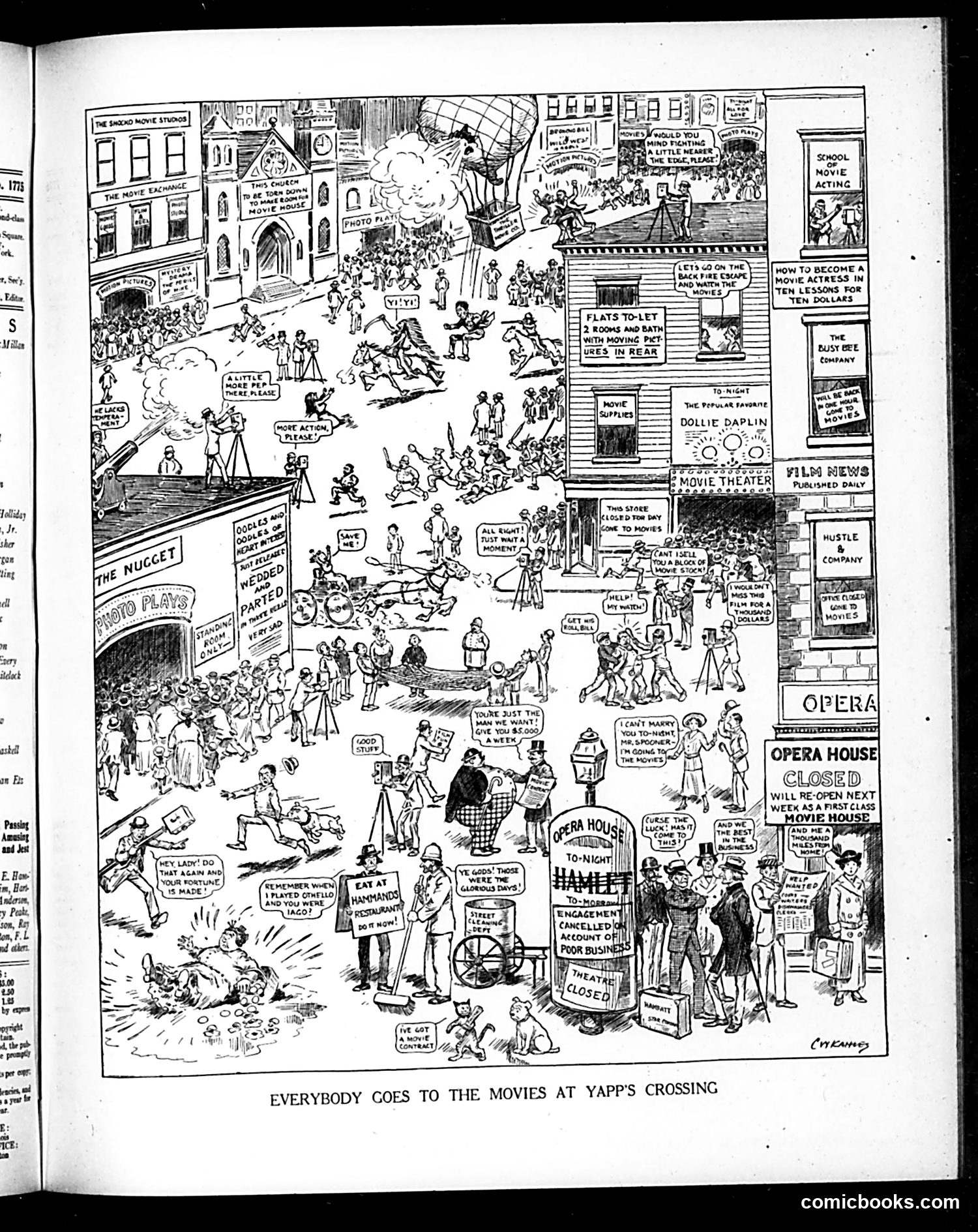
This is primarily a **humorous illustration rather than political satire**. It depicts a bustling movie-theater district in what appears to be early 20th-century America, showcasing the social phenomenon of cinema's explosive popularity. The cartoon satirizes how movies attracted **all social classes and types**: wealthy patrons, working-class families, children, pickpockets, and various street vendors converge on theaters showing films like "Hamlet" and "Dollie Darlin." Speech bubbles capture period-appropriate dialogue about entertainment, romance, and petty crimes. The satire's point: **movies' democratizing effect** on entertainment and urban social life. Rather than targeting specific politicians, it gently mocks how cinema transcended traditional class boundaries, drawing "everybody" to this commercial district regardless of their station or intentions. The page is largely **advertising for local businesses** surrounding the theater district.
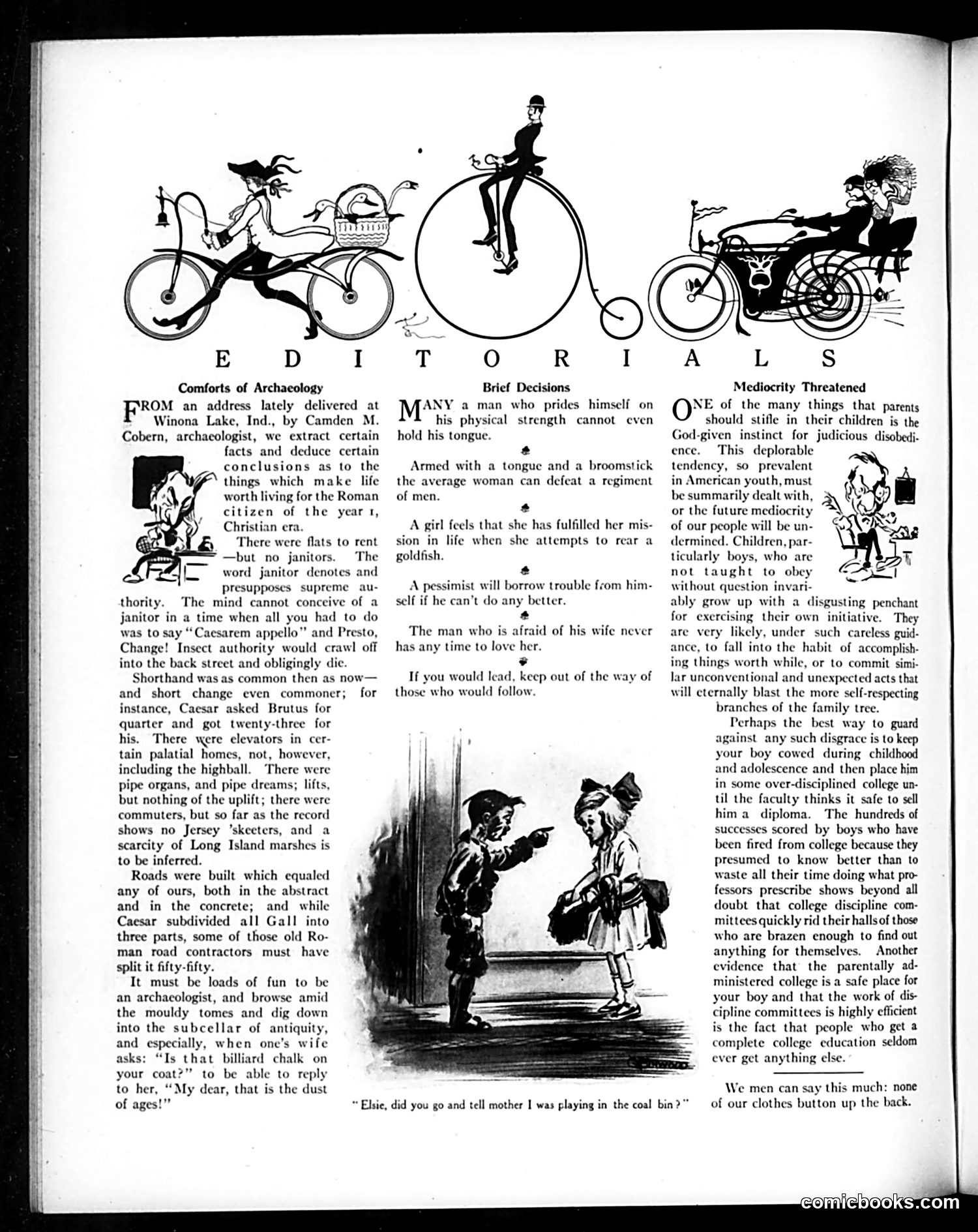
The top illustration "EDITORIAL" depicts various bicycle and tricycle riders of exaggerated, absurd proportions—likely satirizing late 19th/early 20th-century fads and pretension around cycling culture. The main editorial text criticizes what appears to be American youth's declining judgment and character. It attacks: - Boys lacking proper discipline and obedience - Over-indulgent parenting that encourages independent thinking deemed "disgusting" - College education as ineffective at instilling values - A general cultural loss of authority and respect The lower cartoon shows what appears to be a child being discovered playing in a coal bin, illustrating parental neglect or poor supervision. The page expresses conservative anxiety about generational decline, insufficient parental control, and the failure of institutions to maintain social order and traditional values.
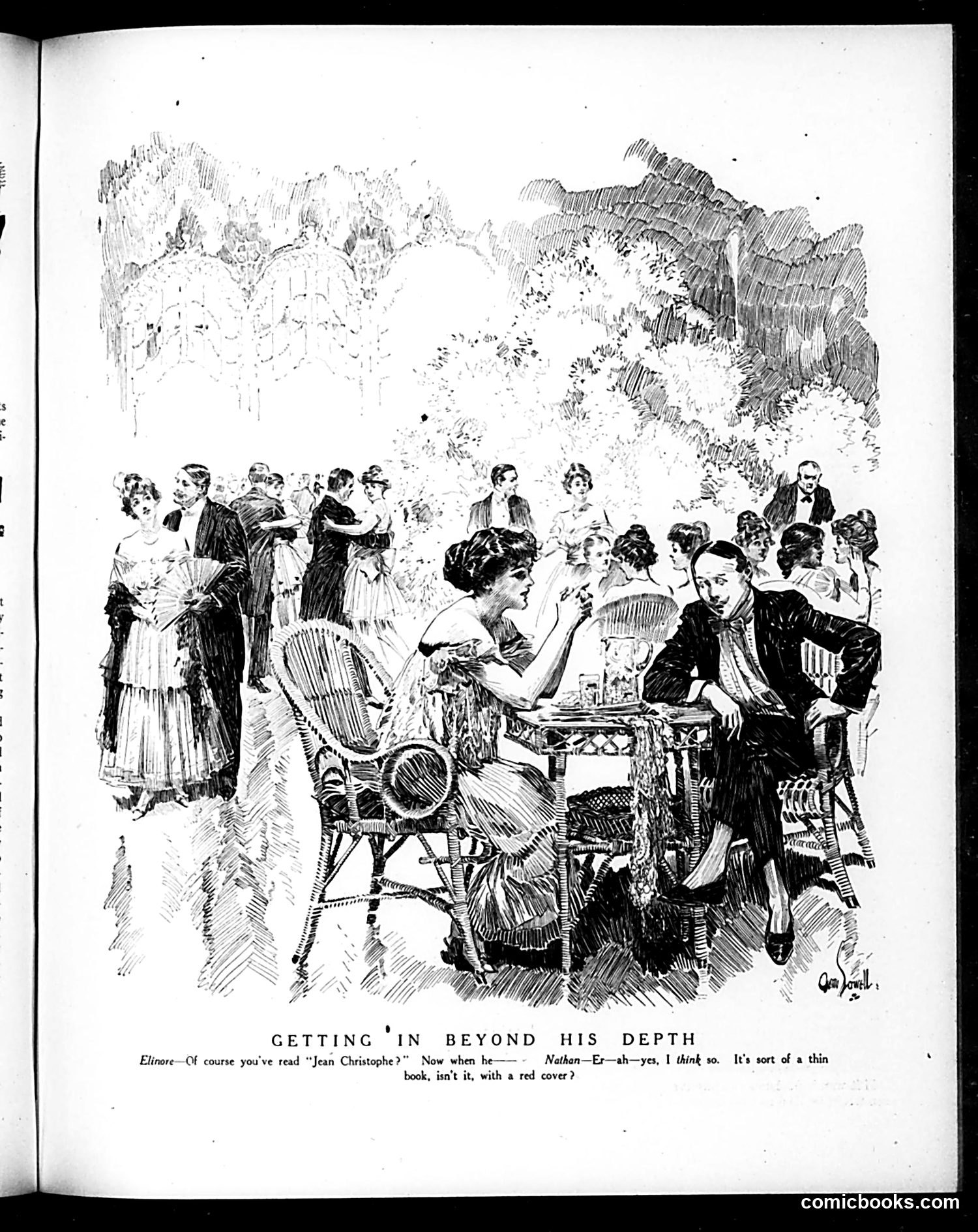
This cartoon satirizes a social situation where someone named Elmore is pretending to have read "Jean Christophe," a serious literary work by French author Romain Rolland. The caption has another character (Nathan-E-) calling him out: he's bluffing about reading an intellectual book, claiming it has "a red cover," suggesting superficial familiarity. The scene depicts a garden party or social gathering where Elmore appears to be among educated, cultured people discussing literature. The satire targets social pretension—someone trying to appear intellectually sophisticated by feigning knowledge of important books without actually reading them. This was a common subject for Judge magazine's humor about class aspiration and social climbing in early-20th-century America.
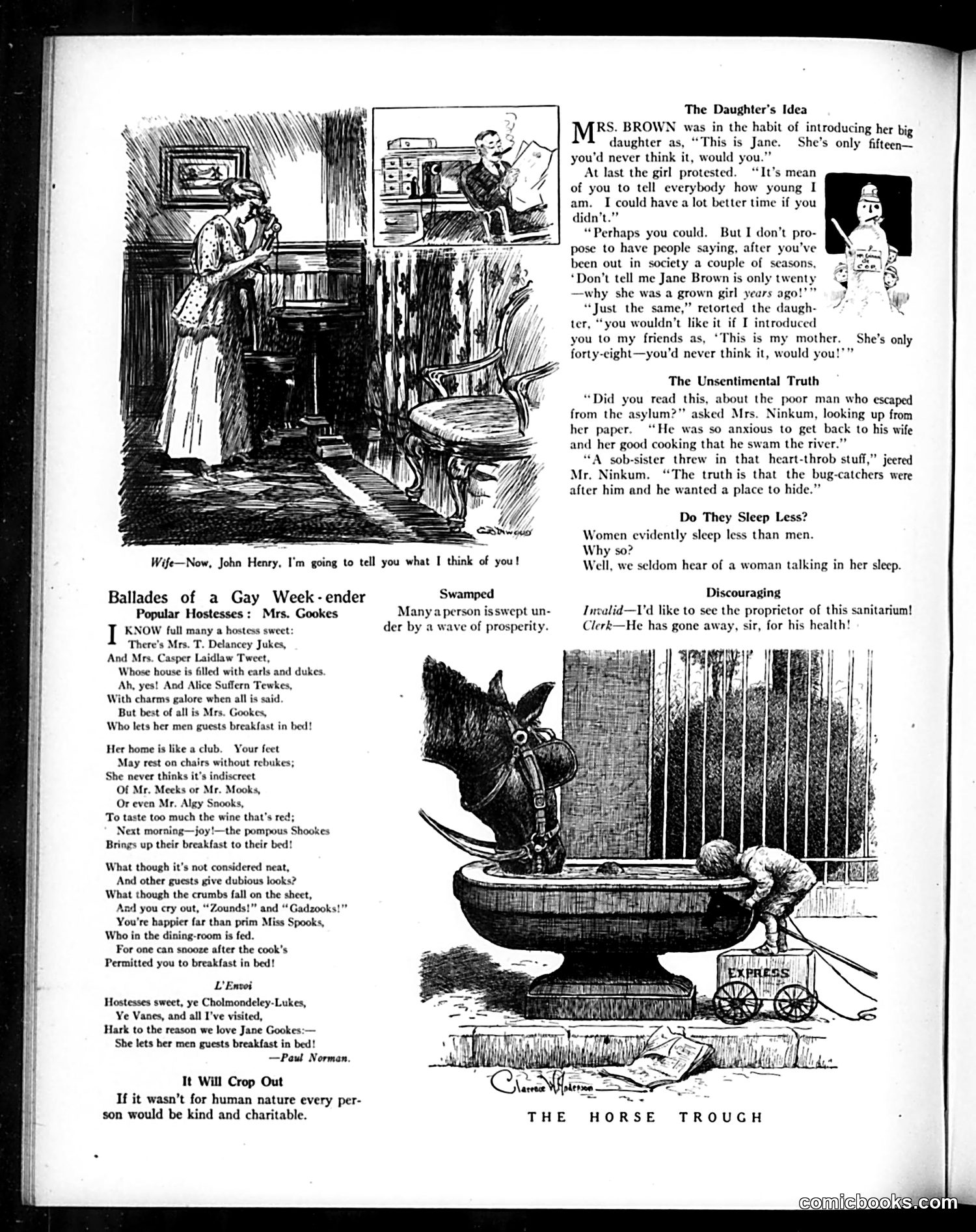
This page contains several short humorous pieces satirizing early 20th-century American social conventions: **"The Daughter's Idea"**: Mocks Mrs. Brown's habit of introducing her fifteen-year-old daughter as younger to make her seem more impressive. The daughter protests this is dishonest and limits her social opportunities. The joke's irony: the mother fears being called old herself, revealing female vanity about aging was a mutual, generational problem. **"Ballades of a Gay Week-ender"**: Celebrates Mrs. Gookes as the ideal hostess because she allows male guests to eat breakfast in bed—a sign of luxurious informality and comfort. The humor mocks upper-class pretense by suggesting comfort matters more than propriety. **Other brief pieces** mock human nature, include a domestic quarrel cartoon, and play on period expectations about gender behavior ("women talk less in their sleep"). The overall tone is gently satirical of social climbing, female vanity, and class pretension rather than harsh political commentary.
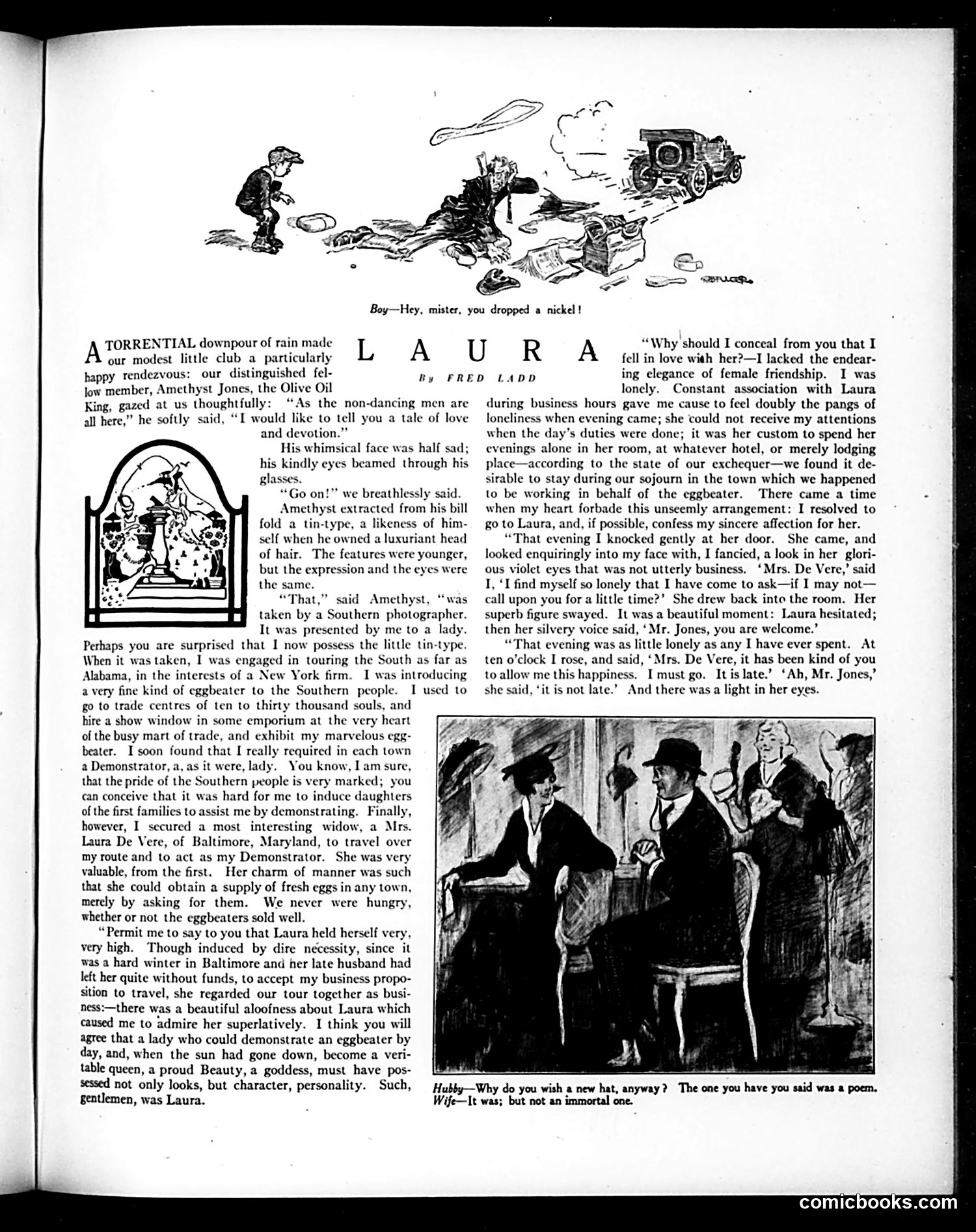
This page presents a sentimental short story framed as a humorous tale told at a gentleman's club. The narrator, Amethyst Jones (a bald man nostalgically showing a tin-type photograph), recounts his past as an eggbeater salesman traveling the American South. The satire targets turn-of-the-century commercial culture: the absurdity of hiring "lady demonstrators" to sell kitchen gadgets by exploiting Southern aristocratic pride and charm. Laura De Vere, a financially desperate Baltimore widow, becomes the salesman's assistant—and the object of his affection. The joke lies in the contrast between Laura's dignified, aloof demeanor during business hours versus her expected romantic vulnerability at night. The cartoon at page top (showing someone dropping a nickel during a rainstorm) sets up the club's rainy-day storytelling mood. This is genteel satirical romance—poking fun at commercial exploitation, class pretension, and sentimental male longing, all wrapped in wistful, flowery prose.
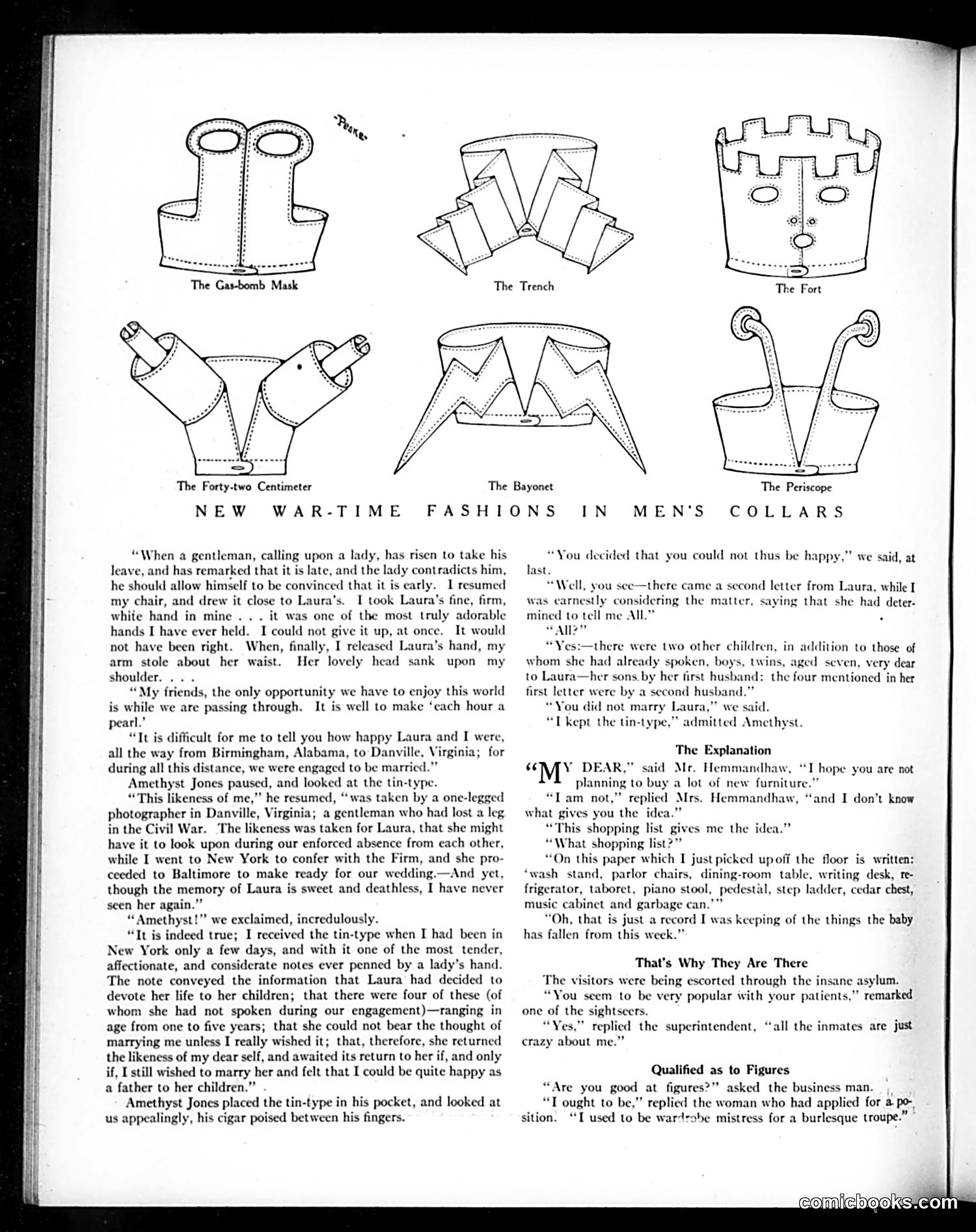
This page satirizes WWI-era fashion through absurd collar designs named after military references: "Gas-bomb Mask," "Trench," "Fort," "Forty-two Centimeter" (a German artillery piece), "Bayonet," and "Periscope." The joke is that civilian menswear has been absurdly militarized—collars literally resemble weapons and battlefield structures—reflecting how thoroughly war had infiltrated everyday life. The accompanying stories are unrelated humorous sketches typical of *Judge* magazine's format: one about a man who receives a tin-type photograph from his fiancée only to learn she has six children, and another about a wife's shopping list being items her baby has fallen from. The satire targets how completely World War I had dominated American consciousness, even making men's fashion inherently war-themed.
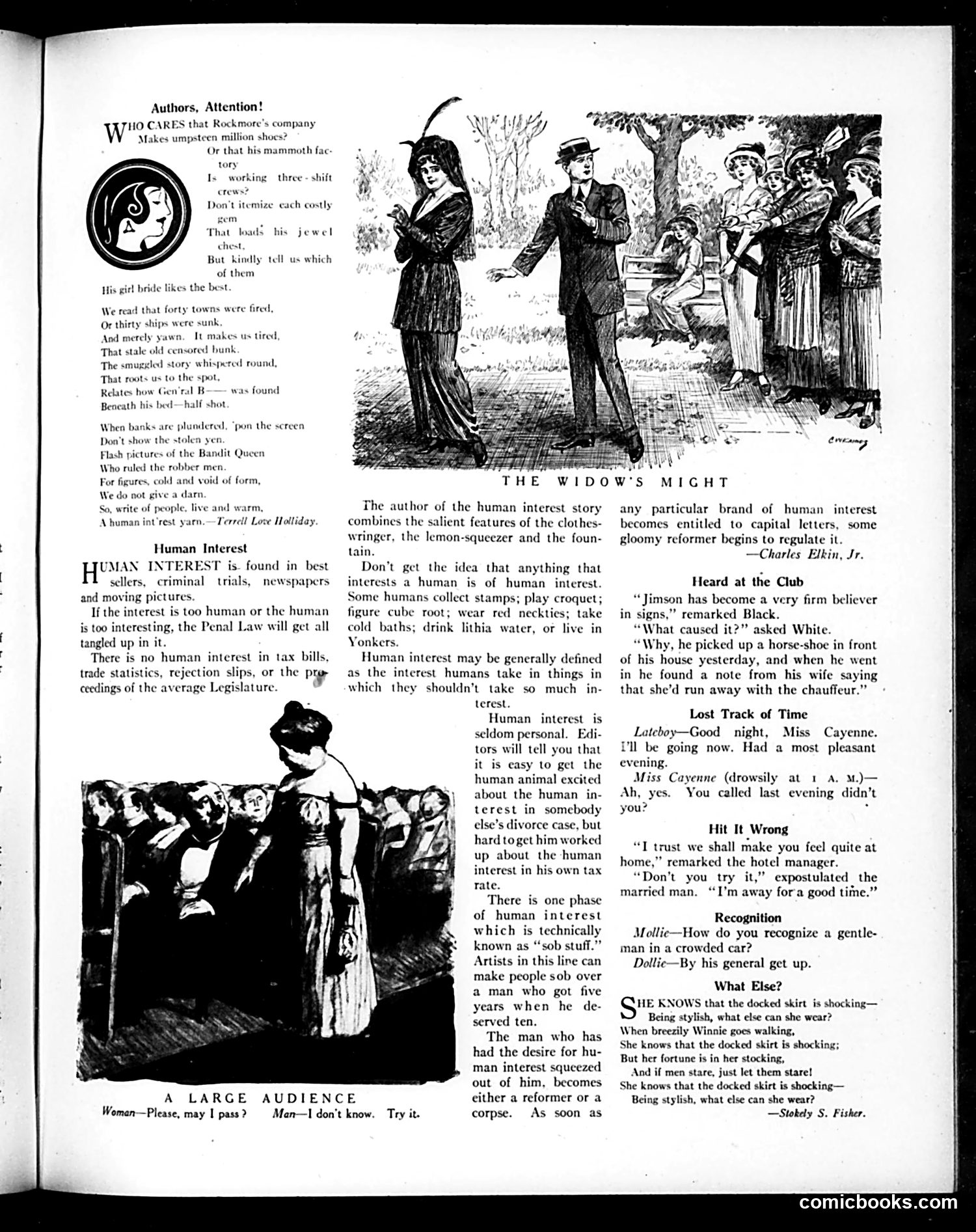
This page satirizes early 20th-century journalism and social attitudes. The opening poem mocks editors' obsession with sensational "human interest" stories over substantive news—they'd rather read about a bride's jewelry than economic data or ship sinkings. The piece defines human interest as voyeuristic fascination with others' scandals (especially divorce) that readers shouldn't actually care about. The accompanying cartoon and short comedic pieces reinforce this theme: people are drawn to trivial personal drama. "Heard at the Club" jokes about superstition and infidelity; "What Else?" satirizes women's fashion obsession with docked (shortened) skirts—scandalous at the time—suggesting vanity trumps propriety. The humor targets both sensationalist media and the public's appetite for gossip over serious information.
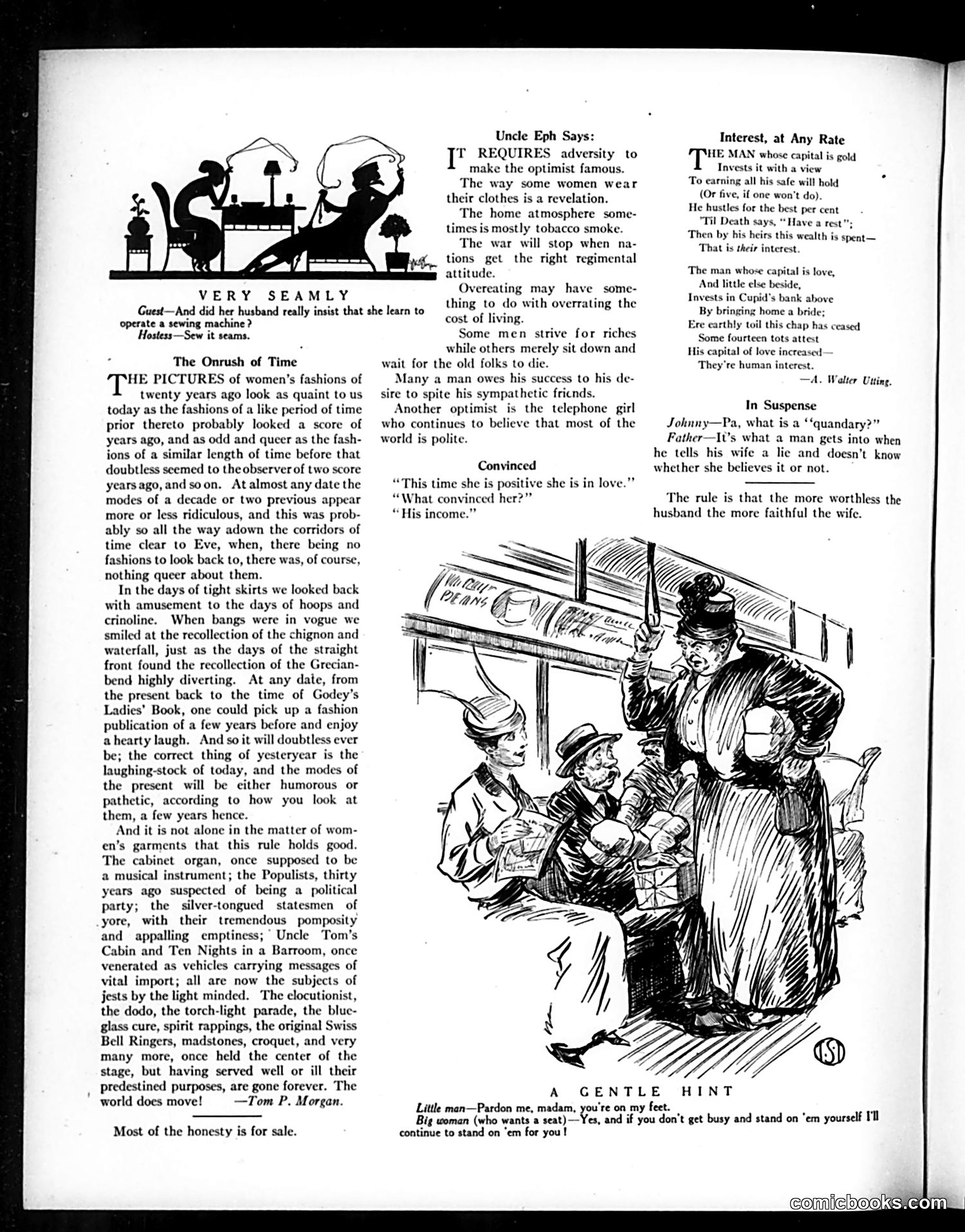
This page contains several satirical pieces typical of early 20th-century American humor: **"The Onrush of Time"** (main article): Mocks how fashion and cultural trends constantly cycle—what seems current becomes ridiculous within years. It references specific outdated fashions (crinolines, bangs, straight-front corsets) and cultural phenomena (cabinet organs, Populist Party, spiritualism, "Uncle Tom's Cabin"). The point: progress is inevitable, yet we're blind to how our own era will seem absurd to future generations. **"Very Seamly"**: A pun-based joke about a woman learning to sew. **"Uncle Eph Says"**: Folk wisdom quips commenting on optimism, marriage, and social behavior—typical aphorisms for the era. **"A Gentle Hint"** (cartoon): Shows a crowded streetcar scene satirizing urban congestion and passenger behavior—likely referencing real transit frustrations of the time. **"Interest, at Any Rate"**: Contrasts financial investment (seeking monetary returns) with romantic love (resulting in children as "human interest"). Light domestic humor. The overall tone reflects Judge's satirical approach to American social life, fashion, and manners.
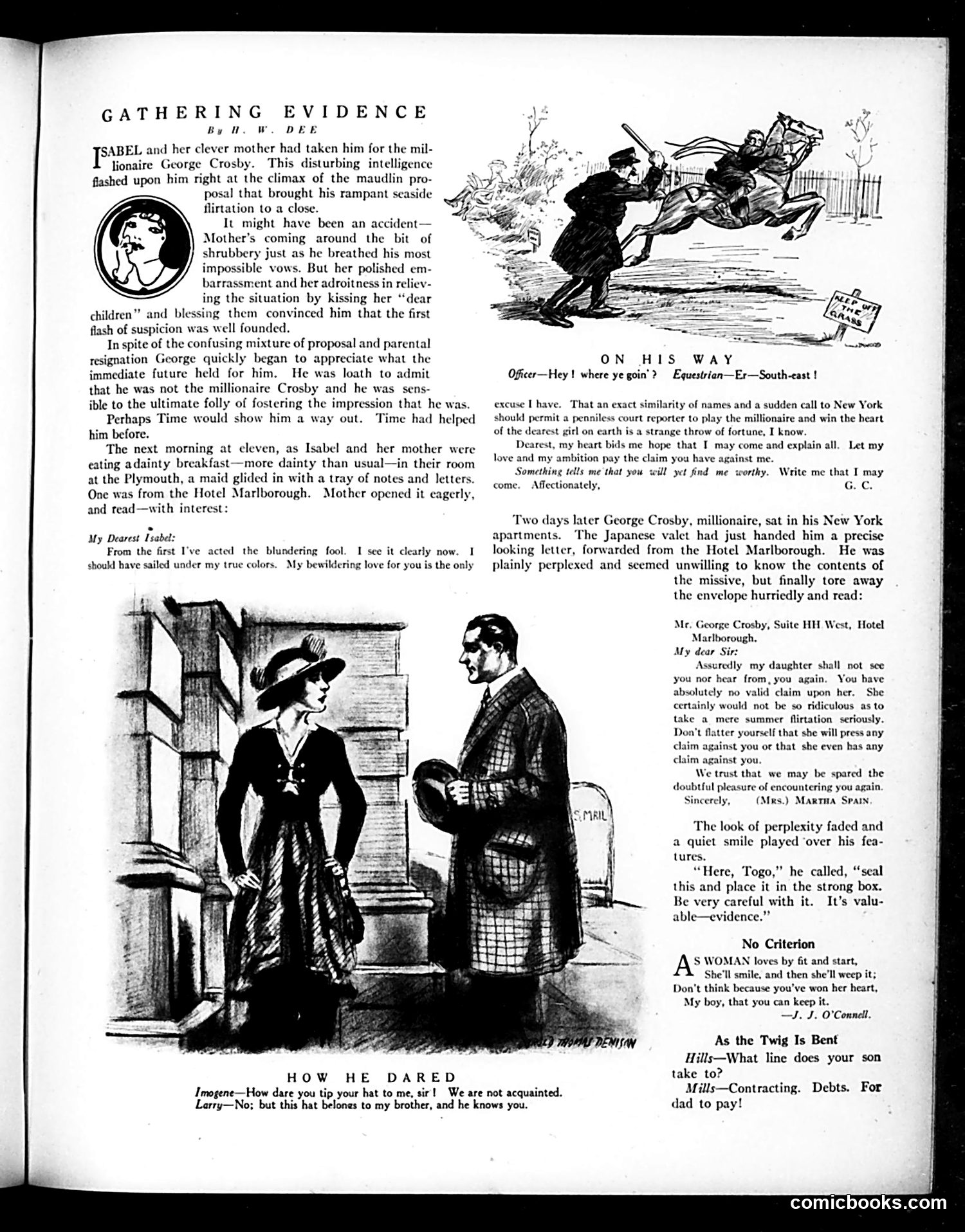
This story satirizes a common turn-of-the-century confidence scheme: a poor man (an unnamed court reporter) impersonates the wealthy George Crosby to seduce a young woman, Isabel, and her socially-ambitious mother during a seaside flirtation. When discovered, the impostor writes a confession letter admitting his deception—but cleverly signs it under his false name. The real George Crosby receives the mother's indignant rejection letter instead. The con artist's final move is brilliant: he preserves the mother's letter as "evidence" proving her daughter was pursued by (what she believes is) the actual millionaire, potentially useful for blackmail or future schemes. The satire targets both the gullibility of social climbers and the resourcefulness of con artists. The accompanying small cartoons joke about social pretension and financial irresponsibility—typical Judge magazine fare mocking middle-class anxieties of the era.
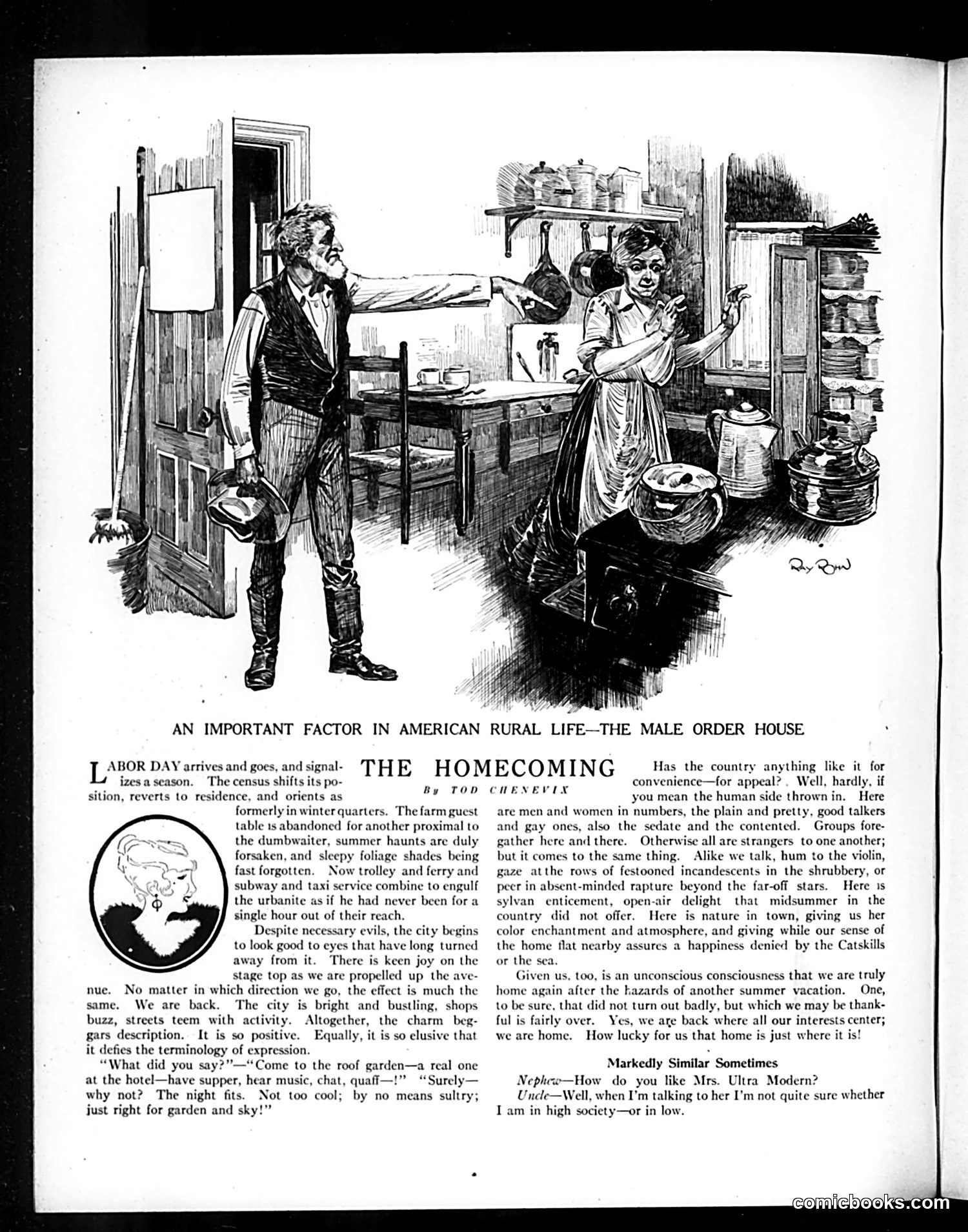
This page from *Judge* magazine satirizes the contrast between urban and rural American life, particularly the "male order house" (a boarding house or hotel where men dominate). **The Main Cartoon:** Depicts a man returning home to his wife after summer vacation. The caption "An Important Factor in American Rural Life—The Male Order House" uses ironic wordplay—"male order" suggests mail-order convenience, but means literally a house ordered/run by males. The sketch shows domestic disorder: the wife gestures in exasperation while the man stands idle, pots and pans clutter the kitchen, and shelves overflow with dishes. **The Satire:** The accompanying article by Tod Chenevix romanticizes urban "homecoming"—city lights, roof gardens, entertainment—but acknowledges country life lacks such human conveniences. The cartoon's visual irony undercuts this: the actual "home" depicted is chaotic and unglamorous, with the husband appearing useless domestically. **The Joke Below:** A brief dialogue mocks Mrs. "Ultra Modern"—unclear whether she's sophisticated or common, reflecting period anxieties about changing social conventions. The overall point: rural domesticity, despite nostalgia, is neither orderly nor romantic.
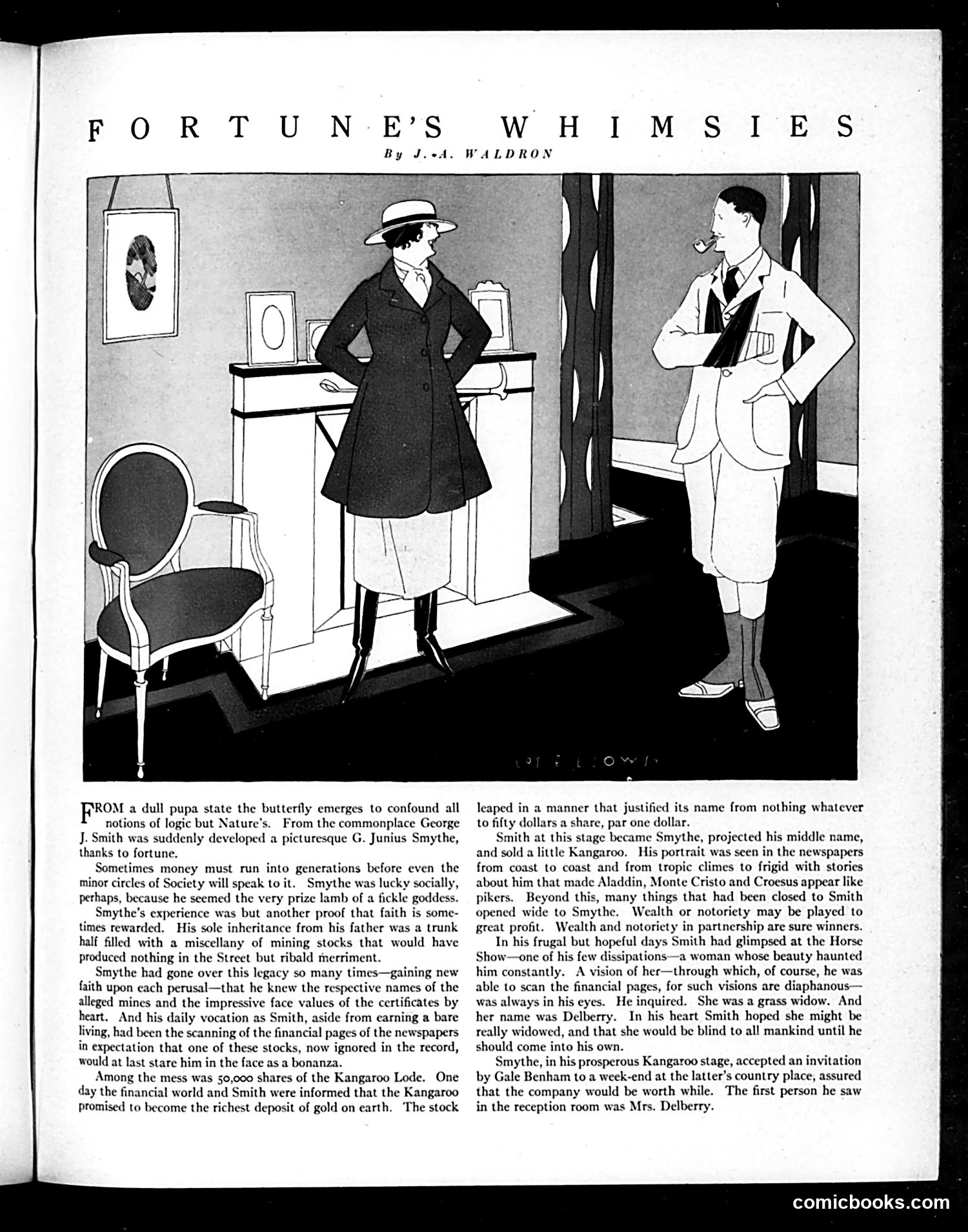
This story-cartoon satirizes the Gilded Age obsession with sudden wealth and social transformation. George J. Smith, an ordinary man, inherits worthless mining stocks. When one—the Kangaroo Lode—unexpectedly strikes gold, he reinvents himself as "G. Junius Smythe," adopting a middle name to sound more refined. The satire targets how society instantly embraces the newly wealthy: newspapers celebrate him coast-to-coast, doors open, and he gains access to elite spaces like the Horse Show. The joke is that nothing about him changed except his bank account, yet social pretension transformed him entirely. His romantic subplot—pursuing Mrs. Delberry, a "grass widow" (divorced woman) previously beyond his reach—reinforces this: wealth, not character, determines social acceptability. The cartoon mocks both the fickleness of society and the shallow opportunism of those who exploit it.
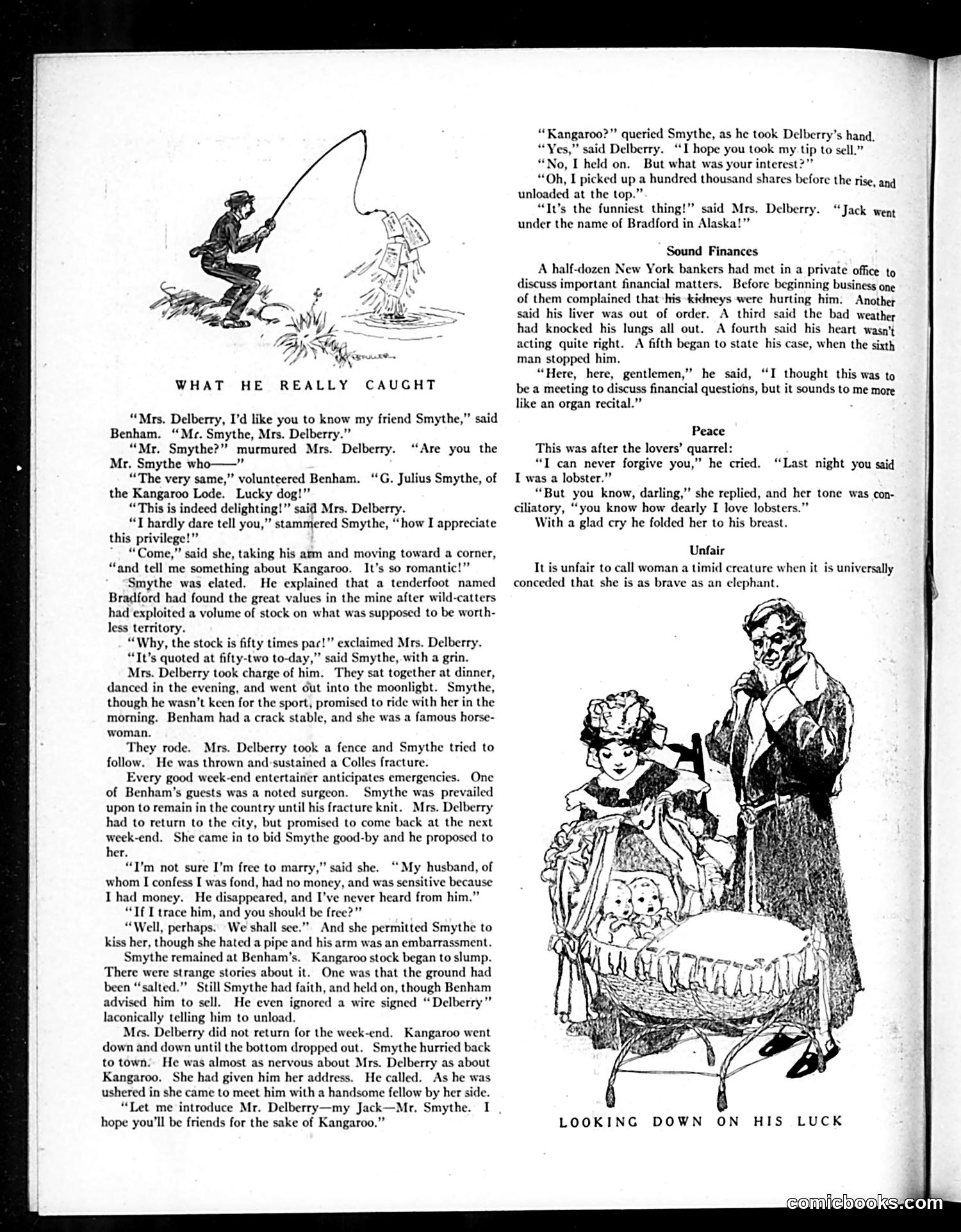
This page contains two satirical stories mocking financial speculation and gullibility during the stock-market era. **"What He Really Caught"** ridicules stock-market fraud. Smythe, a naive investor, is seduced by Mrs. Delberry's romantic interest while she extracts information about the "Kangaroo Lode" mining stock. Her husband—the actual Mr. Delberry—appears to be a con artist who deliberately "salted" (artificially inflated) the mine's value, then sold at peak prices while manipulating Smythe into holding worthless shares. The joke: Smythe "really caught" romantic attention but lost financially to calculated deceivers. **"Sound Finances"** is a brief gag about wealthy New York bankers complaining about health ailments during a financial meeting, until interrupted by the sixth man's implied rebuke—suggesting these supposed financial experts are more preoccupied with personal ailments than serious business. Both pieces satirize early 20th-century investment culture: crooked schemes, investor naiveté, and the dubious competence of financial elites.
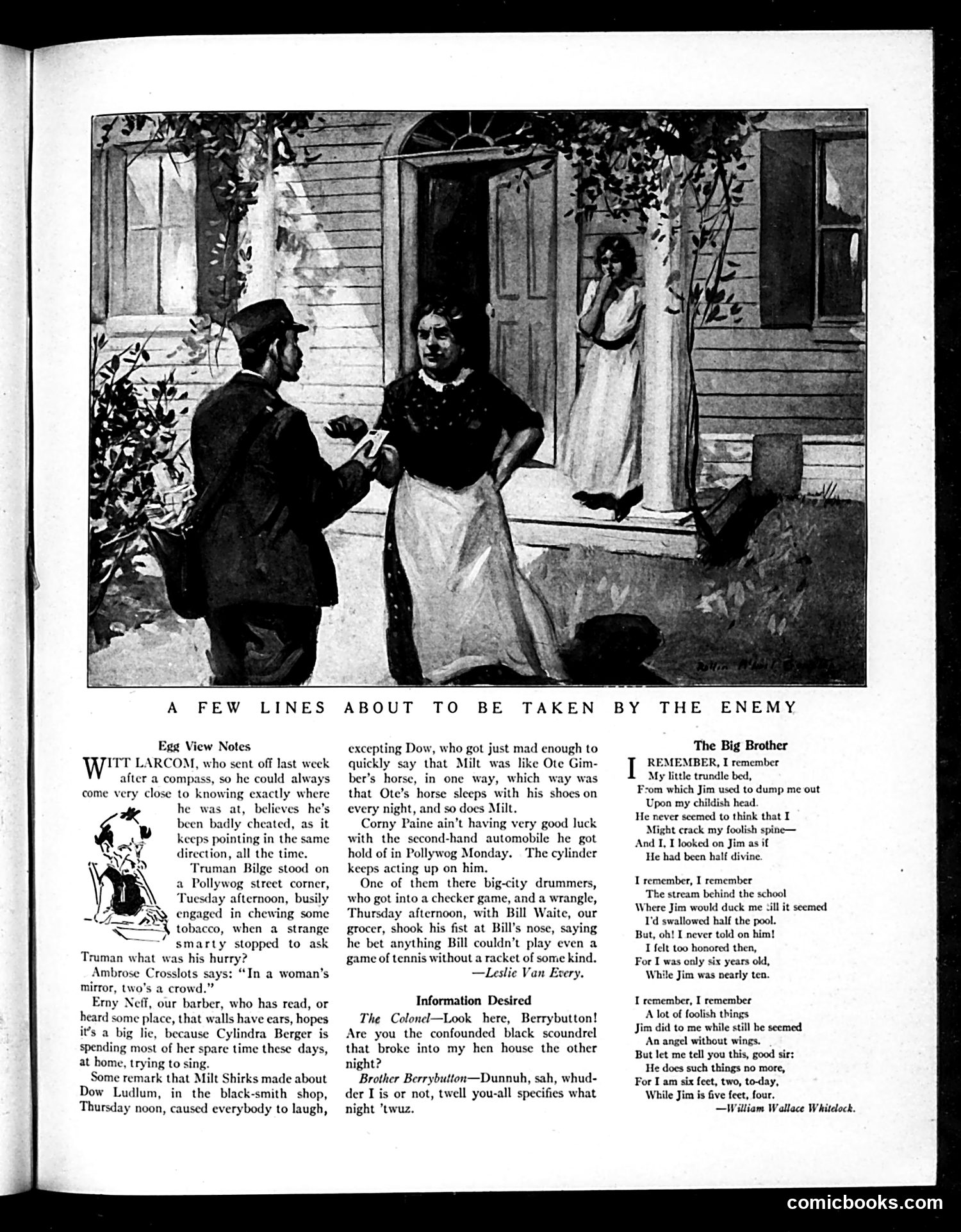
This page contains three distinct humor pieces from what appears to be an early 20th-century rural American setting (references to "Pollywog"): **"Egg View Notes"** - A column of brief, disconnected anecdotes about small-town characters (Witt Larcom, Truman Bilge, etc.). The humor is gentle, folksy, and absurdist—a man upset his compass keeps pointing the same direction; someone worried walls have ears because his neighbor sings constantly; a traveling salesman needlessly insults a grocer at checkers. **"Information Desired"** - A brief dialect joke where a Black man ("Brother Berrybutton") uses deliberately evasive logic when accused of raiding a henhouse, claiming he needs clarification about *which* night—satirizing both racial stereotypes and legalistic hair-splitting. **"The Big Brother"** - A sentimental poem (by William Wallace Whitelock) recalling childhood abuse from an older brother Jim, presented as endearing nostalgia. The punchline: the narrator is now 6'2" while Jim is 5'4"—implying reversed power dynamics and potential comeuppance, though presented humorously rather than threateningly.
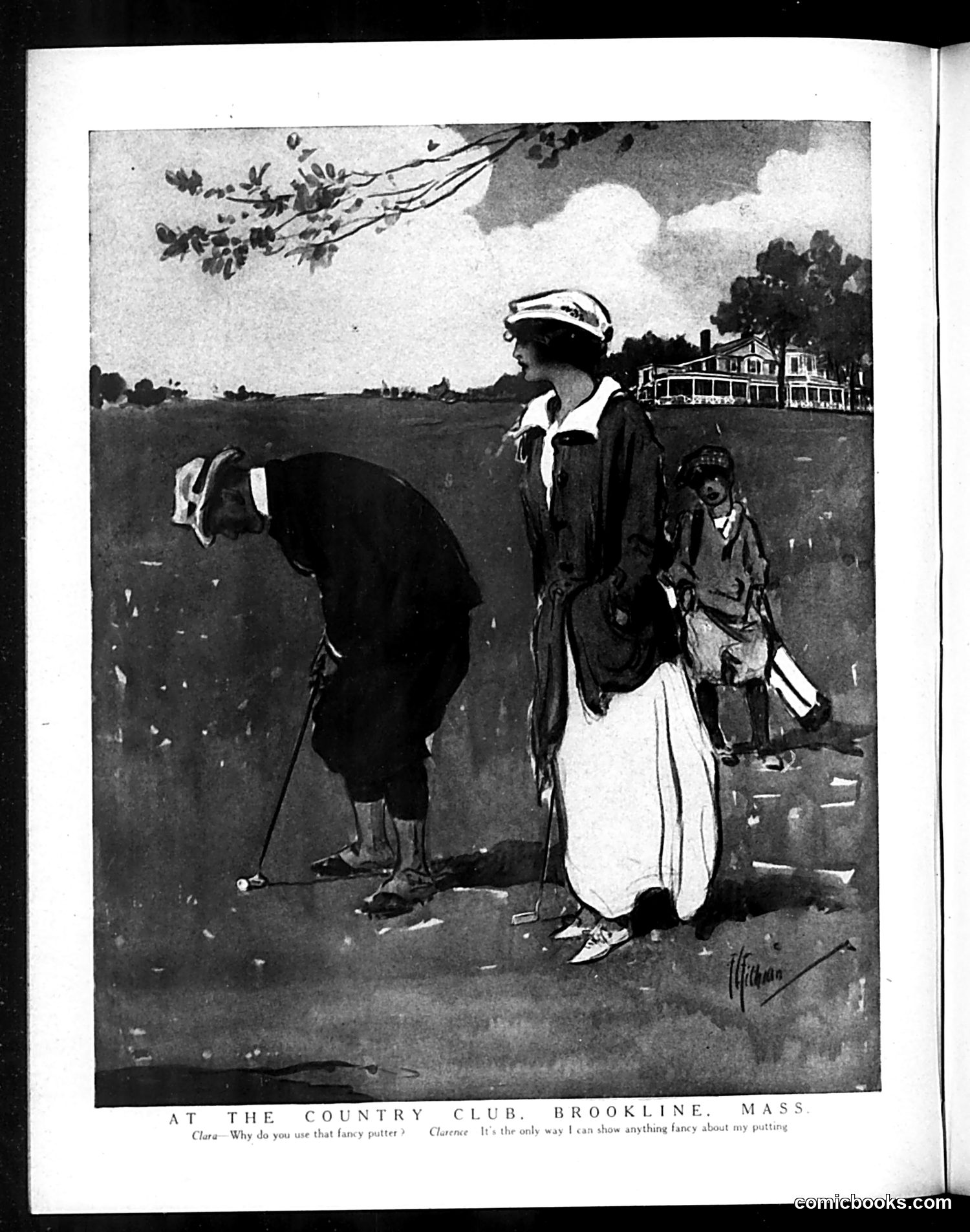
This cartoon satirizes class pretension and golf culture among the wealthy. A woman golfer uses an ornate "fancy putter," which Clara questions as unnecessary. Clarence's response—"It's the only way I can show anything fancy about my putting"—is the joke: his actual golf skill is mediocre, so he compensates by using an expensive, showy club to create an impression of sophistication. The humor targets the nouveaux riches who substitute visible luxury and affectation for genuine ability or breeding. Brookline Country Club was an exclusive Massachusetts golf club, emphasizing the upper-class setting. The illustration, credited to Hilldman, captures early 20th-century anxieties about status display and the gap between appearance and substance in high society.
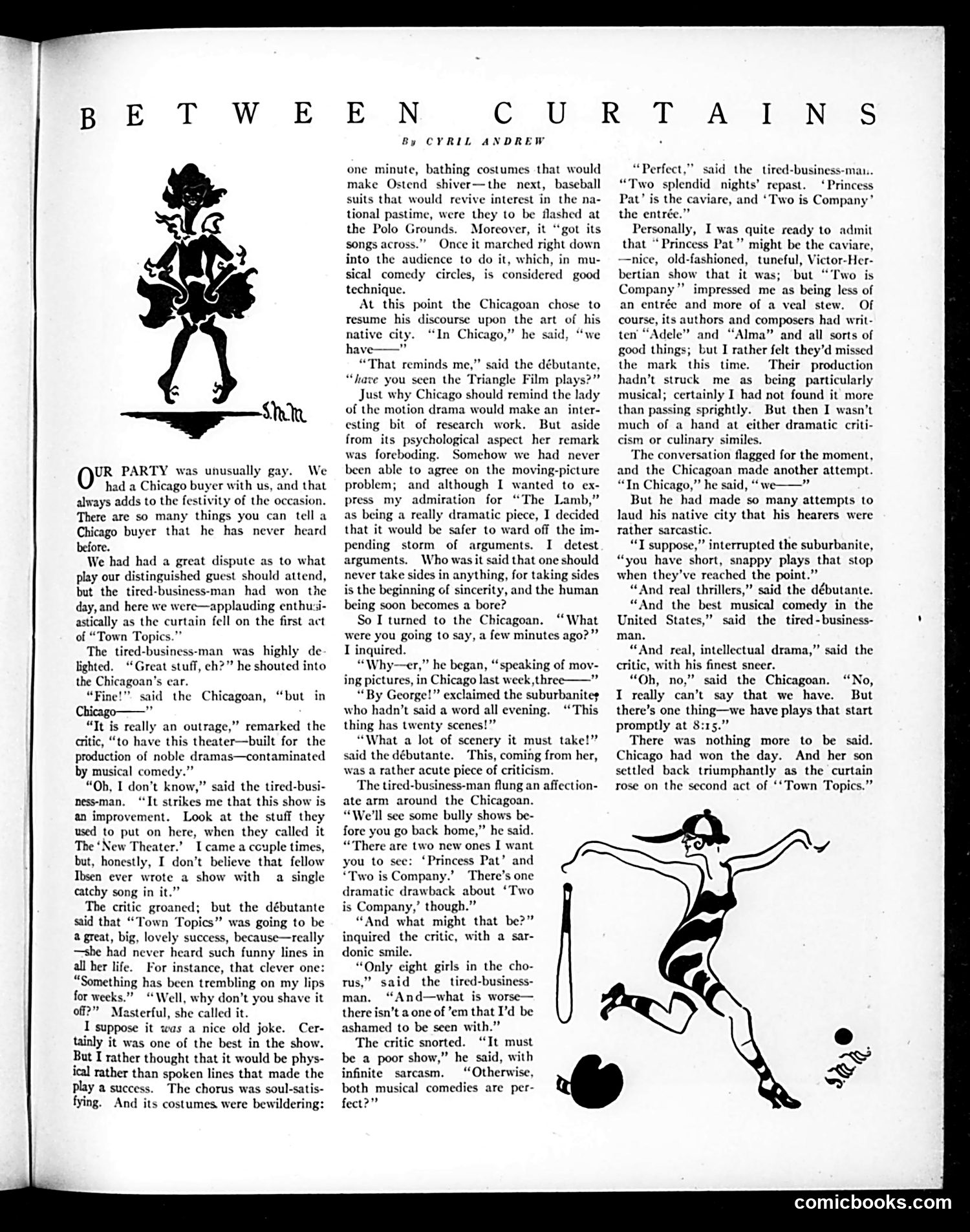
This Cyril Andrew piece satirizes early 1910s theater culture and social pretension. The narrative depicts a "tired-business-man" (a stock Judge character representing practical Americana) defending the musical comedy "Town Topics" against a snobbish theater critic who condemns it as lowbrow contamination of a noble venue. The satire targets cultural gatekeeping: the critic dismisses musical comedy and glorifies Ibsen, while the businessman notes Ibsen's shows lack "catchy songs" — suggesting serious drama can be tedious. A débutante enthusiastically praises a crude joke, exposing that "high culture" doesn't guarantee sophistication. The cartoons accompanying the text show figures in exaggerated dance poses, emphasizing the physical spectacle of musical comedy — the very "lowbrow" entertainment the critic despises but audiences enjoy. The piece mocks intellectual snobbery while defending popular entertainment's legitimacy.
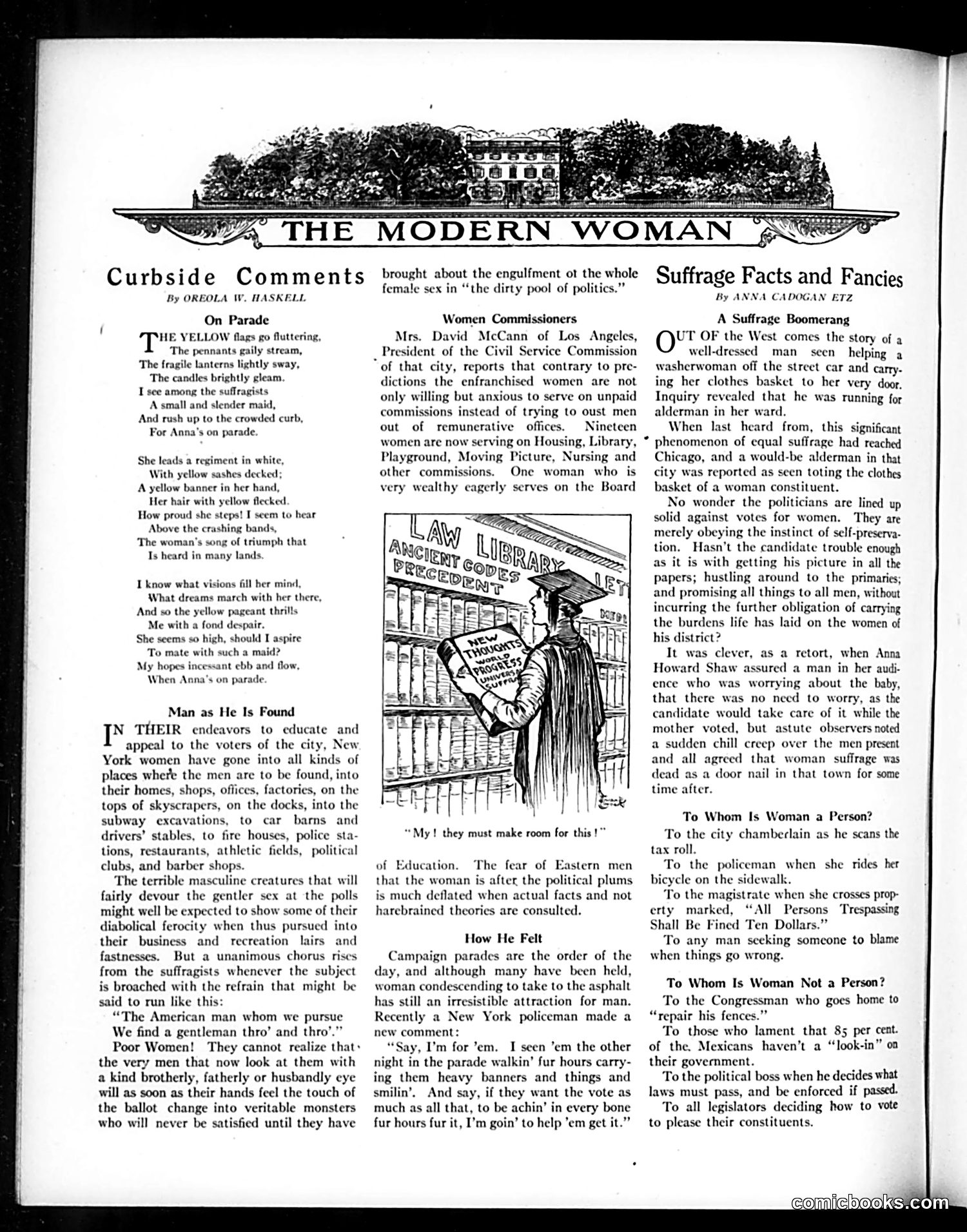
This Judge magazine page satirizes the women's suffrage movement through multiple angles: **"On Parade"** (left column): A romantic poem mocking a young suffragist marching in a parade with yellow flags and banners—yellow being the suffrage movement's color. The narrator's conflicted admiration ("fond despair") ridicules the elevation of suffragists as heroic figures. **"Man as He Is Found"** mocks suffragists' optimism about male support. It claims women canvassing factories and bars find men "gentlemen," but sarcastically suggests these same men will become "veritable monsters" once women gain voting power, supposedly fearing women will enter "the dirty pool of politics." **The cartoon** shows a man at a library card catalog labeled "How to Get the Female Vote," suggesting male politicians cynically study how to manipulate women voters. **Right-side articles** present "facts" allegedly proving suffragists' fears unfounded—women commissioners work unpaid, a policeman supports voting rights—but the framing remains dismissive, treating women's political participation as curiosity rather than justice.
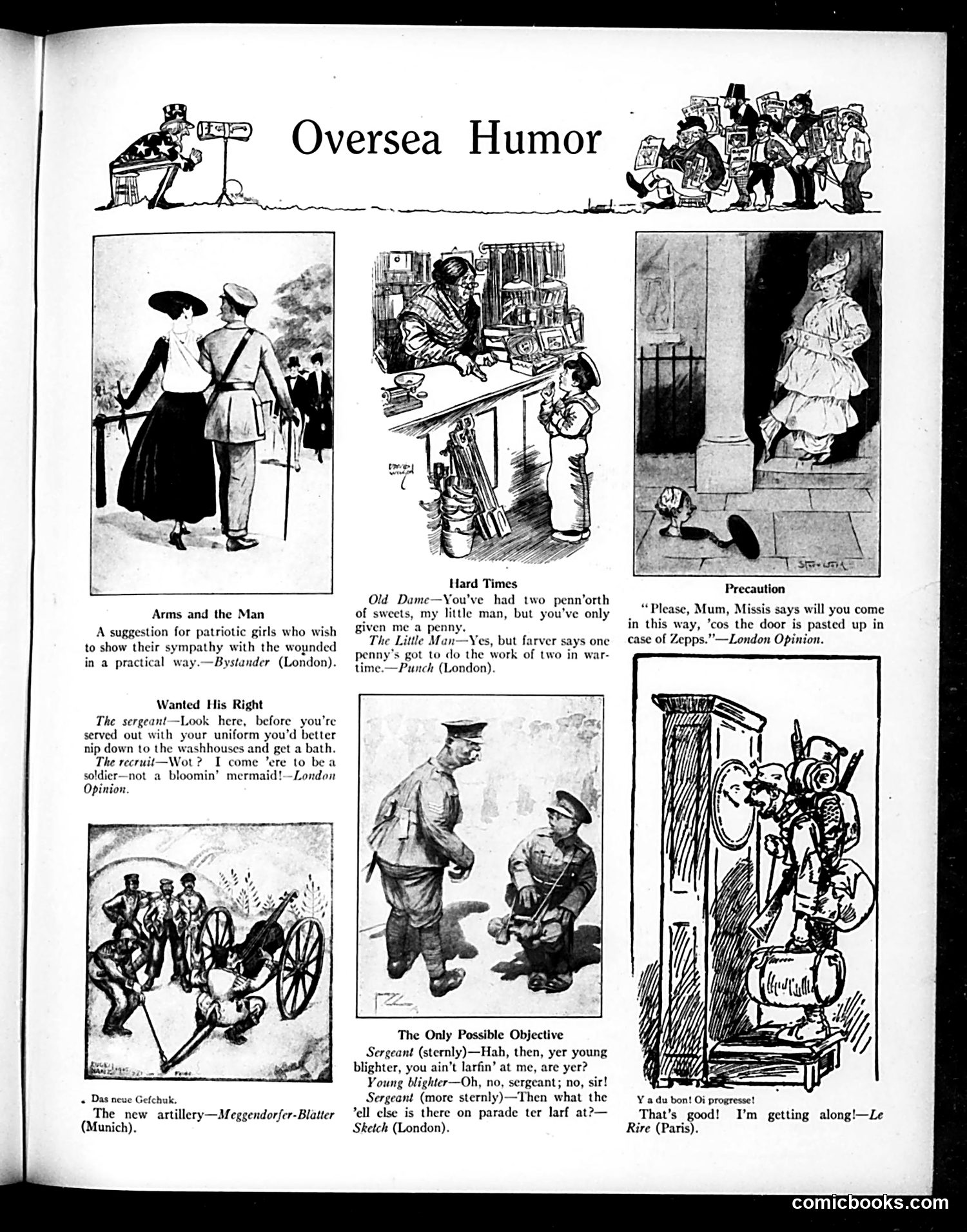
This page collects humorous cartoons from British, German, and French publications during World War I, showcasing how different nations used humor to address wartime conditions. The jokes reflect common WWI anxieties: "Arms and the Man" suggests women support wounded soldiers; recruitment humor mocks both reluctant recruits and military discipline; "Hard Times" shows economic strain (children making pennies do double duty); "Precaution" references German Zeppelin bombing raids on London, a genuine civilian threat that required air-raid precautions. The cartoons depict working-class figures—soldiers, children, servants—coping with or complaining about wartime realities. The "Wanted His Right" joke plays on class differences: a recruit expects soldiering but is ordered to bathe first. By reprinting these foreign cartoons together, *Judge* demonstrated shared wartime experiences across Allied nations while showcasing how humor helped civilians and soldiers endure hardship and fear during the conflict.
This page is primarily **advertising with humorous filler content**, typical of early 20th-century Judge magazine layout. The advertisements promote pipes (Wellington brand), leather key cases, and Evans' Ale stout beer—all positioned as products for men. The main satirical content is the "Spontaneous Humor" section: **actual answers submitted by students taking New York State Regents' examinations**. The joke is how absurdly wrong these answers are—examples include "Pompeii was destroyed by an eruption of lava from the Vatican," "the function of the stomach is to hold up petticoats," and "the feminine of Bull is Mrs. Bull." This reveals the educational gaps of early 1900s students and mocks the examination system itself. The humor is unintentional (from the students) but deliberately curated for readers' amusement—the satire targets public education quality rather than specific political figures or events. It's meant as lighthearted mockery of youthful ignorance.
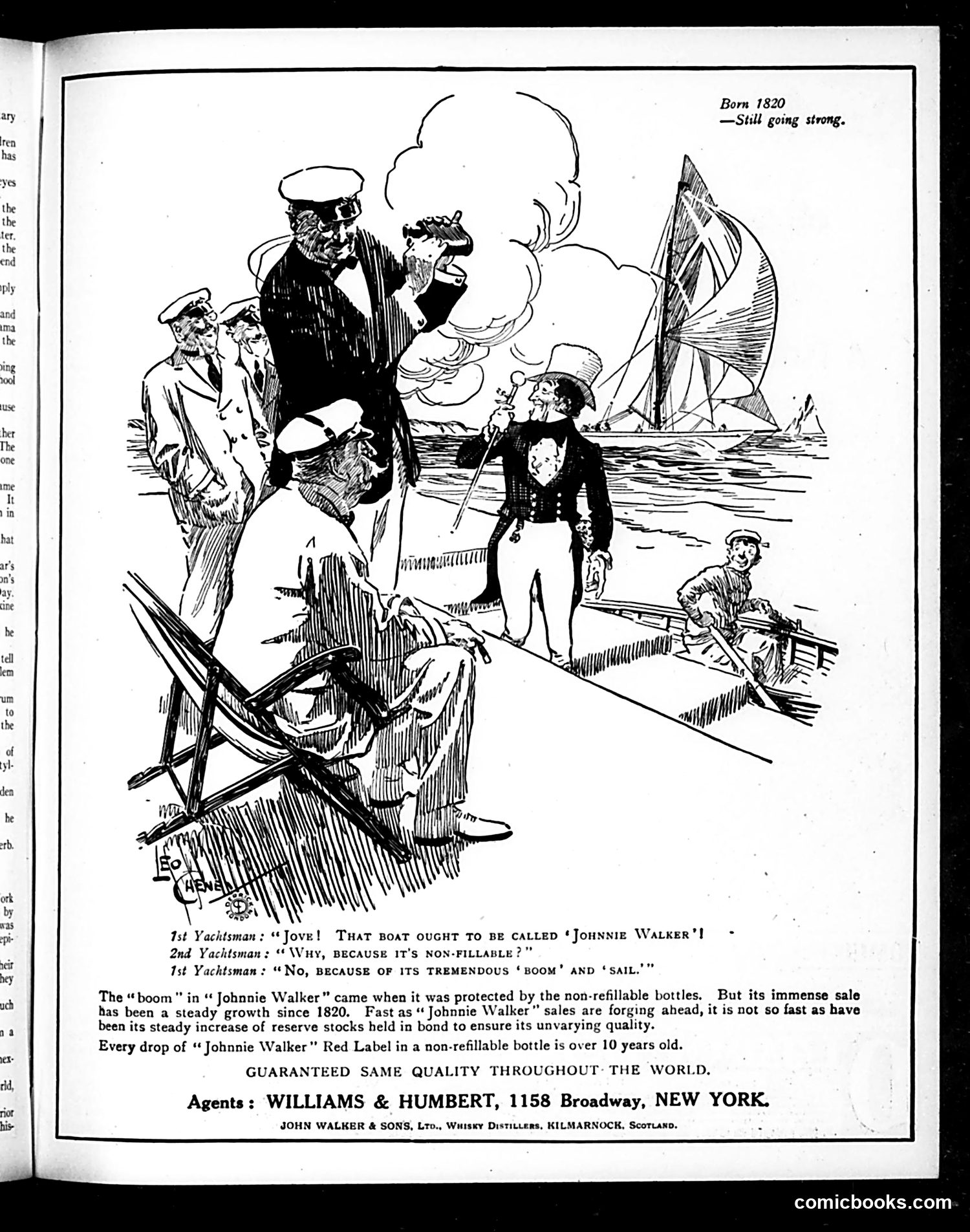
This is a **Johnnie Walker whisky advertisement** disguised as satirical humor, not political commentary. Two yachtsmen joke about naming a boat "Johnnie Walker" because of its "tremendous 'boom' and 'sail'"—a pun on the whisky brand's sales success. The advertisement claims the brand, founded in 1820, experienced explosive growth after introducing non-refillable bottles (preventing refilling with inferior liquor). It emphasizes quality control: every bottle is over 10 years old and maintains consistent quality "throughout the world." The nautical setting and yachtsmen suggest affluence and leisure—the brand's target market. The pun conflates the boat's structural boom and sail with Johnnie Walker's commercial "boom," making the sales pitch entertaining rather than purely promotional. This was typical Judge magazine advertising: mixing humor with product promotion.
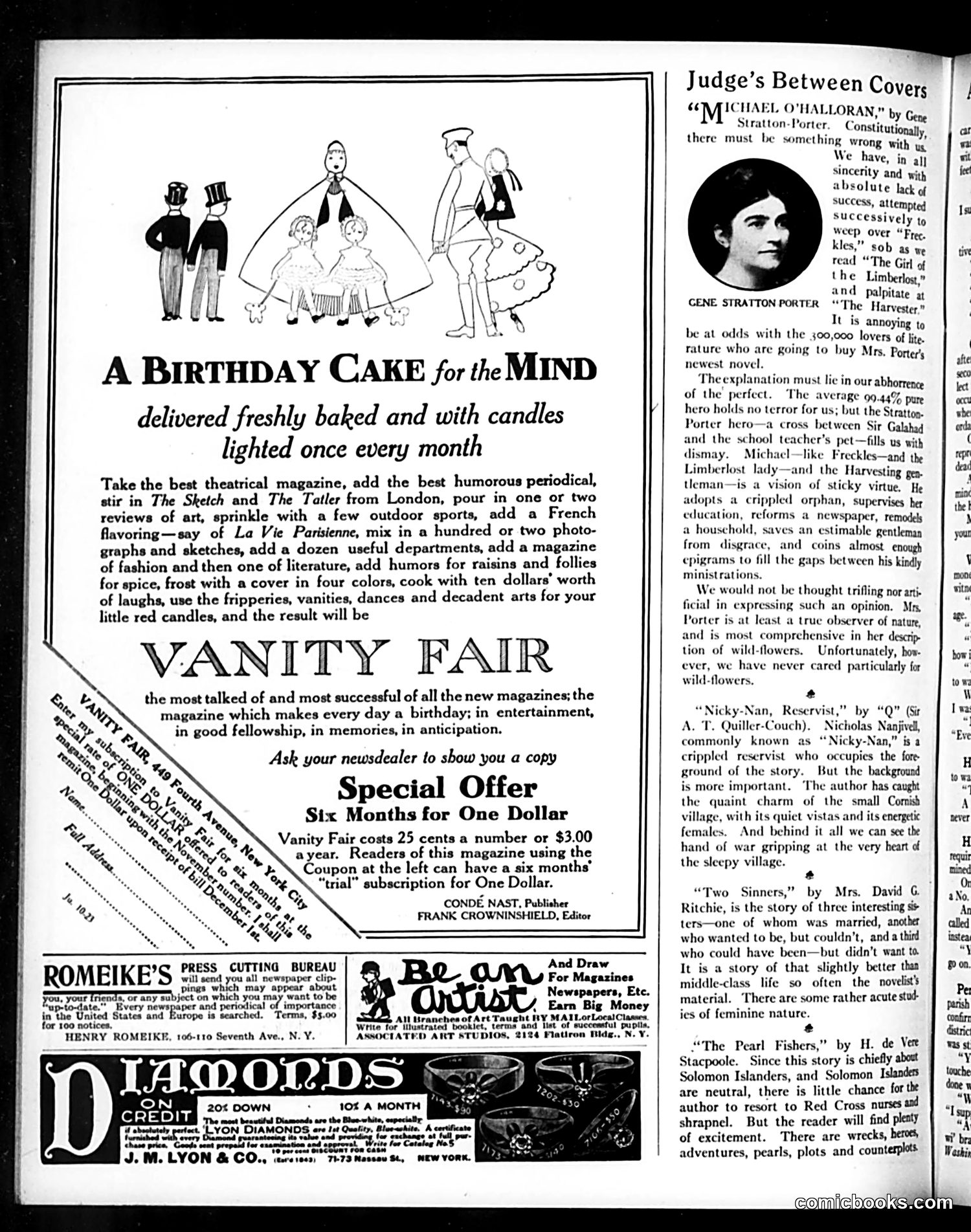
This page combines advertising for **Vanity Fair magazine** with book reviews. The main illustration uses a playful recipe metaphor—mixing theatrical magazines, humor periodicals, fashion, and "decadent arts"—to pitch Vanity Fair as sophisticated entertainment for educated readers seeking "a birthday cake for the mind." The reviews critique popular novelist **Gene Stratton-Porter**, whose sentimental novels about virtuous heroes annoyed Judge's critics. They found her characters—like "Michael" in *Michael O'Halloran*—excessively moralistic ("sticky virtue"), though they acknowledged her genuine nature observation skills, particularly regarding wild-flowers. Other reviews mention *Nicky-Nan, Reservist* by "Q" (a British author) and *Two Sinners*, evaluated as respectable literary entertainment for the middle-class magazine audience. The page reflects early-20th-century literary tastes and Judge's positioning as sophisticated satire for educated readers.
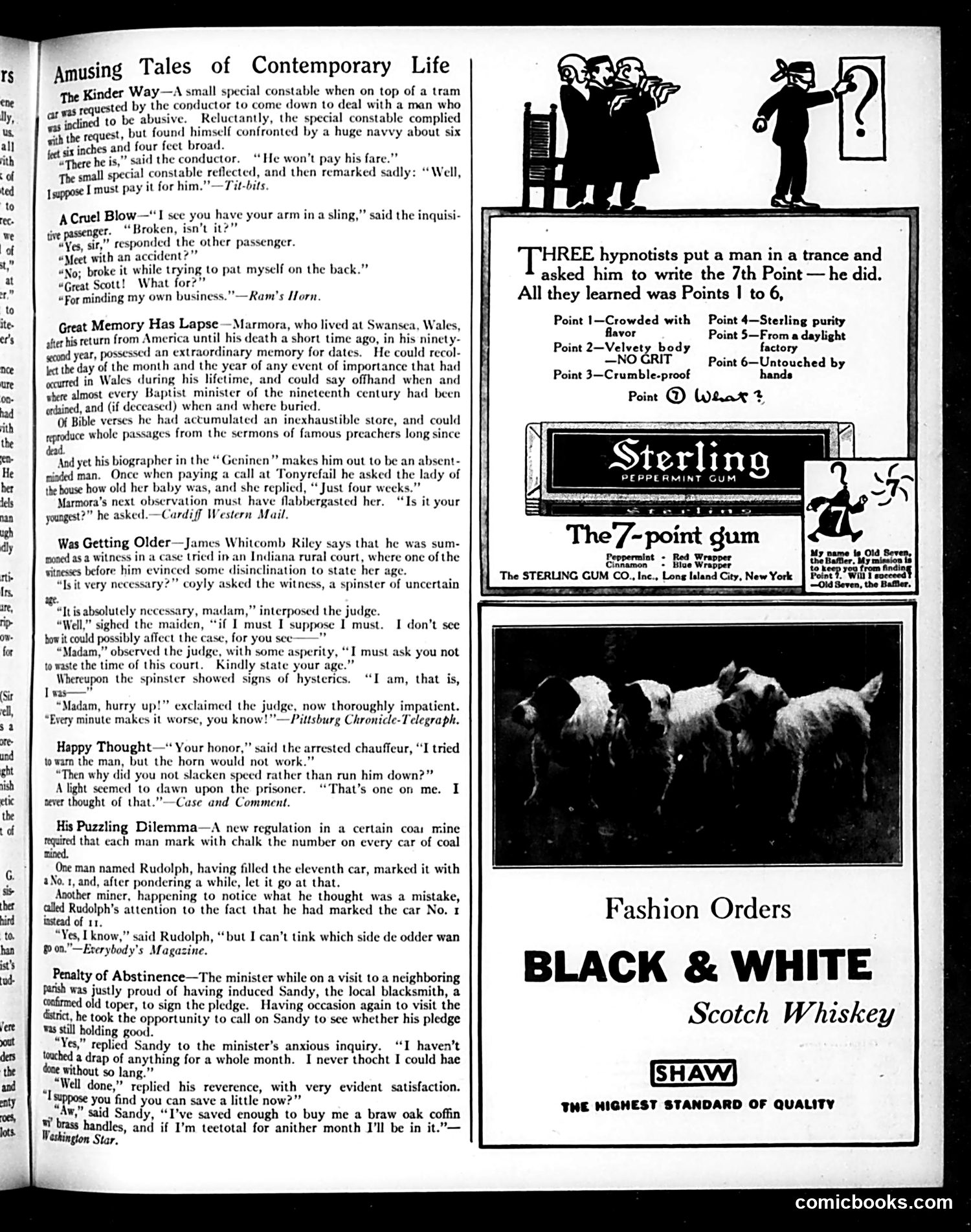
This page from the satirical magazine **Judge** contains multiple short humorous anecdotes mocking contemporary social situations, circa early 20th century. The main cartoon (top) illustrates "Three Hypnotists" performing a trick, likely satirizing the era's fascination with hypnotism as entertainment and pseudo-science. The text stories ridicule various social types: an undersized constable facing an oversized fare-dodger; a witness reluctant to disclose her age in court; a coal miner confused by numbering systems; and a reformed drunk who backslides. The humor relies on irony—characters' attempts to handle situations often backfire or expose human weakness and vanity. The advertisements (Sterling Gum, Black & White Scotch Whiskey) are period commercial content. For modern readers, the appeal lay in gentle mockery of working-class characters, legal pomposity, and the era's social pretensions—typical Judge magazine fare targeting educated, middle-class readers.
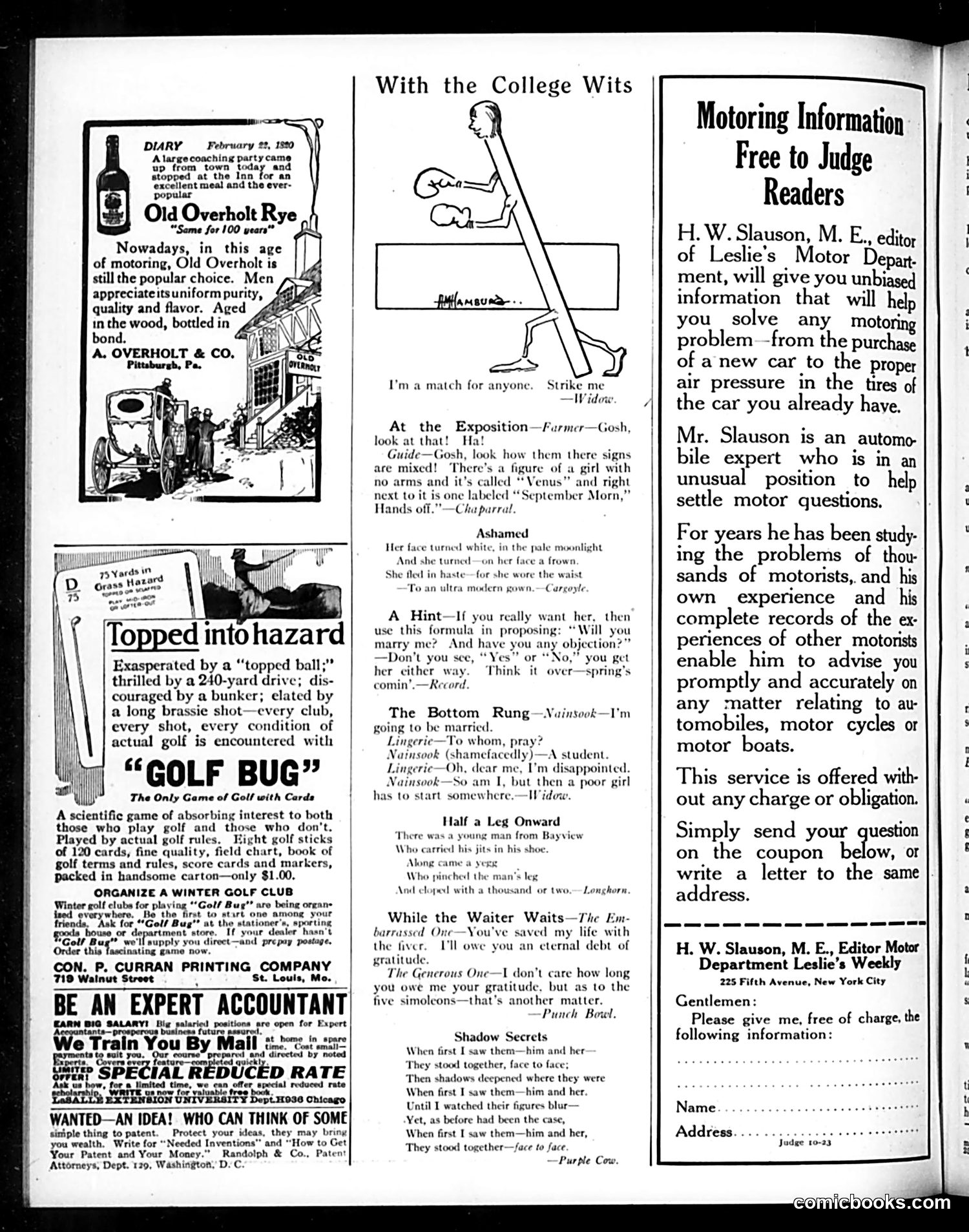
This page mixes advertisements with humor typical of 1890s Judge magazine. The main cartoon shows a stick-figure golfer in an exaggerated pose—the "Golf Bug" described in the accompanying ad for a card game simulating golf. The joke plays on golf's emerging popularity and the obsessive enthusiasm it inspired among players. The "College Wits" section contains brief humorous verses and witticisms on romantic and social themes common to the era. References include "September Morn" (likely a famous painting that scandalized puritanical audiences) and period slang like "simoleons" (dollars). The humor trades in mild innuendo about courtship, fashion ("the waist"), and social pretense—standard fare for a satirical magazine aimed at educated, urban readers. The bulk of the page is advertisements for correspondence courses, patent services, and the Old Overholt Rye whiskey brand, reflecting the magazine's commercial focus alongside satirical content.
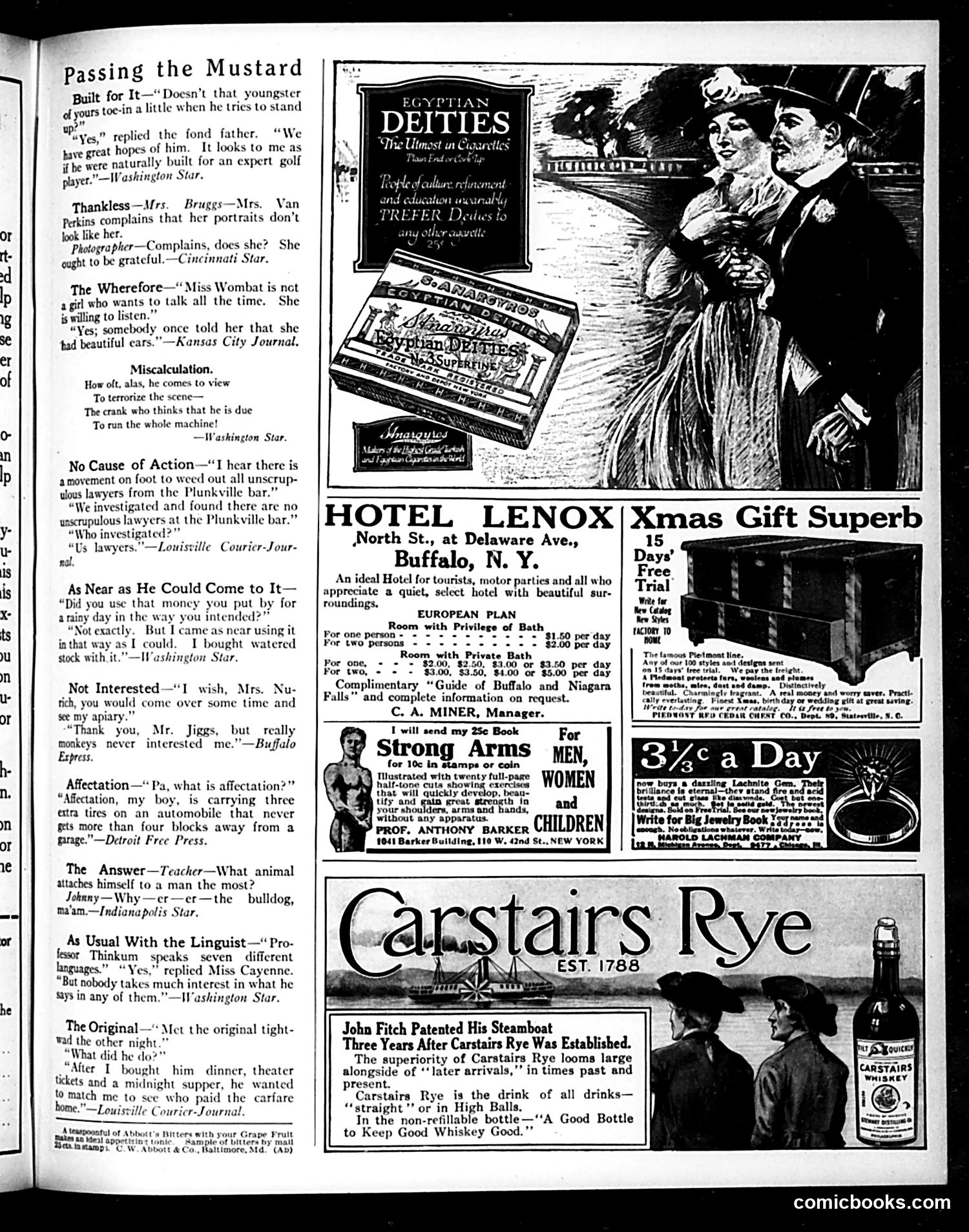
This page from Judge magazine contains primarily **short humorous anecdotes** rather than political cartoons. The jokes satirize everyday American life and social pretense circa early 1900s: Key humor targets include: - **Golf culture** (wealthy leisure activity) - **Affectation** (mocking those who display false sophistication—the example of carrying unused spare tires) - **Stinginess** (the "tightwad" who won't pay carfare after being entertained) - **Bad listening** (praising women who stay silent) - **Professional incompetence** (unscrupulous lawyers; photographers who flatter poorly) The page is **dominated by period advertisements**: Hotel Lenox (Buffalo tourism), Carstairs Rye whiskey (emphasizing historical legitimacy), Egyptian Deities beauty products, and mail-order "Strong Arms" muscle development courses. These jokes reflect middle-class anxieties about social climbing, pretense, and changing consumer culture rather than political satire. The humor is gentle, relying on irony and wordplay rather than sharp social critique.
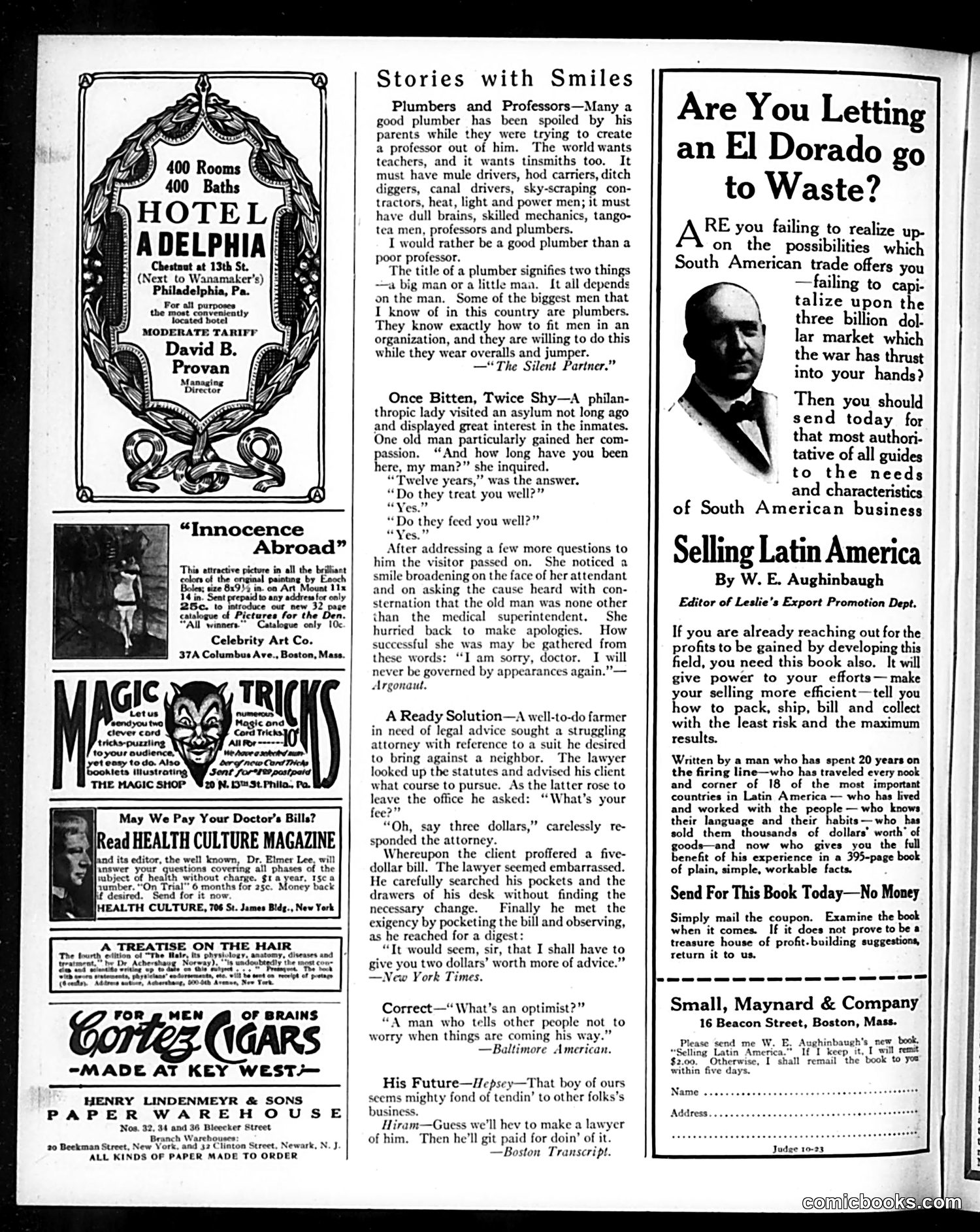
This page is primarily **advertising and humor**, not political satire. The main content consists of: **"Stories with Smiles"** — A humor column containing four anecdotes: 1. **Plumbers vs. Professors** — Social commentary mocking class pretension. Parents aspire to make their sons professors, but society needs skilled tradesmen like plumbers. The joke: a good plumber has more dignity than a poor professor. 2. **Asylum Visit** — A philanthropic woman condescends to an asylum inmate, later horrified to learn he's the superintendent. The satire targets naive upper-class charity workers judging people by appearance. 3. **Lawyer's Fee** — A struggling attorney can't make change for five dollars, so pockets the bill while promising extra legal advice. This satirizes lawyers as penny-pinching and opportunistic. 4. **Optimist Definition** — A brief joke about optimism. These are genteel, mainstream humor pieces typical of Judge magazine — gently mocking professional pretension, class assumptions, and dishonest tradespeople. No specific political figures or events are referenced.
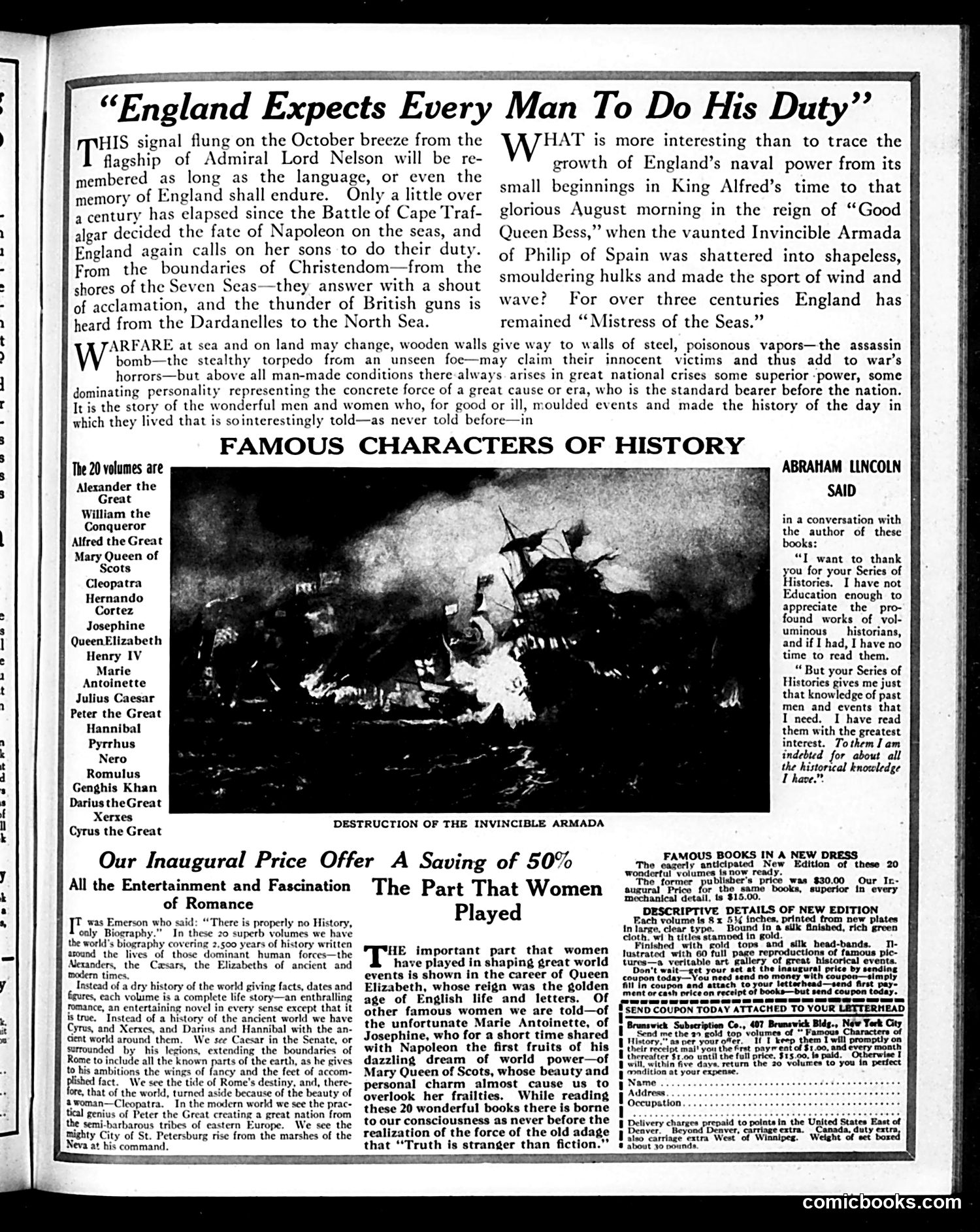
This page advertises a 20-volume biographical history series by promoting England's naval tradition and heroic leadership. The headline quotes Nelson's famous signal at Trafalgar (1805), invoking British naval supremacy against Spain and Napoleon. The central image depicts the **Destruction of the Invincible Armada** (1588)—Spain's failed invasion fleet under Philip II, defeated during Queen Elizabeth I's reign. This historical reference establishes the book series' focus: great individuals who shaped history. The advertisement emphasizes narrative biography over dry facts, claiming these volumes present history as "romance" and "entertaining novel"—appealing to early 20th-century readers seeking engaging rather than academic histories. A fabricated Abraham Lincoln quote endorses the series as accessible education. **The satire is mild**: mostly promotional rather than satirical, using patriotic imagery and historical gravitas to sell books. The tone assumes readers value British naval heritage and admire decisive historical figures.
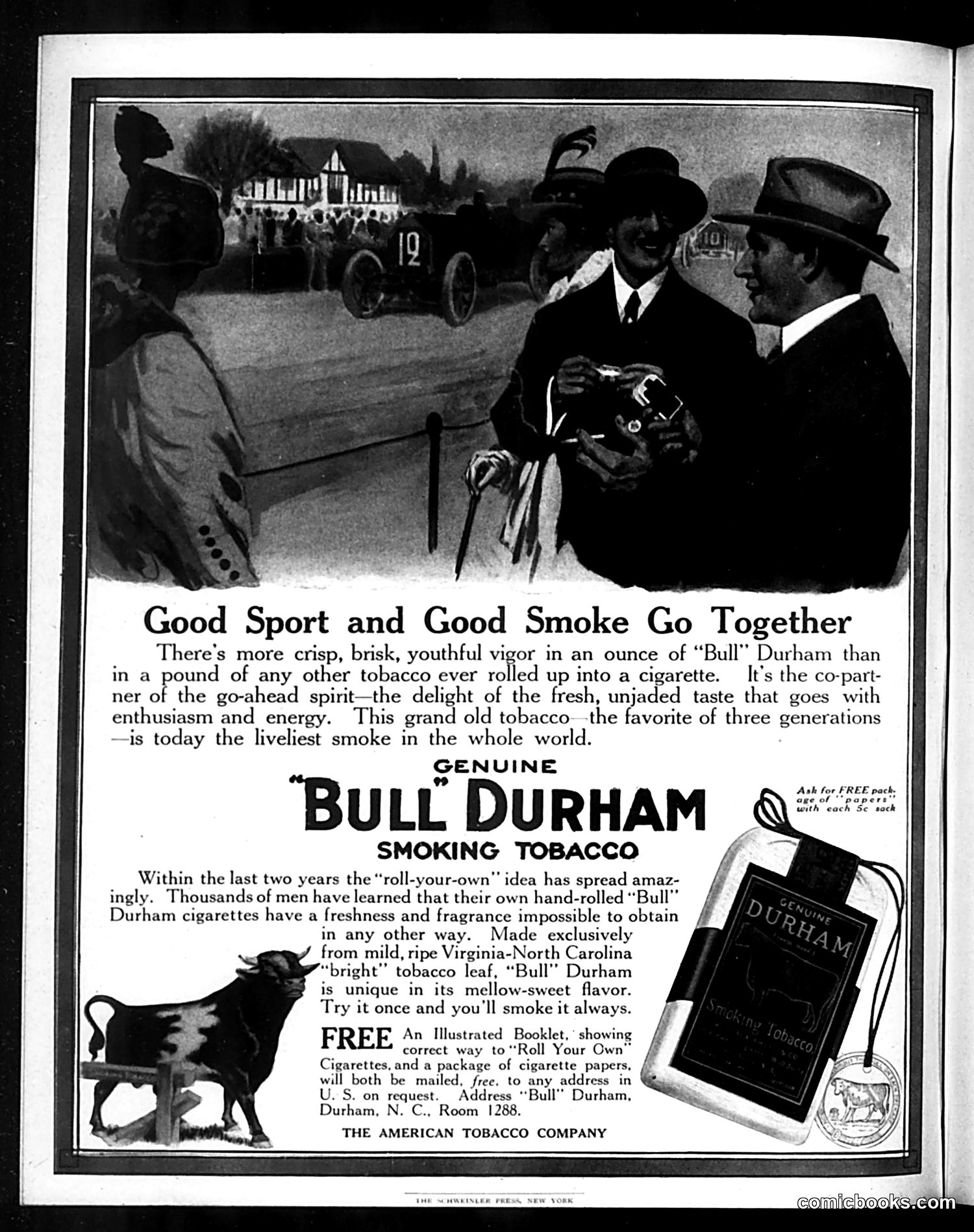
This is primarily a **tobacco advertisement**, not satire or political commentary. The page features a "Bull" Durham smoking tobacco ad from The American Tobacco Company. The image depicts well-dressed men at what appears to be a sporting event (racing cars visible in background), associating tobacco use with gentlemanly leisure and athletics. The headline "Good Sport and Good Smoke Go Together" markets cigarettes as compatible with an active, vigorous lifestyle. The ad emphasizes "roll-your-own" cigarettes as a recent trend, promoting Bull Durham's Virginia-North Carolina tobacco for its purported freshness and flavor. It includes a free offer for rolling papers and instructional booklets. **For modern readers:** This represents early-20th-century advertising that openly linked smoking to health, youth, and social status—marketing practices now prohibited. The association of tobacco with "vigor" and "energy" would be considered dangerous misinformation today.