
Judge, 1915-10-23 · page 12 of 28
Judge — October 23, 1915 — page 12: what you’re looking at
What you’re looking at
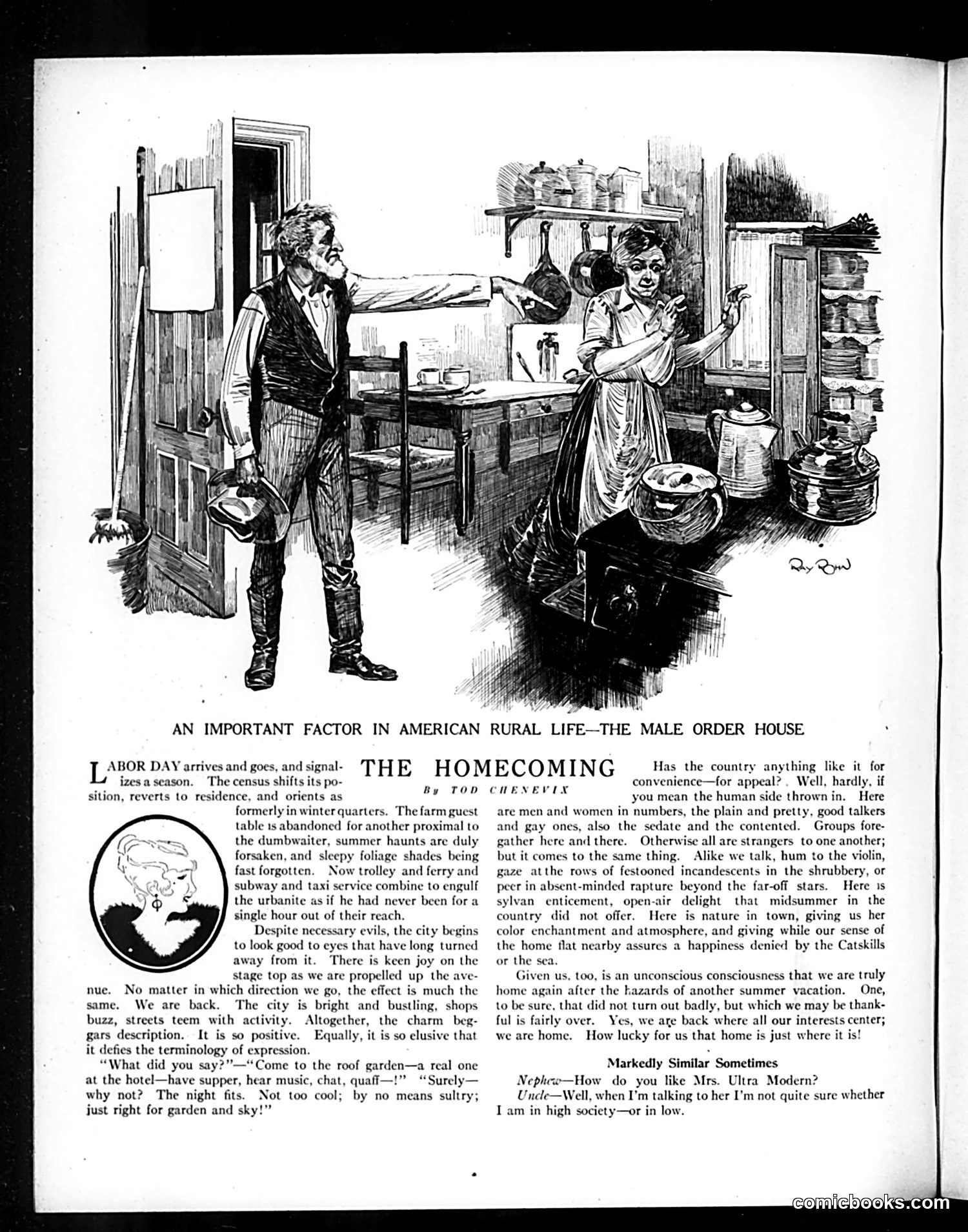
This page from *Judge* magazine satirizes the contrast between urban and rural American life, particularly the "male order house" (a boarding house or hotel where men dominate). **The Main Cartoon:** Depicts a man returning home to his wife after summer vacation. The caption "An Important Factor in American Rural Life—The Male Order House" uses ironic wordplay—"male order" suggests mail-order convenience, but means literally a house ordered/run by males. The sketch shows domestic disorder: the wife gestures in exasperation while the man stands idle, pots and pans clutter the kitchen, and shelves overflow with dishes. **The Satire:** The accompanying article by Tod Chenevix romanticizes urban "homecoming"—city lights, roof gardens, entertainment—but acknowledges country life lacks such human conveniences. The cartoon's visual irony undercuts this: the actual "home" depicted is chaotic and unglamorous, with the husband appearing useless domestically. **The Joke Below:** A brief dialogue mocks Mrs. "Ultra Modern"—unclear whether she's sophisticated or common, reflecting period anxieties about changing social conventions. The overall point: rural domesticity, despite nostalgia, is neither orderly nor romantic.
📄 Transcribed text from this page (OCR, searchable)
Machine-transcribed from the original scan — historical spelling and the odd misread are preserved.
AN IMPORTANT FACTOR IN AMERICAN ABOR DAY arrives and goes, and signal- $ po- izesa season. The census shifts sition, reverts to residence, and orients as formerly in winter quarters. The farm guest table 1s abandoned for another proximal to the dumbwaiter, summer haunts are duly forsaken, and sleepy foliage shades being fast forgotten. Now trolley and ferry and subway and taxi service combine to engulf the urbanite as if he had never been for a single hour out of their reach. Despite necessary the city begins to look good to that h: long turned away from it. There is keen joy on the stage top as we are propelled up the ave- nue. No matter in which direction we go, the effect is much the same. We are back. The city is bright and bustling, shops buzz, streets teem with activ Altogether, the charm beg- gars description. It is so positiv Equally, it is so elusive that it defies the terminology of expression. “What did you say?”—“Come to the roof garden—a real one at the hotel—have supper, hear music, chat, quaff—!” “Surely— why not? The night fits. Not too cool; by no means sultry; just right for garden and sky! S po By TOD THE HOMECOMING RURAL LIFE—THE MALE ORDER HOUSE Has the country anything like it for convenience—for appeal? . Well, hardly, if you mean the human side thrown in. Here are men and women in numbers, the plain and pretty, good talkers and gay ones, also the sedate and the contented. Groups fore- gather here and there. Otherwise all are strangers to one another; but it comes to the same thing. Alike we talk, hum to the violin, gaze atthe rows of festooned incandescents in the shrubbery, or peer in absent-minded rapture beyond the far-off stars. Here 1s sylvan enticement, open-air delight that midsummer in the country did not offer. Here is nature town, giving us her color enchantment and atmosphere, and giving while our sense of the home flat nearby assures a happiness denied by the Catskills or the sea. Given us, too, is an unconscious consciousness that we are truly home again after the hazards of another summer vacation. One, to be sure, that did not turn out badly, but which we may be thank- ful is fairly over. Yes, we are back where all our interests center; we are home. How lucky for us that home is just where it is! CHENEVIX Markedly Similar Sometimes Nephew—How do you like Mrs. Ultra Modern? Uncle—Well, when I'm talking to her I’m not quite sure whether I am in high society—or in low.