
Judge, 1915-10-23 · page 23 of 28
Judge — October 23, 1915 — page 23: what you’re looking at
What you’re looking at
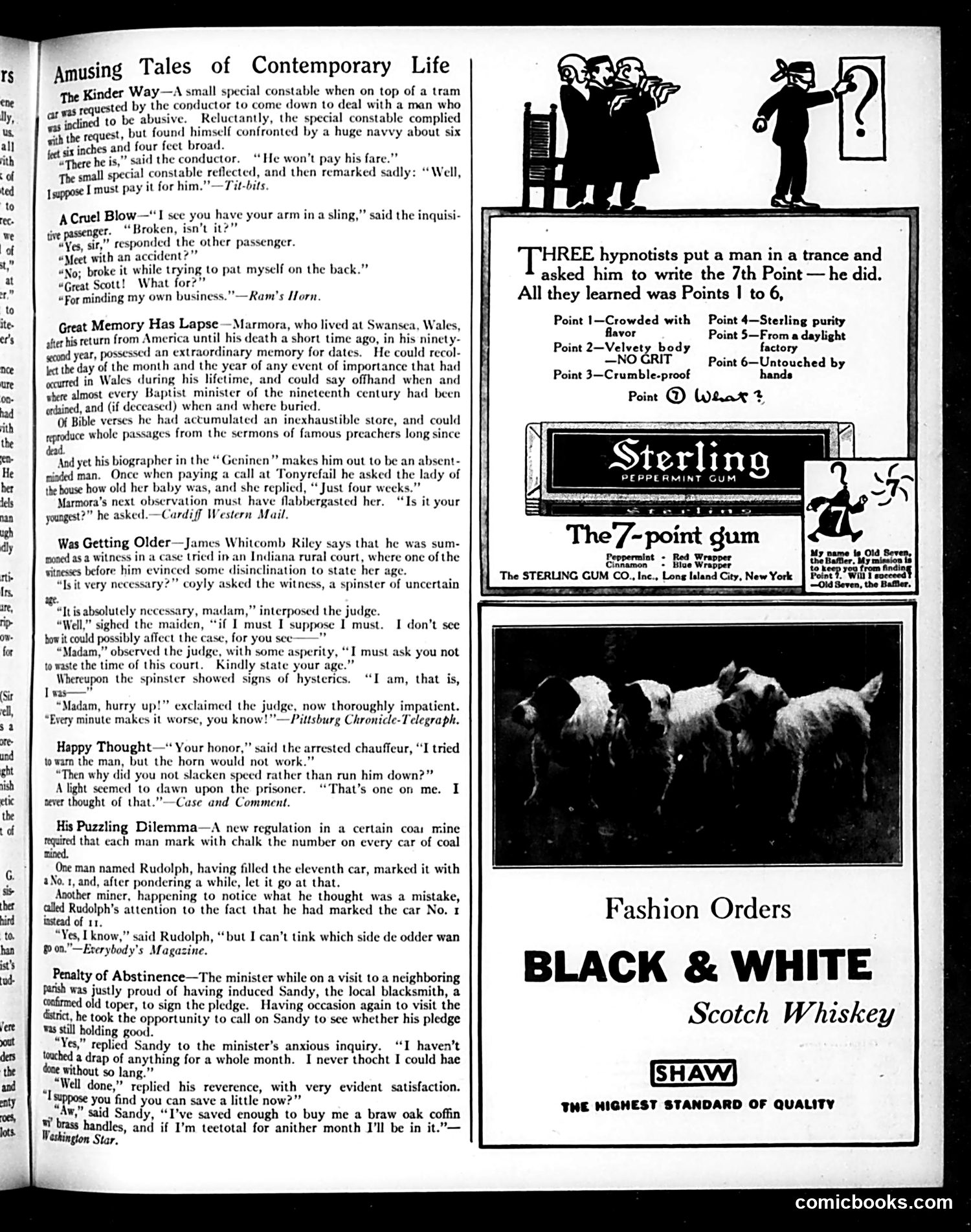
This page from the satirical magazine **Judge** contains multiple short humorous anecdotes mocking contemporary social situations, circa early 20th century. The main cartoon (top) illustrates "Three Hypnotists" performing a trick, likely satirizing the era's fascination with hypnotism as entertainment and pseudo-science. The text stories ridicule various social types: an undersized constable facing an oversized fare-dodger; a witness reluctant to disclose her age in court; a coal miner confused by numbering systems; and a reformed drunk who backslides. The humor relies on irony—characters' attempts to handle situations often backfire or expose human weakness and vanity. The advertisements (Sterling Gum, Black & White Scotch Whiskey) are period commercial content. For modern readers, the appeal lay in gentle mockery of working-class characters, legal pomposity, and the era's social pretensions—typical Judge magazine fare targeting educated, middle-class readers.
📄 Transcribed text from this page (OCR, searchable)
Machine-transcribed from the original scan — historical spelling and the odd misread are preserved.
Rercsing Tales of Contemporary Life Kinder Way—A small special constable when on top of a tram equested by the conductor to come down to deal with a man who ar asad to be abusive. Reluctantly, the special constable complied request, but found himself confronted by a huge navvy about six de inches and four feet broad. . . . There he is,” said the conductor. “He won't pay his fare.” ; The small special constable reflected, and then remarked sadly: “Well, [suppose | must pay it for him.” —Tit-bits. ACrue! Blow—"'I sce you have your arm in a sling,” said the inquisi- tive nger. “Broken, isn’t it?’ “Yes, sir,” responded the other passenger. “Meet with an accident?” “No; broke it while trying to pat myself on the back.” sGreat Scott! What for?”” “For minding my own business.""—Ram's Horn Great Memory Has Lapse Marmora, who lived at Swansea, Wales, aher his return from America until his death a short time ago, in his ninety- second year, possessed an extraordinary memory for dates. He could recol- et the day of the month and the year of any event of importance that had ocurred in Wales during his lifetime, and could say offhand when and where almost every Baptist minister of the nineteenth century had been trisined, and (if deceased) when and where buried. Of Bible verses he had actumulated an inexhaustible store, and could reproduce whole passages from the sermons of famous preachers long since 9d carte yet his biographer in the “Geninen” makes him out to be an absent- nisded man, Once when paying a call at Tonyrefail he asked the lady of the house how old her baby was, and she replied, “ Just four w Marmora’s next observation must have flabbergasted her. “Is it your youngest?” he asked.—Cardiff Western Mail. Was Getting Older—James Whitcomb Riley says that he was sum- noned as a witness in a case tried in an Indiana rural court, where one of the witnesses before him evinced some disineli ion to state her age. “Is it very necessary?” coyly asked the witness, a spinster of uncertain ee. me + “It is absolutely necessary, madam,” interposed the judge. “Well,” sighed the maiden, “if I must I suppose I must. I don’t see bow it could possibly affect the case, for you s id “Madam,” observed the judge, with som to waste the time of this court. K Whereupon the spinster showed signs of hyste I was—” “Madam, hurry up!” exclaimed the judge, now thoroughly impatient. “Every minute makes it worse, you know!" —Pittsburg Chronicle-Telegraph. “T must ask you not “Tam, that is, Happy Thought—* Your honor,” said the arrested chauffeur, “I tried to warn the man, but the horn would not work.” “Then why did you not slacken speed rather than run him down?” A light seemed to dawn upon the prisoner. “That’s one on me. I sever thought of that.”’—Case and Comment. His Puzzling Dilemma—A new regulation in a certain coa: mine required that each man mark with chalk the number on every car of coal mined. One man named Rudolph, having filled the eleventh car, marked it with aNo. 1, and, after pondering a while, let it go at that. Another miner, happening to notice what he thought was a mistake, alled Rudolph’s attention to the fact that he had marked the car No. 1 instead of 11. “Yes, I know,” said Rudolph, “but I can’t tink which side de odder wan 0n.”"—Everybody's Magazine. Penalty of Abstinence—The minister while on a visit to a neighboring was justly proud of having induced Sandy, the local blacksmith, a umed old toper, to sign the pledge. Having occasion again to visit the Gsrct, he took the opportunity to call on Sandy to see whether his pledge ™s still holding good. “Yes,” replied Sandy to the minister’s anxious inquiry. ‘‘I haven’t ‘oached a drap of anything for a whole month. I never thocht I could hae without so lang.” ., Well done,” replied his reverence, with very evident satisfaction. | suppose you find you can save a little now?” , Aw,” said Sandy, “I’ve saved enough to buy me a braw oak coffin " brass handles, and if I’m teetotal for anither month I'll be in it.”— ‘sskington Star. "THREE hypnotists put a man in a trance and asked him to write the 7th Point — he did. All they learned was Points | to 6, Point 1—Crowded with Point 4—Sterling purity flavor Point 5—From a daylight Point 2—Velvety body factory —NO Point 6—Untouched by Point 3—Crumble-proof hands Point @) Ware Sterling, PEPPERMINT GUM Fashion Orders BLACK & WHITE Scotch Whiskey THE HIGHEST STANDARD OF QUALITY comicbooks.com