
Judge, 1915-10-23 · page 7 of 28
Judge — October 23, 1915 — page 7: what you’re looking at
What you’re looking at
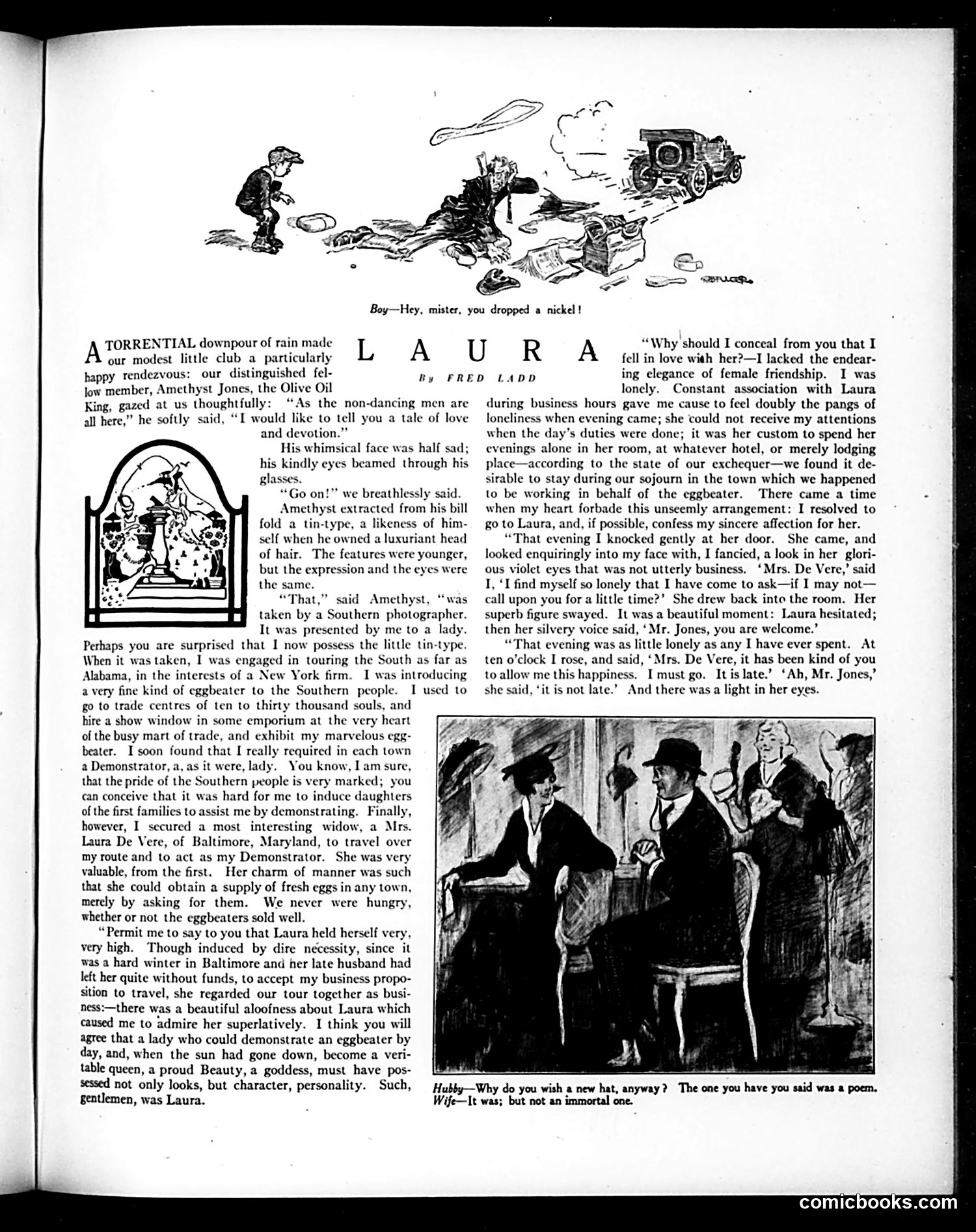
This page presents a sentimental short story framed as a humorous tale told at a gentleman's club. The narrator, Amethyst Jones (a bald man nostalgically showing a tin-type photograph), recounts his past as an eggbeater salesman traveling the American South. The satire targets turn-of-the-century commercial culture: the absurdity of hiring "lady demonstrators" to sell kitchen gadgets by exploiting Southern aristocratic pride and charm. Laura De Vere, a financially desperate Baltimore widow, becomes the salesman's assistant—and the object of his affection. The joke lies in the contrast between Laura's dignified, aloof demeanor during business hours versus her expected romantic vulnerability at night. The cartoon at page top (showing someone dropping a nickel during a rainstorm) sets up the club's rainy-day storytelling mood. This is genteel satirical romance—poking fun at commercial exploitation, class pretension, and sentimental male longing, all wrapped in wistful, flowery prose.
📄 Transcribed text from this page (OCR, searchable)
Machine-transcribed from the original scan — historical spelling and the odd misread are preserved.
Boy—Hey, mister, you dropped a nickel! TORRENTIAL downpour of rain made A our modest little club a particularly happy rendezvous: our distinguished fel- By low member, Amethyst Jones, the Olive Oil King, gazed at us thoughtfully: the non-dancing men are all here,” he softly said, “I would like to tell you a tale of love and devotior His whimsical face was half sad; his kindly eyes beamed through his glasses. “Go on!” we breathlessly said. Amethyst extracted from his bill fold a tin-type, a likeness of him- self when he owned a luxuriant head of hair. The features were younger, but the expression and the eyes were the same. “That,” said Amethyst, “was taken by a Southern photographer. It was presented by me to a lady. Perhaps you are surprised that I now possess the little tin-type. When it was taken, I was engaged in touring the South as far as Alabama, in the interests of a New York firm. I was introducing avery fine kind of eggbeater to the Southern people. I used to go to trade centres of ten to thirty thousand souls, and hire a show window in some emporium at the very heart of the busy mart of trade, and exhibit my marvelous egg- beater. I soon found that I really required in each town a Demonstrator, a, as it were, lady. You know, I am sure, that the pride of the Southern people is very marked; you can conceive that it was hard for me to induce daughters of the first families to assist me by demonstrating. Finally, however, I secured a most interesting widow, a Mrs. Laura De Vere, of Baltimore, Maryland, to travel over my route and to act as my Demonstrator. She was very valuable, from the first. Her charm of manner was such that she could obtain a supply of fresh eggs in any town, merely by asking for them. We never were hungry, whether or not the eggbeaters sold well. “Permit me to say to you that Laura held herself very, very high. Though induced by dire necessity, since it was a hard winter in Baltimore and her late husband had left her quite without funds, to accept my business propo- sition to travel, she regarded our tour together as busi- hess:—there was a beautiful aloofness about Laura which caused me to admire her superlatively. I think you will agree that a lady who could demonstrate an eggbeater by day, and, when the sun had gone down, become a veri- table queen, a proud Beauty, a goddess, must have pos- sessed not only looks, but character, personality. Such, gentlemen, was Laura. L A U RA FRED “Why should I conceal from you that I fell in love with her?—I lacked the endear- ing elegance of female friendship. I was lonely. Constant association with Laura during business hours gave me cause to feel doubly the pangs of loneliness when evening came; she could not receive my attentions when the day’s duties were done; it was her custom to spend her evenings alone in her room, at whatever hotel, or merely lodging place—according to the state of our exchequer—we found it de- sirable to stay during our sojourn in the town which we happened to be working in behalf of the eggbeater. There came a time when my heart forbade this unseemly arrangement: I resolved to go to Laura, and, if possible, confess my sincere affection for her. “That evening I knocked gently at her door. She came, and looked enquiringly into my face with, I fancied, a look in her glori- ous violet eyes that was not utterly business. ‘Mrs. De Vere,’ said I, ‘I find myself so lonely that I have come to ask—if I may not— call upon you for a little time?’ She drew back into the room. Her superb figure swayed. It was a beautiful moment: Laura hesitated; then her silvery voice said, ‘Mr. Jones, you are welcome.’ “That evening was as little lonely as any I have ever spent. At ten o’clock I rose, and said, ‘Mrs. De Vere, it has been kind of you to allow me this happin I must go. Itis late.’ ‘Ah, Mr. Jones,’ she said, ‘it is not late.’ And there was a light in her eyes. LADD nee Hubby—Why do you wish a new hat, anyway? The one you have you said was a poem. Wife—It was; but not an i one. comicbooks.com