
Judge, 1915-10-23 · page 13 of 28
Judge — October 23, 1915 — page 13: what you’re looking at
What you’re looking at
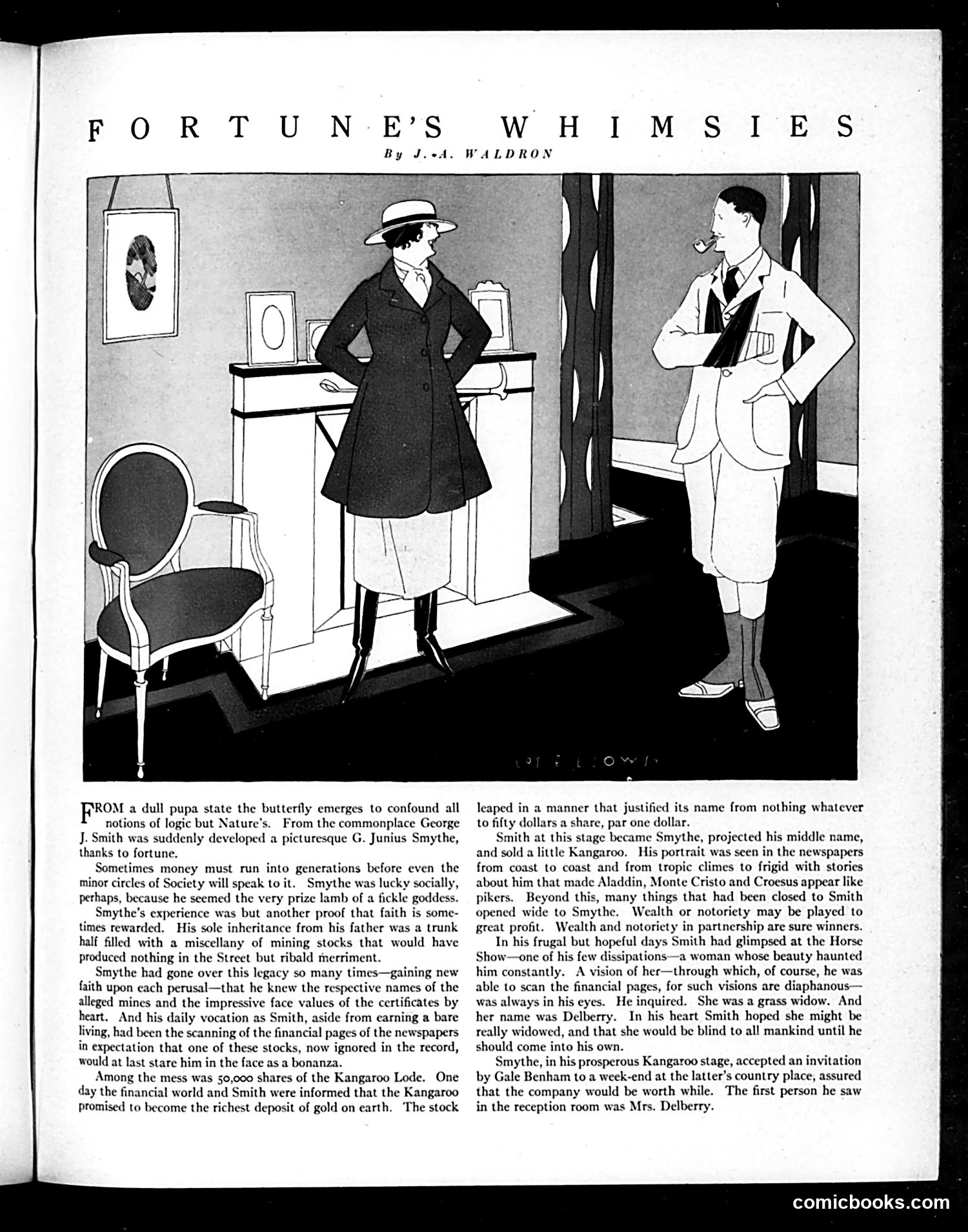
This story-cartoon satirizes the Gilded Age obsession with sudden wealth and social transformation. George J. Smith, an ordinary man, inherits worthless mining stocks. When one—the Kangaroo Lode—unexpectedly strikes gold, he reinvents himself as "G. Junius Smythe," adopting a middle name to sound more refined. The satire targets how society instantly embraces the newly wealthy: newspapers celebrate him coast-to-coast, doors open, and he gains access to elite spaces like the Horse Show. The joke is that nothing about him changed except his bank account, yet social pretension transformed him entirely. His romantic subplot—pursuing Mrs. Delberry, a "grass widow" (divorced woman) previously beyond his reach—reinforces this: wealth, not character, determines social acceptability. The cartoon mocks both the fickleness of society and the shallow opportunism of those who exploit it.
📄 Transcribed text from this page (OCR, searchable)
Machine-transcribed from the original scan — historical spelling and the odd misread are preserved.
FOR T UN -E’S By J.edA. ROM a dull pupa state the butterfly emerges to confound all notions of logic but Nature’s. From the commonplace George J. Smith was suddenly developed a picturesque G. Junius Smythe, thanks to fortune. Sometimes money must run into generations before even the minor circles of Society will speak to it. Smythe was lucky socially, perhaps, because he seemed the very prize lamb of a fickle goddess. Smythe’s experience was but another proof that faith is some- times rewarded. His sole inheritance from his father was a trunk half filled with a miscellany of mining stocks that would have produced nothing in the Street but ribald merriment. Smythe had gone over this legacy so many times—gaining new faith upon each perusal—that he knew the respective names of the alleged mines and the impressive face values of the certificates by heart. And his daily vocation as Smith, aside from earning a bare living, had been the scanning of the financial pages of the newspapers in expectation that one of these stocks, now ignored in the record, would at last stare him in the face as a bonanza. Among the mess was 50,000 shares of the Kangaroo Lode. One day the financial world and Smith were informed that the Kangaroo promised to become the richest deposit of gold on earth. The stock MS? = BS W H WALDRON leaped in a manner that justified its name from nothing whatever to fifty dollars a share, par one dollar. Smith at this stage became Smythe, projected his middle name, and sold a little Kangaroo. His portrait was seen in the newspapers from coast to coast and from tropic climes to frigid with stories about him that made Aladdin, Monte Cristo and Croesus appear like pikers. Beyond this, many things that had been closed to Smith opened wide to Smythe. Wealth or notoriety may be played to great profit. Wealth and notoriety in partnership are sure winners. In his frugal but hopeful days Smith had glimpsed at the Horse Show—one of his few dissipations—a woman whose beauty haunted him constantly. A vision of her—through which, of course, he was able to scan the financial pages, for such visions are diaphanous— was always in his eyes. He inquired. She was a grass widow. And her name was Delberry. In his heart Smith hoped she might be really widowed, and that she would be blind to all mankind until he should come into his own. Smythe, in his prosperous Kangaroo stage, accepted an invitation by Gale Benham to a week-end at the latter’s country place, assured that the company would be worth while. The first person he saw in the reception room was Mrs. Delberry. comicbooks.com